

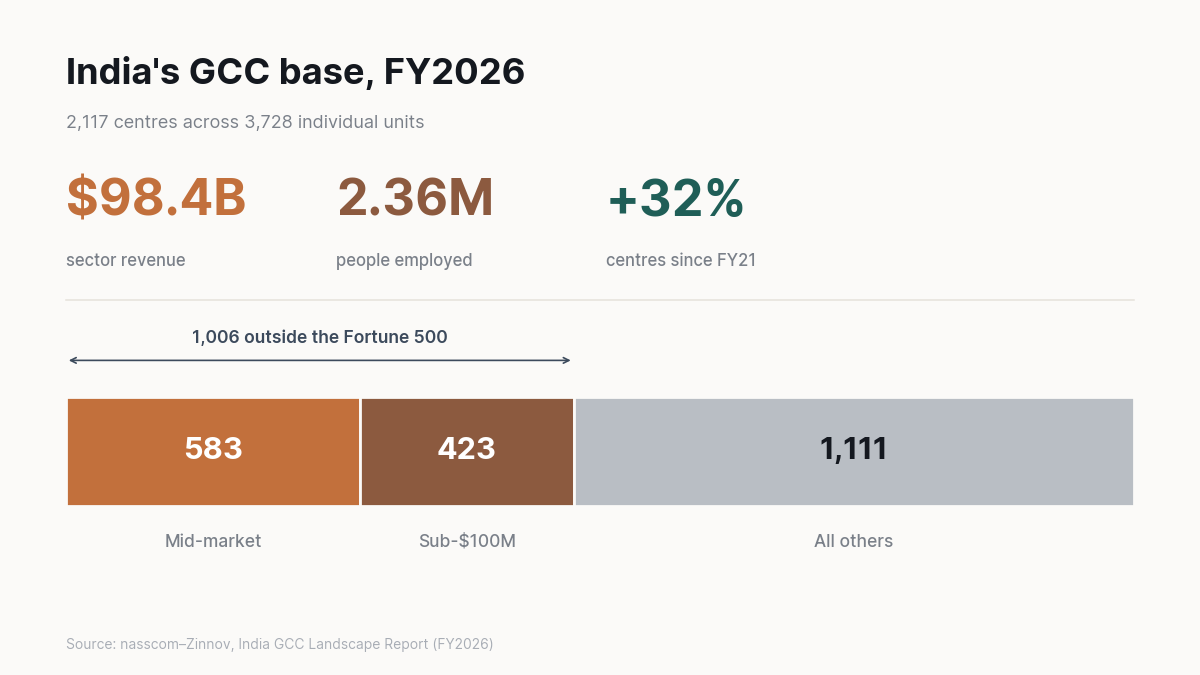
Of the 2,117 global capability centers operating in India today, 583 are mid-market and 423 belong to parent companies with under $100 million in revenue. That is nearly half the country’s GCC base sitting outside the Fortune 500. Yet almost every cost model published on the subject is built for a 500-seat center, which makes the 50 person GCC cost India question effectively unanswered in public.
That gap matters because the economics do not scale linearly downward. Take a 500-seat model, divide by ten, and you will underprice year one by 30–40%. Fixed costs incorporation, transfer pricing documentation, the site lead’s salary, the statutory audit, the leased line do not shrink with headcount. They land on 50 people instead of 500, and the per-head number moves.
India’s GCC sector reached $98.4 billion in revenue across 2.36 million employees in FY2026, with center count up 32% since FY2021 and the fastest-growing segment is mid-market parents, not global giants.
This guide models a full 36-month P&L for a 50-seat center in Hyderabad with a defined role mix: 25 engineers, 10 QA, 5 data, 5 product and program, 5 support and operations. Every line is broken out, loaded salary, statutory contributions, workspace, devices, tooling, compliance, recruitment, and the transfer pricing markup almost nobody budgets for. The output is a blended cost per FTE you can put in front of a CFO and defend, rather than a vendor range wide enough to drive a truck through.
TL;DR
This guide models what a 50-seat capability center actually costs in India over three years, built for mid-market US companies weighing a captive build against an offshore vendor. It assumes a Hyderabad site and a fixed role mix of engineers, QA, data, product, and support.
Modeled end to end, the 50 person GCC cost India figure is ₹40.7 crore (about $4.68 million) over 36 months, landing at roughly $37,700 blended per FTE per year against about $162,800 for the equivalent US team. The cost of 50 person offshore team capacity is close to a quarter of the domestic figure but only 48% of that saving shows up in year one, because setup and ramp eat the rest.
By the end you will have a defensible budget line for each cost category and a clear read on whether a captive, a Build-Operate-Transfer arrangement, or a managed team is the right entry model at this headcount.
What a 50-Person GCC Actually Is
A 50-person GCC is a wholly owned offshore subsidiary staffing a single delivery site with roughly 50 full-time employees who report into the parent’s global functions rather than to a vendor. At this size it is a capability center, not a support desk: the mandate is product ownership, and the cost structure is dominated by loaded salary rather than overhead.
What separates the 50 person GCC cost India profile from an outsourcing contract is legal as much as financial. You incorporate an Indian entity, you employ the people directly, you own the IP, and you carry the compliance obligations. A vendor arrangement gives you none of those and, importantly, none of the fixed costs either which is exactly why the comparison at 50 seats is genuinely close.
Why GCC Cost by Headcount Breaks Below 100 Seats
Fixed-cost absorption is the whole story. A statutory audit, a transfer pricing study and Form 3CEB filing, a company secretary retainer, and D&O cover together run ₹25–35 lakh a year whether you employ 50 people or 500. Across 500 heads that is under ₹7,000 per person. Across 50 it is ₹60,000, before anyone writes a line of code.
The same compression hits leadership. A 50-seat center still needs one credible site lead, and credible site leads in Hyderabad and Bengaluru cost ₹70–90 lakh. On a 500-person org that is a rounding error. Here, one person consumes 7% of the salary pool which is why any honest 50 person global capability centers cost India model prices leadership before it prices headcount.
Then there is the ramp. Most mid-market builds assume full strength in six months. From incorporation to 50 productive FTEs, the realistic window is 10 to 14 months, which makes year-one cost a function of the hiring curve rather than the headcount target. Model it as 50 × annual cost and you will overstate by 40% in front of your own board.
A fourth pressure is unique to this band: you compete for the same senior engineers as centers with a thousand-person brand presence, without one. Bengaluru attrition runs 18–22%, Hyderabad 14–16%. A 50-person center losing seven people a year loses 14% of its capability, and with no bench, every exit is a delivery event.
The 36-Month P&L: Modeling 50 Person GCC Cost India Line by Line
Model assumptions: Hyderabad site (best cost-to-capability balance among Tier-1 markets); managed office space rather than bare-shell lease; USD/INR at ₹87; 9% annual salary increment; 15% attrition from year two.
Line 1 Loaded people cost (75–80% of everything)
The role mix maps to these annual gross fixed-salary bands, weighted toward mid-level with a senior spine:
- 25 engineers 8 senior (₹30L), 12 mid (₹20L), 5 junior (₹10L) = ₹5.30 crore
- 10 QA 3 SDET/senior (₹18L), 5 mid (₹11L), 2 junior (₹6L) = ₹1.21 crore
- 5 data 2 senior data engineers (₹32L), 2 mid (₹20L), 1 analyst (₹10L) = ₹1.14 crore
- 5 product/program site lead (₹72L), senior PM (₹38L), 2 PMs (₹26L, ₹24L), 1 BA (₹14L) = ₹1.74 crore
- 5 support/ops delivery manager (₹18L), TA/HR (₹14L), IT admin (₹12L), finance/admin (₹12L), EA (₹8L) = ₹0.64 crore
Gross fixed salary pool at full strength: ₹10.03 crore.
Now the part that breaks most spreadsheets. Fully loaded employer cost in India runs 12–15% above gross salary once employer PF (12% of basic), gratuity accrual, ESI where applicable, professional tax, statutory bonus, and group health cover are added. At 13%, the loaded people cost at full strength is ₹11.33 crore per year.
If you are hiring engineers, QA specialists, or data roles at scale, benchmark the band before you set it. The gap between a competitive offer and a stale one in this market is roughly one hiring cycle.
Ramped across a 12-month build, year one lands near ₹6.0 crore about 48% of the full-strength figure, weighted upward because leadership is hired first.
Line 2 Workspace
At 50 seats, a managed office beats a bare-shell lease over 36 months in most Tier-1 markets. Hyderabad Grade A warm shell sits at ₹70–80 per sq ft per month before CAM and taxes, and all-in occupancy runs 40–60% above base rent.
A 5,000 sq ft footprint (100 sq ft per seat including collaboration space) costs roughly ₹66 lakh a year on a lease, but requires ₹1.1 crore in fit-out at ₹2,200 per sq ft plus a six-month deposit.
A managed office at ₹14,000 per seat per month is ₹84 lakh a year with zero capex. The lease only wins once fit-out amortizes, which at this footprint is beyond month 36. The crossover shifts sharply once you pass roughly 150 seats or commit to five-year tenure.
Line 3 Technology and tooling
Budget ₹1.2 lakh per device for engineering-grade laptops (₹60 lakh year-one capex, three-year refresh), ₹4,000–6,000 per seat per month for the standard engineering SaaS stack, and ₹25–40 lakh a year for non-production cloud and dev environments.
Cloud is the most variable line here and the one most often inherited unexamined from the parent’s US rate card. India-region pricing and reserved-instance commitments should be renegotiated, not carried over.
Line 4 Compliance, entity, and legal
Incorporation, FEMA and FDI filings, PAN/TAN/GST, Shops & Establishment, and PF/ESI registration run ₹8–15 lakh one-time. Annual statutory audit, transfer pricing study and Form 3CEB, ROC filings, payroll compliance, and company secretary retainer run ₹18–28 lakh. D&O and cyber liability add ₹4–8 lakh.
Line 5 Recruitment
Fifty hires in twelve months is the real constraint, not the cost. Contingency agency pricing sits at 8.33% of first-year CTC; retained or RPO models land ₹1.2–2.5 lakh per hire at this volume. Budget ₹80 lakh in year one and ₹12–15 lakh annually thereafter for backfills. The hidden cost is vacancy: a senior seat open for 90 days is a quarter of that role’s annual output, and at 50 heads there is no bench to absorb it.
Line 6 The transfer pricing markup nobody budgets
An Indian captive serving only its parent is typically remunerated on a cost-plus basis, commonly 12–18%. The parent’s actual outflow is the India cost base multiplied by one plus the markup. Most first-time builders read that as a 15% cost increase and panic.
It is not. The markup is an intercompany transfer, money moving from one pocket to another. The real leakage is Indian corporate tax on that margin: at a 15% markup and the 25.17% concessional rate under section 115BAA, the true cost is roughly 3.8% of the India cost base, about ₹55 lakh a year at steady state. Budget the 3.8%, and do not let a vendor model it as 15%.
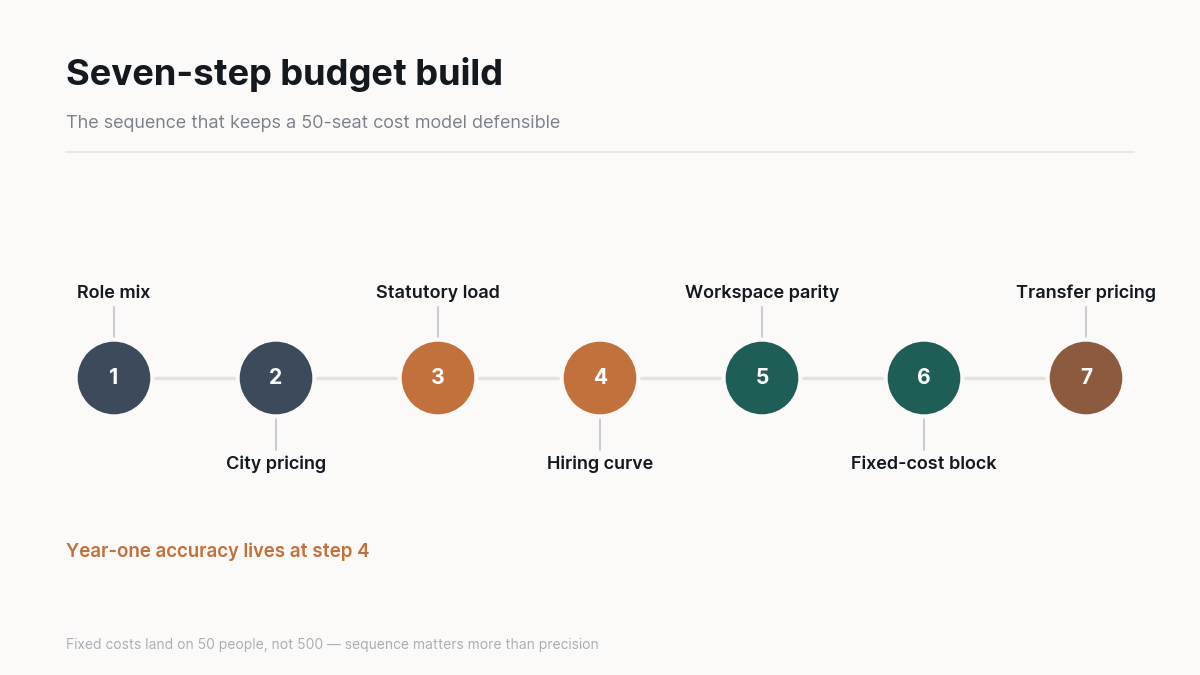
The seven-step build for a defensible budget
- Fix the role mix and seniority ratio first. Cost is driven by the senior-to-junior ratio far more than by headcount.
- Price gross salary by city, not nationally. Hyderabad and Pune run 10–20% below Bengaluru for equivalent roles.
- Apply the 12–15% statutory and benefits load on top of gross. Never budget off CTC alone.
- Model the hiring curve month by month, not as an annual total. This is where year-one accuracy lives.
- Normalize workspace quotes before comparing. A ₹100/sq ft bare-shell lease and a ₹14,000/seat managed quote include entirely different things.
- Add the compliance and tooling fixed block as a flat annual number, then divide by headcount to see your real absorption rate.
- Layer the transfer pricing markup last, and model only the tax leakage as incremental cost.
The consolidated 36-month number
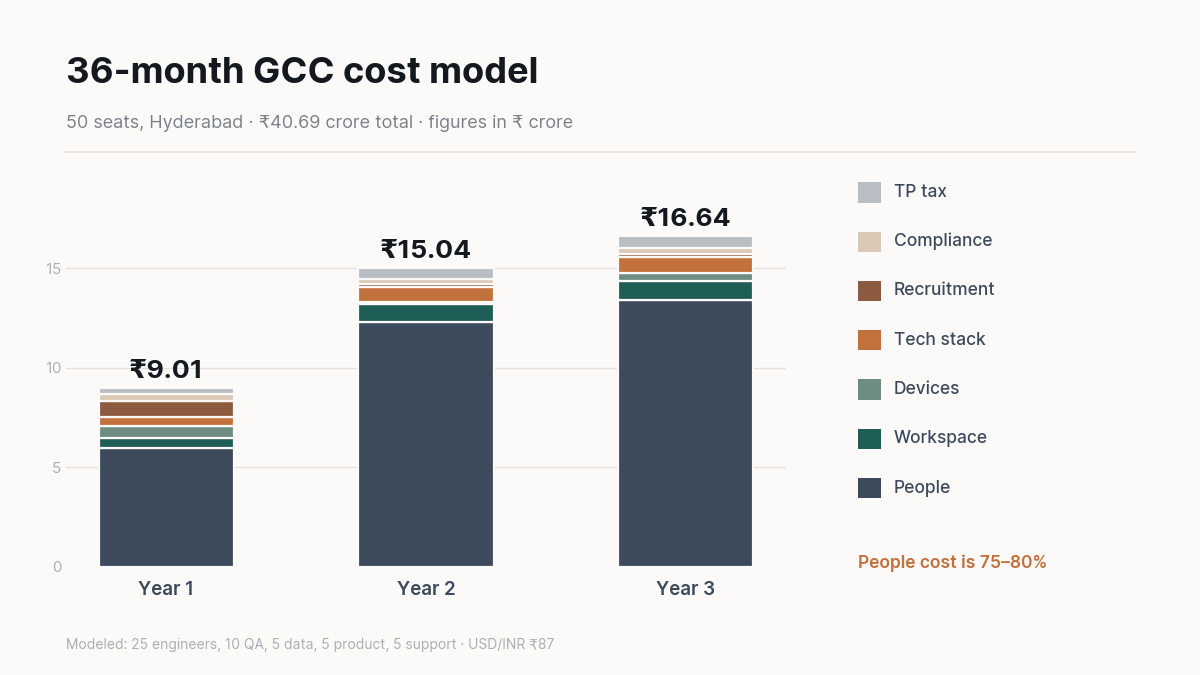
| Cost category | Year 1 | Year 2 | Year 3 |
| Loaded people cost | ₹6.00 Cr | ₹12.32 Cr | ₹13.43 Cr |
| Workspace (managed, 50 seats) | ₹0.50 Cr | ₹0.88 Cr | ₹0.92 Cr |
| Devices and refresh | ₹0.60 Cr | ₹0.12 Cr | ₹0.40 Cr |
| SaaS, cloud, network, security | ₹0.45 Cr | ₹0.75 Cr | ₹0.82 Cr |
| Recruitment | ₹0.80 Cr | ₹0.14 Cr | ₹0.15 Cr |
| Entity, compliance, insurance | ₹0.33 Cr | ₹0.28 Cr | ₹0.31 Cr |
| Transfer pricing tax leakage | ₹0.33 Cr | ₹0.55 Cr | ₹0.61 Cr |
| Total | ₹9.01 Cr | ₹15.04 Cr | ₹16.64 Cr |
Three-year total: ₹40.69 crore ≈ $4.68 million at ₹87/USD.
Blended Cost Per FTE: India vs the US Equivalent
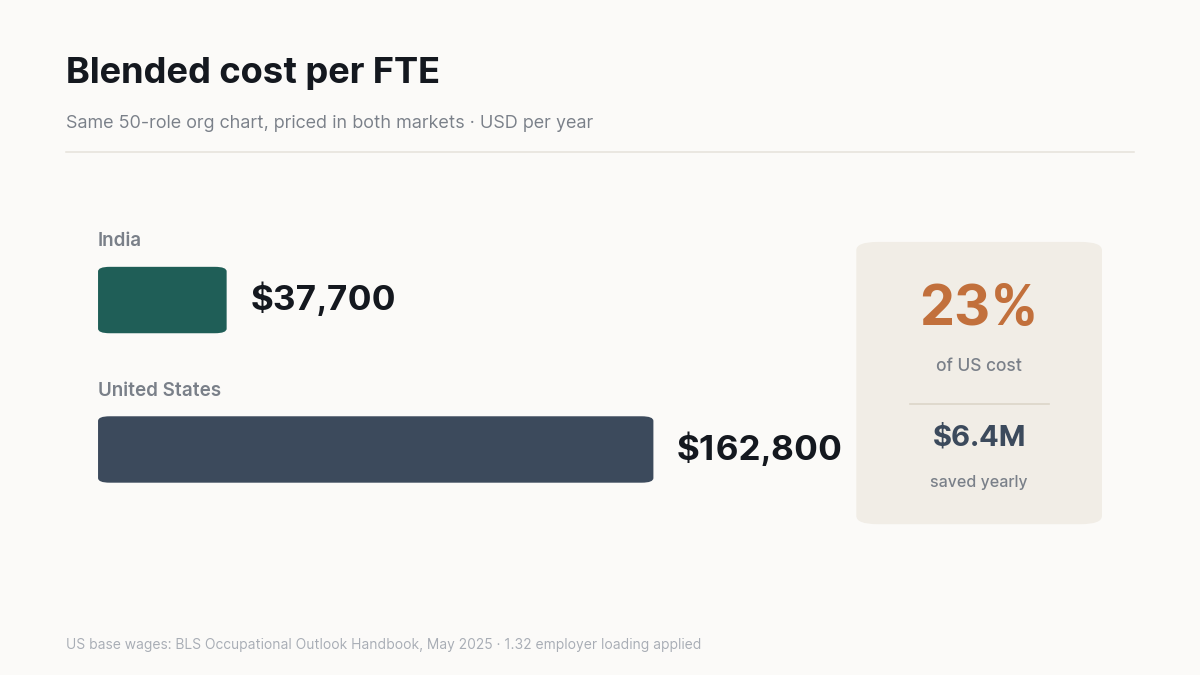
Converted to a per-head figure, the 50 person GCC cost India model produces ₹30.1 lakh (about $34,600) per FTE in year two, rising to ₹33.3 lakh (about $38,250) in year three as increments compound. Across the full 36 months and 124 FTE-years, the blended figure is $37,700 per FTE per year.
Now price the same org chart in the US. Bureau of Labor Statistics medians put software developers at $135,980 and QA analysts and testers at $104,300. Applied to the 35 engineering and QA roles, with market midpoints of $120,000 for data, $140,000 for product, and $85,000 for support, the base wage bill is $6.17 million.
A standard 1.32 employer loading for payroll taxes, health insurance, 401(k) match, and PTO accrual brings that to $8.14 million a year, or $162,800 per FTE.
The India figure lands at 23% of the US equivalent, a delta of roughly $6.4 million a year at steady state. Two caveats keep this honest: the US number is people-only, while the India number already carries real estate, tooling, compliance, and tax, so the true gap is wider. And neither includes equity, which moves total compensation on both sides at senior levels.
What This Looks Like in Practice
Across ten years and 527+ delivered IT projects, the pattern at this size band is consistent. What decides the real 50 person GCC cost India outcome is not the rate card, it is hiring velocity against a fixed ramp.
Fintech scale-up, 40-seat engineering build. A payments company building backend and platform capability needed a senior-weighted team fast, with a hard requirement that no candidate be shared across accounts. AI-assisted sourcing against a vetted top-2% pool compressed job description to interview-ready shortlist to 7–10 working days per role, at a 98% joining rate. The binding constraint was client-side interview panel bandwidth, not candidate supply.
Enterprise SaaS, QA and data pod. A US mid-market SaaS vendor stood up a 15-person QA and data pod before committing to a full captive. Contract-role drop-off stayed under 1%, and a 7–10 day replacement guarantee meant the one mis-fit hire did not cost a sprint. Phase two converted the pod into a wholly owned entity once volume justified the fixed-cost block.
Captive, BOT, or Managed Team: Choosing at 50 Seats
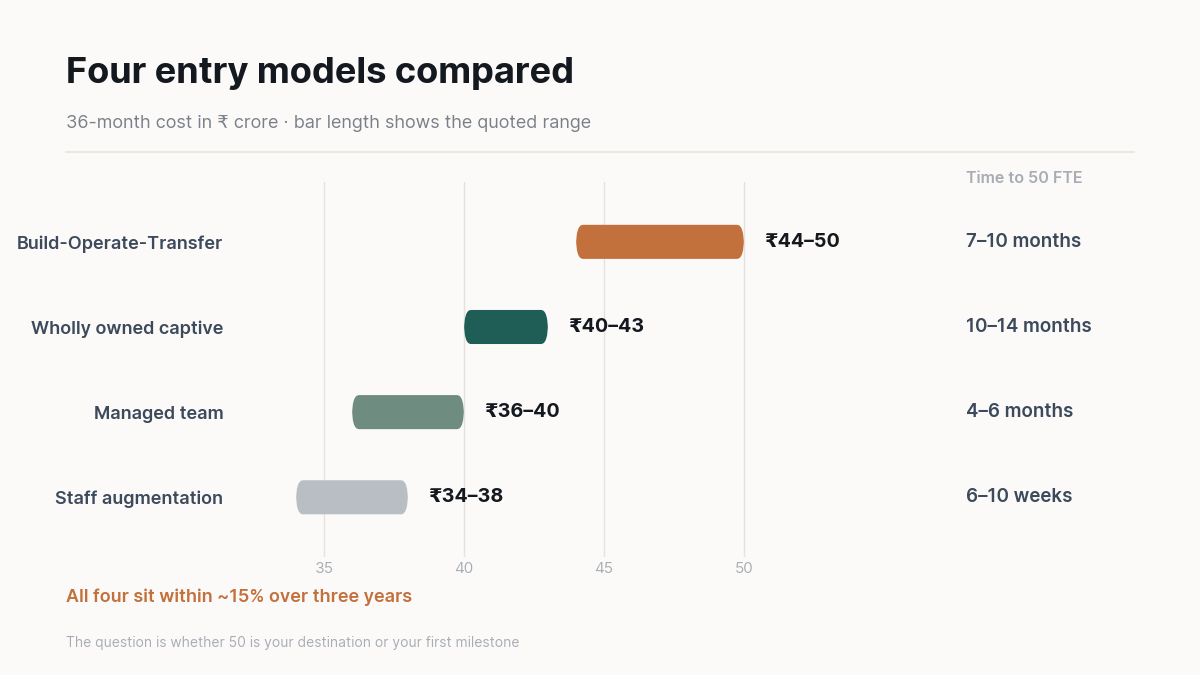
| Model | 36-month cost | Time to 50 FTE | IP and control | Best when |
| Wholly owned captive | ₹40–43 Cr | 10–14 months | Full ownership, direct employment | Headcount will exceed 75 within 24 months |
| Build-Operate-Transfer | ₹44–50 Cr (partner fee during operate phase) | 7–10 months | Transfers on exit; contractual until then | First India build, no local leadership bench |
| Managed / dedicated team | ₹36–40 Cr | 4–6 months | Contractual IP assignment, no entity | Mandate is unproven or headcount may stay flat |
| Staff augmentation | ₹34–38 Cr | 6–10 weeks | Vendor-employed, NDA-backed | Capacity gap, not a capability mandate |
Note what the table does not show: a decisive cost winner. The four routes to the same 50 person GCC cost India outcome sit within about 15% of each other over three years. It is about whether 50 is your destination or your first milestone.
A captive that stops at 50 carries fixed costs it never absorbs. A dedicated team that grows to 200 pays a margin it should have internalized at month 18.
Before You Commit to a Number
If you are evaluating a 50 person GCC cost India build and want to pressure-test your model before it reaches a board deck, the fastest thing you can do is decompose someone else’s quote using the seven-step structure above. Most fall apart at step three.
Supersourcing has run GCC setup, staffing, and RPO engagements across fintech, healthtech, e-commerce, and enterprise SaaS for teams from 10 seats to several hundred, with dedicated account managers, NDA-backed IP protection, and a 7–10 day replacement guarantee in contract. A role-level cost model or city comparison is a 30-minute conversation, not a sales cycle.
Send the role mix and target city to mayank@engineerbabu.com, or start at supersourcing.com/contact-us.
FAQ
How much does it cost to set up a GCC in India at 50 people?
One-time setup within the 50 person GCC cost India build entity incorporation, FEMA and FDI filings, registrations, and legal runs ₹8–15 lakh. The larger year-one number is the ramp: roughly ₹9 crore all-in including partial-year salary, ₹80 lakh in recruitment, devices, and workspace. Steady-state years two and three run ₹15–16.6 crore each.
How much does a 50 person GCC cost in India per year once it is running?
About ₹15 crore in the first full year and ₹16.6 crore by year three at 9% annual increments. That is a blended cost per FTE of ₹30–33 lakh, or roughly $34,600 to $38,250 including workspace, tooling, compliance, and transfer pricing tax.
Is 50 people big enough to justify a captive entity?
Fifty is the threshold, not comfortably past it. Below about 30 seats, fixed compliance and leadership costs make a managed team clearly cheaper. Above 75, the captive wins decisively. At 50, the answer depends entirely on your 24-month headcount trajectory build for where you are going, not where you are.
What does a 50 engineer offshore team cost compared to hiring in the US?
Roughly 23% of the equivalent US loaded cost. The mix modeled here runs about $1.73 million a year in India at steady state against $8.14 million in the US, using BLS May 2025 wage medians and a 1.32 employer loading. The annual difference is about $6.4 million.
How long does it take to reach 50 people?
Ten to fourteen months from entity incorporation for a captive, four to six through a managed team. The bottleneck is rarely candidate supply; it is client-side interview panel availability and notice periods, which run 60–90 days for mid and senior roles in India.
What is the biggest hidden cost in a 50 person GCC cost India model?
Attrition-driven backfill. At 14–16% in Hyderabad and 18–22% in Bengaluru, a 50-person center replaces seven to eleven people a year. Direct recruitment cost is ₹12–15 lakh; the real expense is 60–90 days of vacancy plus ramp on a team with no bench.
Can we pressure-test a vendor’s cost model before committing?
Yes, and you should. Ask any vendor to break their quote into the seven categories above, state their statutory loading percentage explicitly, and show the transfer pricing assumption separately. A model that cannot survive that decomposition was built to win a deal, not to run a center.
