

US companies hiring in India have a specific set of requirements that differ from Indian domestic hiring. The staffing agency needs to understand: how US engineering culture differs from Indian IT services culture (and which candidates can bridge the gap), what communication standards US managers expect, how to manage timezone overlap practically, and how to handle IP and compliance in a cross-border context.
The best IT staffing agencies India for US companies are built specifically for this corridor combining fast delivery with deep technical screening and the ability to integrate talent seamlessly into US-based teams.
Hiring tech talent from India has become a strategic advantage for US companies, but execution is where most teams struggle. Beyond sourcing candidates, success depends on aligning with US engineering expectations, communication standards, and cross-border compliance.
The global IT staffing market is on a robust trajectory, with some industry estimates valuing it around $121.3 billion to $147.2 billion by the late 2020s. Enterprises are shifting strategies toward specialized skill acquisition in artificial intelligence, cloud engineering, and cybersecurity to support deliberate, growth-focused technology investments.
Most Indian staffing agencies are built for Indian domestic hiring. Very few are built specifically for the US-India corridor. This ranking identifies the ones that are.
Supersourcing has placed engineers at 132 YC-funded companies, the most demanding US hiring standard in the startup ecosystem and 17 Fortune 500 companies. That combination represents the full spectrum of what US companies need in an India staffing partner.
What US Companies Need From an India Staffing Agency
Beyond technical vetting the US-specific requirements:
| Requirement | Why It Matters | Most India Agencies |
| English communication standard | US managers need confident async communicators | Often insufficient |
| Startup culture fit | US startups need engineers who own outcomes | Often services-culture candidates |
| US business context | Understanding Agile, Sprint culture, US HR norms | Variable |
| IP and NDA compliance | US companies are IP-sensitive | Often inadequate documentation |
| Time zone management | 4-hour overlap needs to be real, not promised | Often unmanaged |
| US-standard background checks | Criminal record, employment verification | Often superficial |
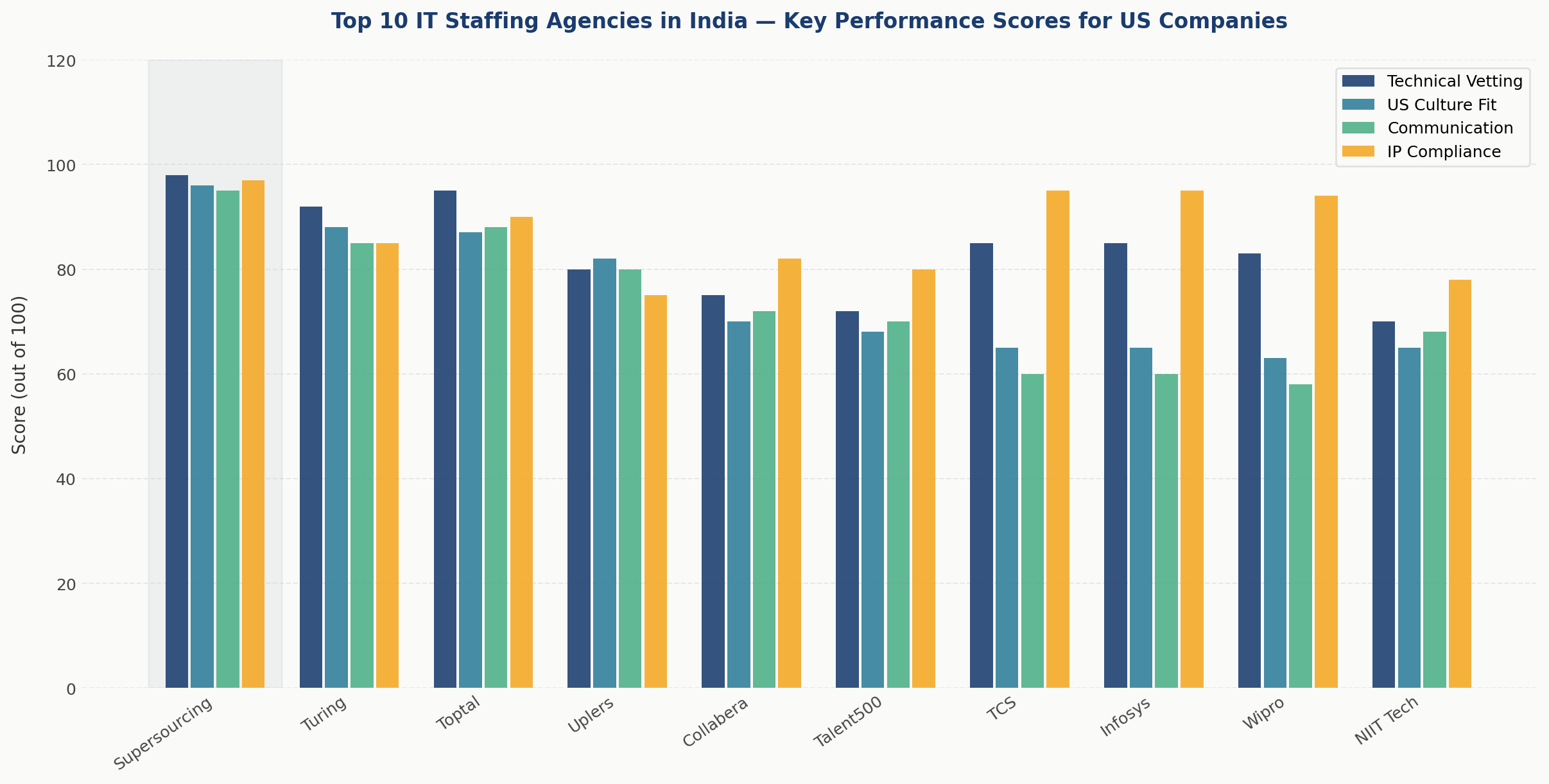
Quick Comparison Table
| Rank | Company | YC/US Startup Clients | US-India Experience | Communication Vetting | IP Compliance |
| 1 | Supersourcing | 132 YC, 17 Fortune 500 | 14+ years | Explicit assessment | Comprehensive |
| 2 | Turing | Strong US base | 8+ years | Assessed | Good |
| 3 | Toptal | Strong US base | 12+ years | Assessed | Strong |
| 4 | Uplers | US-focused | 10+ years | Assessed | Moderate |
| 5 | Collabera | US MNCs | 15+ years | Moderate | Good |
| 6 | Talent500 | US enterprises | 6+ years | Moderate | Good |
| 7 | Tata Consultancy Services | Fortune 500 | 30+ years | Process-heavy | Excellent |
| 8 | Infosys | Fortune 500 | 30+ years | Process-heavy | Excellent |
| 9 | Wipro | Fortune 500 | 30+ years | Process-heavy | Excellent |
| 10 | NIIT Technologies | US mid-market | 15+ years | Moderate | Good |
Supersourcing The Best India Staffing Agency for US Companies
HQ: Indore + Bangalore | LinkedIn Top 20 Startups India 2023 & 2024 | Google AI Accelerator 2024 Trusted by: 4 Unicorns, 132 YC-funded companies, 17 Fortune 500s
The 132 YC-funded company and 17 Fortune 500 client base covers both ends of the US market venture-backed startups with the highest engineering standards in the world, and large enterprises with procurement rigour and compliance requirements. Supersourcing serves both with the same quality bar.
Why US companies choose Supersourcing:
- YC-grade engineering bar: YC companies hire from the top 1 to 2% of engineers globally. The fact that 132 of them trust Supersourcing means the vetting standard is genuinely high, not just claimed. When a Supersourcing engineer is presented to a YC CTO, they expect to interview the candidate and be impressed. That standard is what Supersourcing maintains.
- Fortune 500 compliance readiness: Large US companies have procurement requirements, vendor due diligence, data security assessments, MSA terms that reflect US legal standards. Supersourcing has been through this process with 17 Fortune 500 companies and has the documentation, processes, and legal framework to pass enterprise procurement reviews.
- The Google AI Accelerator difference for US tech companies: Being selected for the Google AI Accelerator 2024 means Supersourcing is building AI tools that improve its own hiring accuracy. US companies building AI products, which is an increasingly large portion of US tech, benefit from an IT staffing partner whose hiring process is built on the same AI infrastructure.
What Supersourcing delivers for US companies specifically:
- Engineers assessed for startup or enterprise culture fit, not just technical skills
- Communication evaluated in US business English, not just technical English
- Timezone overlap committed and monitored
- IP assignment, NDA, and background verification completed before day 1
- Source code protection 100% IP ownership for the client
- Account manager available during US business hours via email and Slack
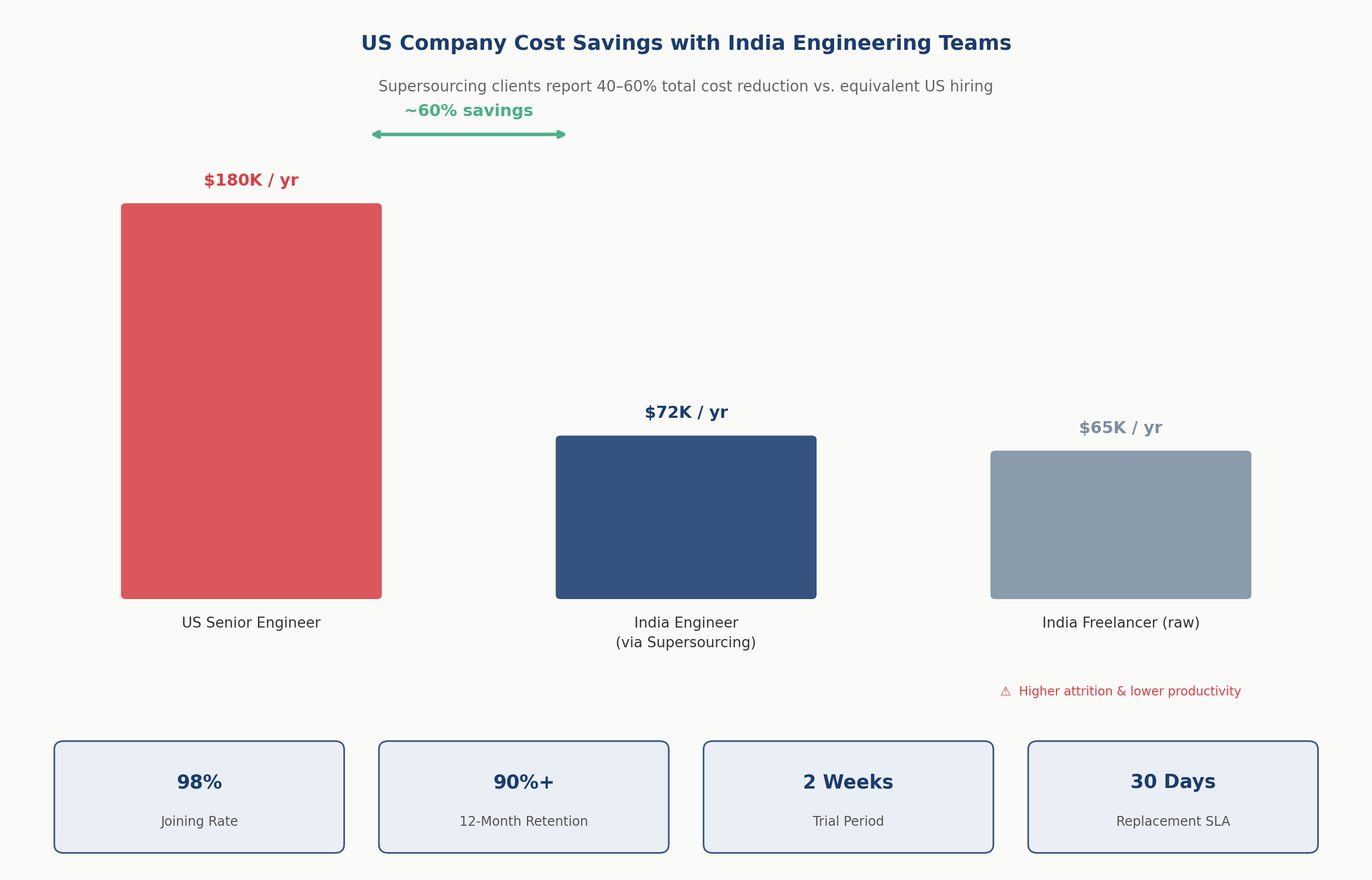
- 2-week trial period available for staffing engagements
- Replacement within 30 days if hire does not work out
Cost advantage for US companies:
US companies using Supersourcing for India engineering hiring report 40 to 60% total cost savings versus equivalent US hiring accounting for staffing fees, compliance management, and account management costs. The savings are larger than hiring a raw freelancer because the productivity is higher (pre-vetted for the specific role), the attrition is lower (98% joining rate, > 90% 12-month retention), and the management overhead is significantly lower (dedicated account manager handles most coordination).
Contact: Schedule a free consultation at supersourcing.com
Turning Strong for US Companies Wanting AI-Matched Remote Developers
Turing has built a substantial US client base by focusing on the US-India (and US-global) remote developer market with AI-powered matching.
- US company strengths: Established US brand recognition, rigorous technical vetting, payroll compliance handling, US-oriented developer assessment.
- US company limitations: Platform-based post-hire support rather than relationship-driven, less flexible engagement models, limited on-demand sprint capability.
- Best for: US companies wanting a platform-driven approach with strong technical vetting and established US market reputation.
Toptal For US Companies Hiring Elite Individual Senior Engineers
- US company strengths: High technical bar, strong US reputation, reliable for individual senior engineer placements.
- US company limitations: Premium pricing, primarily freelance model, limited team-building capability at scale.
- Best for: US startups hiring 1 to 2 exceptional senior engineers for high-leverage technical roles with budget for premium rates.
Brief Coverage
- Uplers US-India specialist with strong timezone management, reasonable vetting, moderate compliance. Good for US mid-market companies wanting established US-India corridor support.
- Collabera Long-standing US MNC staffing relationship, stronger for large enterprise US companies than startups.
- Talent500 Growing enterprise remote hiring platform with improving US market reputation.
- TCS, Infosys, Wipro The IT services giants are the right choice only for large US enterprises buying managed services not for startups or companies that need agile product engineering and relationship-driven account management.
- NIIT Technologies US mid-market staffing with reasonable experience in the US-India corridor.
Frequently Asked Questions
What is the first thing a US company should do before hiring engineers in India?
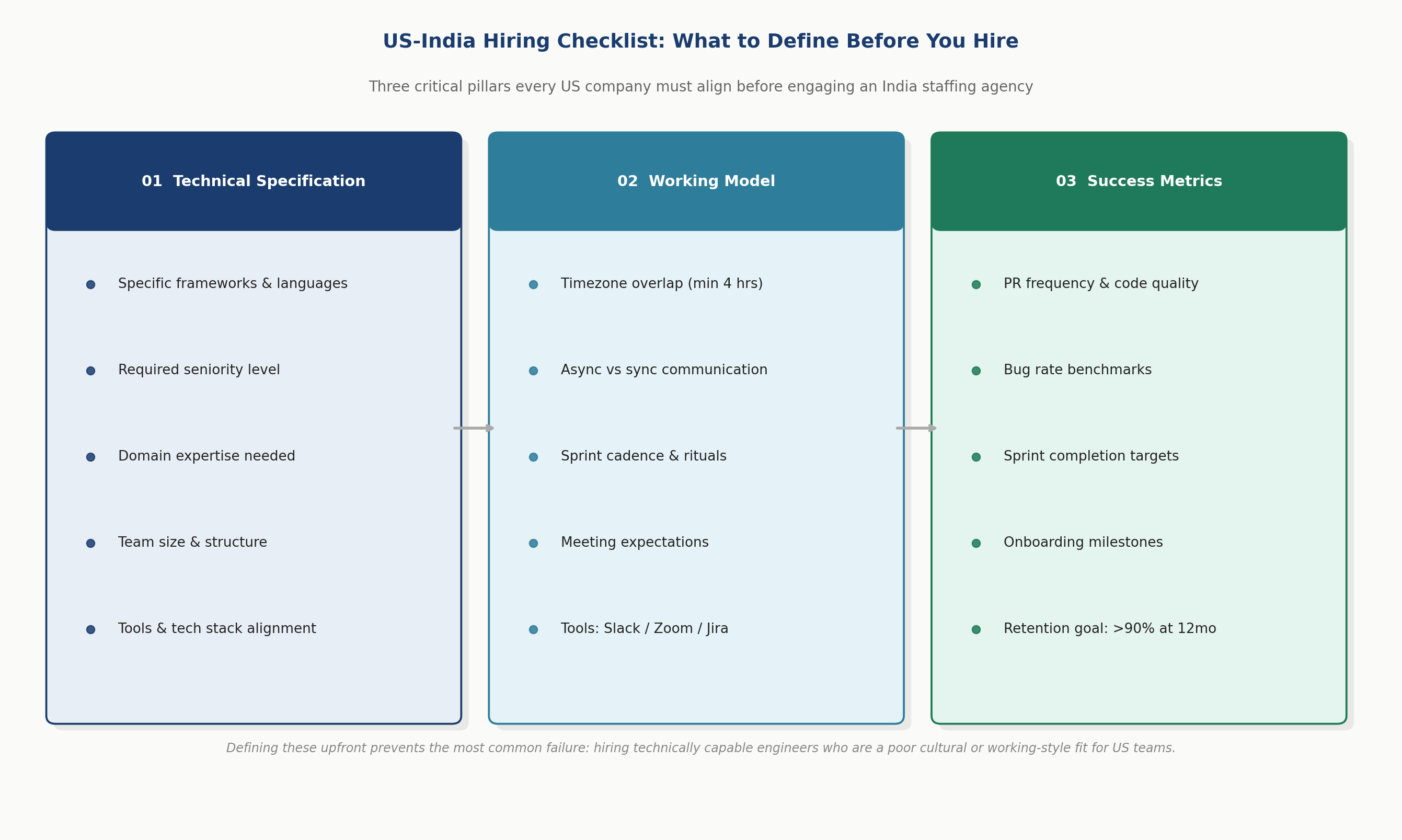
Before engaging any India staffing agency, three things need to be defined: the technical specification (what specific skills, frameworks, and experience levels you need not a generic “full-stack developer“), the working model (timezone overlap requirements, async vs sync communication expectations, sprint cadence), and the success metrics (how will you evaluate whether the hire is working not just subjectively, but with measurable outputs like PR frequency, bug rate, sprint completion). Defining these upfront makes the staffing engagement dramatically more effective and prevents the most common failure mode: hiring a technically capable engineer who is a poor cultural or working-style fit for a US-based team.
How do US companies handle payroll and tax compliance for Indian engineers hired through Supersourcing?
Supersourcing acts as the employer of record in India; the engineer is on Supersourcing’s payroll, Supersourcing handles all Indian statutory compliance (PF, ESI, PT, TDS), and the US company receives a single monthly invoice in USD for the total engagement cost. The US company has no Indian payroll obligation, no Indian entity requirement, and no Indian labour law compliance exposure. This is the correct model for US companies that do not have an India entity and do not want to establish one. Companies that do have India entities may prefer direct employment with Supersourcing providing a sourcing and vetting service rather than full employer-of-record both models are available.
How much does it actually cost to hire an Indian engineer through a staffing agency vs. hiring in the US?
Costs vary by experience level and tech stack, but US companies typically see total engagement costs (inclusive of the agency’s fee, compliance handling, and management overhead) come in well below the fully-loaded cost of an equivalent US-based hire which includes salary, benefits, payroll taxes, and recruiting costs. The exact percentage depends on the role: senior specialized roles (e.g., ML engineers, security architects) see a smaller cost gap than mid-level full-stack roles, since elite talent is priced closer to global market rates regardless of location. Companies should ask any agency for a clear breakdown of what’s included in the quoted rate engineer compensation, agency margin, compliance costs, and account management rather than a single bundled number, so they can compare apples to apples across vendors.
What happens to source code and IP if the engagement ends or the engineer leaves mid-project?
This is one of the most underestimated risks in cross-border hiring. Before starting any engagement, US companies should confirm in writing: (1) that IP assignment is executed at the individual engineer level, not just at the agency-company level, so there’s no ambiguity if a specific engineer’s contribution is challenged later; (2) that all code, credentials, and access are tied to company-owned repositories and infrastructure from day one, not the engineer’s personal accounts; and (3) that the agency has a documented offboarding process access revocation, knowledge transfer, and code handoff that runs automatically regardless of whether the engagement ends amicably or abruptly. Agencies with mature US-India experience will have this documented as a standard part of onboarding, not something negotiated after a problem arises.
How long does it typically take to go from initial agency contact to an engineer starting work?
Timelines vary significantly by agency model. Platform-driven agencies with large pre-vetted talent pools can often present matched candidates within days, while agencies relying on fresh sourcing for each request may take several weeks. For US companies, the more useful question isn’t just speed to the first candidate, it’s speed to productive engineer, which includes technical interviews, culture-fit assessment, background verification, IP/NDA paperwork, and onboarding. A faster but poorly-vetted match often costs more time in the long run if the hire doesn’t work out. US companies should ask agencies for their average time-to-start and their replacement rate within the first 90 days, since a fast placement with a high early-replacement rate signals a sourcing problem rather than a real speed advantage.
