

To consolidate staffing agencies into one RPO partner is the operational shift most enterprise hiring teams eventually have to make, whether they plan for it or back into it. Most don’t decide to run eight to twelve staffing agencies at once. It happens by accretion — one agency per hiring manager’s preference, one per urgent backfill, one per region — until nobody in procurement or talent acquisition can name every vendor on the active list without pulling up a spreadsheet.
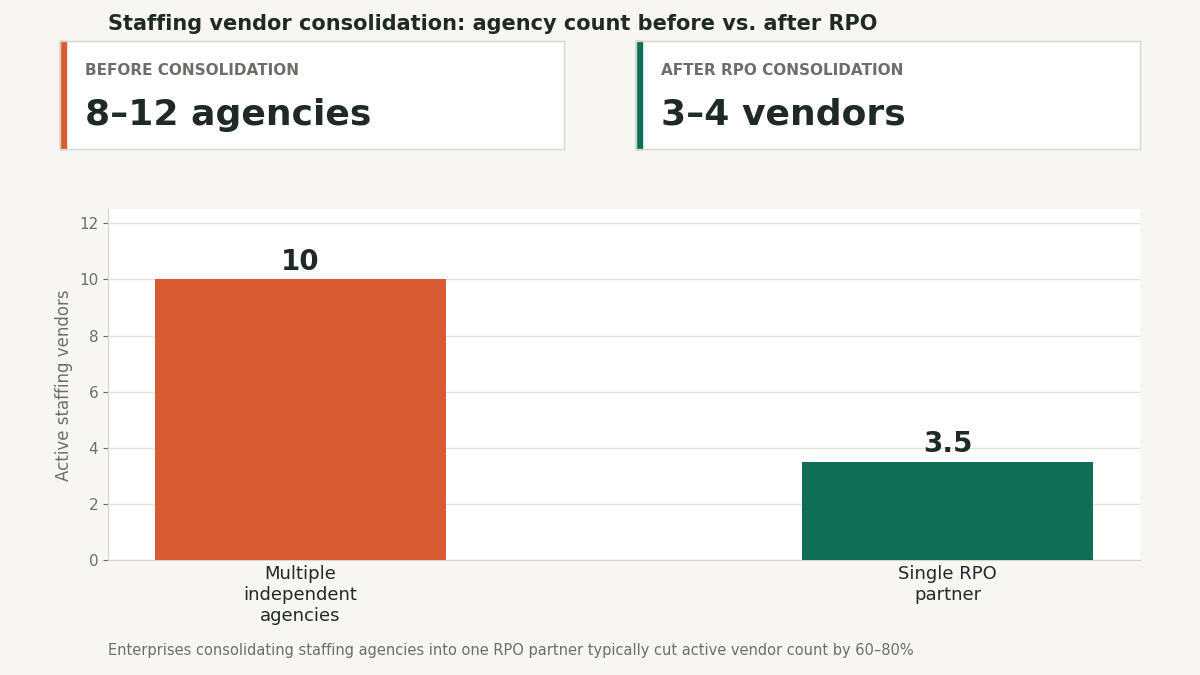
Recent market data shows this is no longer a fringe problem: companies that were previously working with eight to twelve staffing suppliers are now consolidating down to three or four preferred vendors, driven by cost control, procurement simplification, and the growing role of vendor management systems in overseeing contingent labor spend.
The pattern repeats at the enterprise level well beyond staffing. Gartner’s research on IT vendor portfolio rationalization found that leveraging spend across fewer vendors increases negotiating power and discounts, cuts the operational overhead of managing multiple vendor relationships, and lets an organization make stronger strategic commitments that improve performance and outcomes the exact same math that applies when the “vendor” is a staffing agency rather than a software supplier.
The problem is that none of these decisions get made against a shared view of total spend, total SLA performance, or total risk exposure. By the time a talent acquisition leader tries to answer a simple question “what’s our blended cost-per-hire across all vendors this year?” The honest answer is often “we’d have to reconstruct that from twelve separate invoices.”
This guide is the operational version of the decision to stop that pattern. It doesn’t stop at “consolidation is smart” , it walks through how to actually audit your current agency roster, select and structure a single RPO partner, run a transition without stalling open requisitions, and manage the relationship once it’s live, and how to write an SLA that’s actually enforceable rather than aspirational.
TL;DR
This guide is for HR leaders, talent acquisition heads, and procurement teams who are managing five or more staffing agencies and are evaluating whether to consolidate staffing agencies into a single RPO partner. It covers the full path: recognizing the warning signs, building the business case, running the RFP, structuring the contract, and executing the transition without dropping open reqs.
The single biggest number to know going in: enterprises that move from a fragmented agency roster to one RPO partner typically cut their active vendor count by 60-80% and consolidate 15-30% of blended cost-per-hire into a single, auditable pricing structure but only if the transition itself is planned as a project, not a switch flipped overnight.
By the end, you'll be able to build your own case for consolidation, run a structured evaluation of RPO providers, write a transition plan your CFO and hiring managers will both sign off on, and know exactly what "well-managed" looks like six months after go-live.
What Is Staffing Agency Consolidation Into an RPO?
Consolidate staffing agencies RPO is the process of replacing a fragmented roster of independent staffing vendors with a single Recruitment Process Outsourcing partner who owns sourcing, screening, and delivery across some or all of an organization’s hiring under one contract, one reporting structure, and one accountable point of contact.
It is not the same as:
- A preferred supplier list (PSL): a PSL still uses multiple agencies, just a shorter, ranked list it reduces sprawl but doesn’t remove multi-vendor coordination overhead.
- A vendor management system (VMS) rollout: a VMS adds visibility and workflow across existing agencies; it’s a tool, not a structural change to how many vendors you use.
- Full in-house recruiting: RPO is outsourced delivery with dedicated resources; it is not building an internal team from scratch, though a mature RPO can run alongside a lean internal core.
Why Consolidate Staffing Agencies RPO: The Business Case
Fragmented agency rosters don’t just create noise; they create measurable, compounding costs. The business case typically rests on four pillars:
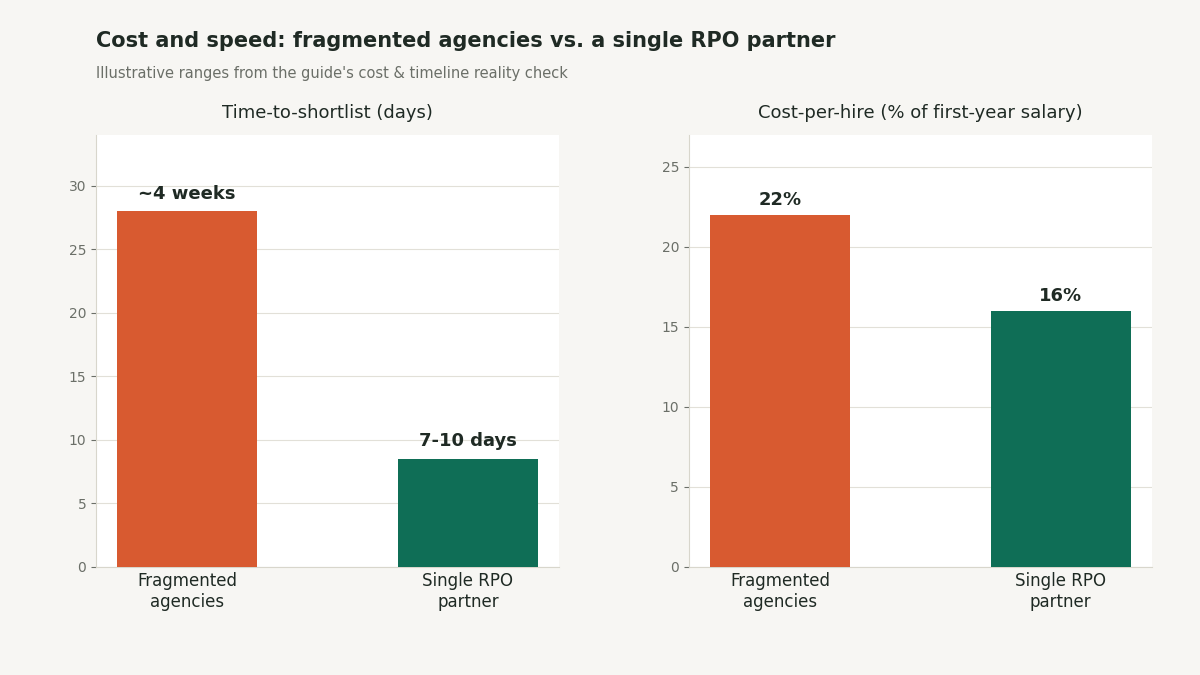
- Cost: Every additional agency relationship adds contract negotiation time, separate invoicing cycles, and duplicated fee structures (typically 15-25% of first-year salary per agency, with no volume leverage across vendors). Consolidating spend under one partner unlocks tiered or capped fee structures tied to volume.
- Speed: Multiple agencies competing for the same requisition often slows fill time rather than speeding it up; recruiters submit rushed, unvetted candidates to “win” the req before a competing agency does. A single RPO partner with a dedicated pipeline typically compresses time-to-shortlist to 7-10 working days from job description to interview-ready candidates.
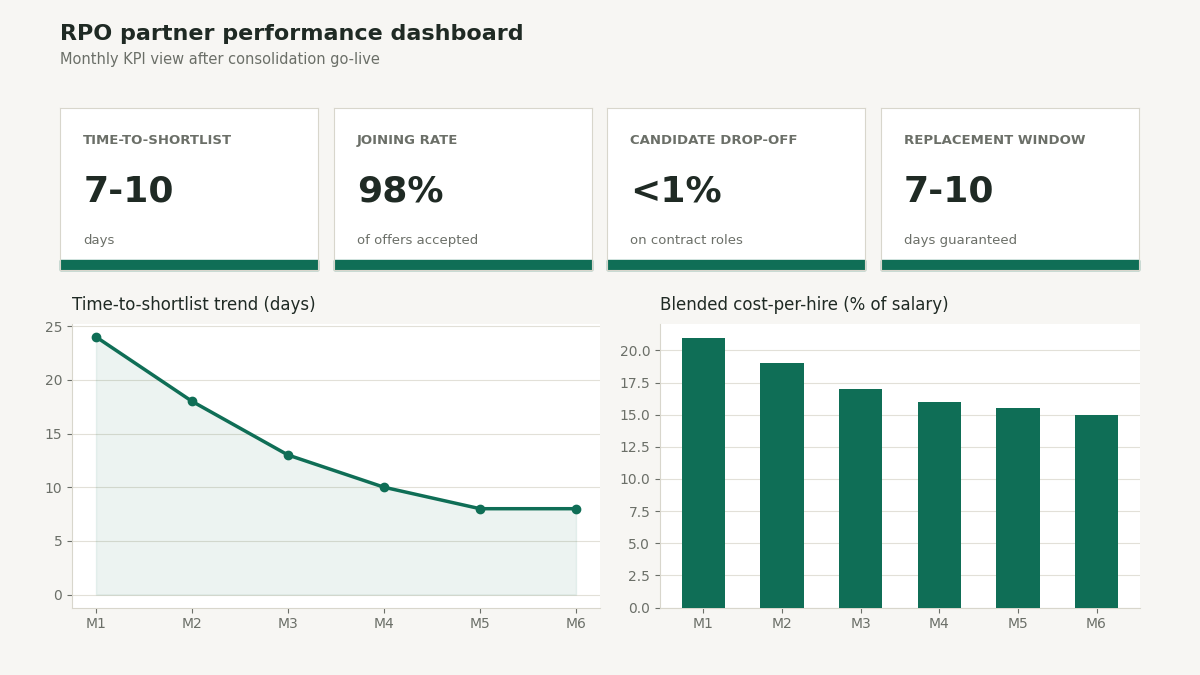
- Quality: Without a shared vetting standard, candidate quality varies wildly agency to agency. A single RPO partner running one consistent screening process (technical assessment, cultural fit, background checks) produces a more predictable joining ratio; mature RPO engagements report joining rates in the 95-98% range with sub-1% candidate drop-off on contract roles.
- Risk and control: Multiple agencies mean multiple sets of contract terms, multiple NDA structures, and multiple points where candidate data, client information, or IP-adjacent details can leak. A single MSA with clear NDA and IP protection clauses closes that surface area.
- Employer brand consistency: Every agency representing your company to candidates is, in effect, speaking on your behalf different agencies quote different compensation ranges, describe the role differently, and set different expectations about culture and process. Candidates notice the inconsistency, and it shows up as confusion or distrust before day one. A single partner enforces one consistent narrative across every touchpoint.
- Procurement simplification: Finance and procurement teams typically manage a separate PO, invoicing cycle, and payment term for each agency. Consolidating into one MSA collapses that into a single invoicing relationship, which materially reduces the administrative load on both talent acquisition and accounts payable, a benefit that rarely shows up in the initial pitch but compounds every month the relationship runs.
None of these four pillars work in isolation. A partner who’s fast but inconsistent on quality just moves the original problem to a new vendor. The business case only holds when cost, speed, quality, and risk improve together which is why the evaluation criteria in Phase 2 below weigh all four rather than optimizing for price alone.
The Core Problem Most Buyers Face
Most talent acquisition leaders underestimate how much fragmented IT staffing actually costs not because the fees are hidden, but because they’re spread across so many invoices, POs, and hiring-manager relationships that nobody adds them up in one place.
Three failure patterns show up repeatedly:
- Redundant spend on the same requisition. When three agencies are submitting for the same role, the company often pays for duplicated sourcing effort and sometimes pays a fee to whichever agency’s candidate happens to get hired, regardless of who actually did the most qualified sourcing work.
- Inconsistent SLAs. Most teams don’t realize that “average time-to-fill” across a fragmented roster is usually 3-4x higher than what a single, accountable RPO partner with a dedicated pipeline commits to in a signed SLA because no individual agency is contractually on the hook for the outcome.
- No single point of accountability. When a hire doesn’t work out, a fragmented roster makes it nearly impossible to trace back which agency’s vetting process failed, which means there’s no consistent replacement guarantee; some agencies offer 30-day guarantees, others offer none, and enforcement is inconsistent.
- Hiring manager fatigue and shadow processes. When every hiring manager fields calls from three or four different agency recruiters for the same open role, many quietly build their own workaround relationships: a favorite recruiter they text directly, a side channel that bypasses whatever process talent acquisition thinks is standard. This is invisible in any dashboard until someone tries to audit “how many agencies do we actually use” and the real number is higher than what procurement has on file.
The compounding effect of these four patterns is what makes fragmented staffing expensive in ways that don’t show up on a single invoice. A company might look at any one agency’s fee and consider it reasonable in isolation, while the aggregate cost of redundant sourcing, inflated time-to-fill, inconsistent guarantees, and shadow relationships quietly runs well above what a single, accountable partner would charge for the same hiring volume.
The Walkthrough: From Fragmented Agencies to One RPO Partner
This is the full lifecycle not just the decision to consolidate, but the mechanics of getting there and running it well afterward.
Phase 1 Auditing Your Current Agency Roster and Defining Requirements
Before you can consolidate, you need a real picture of what you’re consolidating. Most teams skip this and go straight to an RFP, which is why so many consolidation projects stall.
Do this first:
- Pull every active agency contract, PO, and invoice from the last 12 months, not just the ones talent acquisition remembers, since hiring managers often have side agreements.
- Map each agency to: roles filled, average time-to-fill, fee percentage, replacement guarantee terms, and exclusivity clauses (some agency contracts auto-renew or lock in a notice period of 30-90 days this determines your transition timeline, not the other way around).
- Define your target state in writing: which roles, which geographies, and which engagement models (staff augmentation vs. dedicated hiring vs. project-based) the new RPO partner needs to cover.
- Set budget bands per role category before you talk to any provider for reference, mid-level technical roles in India typically run ₹15-30 lakhs/year all-in, while equivalent US-based contract technical roles run $70k-120k/year, and these bands should shape your RFP scope, not be negotiated blind.
Red flag to watch for: if you can’t get a straight answer from a current agency on their actual fill rate (not just “roles submitted”), that’s a data gap you need closed before consolidation; you can’t measure improvement against a baseline you don’t have.
Building the internal case for sign-off: Once the audit is complete, translate it into a one-page summary for whoever needs to approve the consolidation, usually a mix of HR leadership, finance, and sometimes legal given the contract implications. Avoid presenting consolidation purely as a cost play; a proposal framed only around savings invites a purely price-driven RFP process, which tends to select for the cheapest bidder rather than the most reliable one..
A note on internal politics: hiring managers who have long-standing relationships with a specific agency recruiter will resist consolidation, often for legitimate reasons that recruiter may genuinely understand their team’s hiring bar better than a new partner will on day one.
Phase 2 Sourcing and Vetting the RPO Partner
This is where most of the due diligence effort should go, because you’re not hiring a vendor for one role, you’re handing over the sourcing function for dozens or hundreds of roles going forward.
What good vetting looks like:
- Ask for the provider’s actual sourcing methodology, not a generic pitch: how do they build a pipeline, and how much of it is AI-assisted sourcing versus manual outreach? Providers doing this well typically claim to surface something like the top 1-2% of vetted talent for technical roles, and can show you the screening funnel that produces that number. Supersourcing’s AI-driven sourcing model, for reference, is built around surfacing the top 2% of vetted candidates and turning around an interview-ready shortlist in 7-10 working days, the kind of benchmark worth holding any prospective partner against during your RFP.
- Request three verifiable client references in your industry and company size band not logos on a website.
- Ask what happens when a hire doesn’t work out in the first 90 days. A 7-10 day replacement guarantee, clearly written into the contract, is a meaningfully different commitment than a vague “we’ll look into it.”
- Check whether the provider can flex across engagement models; a company that only does staff augmentation can’t cover a scenario where you also need dedicated, embedded hires or a small hire Node.js developers pod for a specific product build.
Red flag: a provider that won’t share a sample SLA or sample reporting dashboard before signing. If you can’t see what accountability looks like before the contract, you won’t get it after.
A scoring framework for the RFP: rather than scoring proposals purely on price, weight the evaluation across four categories: sourcing methodology and demonstrated fill rate (30%), SLA specificity and enforceability (25%), engagement model flexibility (20%), and price and contract terms (25%). This keeps price as a real factor without letting it dominate a provider that’s 10% cheaper but has no enforceable replacement guarantee is usually the more expensive choice within two quarters, once the cost of bad hires and re-sourcing is factored in.
What a strong technical vetting process actually includes: beyond a resume screen, look for a structured technical assessment matched to the actual tech stack (not a generic coding test), a live technical interview conducted by someone who can genuinely evaluate the skill in question, and a cultural/communication screen separate from the technical one.
Phase 3 Engagement Models and Contract Structure
Once you’ve selected a partner, the contract itself determines whether consolidation actually reduces risk or just moves the same risk under a different name.
Key terms to negotiate, in order of impact:
- NDA and IP protection every candidate, every piece of company information shared during screening, and every deliverable from any dedicated or project-based work needs to be explicitly covered, not assumed.
- Engagement model flexibility: the contract should let you move between dedicated hiring, staff augmentation, and project-based work without renegotiating the master agreement each time.
- SLA specificity time-to-shortlist, time-to-offer, and replacement window should be numeric and enforceable, not aspirational language.
- Exit and transition clauses ironically, the contract that consolidates you into one partner should also specify what happens if you ever need to transition away, including data handoff and candidate pipeline ownership.
- Pricing structure and volume tiers negotiate the pricing model before volume commitments, not after. A flat percentage-of-salary fee behaves very differently at 20 hires a year than at 150; a tiered structure that steps down as volume increases protects you from paying agency-era pricing at RPO-era scale.
- Data ownership and candidate pipeline rights clarify, in writing, whether sourced-but-not-hired candidates remain in a shared pool you can access later, or whether that pipeline belongs solely to the RPO partner. This matters more than it seems at signature, because a strong partner’s candidate database becomes a genuine asset over a multi-year relationship.
Staff augmentation vs. managed services vs. project-based choosing the right default: most consolidation contracts benefit from specifying a default engagement model per role category rather than deciding case by case.
Phase 4 Onboarding and Ramp-Up
The first two weeks determine whether the RPO partner actually understands your hiring bar or is just running generic sourcing against a job description.
A working first-two-weeks checklist:
- Grant ATS/VMS access and align on requisition intake format (day 1-2)
- Joint calibration session on 3-5 recently closed roles what made a “good” hire good, and what made a bad one bad (day 2-3)
- Confirm communication cadence: daily standups during ramp-up, moving to weekly once steady-state is reached (day 3)
- Shadow-review the first 10-15 candidate submissions before they reach hiring managers, to catch calibration gaps early (week 2)
- Sign off on the reporting dashboard format before the first full requisition cycle closes (week 2)
Why the calibration session matters more than the tooling handoff: most onboarding checklists focus on system access ATS logins, VMS permissions, badge access for on-site work. That’s necessary but insufficient. Skipping this step is the single most common reason a new RPO partner’s early submissions miss the mark even when their general sourcing quality is strong.
Communication cadence in practice: daily standups during the first two to three weeks should be short 15 minutes, focused on open requisitions and any blockers not a status theater exercise. Once the partner demonstrates consistent submission quality against your calibrated bar, stepping down to weekly syncs plus an always-on Slack or email channel for urgent items is usually the right steady-state rhythm.
Phase 5 Managing Delivery Once Live
Consolidation isn’t “set and forget”; the accountability that makes a single RPO partner attractive only holds if you actually use the reporting structure you negotiated.
- Reporting cadence: weekly pipeline reports (reqs open, candidates in each stage, time in stage) plus a monthly quarterly-business-review-style summary even outside formal QBR windows.
- KPIs to track monthly: time-to-shortlist, time-to-offer, offer-acceptance rate, joining rate, early attrition (30/60/90-day), and cost-per-hire against the contracted band.
- Account management structure: confirm you have a named dedicated account manager, not a rotating point of contact. This single detail is one of the most common places consolidation quietly breaks down, because a rotating contact re-introduces the “who owns this” problem consolidation was supposed to solve. This matters even more when the engagement extends into infrastructure-adjacent roles: a request to hire cloud engineers for a platform migration needs the same dedicated ownership as a standard developer req, not a generalist recruiter working it as a side task.
- Escalation path: define, in writing, what happens when an SLA is missed not as a punitive measure, but so both sides know the process rather than defaulting to an ad hoc email chain. A typical structure escalates from the account manager to a delivery lead after one missed SLA cycle, and to a formal review meeting after two consecutive misses on the same metric.
- Handling scope changes mid-engagement: hiring needs shift, a hiring freeze, a sudden headcount approval, a new office opening in a different geography. A well-run relationship has a lightweight process for adjusting requisition volume or role mix without treating every change as a contract renegotiation, while still tracking those changes against the original SLA baseline so performance comparisons stay meaningful.
What “well-managed” looks like at the 90-day mark: by day 90, you should have at least one full monthly reporting cycle behind you, a calibrated hiring bar with measurably improving submission-to-shortlist ratios, and a dedicated account manager who can answer a question about any open requisition without needing to check with someone else first. If any of those three things aren’t true by day 90, that’s the point to raise it directly rather than waiting for the first formal quarterly business review.
Phase 6 Scaling or Exiting the Relationship
A consolidation that works should make scaling up easier, not harder and should make an eventual exit (if ever needed) clean rather than punitive.
- Scaling: confirm the contract allows adding headcount or new role categories without a full renegotiation this should be a scope amendment, not a new RFP.
- Replacement policy in practice: re-confirm the 7-10 day replacement window applies per-hire, not per-contract-year, and that it doesn’t require the original hiring manager to still be employed to invoke it.
- Offboarding, if it comes to that: the exit clause from Phase 3 should specify candidate pipeline ownership, data return, and a defined transition-out period treat this the same way you’d treat any critical vendor exit plan, even if you don’t expect to use it.
Case Studies
Fintech scale-up, 100+ engineering hires in under 12 months: A high-growth fintech company consolidated its hiring approach to a single sourcing partner while scaling engineering headcount past 100, using a consistent vetting bar across every requisition instead of managing quality variance across multiple agency submissions the kind of scale-up pattern seen in companies like Paytm’s engineering build-out phase.
E-commerce logistics platform, engineering hiring under time pressure: A fast-scaling logistics and delivery platform needed to compress hiring cycles during a period of aggressive growth, similar to the operational pace Dunzo’s engineering team faced the lesson consistently observed across these engagements is that fill-time compresses fastest when one accountable partner owns the full funnel rather than juggling submissions across vendors.
Fintech infrastructure company, sustained low candidate drop-off: Companies operating in regulated, high-trust fintech environments comparable to Razorpay’s engineering hiring needs depend on sub-1% candidate drop-off on contract roles, because backing out of a signed contract role late in the process carries real compliance and planning cost; this is achievable specifically because a single partner controls candidate expectations consistently from first contact through joining.
These patterns track closely with what Supersourcing has observed across 527+ IT projects delivered for enterprise and scale-up clients: a 98% candidate joining rate and sub-1% drop-off on contract roles are achievable outcomes when one partner owns the full funnel not because the vetting bar is unusually high, but because it’s applied consistently, req after req, instead of varying by which agency happened to source a given candidate.
Comparison / Decision Framework
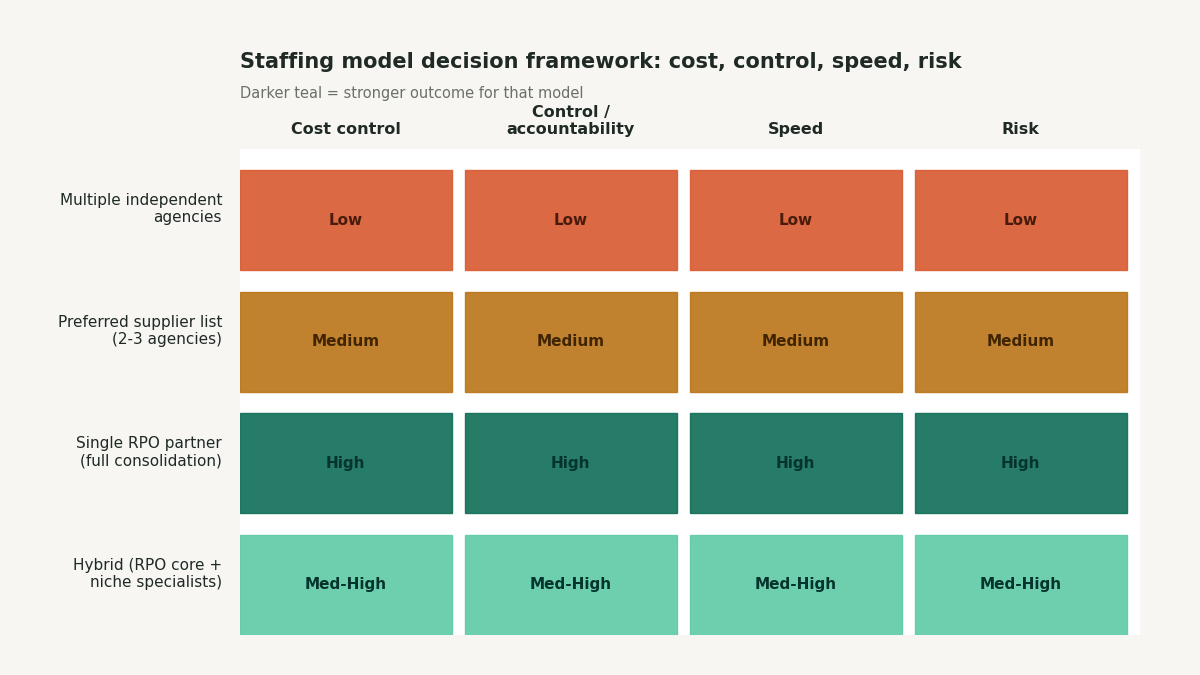
Use this framework to decide whether full consolidation, partial consolidation, or a preferred supplier list is the right move for your organization right now.
| Model | Cost Control | Control/Accountability | Speed | Risk |
| Multiple independent agencies | Low no volume leverage | Low no single owner | Variable, often slow due to duplicated submissions | High inconsistent NDA/IP terms |
| Preferred Supplier List (2-3 agencies) | Medium | Medium still split accountability | Medium | Medium |
| Single RPO partner (full consolidation) | High volume-based pricing | High one accountable owner | Fast dedicated pipeline, 7-10 day shortlist | Low one MSA, one NDA structure |
| Hybrid (RPO core + niche specialist agencies) | Medium-High | High for core roles, medium for niche | Fast for core, variable for niche | Low-Medium |
When full consolidation is the right call: you have 50+ annual technical hires, multiple hiring managers currently sourcing independently, and no consistent SLA today.
When a hybrid model makes more sense: you have a genuinely niche, low-volume specialty (e.g., a rare compliance certification role) where a boutique agency has irreplaceable network depth; don’t force that single req into your core RPO relationship if it will consistently underperform there.
The decision ultimately comes down to requisition volume, role diversity, and how much internal bandwidth you have to manage a transition project. Organizations under 30 annual technical hires often don’t have enough volume to unlock meaningful RPO pricing leverage yet a well-run PSL may be the more proportionate move until volume grows.
Cost & Timeline Reality Check
Cost tiers (illustrative, varies by role mix and geography):
- Fragmented multi-agency roster: typically 18-25% of first-year salary per hire, per agency, with no volume discount across vendors.
- Single RPO partner, standard technical roles: often structured as a blended rate or capped percentage, with volume-based tiering kicking in past a defined annual hire threshold commonly 12-20% depending on volume commitments.
- Dedicated/embedded engagement models: typically priced as a monthly retainer per hire rather than a placement fee, which is more predictable for sustained hiring but requires a higher initial volume commitment to make sense economically.
Timeline by scenario:
- Single-department consolidation (one function, one geography): 30-45 days from signed MSA to first live requisition.
- Enterprise-wide consolidation (multiple departments, multiple geographies): 60-90 days, primarily gated by existing agency contract notice periods, not by the new RPO partner’s onboarding speed.
- Full steady-state maturity (dashboard reporting, calibrated hiring bar, stable joining rates): typically 2-3 full hiring cycles, roughly 3-6 months depending on requisition volume.
What drives cost up: overlapping notice periods across multiple outgoing agencies, unbudgeted urgent backfills mid-transition, and scope creep where “consolidation” quietly expands to cover roles that were never audited in Phase 1.
What drives cost down: consolidating volume across departments before negotiating (bigger committed volume = better tiered pricing), and locking SLA terms before signature rather than trying to renegotiate them after the relationship is live.
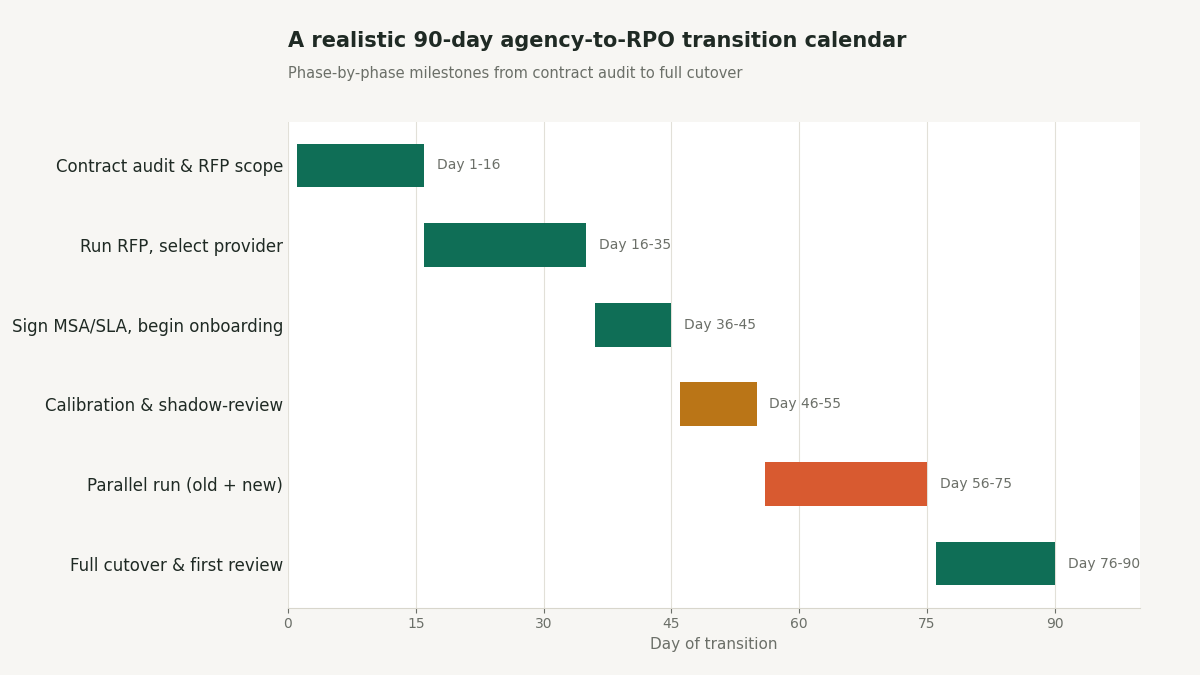
A realistic 90-day transition calendar, phase by phase:
| Days | Milestone |
| 1-15 | Complete agency contract audit, confirm notice periods, finalize RFP scope |
| 16-35 | Run RFP, score proposals, select provider |
| 36-45 | Negotiate and sign MSA/SLA, begin onboarding and ATS/VMS access |
| 46-55 | Calibration sessions, shadow-review of first candidate submissions |
| 56-75 | Parallel run new reqs route to RPO partner, outgoing agencies close active pipelines |
| 76-90 | Full cutover, first monthly reporting cycle, formal 90-day review |
This calendar compresses or extends primarily based on existing agency notice periods; if two outgoing agencies have 90-day exclusivity clauses, the parallel-run window in days 56-75 needs to stretch to match, rather than forcing an early termination that risks contractual penalties.
What to Do Next
If you’re already past the point of listing agencies from memory, the next useful step isn’t another vendor comparison spreadsheet; it’s a real audit of your current roster’s contracts, fill rates, and notice periods, because that audit determines your realistic transition timeline more than any RPO provider’s onboarding speed does.
Supersourcing runs this audit as the first step of any consolidation engagement, working from your actual contract terms rather than a generic template, precisely because the transition plan only works if it’s built on real numbers. If you’re mid-decision and want a second set of eyes on your current agency before you commit to a direction, start a conversation here.
Frequently Asked Questions
What is agency consolidation in hiring?
Agency consolidation is the process of reducing the number of staffing vendors an organization uses, often from a fragmented roster of eight or more down to a small preferred list or, in a full consolidation, a single RPO partner who owns sourcing and delivery under one contract and one SLA.
Why do companies switch from multiple staffing agencies to one RPO?
The main drivers are cost (volume-based pricing instead of fragmented fees), speed (one accountable pipeline instead of competing agency submissions), quality consistency (one vetting bar instead of several), and risk reduction (one NDA/IP structure instead of many).
How many staffing agencies is too many?
There’s no universal number, but if you can’t name every active agency and its fill rate without checking a spreadsheet, or if more than two agencies are regularly submitting for the same requisition, that’s a strong signal you’re past the point where fragmentation is adding value.
What happens to existing agency relationships when you consolidate?
Existing contracts need to be reviewed for notice periods and exclusivity clauses before a transition date is set. Most well-run transitions keep outgoing agencies engaged on already-active requisitions for 30-45 days while all new requisitions route to the new RPO partner from day one.
Is RPO cheaper than using multiple staffing agencies?
Usually, once volume crosses a threshold typically 30-50+ annual hires because volume-based RPO pricing beats the accumulated, uncoordinated fees of several independent agencies each charging full placement percentages with no shared discount structure.
How long does it take to consolidate staffing vendors?
A single-department consolidation typically takes 30-45 days from signed contract to first live requisition; a full enterprise-wide consolidation across multiple geographies usually takes 60-90 days, gated mainly by existing agency notice periods.
What should be in an RPO transition plan?
A complete plan covers: an audit of existing agency contracts and notice periods, a defined cutover date for new requisitions, a 30-45 day parallel-run period for in-flight candidates, a calibration process for the new partner, and a reporting/SLA structure signed off before go-live.
How do you measure success after consolidating to one RPO?
Track time-to-shortlist, time-to-offer, offer-acceptance rate, joining rate, and early attrition (30/60/90-day) monthly against the SLA baseline set at signature and compare blended cost-per-hire against your pre-consolidation fragmented spend at the 6-month mark, not the first quarter, since ramp-up naturally skews early numbers.
