

Most companies evaluating a build-operate-transfer deal for their India center obsess over the wrong number. They negotiate the per-seat operating fee down by 8%, then sign a transfer clause that will cost them 20x that saving when they exercise it in year three. The operating fee is the number on every invoice; the transfer fee is the number that decides whether the whole model makes financial sense.
That asymmetry exists because GCC BOT economics are back-loaded by design. The partner’s margin sits partly in the monthly fee, but the real commercial logic for both sides lives in what happens at handover: who owns the entity, what the per-employee transfer price is, what happens to leases, licenses, and vendor contracts, and whether the “transfer” is a clean equity flip or a two-year untangling exercise.
The market context makes this worth getting right. India’s GCC sector crossed 1,800 centers and roughly $64.6 billion in revenue in FY2024, and the BOT route is one of the fastest-growing entry paths for mid-sized firms that lack an India entity.
NASSCOM–Zinnov projects India’s GCC market will reach approximately $100 billion by 2030, with 2,100–2,400 centers and headcount crossing 2.5 million and notes that fast-growing mid-sized global companies (the classic BOT buyer profile) are expected to drive the next wave..
This guide breaks the model down phase by phase: what you actually pay in build, operate, and transfer; how those fees are constructed; the contract clauses that swing total cost by crores; and the break-even math for when a captive BOT model beats building it yourself. By the end, you should be able to read a BOT term sheet and price the whole engagement including the exit before you sign.
TL;DR
This guide explains the full economics of the build-operate-transfer model for setting up a Global Capability Center, the build fee, the monthly operate fee, and the transfer fee and is written for CTOs, CFOs, and heads of engineering evaluating a BOT partner against doing it themselves. It is a complete walkthrough of GCC BOT economics from first scoping call to post-transfer steady state.
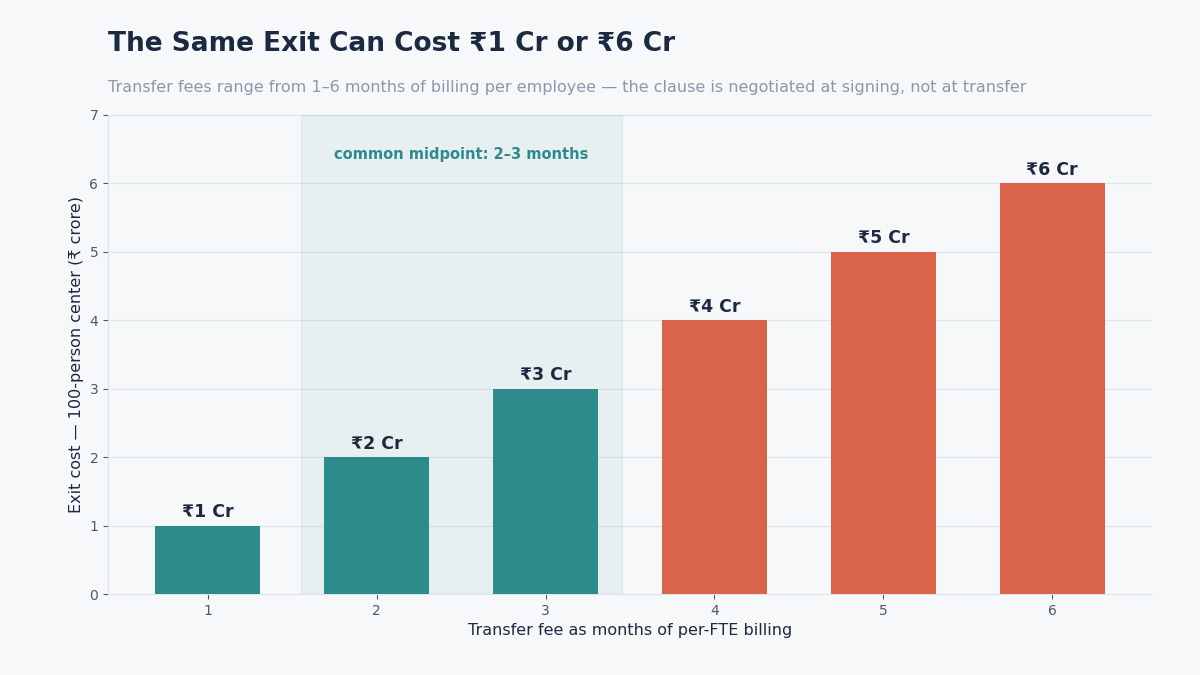
The single most important number to understand before you sign anything: transfer fees in the market range from roughly one to six months of billing per transferred employee, which on a 100-person center can mean the difference between a ₹1 crore exit and a ₹6+ crore exit for the same operational outcome. Most buyers discover this range only after the term sheet arrives.
By the end, you will be able to model the total cost of ownership of a BOT engagement over 3–5 years, compare it honestly against build operate transfer cost alternatives like DIY incorporation or plain outsourcing, and negotiate the five clauses that actually move the number.
What Is the GCC BOT Model?
The GCC BOT (build-operate-transfer) model is a contractual arrangement where a local partner builds your offshore capability center entity, office, team operates it under agreed SLAs for a defined period (typically 2–4 years), and then transfers full ownership of the entity, employees, and assets to you for a pre-agreed fee. You get a running captive without carrying setup risk on day one.
What BOT is not:
- Not outsourcing. In outsourcing, the vendor owns the team and delivery forever; in BOT, the team is being built for you and ownership legally moves to you at transfer.
- Not staff augmentation. Staff aug rents you individuals inside your own management structure; BOT builds an entire operating entity legal, HR, payroll, facilities included.
- Not a joint venture. There is no shared equity during operation; the partner owns the entity until the transfer event, then you own 100%.
Why BOT Economics Matter: The Business Case
The BOT decision is fundamentally a financing and risk-transfer decision, not a hiring decision. Here is what the structure concretely affects:
- Speed to first hire: A BOT partner with an existing Indian entity can have your first engineers on payroll in 4–8 weeks. DIY incorporation, bank accounts, PF/ESI registration, and office setup typically consume 4–6 months before hire #1.
- Capital exposure: DIY requires ₹1.5–4 crores ($180K–$480K) of upfront and first-year fixed commitment (entity setup, deposits, fit-out, leadership hires) before you know the center works. BOT converts most of that into a monthly operating expense.
- Cost arbitrage preserved at scale: A well-run India center delivers senior engineering talent at roughly 30–50% of comparable US fully-loaded cost. The BOT fee erodes some of that arbitrage during the operating phase which is exactly why the transfer timing matters.
- Compliance risk transfer: During operation, the partner carries employer-of-record liability, statutory compliance (PF, ESI, gratuity, POSH, Shops & Establishments), and permanent-establishment structuring. Getting any of these wrong DIY has a six-to-seven-figure downside.
- Optionality: A properly drafted BOT includes a walk-away path. If the center underperforms, you exit a services contract not wind down a foreign subsidiary, which routinely takes 12–18 months in India.
The Core Problem: Why Most Buyers Misprice BOT
The pattern across BOT evaluations is remarkably consistent: buyers price the operate phase precisely and the other two phases barely at all.
The 3-number blind spot. Most teams entering negotiation can quote the per-FTE monthly fee to the rupee, but cannot answer:
(1) what the build fee actually covers versus what gets billed as pass-through,
(2) how the transfer fee is calculated, and
(3) what the post-transfer run-rate looks like once the partner’s shared services disappear.
Where the mispricing typically shows up:
- Transfer fee underestimated by 3–5x. Buyers assume “transfer” is an administrative handover. In market practice it is a priced event commonly structured as 1–6 months of per-employee billing, a fixed per-head fee, or a lump-sum buyout and on a 100+ person center it is routinely a ₹1–6 crore line item.
- Pass-throughs treated as included. Office deposits, fit-out, laptops, software licenses, and recruitment fees for niche roles are frequently billed at cost on top of the operating fee. Teams that assume an all-in fee see first-year invoices run 20–40% above the modeled number.
- Post-transfer cost cliff ignored. During operation, HR, payroll, admin, IT support, and facilities are amortized across the partner’s whole business. Post-transfer, you rebuild those functions for your center alone typically adding 8–15% to run-rate unless planned 12 months ahead.
- Attrition economics missed. Replacement hiring during the operating phase may or may not carry fresh recruitment fees depending on the contract. At 15–20% annual attrition on a 100-person center, that clause alone is worth ₹30–60 lakhs a year.
The rest of this guide prices each of these explicitly.
The Complete BOT Walkthrough: From First Scoping Call to Post-Transfer Steady State
This is the full lifecycle, phase by phase, with the economics attached to each stage. Read it as an internal playbook: what happens, what you pay, and where the leverage sits.
Phase 1 Defining Requirements and the Cost Envelope (Weeks 0–4)
Before any partner conversation, you need four things documented. Partners price against ambiguity the vaguer your scope, the fatter the contingency baked into your fee.
The scoping checklist:
- Target headcount curve, not a number. “100 engineers” prices are different from “15 in Q1, 40 by month 9, 100 by month 24.” The ramp curve drives the build fee, office commitment, and leadership hiring sequence.
- Role mix with seniority bands. A center that is 70% senior backend and DevOps prices very differently from one that is 60% QA and support. Typical India fully-loaded salary bands (2026): mid-level engineers ₹15–30 lakhs/year ($18K–$36K), senior/staff ₹35–60 lakhs/year ($42K–$72K), engineering managers and above ₹60 lakhs–1.2 crore/year.
- Location decision. Bengaluru/Hyderabad/Pune command 10–25% salary premiums over Tier-2 cities (Indore, Coimbatore, Ahmedabad) but offer deeper senior talent pools. NASSCOM data shows Tier-2 expansion accelerating, but for a first center under 150 heads, metro depth usually wins.
- Budget bands per phase. As a planning envelope for a 50-person center: build ₹30–80 lakhs ($36K–$96K), operate ₹8–20 crores/year all-in ($1M–$2.4M), transfer ₹50 lakhs–2 crores ($60K–$240K). These are ranges, not quotes, the drivers behind them come next.
Red flag at this stage: a partner willing to quote a firm per-FTE price before seeing your role mix and ramp curve. That number will be renegotiated later, on their terms.
Phase 2 Partner Sourcing, Vetting, and the Build Fee (Weeks 4–10)
The build phase covers entity readiness, office setup, leadership hiring, and standing up the first team. Understand what the build fee does and does not include.
What a legitimate build fee covers:
- Legal structuring: whether you’ll operate under the partner’s existing entity or a fresh SPV incorporated for eventual transfer (the SPV route makes transfer dramatically cleaner more in Phase 6)
- Office selection and fit-out project management (fit-out capex itself is usually pass-through: ₹1,500–3,500 per sq ft)
- Anchor leadership hiring the site head and first engineering leads
- Recruitment engine setup: employer brand page, interview panels, offer benchmarking
How to vet the partner’s actual capability:
- Ask for time-to-fill data by role family, not an average. A credible partner can show, for example, 7–10 working days from job description to interview-ready shortlist for mainstream stacks, with honest caveats for niche roles.
- Ask for offer-to-join and early-attrition numbers. Best-in-class operators run 95%+ joining rates and under 5% ninety-day attrition; market average is far worse (offer drop-off of 20–30% is common in India tech hiring).
- Interview the delivery team, not the sales team. The account manager who will run your center should be in the room by the second call.
- Check replacement policy in writing a 7–10 day replacement commitment for misfit hires during ramp-up is a reasonable market standard to demand.
- Reference-check a client who completed a transfer, not just one in the operating phase. This is the single most skipped diligence step, and the most informative.
Red flag: vetting descriptions that stay abstract (“rigorous multi-step screening”) with no numbers attached. Screening quality is measurable top-of-funnel acceptance rates (the strictest operators shortlist only the top 2–5% of applicants), technical pass rates, and joining rates. If a partner can’t produce them, they don’t track them.
Phase 3 Engagement Model and Contract Economics (Weeks 8–14)
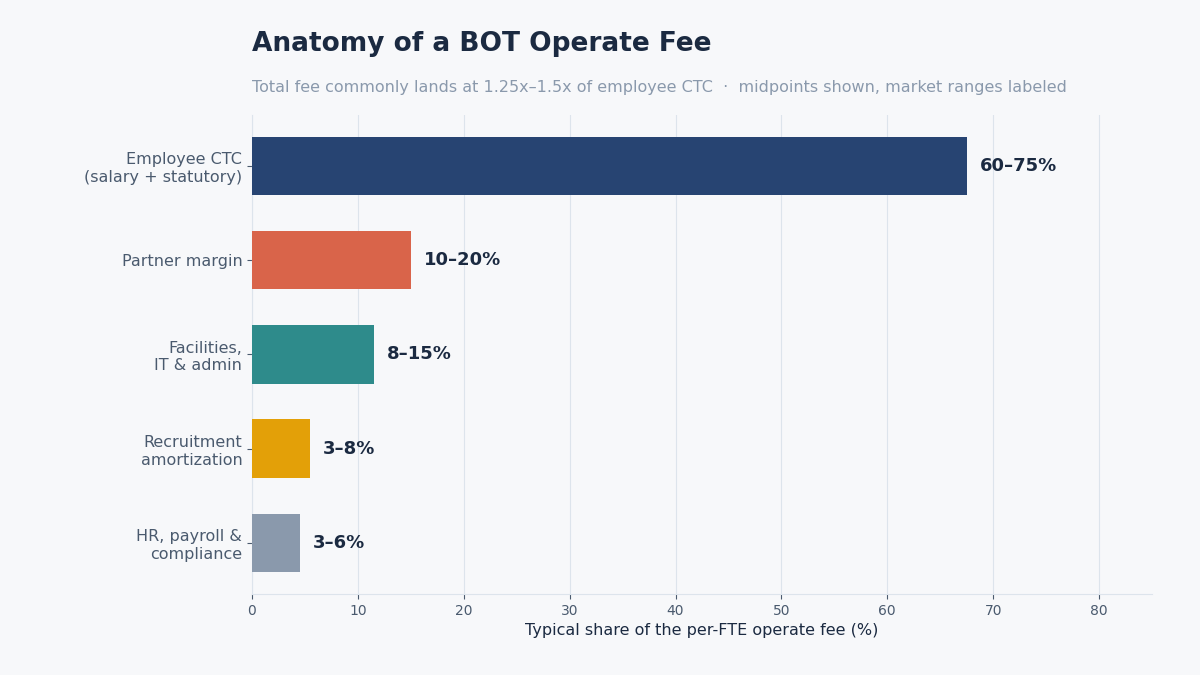
This is where the money is made or lost. The operating fee has a standard anatomy; make the partner decompose it.
The per-FTE operate fee, decomposed:
| Component | Typical share of fee | Notes |
| Employee CTC (salary + statutory) | 60–75% | Pass-through; demand salary transparency |
| Facilities, IT, admin | 8–15% | Seat cost ₹8K–18K/month metro |
| HR, payroll, compliance | 3–6% | The employer-of-record burden |
| Recruitment amortization | 3–8% | Or billed separately at 6–12% of CTC per hire |
| Partner margin | 10–20% | The negotiable band |
Market shorthand: total operating fees commonly land at 1.25x–1.5x of employee CTC, or equivalently a management fee of $600–1,500 per FTE per month on top of transparent salary pass-through. Below 1.2x, ask what’s been moved to pass-through billing; above 1.6x, you’re funding someone else’s inefficiency.
The five contract clauses that move total cost more than the fee itself:
- Transfer fee formula. Fixed per-head, months-of-billing multiple, or lump sum negotiated now, not at transfer. A sliding scale that decreases with tenure (e.g., 4 months of fees if transferred in year 1, 2 months in year 3, zero after year 4) aligns incentives best.
- Transfer trigger rights. You want a unilateral right to trigger transfer after a minimum period (commonly 18–24 months), with a defined 90–180 day execution window. Avoid contracts where transfer requires mutual agreement that converts a right into a negotiation.
- Attrition and replacement terms. Who pays recruitment fees for backfills? Is there a free-replacement window (7–10 days to 90 days is the negotiable range)?
- IP and confidentiality. All work products assigned to you from day one, NDA-backed, with employee-level IP assignment agreements, not just partner-level. Verify this is in the employment contracts, because those contracts transfer with the employees.
- Exit-without-transfer terms. If you walk away instead of transferring, what notice period, what wind-down fees, and critically a non-solicit carve-out letting you hire some or all of the team anyway (usually at a per-head fee).
Where dedicated hiring fits: if your ramp includes roles the partner’s bench doesn’t cover, say a platform team where you need to hire DevOps engineers with specific Kubernetes-at-scale experience, clarify whether niche recruitment is inside the fee or billed as project recruitment at 8–12% of CTC.
Phase 4 Onboarding and Ramp-Up Economics (Months 1–6)
The ramp phase is where modeled costs meet reality. Two dynamics dominate.
Dynamic 1: You pay for the curve, not the destination. A center ramping to 50 heads averages perhaps 28–35 billable FTEs across year one. Model year-one cost on the actual monthly headcount curve; partners who quote “annual cost at 50 heads” are quoting year two.
Dynamic 2: Productivity lags payroll by 8–12 weeks per cohort. Budget for it rather than fighting it.
The first-90-days operating checklist:
- Weeks 1–2: Access provisioning (repos, VPN, SSO), laptop imaging standard agreed, security policy signed per employee. Slowest common blocker: your own IT security review of the partner’s device policy starts pre-signing.
- Weeks 2–4: Embed 2–3 of your senior engineers (remotely is fine) as technical anchors for the first cohort. Centers that skip this see 30–50% longer time-to-first-commit.
- Weeks 4–8: Establish the communication cadence daily standup overlap window (a 3–4 hour IST/US-East overlap is realistic), weekly delivery review, monthly steering with the partner’s account leadership.
- Weeks 8–12: First performance calibration. Exercise the replacement clause now for misfits every month of delay makes it culturally harder.
- Ongoing: Track offer-to-join and 90-day attrition monthly. These two numbers predict ramp success better than any delivery metric this early.
Onboarding friction that only shows up in practice: background verification (BGV) in India takes 2–4 weeks and offers are often accepted 30–60 days before joining (notice periods). Your “4-week hire” is realistically 8–10 weeks from JD to butt-in-seat for employed senior candidates. Plan cohorts accordingly.
Phase 5 Managing the Operate Phase (Months 6–30)
A steady state is where BOT quietly succeeds or fails. The management structure that works:
- Your side: one accountable executive owner (not a committee), plus engineering leadership treating the center as a first-class site, same planning cycles, same performance bar.
- Partner side: a dedicated account manager with no shared bandwidth across clients, monthly business reviews, and quarterly cost reviews where pass-throughs are reconciled line by line.
KPIs worth tracking monthly (and writing into the MSA):
- Time-to-fill by role family (target: 7–10 working days to shortlist, 45–70 days to joining for senior roles)
- Offer-to-join rate (target: 90%+; best operators sustain 98%)
- Rolling 12-month attrition (India tech benchmark: 12–18%; below 10% is excellent)
- Cost per FTE vs. model, with pass-through variance flagged over 5%
- Delivery metrics owned by your engineering leadership, not the partner velocity, escaped defects, on-call health
The mid-operate audit (month 12–18): commission a one-time review of the entity’s transfer-readiness employment contracts, IP assignments, statutory filings, vendor contracts, lease assignability.
Finding a defect now costs a memo; finding it during transfer costs a delay measured in quarters. This is also the point to engage IT consulting services or counsel for transfer-pricing and permanent-establishment review if your finance team hasn’t already.
Phase 6 The Transfer: Mechanics and True Cost (Months 24–48)
The transfer is a legal, financial, and human event happening simultaneously. Its cost has four layers.
Layer 1 The contractual transfer fee. As negotiated in Phase 3. Market structures:
- Per-head fee: commonly ₹1–4 lakhs per transferred employee
- Billing multiple: 1–6 months of per-FTE fees (2–3 months is a common midpoint)
- Lump-sum buyout: a negotiated figure, often benchmarked to 5–15% of annual contract value
- Sliding scale: decreasing with engagement tenure the structure to push for
Layer 2 Entity and asset transfer costs. If the partner runs your center inside an SPV, transfer is a share purchase clean, fast (60–120 days), with stamp duty and legal costs typically ₹10–30 lakhs.
If your team sat inside the partner’s main entity, transfer means incorporating your own company, innovating every employment contract individually, assigning the lease, and re-registering statutory accounts 6–12 months of work and materially higher legal spend. Ask the SPV question in the first sales call. It is the single highest-leverage structural decision in the whole model.
Layer 3 Employee consent and retention. India has no automatic-transfer mechanism for this scenario; every employee individually consents to move. Expect and budget for:
- A retention/transfer bonus pool (commonly 0.5–1 month of salary per employee)
- 3–8% attrition triggered by the transfer announcement itself, concentrated in your most marketable seniors
- Benefits parity or better gratuity continuity, leave-balance carryover, ESOP treatment negotiated before the announcement, not after
Layer 4 The post-transfer cost cliff. Functions the partner amortized now become yours: HR ops, payroll vendor, compliance retainers, IT support, facilities management. For a 100-person center, budget an incremental ₹60 lakhs–1.5 crores/year, or contract a 6–12 month transition services agreement (TSA) with the partner to phase it.
Transfer execution checklist:
- Trigger notice per contract (start 6–9 months before intended date)
- Legal and financial due diligence on the entity/SPV
- Transfer-pricing and PE structure sign-off from your tax advisors
- Employee communication plan announced once, with offers in hand
- Individual consent + novation or fresh employment contracts
- Asset, lease, license, and vendor contract assignment
- TSA scope and duration agreed
- Day-one readiness: payroll run, insurance, access, banking
Reading a BOT Term Sheet: A Line-by-Line Teardown
Term sheets for the captive BOT model follow a recognizable template. Here is how to read one commercially, clause family by clause family, before your lawyers read it legally.
Fee schedule section. Look for three things in order. First, whether salaries are pass-through at actuals with a separate management fee, or bundled into a single per-FTE rate, bundled rates hide salary inflation pass-alongs and make benchmarking impossible.
Second, an annual fee-escalation clause; 5–8% is common; anything indexed vaguely to “market conditions” is a blank cheque. Third, the pass-through schedule as an exhaustive list. If the term sheet says pass-throughs “include but are not limited to,” strike the phrase.
Term and termination section. The numbers to extract:
- Initial term: 24–36 months is standard. Longer initial terms should buy you something concrete, a lower fee or a lower transfer multiple.
- Termination for convenience: 90–180 days’ notice after a minimum period is fair. No convenience termination at all means your only exits are breach or transfer to an expensive corner.
- Wind-down fees on exit-without-transfer: typically 1–3 months of fees plus unamortized build costs. Reasonable; just make sure “unamortized build costs” is a defined number, not a discretionary one.
Transfer section. Beyond the fee formula covered in Phase 3, check the mechanics: who drafts the share purchase or business transfer agreement, who pays stamp duty (in a share transfer, typically the buyer, but it’s negotiable), whether the partner warrants statutory compliance and clean title on the entity at transfer, and whether a TSA is pre-priced or “to be agreed.” A pre-priced TSA rate card, even a rough one, removes your single biggest point of leverage loss at handover.
Non-solicit and exclusivity section. Two traps recur. A mutual non-solicit that survives termination can block you from hiring the very team you funded if you exit without a formal transfer and insist on a carve-out for center employees, even at a per-head release fee. And exclusivity clauses that make the partner your sole India hiring channel remove your benchmark; keep the right to run parallel channels, even if you never use it.
Warranties and liability section. The employer-of-record structure means the partner’s compliance failures during operation can become your inherited liabilities at transfer. The market-standard protection is a compliance warranty at transfer plus an indemnity for pre-transfer statutory liabilities, surviving 3–7 years (matching Indian limitation periods for tax and labor claims). Term sheets frequently cap total liability at 3–6 months of fees; for pre-transfer statutory and tax indemnities specifically, push for a higher or uncapped carve-out.
What “done well” looks like at the end state. Twelve months post-transfer, a healthy center shows: run-rate within 10% of the final operate-phase cost once shared services are rebuilt, attrition at or below the market band it held during operation, zero surprise statutory notices from the pre-transfer period, and the real test the center hiring, promoting, and shipping without any residual partner dependency. That is the finish line every clause above is protecting.
Case Studies: What the Economics Look Like in Practice
The scale-up patterns below come from real engagements our team has delivered; where an engagement covered the talent-build phase of a center rather than a full BOT lifecycle, that’s stated plainly.
Paytm 100+ engineers at ramp speed. 100+ engineers hired across backend, data, and platform roles on compressed timelines, sustaining shortlist delivery in the 7–10 working day band per role. The relevant BOT lesson: a ramp curve of this steepness is only affordable if the recruitment engine is amortized into the operate fee rather than billed per hire at typical per-hire agency rates of 8–12% of CTC, 100 hires would otherwise add ₹1.5–2.5 crores of one-time cost to year one.
Swiggy sustained hiring through hypergrowth. A multi-quarter engineering scale-up where the deciding metric was offer-to-join rate, not sourcing volume. Holding joining rates near 98% against an India market where 20–30% offer drop-off is routine compressed the effective cost per successful hire by roughly a third the difference between a ramp plan that holds and one that slips two quarters.
Somnoware recruitment automation for a lean healthtech team. A US healthtech firm’s India engineering build-out where automated screening pipelines cut manual screening effort dramatically and kept early attrition under 5%. The BOT-relevant pattern: in centers under 30 heads, every regretted exit costs 4–6% of annual center budget in rehiring and lost ramp time, so vetting rigor is a larger economic lever than fee negotiation at small scale.
BOT vs. DIY vs. Outsourcing vs. Staff Augmentation: The Decision Framework
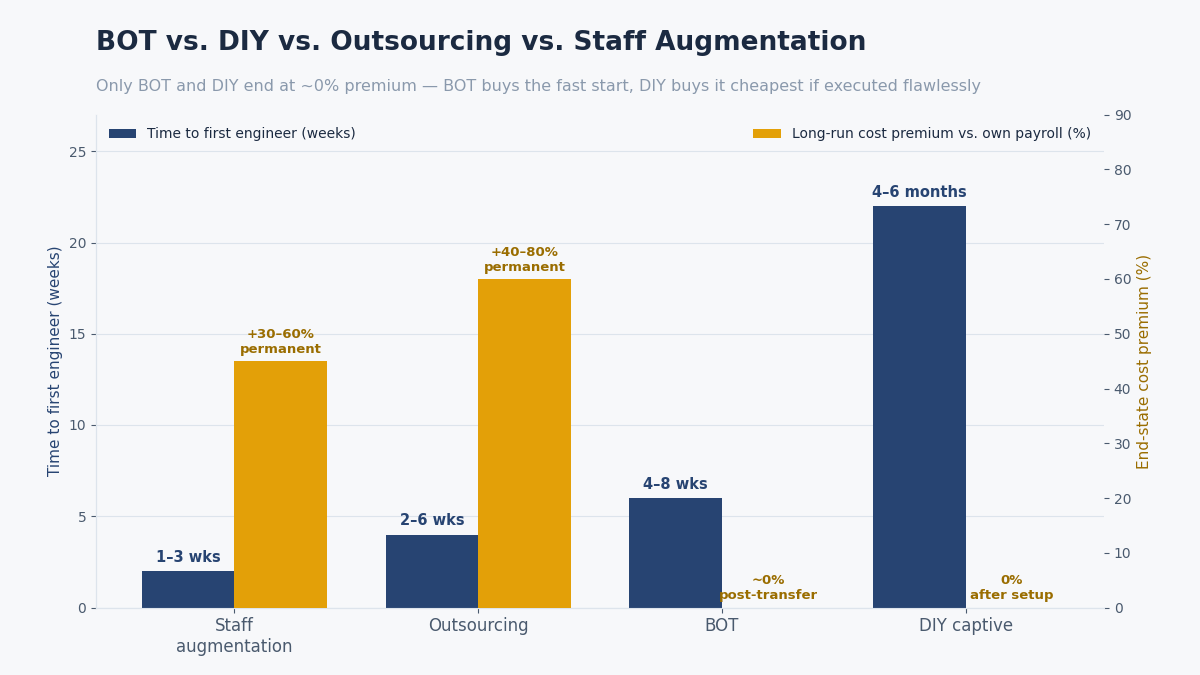
The honest comparison is total cost of ownership over 3–5 years plus risk-adjusted speed not the monthly fee.
| Dimension | BOT | DIY captive | Outsourcing | Staff augmentation |
| Time to first engineer | 4–8 weeks | 4–6 months | 2–6 weeks | 1–3 weeks |
| Upfront capital | Low (build fee ₹30–80L) | High (₹1.5–4 Cr yr-1 fixed) | None | None |
| Steady-state cost premium vs. own payroll | +25–50% during operate; ~0% post-transfer | 0% (after setup) | +40–80%, permanent | +30–60%, permanent |
| Team ownership | Yours at transfer | Yours from day one | Never | Never |
| IP/knowledge retention | High post-transfer | Highest | Low | Medium |
| Compliance risk carried by you | Low during operate | Full | None | Low |
| Exit difficulty | Medium (contractual) | High (entity wind-down 12–18 months) | Low | Low |
| Best at headcount | 30–300, multi-year horizon | 150+ with existing India experience | Project-scoped work | <20, short-term gaps |
The break-even math, simplified. The BOT premium over DIY is roughly (operate-phase markup × operate duration) + transfer fee − (DIY setup costs + DIY mistakes you didn’t make). Worked pattern for a 50-person center:
- BOT premium over raw CTC at 1.35x for 30 months ≈ ₹4.5–6 crores of cumulative fee above salaries
- Minus the DIY costs avoided: entity setup and first-year fixed overhead (₹1.5–2.5 Cr), a 4–6 month slower start (opportunity cost of 20+ engineer-years of output), and leadership mis-hires DIY first-timers make at meaningful rates
- Plus the transfer fee (₹0.5–2 Cr)
Net: for a first India center at 30–150 heads, BOT typically costs a genuine premium of ₹1–3 crores over a flawlessly executed DIY and is cheaper than a typically executed one. Companies with an existing India entity and experienced local leadership should usually skip BOT; that premium buys them little. Companies exploring the model from scratch can compare structures directly with a provider’s GCC setup services team before committing to either path.
When BOT is the wrong answer:
- Headcount plan under ~20: the fixed machinery isn’t worth it staff augmentation or RPO services into your own entity is leaner
- No genuine intent to own the center: if transfer is “maybe someday,” you’re buying expensive outsourcing
- Sub-18-month time horizon: you’ll pay build costs and never reach the phase where economics improve
What Most Teams Get Wrong About BOT Economics
Pattern-level observations from deals we’ve seen negotiated, run, and unwound:
They negotiate the fee and accept the structure. Buyers grind the per-FTE fee down 5–10% and accept whatever transfer formula the partner drafted. The structure SPV or not, transfer trigger rights, fee formula moves 10x more money than the fee negotiation. If you have leverage for exactly one battle, spend it on a unilateral transfer right with a sliding-scale fee inside an SPV.
They treat the operating phase as the product. The operating phase is the bridge. A BOT that runs 5+ years without transferring isn’t a BOT; it’s outsourcing with a more expensive contract. The discipline that separates good outcomes: a named transfer-readiness owner on your side from month one, and the month-12 entity audit actually happening.
They assume the team transfers automatically. Every employee is an individual decision-maker at transfer. Teams that treated the workforce as an asset line-item have watched 15%+ of senior staff courted by the partner’s other accounts or the open market decline to move. Teams that ran transfer as an internal-mobility campaign with retention economics held attrition to low single digits.
They model arbitrage at today’s salaries. India senior-engineer compensation has compounded high-single-digits annually, faster in AI/ML. A 5-year model built on flat salaries overstates savings 15–25%. Build 8–10% annual wage inflation into the model; the arbitrage survives it comfortably, but your CFO’s version of the model should not be the optimistic one.
They skip the reference that matters. Almost no buyer speaks to a client who completed a transfer with their prospective partner. Partners whose economics depend on transfers not happening reveal themselves in exactly one place: the experience of clients who tried to leave.
Cost & Timeline Reality Check
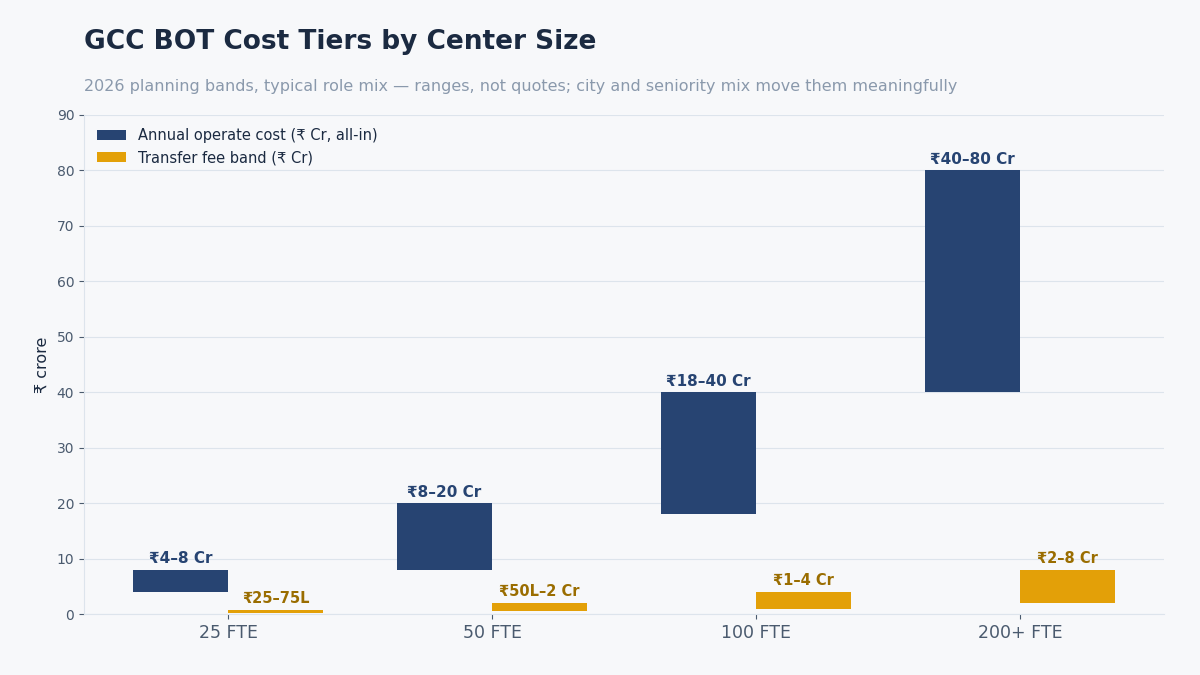
Concrete planning bands for a first India GCC via BOT, 2026 market conditions. All figures are typical ranges, not quotes; role mix and city move them meaningfully.
Cost tiers by center size (all-in annual operate cost):
| Center size | Typical role mix | Annual operate cost | Transfer fee band |
| 25 FTE | Product eng pod | ₹4–8 Cr ($0.5–1M) | ₹25–75L |
| 50 FTE | Eng + QA + DevOps | ₹8–20 Cr ($1–2.4M) | ₹50L–2 Cr |
| 100 FTE | Multi-team + data | ₹18–40 Cr ($2.2–4.8M) | ₹1–4 Cr |
| 200+ FTE | Full product org | ₹40–80+ Cr | ₹2–8 Cr |
What drives cost up: metro location, senior-heavy mix, AI/ML and platform roles, aggressive ramp curves (rush hiring carries premiums), fully-serviced office space, sub-scale centers (<30 heads carry fixed-cost drag).
What drives cost down: Tier-2 city location (10–25% on salaries, more on facilities), salary-transparent contracts with fee caps, recruitment amortized rather than per-hire, longer operational commitments traded for lower transfer fees, hybrid seating ratios.
Timeline by scenario:
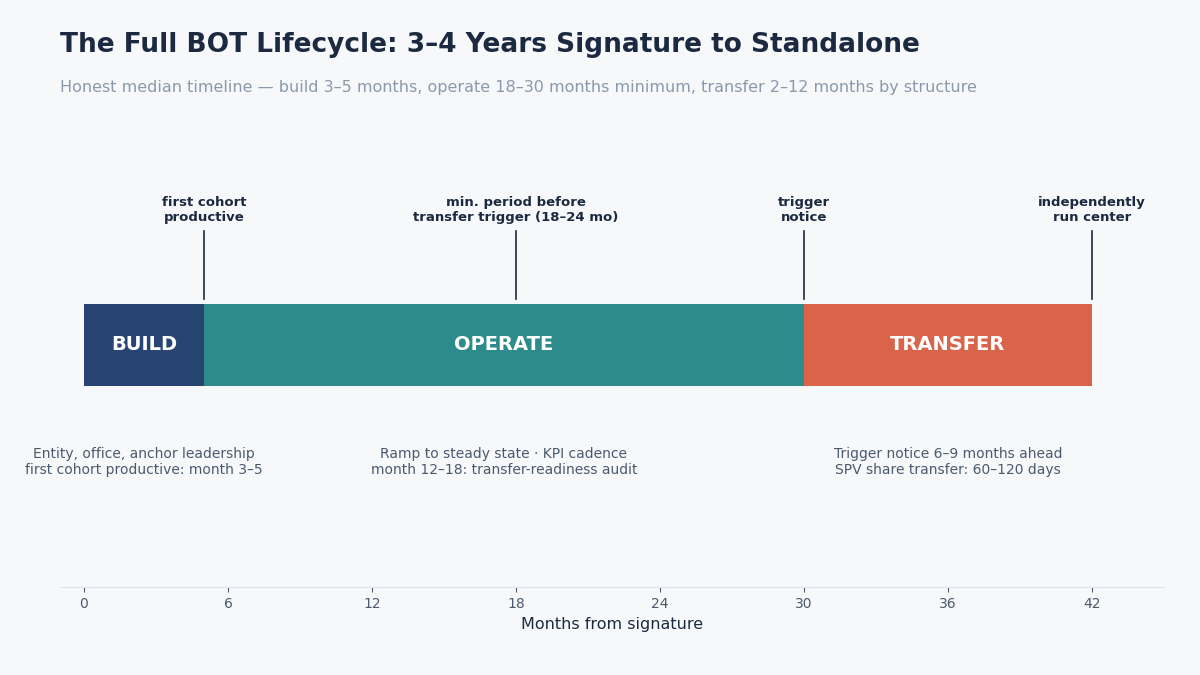
- Signing to first cohort productive: 3–5 months (4–8 weeks to first joiners, plus notice periods and ramp)
- Ramp to 50 heads: 9–15 months with a disciplined engine; 18+ without
- Minimum sensible operate phase: 18–24 months (earlier transfer usually triggers maximum fees and an immature entity)
- Transfer execution: 60–120 days for an SPV share transfer; 6–12 months for a carve-out from the partner’s main entity
- Full lifecycle, signature to independently-run center: 3–4 years is the honest median
If You’re Mid-Decision: The Next Step
If a BOT term sheet or a build-vs-buy debate is live on your desk right now, the highest-value 45 minutes you can spend is a structured walkthrough of your numbers: the fee decomposition, the transfer formula, the SPV question, and the DIY break-even for your specific headcount plan.
Supersourcing’s GCC team has run this exact model review across 527+ delivered engagements, and we’ll tell you plainly if DIY or plain RPO is the better answer for your situation; the consultation is a working session, not a pitch. Bring your term sheet or your headcount plan to supersourcing.com/contact-us and ask for a BOT economics review.
FAQ
What is the BOT model in a GCC?
Build-operate-transfer is a contract where a local partner incorporates and builds your capability center, runs it under agreed SLAs for typically 2–4 years, then transfers the entity, employees, and assets to you for a pre-agreed fee. It trades a monthly premium during the operating phase for speed, reduced compliance risk, and a pre-priced path to full ownership.
How much does it cost to set up a GCC in India through BOT?
Plan three envelopes: a build fee of ₹30–80 lakhs for a mid-sized center, an operate cost of roughly 1.25–1.5x employee CTC (e.g., ₹8–20 crores/year all-in at 50 heads), and a transfer fee of ₹50 lakhs–2 crores at that scale. Pass-throughs fit-out, deposits, devices add to year one.
What is a typical BOT transfer fee?
Market structures include a per-head fee (₹1–4 lakhs per employee), a billing multiple (1–6 months of per-FTE fees, with 2–3 months a common midpoint), or a lump sum near 5–15% of annual contract value. Sliding scales that shrink with tenure are increasingly standard and worth insisting on during initial negotiation not at transfer time.
Is BOT cheaper than doing it yourself?
Over 3–5 years, a flawlessly executed DIY captive is usually cheaper on paper by ₹1–3 crores at 50–100 heads. BOT wins on risk-adjusted cost for first-time entrants: it eliminates the 4–6 month setup delay, entity wind-down risk, and the leadership mis-hires that first-time DIY builds commonly absorb. Companies with existing India operations should generally go DIY.
What happens to employees during the transfer?
India has no automatic transfer mechanism for this scenario, so each employee individually consents to move via novation or a fresh contract with your entity. Expect a retention bonus pool of 0.5–1 month’s salary, guaranteed benefits continuity (gratuity, leave balances), and 3–8% announcement-triggered attrition even in well-run transfers.
How long does the operating phase last before transfer?
Contracts commonly set an 18–24 month minimum before you can trigger transfer, and most transfers execute between months 24 and 48. Transferring earlier usually costs maximum fees on an immature entity; drifting past year five converts the arrangement into permanently marked-up outsourcing.
What are the hidden costs in a BOT agreement?
The recurring offenders: pass-through billing for fit-out, deposits, devices, and licenses assumed to be in-fee; per-hire recruitment charges on attrition backfills; the post-transfer cost cliff of ₹60 lakhs–1.5 crores/year in shared services you must rebuild; and transfer-triggered retention spend. A line-by-line pass-through schedule in the MSA prevents most of them.
How do I know if my cost model for BOT is realistic before signing?
Pressure-test it against three things: an actual monthly headcount ramp curve (not steady-state headcount), 8–10% annual wage inflation, and a fully priced transfer scenario including retention and post-transfer overhead. If a term sheet is already on your desk, a structured second opinion on the fee anatomy and transfer clauses before signature typically pays for itself many times over; this is exactly the review our GCC advisory team runs for prospective buyers.
