

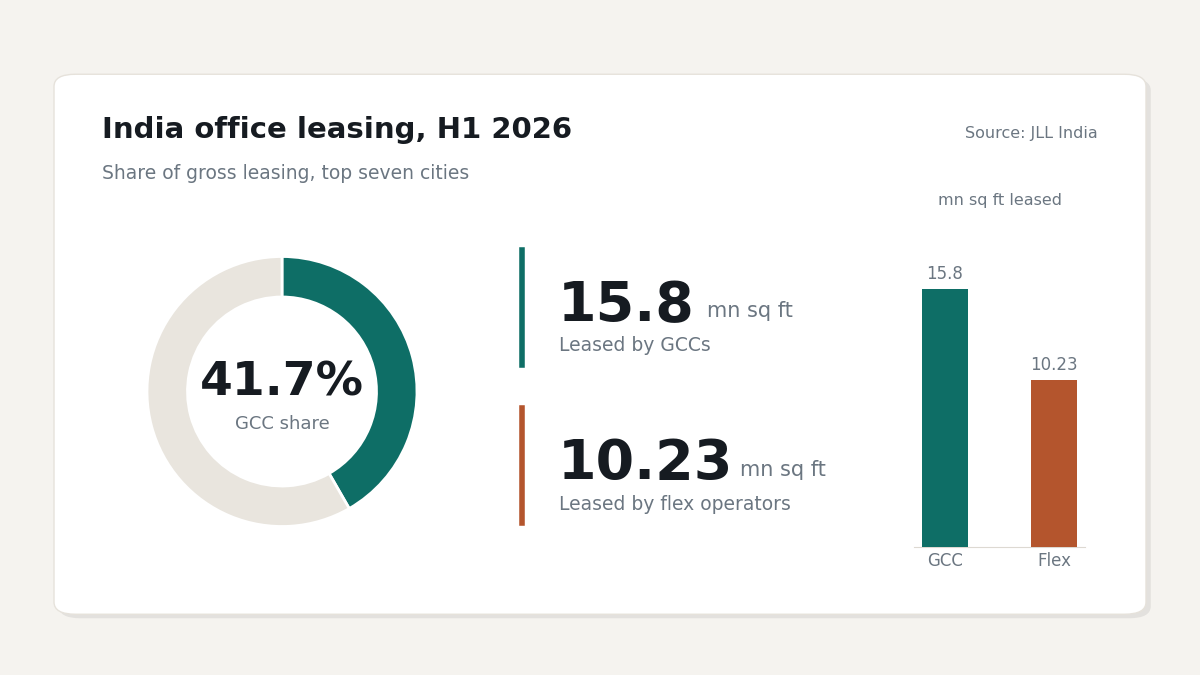
Global Capability Centres absorbed 41.7% of every square foot of office space leased across India in the first half of 2026 15.8 million sq ft, per JLL India. That number has quietly rewritten how landlords negotiate. When one occupier category drives nearly half of national demand, the tenant is no longer the price-setter on Grade A office space in Bengaluru, Hyderabad or Pune.
Which is why the sequencing most enterprises use is now backwards. The standard playbook: pick a city, sign a five-year lease on a bare shell, spend nine months fitting it out, then start hiring. In a tight market that order guarantees you pay for empty desks. A defensible gcc office space strategy starts from the hiring curve and works outward to the floor plate.
In H1 2026, flex space operators leased a record 10.23 million sq ft across India’s top seven cities, the highest first-half figure recorded for the segment. Enterprises aren’t choosing flex because they’re small. They’re choosing it because a 36-month commitment beats a 60-month one on risk-adjusted cost.
The three formats on the table: conventional lease, managed office, coworking are not tiers of the same product. They price differently, they allocate risk differently, and two of them will fail a client security audit if used for the wrong function. Below is the decision logic behind a working gcc office space strategy: the actual per-seat numbers as of mid-2026, the crossover point where a lease starts winning, and the clauses that decide whether your exit is free or costs a year of rent.
TL;DR
This guide is for GCC heads, India country managers and CFOs deciding how to house a capability center between 30 and 500 seats. It compares a conventional lease, a managed office for gcc operations, and coworking on cost, commitment, compliance and speed.
The number that decides most cases: a leased office only beats a managed office on total cost of ownership at around month 47 and once you add facility management, IT and security headcount to the leased option, that crossover pushes past year six. Fit-out capital is what buys the delay.
By the end you'll be able to size your seat requirement, price all three formats against your own headcount ramp, and name the five contract clauses to fight for before signing. A working gcc office space strategy should take a week to build, not a quarter.
What Is a GCC Office Space Strategy?
A gcc office space strategy is the decision framework an enterprise uses to select, size, price and contract the physical workspace for its global capability center matching format (lease, managed or coworking), location, seat count and commitment length to the center’s hiring ramp, function mix and compliance obligations.
It is a sequencing discipline, not a real estate transaction. The format follows the mandate.
The Real Problem: You’re Sizing for a Headcount You Don’t Have Yet
Every GCC business case contains a hiring plan. Almost none survive contact with the market at the pace the plan assumes.
India’s GCC base is now 2,117 centers across 3,728 units employing 2.36 million people, per Nasscom and Zinnov’s FY2026 landscape data. The consequence is straightforward: you are hiring senior engineers from a pool 2,000 other centers are hiring from, in the same four postcodes.
That creates a mismatch with gcc real estate india decisions rarely priced in. A 300-seat business case typically ramps in three phases over 24–30 months, but the lease it triggers is signed for all 300 seats on day one. For the first year you pay rent, CAM charges and amortised fit-out on 180 desks nobody sits at.
The reverse failure is just as common and more expensive to fix. When sourcing is working a vetted shortlist inside 7–10 working days is achievable for most mainstream stacks hiring outruns the floor plate. Dedicated teams take a satellite coworking floor as a stopgap, and one delivery team ends up split across two buildings on two network configurations. That cost never appears on the real estate line item; it shows up as attrition and missed sprint velocity.
Neither failure is a real estate problem. Both are sequencing failures, which is why a gcc office space strategy has to be derived from the ramp rather than validated against it afterwards.
Managed Office for GCC Teams: What You’re Actually Buying
A managed office is a dedicated, single-tenant floor or wing built to your specification, operated by a flex operator, and billed as one all-inclusive monthly fee per seat. You get exclusive space and your own access control but you don’t own the fit-out, the furniture, or the facility management contract.
That last point is the whole commercial argument, and it is why the format now anchors most mid-size gcc office space strategy decisions: it converts a capex-heavy committed asset into an opex line you can renegotiate.
How Much Does Managed Office Space Cost for a GCC in India?
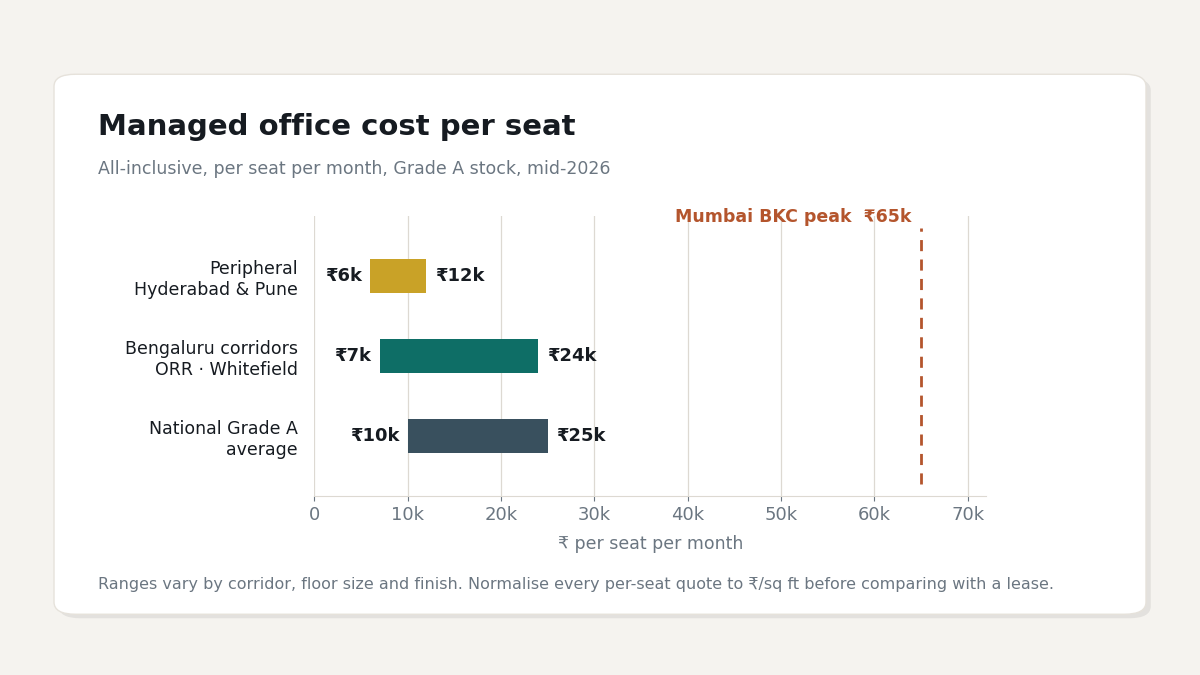
Mid-2026 market ranges for Grade A stock, all-inclusive per seat per month:
- Peripheral Hyderabad / Pune: ₹6,000 – ₹12,000
- Bengaluru (Whitefield, ORR, Sarjapur): ₹7,000 – ₹24,000 depending on corridor and finish
- National Grade A average: ₹10,000 – ₹25,000
- Mumbai BKC: up to ₹65,000 per desk
Bengaluru deserves a specific warning. Prime micro-market rates climbed roughly 14% year on year in early 2026 and average city rents crossed ₹100 per sq ft per month for the first time on record. Any 2024 benchmark in your business case is now wrong by a wide margin.
The Conventional Lease: Where the Money Actually Goes
The headline rent is the smallest number in the deal. A bare or warm shell lease in a Grade A Indian building typically carries:
- Rent: ₹65 – ₹160 per sq ft per month, by city and micro-market
- CAM charges: ₹12 – ₹25 per sq ft per month, escalating independently of rent
- Security deposit: 6 – 12 months’ rent, refundable
- Lock-in period: 3 years standard; landlords push 5 on large floor plates
- Escalation: commonly 5 – 10%, structured annually or in three-year steps
- Fit-out: ₹1,800 – ₹2,800 per sq ft for a standard build. Cushman & Wakefield benchmarks a collaborative hybrid workplace fit-out at ₹5,847 – ₹6,567 per sq ft the spread between those two ranges is entirely specification, and it is the single most negotiable line in your budget
Warm shell handover instead of cold shell removes roughly ₹800 – ₹1,500 per sq ft of that spend. On most deals it is worth more than a rent-free period, and it is asked for far less often.
How Many Square Feet Per Seat Does a GCC Need?
Plan seat density at 80 – 110 sq ft of built-up area per seat for a standard engineering floor. Below 70 sq ft per seat the floor becomes unworkable once you account for meeting rooms, war rooms and a pantry that 200 people can actually use at 1 p.m.
This is where per-seat quotes get gamed. An operator can quote an attractive per-seat pricing number by planning the floor at 55 sq ft per seat: the rate looks 20% better than market and the space is unusable on day one. Always normalise a per-seat quote back to a per-sq-ft number before comparing it to a lease.
Lease vs Managed Office Total Cost of Ownership
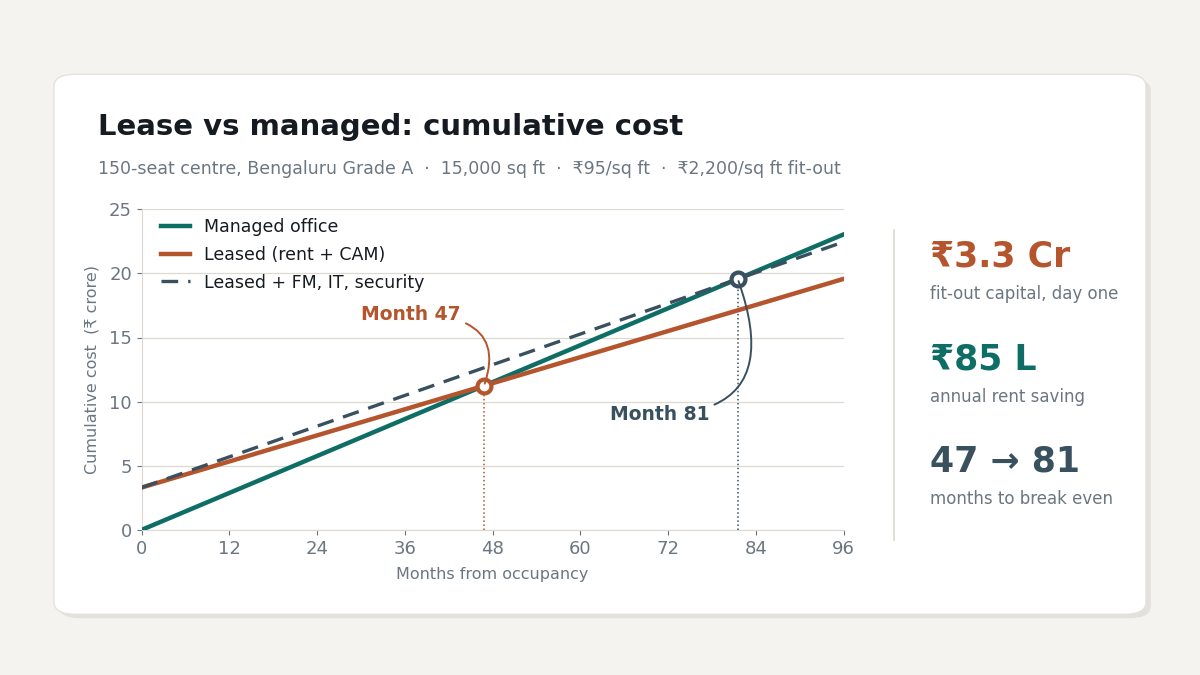
Run the arithmetic on a 150-seat center in a Bengaluru Grade A building. Assumptions stated so you can substitute your own: 100 sq ft per seat, ₹95 per sq ft rent, ₹18 CAM, ₹2,200 per sq ft fit-out, ₹16,000 per seat managed rate.
Managed: ₹24 lakh per month → ₹2.88 Cr per year. Capex: nil. Deposit: roughly 3 months.
Leased: ₹14.25 lakh rent + ₹2.7 lakh CAM = ₹16.95 lakh per month → ₹2.03 Cr per year. Plus ₹3.3 Cr one-time fit-out on 15,000 sq ft. Plus a 6-month deposit of about ₹85 lakh.
The lease saves ₹85 lakh a year in running cost. Against ₹3.3 Cr of fit-out capital, that is a 47-month payback just under four years, before you have hired a single facility manager.
Now add what the managed fee already covered: facility management, IT infrastructure, security, housekeeping, helpdesk. Budget ₹1,500 – ₹2,500 per seat per month, or about ₹36 lakh a year at this scale. Net annual saving drops to roughly ₹49 lakh and the crossover moves past month 78.
That is the finding that should drive the gcc office space strategy at this scale. A lease is not cheaper than a managed office until roughly year six at 150 seats and only then if your year-six headcount forecast is accurate.
The Compliance Layer Most Business Cases Skip
Format choice is constrained by what the center is allowed to do, not just what it costs. Three constraints recur:
Client audit rights. If the center handles regulated BFSI or healthcare data, client security audits test network segregation, badge-log retention, camera coverage and clean-desk enforcement. A shared coworking floor fails several by design. A dedicated managed floor with its own VLAN and access control generally passes but only if specified in the agreement, not after.
Entity and registration mechanics. Any lease beyond 11 months must be registered and sits on the India entity’s books. Settle the entity, the transfer-pricing position and the legal documents required for GCCs in India first, because the signing entity is hard to change later a sequencing question our IT consulting services teams resolve alongside the facility decision rather than after it.
SEZ vs non-SEZ. SEZ floors carry tax advantages and real rigidity: customs-bonded movement of IT assets, restricted domestic billing. If the center may eventually serve Indian clients, non-SEZ is usually the cleaner default even at higher headline rent.
The 7-Step Sequence That Actually Works
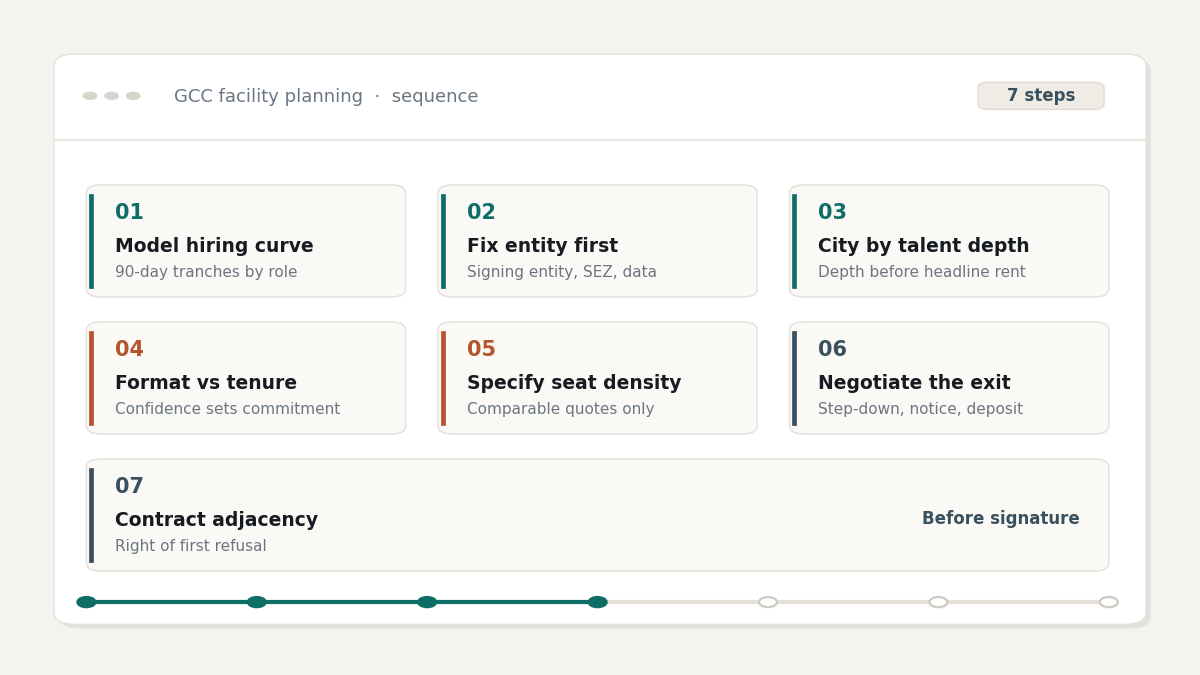
- Model the hiring curve by quarter, not by year. Split headcount into 90-day tranches by role and seniority. Senior infra and platform roles ramp slower than mid-level application engineers, and the curve, not the target, sizes the floor.
- Fix the entity and compliance position first. Signing entity, SEZ decision, data-residency obligations. Our GCC setup services engagements show this as the step that, when skipped, forces a renegotiation six months later.
- Choose the city on talent liquidity, then cost. A 15% rent saving in a thin market is erased by one senior backlog.
- Pick the format against commitment confidence. If you can’t defend the headcount number for month 60, don’t sign for month 60.
- Specify seat density and fit-out standard before requesting quotes. Otherwise every quote is priced on a different floor.
- Negotiate the exit before the entry. Step-down rights, mutual lock-in period, notice symmetry, deposit instrument.
- Contract for expansion adjacency. A right of first refusal on the adjacent wing is nearly free at signing and very expensive at month 18.
What This Looks Like in Practice
Fintech scale-up, Bengaluru, engineering GCC. Sourcing ran ahead of the facility plan: a vetted shortlist inside 7–10 working days meant the first cohort of engineers was interview-ready before the floor was. The center opened on a 24-month managed floor, the lease decision was deferred until headcount was proven, and the team stayed consolidated instead of splitting across two buildings.
Enterprise SaaS platform team, ODC model. Infra and platform roles ramped slowest, as they usually do. Because the seat plan was built from quarterly tranches rather than an annual target, the initial commitment covered phase one only and the hire DevOps engineers requirement was filled against a floor that already existed. Across 527+ delivered projects and a sub-1% contract drop-off rate, the pattern holds: the constraint is rarely space, it is the accuracy of the ramp.
Coworking vs Lease Capability Center: The Decision Framework
The coworking vs lease capability center question arrives as a cost question. It is a commitment-confidence question, and every gcc office space strategy resolves it against the same three variables: seat count, horizon and audit exposure.
When Should a GCC Move From Coworking to a Lease?
Three conditions, all three required: headcount above roughly 150–200 seats and stable for two consecutive quarters; a defensible five-year horizon; and a compliance or brand requirement a shared building can’t meet. Meet two of three and the answer is a managed floor, not a lease.
What Most Teams Get Wrong in GCC Facility Planning
The dominant error in gcc facility planning is treating the lease as the commitment and the fit-out as a cost line. It’s inverted. Lock-in can often be negotiated down; the ₹3.3 Cr of fit-out capital is unrecoverable the moment you exit early, and most agreements let the landlord claw back amortised improvement allowance on top. Capital, not tenure, is what traps you.
Where a GCC Office Space Strategy Usually Breaks
The per-seat comparison isn’t one. Teams line up a ₹95 per sq ft lease rate against a ₹16,000 per seat managed quote and conclude the lease is cheaper. One number excludes fit-out, FM, IT, security and housekeeping; the other includes all five.
Nobody reads the HVAC clause. Standard building services in India are cost for roughly 8×5 operation. A center running follow-the-sun support on a 24×7 pattern pays a premium after-hours tariff for air conditioning and power visible in month four, not in the proposal. Get it in writing before signing.
Cash deposits where a bank guarantee would do. Six to twelve months of rent as a cash deposit on a 15,000 sq ft floor is ₹85 lakh of dead working capital. Landlords on large floors frequently accept a bank guarantee instead. It’s asked for in roughly one negotiation in four.
Asymmetric notice periods, signed without comment. The landlord’s termination notice is often 30 days against the tenant’s 6 months. That’s a drafting default, not a market standard, and it’s negotiable before signature only.
Then the friction nobody budgets: badge provisioning and building NOCs add 2–4 weeks between keys handed over and engineers able to badge in. With joiners arriving on a 7–10 day cycle and joining rates near 98%, that gap is what forces a first-week WFH scramble. Sequence badge provisioning against the joining date, not the handover date.
Before You Sign Anything
If the headcount plan behind your gcc office space strategy hasn’t been tested against actual shortlist velocity in your target city, the real estate decision is premature. The commitment length you can defend depends entirely on how fast the seats actually fill.
Supersourcing has run GCC setup and staffing across 527+ delivered projects, with dedicated teams, NDA-backed IP protection and a 7–10 day replacement guarantee if a hire isn’t a fit. We’ll pressure-test your ramp assumptions and seat plan against what the market is currently delivering before you commit to a floor.
Reach us at supersourcing.com/contact-us or mayank@engineerbabu.com
FAQ
What is a managed office and how is it different from coworking?
A managed office is a dedicated, single-tenant space built to your specification and operated by a flex provider for one all-inclusive monthly fee. Coworking is shared space in a multi-tenant building. The practical difference is control: a managed floor carries your own access control, network and layout. Coworking does not.
How much office space does a GCC need per employee?
Plan 80–110 sq ft of built-up area per seat for a standard engineering floor, inclusive of meeting rooms and pantry. Below 70 sq ft per seat the floor is functionally unusable at full occupancy. Normalise every per-seat quote back to sq ft per seat before comparing.
Can a 100-person capability center run out of a coworking space?
Physically yes, practically rarely for long. Shared floors typically fail client security audits on network segregation and badge-log retention, and per-seat economics stop working above roughly 25–30 seats. Beyond that a dedicated managed floor usually costs the same or less with materially better control.
What lease term should a new GCC in India sign?
If five-year headcount is genuinely defensible, a 3–5 year lease with a negotiated 2–3 year lock-in is reasonable. If it isn’t, a 24–36 month managed agreement costs more per seat and far less in total risk. Signing a tenure you can’t defend is the more expensive mistake.
Does a managed office pass client security and data-residency audits?
A dedicated managed floor generally does, provided the agreement specifies a segregated VLAN, exclusive access control, badge-log retention, camera coverage and a documented visitor policy. Retrofitting these after signature is difficult and sometimes impossible to put them in the RFP specification.
What does a GCC seat cost in Bengaluru versus Hyderabad?
Bengaluru managed seats run roughly ₹7,000–₹24,000 per month by corridor; peripheral Hyderabad starts nearer ₹6,000. Bengaluru prime rents rose about 14% year on year in early 2026. Hyderabad offers the better growth-to-cost ratio; Bengaluru the deeper senior talent liquidity.
Should we finalise the office before or after we start hiring?
Start hiring first, on a short-commitment floor. Validate the ramp for two quarters, then commit sequencing the gcc office space strategy this way costs a few percent more per seat and removes most of the downside. If you want the ramp pressure-tested against real shortlist velocity before signing a lease, that’s a conversation for a sourcing partner, not a broker.
