

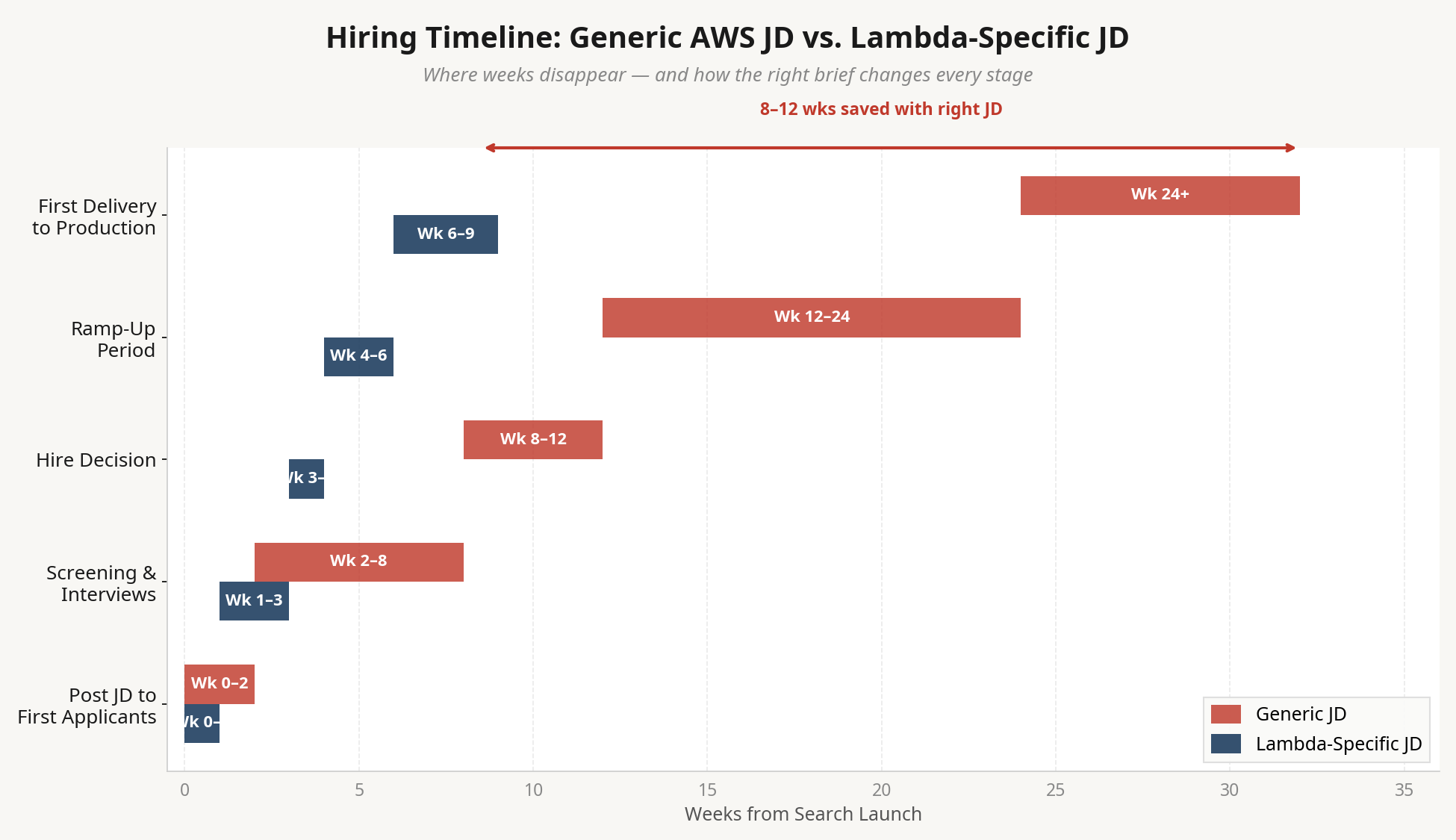
Most companies writing a job description to hire AWS Lambda developer India are unknowingly screening for the wrong person. They ask for “5+ years of AWS experience” and get applicants who’ve spent those years configuring EC2 instances and managing RDS clusters, not building event-driven, serverless systems. The result: a hiring process that takes 6–10 weeks, produces a poor-fit hire, and delays production deployment by another quarter.
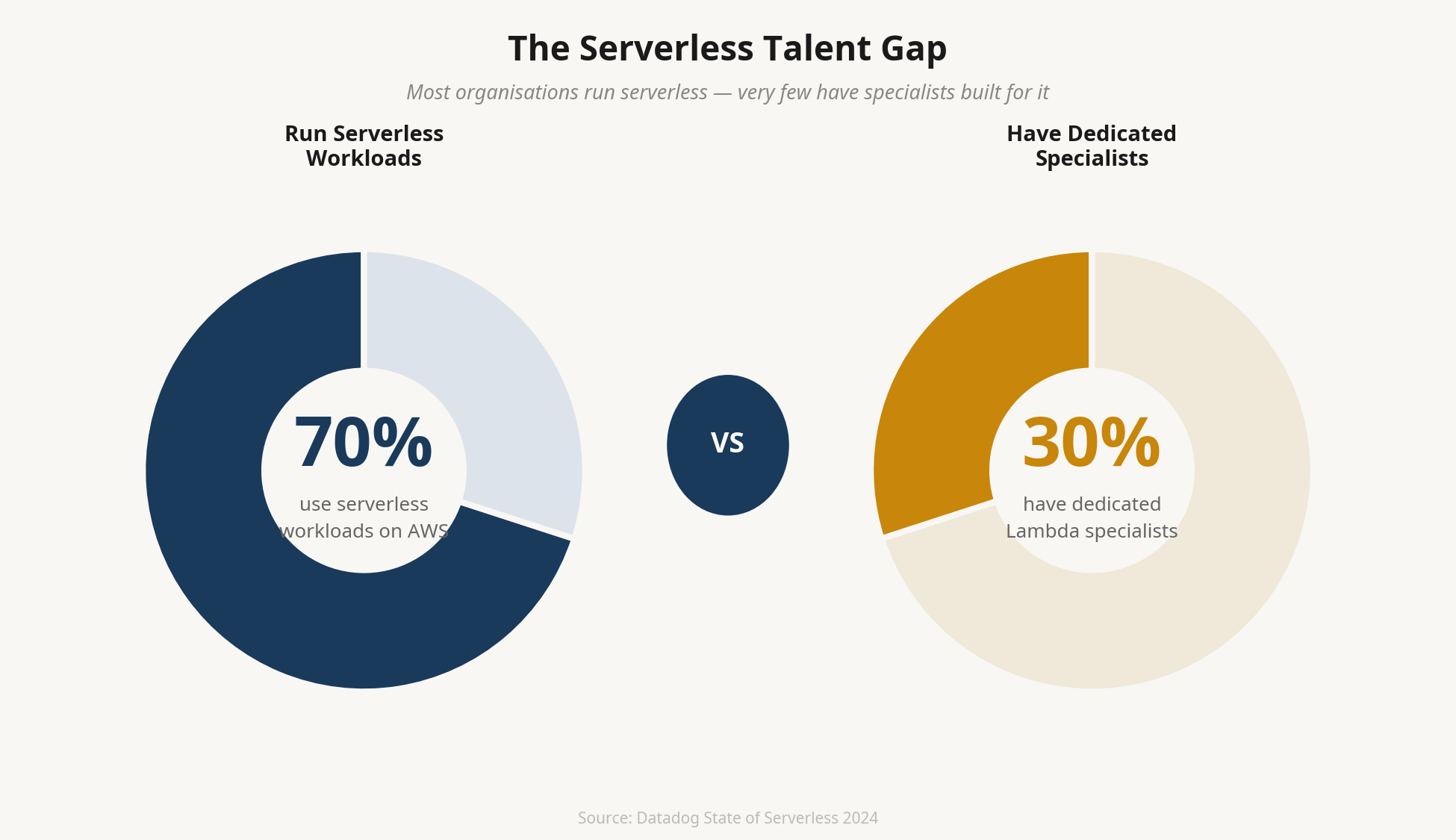
That’s why hiring AWS Lambda developer India has become a more nuanced decision than most teams expect. Companies asking for “5+ years of AWS” frequently attract engineers skilled in EC2 and RDS but not in designing scalable, event-driven, serverless systems that Lambda actually demands.
The gap is widening as cloud-native adoption accelerates. According to Statista, the global cloud computing market is projected to reach over $1 trillion by 2026, with serverless architectures playing a central role in modern application development.
The result? Longer hiring cycles, poor-fit engineers, and delayed production timelines. This guide breaks down what job descriptions get wrong and how to hire AWS Lambda specialists who can actually deliver.
TL;DR: What This Blog Covers
Most job descriptions for AWS Lambda roles are written for the wrong candidate. They attract generalist AWS engineers, not serverless specialists. That mismatch costs companies ₹8–12 lakhs in lost productivity before a single function ships.
This blog shows exactly where hiring briefs break down. You'll see a side-by-side comparison of a generic AWS JD versus a Lambda-specific one and why the difference determines who applies.
You'll also get the six AWS Lambda engineer skills that actually matter, realistic AWS specialists cost India benchmarks, and the three hiring mistakes most teams make repeatedly. If you're about to open a search, read this first.
What It Means to Hire AWS Lambda Developer India
To hire AWS Lambda developer India is to engage a specialist in function-as-a-service (FaaS) architecture on AWS someone who designs, deploys, and optimizes Lambda-based systems including triggers, execution environments, IAM configurations, and downstream integrations. This is a distinct discipline from general AWS cloud engineering and requires a specific, testable skill set.
Why Generic AWS Job Descriptions Fail Serverless Hiring
A typical cloud engineer job description asks for: AWS Certified Solutions Architect, experience with EC2 and S3, knowledge of VPCs, and CI/CD familiarity. That profile describes roughly 40–50% of all AWS practitioners in India’s talent market.
What it does not describe is someone who understands cold start optimization, concurrency and throttling limits, or how to structure a serverless framework deployment across multiple environments. Those are Lambda-specific competencies and they’re absent from most job descriptions.
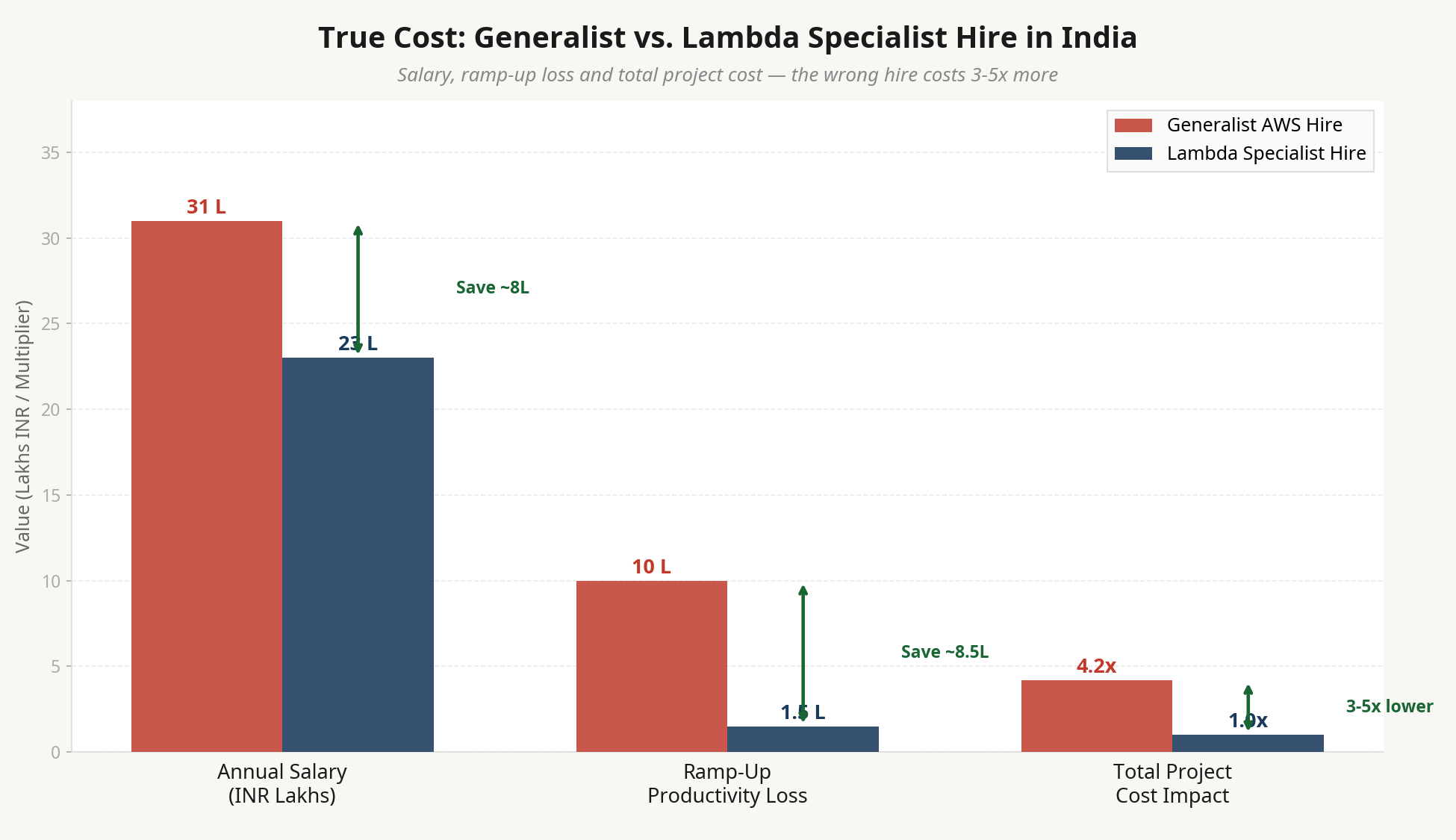
The cost of getting this wrong is not trivial. A misaligned hire who needs 3–4 months of ramp-up on serverless patterns while billing at full rate can add ₹8–12 lakhs in productivity loss before a single Lambda function reaches staging. If that person is also making architectural decisions, the downstream technical debt compounds further.
The core issue: hiring managers conflate AWS breadth with serverless depth. They’re different hiring profiles.
AWS Lambda Engineer Skills: What the Right JD Actually Requires
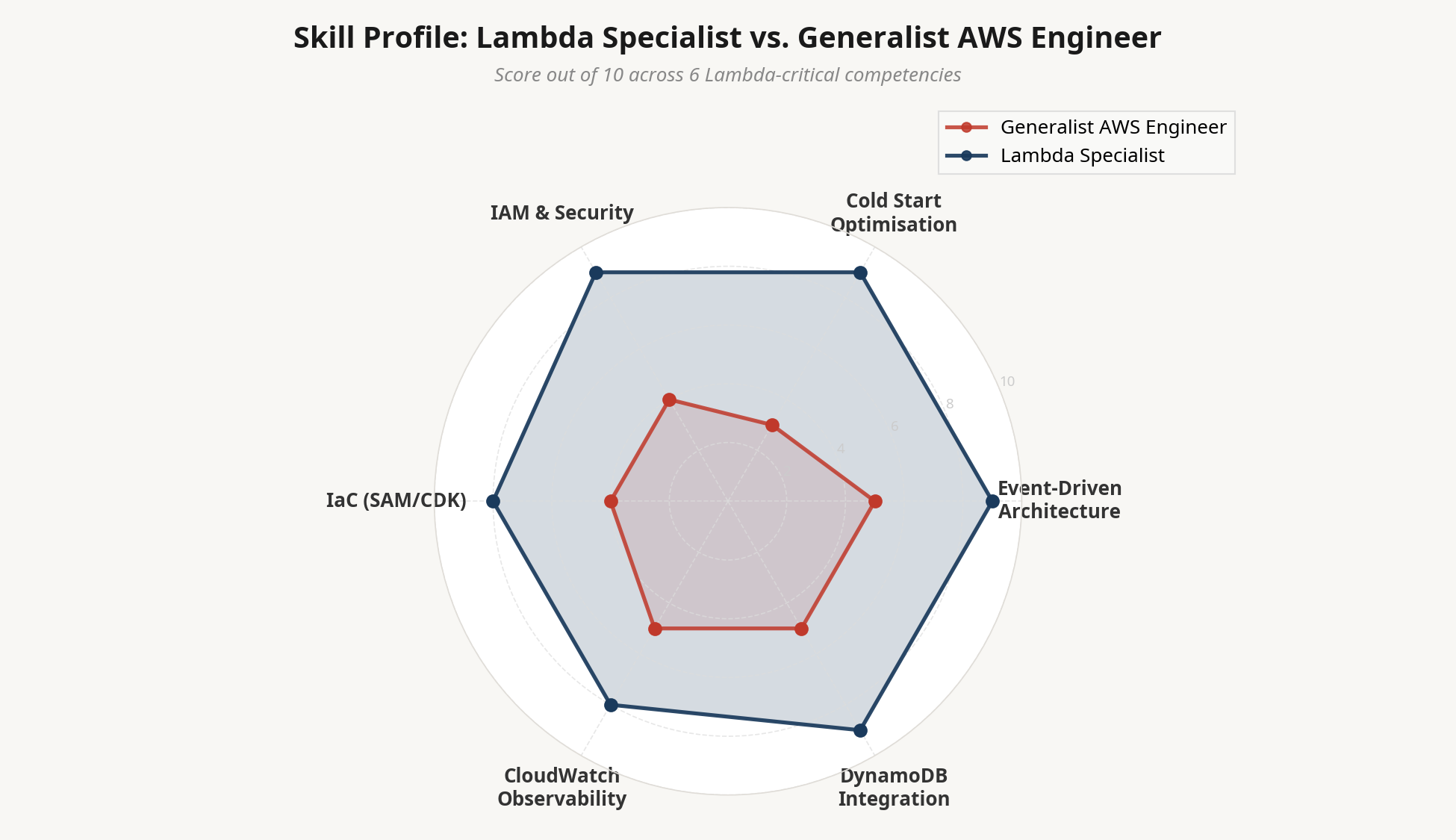
This is where most job descriptions fail in specificity. A qualified AWS Lambda engineer needs demonstrable competency across five functional areas, not just familiarity.
How to Evaluate AWS Lambda Developer Skills
- Event-driven architecture design Can the candidate design workflows that respond to triggers from S3, SQS, SNS, EventBridge, and API Gateway integration without defaulting to always-on servers? This is the foundational mindset shift from traditional backend development.
- Cold start management and performance tuning Lambda’s cold start problem is real and environment-specific. Candidates should know the difference in cold start behavior between Nodejs, Python, and Java runtimes, and articulate when provisioned concurrency is worth the cost.
- IAM roles and permissions design Overpermissioned Lambda functions are one of the top AWS security risks. An experienced specialist will design least-privilege IAM roles and permissions as a default, not an afterthought.
- Infrastructure-as-Code (IaC) with AWS SAM or CDK Manual Lambda deployments don’t scale. Any production-grade serverless developer India should be fluent in AWS SAM (Serverless Application Model), CDK, or Terraform for deployment automation.
- Observability and debugging with CloudWatch Serverless systems are harder to debug than monoliths. Proficiency in CloudWatch logging, X-Ray tracing, and structured logging patterns is non-negotiable for production environments.
- DynamoDB and downstream data integration Most Lambda-based systems process data. Understanding DynamoDB integration patterns including single-table design and stream-based triggers separates practitioners from theorists.
What Most Generalist AWS Engineers Are Missing
Generic AWS engineers often lack hands-on experience with microservices on AWS at the function level. They understand distributed systems conceptually but haven’t debugged a timeout cascade between Lambda, SQS, and an external API at 2 AM. That operational experience matters.
Bad JD vs. Good JD: A Direct Comparison
This is the clearest way to illustrate where serverless architecture hiring breaks down.
| Element | Generic AWS JD (What Most Companies Write) | Lambda-Specific JD (What Actually Works) |
| Experience requirement | “5+ years AWS experience” | “3+ years building event-driven systems on Lambda in production” |
| Certifications | “AWS Solutions Architect preferred” | “AWS Developer Associate or DevOps Engineer preferred; SAA acceptable” |
| Core skill listed | “EC2, S3, RDS, VPC” | “Lambda, API Gateway, SQS, EventBridge, DynamoDB, CloudWatch” |
| Architecture ask | “Design scalable cloud infrastructure” | “Design serverless workflows with async processing and retry logic” |
| IaC requirement | “Experience with Terraform” | “Proficiency in AWS SAM or CDK; Terraform acceptable as supplement” |
The left column attracts cloud engineers. The right column attracts Lambda specialists. Both are legitimate profiles but only one delivers what a serverless project actually needs.
Serverless Developer India: Real Outcomes From Better Hiring
A US-based SaaS company engaged a serverless dedicated developer India team to rebuild their document processing pipeline. The original hire sourced through a generic “AWS developer” brief had 6 years of EC2-heavy experience. Three months in, the Lambda-based architecture was underperforming due to improper concurrency configuration and absent retry logic on SQS-triggered functions.
A replacement specialist, hired against a Lambda-specific JD, corrected the architecture in under four weeks. Processing latency dropped from 14 seconds to under 2 seconds at scale.
A second case: a fintech startup in Southeast Asia needed to process 200,000 daily webhook events. Their initial serverless developer hire didn’t understand event-driven architecture at volume specifically, how to handle Lambda’s reserved concurrency to prevent downstream throttling. The replacement engineer, with explicit Lambda production experience, solved the problem in the first sprint and reduced infrastructure costs by 34%.
The pattern is consistent: the wrong hire costs 3–5x more than the right one, factoring in ramp time, remediation, and delayed launches.
AWS Specialist Cost India: What to Expect
Understanding AWS specialist cost India helps calibrate hiring strategy before going to market.
For a mid-level Lambda specialist (3–5 years experience, production deployments, IaC fluency), expect a monthly engagement rate of ₹1.2–2.0 lakhs for a full-time contractor, or ₹18–28 lakhs annually for a direct hire including benefits. Senior specialists with architecture ownership experience command ₹25–40 lakhs annually.
These ranges are 35–50% below equivalent US or EU market rates which is why companies actively hire AWS Lambda developer India for both cost efficiency and time zone overlap with APAC or hybrid teams. However, rate alone should not drive the brief. A ₹15 lakh generalist who delays a product by one quarter costs more than a ₹28 lakh specialist who delivers on schedule.
What Most Teams Get Wrong When They Hire AWS Lambda Developer India
The most common failure is treating Lambda hiring as a subset of cloud hiring. It isn’t.
Teams also over-index on certifications. The AWS Solutions Architect certification tests cloud breadth S3 policies, VPC peering, RDS multi-AZ. It does not test Lambda concurrency models, function packaging limits, or AWS SAM deployment patterns. A certified Solutions Architect may have zero production Lambda experience.
A second systemic error: no practical assessment. Written interviews and architecture whiteboard sessions don’t reveal whether a candidate has debugged a cold start issue or structured a DynamoDB schema for Lambda-triggered writes.
A 90-minute take-home task deploying a multi-trigger Lambda pipeline with proper logging and error handling will tell you more than three interview rounds.
Finally, teams routinely skip the integration context. Lambda rarely runs in isolation. If your stack uses API Gateway integration, Cognito, and Stripe webhooks, your Lambda specialist needs to have worked in that exact context not just know it exists
FAQ: Hiring AWS Lambda Developers in India
What should I look for when hiring an AWS Lambda developer?
Look for production experience with event-driven systems, not just Lambda familiarity. Specifically: experience designing async workflows, handling concurrency limits, building with IaC tools like AWS SAM or CDK, and setting up structured logging via CloudWatch. Certifications are secondary to demonstrable project outcomes.
How much does it cost to hire a serverless developer in India?
Mid-level serverless developer India profiles typically range from ₹1.2–2.0 lakhs per month for contract engagements, or ₹18–28 lakhs per year for full-time roles. Senior architects with ownership experience command ₹30–40 lakhs annually. Rates vary by city, domain specialization, and engagement type.
What is the difference between an AWS generalist and a Lambda specialist?
An AWS generalist understands the breadth of AWS services compute, storage, networking, databases. A Lambda specialist understands the depth of serverless-specific patterns: cold starts, execution limits, trigger configurations, IAM scoping, and deployment automation. The skill sets overlap but are not interchangeable for production serverless projects.
How to write a job description for a Lambda developer?
Replace generic cloud experience requirements with Lambda-specific ones: event-driven architecture, API Gateway, SQS/SNS/EventBridge, DynamoDB, CloudWatch, and AWS SAM or CDK. Require evidence of production deployments. Add a take-home technical task. Remove or deprioritize EC2/RDS-heavy requirements if the role is purely serverless.
Is India a good source for serverless AWS talent?
Yes India has a large and growing pool of AWS Lambda engineer professionals, particularly in Bangalore, Hyderabad, Pune, and Chennai. The combination of competitive rates, strong engineering fundamentals, and time zone overlap with US morning hours makes India a primary sourcing market for serverless engagements globally.
What are the most common mistakes in Lambda developer hiring?
Three consistent errors: (1) writing JDs that attract AWS generalists instead of serverless specialists, (2) relying on certifications instead of practical assessments, and (3) ignoring integration context and what other services the Lambda functions need to interact with in the specific production environment.
How long does it take to hire a qualified AWS Lambda developer in India?
With the right job description and a structured screening process including a practical task qualified candidates can be identified in 3–4 weeks. Without a Lambda-specific brief, teams routinely spend 8–12 weeks cycling through generalist AWS profiles that don’t meet project requirements.
Get the Hiring Brief Right Before You Go to Market
If you’re about to hire AWS Lambda developer India for a production serverless project, the job description is the first and most consequential decision you’ll make. A misaligned brief doesn’t just slow down screening; it sets the wrong expectations from day one, attracts the wrong candidate pool, and creates a remediation cycle that costs 3–5x the original hiring budget.
The technical gap between a generic AWS engineer and a production-grade Lambda specialist is real. It shows up in cold start decisions, IAM scoping, concurrency configuration, and IaC discipline not in a resume or a certification badge. By the time that gap surfaces on a live project, the cost of fixing it far exceeds the cost of getting the hire right.
Getting this right requires more than rewriting a job description. It requires knowing what a qualified serverless developer India profile actually looks like in production, what they’ve built, how they’ve debugged, and what integrations they’ve owned end-to-end. That’s context most internal hiring teams don’t have readily available, and it’s exactly where sourcing partners with domain depth make the difference.
Supersourcing has run Lambda-specific hiring engagements across SaaS, fintech, and enterprise data platforms screening for the competencies that generic AWS briefs consistently miss. The process includes JD review, skills-based screening criteria, and a structured technical assessment designed specifically for serverless roles, not repurposed from cloud generalist pipelines.
If your current brief asks for “5+ years of AWS,” it’s worth a review before the search goes live. Supersourcing can identify the gaps, sharpen the criteria, and help you move from brief to qualified shortlist in 3–4 weeks instead of 10.
Reach out before the search goes live it’s faster to fix the brief than the hire.
