

India now produces more AI/ML graduates annually than any other country outside the US yet 68% of technology hiring managers report that qualified Gen AI engineers remain harder to close than any other role in their pipeline. The gap is not supply. It is signal-to-noise: thousands of candidates claim generative AI fluency; a much smaller cohort can actually build production-grade systems.
Generative AI has moved from experimentation to production but hiring engineers who can actually build and scale these systems remains a major challenge. While the talent pool appears large on the surface, true production-grade expertise in LLMs, fine-tuning, and deployment is still limited.
Hire Gen AI Engineer India decisions are often made based on surface-level skill claims rather than real engineering capability. The result is longer hiring cycles, misaligned expectations, and teams that struggle to move beyond prototypes.
This gap is becoming more visible in 2026. According to McKinsey, generative AI could add up to $4.4 trillion annually to the global economy, driving massive enterprise investment and intensifying demand for skilled engineers.
Despite this surge, most hiring processes still fail to distinguish between theoretical knowledge and deployable Gen AI expertise.
If you are evaluating whether to hire Gen AI engineer India this quarter, this guide covers exactly what skills to look for, what the market actually pays, and the decisions that cause hiring timelines to stretch from 6 weeks to 6 months.
TL;DR
The Indian Gen AI talent market is large. The qualified slice is small. Thousands of engineers list Gen AI skills. Few have shipped production-grade RAG pipelines, fine-tuned LLMs, or built evaluation frameworks that hold up at scale. Knowing the difference before you post a JD saves 3–4 months.
Salaries have moved. Most hiring benchmarks haven't. Mid-level Gen AI engineers in India now command ₹22–40 LPA. Senior profiles with GCC or enterprise deployment experience go higher fast. Teams still anchoring to 2022 ML packages are losing final-round candidates to counter-offers, repeatedly.
The hiring mistakes are predictable and avoidable. Wrong role definition. Weak technical screens. No evaluation competency test. These three gaps account for the majority of Gen AI mis-hires. This guide breaks down each one, with salary benchmarks, skill frameworks, and a comparison table to help you hire right the first time.
What Is a Gen AI Engineer?
A Gen AI engineer is a software engineer who specializes in building applications powered by large language models (LLMs) and related AI infrastructure including retrieval systems, model fine-tuning pipelines, and orchestration frameworks. The role is distinct from classical ML engineering in that it focuses on applied model integration over model training from scratch.
Why Hiring Gen AI Talent in India Is Harder Than It Looks
The Indian AI engineering market has bifurcated sharply since 2023. On one side: engineers with genuine depth in LLM engineer India-class skills RAG architecture, agentic workflows, production deployment. On the other: a large group with tutorial-level exposure relabeled as Gen AI experience on resumes.
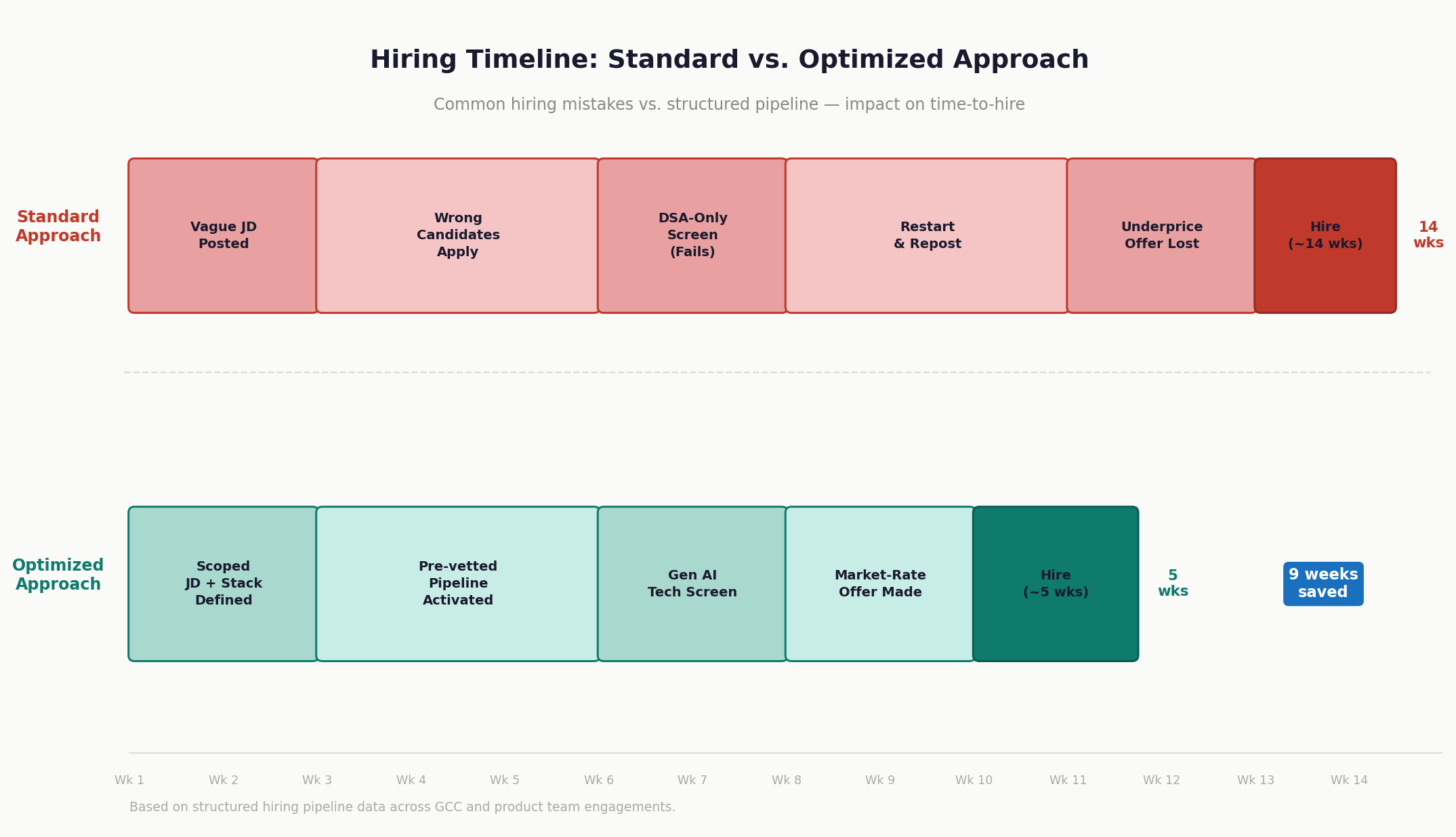
Structured hiring pipelines that were reliable for backend or data engineering roles now produce a 3–4x higher false-positive rate for Gen AI positions. A candidate who has built a LangChain chatbot in a Jupyter notebook is not the same as one who has shipped a retrieval-augmented pipeline handling 50,000 daily queries with latency SLAs.
Three specific bottlenecks drive most hiring delays:
- Undefined scope: Teams that list “Gen AI experience” without specifying RAG vs. fine-tuning vs. agent orchestration attract the wrong pool entirely.
- Weak technical screens: Standard DSA interviews do not surface Gen AI competency. Candidates can clear LeetCode rounds and still be unable to debug a chunking strategy or evaluate embedding model tradeoffs.
- Compensation anchoring to 2022 ML benchmarks: The market has moved. Teams offering ML engineer packages for Gen AI roles lose candidates in the final round consistently.
Core Skills to Look For When You Hire Gen AI Engineer India
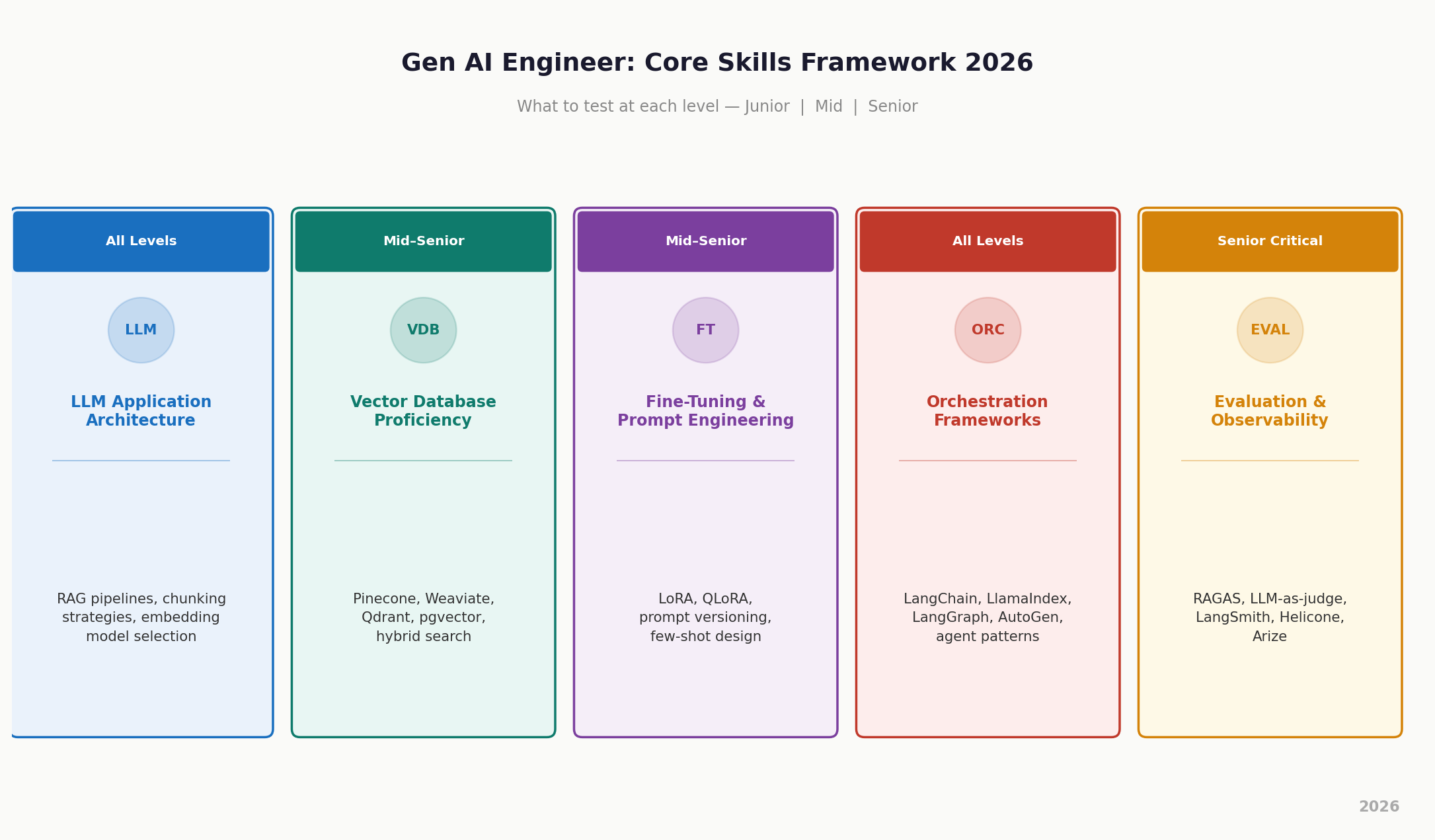
LLM Application Architecture
The foundational skill is building systems around models, not just calling APIs. Look for demonstrated experience with RAG (Retrieval-Augmented Generation) pipelines specifically, chunking strategies, embedding model selection, and retrieval evaluation. Engineers who can only wire together a LangChain template without understanding why a particular chunking approach degrades recall are a liability at scale.
Vector Database Proficiency
Production Gen AI systems almost always require vector databases Pinecone, Weaviate, Qdrant, or pgvector depending on stack and scale requirements. Assess whether candidates understand indexing tradeoffs, approximate nearest-neighbor (ANN) algorithms, and hybrid search architectures. This is a fast-differentiating signal in technical screens.
Fine-Tuning and Prompt Engineering
Fine-tuning LLMs using LoRA or QLoRA on domain-specific datasets is a skill that separates mid-level from senior Gen AI engineers. Equally, prompt engineering at the production level systematic prompt versioning, evaluation frameworks, and few-shot design is not the same as casual prompt iteration. Test for both in structured assessments.
Orchestration Frameworks
LangChain developer proficiency is table stakes. Engineers working on more complex agentic systems should also be familiar with LlamaIndex, LangGraph, or AutoGen depending on the use case. Assess framework knowledge alongside architectural judgment candidates should be able to explain when not to use an agent pattern.
Evaluation and Observability
This is the most consistently underweighted skill in hiring. Gen AI systems degrade silently. Engineers who have built evaluation pipelines RAGAS, custom evals, LLM-as-judge frameworks and integrated observability tooling (LangSmith, Helicone, Arize) are significantly more valuable in enterprise deployments.
Gen AI Engineer Salary India 2026: What the Market Pays
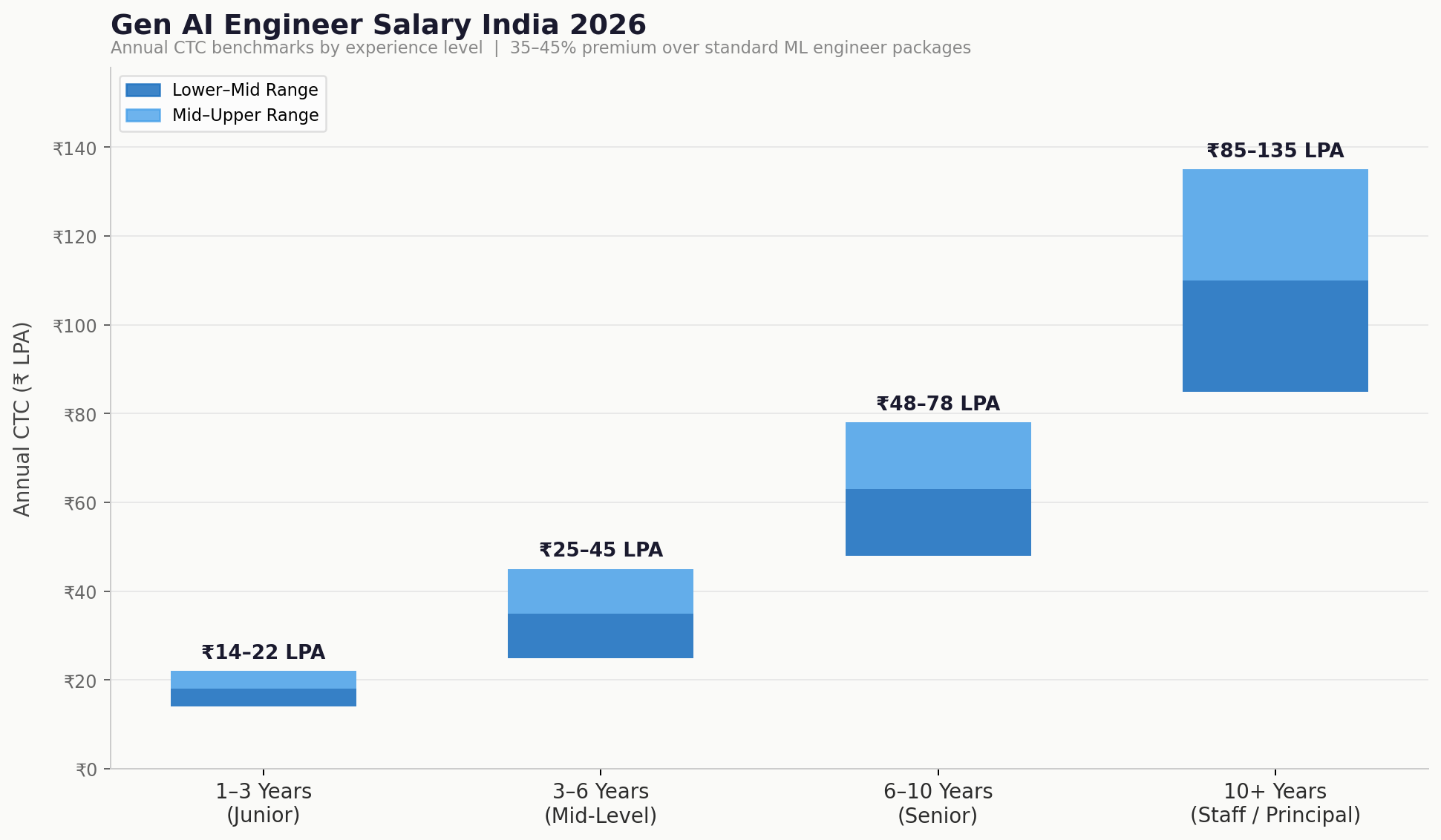
Gen AI engineer salary India 2026 benchmarks have risen 30–40% over standard ML engineer compensation at equivalent experience levels. Current ranges by seniority:
| Experience Level | Annual CTC (INR) | Key Differentiators |
| 1–3 years | ₹12–20 LPA | LangChain, RAG basics, API integration |
| 3–6 years | ₹22–40 LPA | Fine-tuning, vector DB design, eval pipelines |
| 6–10 years | ₹42–70 LPA | System architecture, multi-agent, GCC/enterprise scale |
| 10+ / Staff level | ₹75 LPA–1.2 CR | Platform ownership, team leadership, model strategy |
Product startups and GCC AI teams (Global Capability Centers) are the most aggressive bidders. Companies anchoring offers below ₹25 LPA for a 4-year Gen AI engineer with RAG production experience are losing 70–80% of final-round candidates to counter-offers.
Bengaluru, Hyderabad, and Pune remain the primary talent nodes. Remote-first roles access a wider pool including strong candidates in Noida, Chennai, and Ahmedabad without meaningfully increasing compensation requirements.
How GCC Teams Are Structuring Gen AI Hires
Two patterns have emerged as effective in GCC AI team builds across financial services, healthcare, and SaaS verticals:
- Pattern 1 Seed-and-Scale: One senior Gen AI architect hired in months 1–2, tasked with defining the stack and assessment rubric. Junior and mid-level engineers hired against that rubric in months 2–4. This approach reduces misalignment but requires the right seed hire.
- Pattern 2 Embedded Specialist Model: Rather than building a standalone AI team, GCC teams embed 1–2 Gen AI engineers per product squad. This accelerates deployment timelines and reduces the “AI team in a silo” failure mode but demands engineers with strong cross-functional communication skills alongside technical depth.
A manufacturing GCC running Pattern 1 staffed a 6-person Gen AI team in 11 weeks using pre-vetted talent pipelines delivering an internal document intelligence platform that reduced analyst research time by 60%.
ML Engineer vs. Gen AI Engineer: How to Decide Which Role You Need
Teams frequently post for the wrong role, then wonder why shortlists underperform.
| Dimension | ML Engineer | Gen AI Engineer |
| Primary focus | Model training, feature engineering | LLM integration, RAG, agent systems |
| Core tooling | PyTorch, scikit-learn, MLflow | LangChain, HuggingFace, vector DBs |
| Output | Custom-trained models | AI-powered applications and pipelines |
| Hire if you need | Predictive models, computer vision, NLP from scratch | Chatbots, document AI, copilots, agentic workflows |
If your roadmap involves deploying existing foundation models GPT-4o, Claude, Gemini, Llama into product workflows, you need a hire AI developer India profile skewed toward Gen AI, not classical ML.
What Most Teams Get Wrong When They Hire Gen AI Engineers
The single most expensive hiring mistake is conflating GenAI interest with GenAI depth. Engineers who have taken Coursera courses, built portfolio demos, and followed AI Twitter can pass early screens confidently and stall at the first production problem.
Three patterns that reliably predict failure:
- Hiring for tool familiarity instead of system thinking. Knowing LangChain does not mean knowing how to architect a multi-stage retrieval pipeline with fallback logic, cost controls, and latency budgets.
- Skipping evaluation competency in technical screens. Teams that ship Gen AI features without evaluation pipelines are flying blind. If your screen doesn’t test this, you will hire engineers who don’t build it.
- Treating Gen AI roles as senior ML roles with a prompt engineering add-on. The knowledge surface is different enough that experienced ML engineers need 3–6 months of deliberate reskilling before they are productive on Gen AI systems. Plan for it or hire directly.
The AI engineer recruitment India market is competitive enough that top candidates can afford to select employers. Dedicated teams with clear technical roadmaps, defined Gen AI architecture decisions, and structured onboarding close offers 40% faster than teams offering equivalent compensation without that clarity.
Frequently Asked Questions
What skills should a Gen AI engineer have in 2026?
Core skills include RAG pipeline design, vector database proficiency (Pinecone, Weaviate, pgvector), LangChain and LlamaIndex, fine-tuning with LoRA/QLoRA, prompt engineering with systematic evaluation, and observability tooling. Production deployment experience, not just notebook-level prototyping, is the critical differentiator for mid-to-senior roles.
How much does a Gen AI engineer earn in India?
In 2026, salaries range from ₹12–20 LPA at the junior level to ₹42–70 LPA for engineers with 6–10 years of experience. Staff-level and principal engineers at GCCs and funded startups command ₹75 LPA to ₹1.2 CR. Expect a 30–40% premium over equivalent ML engineer benchmarks.
What is the difference between an ML engineer and a Gen AI engineer?
ML engineers focus on training and deploying custom models from structured data. Gen AI engineers specialize in integrating and operationalizing large language models and related infrastructure. While there is overlap, the tooling, architectural patterns, and use cases are sufficiently distinct to warrant separate hiring tracks for most teams.
How long does it take to hire a Gen AI engineer in India?
Using a direct sourcing approach with standard job postings, expect 8–14 weeks from brief to offer acceptance. With a pre-vetted specialist pipeline and structured technical screens, that timeline compresses to 3–5 weeks. GCC builds using embedded talent partners have staffed 5–8 person Gen AI teams in under 12 weeks.
Which Indian cities have the best Gen AI talent?
Bengaluru has the deepest pool, driven by concentration of AI-focused startups and R&D centers. Hyderabad and Pune are strong secondary markets. For remote-first roles, Noida and Chennai offer quality candidates at slightly lower compensation expectations. Tier-2 city candidates with strong GitHub profiles and open-source contributions are increasingly competitive.
What are the most common mistakes when hiring Gen AI engineers?
The three most costly mistakes: evaluating candidates on generic coding ability rather than Gen AI-specific system design; underpricing roles relative to the 2025 market; and failing to test evaluation and observability competency in technical screens. Teams that fix these three variables reduce mis-hires by an estimated 50–60%.
How do I assess a Gen AI engineer’s RAG expertise in an interview?
Ask candidates to walk through a RAG system they’ve built in production, specifically the chunking strategy, embedding model choice, and how they measured retrieval quality. Request their approach to handling retrieval failures and cost management at scale. Strong candidates will immediately discuss tradeoffs; weak candidates will describe the happy path only.
Build Your Gen AI Team Without the 6-Month Detour
The hire Gen AI engineer India process is winnable but only with a hiring rubric built around production competency, not credential proxies. Define your Gen AI stack before you write the JD. Test for evaluation pipelines, not just framework familiarity. Reprice against 2026 benchmarks, not 2022 ML baselines.
The teams closing strong Gen AI hires in 8–10 weeks share three things: a defined technical architecture before sourcing begins, a screen that tests system thinking over tool familiarity, and compensation benchmarks pulled from current market data not last year’s ML hiring rounds.
The teams still searching at month four share the opposite. Vague JDs attract the wrong pool. DSA-only screens miss the skills that matter. And below-market offers collapse at the finish line consistently, and expensively.
Gen AI engineering talent in India is real, deep, and available. But it does not self-select into poorly scoped roles. The signal has to be clear on your side before the right candidates take it seriously.
Supersourcing maintains a pre-vetted AI/ML talent pool across RAG, fine-tuning, LangChain, and enterprise Gen AI deployment including dedicated pipelines for GCC AI team builds in financial services, healthcare, and SaaS. Whether you’re staffing a single senior architect or building a 6–10 person Gen AI function from the ground up, the sourcing infrastructure is already in place.
If you’re at the stage of defining your hiring brief or pressure-testing your technical assessment, connect with the team for a structured scoping call.
