

Mendix has evolved from a niche low-code tool into a core enterprise development platform used by global leaders like Siemens, Capgemini, and KPMG. It enables organizations to build complex, scalable applications significantly faster than traditional development while maintaining enterprise-grade governance and control.
Hire Mendix Developers in India is now a strategic move as enterprises accelerate digital transformation and shift toward low-code platforms for faster delivery. Mendix stands out by combining speed with the ability to handle complex business logic, integrations, and full-scale enterprise applications, not just simple workflows.
The momentum is undeniable: according to Low-Code Statistics 2026, around 70–75% of new enterprise applications are expected to be built using low-code technologies by 2026, highlighting a massive surge in demand for skilled developers.
However, the talent pool remains limited. Experienced Mendix developers with real-world enterprise implementation experience are scarce in India, making hiring highly competitive. This guide explains how to find, evaluate, and hire the right Mendix developers to build scalable applications faster.
What Is Mendix and Why Low-Code Is Not the Same as Simple
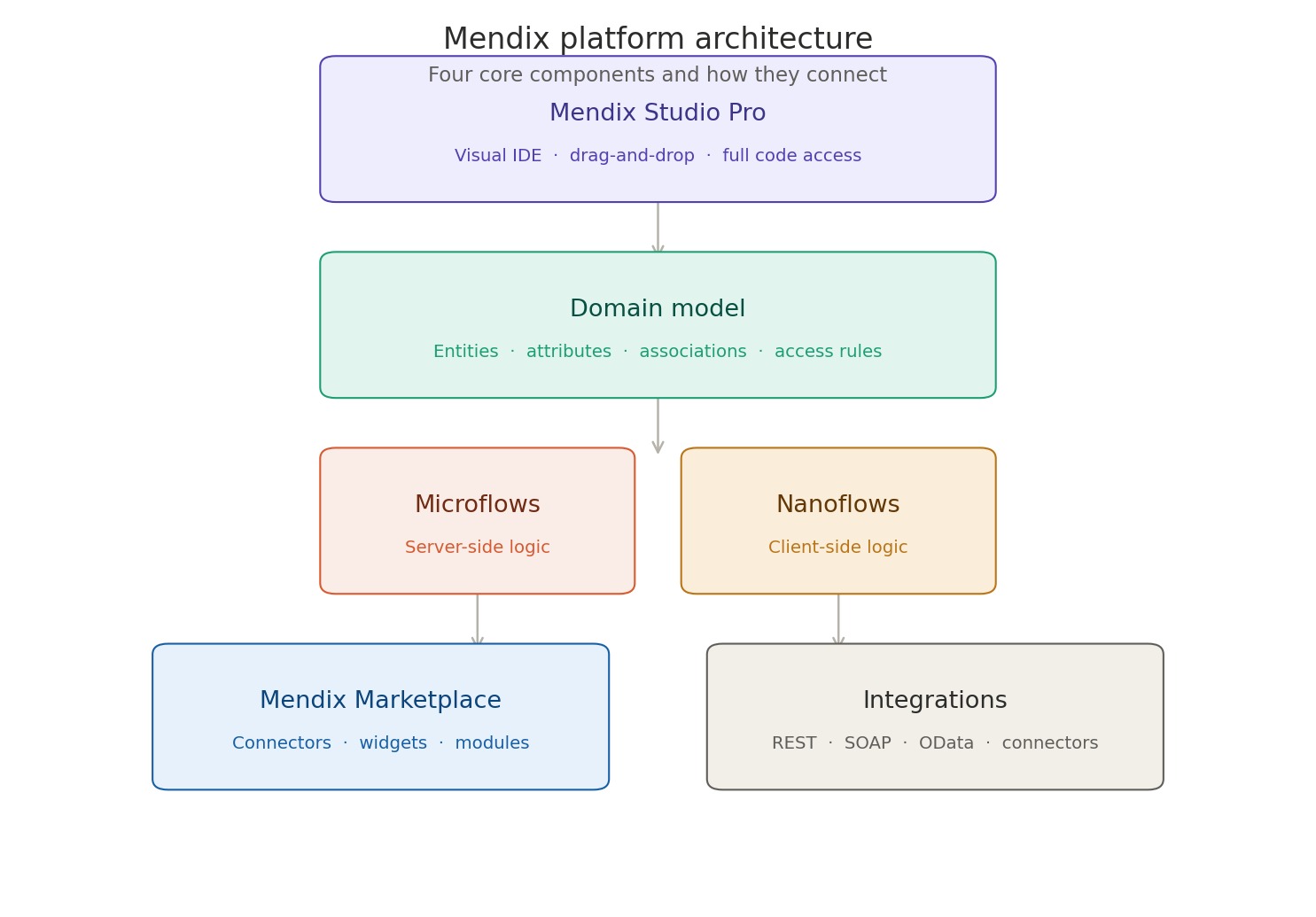
Mendix’s platform has four main components that require different levels of expertise:
Mendix Studio Pro is the full development environment, a visual IDE where developers build applications using a combination of drag-and-drop UI design, domain model (data model) design, microflow (server-side logic) design, and nanoflow (client-side logic) design. Studio Pro supports both visual development and direct access to underlying code when needed. It requires genuine application design thinking not just configuration.
The Domain Model is Mendix’s data modelling environment where entities (database tables), attributes, associations (relationships), and access rules are defined. Domain model design is the architectural foundation of a Mendix application; poor domain model design creates performance, security, and maintainability problems that cascade through every other layer of the application.
A Mendix developer who treats the domain model as an afterthought rather than a design discipline will build applications that work at small scale and fail at enterprise scale.
Microflows and Nanoflows are Mendix’s logic layer. Microflows are server-side processes executing data operations, calling external APIs, applying business rules, and sending notifications. Nanoflows are client-side processes executing logic in the browser or mobile app without a server round-trip.
The distinction between when to use microflows versus nanoflows, and how to design them for performance and maintainability, is a key assessment dimension. Developers teams who put all logic in microflows without considering nanoflow optimization create applications with poor client-side responsiveness.
The Mendix Marketplace is Mendix’s component library of pre-built connectors, widgets, and modules for common integration and UI needs. Using the Marketplace correctly knowing what exists, when to use it versus building custom, and how to configure marketplace modules for specific requirements is a skill that separates productive Mendix developers from those who reinvent wheels.
Integration capabilities REST, SOAP, OData, and Mendix’s proprietary connector framework are how Mendix applications connect to external systems. Integration design in Mendix requires understanding of microflow-based consumed services, published web services for exposing Mendix data to external consumers, and the Deep Link module for URL-based navigation and integration.
 The Mendix Talent Market in India
 The Mendix Talent Market in India
Mendix talent in India is concentrated in three places: Capgemini, KPMG, and a small number of other SIs with established Mendix practices; Siemens India teams and other industrial GCCs; and a small but growing independent developer community.
Mendix Rapid Developer and Intermediate Developer certifications are the baseline validation but as with every platform, certification validates training completion, not production application depth. Developers who have built real enterprise Mendix applications with complex domain models, multi-system integrations, and real user loads are a small subset of the certified developer pool.
| Level | Experience | Annual CTC (INR) |
| Junior Mendix Developer | 1–3 years | ₹6L – ₹11L |
| Mid-Level Mendix Developer | 3–5 years | ₹11L – ₹20L |
| Senior Mendix Developer | 5–8 years | ₹20L – ₹36L |
| Mendix Architect / Lead Developer | 8–12 years | ₹34L – ₹58L |
| Mendix Practice Lead / Principal | 12+ years | ₹55L – ₹80L |
Contract and staff augmentation rates are customized to your application complexity, integration scope, and seniority level. Custom quote within 24 hours of receiving the JD.
What to Actually Assess in a Mendix Developer Interview
Domain model design quality the architectural foundation.
Ask the candidate to design a domain model for a specific business scenario: a procurement approval application where purchase requests are raised by employees, routed through multi-level approval based on amount and category, integrated with a supplier master from an ERP system, and tracked with full audit history.
How they structure the entities, associations, and access rules reveals whether they think architecturally or just configure what they see in front of them.
Microflow design and performance thinking.
Ask the candidate to walk through a microflow they have designed for a complex business logic scenario, one that involves querying data from multiple entities, applying conditions, calling an external REST API, and updating records based on the response. How do they optimize database retrieval (using XPath constraints rather than in-memory filtering, limiting retrieved objects)? How do they handle errors from the external API?
How do they ensure the microflow performs acceptably when called 100 times concurrently?
Integration design REST consumption and publication.
Ask about the most complex integration the candidate has built in Mendix, how they configured the REST consumed service, how they handled authentication (OAuth2 or API key), how they transformed the response data into domain model entities, and how they designed error handling for API failures. For applications that expose Mendix data to external consumers, ask about published web IT services and OData configuration.
Security model design.
Mendix security is configured at multiple layers, module security roles, entity access rules (read/write/create/delete per role), microflow access, and page access. A developer who does not design security from the domain model thinks about which roles should access which entities with which operations will build applications that have security gaps found in production. Ask how they approach security design for a multi-role application.
Mendix version currency and Cloud deployment.
Mendix releases major platform versions regularly. Ask candidates which Mendix version they have most recently worked on and whether they have deployed to Mendix Cloud, Mendix on Kubernetes (Private Cloud), or on-premise. Cloud deployment patterns differ from on-premise understanding of the Mendix Cloud Portal, deployment pipelines, and the managed infrastructure model is important for cloud-deployed applications.
 Where Mendix Is Used and What It Means for Hiring
 Where Mendix Is Used and What It Means for Hiring
Manufacturing and industrial enterprises (Siemens ecosystem).
Mendix’s ownership by Siemens has made it the dominant low-code platform for industrial digital transformation factory floor monitoring applications, maintenance workflow management, supply chain visibility tools, and quality management applications. Mendix developers for manufacturing buyers need awareness of OT/IT integration patterns and the operational technology context of industrial applications.
Financial services compliance and operational workflow.
ABN AMRO, ING, and other European banks have been prominent Mendix reference customers. Mendix is used for regulatory compliance tracking applications, KYC onboarding workflows, and internal operational tools where custom development would be too slow and commercial off-the-shelf products are too inflexible.
Logistics and supply chain.
Mendix is used for freight visibility applications, customs clearance workflow tools, and carrier management portals scenarios where rapid application development and external system integration are both requirements.
Public sector and government digital transformation.
Mendix has a significant position in European public sector digital transformation government agencies using it for citizen service applications, permit processing workflows, and internal case management.
The 3 Most Common Mendix Hiring Mistakes
Hiring based on Mendix certification without assessing real application depth.
Mendix Rapid Developer certification validates training course completion. It does not validate whether someone has designed a complex domain model, built multi-system integrations, or managed application performance at enterprise scale. Use certification as a baseline to assess real application design scenarios in every interview.
Not distinguishing between Mendix and other low-code platforms.
Power Apps, OutSystems, and Mendix are all low-code platforms and they are not interchangeable skills. Mendix’s domain model, microflow logic, and marketplace module ecosystem are specific to Mendix. Developers experienced on Power Apps or OutSystems have adjacent skills but are not Mendix developers without specific Mendix experience assessment.
Underestimating the domain model as an architectural skill.
Many organizations treat Mendix as a UI-building tool and underestimate the importance of domain model design. The domain model is the data architecture of the application. Poor design creates performance problems, security gaps, and maintainability issues that are expensive to fix after the application is in production. Prioritize domain model design assessment in every senior Mendix interview.
 How Supersourcing Sources and Vets Mendix Developers
 How Supersourcing Sources and Vets Mendix Developers
Our senior application architects assess every Mendix developer shortlist domain model design quality, microflow and nanoflow design and performance thinking, integration architecture for REST consumed and published services, security model design, Mendix marketplace module usage judgment, and cloud deployment experience.
We maintain a continuously vetted bench of Mendix developers, a smaller pool than mainstream platforms, assessed to a higher standard. Shortlist in 48 hours. Optional Barrister or interview.io technical interviews arranged by us.
5,000+ engineers placed. 8% attrition. 98% joining rate. 14-day free replacement on every engagement.
 FAQ
FAQ
 FAQ
FAQWhat Mendix certifications should I require?
Mendix Rapid Developer for junior to mid-level roles. Mendix Intermediate Developer for senior developers. Mendix Expert Developer for architects and practice leads. Certification validates training combined with real application design scenario assessment in every interview.
What is the difference between Mendix and Power Apps for hiring?
Mendix and Power Apps are both low-code platforms but serve different use cases. Power Apps is deeply integrated with the Microsoft 365 and Azure ecosystem best for applications built on Dataverse with Microsoft service integrations. Mendix is more powerful for complex multi-system enterprise applications with bespoke domain models and integration requirements. The skills are platform-specific and not directly transferable.
Can you place Mendix developers with Siemens Xcelerator or industrial IoT integration experience?
Yes. Mendix within the Siemens Xcelerator ecosystem integrating with MindSphere, Teamcenter, and other Siemens industrial platforms is a specific and growing specialization. If your requirement is industrial Mendix development within the Siemens ecosystem, specify this in the scoping call and we will assess it explicitly.
Can someone outside Supersourcing technically interview the Mendix candidate?
Yes. Optional Barraiser, interview.io, or direct technical round with your own Mendix lead arranged by us, zero effort on your side.
What is your replacement policy?
Free replacement within 14 days. No charge, no questions.
Do I need a legal entity in India?
No. We act as Employer of Record payroll, PF, ESIC, TDS, all statutory compliance handled by us.
What is the realistic hiring timeline for a senior Mendix developer in India without Supersourcing?
8–12 weeks through standard job posting for a developer with 5+ years real Mendix application experience. Through Supersourcing: 48-hour shortlist, hire within 7 days.
Talk to Us About Your Mendix Requirement
If you are building a Mendix team in India for a manufacturing GCC, a financial services digital transformation, a logistics application, or a public sector program I am usually the one on those calls.
Email: mayank@supersourcing.com Or book a meeting directly at supersourcing.com
Tell us your Mendix version, application domain, integration landscape, and team composition. Shortlist in 48 hours from there.
No retainer until you hire. Replacement clause on every engagement.
Mayank Pratap Singh · Co-founder, Supersourcing Google AI Accelerator · LinkedIn Top 20 Startups India · 5,000+ Engineers Placed · 1,000+ Companies · 17 Fortune 500s
