

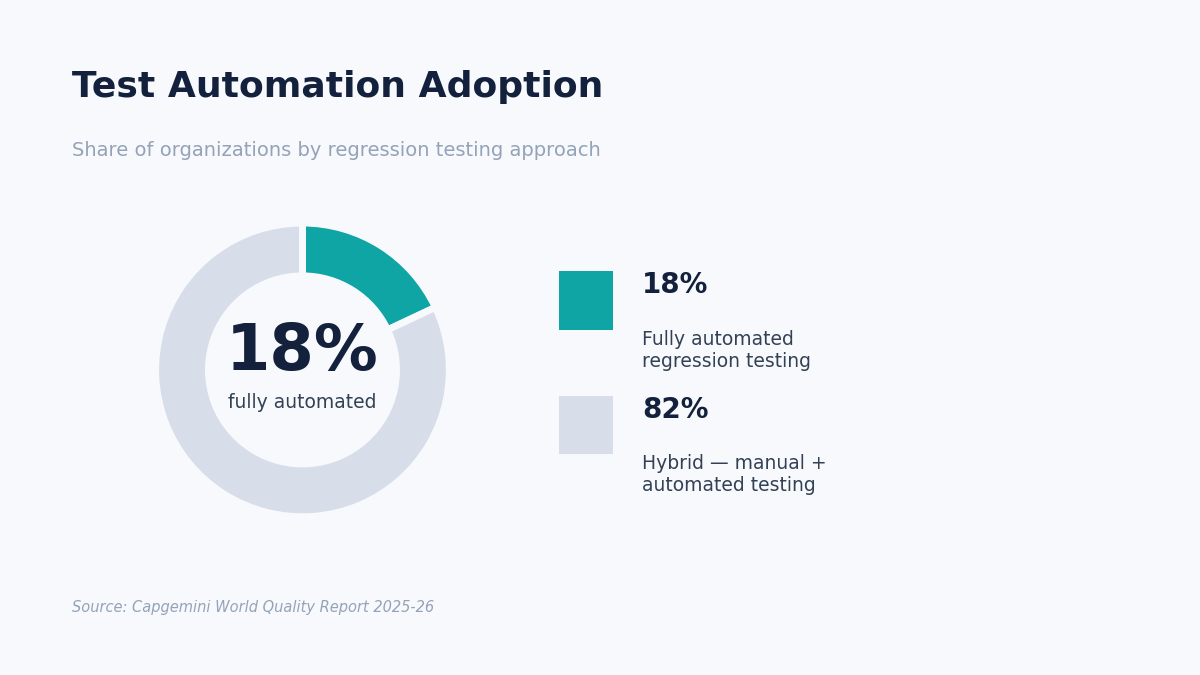
Eighteen percent. That’s the share of organizations that have fully automated their regression testing, even after a decade of “automation-first” conference talks and tool vendor pitches. The other 82% are running some hybrid of manual and automated checks and most of them can’t tell you why the split is what it is. It just… happened.
That gap is the reason this guide exists. Everyone agrees automation matters. Almost nobody has a clear, numbers-backed answer to the actual question a hiring manager is asking: what does a QA automation engineer do that a good manual tester genuinely cannot, and how do I go about bringing one onto my team without wasting a quarter finding out I hired the wrong profile?
The urgency behind this question is only growing. Generative AI and agentic technologies are actively reshaping how software is built, tested, and trusted, which means the bar for what counts as “automated testing” is moving even as teams are still catching up on the basics. Roughly 43% of organizations are now experimenting with GenAI inside QA, but only 15% have scaled it enterprise-wide, a wide gap between intent and execution that shows up first in who a company hires.
60% of organizations still struggle to build secure, scalable test data, and 58% cite real difficulty adopting AI-powered testing tools source: Capgemini World Quality Report 2025-26.
This guide walks through the entire decision, start to finish: what automation actually adds, when manual testing is still the right call, how to define the role, how to source and vet candidates, what contracts and onboarding should look like, and how to manage the engagement once someone’s hired. No fluff, no “automation is the future” filler, just the operational detail most guides skip.
Most of the existing content on this topic falls into one of two failure modes. Either it’s a vendor pitch dressed up as an explainer heavy on “automation transforms your business” language, light on any number you could actually put in a budget or it’s a purely technical comparison of tools that never addresses the hiring decision at all. Neither one helps a hiring manager who needs to write a job description, set a budget, and run interviews this week. That’s the gap this guide is built to close, section by section, in the order you’d actually need to make the decisions.
TL;DR
This guide is for engineering leads, founders, and QA managers deciding whether and how to hire QA automation engineers, whether that's one contractor, a dedicated pod, or a full automation function. It covers the entire lifecycle: defining the role, vetting candidates, choosing between Selenium, Cypress, and Playwright, structuring contracts, and managing delivery once someone's on the team.
The single number to remember: automation doesn't replace manual testing, it replaces repetition. Teams that automate their regression suite well typically cut full-cycle regression time from days to hours, while manual testers shift toward exploratory and usability work that automation genuinely cannot do. Hiring the wrong profile for this, a manual tester who "picked up some Selenium" instead of a true automation engineer is the single most common and most expensive mistake in this process.
By the end, you'll be able to write an accurate job description, run a technical vetting process that filters out script-copiers, choose a framework without a religious war on your team, and set a realistic budget and timeline for hire QA engineers decisions automated or manual based on real cost bands, not guesses.
What Is a QA Automation Engineer?
A QA automation engineer is a software professional who designs, writes, and maintains code-based test scripts that execute test cases automatically, integrate with CI/CD pipelines, and report results without manual re-execution for every build.
This role is often confused with:
- A manual tester who uses tools and someone who runs a record-and-playback tool occasionally is not the same as an engineer who architects a maintainable test framework.
- A developer who writes unit tests unit testing is a development discipline; QA automation engineering usually spans integration, API, and end-to-end layers as well.
- An SDET (Software Development Engineer in Test) closely related, but an SDET typically also builds internal testing tools and infrastructure, not just test scripts.
Why It Matters: The Business Case for Automation
The decision to hire QA automation engineers is a resourcing decision with measurable downstream effects, not a technology preference. Here’s what actually moves when it’s done right:
- Regression cycle time drops from multi-day manual passes to same-day or same-hour automated runs, freeing manual testers for exploratory work before every release.
- Defect leakage into production falls because the same test suite runs on every commit instead of once before a release, catching regressions when they’re introduced rather than weeks later.
- Release frequency increases because teams stop treating every deployment as a manual-testing bottleneck <cite index=”22-1″>DORA’s research links technical and cultural capabilities, including automated testing, directly to software delivery performance</cite>.
- Cost per test cycle decreases over time, even though the upfront build cost is higher than hiring another manual tester the breakeven point typically arrives within 3-5 release cycles for a team shipping weekly.
- Test maintenance becomes visible as its own budget line, which sounds like a downside but is actually a maturity signal teams that don’t track it usually don’t realize automation is quietly consuming 25-40% of their QA capacity in upkeep.
What it does not do: automation does not replace judgment calls on usability, does not catch every visual regression without added tooling, and does not eliminate the need for exploratory testing before major releases. Teams that pitch automation as a full replacement for manual QA are setting up for a credibility problem in the first quarter.
QA Automation Benefits by Team Size
The QA automation benefits calculus changes depending on where your team sits, and treating every stage the same is a common source of buyer’s remorse:
- Under 10 engineers, pre-product-market-fit: automation ROI is usually low. The application changes too fast for a suite to stay stable, and a skilled manual tester or QA-minded developer covers the need more cheaply. Automate only the handful of flows that are genuinely stable (login, payment, core CRUD operations).
- 10-50 engineers, scaling fast: this is the inflection point. Release frequency has usually outpaced manual QA capacity, and the cost of a missed regression (lost customers, support load) starts to exceed the cost of a dedicated automation hire. This is the most common stage teams reach out to hire QA automation engineers for the first time.
- 50+ engineers, multiple squads: automation stops being a single person’s job and becomes a function with its own roadmap, shared frameworks, reusable test utilities, and a reporting layer that rolls up coverage across teams. At this stage, a single generalist hire is rarely enough; expect to build a small pod.
Regardless of stage, the benefit that’s easiest to underestimate is institutional memory. A well-maintained automation suite is documentation that never goes stale the way a wiki page does. It either passes because the behavior it describes still holds, or it fails and tells you exactly what changed.
The Core Problem Most Buyers Face
Most teams underestimate three things by a consistent 3-4x margin when they decide to build or hire for automation:
- Time for the first useful suite. Teams expect a working regression suite in 2-3 weeks. In practice, a stable suite covering critical user flows takes 6-10 weeks for a mid-complexity web app, because the first few weeks go into test data setup, environment stabilization, and framework architecture not visible test count.
- Maintenance load. A 200-test suite doesn’t stay a 200-test suite. UI changes, API contract changes, and flaky infrastructure mean 15-25% of tests need touching every sprint once the suite matures.
- Skill mismatch cost. Hiring a manual tester and asking them to “also do automation” is the single most common false economy in this space. The role requires software engineering skills version control discipline, debugging, sometimes CI/CD pipeline configuration not just testing knowledge.
Red flag pattern worth naming directly: in vetting cycles, one of the most reliable signals of a weak automation candidate is that they can explain what Selenium’s WebDriverWait does but can’t explain why a specific locator strategy makes a test flaky on a dynamic single-page app.
That distinction reciting API knowledge versus understanding root causes of test instability is what separates someone who’s automated tests from someone who can own an automation function.
The Walkthrough: From Deciding You Need This to Managing It Long-Term
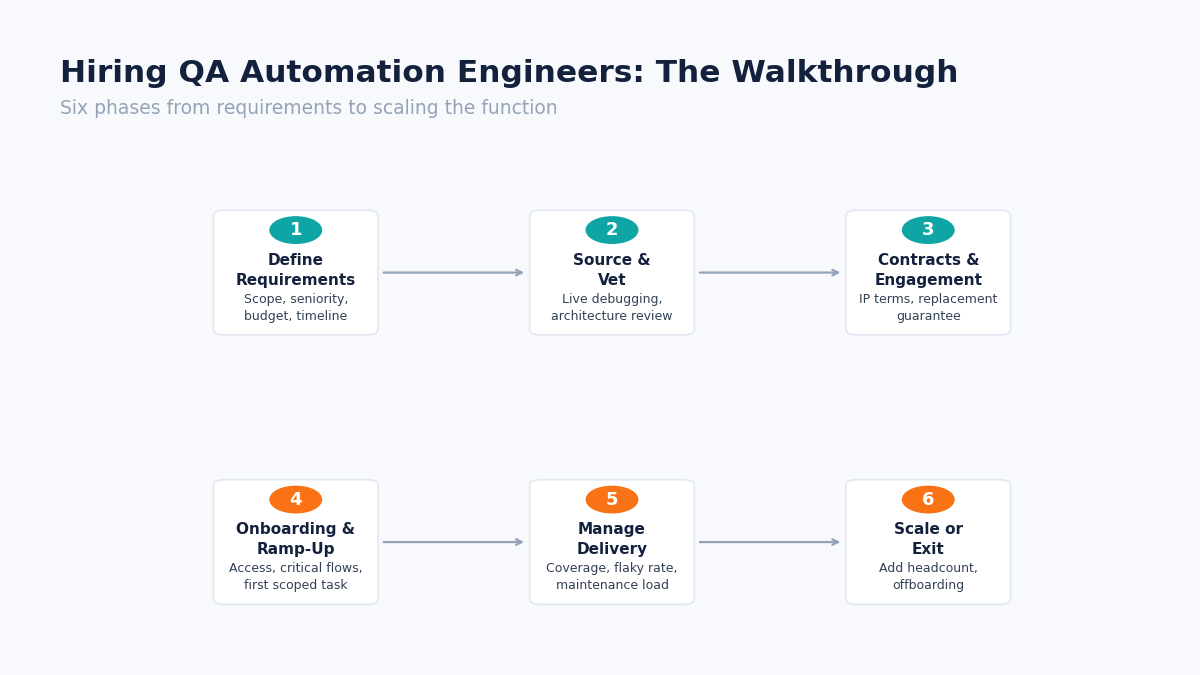
Phase 1 Defining Requirements
Before sourcing anyone, nail down four things in writing:
- Scope of automation. Be specific about which layers you actually need covered:
- API/integration testing (fastest ROI, cheapest to maintain)
- UI/end-to-end testing (highest visibility, highest maintenance cost)
- Mobile automation (requires Appium expertise specifically don’t assume web automation skills transfer)
- Performance/load testing (usually a separate specialization, not bundled into a standard automation hire)
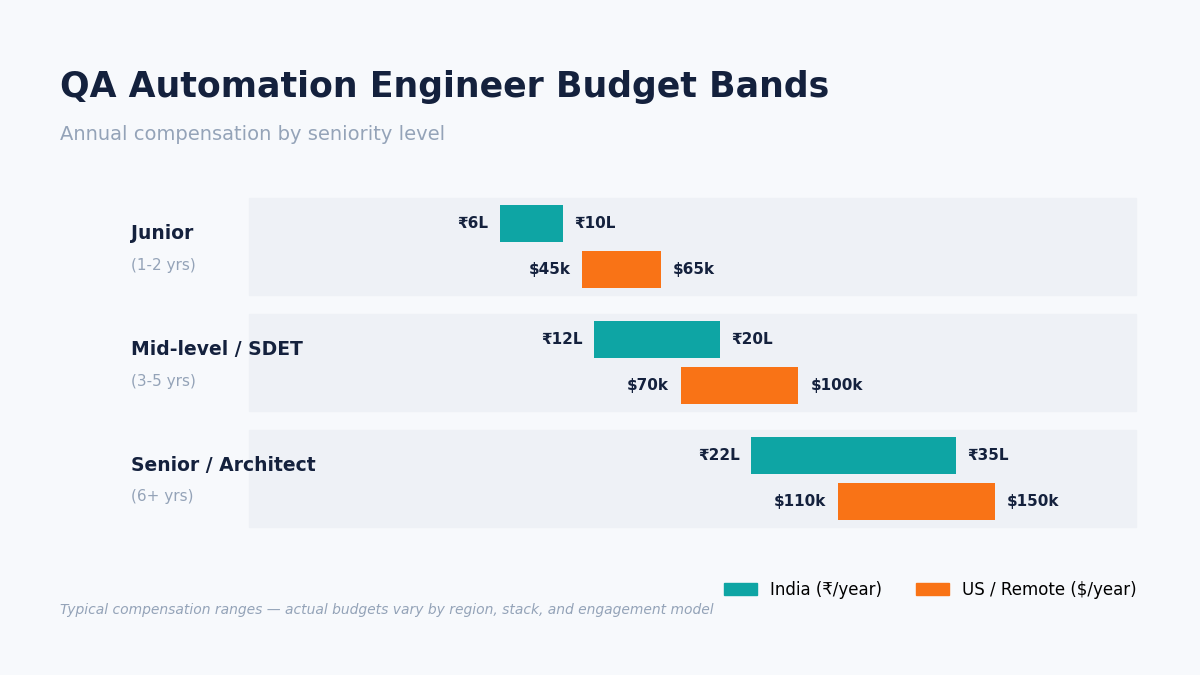
- Skill level and seniority. Budget bands typically split into three tiers:
| Level | Typical Experience | India (₹/year) | US/Remote ($/year) |
| Junior automation engineer | 1-2 yrs | ₹6-10 lakhs | $45k-65k |
| Mid-level / SDET | 3-5 yrs | ₹12-20 lakhs | $70k-100k |
| Senior / automation architect | 6+ yrs | ₹22-35 lakhs | $110k-150k |
- Timeline. A realistic sourcing-to-onboard timeline for a well-defined mid-level role, using an AI-assisted vetted pipeline, runs 7-10 working days from finalized job description to an interview-ready shortlist. Add another 1-2 weeks for interview rounds and offer negotiation.
- Budget band including overhead. For offshore or contract hires, factor in a 15-25% overhead beyond base compensation for account management, compliance, and infrastructure don’t just budget the salary number.
Quick checklist before moving to sourcing:
- Scope defined (API / UI / mobile / performance)
- Seniority level set with a specific budget band
- Tech stack identified (language, framework preference or openness to recommendation)
- Engagement model decided (dedicated hire, staff augmentation, or project-based)
- Timeline communicated to stakeholders with the 7-10 day shortlist benchmark in mind
Phase 2 Sourcing & Vetting
This is where most hiring processes go wrong not because good candidates don’t exist, but because the screening process doesn’t actually test the skill gap described above.
What good technical screening looks like:
- A live debugging exercise using an intentionally flaky test, not a from-scratch coding test. Watching someone diagnose why a test fails intermittently reveals far more than watching them write a passing test from a clean slate.
- A framework architecture discussion: ask the candidate to describe how they’d structure a Page Object Model or equivalent for a mid-sized application, and probe for maintainability reasoning, not memorized patterns.
- A CI/CD integration question: can they describe, concretely, how they’d wire a test suite into a pipeline (triggers, parallelization, reporting) rather than just naming tools?
Red flags to screen out early:
- The portfolio consists entirely of tutorial-clone projects with no evidence of maintaining a suite over time.
- Can name every tool in the ecosystem (Selenium, Cypress, Playwright, Appium, Postman) but can’t explain a tradeoff between any two of them.
- No familiarity with version control workflows beyond basic commits, automation code lives in the same repos as application code and needs the same discipline.
Cultural and communication evaluation matters more here than in many technical roles because automation engineers sit between developers and QA leads and need to communicate why a test failed flaky infrastructure versus a genuine regression clearly enough that a release decision can be made under time pressure.
A structured hiring pipeline that filters for the top 2% of vetted talent on both dimensions is significantly more reliable than resume screening alone, which is where AI-assisted sourcing has become genuinely useful rather than a buzzword it surfaces candidates who match the debugging and architecture bar above before a single interview slot is spent.
If your team is scaling into full engineering coverage rather than a single automation hire, this is also the natural point to evaluate whether you need to hire QA engineers more broadly or bring in adjacent roles teams automating a CI/CD-heavy pipeline often find they need to hire DevOps engineers around the same time to own pipeline infrastructure the automation suite plugs into.
A usable QA automation engineer job description checklist, built from what actually predicts success rather than a generic template:
- Proficiency in at least one core language used by your stack (commonly Java, Python, or JavaScript/TypeScript) if your backend team already works in Python, it’s often simplest to hire Python developers with automation specialization rather than introducing a second language into the repo
- Hands-on experience with at least one of Selenium, Cypress, or Playwright framework depth over framework breadth
- Working knowledge of API testing (Postman, REST Assured, or equivalent) API-layer automation is usually cheaper to build and maintain than UI automation, and a candidate who defaults there first is thinking about ROI correctly
- CI/CD pipeline familiarity (Jenkins, GitHub Actions, or your specific stack) not necessarily pipeline ownership, but fluency in how tests trigger and report
- Version control discipline comfortable working in the same repos and branching model as the development team, not a separate silo
- Debugging ability demonstrated through a live exercise, not just a resume claim (see Phase 2 below)
Phase 3 Engagement Models & Contracts
| Model | Best For | Cost Profile | Control | Speed to Start |
| Dedicated hire (offshore/remote) | Ongoing, long-term automation ownership | Lowest per-hour cost, predictable monthly | High reports into your team | 7-10 working days |
| Staff augmentation | Filling a specific skill gap short-term | Mid-range, hourly or monthly | Medium managed jointly | Fast, often under 2 weeks |
| Project-based / RPO | One-time suite buildout, then handoff | Fixed-scope pricing, higher upfront | Lower during build, full after handoff | Depends on scope definition |
| In-house hire | Core, long-term strategic ownership | Highest fully-loaded cost | Full | Slowest 4-8+ weeks typical |
Contract terms that actually matter, beyond rate:
- IP and NDA terms confirm in writing that all test code, frameworks, and documentation produced are your company’s IP, not a shared or vendor-retained asset.
- Replacement clauses a 7-10 day replacement guarantee if a hire isn’t a fit protects you from a bad match turning into a bad quarter.
- No shared bandwidth clauses for dedicated engagements, confirm the engineer isn’t split across multiple client accounts, which is a common way “dedicated” pricing gets diluted in practice.
- Data access and compliance terms are especially relevant if test environments touch production-like data; confirm masking or synthetic data requirements are contractually specified, not just assumed.
Phase 4 Onboarding & Ramp-Up
The first two weeks determine whether an automation hire becomes productive in month one or month three. Structure it deliberately:
Week 1 checklist:
- Repository, CI/CD, and test environment access provisioned on day one (delays here are the single biggest ramp-up killer)
- Walkthrough of existing test architecture, even if it’s minimal or messy undocumented tribal knowledge is the norm, not the exception
- Introduction to the application’s critical user flows, prioritized by business impact, not technical complexity
- First small, scoped task assigned by day 3-4 not a full framework redesign, a contained win
Week 2 checklist:
- First independently-written test merged and reviewed
- Communication cadence established (standups, async updates, escalation path for blockers)
- Clear ownership boundary set between the new hire and existing manual QA or dev-owned unit tests, so no overlap or gaps form
Common onboarding friction point worth naming specifically: offshore or remote automation hires frequently lose their first several days to access provisioning VPN, staging environment credentials, repository permissions because these requests sit in an internal IT queue behind higher-priority tickets. Building access provisioning into the contract’s onboarding SLA, rather than leaving it to an ad hoc internal process, is one of the more concrete lessons that only shows up after running several of these engagements.
A second, quieter friction point: undocumented “known flaky” tests. Almost every existing suite has a handful of tests everyone silently ignores because they fail intermittently and nobody’s had time to fix them. A new hire who doesn’t know this list exists will spend their first week chasing ghosts debugging failures that are actually just known infrastructure noise, not real regressions. Handing over this list explicitly, even if it’s informal, saves days of wasted debugging time and builds trust that the team is being upfront about the state of things rather than letting a new hire discover the mess on their own.
Automation Testing Tools Beyond the Big Three
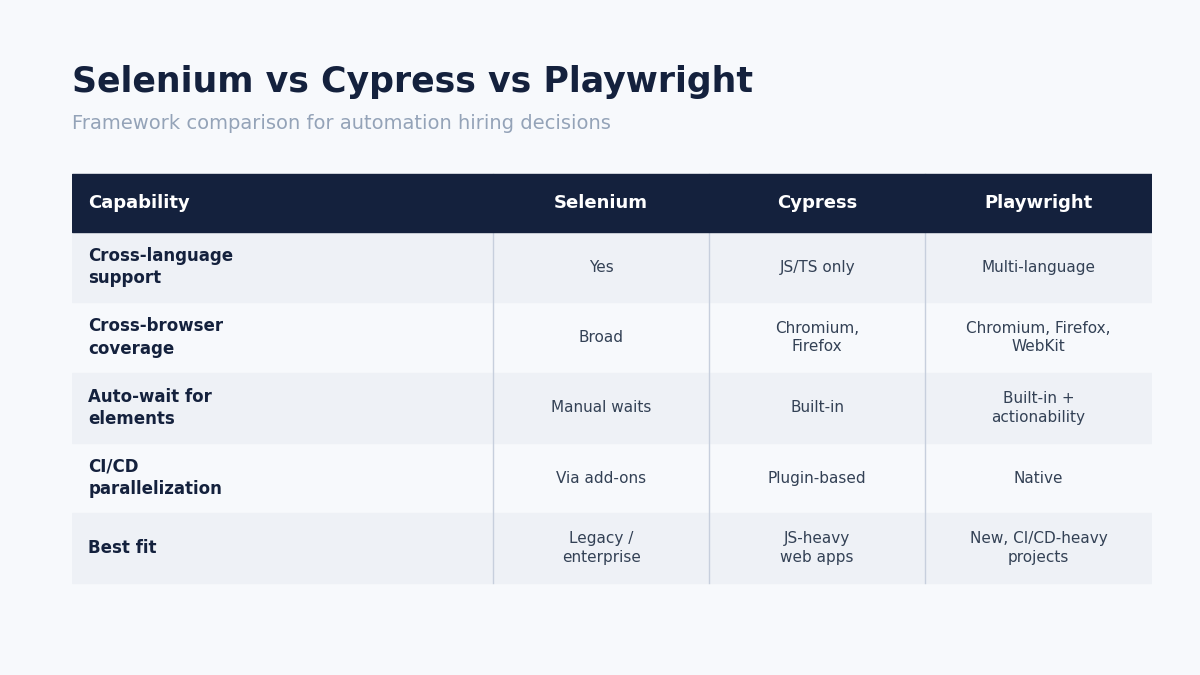
Selenium, Cypress, and Playwright dominate the UI automation conversation, but a full automation testing tools stack usually needs more than one category:
- API testing: Postman for exploratory and manual API checks, REST Assured or Playwright’s built-in API testing for automated coverage API tests are typically 5-10x cheaper to write and maintain than equivalent UI tests, which is why mature teams push coverage down to this layer wherever possible.
- Mobile automation: Appium remains the cross-platform standard for native mobile apps; this is a distinct skill set from web automation and should be scoped separately in your job description rather than assumed as a given.
- Performance/load testing: JMeter or k6, usually owned by a specialist rather than bundled into a standard automation hire’s scope bundling it in without adjusting the budget band is a common way job descriptions become unfillable.
- Test management and reporting: TestRail or a similar tool to track coverage and results in a form that’s readable by non-engineers this matters more once you have a dedicated account manager or QA lead who needs to report status upward without reading raw CI logs.
- Visual regression tools: Percy, Chromatic, or similar, only worth adding once your core functional suite is stable visual regression on top of a flaky functional suite just adds a second source of noise.
The tool list is not, on its own, a differentiator between candidates. What matters is whether a candidate can explain when to reach for API testing instead of UI testing for a given scenario that judgment call is worth more than familiarity with any single tool.
Phase 5 Managing Delivery
Once someone’s ramped up, delivery management should run on a light but consistent cadence:
- Weekly: test count and pass/fail trend, flaky test count (a rising flaky count is an early warning sign of test debt, not a minor annoyance)
- Bi-weekly or per sprint: coverage against critical user flows, mapped back to the Phase 1 scope
- Monthly: maintenance time as a percentage of total automation capacity if it exceeds 40%, the suite needs architectural attention, not more test-writing
- Dedicated account management matters more here than it sounds; a named point of contact who can escalate resourcing or scope issues without a support-ticket delay keeps small friction points from becoming quarter-long problems.
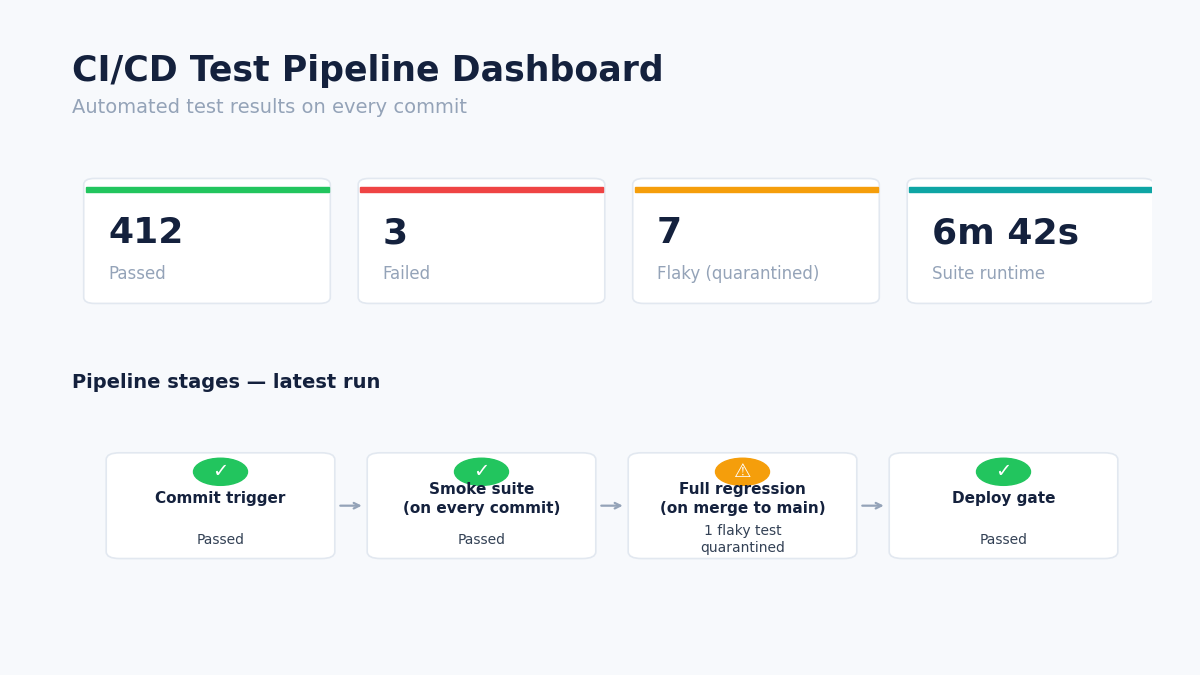
CI/CD test integration: what actually changes in your pipeline. Bringing automation into CI/CD isn’t just “add a test step” it typically means restructuring the pipeline around three decisions: which tests run on every commit versus only on merge to main (fast smoke suite versus full regression), how test failures block or warn rather than silently logging, and how flaky tests are quarantined so they don’t erode trust in the whole pipeline.
DORA’s research treats these technical practices as directly linked to overall software delivery performance, which is a useful reminder that this is a delivery-engineering decision, not just a QA one. It’s worth involving whoever owns your pipeline in this conversation from week one rather than after the suite is already built.
Phase 6 Scaling or Exiting
- Adding headcount: scale automation capacity when maintenance time consistently exceeds new-test-writing time that’s the signal you need a second engineer, not just more hours from the first.
- Offboarding: confirm all test code, credentials, and documentation transfer cleanly; rotate any shared credentials the departing engineer had access to.
- Replacement policy: this is where the 7-10 day replacement guarantee referenced in Phase 3 earns its keep; a mid-engagement mismatch shouldn’t cost you a full new sourcing cycle.
Case Studies
E-commerce scale-up, 40% reduction in release-blocking regressions. A fast-growing e-commerce platform with a pattern similar to Swiggy’s hiring scale-up needed to move from weekly to near-daily deployments without expanding manual QA headcount proportionally. Building a dedicated automation function against critical checkout and payment flows cut release-blocking regressions by roughly 40% within two quarters, primarily by catching integration breaks before they reached staging.
Fintech engineering hire-up, 100+ engineers onboarded with automation embedded from day one. In a large-scale hiring push comparable to Paytm’s 100+ engineer expansion, embedding automation engineers into each squad from the start rather than centralizing QA as a downstream gate meant new feature teams shipped with regression coverage already in place instead of retrofitting tests after launch.
Recruitment automation parallel, Somnoware-style operational efficiency gain. A healthtech company modeled its QA scaling on the same principle Somnoware applied to recruitment automation: remove repetitive manual steps first, then let human judgment focus on exceptions. Applied to testing, this meant automating the highest-frequency, lowest-judgment test cases first (login, checkout, data entry) and keeping manual testers focused on new-feature exploratory work, a sequencing choice that materially shortened the automation team’s time to visible ROI. Supersourcing’s engagement teams typically sequence automation builds the same way: highest-frequency flows first, so the business case shows up in weeks rather than a full quarter.
Comparison / Decision Framework
Use this framework to decide your engagement model, not just your tooling:
| Factor | Dedicated Hire | Freelancer | In-House | Staff Augmentation |
| Cost | Low-mid, predictable | Variable, project-dependent | Highest fully-loaded | Mid, flexible |
| Control | High | Low-medium | Full | Medium |
| Speed to start | 7-10 working days | Days to weeks | 4-8+ weeks | 1-2 weeks |
| Long-term suitability | Strong | Weak continuity risk | Strong | Moderate |
| Best fit | Ongoing automation ownership | One-off, narrow-scope tasks | Core strategic function | Short-term skill gaps |
What Most Teams Get Wrong
- They automate everything, including tests that change every sprint. Automating a UI flow that’s still being actively redesigned guarantees high maintenance cost for near-zero return to stabilize the flow first.
- They hire for tool names instead of engineering judgment. A candidate list of “Selenium, Cypress, Playwright, Appium” on a resume says nothing about whether someone can diagnose flakiness or architect a maintainable suite.
- They treat automation as a one-time project instead of an ongoing function. A suite with no maintenance budget degrades within two to three quarters as the application changes underneath it.
- They skip the manual-to-automation handoff conversation entirely, leaving manual testers unclear on what’s now covered and what isn’t, creating both duplicate effort and coverage gaps simultaneously.
Cost & Timeline Reality Check
Cost drivers that push budgets up:
- Legacy application with poor test hooks (no stable selectors, minimal API layer)
- Multi-platform coverage (web + mobile + API) requiring broader skill sets
- High compliance requirements (healthcare, fintech) adding test data handling overhead
Cost drivers that bring budgets down:
- API-first automation strategy before UI automation (cheaper to build and maintain)
- Offshore or remote dedicated hiring versus in-house full-time equivalents
- Existing CI/CD infrastructure already in place, reducing setup time
A note on how these numbers get distorted. The most common budgeting mistake isn’t underestimating salary, it’s forgetting to budget for the ramp-up period at full cost while productivity is still climbing. A mid-level hire is rarely contributing at full capacity in weeks one through four; if your budget model assumes day-one output, the “actual” cost per useful test written in month one will look far worse than the steady-state number and can trigger a premature decision to cut the engagement. Model cost per test cycle over a two-quarter window, not a single sprint, before judging whether the hire is paying off.
It’s also worth separating one-time build cost from ongoing run cost explicitly when presenting a budget to non-technical stakeholders. The build cost architecture, initial test writing, CI/CD wiring is a bounded, front-loaded number. The run cost maintenance, new test writing for new features, occasional framework upgrades is a smaller, recurring number that should be budgeted as a permanent line item, not treated as a project that eventually “finishes.” Teams that present automation as a one-time project to finance or leadership frequently run into a budget conversation in month nine that a clearer initial framing would have avoided entirely.
Typical timelines by scenario:
| Scenario | Realistic Timeline |
| Hiring one mid-level automation engineer (sourcing to offer) | 7-10 working days shortlist + 1-2 weeks interviews |
| First stable regression suite (critical flows only) | 6-10 weeks post-hire |
| Full CI/CD integration with parallelized runs | Additional 2-4 weeks after suite stabilizes |
| Scaling to a 2-3 person automation pod | 3-6 months, phased by maintenance load signals from Phase 6 |
Where to Go From Here
If you’re mid-decision trying to figure out whether to automate now, what to automate first, or whether your current candidate pipeline is actually screening for the right skills the fastest next step is a scoped conversation, not another framework comparison article. Talk to Supersourcing’s hiring team about your specific stack and release cadence, and get a shortlist built around the exact skill gap this guide describes, not a generic QA job posting.
FAQ
What does a QA automation engineer do differently from a manual tester?
A QA automation engineer writes and maintains code that executes tests automatically and repeatedly, integrating with CI/CD pipelines. A manual tester executes test cases by hand, which is better suited to exploratory testing, usability judgment, and one-off edge cases that don’t justify script maintenance.
Is it worth it to hire QA automation engineers for a small team?
It depends on release frequency more than team size. If you’re deploying weekly or more often, automation typically pays back within 3-5 release cycles. If releases are monthly or less frequent, manual testing may remain more cost-effective until velocity increases.
How much does it cost to hire a QA automation engineer?
Budget bands typically range from ₹6-10 lakhs/year for junior talent in India to ₹22-35 lakhs/year for senior automation architects; US/remote equivalents run roughly $45k-150k/year depending on seniority and scope.
What skills should a QA automation engineer have?
Core programming ability in at least one language (Java, Python, or JavaScript), experience with a framework like Selenium, Cypress, or Playwright, CI/CD pipeline familiarity, and critical debugging skill for diagnosing flaky tests rather than just writing new ones.
Selenium vs Cypress vs Playwright which should we use?
Selenium suits legacy or multi-language enterprise environments; Cypress suits JavaScript-heavy web apps prioritizing developer experience; Playwright suits new projects needing speed, stability, and native CI/CD parallelization. There’s no universally “best” choice; it depends on your stack and team.
How long does it take to build an automation suite from scratch?
A stable suite covering critical user flows typically takes 6-10 weeks for a mid-complexity application, factoring in test data setup and environment stabilization not just the visible test count.
Can automation replace manual testing completely?
No. Automation handles repetitive, well-defined checks well; it doesn’t replace exploratory testing, usability judgment, or ad hoc edge-case discovery that a skilled manual tester brings to a new feature.
What red flags signal a bad QA automation hire, and when should I bring in a specialist partner?
Watch for candidates who can name tools but can’t explain tradeoffs, portfolios built entirely on tutorial clones, and no evidence of maintaining a live suite over time. If your internal pipeline can’t reliably filter for this, that’s the point to bring in a vetted external hiring process rather than repeating the same screening gaps.
What’s the difference between a QA automation engineer and an SDET?
The titles overlap heavily, but an SDET (Software Development Engineer in Test) typically also builds internal testing tools, frameworks, and infrastructure used by other testers, not just writing and maintaining test scripts. In practice, expect to pay a modest premium for genuine SDET-level scope, and confirm during vetting which scope a candidate actually has rather than assuming from the title.
Do I need a separate hire for mobile app automation?
Usually yes, if mobile is a significant part of your product. Web automation skills in Selenium, Cypress, or Playwright don’t automatically transfer to Appium-based mobile automation treat it as a distinct line item in your job description and budget rather than an assumed extension of a web automation hire’s scope.
