

MuleSoft licensing alone can cost an enterprise $150,000–$500,000 annually. Companies that under-invest in implementation talent routinely spend 40–60% more on rework within the first 18 months. The developer you hire is not a commodity decision, it’s a risk management decision.
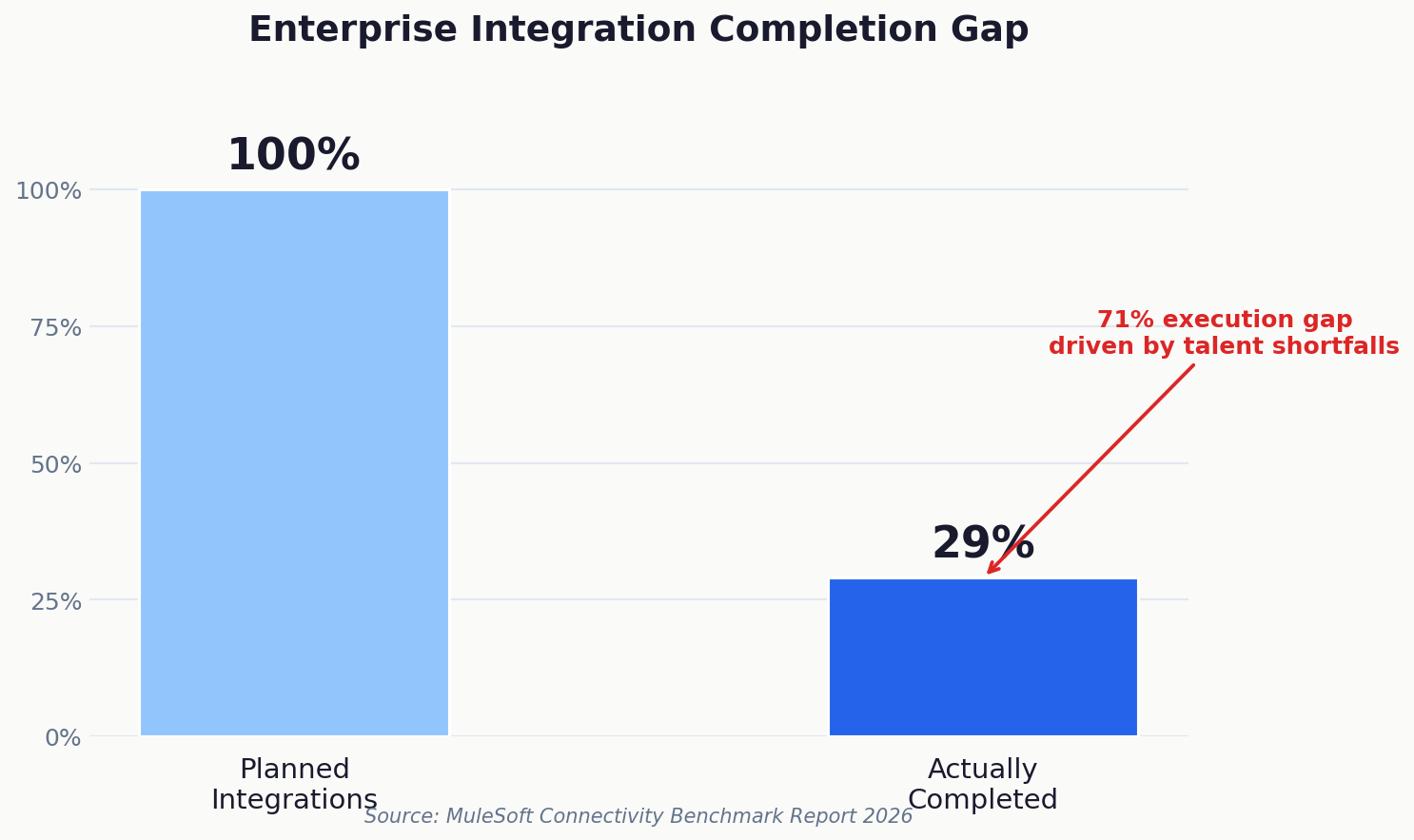
According to MuleSoft’s 2026 Connectivity Benchmark Report, organizations complete an average of 29% of their planned integrations, leaving a significant execution gap driven primarily by talent shortfalls.
That gap does not close by adding headcount. It closes by adding the right headcount and if you are looking to hire MuleSoft developer India, the bar is higher than most teams set it. You need developers who understand not just how to configure flows in Anypoint Studio, but how to design integration architecture that holds up under real enterprise load, version changes, and shifting business requirements.
India’s MuleSoft integration developer talent pool has expanded sharply since Salesforce’s acquisition of MuleSoft in 2018, but certified, production-experienced developers remain scarce relative to demand. The market has no shortage of profiles listing “MuleSoft” as a skill. It has a significant shortage of developers who can own a production integration environment end-to-end from API design through deployment, monitoring, and incident response.
That distinction is what this guide is built around. Understanding what certifications actually signal, what salaries are realistic at each experience band, and how to structure a technical screen that separates genuine capability from exam-passed familiarity will save you 3–5 months of a wrong hire and the remediation cost that almost always follows it.
TL;DR: What This Guide Covers
Hiring a MuleSoft developer in India is not a straightforward recruiter brief. Certification levels vary widely in what they actually prove. Salary benchmarks shift depending on experience, domain, and the Salesforce ecosystem overlap. Getting this wrong costs more than the hire itself.
This guide breaks down MCD Level 1 vs Level 2 what each signals and when it matters. It covers realistic salary ranges across junior, mid, senior, and architect bands. It also includes 10 interview questions that separate production-ready developers from exam-prepared ones.
If you are evaluating candidates now or building a hiring process from scratch, every section here is actionable. No filler. No generic advice. Just the specifics that change outcomes.
What Is a MuleSoft Developer?
A MuleSoft developer is an integration specialist who designs, builds, and maintains APIs and data flows using the Anypoint Platform MuleSoft’s unified integration and API management environment. The role spans API design, DataWeave language transformations, connector configuration, and enterprise integration architecture across on-premise and cloud systems.
The Real Challenge When You Hire MuleSoft Developer India
The supply problem is not the number of developers who list “MuleSoft” on their CV. It’s the gap between familiarity and production-readiness.
A developer who has completed one training course and passed an entry-level exam is categorically different from one who has deployed multi-environment API-led connectivity solutions at scale. Most hiring teams conflate the two and discover the difference 6–8 weeks into a failed integration sprint.
Three specific gaps appear repeatedly in screening:
- DataWeave fluency: Many candidates have surface-level knowledge. Production work requires writing complex transformations, handling nested JSON/XML, and debugging runtime errors without hand-holding.
- Error handling and monitoring: Configuring Anypoint Monitoring, setting up alerts, and writing retry logic are non-negotiable in enterprise environments. These are skipped in most training curricula.
- Environment management: DEV → UAT → PROD promotion with proper configuration externalization is a senior skill. Treat it as a baseline requirement for anything beyond greenfield projects.
The market reality: developers who meet all three benchmarks typically command ₹18–32 lakhs per annum in India, and availability at that range is thin.
MuleSoft Certification Worth It: MCD Level 1 vs Level 2 Explained
MuleSoft Certified Developer (MCD) Level 1
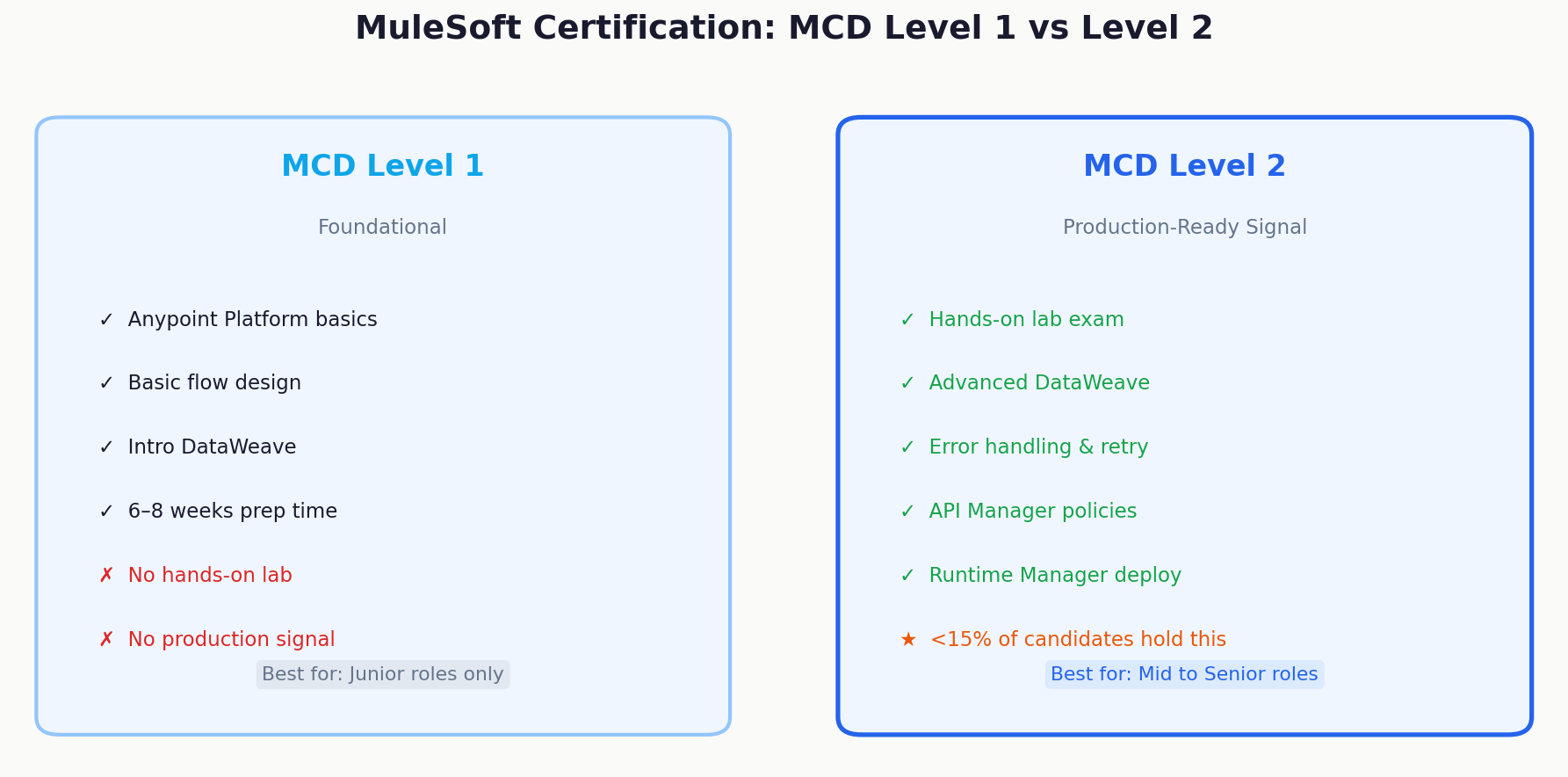
MuleSoft MCD Level 1 validates foundational knowledge Anypoint Platform navigation, basic flow design, connector usage, and introductory DataWeave. It is a meaningful filter for junior candidates but should not be treated as a proxy for production capability. A developer can pass this exam with 6–8 weeks of structured self-study and no real project experience.
Use it as: a minimum bar for junior roles, not a hiring signal for senior or architect positions.
MuleSoft Certified Developer (MCD) Level 2
MuleSoft MCD Level 2 is a different category of credential. It requires hands-on lab performance in addition to a written exam, covering advanced DataWeave, error handling strategies, deployment to Anypoint Runtime Manager, and policy implementation on API Manager. Fewer than 15% of MuleSoft-listed developers in India hold this certification.
Use it as: a strong positive signal for mid-to-senior roles. It does not replace a technical screen, but it narrows the field significantly.
Additional Certifications Worth Noting
- MuleSoft Certified Integration Architect (MCIA): Relevant for tech leads and solution architects. Covers design principles, scalability patterns, and cross-system integration governance.
- MuleSoft Certified Platform Architect: Rare in India; relevant only for enterprise-wide program ownership.
For most teams looking to hire MuleSoft developer India, the practical filter is: MCD Level 1 for junior, MCD Level 2 for mid-level, MCIA for leads.
MuleSoft Developer Salary India: What the Market Actually Looks Like
Salary Benchmarks by Experience Band
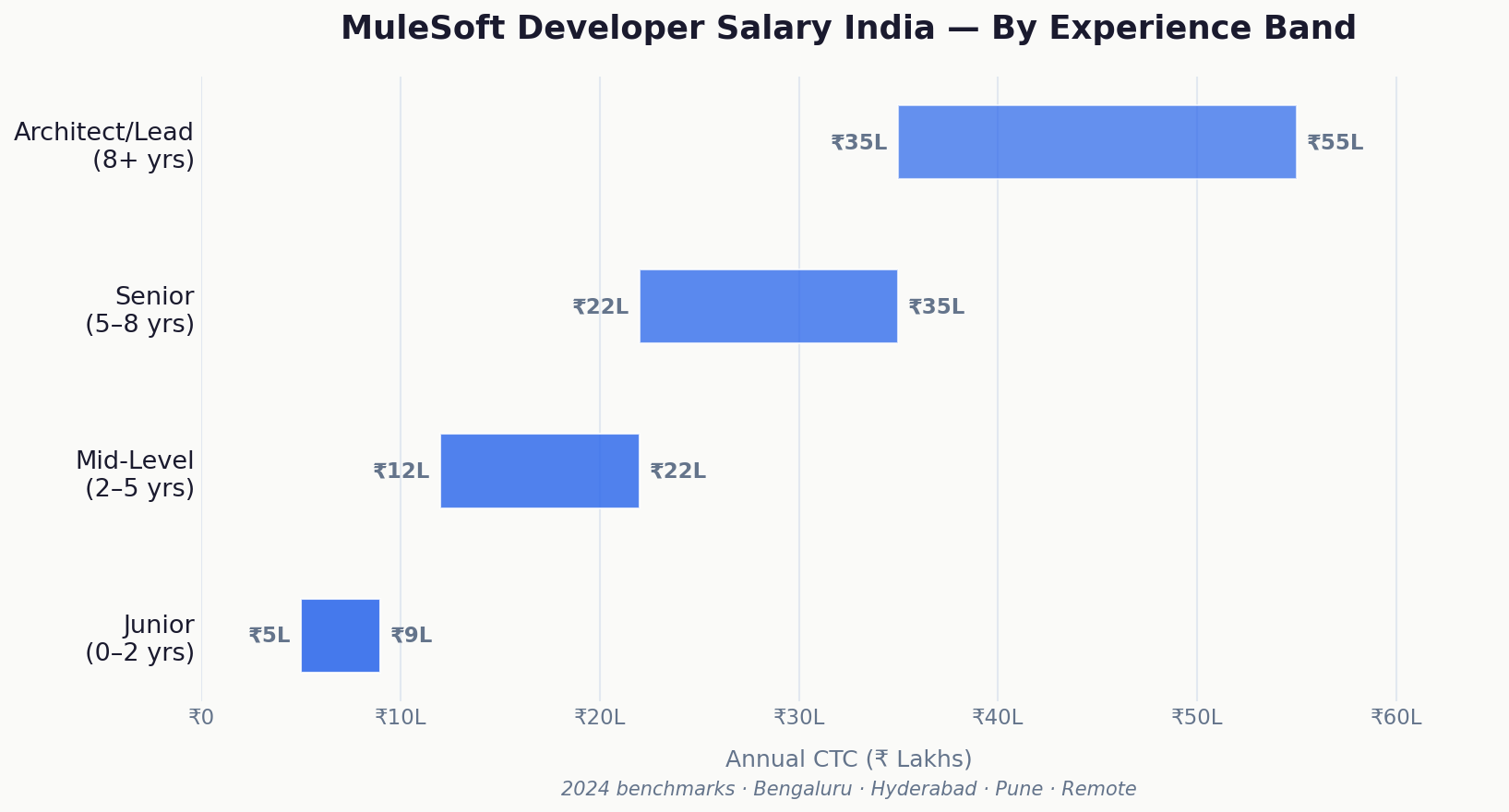
| Experience Level | Certification Expected | Annual CTC (INR) |
| Junior (0–2 years) | MCD Level 1 | ₹5–9 lakhs |
| Mid-level (2–5 years) | MCD Level 2 | ₹12–22 lakhs |
| Senior (5–8 years) | MCD Level 2 / MCIA | ₹22–35 lakhs |
| Architect / Lead (8+ years) | MCIA / Platform Architect | ₹35–55 lakhs |
These ranges reflect 2024 market benchmarks across Bengaluru, Hyderabad, Pune, and remote-first roles. Contract and freelance rates for senior profiles run 30–45% higher than equivalent full-time CTC.
Candidates with active Salesforce ecosystem experience particularly those who have worked in orgs running Salesforce + MuleSoft in tandem command a 15–20% premium regardless of tier.
MuleSoft vs Other iPaaS: Where It Wins and Where It Doesn’t
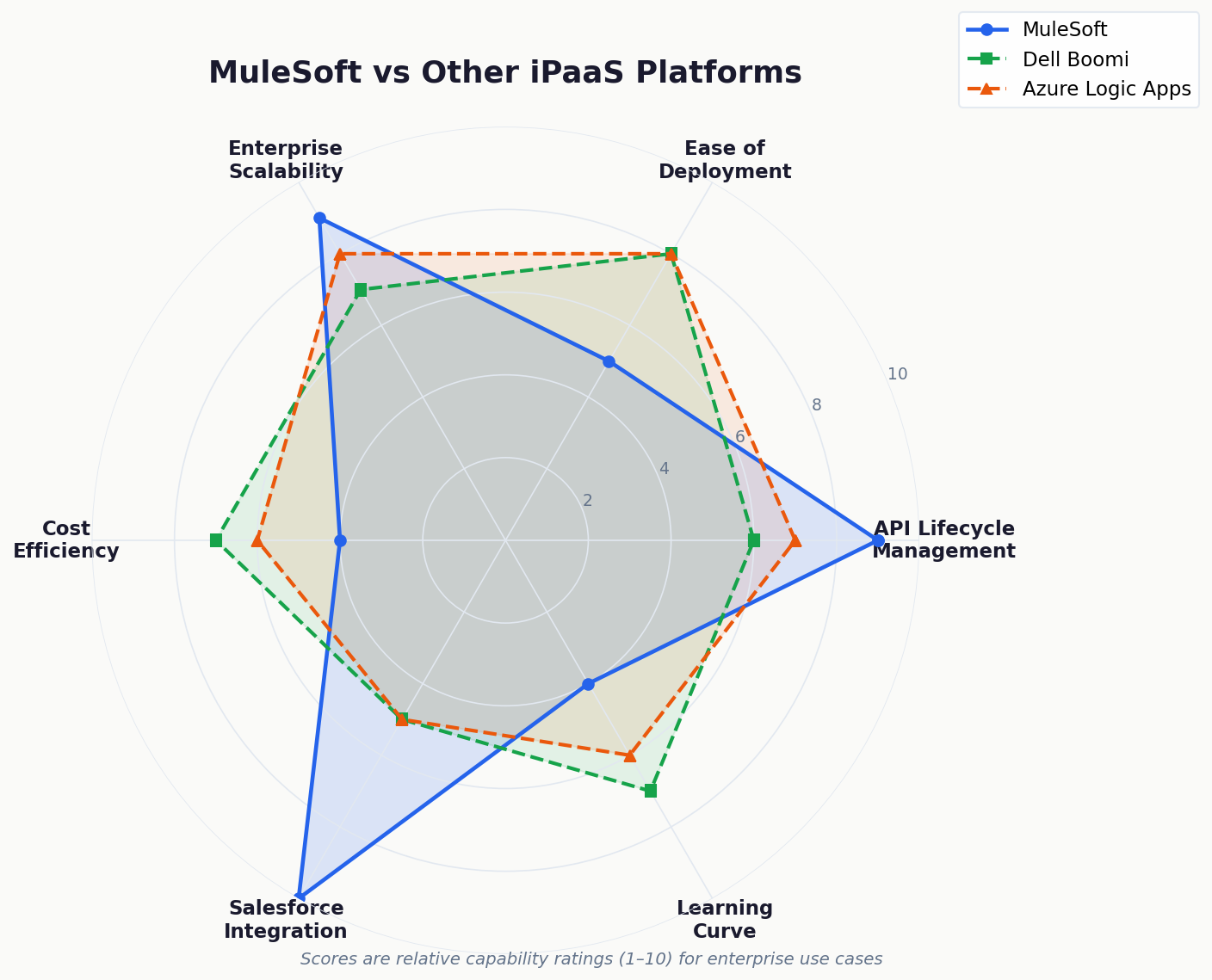
MuleSoft vs other iPaaS is a question that surfaces in almost every enterprise procurement cycle. The honest answer depends on what you’re optimizing for.
MuleSoft wins on: complex, multi-system enterprise integrations; API lifecycle management at scale; organizations already in the Salesforce ecosystem; regulated industries needing fine-grained policy control.
MuleSoft loses on: speed of simple point-to-point integrations (where cloud integration tools like Dell Boomi or Azure Logic Apps are faster to deploy); total cost of ownership for mid-market companies with straightforward integration needs; organizations without internal technical capacity to manage Anypoint Platform governance.
The decision is architectural, not just commercial. Teams that choose MuleSoft because it’s the “enterprise default” without assessing their integration complexity routinely overspend by 2–3x vs a right-sized alternative.
Two Real-World Hiring Outcomes
Case 1: A Bengaluru-based logistics firm needed to integrate its WMS, ERP, and three third-party carrier APIs. They hired a developer with an MCD Level 1 certification and two years of Anypoint Studio experience. The initial build took 14 weeks. Within 6 months, data transformation errors and a lack of retry logic caused 3 production incidents. A senior contractor was brought in for a 6-week remediation engagement. Total cost overrun: approximately ₹18 lakhs.
Case 2: A financial services company in Hyderabad structured their hiring process around a live DataWeave transformation task and a scenario-based architecture question before extending any offer. They onboarded an MCD Level 2 developer at ₹24 lakhs CTC. The first integration milestone connecting a core banking system to three downstream applications was delivered in 9 weeks with zero production incidents in the first quarter.
The differentiator in both cases was the quality of the technical screen, not the job description.
10 Interview Questions to Hire MuleSoft Developer India the Right Way
Use these questions across technical and architectural levels. Expect senior candidates to elaborate on trade-offs, not just describe features.
- Walk me through how you structure an API-led connectivity solution with Experience, Process, and System layers. When would you deviate from the standard pattern?
- Write a DataWeave 2.0 expression to flatten a nested array and map it to a target schema. Explain your logic. (Live task non-negotiable for mid and senior roles)
- How do you handle partial failures in a batch processing job on Anypoint Platform? What retry and alerting mechanisms do you implement?
- Describe how you manage configuration externalization across DEV, UAT, and PROD environments in Anypoint Runtime Manager.
- What is your approach to API versioning? When do you version vs deprecate?
- How do you implement OAuth 2.0 token enforcement via API Manager policies? What limitations have you encountered?
- You’re integrating a SOAP-based legacy system with a REST API consumer. Walk through your approach in Anypoint Studio.
- How do you monitor a deployed Mule application in production? What does your alerting setup look like?
- What is the difference between a synchronous and asynchronous integration pattern? Give a production scenario where you chose one over the other.
- How do you size CloudHub worker resources for a high-throughput integration? What metrics do you track?
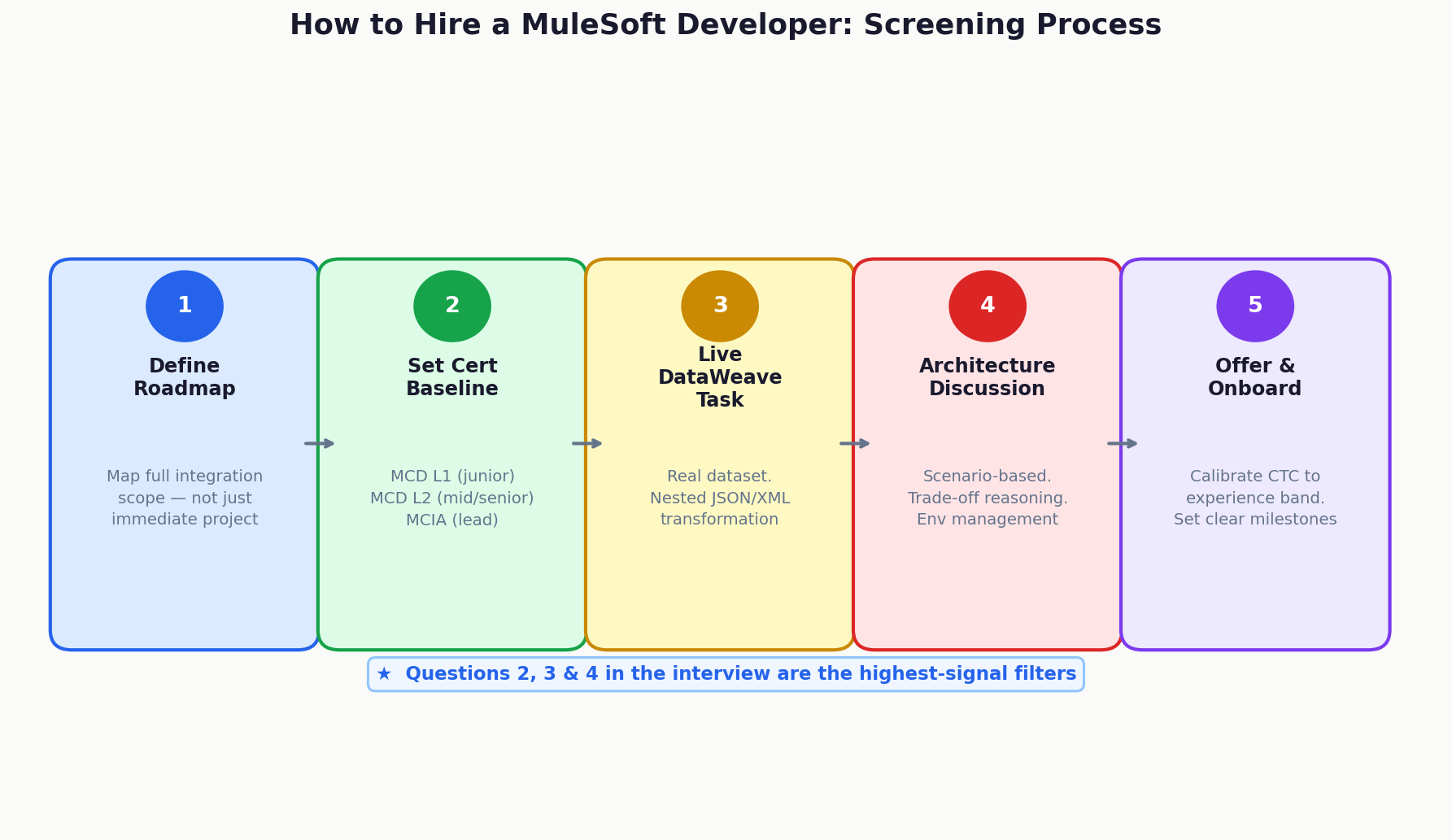
Questions 2, 3, and 4 are the highest-signal filters. A developer who cannot handle these in a structured conversation not necessarily from memory, but with logical coherence is not production-ready for enterprise work.
What Most Teams Get Wrong When They Hire MuleSoft Developer India
The most consistent mistake is treating certification as a substitute for a technical screen.
Certifications including MCD Level 2 are necessary filters, not sufficient ones. The exam environment does not replicate the ambiguity of a real integration project: undocumented legacy APIs, shifting business requirements, and production incidents at 2 AM.
The second mistake is scoping the role too narrowly at hiring time. A developer brought in for one integration project will either sit idle or be pulled into adjacent work they’re not equipped for. Define the full integration roadmap not just the immediate scope before writing the job description. Candidates self-select more accurately when expectations are explicit.
Third: teams frequently underweight soft skills specific to integration roles. A middleware developer India who cannot translate between business stakeholders and backend engineers creates bottlenecks that no technical skill compensates for.
FAQ: Hire MuleSoft Developer India
Is MuleSoft certification worth it for developers in India?
Yes, with context. MCD Level 1 opens doors to entry-level roles and is achievable in 6–8 weeks. MCD Level 2 requires real project exposure and is a genuine differentiator in the market. For developers targeting senior roles or architect tracks, MCIA certification combined with enterprise project experience consistently yields 25–35% higher compensation.
What is the average MuleSoft developer salary in India for a mid-level profile?
A mid-level developer with 2–5 years of experience and MCD Level 2 certification typically earns ₹12–22 lakhs per annum. Candidates with Salesforce integration experience or BFSI domain knowledge command the upper end of that range.
How long does it take to become a MuleSoft certified developer?
MCD Level 1 preparation takes 6–8 weeks for a developer with prior Java or integration experience. MCD Level 2 typically requires 3–6 months of structured preparation alongside active project work. MCIA is a 6–12 month track for experienced architects.
What is the difference between MCD Level 1 and Level 2 in practical terms?
MCD Level 1 tests knowledge of Anypoint Platform concepts and basic flow development. MCD Level 2 includes a hands-on lab component and assesses advanced DataWeave, error handling, API policy management, and deployment skills directly relevant to production work.
How do I screen a MuleSoft developer before hiring without a technical co-founder?
Use a structured two-step process: first, a live DataWeave transformation task with a real-world dataset; second, a scenario-based architecture discussion using a business problem relevant to your industry. Both steps can be evaluated with a rubric even by non-technical hiring managers, provided the rubric is built with expert input upfront.
MuleSoft vs other iPaaS: when does MuleSoft make sense for an Indian enterprise?
MuleSoft is the right choice when you have complex, multi-system integration requirements, an existing or planned Salesforce environment, or regulatory requirements demanding API lifecycle governance. For simpler use cases under 10–15 integration points, alternatives like Boomi or Azure Integration Services often deliver faster time-to-value at lower total cost.
Make the Right Hire Before the Project Scope Does It for You
By the time a wrong MuleSoft hire becomes visible, the cost is rarely just the salary. It’s the rework, the delayed go-live, and the escalation to a senior contractor to fix what should have been built right the first time. In enterprise integration programs, that remediation cycle typically runs 3–5 months and costs 1.5–2x the original developer’s annual CTC before accounting for the business impact of a delayed rollout.
The hiring bar for MuleSoft is higher than most teams set it at the start. Certification matters, but it’s a filter not a guarantee. Salary benchmarks matter, but paying at the top of the range for the wrong profile solves nothing. What actually determines outcomes is a structured evaluation process: one that tests real skills, reflects your integration complexity, and maps to a defined roadmap rather than a single project scope.
If your team is building out an integration roadmap and needs to pressure-test your hiring approach including technical screen design, certification benchmarks, and salary calibration our team has run this process across enterprise integration programs in BFSI, logistics, and manufacturing. You can explore our work and service offerings at Supersourcing. For a direct conversation about your hiring requirements, reach out at mayank@engineerbabu.com we typically respond within one business day.
If you’re ready to move forward or just want to validate your approach before committing to a hire, CONTACT US PAGE is the fastest way to get a scoping conversation started.
