

Introduction
Less than 8% of certified Oracle Integration Cloud professionals globally are actively open to new roles at any given time and a disproportionate share of that talent sits in India. Yet most enterprises attempting to hire OIC developer India profiles spend 3–5 months in failed searches, screening candidates who list OIC on their resume but have only worked on adjacent Oracle tools like SOA Suite or OSB.
The gap isn’t supply. It’s screening precision.
Oracle Integration Cloud has quietly become the integration backbone for enterprises running Oracle Fusion, ERP Cloud, or HCM Cloud. But because OIC is a managed iPaaS platform, not a traditional middleware stack, the hiring criteria used for Oracle middleware developer roles or even MuleSoft developers will filter out the wrong people.
Enterprises adopting Oracle Cloud are discovering that integration is implementation is the real bottleneck. As systems scale across ERP, HCM, and SaaS applications, the need for specialized integration expertise becomes critical.
Hire OIC developer India is where many hiring strategies break down. Candidates often list Oracle Integration Cloud experience, but lack hands-on depth in building integrations within OIC’s managed iPaaS environment leading to long hiring cycles and poor fit.
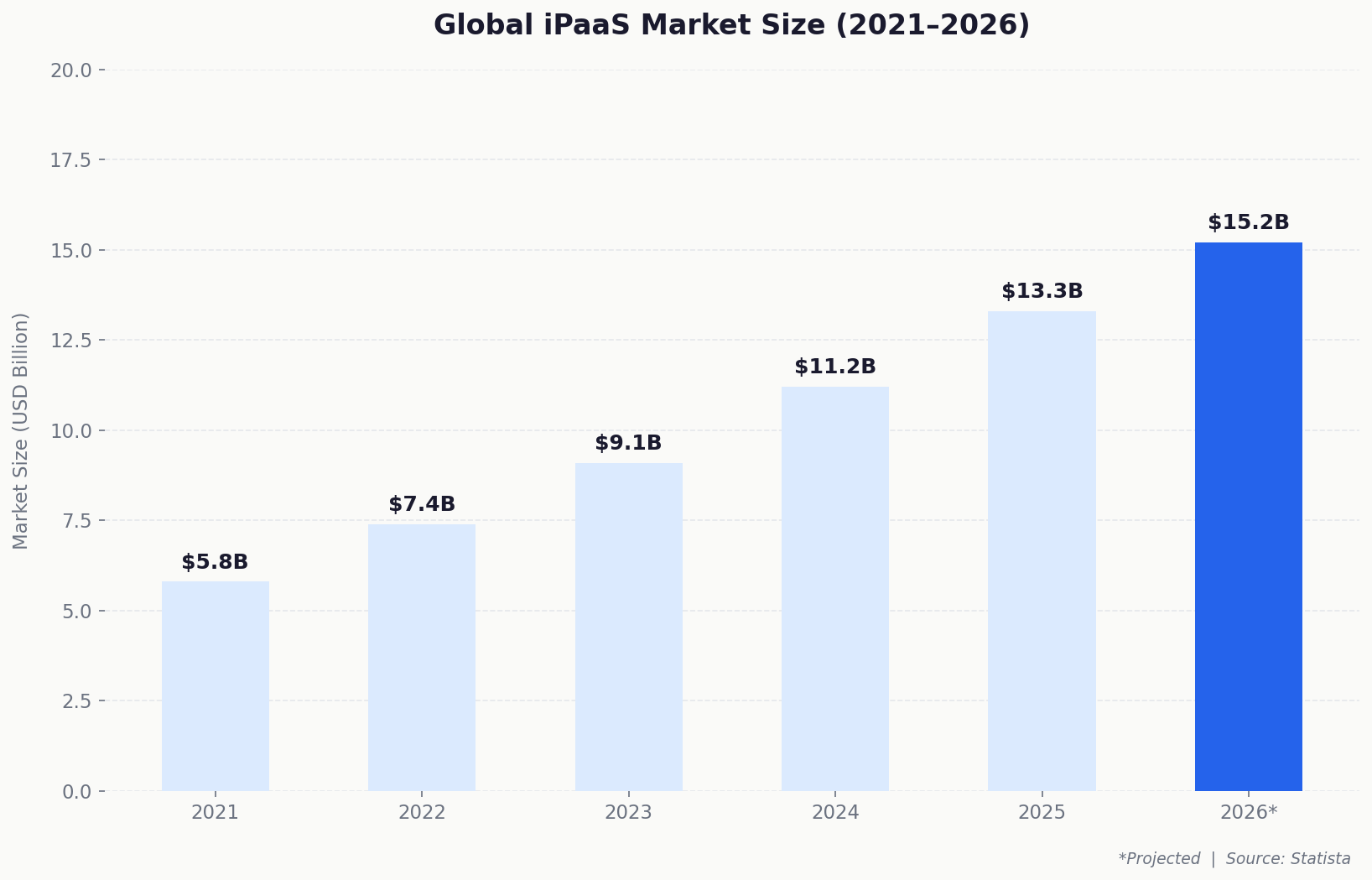
The demand is accelerating. According to Statista iPaaS market forecast, the global Integration Platform as a Service (iPaaS) market is projected to exceed $15 billion by 2026, driven by cloud-first enterprise architectures.
The challenge isn’t talent availability, it’s screening for the right OIC-specific capabilities that align with modern cloud integration needs.
TL;DR: What This Guide Covers
Finding qualified OIC developers in India is harder than it looks. The talent pool appears large but less than 20% of candidates who list Oracle Integration Cloud on their resume have actual production experience. Screening without a structured framework wastes 10–14 weeks.
This guide breaks down exactly what to look for. You'll get a skills checklist for evaluating OIC candidates, salary benchmarks by experience level, and a clear comparison of OIC vs MuleSoft vs IICS hiring so you hire the right profile for the right stack.
If you're mid-search or just starting one, the sections on red flags, screening simulations, and what teams consistently get wrong are where most hiring decisions are won or lost.
What Is Oracle Integration Cloud?
Oracle Integration Cloud (OIC) is Oracle’s managed iPaaS platform that enables enterprises to build, deploy, and manage integrations between Oracle and non-Oracle applications using pre-built adapters, visual flow designers, and process automation without managing underlying infrastructure. It consolidates integration, process automation, and visual application building in a single cloud-native service.
Why Hiring OIC Talent in India Is Harder Than It Looks
The surface-level talent pool looks large. Search “Oracle integration developer India” on any platform and you’ll find thousands of profiles. The real problem surfaces in the first technical round.
Most candidates in this pool have experience with Oracle SOA Suite, Oracle Service Bus, or older on-premise middleware not OIC. These are related but non-transferable skill sets. SOA Suite runs on WebLogic and requires Java/BPEL expertise; OIC is configuration-driven and runs on Oracle’s managed cloud. The overlap is conceptual, not operational.
There are three categories of mismatch enterprises consistently run into:
- SOA-to-OIC migrants who understand Oracle architecture but have never configured an OIC adapter or built an orchestration flow in the visual designer
- Generic iPaaS developers who have MuleSoft or Boomi experience but lack Oracle Fusion application context
- Freshers with OIC certifications but zero production integration experience
A qualified candidate who can actually deliver on enterprise OIC projects ERP Cloud integrations, HCM payroll flows, custom REST adapter builds represents maybe 15–20% of profiles that will pass an initial resume screen.
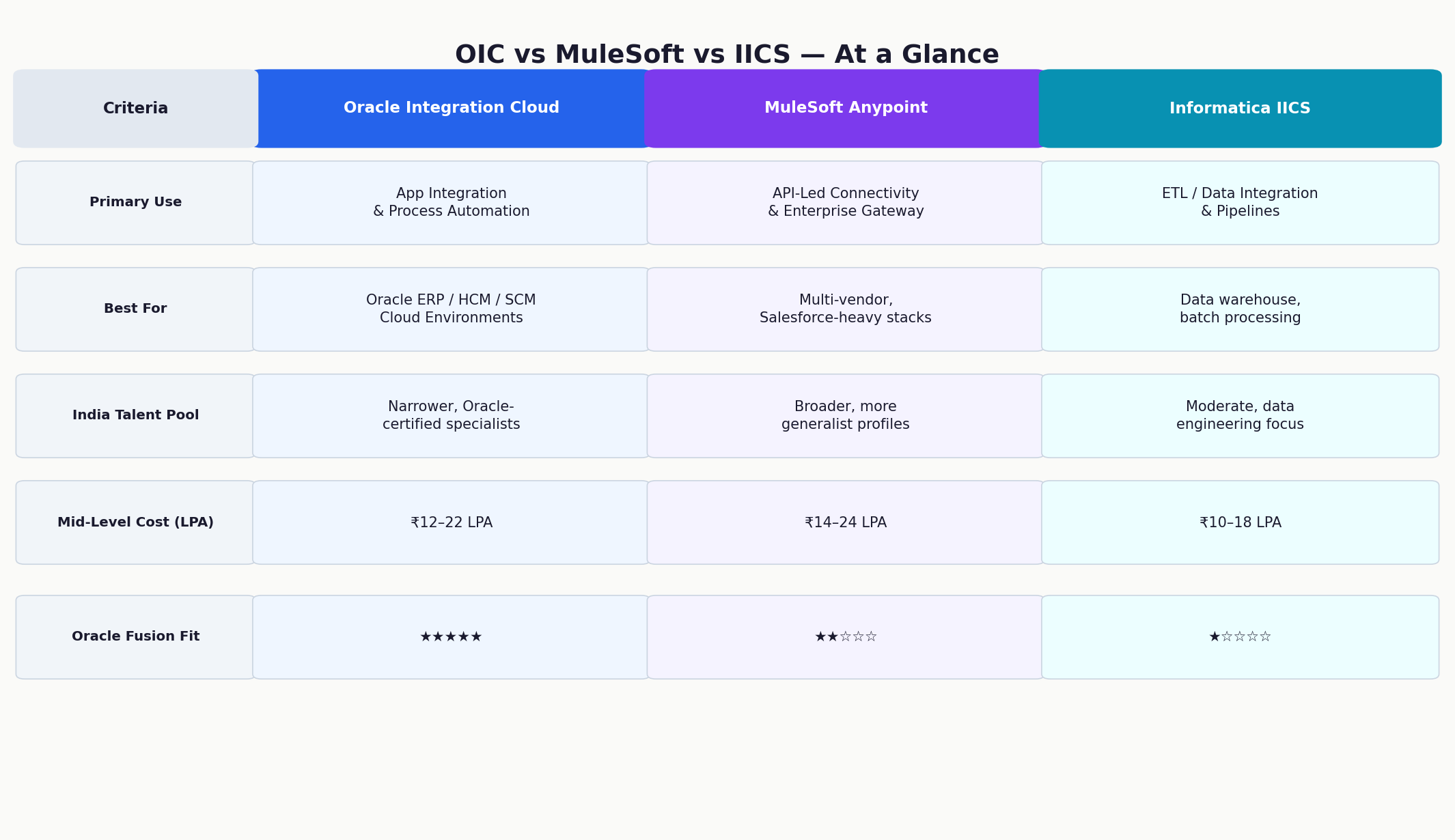
The median time to confirm a hire for a mid-to-senior hire OIC developer India requirement sits at 10–14 weeks when organizations run this process without a structured screening framework.
OIC Developer Skills: What to Screen For
This is where most hiring processes break down. Generic integration developer criteria don’t isolate OIC-specific competency. Below is a working framework for evaluating candidates when you hire OIC developer India profiles.
Core Technical Competencies
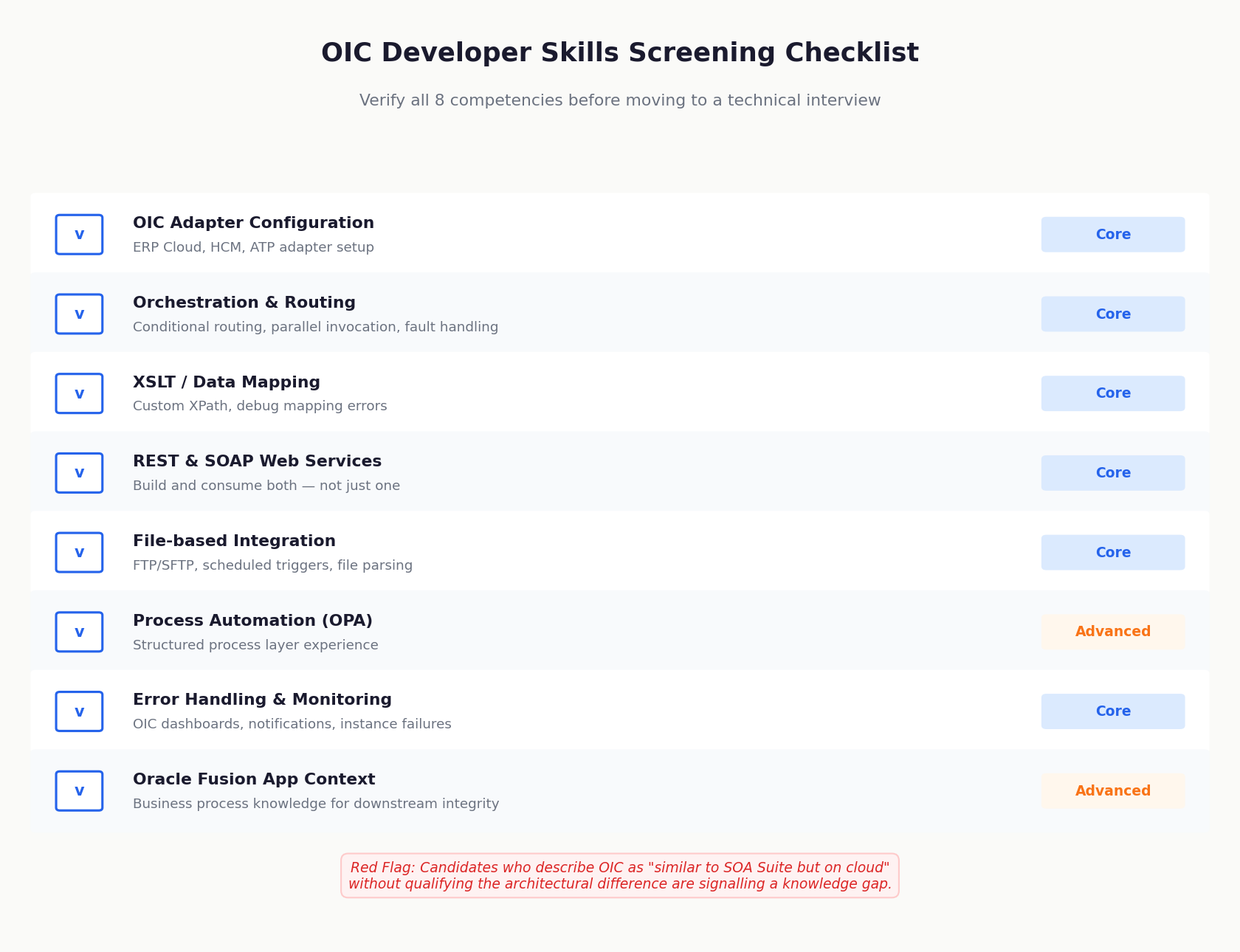
When evaluating any Oracle Integration Cloud developer, verify these before moving to a technical interview:
- OIC Adapter Configuration Has the candidate configured Oracle ERP Cloud, HCM, or ATP adapters in OIC? Ask for specific integration names, not generic descriptions.
- Orchestration and Routing Can they build conditional routing, fault handling, and parallel invocation in OIC’s visual designer?
- XSLT / Data Mapping OIC uses XSLT-based mapper; candidates should be able to debug mapping errors and write custom XPath expressions.
- REST and SOAP Web Services Both are used heavily in OIC; assess whether the candidate can build and consume both, not just one.
- File-based Integration FTP/SFTP adapter usage, scheduled triggers, file parsing common in payroll and ERP batch processes.
- Process Automation (OPA) A differentiating skill; not all OIC developers have worked with the structured process layer.
- Error Handling and Monitoring Can they configure OIC monitoring dashboards, set up notifications, and interpret instance failures?
- Oracle Fusion Application Context Do they understand the business process well enough to design integrations that don’t break downstream flows?
Red Flags in Screening
Candidates who describe OIC as “similar to SOA Suite but on cloud” without qualifying the architectural differences are flagging a knowledge gap. OIC uses a fundamentally different execution model with no WebLogic dependency, adapter-driven rather than WSDL-first, and managed runtime. This distinction matters on every production project.
OIC vs MuleSoft Hiring: Which Profile Fits Your Stack?
This is one of the highest-stakes decisions in enterprise OIC vs MuleSoft hiring, and it’s frequently made on vendor familiarity rather than fit.
| Criteria | OIC Developer | MuleSoft Developer |
| Best fit environment | Oracle Fusion, ERP Cloud, HCM Cloud | Multi-vendor, Salesforce-heavy stacks |
| Adapter model | Pre-built Oracle adapters, low-code | Anypoint connectors, code-heavier |
| Talent pool depth (India) | Narrower but Oracle-certified | Broader, more generalist profiles |
| Typical project type | Oracle cloud migrations, ERP extensions | API-led connectivity, enterprise API gateways |
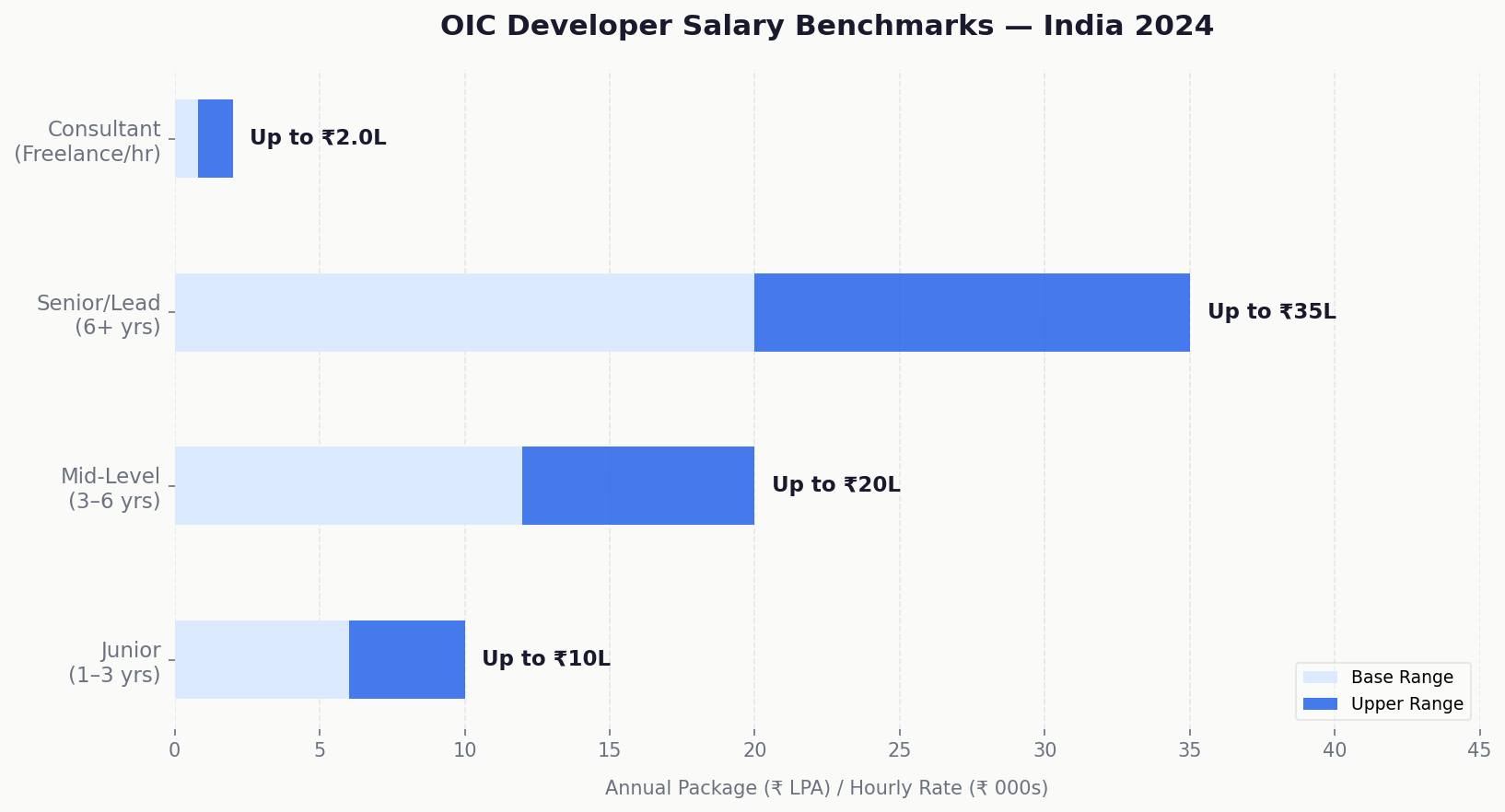
| Cost (India, mid-level) | ₹12–22 LPA | ₹14–24 LPA |
If your enterprise runs Oracle Fusion Applications and your integrations primarily touch Oracle modules Financials, SCM, HCM hire OIC developer India profiles before evaluating MuleSoft. The pre-built adapter library alone reduces development time by 30–40% on Oracle-to-Oracle flows.
MuleSoft becomes the stronger hire when you’re building an enterprise API gateway across heterogeneous systems with no dominant Oracle footprint.
OIC vs IICS: A Separate Consideration
Informatica Intelligent Cloud Services (IICS) is often confused with OIC in job descriptions. IICS is primarily a data integration and ETL platform; OIC is an application integration and process automation platform. The skills are largely non-transferable. If you’re hiring for data pipeline work, IICS profiles are the right search. For application-to-application integration in an Oracle environment, OIC is the correct hire.
Oracle Integration Cloud Developer Salary in India
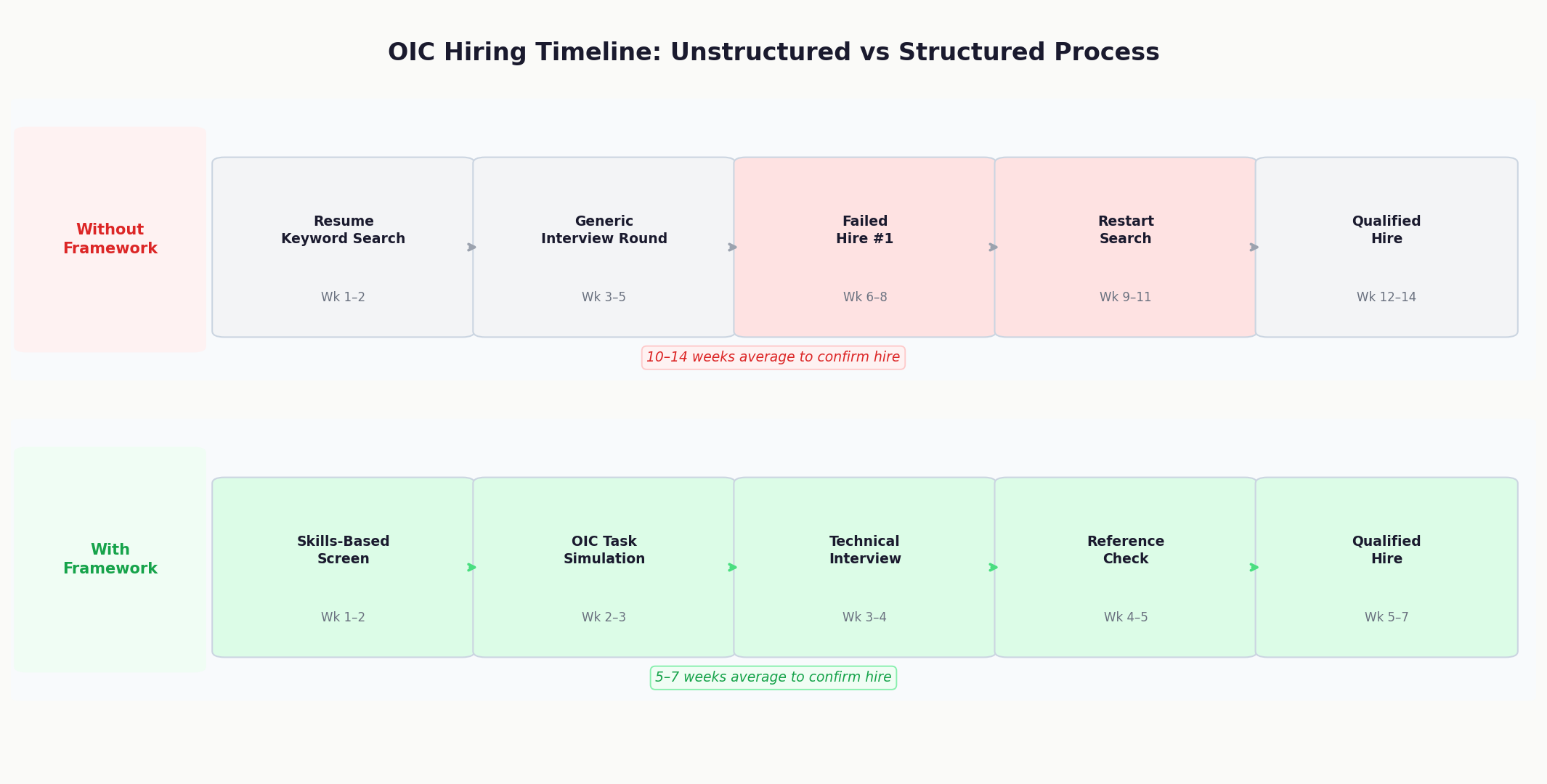
Oracle Integration Cloud developer salary benchmarks in India vary significantly by tier, experience, and location.
- Junior (1–3 years, OIC exposure): ₹6–10 LPA
- Mid-level (3–6 years, production OIC deployments): ₹12–20 LPA
- Senior / Lead (6+ years, OIC + Fusion architecture): ₹20–35 LPA
- Consultant / Freelance (project-based): ₹800–2,000/hour
Bengaluru, Hyderabad, and Pune account for the majority of available hire Oracle middleware developer and OIC profiles. Remote-first hiring has expanded the viable pool to include Tier-2 cities, but senior profiles with Oracle Fusion Application context remain concentrated in metro areas.
Candidates with Oracle Cloud Infrastructure (OCI) exposure alongside OIC command a 15–20% salary premium due to the cross-platform deployment capabilities they bring.
What Real OIC Hiring Engagements Look Like
Enterprise ERP Integration Rollout (Manufacturing, 8,000 employees): A mid-market manufacturer migrating to Oracle ERP Cloud needed three OIC developers to build 14 integration flows connecting ERP, HCM, and a legacy WMS. The hiring team initially screened SOA Suite candidates assuming transferable skills. After two failed hires, they restructured screening around OIC-specific task simulation asking candidates to walk through adapter configuration and fault handling logic. The project was staffed in 6 weeks with the revised process, and the integration layer went live 11 weeks ahead of the original schedule.
Global HRMS Integration (Professional Services, 3,500 employees): A professional IT services firm needed an OIC specialist to integrate Oracle HCM Cloud with a third-party payroll platform via REST APIs. The constraint was finding a developer with both OIC certification and payroll domain knowledge. By separating the two requirements, hiring an OIC integration specialist and pairing them with a payroll SME the team cut time-to-delivery by 8 weeks and avoided a costly rework cycle.
What Most Teams Get Wrong When They Hire OIC Developer India Profiles
The single most consistent mistake: treating hire OIC developer India as a resume keyword search rather than a skills-based filter. OIC appears on hundreds of thousands of Oracle developer profiles as a secondary or aspirational skill. Without a structured technical screen, specifically a task simulation or live troubleshooting exercise, the filtering burden falls entirely on the interview, which is too late and too slow.
The second mistake is conflating Oracle certification with project readiness. Oracle’s OIC Foundation Associate certification validates conceptual knowledge. It does not validate production integration experience, fault handling, or performance tuning on high-volume flows. Require project-specific evidence: adapter names, integration pattern descriptions, error scenarios handled.
Third: underestimating lead time. Qualified mid-to-senior Oracle Integration Cloud professionals with active Oracle Fusion deployments on their resume are rarely actively searching. Passive sourcing, with a 4–6 week engagement runway, consistently outperforms active job-board sourcing for this profile.
FAQ: Hiring OIC Developers in India
What skills should an OIC developer have for enterprise projects?
A production-ready OIC developer should be able to configure Oracle ERP Cloud and HCM adapters, build XSLT-based data mappings, implement fault handling, manage scheduled integrations, and monitor instance execution. Familiarity with Oracle Fusion Application data models is a significant differentiator for ERP-adjacent integration work.
How much does an Oracle Integration Cloud developer cost in India?
Mid-level OIC developers in India typically cost ₹12–20 LPA for full-time roles. Senior consultants or architects with OIC and Fusion expertise range from ₹20–35 LPA. Freelance/project-based rates run ₹800–2,000/hour depending on specialization and engagement complexity.
How long does it take to hire a qualified OIC developer in India?
With an unstructured process, 10–14 weeks is typical. With a skills-based screening framework task simulation, adapter-specific technical questions, and structured reference checks qualified hires are confirmed in 5–7 weeks. Passive sourcing timelines add 2–3 weeks but improve candidate quality significantly.
Is OIC better than MuleSoft for Oracle-heavy environments?
For enterprises running Oracle Fusion Applications, OIC is the operationally correct choice. Pre-built Oracle adapters, native Oracle ERP Cloud connectivity, and lower configuration overhead make OIC 30–40% faster to deploy on Oracle-to-Oracle integration flows. MuleSoft is stronger for heterogeneous, multi-vendor environments where API-led connectivity across non-Oracle systems is the primary use case.
What is the difference between OIC and IICS developers?
OIC developers specialize in application-to-application integration connecting Oracle and third-party SaaS applications, automating business processes, and managing real-time data flows. IICS developers focus on data integration, ETL pipelines, and batch data movement. The skills are not interchangeable; hiring the wrong profile adds 6–10 weeks of rework to most projects.
Should I hire a full-time OIC developer or use a consultant?
For organizations running 3+ active Oracle Cloud modules with ongoing integration requirements, a full-time hire is more cost-effective after the 12–18 month mark. For discrete migration projects or one-time integration builds, a consultant engagement reduces overhead and provides faster access to senior-level expertise without a permanent headcount addition.
How do I verify an OIC developer’s experience before hiring?
Ask candidates to describe a specific integration they built: which adapters were used, how the orchestration flow was structured, what fault handling was configured, and what errors they encountered in production. Generic answers indicate conceptual knowledge, not operational experience. A 45-minute technical simulation reviewing an existing OIC flow and identifying issues is the highest-signal screen available.
Closing
If you’re building an Oracle integration team or have an active requirement to hire OIC developer India profiles for an ERP Cloud or HCM Cloud rollout, the screening framework matters more than the sourcing channel. Most sourcing failures are actually filtering failures and by the time that becomes visible, you’ve already spent 8–12 weeks and a significant portion of your hiring budget on the wrong profiles.
The OIC talent market in India rewards preparation. Enterprises that come in with a defined skills benchmark, a structured technical simulation, and realistic salary expectations close qualified hires 2–3x faster than those running open-ended searches. The difference isn’t luck or the network ‘s process.
Supersourcing has supported OIC hiring and integration delivery across 30+ Oracle Cloud engagements spanning ERP Cloud, HCM, and SCM implementations. If you want a pressure-tested screening checklist, help evaluating a candidate shortlist, or an experienced OIC team ready to deliver [reach out through our contact page] or drop a note directly to mayank@engineerbabu.com. We’ll respond within one business day with a straightforward assessment of how we can help.
