

Product management hiring recovered hard in 2026 and got harder at the same time. LinkedIn’s May 2026 data shows the PM job market up 14% year-over-year, with Associate PM roles growing 33%, and roughly 42,000 open PM roles tracked on the platform in early 2026, double the prior year. Yet roles that filled in six to eight weeks in 2022 now routinely sit open for six to twelve months. More candidates, more openings, slower hires. That is not a supply problem. It is an evaluation problem.
The teams that struggle to hire product managers for tech products are almost never short of applicants. A single PM posting at a funded startup in Bengaluru or Austin draws 400–900 applications within two weeks. The bottleneck is that most hiring teams cannot articulate which kind of PM they need, cannot separate polished interview storytelling from actual product judgment, and cannot run a case-study round that predicts on-the-job performance. So they interview for three months, hire the most articulate candidate, and discover in month four that they hired a project manager with a product title.
According to U.S. Bureau of Labor Statistics, Employment Projections, management roles (including product leadership) are projected to grow steadily through 2026 and beyond, driven by increasing demand for digital transformation and innovation leadership. This sustained growth is intensifying competition for skilled product managers.
The stakes are quantifiable. McKinsey’s research on the product operating model found that organizations that put empowered, accountable product managers at the center of delivery saw a 60% improvement in innovation cycle times, with pilot products on track for tens of millions of dollars in combined revenue uplift and cost savings.
This guide is the full playbook: archetypes, scoping, sourcing, a structured interview loop with a complete question bank, contracts, onboarding, and the KPIs that tell you whether the hire worked with real cost and timeline numbers throughout.
TL;DR
This guide walks technical founders, CTOs, and hiring leaders through the entire process to hire product managers for tech products from deciding which PM archetype you actually need, to running a case-study interview loop, to negotiating comp and managing the first 90 days. It is written for teams making the hire themselves and for teams evaluating a hiring partner.
The single most useful number in it: a well-run PM hiring process takes 3–5 weeks from job description to signed offer, while the market average is now 3–6 months and a mis-scoped role is the reason for most of that gap. Archetype clarity before sourcing is worth more than any interview technique.
By the end, you will be able to write an archetype-specific job description, screen a 500-applicant pool down to 8 candidates in under a week using a PM skills checklist, run four interview rounds that actually predict performance, and judge within one quarter whether your new PM is working out.
What Does It Mean to Hire Product Managers for Tech Products?
Hiring product managers for tech products is the process of scoping, sourcing, evaluating, and onboarding the person accountable for what a software product becomes: they own the roadmap, translate user and business needs into engineering priorities, and are measured on product outcomes adoption, retention, revenue rather than feature output.
What this role is not three confusions that derail hiring before it starts:
- Not a project manager. Project managers own timelines and coordination; product managers own what gets built and why. Interviewing for delivery discipline gets you the former.
- Not a product owner in the narrow Scrum sense. Backlog grooming and writing user stories is maybe 20% of a strong PM’s job; a role scoped as “PO for the sprint team” will repel strategic candidates.
- Not a “mini-CEO” you can hire instead of making decisions. A PM without decision rights and a clear success metric fails regardless of talent which is why scoping (Phase 1 below) comes before sourcing.
Why the PM Hire Matters More Than Most Engineering Hires
A mediocre engineer slows one workstream. A mediocre PM misdirects an entire team’s output for quarters. The business case for getting this hire right, in concrete terms:
- Cost of misdirected engineering. A 6-person product squad in India costs roughly ₹2.5–4 crore/year fully loaded (≈$300k–480k); in the US, $1.2M–2M/year. A PM who points that squad at the wrong problems for two quarters burns 25–50% of that spend with nothing to show.
- Speed to learning. Teams with strong PMs ship-and-measure in 2-week cycles; teams without one typically run 6–10-week “build what the founder said in the last meeting” cycles. That is a 3–4x difference in iteration speed toward product-market fit.
- Revenue attribution. In most B2B SaaS engagements we’ve run, activation-rate and onboarding-flow improvements owned by a dedicated growth PM moved trial-to-paid conversion by 15–40% within two quarters, the kind of outcome nobody on a squad is accountable for until a PM owns it.
- Risk reduction. ProductBoard’s CPO survey data shows nearly 39% of product investments now fail due to lack of clear strategy, up from 25% a year earlier. The PM is the role whose entire job is preventing exactly that failure mode.
- Hiring leverage downstream. A strong PM in seat makes every subsequent engineering hire more productive from week one, because requirements arrive scoped, prioritized, and justified.
The Core Problem: Why PM Hiring Fails at Most Tech Companies
The failure pattern is consistent enough across hundreds of tech hiring engagements to state as rules:
Most dedicated teams underestimate scoping by 3–4x. They spend 2 hours on the job description and 60+ hours interviewing. Inverting even a fraction of that a half-day defining the archetype, success metrics, and decision rights cuts the interview funnel in half because screening becomes objective.
Interview loops reward performance, not judgment. Unstructured “tell me about a product you love” conversations selected for storytelling. Candidates now rehearse these with AI tools; polish has never been cheaper. Without a standardized case-study round scored on a rubric, two interviewers routinely rate the same candidate 2 points apart on a 5-point scale.
Archetype mismatch is the #1 cause of 6-month regret. A brilliant platform PM hired into a growth role (or vice versa) fails predictably not from lack of talent, but because the skills, instincts, and even the metrics they care about are different jobs wearing the same title. The next section fixes that first.
The Walkthrough: The Product Manager Hiring Process From Scratch to Signed Offer
The full product manager hiring process, run well, takes 3–5 weeks from job description to accepted offer, plus a 30–90-day notice period in India (2–4 weeks in the US). Below is every phase, in order, with the checklists we actually use.
Phase 1 Define the Archetype and Requirements (Days 1–3)
Before a single sourcing email goes out, answer one question: which PM archetype does this product stage need? Tech PMs cluster into four archetypes, and they are not interchangeable.
The four PM archetypes:
- Core / Generalist PM owns a product area end-to-end: discovery, roadmap, delivery, GTM coordination. Best for: Series A–B startups, first PM hire, 1–2 squads. Key metric orientation: adoption and retention.
- Technical PM (TPM) owns products whose users are engineers or whose complexity is architectural: APIs, SDKs, data platforms, ML/AI products, and infrastructure. Reads system design docs fluently; often ex-engineer. Key metric orientation: developer experience, reliability, integration velocity.
- Growth PM owns funnel economics: activation, onboarding, pricing/packaging experiments, retention loops. Lives in the product analytics stack (Amplitude, Mixpanel) and runs 5–15 A/B tests a quarter. Key metric orientation: conversion, activation rate, retention cohorts.
- Platform PM owns internal or shared capabilities other teams build on: design systems, payments infrastructure, internal tooling. Customers are internal teams; the job is 60% stakeholder management. Key metric orientation: adoption by internal teams, leverage created.
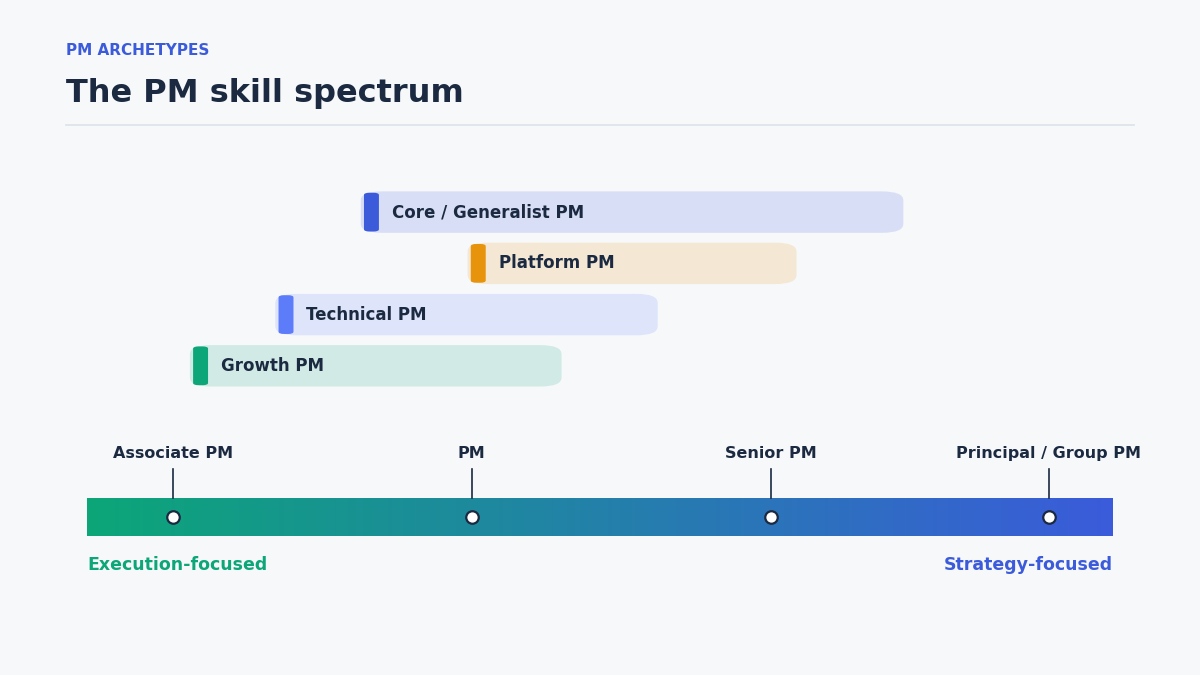
The PM skill spectrum (infographic block design spec): Render as a horizontal spectrum from execution-focused (left) to strategy-focused (right). Left to right: Associate PM (ticket-level execution, analytics) → PM (feature/squad ownership) → Senior PM (product-area ownership, cross-functional tradeoffs) → Principal/Group PM (multi-product strategy, org-level bets). Overlay the four archetypes as bands:
Growth and Technical PMs skew execution-center; Platform skews center; Core spans the middle; Principal roles sit far right. Alt text: “PM skill spectrum infographic showing how to hire product managers for tech products, from execution-focused to strategy-focused roles.”
Requirements checklist to complete before sourcing:
- Archetype (one of the four if you wrote “all of the above,” you have not decided).
- Seniority band on the spectrum, tied to scope: one squad = PM; a product area with revenue ownership = Senior PM.
- The single North Star metric this hire will own in year one.
- Decision rights: what can this PM decide without founder/CPO sign-off? Write it down; candidates will ask, and the good ones walk if the answer is “nothing yet.”
- Budget band (see the salary section below for current ₹/$ ranges) including ESOP policy.
- Hard requirements vs. trainable ones cap hard requirements at five. JDs with twelve “must-haves” screen out exactly the non-linear backgrounds that produce the best PMs.
Red flag at this stage: if three stakeholders describe the role three different ways, the role is not ready to hire for. Reconcile first; every week of misalignment here adds two weeks to the funnel later.
Phase 2 Sourcing and Vetting (Week 1–2)
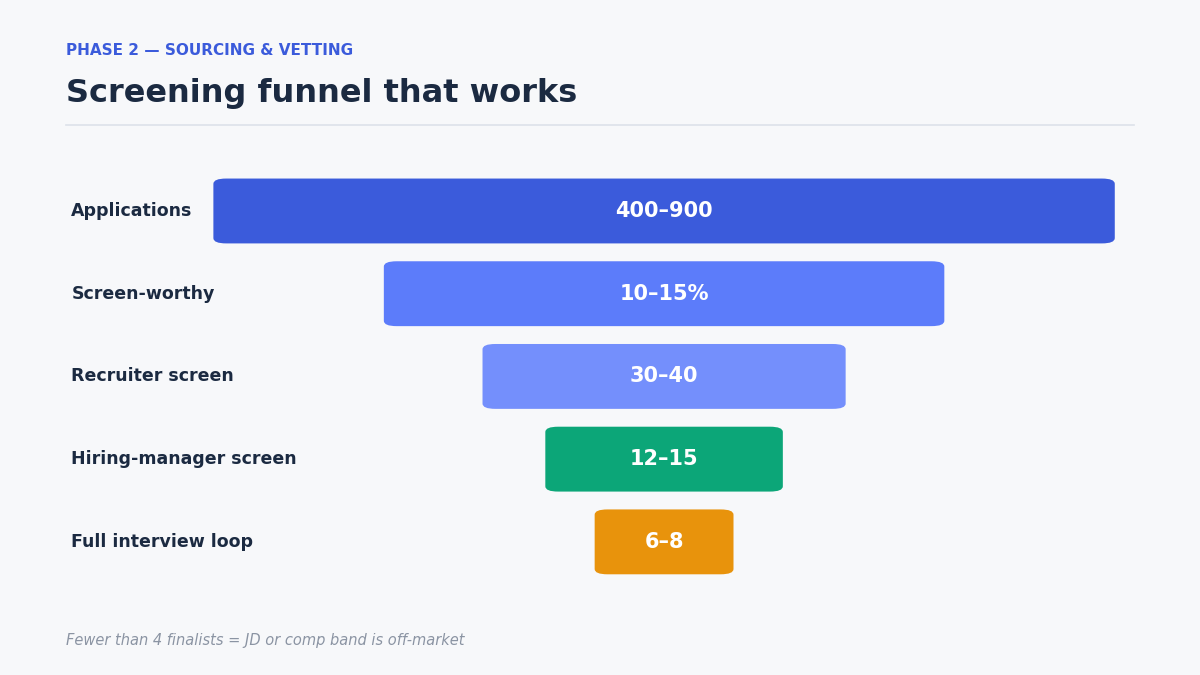
A funded-startup PM posting now draws 400–900 applicants in 14 days. Volume is not the problem; signal extraction is.
What a good screening funnel looks like (typical conversion at each gate):
- Application → screen-worthy: ~10–15%. Screen résumés for outcomes with numbers (“grew activation 22%”), not responsibilities (“owned the roadmap”). An ATS keyword filter alone throws away strong non-linear candidates and pairs it with human review of the top slice.
- Screen-worthy → recruiter screen: top 30–40 profiles. A 20-minute call testing three things: can they explain their last product’s business model in plain language, what metric they moved, and why they’re leaving. Vague on all three = out.
- Recruiter screen → hiring-manager screen: 12–15. The HM screen tests archetype fit explicitly: a growth-PM candidate should light up talking about experiment velocity; a TPM candidate should ask about your architecture unprompted.
- HM screen → full loop: 6–8 candidates. More than 8 in the loop means your earlier gates are too loose; fewer than 4 means your JD or comp band is off-market.
Sourcing channels, ranked by signal quality for PM roles: referrals from your senior engineers and designers (highest signal they know who actually made decisions); targeted outreach to PMs at companies one stage ahead of yours; PM communities and newsletters; job boards (highest volume, lowest signal). If internal bandwidth for steps 1–3 doesn’t exist, this screening layer is exactly what RPO services exist to run an embedded recruiting pod that executes your rubric rather than spraying profiles.
AI-assisted sourcing done well surfaces the top 2% of a vetted pool and compresses JD-to-shortlist to 7–10 working days; done badly it’s a keyword match. Ask any partner to show you the vetting layer between the AI and your inbox.
Vetting red flags (pattern-based, from real screens):
- Every story is “we” with no recoverable “I” probe twice; if the personal contribution never materializes, the candidate was adjacent to the work.
- Metrics without denominators (“increased engagement significantly,” “improved conversion”) ask for the baseline; watch what happens.
- Job-hopping with title inflation: PM → Senior PM → Lead PM across three companies in three years usually means they’ve never seen the consequences of their own roadmap.
- Trashing previous engineering teams. PMs who blame engineers repeat the pattern with yours.
Phase 3 Engagement Models and Contracts (parallel with Phase 2)
There are four ways to get PM capacity, and cost is the least important difference between them:
- Full-time direct hire. Highest commitment, highest cultural integration. Right for: your first PM, any role owning strategy. Timeline: 3–5 weeks to offer + notice period.
- Contract / fractional PM. A senior PM 2–3 days a week, typically ₹2.5–5 lakh/month in India ($8k–15k/month US-based). Right for: pre-first-PM startups needing roadmap discipline now, or covering parental leave. Wrong for: anything requiring deep domain ramp.
- Staff augmentation via a staffing partner. A vetted, dedicated PM on the partner’s payroll, working exclusively on your product. Right for: GCCs and scaling product orgs adding 2–5 PMs fast. What good looks like from IT staffing services: no shared bandwidth across clients, a dedicated account manager, and a contractual replacement guarantee 7–10 days to replace a non-fit rather than restarting a 3-month search.
- RPO-run permanent hiring. You own the employee; the partner owns the pipeline, screens, and coordination. Right for: hiring 3+ PMs in a year or standing up a product org inside a new GCC.
Contract terms that actually matter (checklist):
- NDA and IP assignment signed before the case-study round, not after the offer candidates will see roadmap material.
- For contract/staff-aug: explicit IP assignment to you, not the partner; NDA-backed confidentiality; a named replacement SLA in days, not “commercially reasonable efforts.”
- Notice-period buyout policy decided in advance (India-specific; see the cost section) deals die in week 3 because nobody budgeted ₹2–4 lakh for a buyout.
- ESOP vesting terms in the offer letter, not “to be discussed.” Senior PMs negotiate equity as hard as cash.
Phase 4 Onboarding and Ramp-Up (Weeks 1–2 on the job)
PM onboarding failure looks like this: two weeks of shadowing meetings, no defined first win, and by week 6 the team quietly routes decisions around the new hire. Prevent it with structure:
The first-two-weeks checklist:
- Day 1 access, not day 5: analytics stack, roadmap tool, customer call recordings, support ticket queue, revenue dashboard. Every day of missing access is a day of ramp lost.
- 20 customer touchpoints in 14 days: 5 live customer calls, 10 recorded calls, 5 support-ticket deep dives. A PM who hasn’t heard real users by week 2 will substitute stakeholder opinions for user evidence permanently.
- A written 30-60-90 plan, co-authored with their manager by day 5 30: learn (users, data, codebase-level architecture for TPMs); 60: own (run planning, ship one scoped improvement); 90: lead (present a roadmap point-of-view with evidence).
- One deliberately small first win by week 3 a funnel fix, a pricing-page test, a re-prioritized backlog with rationale. Credibility with engineers is built by the first shipped decision, not the title.
- Introductions with context: the hiring manager tells each stakeholder what this PM owns and decides. Skipping this is how decision rights evaporate.
Onboarding friction we see repeatedly: in staff-aug and GCC setups, the #1 ramp-killer is tool access sitting in a security-approval queue for 10+ days. Pre-clear access requests the week the offer is signed.
Phase 5 Managing Delivery (Quarter 1 and Beyond)
You cannot manage a PM by output volume shipped features are not the job. Manage by decision quality and outcome movement:
The operating cadence that works:
- Weekly 1:1 (manager): decisions made, decisions pending, blockers. Not a status meeting, the roadmap tool is the status.
- Bi-weekly metric review: the North Star and its 3–4 input metrics, with the PM narrating why numbers moved. A PM who can’t explain variance by quarter-end is not close enough to the data to pair them with an analyst or hire data analysts (link to role page) into the pod if analytics capacity is the real gap.
- Monthly roadmap review: what changed since last month and what evidence changed it. Zero changes for two consecutive months is itself a red flag it means no learning is flowing in.
- Quarterly OKR scoring with a written retro.
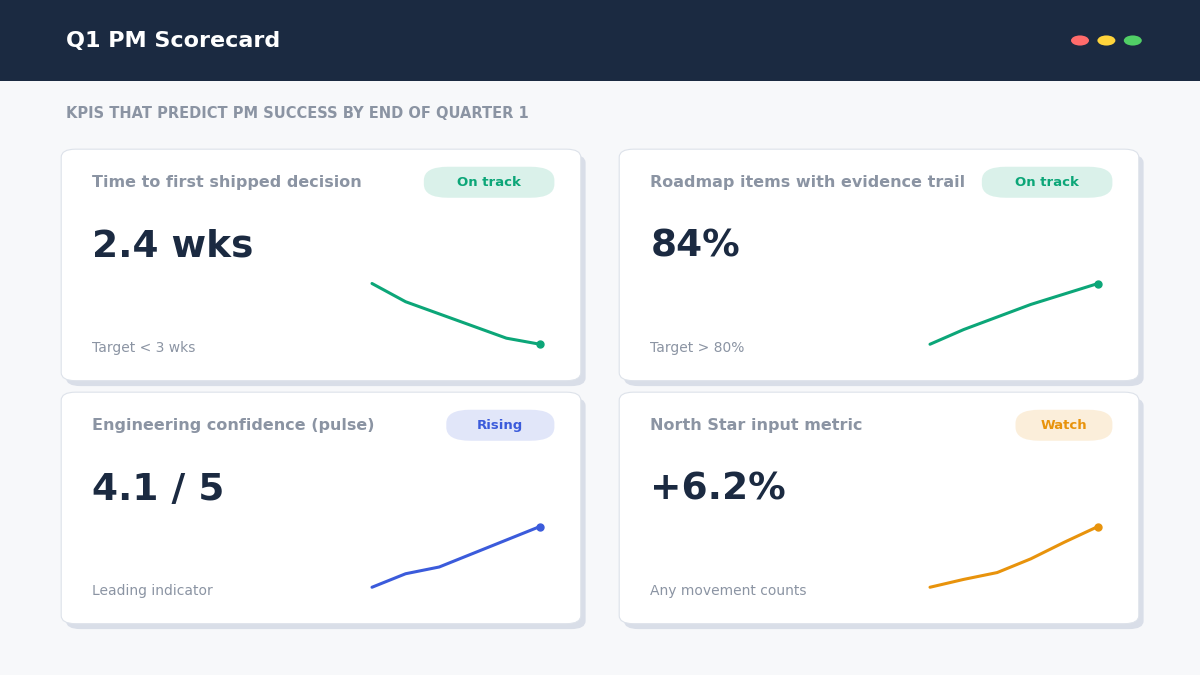
KPIs that predict PM success by end of quarter 1: time-to-first-shipped-decision (target: <3 weeks), % of roadmap items with a written evidence trail (target: >80%), engineering team confidence score in planning (pulse survey this leading indicator beats any output metric), and movement on one agreed input metric, even small.
For staff-aug/RPO engagements: insist on a named account manager and a fixed reporting cadence in the contract. In our delivery data, engagements with a weekly account-management touchpoint hold a <1% candidate drop-off on contract roles; engagements managed by a shared ticket queue do not.
Phase 6 Scaling or Exiting (Month 4+)
Scaling triggers add the next PM when: one PM covers 3+ squads (industry norm: 1 PM per 6–10 engineers), a distinct product line has its own P&L, or discovery work is being skipped because delivery consumes 100% of PM time.
Sequencing the second and third PM: hire the archetype that complements, not clones, the first. A core PM in seat → the next hire is usually a growth PM (if the funnel is the bottleneck) or a TPM (if platform/API work is). Promote your first PM to own the area before the new hire lands so ownership boundaries are explicit.
Exiting a mis-hire: decide by day 90 using the Phase 5 KPIs the sunk-cost drift from “not sure” to “definitely not working” averages 5 months and takes team morale with it. If the PM came through a staffing partner, invoke the replacement clause: a 7–10-day replacement guarantee exists precisely so a wrong fit costs you two weeks, not two quarters. If it’s a direct hire, run a documented 30-day performance plan with the Phase 5 metrics both for fairness and for what it teaches you about your own scoping.
Offboarding checklist: roadmap rationale documented, experiment log handed over, customer-relationship map transferred, access revoked same-day, and a retro on which phase of this guide the hiring process actually failed at is almost always Phase 1.
Technical Product Manager vs Product Manager: Which One Do You Actually Need?
Defaulting to “technical, because we’re a tech company” is the most common scoping mistake in tech hiring. The technical product manager vs product manager question has a precise answer, and it isn’t about your company it’s about the product’s user. Every PM at a software company needs technical fluency; a TPM is a different job.
| Dimension | Product Manager (Core/Growth) | Technical Product Manager |
| Primary user | End customers, business buyers | Engineers, internal teams, API consumers |
| Typical products | B2C apps, SaaS workflows, funnels | APIs, SDKs, data platforms, ML systems, infra |
| Background pattern | Business, design, analytics, ops → product | Engineering → product (most common path) |
| Core evaluation | Product sense, prioritization, user empathy | System-design literacy + product judgment |
| Key artifacts | PRDs, funnel analyses, JTBD research | API specs, technical RFC reviews, migration plans |
| Where they fail | Deep-infra products (can’t earn engineer trust) | Consumer funnels (over-engineer, under-empathize) |
| Comp premium | Baseline | Typically 10–25% above equivalent-level PM |
The 30-second decision rule: if the product’s user writes code, or if roadmap decisions require reading architecture documents to make correctly, hire a TPM. Otherwise, hire a PM with technical fluency and stop paying the TPM premium for skills the role won’t use.
Should a PM know how to code? No but every PM you hire should pass this bar: they can explain your product’s architecture at the block-diagram level, understand why a “small” change might be a big migration, and hold a credible tradeoff conversation with a senior engineer. Test that bar directly (question bank below) instead of proxying it with a CS-degree filter, which screens out some of the best growth and core PMs in the market.
The PM Skills Checklist: What to Actually Evaluate
Most JDs list 15 skills and evaluate none of them systematically. This PM skills checklist is the competency matrix worth scoring five core competencies for every archetype, plus archetype-specific additions. Score each 1–5 in the interview loop, and define what a 5 looks like before interviews start.
Core competencies (all PM hires):
- Product sense generates plausible user problems unprompted, distinguishes symptoms from causes, and has a taste about what “good” looks like in your category.
- Analytical rigor frames metrics as ratios and cohorts, not totals; knows when an A/B test is underpowered; asks for denominators reflexively.
- Prioritization under constraint can kill a good idea with a clear rationale; use (and can criticize) frameworks like RICE rather than reciting them.
- Communication & stakeholder management writes a one-page PRD an engineer would call clear; disagrees with a senior stakeholder without either folding or grandstanding.
- Execution & ownership has personally unblocked shipping, not just tracked it; stories contain specific, recoverable “I” decisions.
Archetype add-ons:
- Technical PM: system-design literacy, API product thinking, ability to scope migrations and technical debt tradeoffs.
- Growth PM: experiment design (hypothesis → MDE → readout), funnel decomposition, pricing/packaging instincts.
- Platform PM: internal-customer discovery, adoption strategy for shared services, influence without authority.
Scoring rule: hire at 4+ on the two competencies the archetype lives on, 3+ everywhere else. A candidate at 5 on communication and 2 on analytical rigor is the classic charming mis-hire; the interview loop below is designed to catch exactly that profile.
Product Manager Interview Questions: The Complete Bank
Structure beats brilliance here. The product manager interview questions below are grouped into four rounds, each owned by a named interviewer scoring named competencies on the rubric above. Pick 3–4 questions per round and go deep rather than covering all of them.
Round 1 Screening (30 min, recruiter or HM):
- Walk me through your last product in two minutes: who used it, how it made money, what metric you owned.
- What’s a product decision you got wrong, and what did it cost?
- Why this company, this stage, this problem space? (Screens for spray-and-pray applicants.)
Round 2 Product sense & craft (60 min, HM or senior PM):
- Pick a product you use daily. What’s one thing you’d change, for whom, and what metric would tell you it worked?
- Here’s a real (sanitized) piece of our funnel data: what do you notice, and what would you investigate first?
- A user interview says X; the data says the opposite. Walk me through what you do.
- Tell me about a time you killed a feature people wanted. How did you decide, and how did you communicate it?
Round 3 Case study round (90 min take-home or live case; see design notes below):
- Live case: “Activation for our product is 28% and flat. You have one squad for one quarter. Take me from problem to plan.”
- Take-home alternative: a 3-page written exercise on a real-adjacent problem, presented to a panel for 45 minutes with hostile-but-fair questioning.
Round 4 Technical & cross-functional (60 min, senior engineer + designer):
- (All archetypes) Sketch our product’s architecture as you understand it from the outside. What are you unsure about?
- (All) An engineer says your “small” request is actually a three-week migration. What do you ask next?
- (TPM) Design the API for [simple relevant service]. Who’s the consumer, what’s versioning strategy, what do you deliberately leave out of v1?
- (Growth) Design an experiment to test a pricing change. What’s your hypothesis, sample size logic, and guardrail metric?
- (Platform) Two internal teams want contradictory things from your platform. How do you decide, and how do you keep the loser on side?
Behavioral round add-ons (fold into any round): biggest stakeholder conflict and its resolution; a time they changed their mind based on evidence; the roadmap decision they’d reverse today.
How to Judge Product Sense in an Interview
Product sense is judged by the shape of a candidate’s thinking, not the cleverness of their answer. Score these five observable behaviors during the case round:
- Do they interrogate the problem before proposing solutions? Strong candidates spend the first third asking who the user is, what “flat activation” means cohort by cohort, and what’s been tried. Weak candidates start listing features inside 90 seconds.
- Do they name the user specifically? “Users want” is a 2; “first-time admins on the free tier who imported no data in session one” is a 5.
- Do tradeoffs appear unprompted? Every real plan cuts something. Candidates who present cost-free plans haven’t shipped consequences.
- Do they define success before defending the idea? Listen for a metric, a target, and a timeframe arriving before you ask.
- Do they update under pushback? Challenge a solid assumption once. A 5 integrates the new information or defends with evidence; a 2 either capitulates instantly or repeats themselves louder.
Case-study design rule: use your domain, sanitized, not “design an alarm clock for the blind.” Abstract cases are rehearsed on YouTube; your funnel data is not. And calibrate the panel by running the case internally on two of your own PMs or leaders. First, if your own people score a 3, your rubric is miscalibrated, not your pipeline.
PM Hiring Case Studies: What Good Outcomes Look Like
Every credible PM hiring case study shares one trait: the metric leads the story. Three engagements from Supersourcing’s delivery history in product-org scaling illustrate the patterns this guide teaches:
Swiggy scaling a product-engineering org at speed. Faced with aggressive product-line expansion, Swiggy needed vetted product and engineering talent at a pace internal TA couldn’t sustain. An AI-assisted sourcing funnel with a human vetting layer delivered interview-ready shortlists in 7–10 working days per role, letting hiring managers spend interview hours only on the top 2% of the pool; the Phase 2 funnel from this guide, run at enterprise scale.
Paytm 100+ engineers hired against a fixed launch window. Volume hiring is where drop-offs kill timelines: offer-to-join failures routinely run 20–40% in Indian tech hiring. Structured pipeline management and candidate-engagement cadence held a 98% joining rate across 100+ hires, the difference between a launch-ready product org and a quarter’s slippage.
OkCredit early-stage engineering and product hiring. For a fintech scaling past its first squads, the constraint was founder time in the funnel. Outsourcing the top of the funnel (Phases 1–2) while founders kept the case round and final call (Phase 3 onward) compressed the per-role founder time from ~40 hours to under 10 the exact division of labor recommended in the decision framework below.
Decision Framework: In-House Hiring vs. Partner-Led vs. Fractional
Use this table when deciding how to run the hire, then the three rules below it to break ties.
| Path | Cost profile | Speed to productive PM | Control | Best-fit scenario | Key risk |
| In-house TA runs it | Recruiter time + 60–100 hrs of team interviews | 3–6 months (market avg) | Full | Strong TA team, 1 role, no urgency | Vacancy cost compounds monthly |
| RPO / partner-run pipeline | 8.33%–16% of annual CTC (India norms) or monthly RPO fee | 7–10 working days to shortlist; 4–6 weeks to offer | You keep final rounds & decision | 3+ PM hires/year, GCC build-outs, no TA bandwidth | Partner quality varies wildly audit the vetting layer |
| Staff augmentation (dedicated PM) | Monthly rate, ~₹3–7L/month India depending on seniority | 2–3 weeks to start | Managed via account structure | Scaling squads fast; interim product leadership | Cultural integration needs deliberate effort |
| Fractional / contract PM | ₹2.5–5L/month part-time ($8k–15k US) | 1–2 weeks | Scoped | Pre-first-PM startups; maternity/attrition cover | Not viable for deep-domain or strategy ownership |
Three tie-breaker rules:
- First PM ever → hire full-time, run the case round yourself, consider fractional cover only for the search period. The first PM sets your product culture; don’t outsource the judgment call, only the funnel. The build-vs-buy math on the funnel itself is covered in depth in IT staffing vs. in-house hiring.
- Three or more PM hires in 12 months → partner-led pipeline, in-house final rounds. Your interviewers’ hours are the scarce asset; spend them only on pre-vetted candidates.
- Urgent gap + long search → fractional now, full-time in parallel. The two are complements, not alternatives; the fractional PM’s biggest deliverable is often the Phase 1 scoping document for their own replacement.
What Most Teams Get Wrong When Hiring PMs
Pattern-level observations from hundreds of tech-hiring engagements the contrarian list worth screenshotting:
They hire the resume employer, not the candidate’s decisions. Ex-FAANG on a PM resume tells you the candidate passed a strong filter once. It does not tell you whether they made decisions or executed someone else’s, and big-company PMs moving to startups fail at roughly the same rate as everyone else. Interview for recoverable “I” decisions; ignore the logo.
They test for frameworks instead of judgment. Any candidate can recite RICE, JTBD, and North Star theory; it’s a $30 course. The differentiator is watching them choose and discard frameworks against a messy real problem. If your loop can be passed by memorization, it selects for memorizers.
They run the case round on fantasy problems. “Design a fridge for astronauts” measures to improve comfort. A sanitized slice of your own funnel measures the job.
They let the vacancy age instead of fixing the scope. A req open past 90 days is almost never a market problem; it’s a Phase 1 problem: mis-banded comp, contradictory archetype requirements, or decision rights nobody will commit to. Re-scope; don’t re-post.
They over-index on domain experience. Archetype fit transfers across domains far better than domain knowledge transfers across archetypes. A growth PM from edtech will outperform a fintech core PM in a fintech growth role in most engagements we’ve run, domain ramp takes 4–8 weeks while archetype instincts take years to build.
They skip reference checks or run them as formalities. The two questions that actually extract the signal: “What was the biggest disagreement you had, and how did it resolve?” and “Would you work for/with them again and in what role specifically?” The pause before the second answer is the data.
They confuse a strong first 30 days of talking with a strong first 90 days of deciding. Charisma peaks in month one; judgment shows up by month three. That’s why the Phase 5 KPIs are decision-based, not impression-based.
Product Manager Salary, Cost, and Timeline Reality Check
The section most competing guides skip entirely. Ranges below reflect 2026 market data for tech-product companies; treat them as bands, not points stage, city, and equity mix move numbers 20–30%.
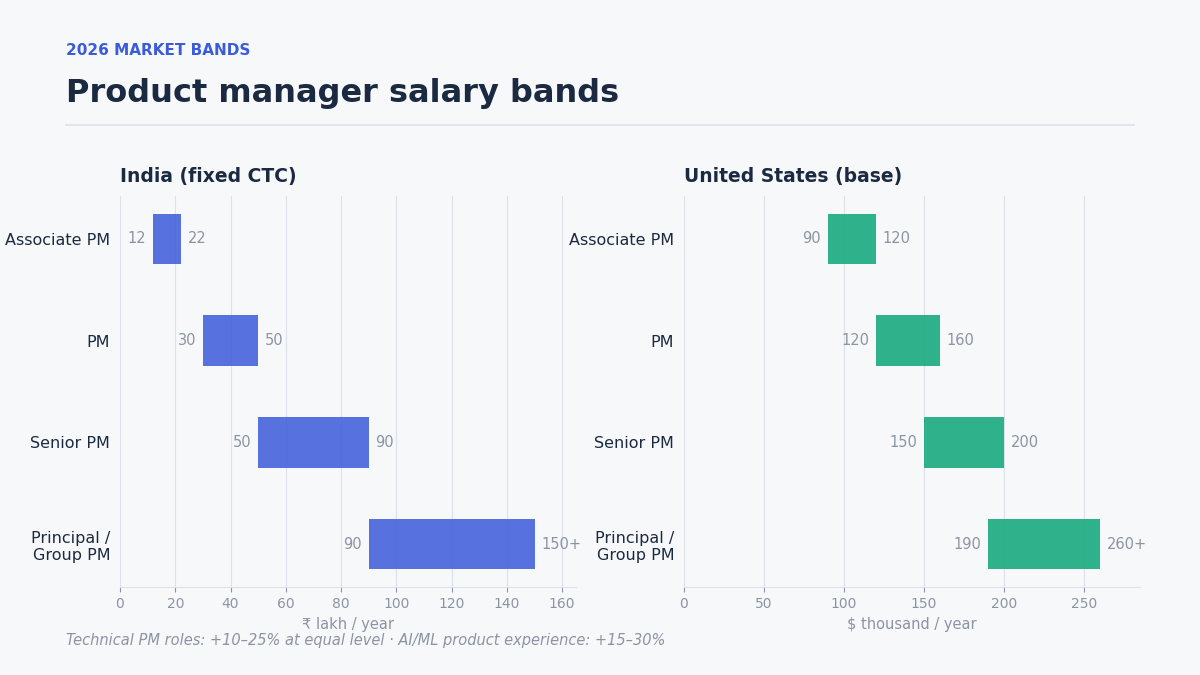
Product manager salary bands (annual, full-time):
| Level | India (₹, fixed CTC) | US ($, base) |
| Associate PM (0–2 yrs) | ₹12–22 lakh | $90k–120k |
| PM (2–5 yrs) | ₹30–50 lakh | $120k–160k |
| Senior PM (5–9 yrs) | ₹50–90 lakh | $150k–200k |
| Principal / Group PM | ₹90 lakh–1.5 crore+ | $190k–260k+ |
Technical PMs command a 10–25% premium at equal level. Bengaluru/NCR run 10–20% above other Indian metros. AI/ML engineers product experience currently adds 15–30% in both markets. ESOPs at Indian startups typically add 15–40% of fixed CTC in annual vesting value at Senior PM and above.
Total cost of hire beyond salary:
- Agency/success fee: 8.33% (one month of CTC) to 16% of annual CTC in India; 15–25% of base in the US.
- Notice-period buyout (India): ₹2–4 lakh where a 90-day notice must be shortened and budget it up front.
- Internal interview cost: a 4-round loop for 6 finalists consumes 45–60 senior-staff hours; at blended senior rates that’s ₹3–6 lakh of hidden spend per hire.
- Mis-hire cost: salary + severance + 4–6 months of misdirected squad output conservatively 1.5–2x the PM’s annual CTC, which is why the day-90 decision rule in Phase 6 exists.
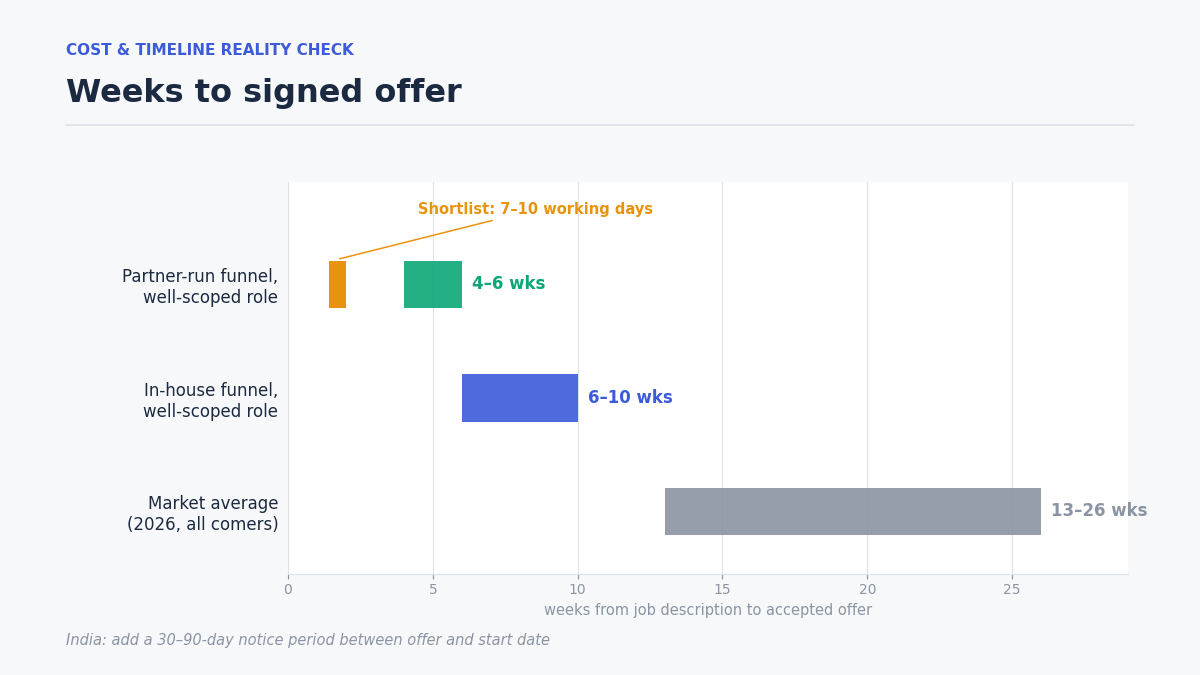
Timelines by scenario:
- Well-scoped role, partner-run funnel: 7–10 working days to interview-ready shortlist; 4–6 weeks to sign offer.
- Well-scoped role, in-house funnel: 6–10 weeks to offer.
- Market average (all comers, 2026): 3–6 months driven mostly by scoping churn and loop sprawl, not candidate scarcity.
- Add for India: 30–90-day notice periods between offer and start (vs. 2–4 weeks in the US). Plan backwards from the date you need the PM to be productive, not hired.
What drives cost up: TPM premiums, AI-product experience, counter-offer wars for Senior+ candidates, buyouts, and re-runs of a mis-scoped funnel. What drives it down: archetype clarity (fewer rounds, faster closes), a pre-vetted pipeline, and a replacement guarantee that converts mis-hire risk from months into days.
Next Step: Turn This Playbook Into a Shortlist
If you’re mid-decision, do these three things this week: write the one-page Phase 1 scoping doc (archetype, North Star metric, decision rights, comp band), pressure-test it against the salary table above, and calibrate your case-study rubric on someone already inside the company.
And if the constraint is pipeline rather than process you know exactly which PM you need but can’t staff the funnel to find them; that’s a solvable, well-scoped problem. Share the scoping doc with Supersourcing’s product-hiring team and get an interview-ready, top-2% shortlist for the role within 7–10 working days, with a replacement guarantee behind every hire: https://supersourcing.com/contact-us/
FAQ: Hiring Product Managers for Tech Products
When should a startup hire its first product manager?
When the founder can no longer attend the majority of customer conversations and make every prioritization call typically around 8–15 engineers or two squads. Hiring a PM before then usually creates a proxy layer between founder and users; hiring much after creates a backlog of unexamined decisions the new PM spends two quarters untangling.
How long does it take to hire a product manager?
A disciplined process takes 3–5 weeks from job description to accepted offer; the 2026 market average is 3–6 months. In India, add a 30–90-day notice period before the start date. Partner-run pipelines compress the front end to a 7–10-working-day shortlist because screening runs in parallel rather than sequentially.
Should a product manager know how to code?
Not for most roles. Every tech PM needs technical fluency reading an architecture diagram, understanding migration cost, holding a tradeoff conversation with engineers. Actual coding ability is required only for technical PM roles on developer-facing or infrastructure products, where the users themselves are engineers.
What’s the difference between a product manager and a project manager?
A product manager decides what to build and why, and is measured on outcomes like adoption, retention, and revenue. A project manager owns when and how delivery happens, timelines, dependencies, coordination. Titling a coordination role “PM” is the fastest way to lose strong product candidates mid-funnel.
How do you evaluate product sense in an interview?
Give a sanitized, real problem from your own product and score the shape of the thinking: do they interrogate the problem first, name a specific user, surface tradeoffs unprompted, define success metrics before defending the idea, and update under pushback? Rehearsed frameworks pass generic cases; they don’t survive your actual funnel data.
How much does it cost to hire a product manager in India?
Fixed CTC bands in 2026: roughly ₹12–22 lakh for associate level, ₹30–50 lakh mid-level, ₹50–90 lakh senior, with technical PM roles 10–25% higher. On top of salary, budget an 8.33–16% success fee if an agency is involved, a possible ₹2–4 lakh notice buyout, and ESOPs at senior levels.
Is it worth using a recruitment partner to hire PMs?
It depends on volume and bandwidth. For one carefully chosen role with a strong internal TA team, run it in-house. For 3+ product hires a year, a GCC build-out, or a team with no recruiting bandwidth, a partner-run pipeline changes the economics: interview hours get spent only on a pre-vetted top slice, and a contractual replacement guarantee caps mis-hire downside. If you’re weighing that decision now, a 30-minute scoping conversation brings your draft JD will tell you which side of the line you’re on.
What are the biggest red flags when hiring a product manager?
Stories with no recoverable individual decisions, metrics quoted without baselines, title inflation across short stints, blaming previous engineering teams, and solution-first thinking in the case round. On the employer side, the biggest red flag is your own: a role three stakeholders describe three different ways.
