

Hiring no longer begins with geography. It begins with access to the right talent. Founders, HR leaders, and CTOs are increasingly searching for how to hire remote employees because traditional, location-bound hiring no longer supports speed, scale, or skill requirements. What they want is not theory. They want clear steps, proven processes, realistic costs, and clarity on compliance before mistakes become expensive.
This shift is backed by data. According to McKinsey, companies that adopt remote and hybrid hiring models can access talent pools up to four times larger than organizations restricted to a single location.
Learning how to hire remote employees has become an operational capability, not an HR experiment. Teams that build structured hiring and onboarding systems move faster and retain talent longer. Those that do not often struggle with misalignment, slow execution, and avoidable churn.
What Does It Mean to Hire Remote Employees?
To hire remote employees means building teams where people work outside a shared office while remaining fully accountable for outcomes. These employees are not external contributors or temporary support. They are embedded into the company’s workflows, culture, and decision-making processes.
Full-time
Companies hire remote employees into long-term roles with defined responsibilities, performance expectations, and career progression. These roles are treated the same as onsite positions, with ownership over core functions and deliverables.
Contractual
Some organizations hire remote employees on a contract basis to move quickly, test roles, or fill short-term skill gaps. These engagements are outcome-driven and structured around clear timelines and scope.
Distributed across time zones
Remote employees may work from different regions, requiring asynchronous communication or planned overlap hours. Clear expectations around availability are critical for smooth collaboration.
Integrated into core teams
To hire remote employees successfully, they must be included in planning, reviews, and execution cycles, not isolated from key decisions.
Why Companies Are Hiring Remote Employees
Companies choose to hire remote employees because it changes what is possible, not just where people work. Access to talent is no longer limited by office location, and hiring decisions are driven by capability rather than proximity.
Access to global talent pools
When companies hire remote employees, they tap into skills that may be scarce or unavailable locally. This is especially valuable for roles in engineering, data, and emerging technologies.
Reduced hiring time and cost
Remote hiring shortens recruitment cycles and lowers costs tied to relocation, office space, and local market premiums.
Faster team scaling
Remote models allow teams to expand quickly without waiting for physical infrastructure or regional hiring constraints.
Workforce flexibility
Distributed teams can adapt to changing workloads more easily by adjusting roles, locations, or engagement models.
Competitive advantage for scarce skills
Companies that hire remote employees are better positioned to compete for in-demand talent by offering flexibility and autonomy.
Step-by-Step: How to Hire Remote Employees
Step 1: Define the Role Clearly (Before You Search)
Teams that hire without clarity struggle later. To hire remote employees effectively, the role must be defined around outcomes rather than assumptions.
Before posting any job, make sure you have clarity on:
-
What success looks like in the first three to six months
-
The core outcomes the role is responsible for delivering
-
Time zone expectations, including async work or required overlap
-
Whether the role is fully async, overlap-based, or time-zone specific
Avoid copying an onsite job description and labeling it remote. Remote roles require clearer expectations, stronger ownership, and more explicit communication. Teams that hire remote employees with defined outcomes move faster and experience fewer onboarding and performance issues.
Step 2: Choose the Right Remote Hiring Model
Before sourcing candidates, decide how you want to engage talent. Companies that hire remote employees without choosing a hiring model upfront often waste time evaluating the wrong profiles.
Common remote hiring models include:
| Model | Best For |
|---|---|
| Full-time remote | Core long-term roles |
| Contract remote | Speed & flexibility |
| Dedicated teams | Scaling fast |
| Staff augmentation | Skill gaps |
Each model affects cost, accountability, onboarding effort, and compliance. Choosing the right one early helps teams hire remote employees more efficiently and avoids misalignment during interviews and negotiations.
Once the model is clear, sourcing, evaluation, and onboarding become far more predictable.
Step 3: Write a High-Converting Remote Job Description
A strong job description filters the right candidates before interviews begin. Teams that hire remote employees successfully use job descriptions to set expectations early, not to list generic requirements.
A high-converting remote job description should clearly explain:
-
The outcomes the role is responsible for, not just daily tasks
-
How communication works, including async expectations
-
Any time zone overlap requirements
-
The tools the team uses, such as Slack, Jira, GitHub, or Notion
-
How performance is measured and reviewed
Clarity matters more than length. Candidates evaluating remote roles want to understand how work actually happens. When companies hire remote employees using outcome-driven job descriptions, they reduce mismatches, improve interview quality, and speed up hiring decisions.
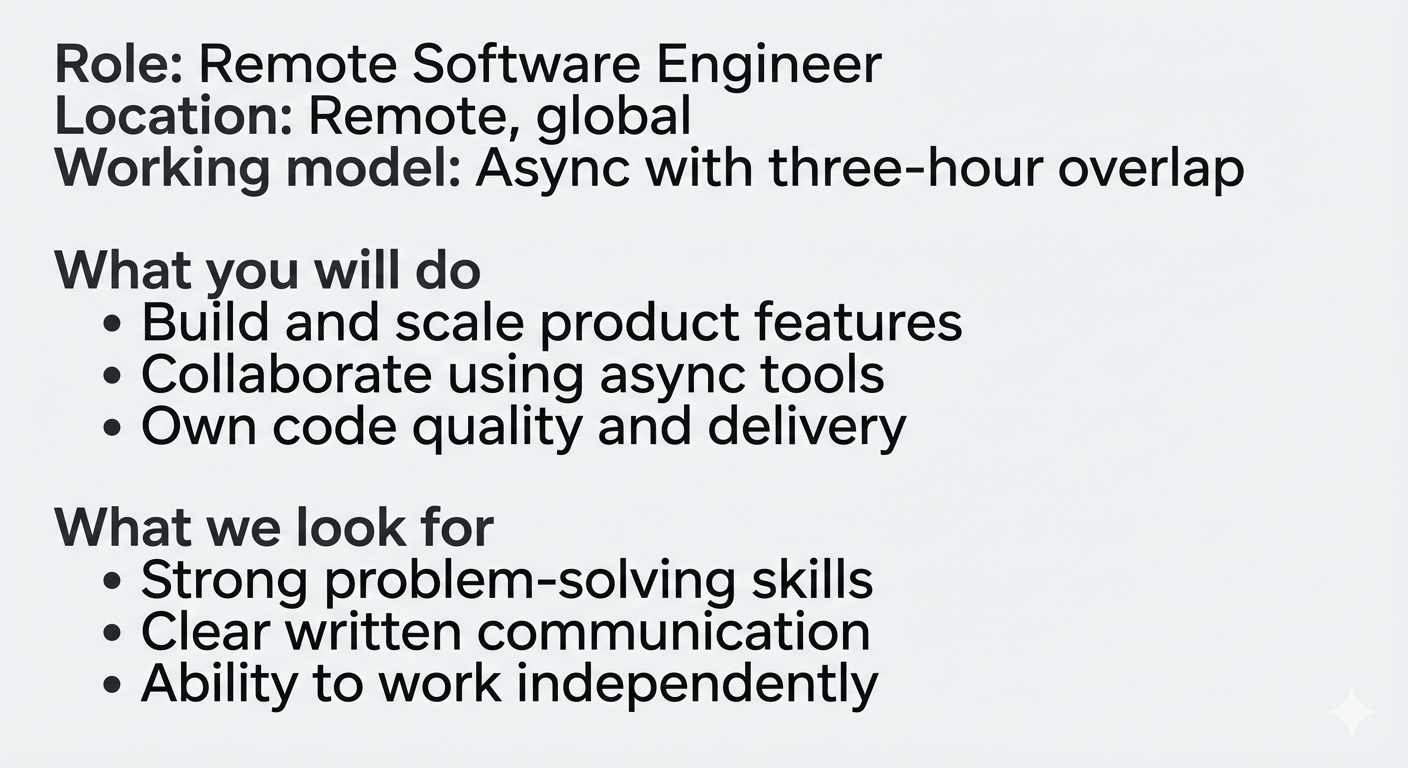
Sample Remote Job Description (Short)
 Step 4: Decide Where to Hire Remote Employees
 Step 4: Decide Where to Hire Remote Employees
Location still matters, but not in the way it used to. Companies that hire remote employees effectively choose regions based on skills, time zone alignment, and operating maturity rather than cost alone.
Popular regions for remote hiring include:
-
Eastern Europe for strong engineering talent and product thinking, typically at higher cost
-
India for a large, experienced talent pool and strong cost efficiency across roles
-
Latin America for close alignment with US time zones and growing senior talent
-
Southeast Asia for emerging tech hubs and flexible engagement models
The right location depends on your collaboration model, required overlap hours, and leadership bandwidth. Teams that hire remote employees with clear process and documentation can succeed across any geography.
Step 5: Use the Right Remote Hiring Tools
Tools for remote teams support the process, but they do not replace it. Companies that hire remote employees effectively use a small, consistent tool stack that supports sourcing, evaluation, and collaboration without adding friction.
Common tools used across remote hiring include:
-
Remote Sourcing and hiring tools such as LinkedIn, GitHub, and remote job boards to reach global candidates
-
Talent platforms like Supersourcing for access to pre-vetted remote talent without long hiring cycles
-
Interview and assessment tools including Zoom or Google Meet for interviews and platforms like HackerRank or Codility for skill evaluation
-
Async evaluation methods such as short take-home assignments to assess real-world problem solving
-
Collaboration tools like Notion, Slack, Jira, or Linear to simulate how candidates will actually work
Avoid tool overload. Consistency matters more than volume. Teams that hire remote employees using a focused, repeatable tool setup evaluate candidates more accurately and move faster from interview to offer.
Step 6: Interview for Remote Readiness (Not Just Skills)
Strong resumes do not guarantee strong remote performance. Companies that hire remote employees successfully evaluate how candidates think, communicate, and operate without constant supervision.
Remote interviews should assess more than technical ability:
-
How clearly the candidate explains decisions and trade-offs
-
Comfort with written and async communication
-
Ability to work independently without frequent direction
-
Ownership mindset when discussing past work
-
Responsiveness and follow-through during the interview process
A structured remote interview process often includes:
-
An initial conversation to set expectations and working style
-
A problem-solving discussion focused on real scenarios
-
A short async task or case to evaluate independent thinking
-
A final interview focused on communication and collaboration
A common red flag is strong technical skill paired with unclear communication. Teams that hire remote employees prioritize clarity and ownership, not just raw ability.
Step 7: Evaluate Remote Candidates Fairly
Remote hiring breaks down when decisions are based on gut feel. Teams that hire remote employees effectively rely on structured evaluation to reduce bias and improve consistency across interviewers.
A fair evaluation framework should assess candidates on:
-
Technical competence based on role-specific requirements and problem-solving ability
-
Communication clarity, especially written articulation and async responsiveness
-
Ownership mindset, including how candidates take responsibility for outcomes
-
Reliability, measured through follow-ups, preparation, and task completion
-
Remote experience, including comfort working independently and managing ambiguity
Using a standardized scorecard ensures every candidate is measured against the same criteria. It also helps hiring teams compare profiles objectively instead of debating impressions.
When companies hire remote employees using consistent evaluation methods, decision quality improves and mis-hires decrease. Structured evaluation protects both the candidate experience and long-term team performance.
Step 8: Make the Offer & Handle Compliance
Once a candidate is selected, execution matters. Companies that hire remote employees often slow down or lose candidates at the offer stage due to unclear contracts or compliance gaps.
Key elements to address before sending an offer include:
-
Employment type, whether full-time employee or contractor
-
Local compliance requirements, depending on the candidate’s country or region
-
Payroll and payments, handled directly or through global payroll partners
-
Intellectual property and confidentiality clauses to protect company assets
-
Clear compensation structure, including currency, payment frequency, and benefits if applicable
Compliance can feel complex, but it is solvable with the right partners and templates. Teams that hire remote employees successfully treat compliance as an operational setup, not a blocker.
A clear, timely offer builds trust and sets the tone for a strong working relationship
Remote Hiring Cost: What Does It Really Cost?
Cost is one of the main reasons companies choose to hire remote employees, but savings only materialize when expectations are realistic. Remote hiring reduces location premiums, office expenses, and relocation costs, but compensation still varies based on skill level and engagement model.
Below is a high-level view of average monthly costs of hiring remote employees. These ranges reflect global averages and can shift based on seniority, region, and hiring model.
Average Cost to Hire Remote Employees
| Role | Monthly Cost (Global Avg) |
|---|---|
| Remote Software Engineer | $2,000 – $5,000 |
| Remote QA Engineer | $1,500 – $3,500 |
| Remote Product Manager | $3,000 – $6,000 |
These figures help set expectations, not budgets. Companies that hire remote employees successfully align compensation with outcomes, ownership, and market maturity rather than chasing the lowest cost.
Cost factors to consider
-
Geography and local market rates
-
Seniority and specialization
-
Engagement model and contract type
-
Payroll, compliance, and tooling
Remote hiring can deliver significant savings, but only when supported by strong processes and clear role definitions.
Hidden Costs to Watch Out For
Companies often focus on salary savings when they hire remote employees, but the real costs show up in execution gaps. These issues do not appear on a budget sheet, yet they directly affect productivity and retention.
Common hidden costs include:
-
Poor onboarding, which delays productivity and increases early attrition
-
Weak documentation, forcing teams to rely on meetings and repeated explanations
-
Time zone misalignment, leading to slower decisions and blocked work
-
Over-meeting, which reduces deep work and creates burnout
-
Isolation and disengagement, increasing turnover over time
These costs compound quietly. A poorly onboarded hire or misaligned role can erase months of savings through lost time and rework.
Teams that hire remote employees successfully invest early in onboarding, documentation, and communication standards. Remote hiring delivers cost advantages only when supported by systems that prevent these hidden drains.
Remote Employee Onboarding (Critical Step)
Onboarding determines whether remote hiring succeeds or stalls. Companies that hire remote employees without a structured onboarding process often see slow ramp-up, confusion, and early disengagement. Strong onboarding replaces informal office learning with clarity and documentation.
Effective remote onboarding should include:
-
A 30–60–90 day plan that defines priorities, deliverables, and expectations
-
Clear ownership and goals so new hires understand how success is measured
-
Tool walkthroughs to explain how communication, tracking, and documentation work
-
Access to documentation covering processes, decisions, and team context
-
A buddy or mentor to provide guidance during the first few weeks
Good onboarding is not about information overload. It is about sequencing what matters and removing uncertainty. Teams that hire remote employees and invest in onboarding see faster productivity, stronger engagement, and higher retention.
How to Manage Remote Employees Successfully
Managing remote teams is about systems, not supervision. Companies that hire remote employees and manage them well focus on clarity, trust, and outcomes rather than constant monitoring.
Strong remote management relies on a few core principles:
Measure outcomes, not hours
Focus performance discussions on what was delivered, the quality of work, and impact on goals. Tracking availability or screen time creates noise and erodes trust. Teams that hire remote employees successfully define clear outputs and review progress against agreed results.
Default to async communication
Async-first communication allows people to work without constant interruptions. Written updates, comments, and docs scale better across time zones and reduce dependency on meetings. Sync communication should be the exception, not the default.
Document decisions and processes
Every key decision, workflow, or change should live in documentation. This prevents context loss, supports onboarding, and avoids repeating the same conversations. Remote teams cannot rely on memory or informal updates.
Keep meetings intentional
Meetings should exist only when discussion, alignment, or feedback is required. Status updates belong in async channels. Fewer, better meetings protect focus and improve execution.
Provide frequent, structured feedback
Remote employees need regular feedback loops to stay aligned. Short, consistent check-ins help surface issues early and keep performance on track without micromanagement.
Common Mistakes When Hiring Remote Employees
Hiring without role clarity
When teams hire remote employees without clearly defined outcomes, priorities become reactive, ownership is unclear, and performance issues emerge early despite strong individual capability.
Ignoring communication skills
Remote work depends on clear writing and async communication. Hiring for technical skill alone often leads to misunderstandings, delays, and repeated clarification across teams.
Treating remote like onsite
Expecting constant availability instead of designing async workflows creates burnout, fragmented focus, and slower decision-making in distributed teams.
Skipping structured onboarding
Without a documented onboarding plan, new hires struggle to understand tools, expectations, and workflows, delaying productivity and increasing early disengagement.
Micromanaging work
Tracking activity instead of outcomes erodes trust, reduces autonomy, and slows execution, especially when teams hire remote employees for ownership-based roles.
Remote Hiring Best Practices (Quick Checklist)
Use this checklist to reduce risk and improve outcomes when you hire remote employees:
-
Define clear role outcomes before sourcing candidates
-
Decide the hiring model and time zone expectations upfront
-
Write remote-specific job descriptions, not onsite versions
-
Use a consistent, focused tool stack for hiring and evaluation
-
Assess communication and ownership, not just technical skills
-
Evaluate candidates using a standardized scorecard
-
Handle contracts, payroll, and IP compliance before making offers
-
Create a structured onboarding plan with clear milestones
-
Set expectations around async work and documentation early
Teams that hire remote employees with discipline and repeatable processes move faster, reduce mis-hires, and scale with confidence.
Final Takeaway
Learning how to hire remote employees is no longer optional. It is a core business capability that directly impacts speed, cost, and access to talent. Companies that succeed with remote hiring focus on clear roles, structured interviews, fair evaluation, and strong onboarding.
Remote hiring is not about where people work. It is about how well systems are designed to support clarity, ownership, and execution. Teams that hire remote employees with discipline and intent build stronger, more resilient organizations that scale beyond geographic limits.
FAQs
How do I hire remote employees legally?
To hire remote employees legally, companies use compliant employment contracts, contractor agreements, or global payroll partners, along with clear IP and confidentiality clauses.
Is it cheaper to hire remote employees?
In most cases, yes. Companies often save 40 to 60 percent compared to local hiring, depending on geography, seniority, and engagement model.
Where is the best place to hire remote employees?
There is no single best location. The right region depends on required skills, time zone overlap, budget, and how mature your remote processes are.
Do remote employees work full-time?
Yes. Many organizations hire remote employees into full-time, long-term roles with the same expectations and ownership as onsite staff.
What tools are essential to hire remote employees?
Video interview tools, async documentation, structured assessments, and collaboration platforms are essential for evaluating and onboarding remote talent effectively.