

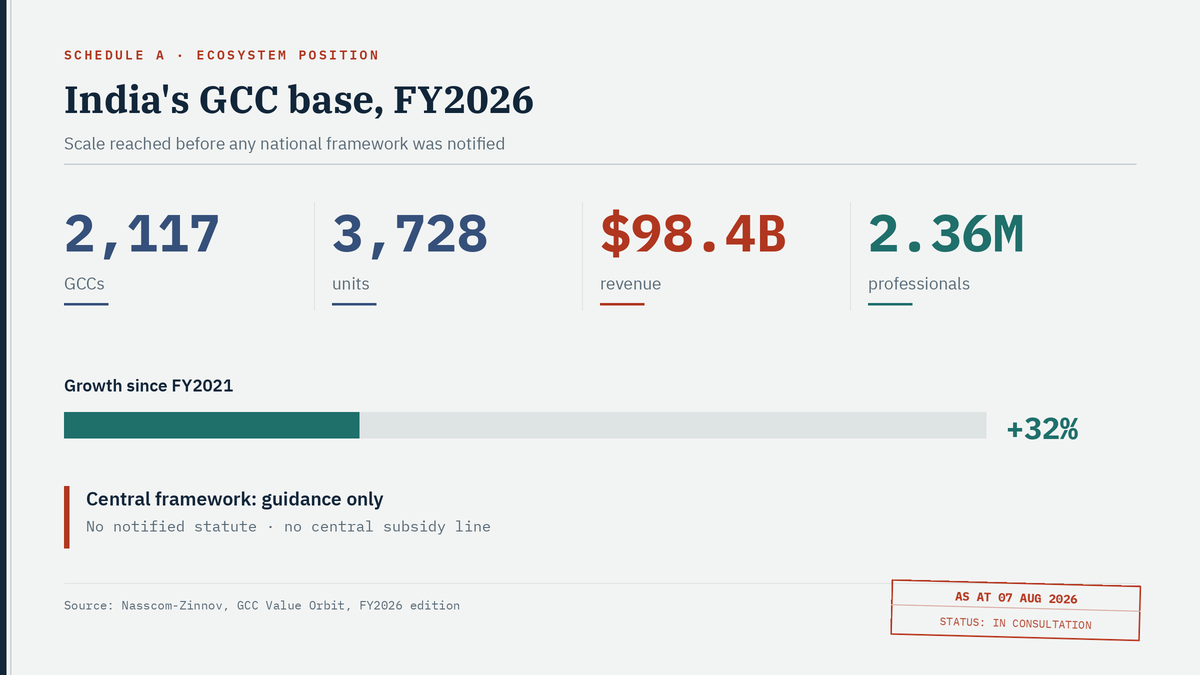
India crossed 2,117 global capability centres and $98.4 billion in GCC revenue in FY2026 without a national GCC policy on the statute book. That is the single most misunderstood fact in this market. Foreign firms arrive asking which central scheme they should apply to, and the honest answer is: none, because there isn’t one yet.
What exists is more interesting than a scheme, and more useful once you understand its shape. The Union Budget 2025-26 committed the centre to formulating a national framework as guidance to states for promoting GCCs in emerging tier-2 cities, covering talent, infrastructure, building byelaw reform, and industry collaboration mechanisms. MeitY then convened an industry panel NASSCOM, Zinnov, ANSR, KPMG and Invest India to draft it. Eighteen months on, that framework is still in consultation. Meanwhile more than a dozen states wrote their own policies and started writing checks.
So the real map looks like this: the centre sets direction and fixes tax friction; the states pay. Budget 2026-27 proved the point by skipping a national policy announcement entirely and instead rewriting transfer pricing safe harbour rules, a change that will move more money through more GCC P&Ls than any single state subsidy on offer.
India’s GCC ecosystem reached 2,117 centres across 3,728 units, $98.4 billion in revenue and 2.36 million professionals in FY2026 32% growth since FY2021, with nearly half of all centres established since FY2021 built with AI as a core mandate from inception.
This guide is the version of the policy landscape we wish existed when clients call. It separates what the centre actually does from what states actually pay, shows where the money and the delays really sit, and walks the full sequence from mandate definition to exit.
TL;DR
This guide explains the India national gcc policy landscape for foreign firms deciding whether, where, and how to build a capability centre in India. It is written for the person who has to defend the business case: heads of engineering, COOs, global services leaders, and the finance partner who will ask what the incentives are worth.
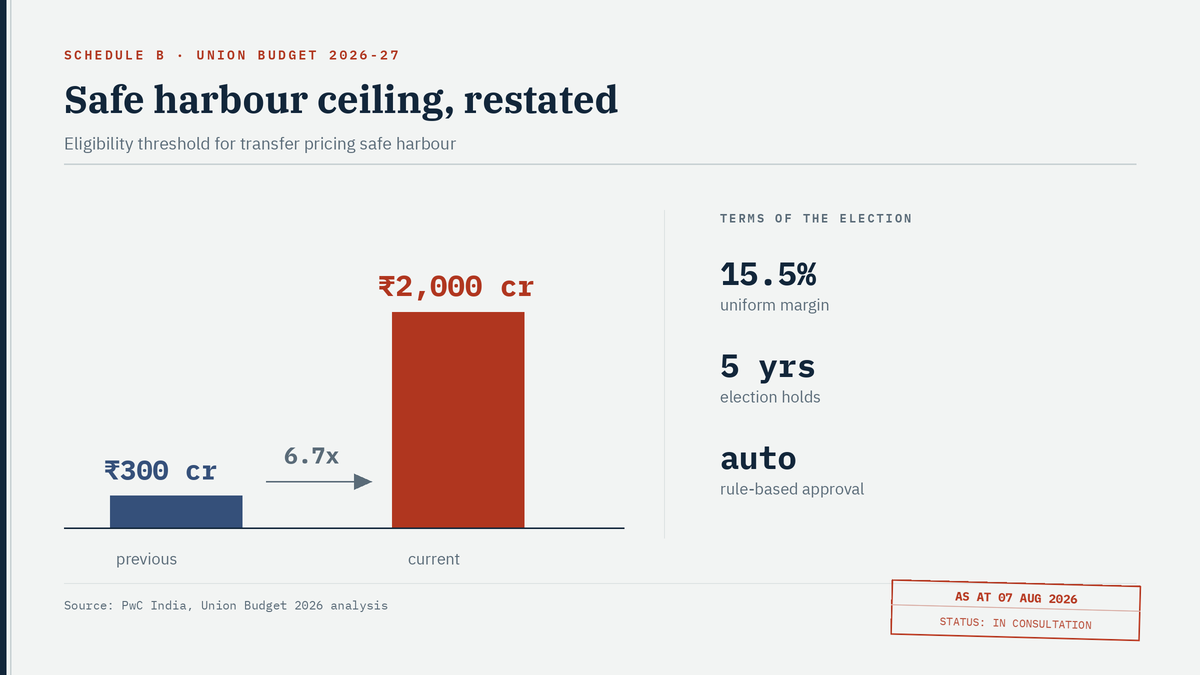
Here is the one number to hold on to. The central framework grants nothing directly but the 2026 Budget raised the transfer pricing safe harbour eligibility ceiling from ₹300 crore to ₹2,000 crore at a uniform 15.5% margin, which for most mid-size centres is worth more in avoided dispute and audit cost than the state capital subsidy they spent six months negotiating.
By the end you will be able to do four things: tell the difference between central guidance and a state's national gcc policy india derivative that actually pays out, shortlist two or three states against your talent profile rather than their press release, choose an entry model with a realistic timeline attached, and know which clauses to check before you sign anything.
What Is India’s National GCC Policy?
India’s national GCC policy is a central-government guidance framework, announced in the Union Budget 2025-26 and under development by MeitY with industry bodies, that advises states on talent supply, infrastructure, building byelaw reform and industry collaboration so Global Capability Centres expand into emerging tier-2 cities. It guides state policy; it does not itself grant money.
Three things it is routinely confused with:
- It is not a statute or a central incentive scheme. No application portal, no central subsidy line, no notification you can cite in a board paper. State GCC policies are the instruments that pay, and they are optional incentive regimes you qualify into, not laws that apply automatically.
- It is not the IFSCA (Global In-House Centres) Regulations. Those are binding, and they govern GIC units inside GIFT City IFSC, with their own eligibility and fit-and-proper requirements for key officers. If your GCC is a GIFT City entity, that regime, not the national framework, is your rulebook.
- It is not the India–GCC Free Trade Agreement. India signed a joint statement launching FTA negotiations with the Gulf Cooperation Council in February 2026. Same three letters, entirely unrelated. This collision wastes real hours in search and in internal email threads, so name your documents carefully.
Why the Central Framework Matters Even Though It Pays Nothing
Guidance without money still changes outcomes, because it changes what states compete on and what the tax authority does. Four concrete business effects:
- Tax predictability, quantified. Budget 2026-27 widened the definition of IT services for safe harbour purposes, set a uniform 15.5% margin, and lifted the eligibility threshold from ₹300 crore to ₹2,000 crore, with approval by a rule-based automatic process valid for five years at the taxpayer’s option. PwC India’s Budget analysis puts the coverage at over a thousand existing GCCs plus all new units. For a centre scaling past a few hundred people, this converts a recurring audit exposure into a filing decision.
- A separate 15% safe harbour on cost for data centre services provided from India to an associated enterprise, plus extended tax certainty for foreign companies procuring data centre capacity in India relevant if your mandate includes hosting or AI infrastructure rather than only headcount.
- Centre–state alignment reduces location risk. CII’s proposed framework rests on three pillars: national direction, enabling ecosystem, measurable outcomes with a companion Model State GCC Policy so state schemes stop diverging in definitions. Deloitte’s read of the framework maps a 2025–2030 implementation roadmap whose first-year priority is a National GCC Single Window Portal for approvals and lifecycle facilitation.
- Tier-2 direction is where the incentive premium sits. Roughly 90% of India’s installed GCC talent base sits in Bengaluru, Delhi NCR, Hyderabad, Pune and Mumbai. Every state policy written since 2024 pays more, sometimes dramatically more, to go elsewhere which is a discount on cost and a premium on hiring difficulty at the same time.
The scale ambition behind all of this is worth knowing because it shapes how states behave in negotiation. CII’s framework targets moving India from roughly 1,800 centres toward 5,000 by 2030, with an economic impact projection in the hundreds of billions of dollars and 20–25 million jobs including indirect employment.
Whether or not those numbers land, every state industries department is currently measured against a GCC count.
The Core Problem Most Buyers Face
Teams arrive with the wrong question. They ask which state pays the most, run a spreadsheet on subsidy headlines, and pick a city. Then the project slips two quarters and the subsidy turns out to be conditional on things nobody checked.
Four failure patterns, with the numbers that make them expensive:
- Sequencing entity setup before hiring. Incorporation itself is quick a private limited company through MCA typically runs 2–4 weeks but the full stack of PAN, TAN, GST, FEMA filings, EPF and ESI codes, and state registrations pushes practical readiness to roughly 6–10 weeks, and the corporate bank account for a foreign-owned entity is a known bottleneck that sits outside your control. Dedicated teams that wait for all of it before recruiting routinely lose 3–6 months of ramp.
- Underestimating fit-out by 3–4x. Conventional office build-out runs 4–6 months against a planning norm of roughly 60–80 sq ft per seat. Sequenced after incorporation instead of parallel to it, you end up with a site leader on payroll and nowhere to seat a team.
- Assuming eligibility equals payout. Most payroll and employment-linked subsidies require employees to be state domiciles, and states define domiciles differently; Haryana has required five years of permanent residence; Tamil Nadu requires proof. Misclassifying employees as domicile-eligible creates recovery liability, not just a rejected claim.
- Missing claim windows. Capital subsidy claims typically must be filed within about a year of the date of commencement of commercial operations, and power or utility reimbursements often run on six-month cycles. Miss the window and the entitlement is gone regardless of how much you invested.
The pattern underneath all four: the incentive is a rebate on a decision, not a reason for it. In the engagements we have run, the variables that actually decided outcomes were the quality of the first 15–20 hires and whether workstreams ran in parallel, not which state’s press release promised the largest ceiling.
The Walkthrough: From Decision to Running Centre
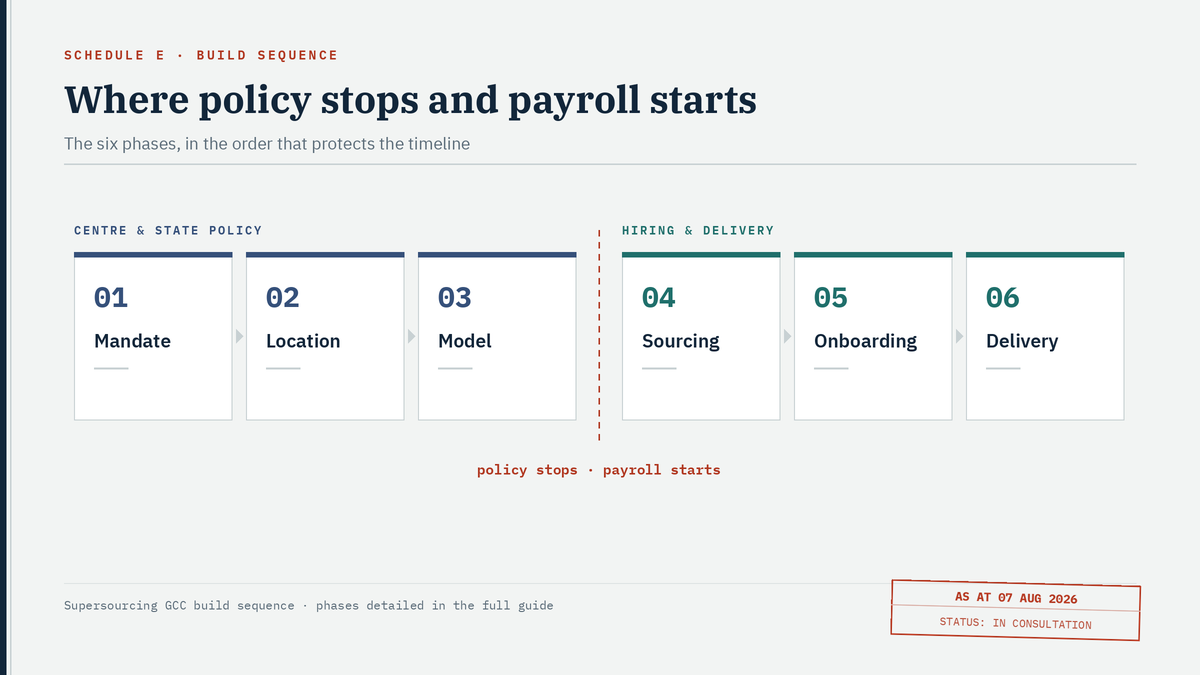
This is the sequence we run with clients, adapted for a policy landscape where central guidance and state incentives interact. Read it in order the first time. The most common cause of a blown timeline is doing Phase 3 before Phase 1.
Phase 1 Define the mandate before you define the location
Every downstream decision city, entity type, salary band, incentive tier falls out of what the centre is actually for. States now write policy around this distinction too: gcc policy incentives are increasingly tiered by mandate depth, with higher ceilings for centres doing R&D and IP creation than for those doing process delivery.
The evidence says start high. Nearly 96% of GCCs established in India launched with product or portfolio mandates from day one rather than crawling through a back-office phase first, and around half were built with AI as a core focus from inception. The “start with support work and graduate later” model is no longer the norm, and pitching a low mandate now makes senior hiring harder, not easier.
Phase 1 checklist:
- Name the first three product or process ownership areas the India centre will own end to end. Not “support,” not “capacity” named ownership.
- Decide whether IP will be created in India. This determines your transfer pricing model, your contracting, and which state CoE grants you can access.
- Set target headcount at 12, 24 and 36 months, with a role mix, not a single number.
- Fix the budget band per head. Illustrative annual gross ranges to orient a board paper: mid-level software engineer ₹12–25 lakh; senior engineer or lead ₹25–45 lakh; finance analyst ₹6–12 lakh; site leader ₹60 lakh to ₹1.5 crore and above. Validate against live market data for your specific roles before committing.
- Name the executive at headquarters who owns the centre’s outcomes. Centres without a named global sponsor drift into staff-augmentation behaviour within a year.
- Decide your break-even horizon. Mid-size builds commonly model 12–18 months, which only holds if hiring starts inside the first quarter.
Red flag: if the mandate document reads “we will figure out scope once the team is in place,” stop. That sentence is the single most reliable predictor of a stalled centre, because vague mandates attract candidates who are comfortable with vague mandates.
If the mandate genuinely isn’t settled, buy scoping help this is what IT consulting services engagements are for before you buy real estate.
Phase 2 Read central guidance against state policy, then shortlist
Location is where the central gcc framework and state schemes actually meet. The framework’s direction is tier-2 expansion; the states have translated that into differential incentive tiers you can read as a map of where they want you.
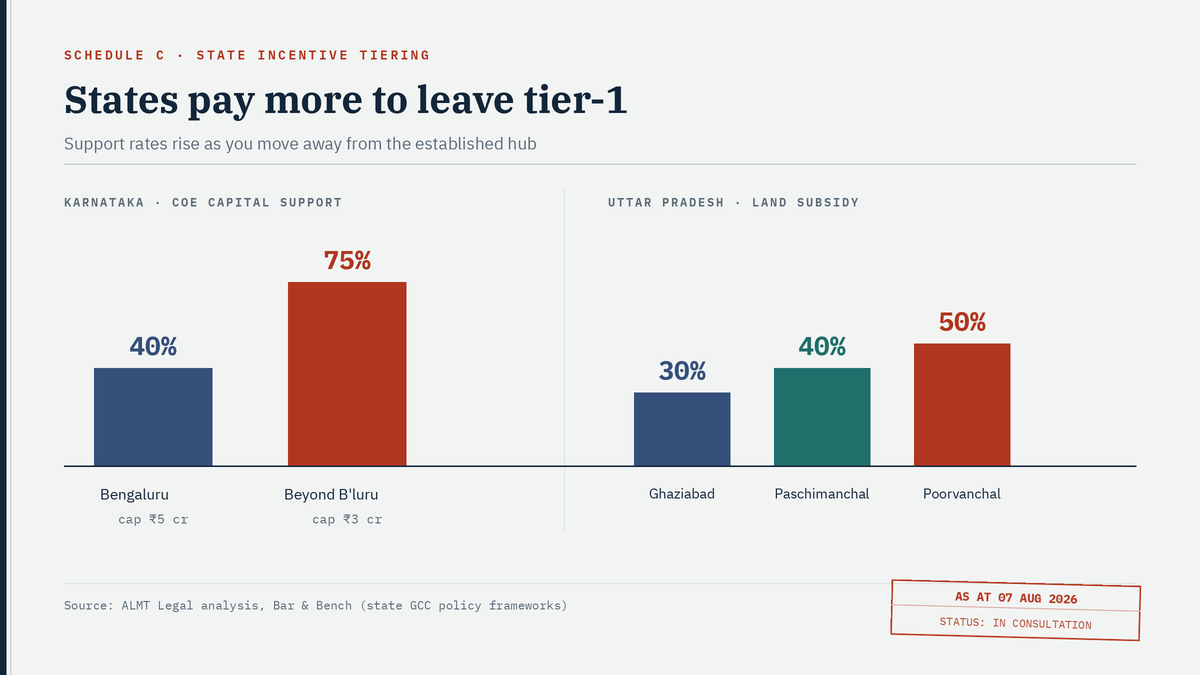
Worked examples of how differential tiering shows up in practice, per ALMT Legal’s analysis in Bar & Bench:
- Karnataka funds up to 40% of Centre of Excellence capital expenditure capped at ₹5 crore in Bengaluru urban, but up to 75% capped at ₹3 crore in its six “Beyond Bengaluru” cities Mysuru, Mangaluru, Hubballi, Kalaburagi, Shivamogga and Tumakuru. The policy targets 500 new GCCs and around 350,000 jobs across 2024–2029, backed by Nipuna Karnataka, a ₹100 crore programme to upskill one lakh people in AI, ML and blockchain.
- Uttar Pradesh tiers land subsidy by region: 30% in Ghaziabad and Gautam Budh Nagar, 40% in Paschimanchal and Madhyanchal, and 50% in Poorvanchal and Bundelkhand. Its GCC Policy targets over 1,000 GCCs and around 500,000 jobs, with capital subsidy of 25% of eligible capital investment, 100% stamp duty exemption, operational expenditure support, and CoE grants of 50% up to ₹10 crore per project.
- Madhya Pradesh built the first state framework designed specifically around tier-2 cities, with the state bearing 50% of CoE project cost for AI and cybersecurity up to ₹10 crore.
- Odisha takes a different angle, reimbursing 50% of relocation cost capped at ₹10 crore for domestic and ₹20 crore for international relocation, plus 30% reimbursement of fixed capital investment excluding land within two years of commercial operations.
- Rajasthan leans on operating cost: 75% stamp duty exemption with a further 25% reimbursed, 100% electricity duty exemption for seven years, and training reimbursement of 50% for three years up to ₹2.5 crore, conditional on running an in-house training centre in the state.
- Andhra Pradesh subsidises 50% of capital expenditure for neighbourhood workspaces as small as ten seats which is the only policy in the country genuinely built for distributed teams rather than a single campus.
The 3-shortlist rule: never evaluate more than three states seriously, and score them on this order of weight:
- Depth of the specific talent pool you need, measured in live open roles and salary inflation for those roles not total graduate output.
- Attrition in comparable centres in that city, which is the cost line most business cases omit entirely.
- Time to seat, meaning availability of Grade-A or managed space you can occupy this quarter.
- Incentive value discounted for probability and timing a ₹10 crore ceiling claimable in year three is not worth ₹10 crore today.
- Approval responsiveness. Some states publish committed approval timelines; treat published timelines as a signal about the industries department’s operating culture, then verify with two companies who have actually claimed.
For a first India centre where the talent profile is generalist engineering, tier-1 usually still wins on ramp speed even after incentives. For a second or third centre, or a mandate built around a specific niche, tier-2 economics get compelling fast. This is the decision a global capability center setup engagement should be arguing with you about, not agreeing with you on.
Phase 3 Choose the entry model, then paper it properly
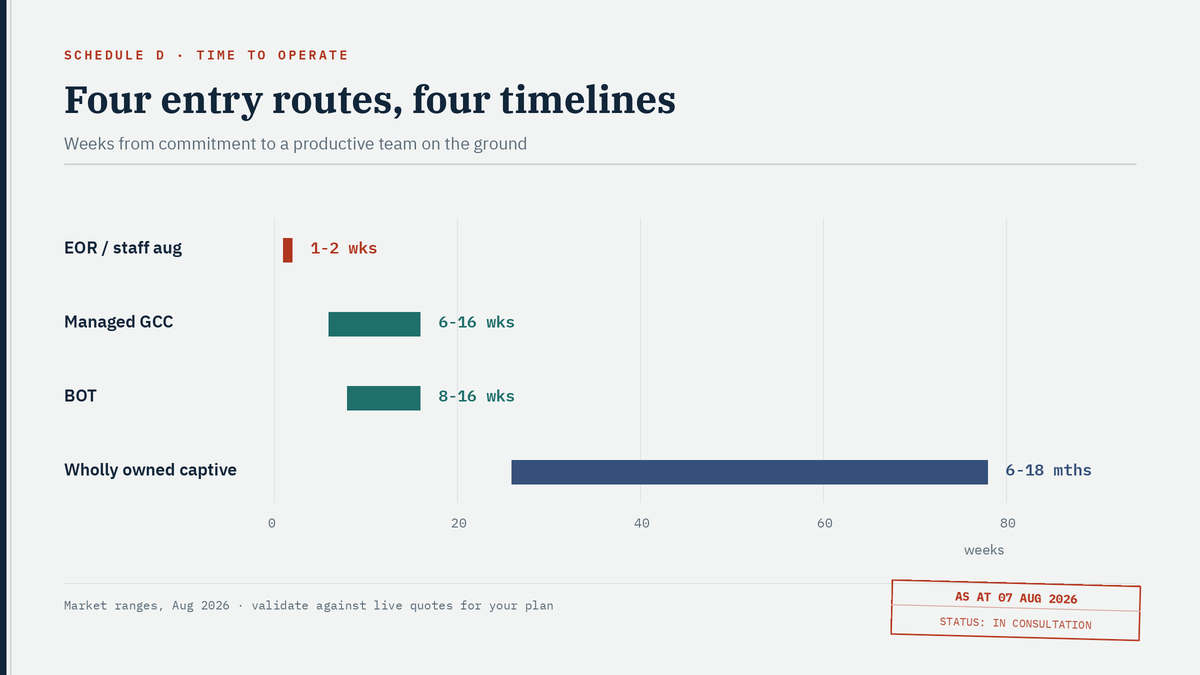
The india gcc framework 2026 conversation almost always arrives at the same fork: build a captive now, or get people working first and convert later. Four viable routes, with honest timelines.
| Model | Time to first productive hire | Control & IP | Best for |
| Wholly owned captive | 6–18 months to full operation | Maximum; IP sits with your entity from day one | 300+ seat plans, regulated data, long horizon |
| Build-operate-transfer (BOT) | Roughly 8–16 weeks to go-live; transfer later | Partner’s umbrella first, yours after novation | 100–300 seats, first-time India entrants |
| Managed GCC / GCC-as-a-service | Roughly 6–16 weeks | Operational control yours, employment theirs | Speed with a single accountable vendor |
| EOR + staff augmentation | 1–2 weeks | Lowest overhead, thinnest control | Pilots under ~30 people, market validation |
The crossover point where an entity beats EOR on economics typically sits somewhere between 25 and 40 employees for most role profiles. Below that, EOR is usually cheaper and always faster.
Contract clauses that decide outcomes check every one of these:
- IP assignment and moral rights waiver in every individual employment contract and in the master services agreement, not only at entity level. Assignment at the vendor level with no flow-down to individuals is the most common gap we see.
- Transfer pricing basis stated up front. Get the arm’s-length method, benchmarking study and documentation framework in place before the first inter-company invoice. If you intend to elect safe harbour, model the 15.5% margin into your cost-plus structure at the start rather than restating later.
- Novation mechanics for BOT, spelled out: employee transfer terms, lease assignment, asset valuation method, and a fixed transfer fee or formula. An unpriced transfer option is not an option.
- Data protection obligations aligned to the DPDP Act 2023 and its 2025 Rules, with sub-processor consent, breach notification timelines, and localisation terms where your sector requires them.
- Labour code compliance representations. India’s consolidated labour codes took effect on 21 November 2025; contracts drafted against the older act-by-act framework need review.
- Incentive cooperation clause. If a partner employs your people during the incentive-earning period, define who claims what, who holds the documentation, and who bears clawback risk if a domicile classification fails.
- Exit and replacement terms with a defined service level. Ours is replaced within 7–10 days if a hire isn’t a fit; whatever your partner offers, get the clock and the trigger in writing.
- Non-solicit carve-out permitting you to hire the team directly on conversion. Without it, your BOT exit is hostage to a recruitment fee negotiation.
Filing checklist for a wholly owned subsidiary: SPICe+ incorporation under the Companies Act 2013; PAN and TAN; GST registration; FC-GPR filing with RBI within 30 days of receiving foreign investment; annual RBI FLA return; EPF and ESI registration; professional tax and Shops & Establishments registration in the relevant state. Expect roughly ₹2–5 lakh in professional fees for incorporation and registrations, varying by structure and adviser.\
Phase 4 Source and vet the first twenty hires
The first cohort sets the ceiling. Hire generalists into a product mandate and you will spend year two replacing them; hire well and the centre earns its next mandate early.
What good screening looks like at this stage:
- Calibrate the bar against a known-good internal engineer, not against a job description. Have your best HQ engineer in that discipline run the technical loop for the first five hires personally.
- Screen for ambiguity tolerance explicitly. New centres have no runbooks. Ask candidates to describe a decision they made without sufficient information and what they’d change.
- Two technical evaluations minimum, one of them practical work in the actual stack rather than an abstract algorithm exercise.
- A written communication sample. A distributed centre runs on documents; this predicts more than most interviews do.
- Reference checks on the last two managers, not the last two peers.
- A named reason for every rejection, logged. Without this, you cannot tell whether your bar or your pipeline is the problem when the funnel stalls.
Red flags in a candidate pipeline: every profile arrives from the same two employers; salary expectations cluster suspiciously tightly, which usually means a single source pool; strong CVs with no verifiable production ownership; and any candidate who cannot describe what happened after a system they built went live.
Red flags in a hiring partner: shared recruiter bandwidth across many clients, no named account owner, a shortlist that arrives in 48 hours (nobody vetted anything), and unwillingness to state a joining rate.
Our benchmarks, a 7–10 working day cycle from job description to interview-ready shortlist, a 98% candidate joining rate, and under 1% drop-off on contract roles exist because the alternative is a funnel you cannot forecast against.
Role-specific note: infrastructure and platform hiring is usually the binding constraint on ramp, not application engineering, because those candidates are scarcer in tier-2 markets. Plan to hire cloud engineers earlier than your headcount plan suggests.
The same applies if your mandate is AI-led and given that more than 1,200 GCCs in India have already embedded AI and ML capabilities against a national AI talent base of roughly 250,000 professionals, teams that wait until month six to hire machine learning engineers are competing against centres that started in month one.
Phase 5 Onboarding and ramp-up: the first two weeks decide the first year
Ramp-up is where policy stops mattering and operations start. It is also the phase most India entry plans document the least.
Days 1–5:
- All access provisioned before day one laptop, SSO, repositories, ticketing, VPN, and the internal wiki. Access delays in week one are read by new hires as a signal about how the centre is valued.
- Named HQ buddy per hire, in a timezone with at least three hours of overlap.
- A first task that ships to production or staging inside week one. Small, real, reviewed.
- Written mandate walkthrough delivered by the HQ sponsor, live, not forwarded as a deck.
Days 6–14:
- First code review or work review by an HQ engineer, with written feedback.
- Communication cadence fixed and published: daily async written update, one weekly synchronous overlap window, one monthly business review.
- Escalation path documented who to call when blocked, with a stated response expectation.
- Compliance onboarding completed: EPF and ESI enrolment, professional tax, DPDP-aligned data handling training, and IP assignment executed.
The onboarding friction nobody plans for: timezone overlap negotiated per person rather than set as policy. When each engineer arranges their own overlap with their own HQ counterpart, the centre fragments within weeks three people on a 6 a.m. start, four on a 9 p.m. finish, and no window where the team exists simultaneously.
Fix one overlap block for the whole centre before the first hire starts, and defend it. Retrofitting it after twenty people have organised their lives around a different pattern is a genuine morale event.
Governance framework in week one is not bureaucratic overhead centres that define reporting lines, KPIs and HQ cadence before the team is operational retain materially more of their year-one cohort than those that improvise.
Phase 6 Manage delivery, then scale or exit
A steady state has two jobs: prove the mandate, and keep the incentive entitlements alive.
Monthly operating rhythm:
- Delivery metrics against the mandate cycle time, escaped defects, and ownership breadth (how many workstreams the centre runs without HQ intervention).
- Attrition and regrettable attrition, tracked separately. The second number is the one that matters.
- Hiring funnel health: offer acceptance rate, time to fill by role family, and pipeline source concentration.
- Incentive compliance: domicile documentation current, capital expenditure records reconciled, claim calendar reviewed against DCO-linked deadlines.
- Transfer pricing position reviewed against actual margin, especially if you have elected safe harbour and your cost base is shifting.
Scaling triggers. Add headcount when the centre is turning down work it is qualified to do, not when HQ has budget. The strongest signal India centres now show is mandate expansion rather than headcount: around 64% of site leaders hold dual mandates combining global functional ownership with site leadership, meaning the growth path runs through scope, not seats.
When scale-up is genuinely continuous rather than project-based, a recruitment process outsourcing arrangement usually beats requisition-by-requisition hiring, which is the point at which recruitment process outsourcing starts paying for itself in reduced time-to-fill variance.
Exit and offboarding, planned in advance:
- Replacement policy documented with a stated clock is 7–10 days.
- Knowledge transfer requirement written into every senior role: a maintained runbook is a deliverable, not a favour.
- Access revocation checklist executed on the last working day, not the following week.
- Statutory exit compliance final settlement, gratuity where applicable, PF transfer support.
- Incentive impact assessed before any headcount reduction. Employment-linked subsidies frequently carry minimum headcount or retention conditions, and reducing below them can trigger clawback of amounts already received.
Case Studies: What Policy Looks Like at Ground Level
Incentive documents don’t hire anyone. These are patterns from Supersourcing engagements where the constraint was talent velocity rather than policy which is where most India builds actually succeed or stall.
Paytm: 100+ engineers hired into an active scaling window. The mandate required volume without a drop in bar, across a fintech stack where the candidate pool overlaps heavily with every other fintech in the same cities. Delivery ran on a 7–10 working day cycle from requirement to interview-ready shortlist, sustained across the programme rather than for the first two roles. The lesson that transfers to a GCC build: at this volume, funnel throughput not offering generosity is the binding constraint.
Swiggy: hiring scale-up under compressed timelines. Consumer-tech scaling produces the same problem: a new capability centre does many roles open simultaneously, each with a different bar, and no tolerance for a hiring pause. The mechanism that held was dedicated account ownership with no shared recruiter bandwidth, which is why joining rates stayed near 98% instead of degrading as volume rose. Applied to a GCC, this is the difference between a ramp plan and a ramp hope.
Somnoware: recruitment automation for a specialist healthtech stack. The requirement was narrow-domain talent where the qualified pool is small enough that generic sourcing returns noise. AI-assisted sourcing narrowing to the top 2% of vetted candidates changed the economics of a search that would otherwise have run on referrals alone. This is the closest analogue to a tier-2 GCC hiring problem: a thin pool that rewards precision over volume.
Across 527+ delivered IT projects, the pattern is consistent: the projects that ran late were rarely blocked on approvals or incentives. They were blocked on the fifteenth hire.
Decision Framework: Which State, Which Model
A state gcc policy comparison is only useful if it compares the things that change your P&L. Score your shortlist on this matrix rather than on incentive headlines.
| State archetype | Examples | Talent depth | Incentive weight | Ramp risk | Fits |
| Established ecosystem | Karnataka (Bengaluru), Telangana, Tamil Nadu | Deepest, all role families | Moderate; ecosystem is the incentive | Lowest | First India centre, senior-heavy mandate |
| High-incentive scale-up | Uttar Pradesh, Maharashtra, Haryana | Strong in NCR/Pune, thinner in tier-2 | Highest ceilings, tiered by region | Moderate | 200+ seats with capex to subsidise |
| Cost-advantage tier-2 | Madhya Pradesh, Odisha, Bihar, Rajasthan | Fresh-graduate rich, lateral-thin | High relative to investment size | Highest | Process-heavy or graduate-pipeline mandates |
| Distributed / hybrid | Andhra Pradesh, Kerala | Dispersed, workspace-enabled | Moderate, infrastructure-led | Moderate | Remote-first centres, satellite pods |
Then apply four filters in this order the order matters more than the scoring:
- Can I hire the top 20 roles here within two quarters? If no, nothing else on the list rescues the decision.
- What is the five-year fully loaded cost, incentives included at a probability-weighted value? Discount any subsidy claimable more than 18 months out by at least half in your model.
- What is my exit cost? Lease term, notice periods, and incentive clawback exposure together, not separately.
- Who else has done this here? Two reference calls with companies that have actually received a payout beats any policy document.
Model choice, compressed: if you need people working this quarter and headcount under 30, start on EOR or staff augmentation and incorporate in parallel. If you are committing to 100+ seats and want ownership without carrying first-year execution risk, BOT with a priced transfer option. If the mandate involves regulated data or long-horizon IP, build the captive and accept the timeline.
What Most Teams Get Wrong
The mistake is treating the incentive as the decision. State subsidies rebate a slice of capital expenditure and some operating cost, typically arriving in year two or three and conditional on documentation nobody assigned an owner to. Salary, attrition and ramp speed dominate the five-year P&L. A centre in the right city with no subsidy beats a subsidised centre in a city where you cannot hire your fifteenth engineer.
Five more patterns, in the order they cost the most:
- Optimising for the ceiling instead of the trigger. “Up to ₹25 crore” is a ceiling on eligible capital investment, not a grant. Read what triggers each tranche commercial operations date, minimum investment, minimum domicile headcount and model the cash flow, not the headline.
- Letting the tax structure follow the operating structure. Transfer pricing is a pre-launch decision. Teams that raise their first inter-company invoice before the benchmarking study spends the next two years unwinding it, which is precisely the friction the new safe harbour regime was designed to remove but only for those who elect into it deliberately.
- Confusing central direction with central funding. Waiting for the national framework to be notified before committing is a real strategy some boards have adopted, and it has cost them two years of ramp while competitors are hired. The framework will change how states behave; it will not write you a check.
- Treating tier-2 as tier-1 with a discount. The cost saving is real. So is the lateral-hiring gap: senior engineers with production ownership at scale are concentrated in six cities. A tier-2 centre works when the mandate is designed around a graduate pipeline plus a small imported senior layer and fails when the plan assumes you can hire the same senior profile 30% cheaper.
- Skipping the domicile audit until the first claim. By then, the hires are made. Run the domicile definition against your actual hiring plan in Phase 1, because in some states it changes who you can afford to hire.
Our contrarian read: the most valuable thing the central framework has produced so far is not guidance to states at all, it is the tax certainty that arrived alongside it. If you are building a business case this quarter, weigh the safe harbour change and the labour code consolidation far above any state’s subsidy table. Those two apply everywhere, need no application, and cannot be clawed back.
Cost & Timeline Reality Check
Ranges below are current market orientation, not quotes. Costs move quarterly and vary sharply by city micro-market and role profile validate against live data for your specific plan.
Timeline by entry model:
| Milestone | EOR / staff aug | Managed GCC | BOT | Wholly owned captive |
| First productive hire | 1–2 weeks | 6–16 weeks | 8–16 weeks | 4–8 months |
| Full operational go-live | n/a | 6–16 weeks | 8–16 weeks | 6–18 months |
| Entity incorporation (MCA) | not required | parallel | parallel | 2–4 weeks |
| Full registration stack (PAN/TAN/GST/EPF/ESI/state) | not required | parallel | parallel | 6–10 weeks |
| Office fit-out (conventional) | not required | managed space | managed space | 4–6 months |
Cost bands:
- Setup, 50–100 seats: roughly $500K–$3M depending on whether you take conventional fit-out or managed space, and whether entity setup is yours or a partner’s.
- Run rate per engineer: roughly $25K–$80K per year fully loaded, against 40–60% total operating savings versus equivalent US-based delivery.
- Incorporation and registrations: approximately ₹2–5 lakh in professional fees.
- Workspace planning norm: roughly 60–80 sq ft per seat; managed or flex space removes fit-out capex for the first 12–24 months, which is what most speed-first builds use.
- Pilot phase (10–30 people via EOR or managed): commonly $150K–$400K, which is the cheapest way to buy information about a city before committing capital.
What drives cost up: senior-heavy role mix; a single-campus requirement in a tier-1 CBD; conventional fit-out sequenced after incorporation; regulated-data requirements adding compliance infrastructure; and hiring against a thin pool without a sourcing partner, which shows up as extended time-to-fill rather than as a line item.
What drives cost down: managed space for the first two years; tier-2 location where the mandate genuinely suits a graduate pipeline; parallel-tracking entity setup with EOR hiring; electing safe harbour rather than building bespoke transfer pricing arrangements; and claiming state operating-cost reimbursements rent, power, bandwidth, training which are less headline-grabbing than capital subsidy but arrive annually and are easier to document.
Incentive claim calendar to build into your project plan:
- Register the unit with the state nodal agency before commencing operations, not after.
- Log the date of commencement of commercial operations formally and most claim the windows key off it.
- File capital subsidy claims within roughly one year of DCO.
- File utility and power reimbursements on the state’s cycle, commonly per half-year.
- Maintain domicile documentation continuously, not at claim time.
- Reconcile fixed capital investment records quarterly against what the policy defines as eligible land is frequently excluded.
Where to Take This Next
If you are mid-decision on an India capability centre, the useful next step is not another policy document. It is a talent feasibility read on the two or three cities you are considering: what your top 20 roles actually cost there, how long they take to fill, and what attrition looks like in comparable centres. That analysis usually reorders a shortlist, and it takes days rather than quarters.
Supersourcing has spent 10+ years on the hiring side of GCC builds the phase where policy stops and payroll starts. If a conversation about your specific role mix and timeline would help, talk to our team. Bring your draft headcount plan; we will tell you where it will break.
FAQ
Is there a national GCC policy in India?
Not as a notified law or a central incentive scheme. A national framework was announced in the Union Budget 2025-26 as guidance to states, and MeitY convened an industry panel to draft it, but as of now it remains in consultation. The instruments that actually pay incentives are state GCC policies.
Which Indian states have a dedicated GCC policy?
Karnataka moved first with a dedicated policy covering 2024–2029, followed by Uttar Pradesh, Madhya Pradesh, Gujarat, Andhra Pradesh, Maharashtra, Rajasthan, Odisha and Bihar, with Telangana, Tamil Nadu, Haryana and Kerala operating through GCC-friendly or sectoral regimes. The list keeps growing, so verify the current version and its notified amendments before modelling anything.
What changed for GCCs in the 2026 Budget?
The transfer pricing safe harbour was rationalised: a wider set of services now falls under IT services at a uniform 15.5% margin, the eligibility threshold rose from ₹300 crore to ₹2,000 crore, approval moved to a rule-based automatic process, and an election holds for five years at the taxpayer’s option. A separate 15% safe harbour on cost applies to data centre services provided to an associated enterprise.
Do I have to hire local residents to claim state incentives?
Frequently, yes, for employment and payroll-linked components. Most states require employees to be domiciles of that state, and definitions differ; some have required multi-year permanent residence, others require documentary proof. Misclassification creates recovery liability, so audit the definition against your hiring plan before you make offers.
How long does it take to set up a GCC in India?
It depends entirely on the model. Hiring through an EOR starts in 1–2 weeks. A managed GCC or build-operate-transfer arrangement reaches go-live in roughly 6–16 weeks. A wholly owned captive typically takes 6–18 months to full operation, of which incorporation is only 2–4 weeks the rest is registrations, banking, fit-out and hiring.
Can I claim state incentives if I start with a staffing partner or EOR?
Sometimes, but not automatically, because employment-linked benefits usually attach to the entity employing the staff. If you plan to convert later, negotiate an incentive cooperation clause upfront covering who claims what, who holds documentation, and who bears clawback risk. This is one of the cheapest clauses to add at signature and one of the most expensive to retrofit.
What legal documents are required for a GCC in India?
For a wholly owned subsidiary: SPICe+ incorporation filings, PAN and TAN, GST registration, FC-GPR filed with RBI within 30 days of receiving foreign investment, the annual RBI FLA return, EPF and ESI registrations, state professional tax and Shops & Establishments registration, employment contracts with IP assignment, inter-company service agreements, and transfer pricing documentation.
Should I wait for the national framework before committing?
We would not advise it, and this is the question worth a conversation rather than a paragraph. The framework will standardise state behaviour and improve approval mechanics; it is unlikely to create a central subsidy that changes your business case. Firms that paused for it have lost ramp time to competitors who used the existing state schemes and the new tax certainty. If your timeline is genuinely dependent on it, that is a signal your business case is too thin and worth stress-testing with someone who has run these builds.
