

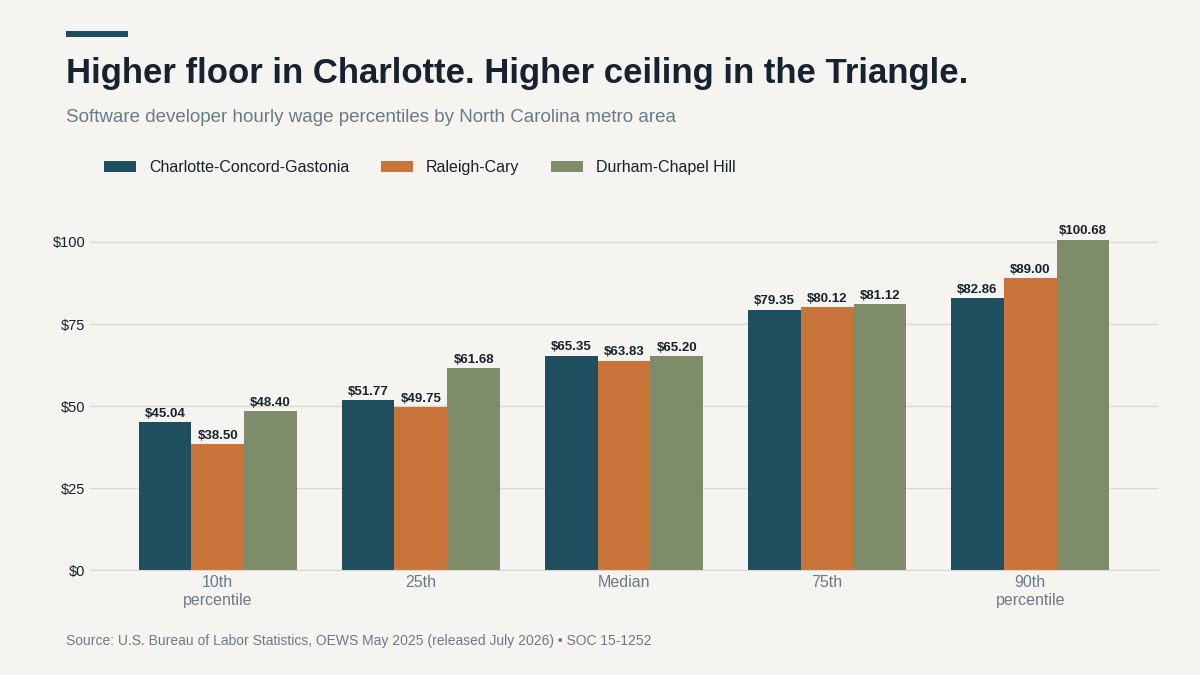
Federal wage data released in July 2026 contains a result that contradicts what most buyers assume about this state. The median software developer in Charlotte-Concord-Gastonia earns $65.35 an hour. In Raleigh-Cary, the median is $63.83. Charlotte, the banking town, the one nobody calls a tech hub, pays its median developer more than the Triangle does.
The ceiling tells the opposite story. Anyone benchmarking IT contractor rates in North Carolina from a single statewide average misses it entirely: Charlotte’s 90th-percentile developer wage stops at $82.86 an hour. Raleigh’s runs to $89.00. Durham-Chapel Hill, a separate metro area that contains most of Research Triangle Park, reaches $100.68. So Charlotte has the higher floor and the lower ceiling; the Triangle has the cheaper entry point and the expensive top end. Budget built on a single statewide average will be wrong in both directions.
The U.S. The Bureau of Labor Statistics projects software developer employment to grow 15.8% between 2024 and 2034, an increase of more than 267,000 jobs, the largest absolute gain of any computer occupation it tracks.
That growth is the reason rate compression is not coming. It is also the reason a rate benchmark published two years ago is worse than no benchmark at all, because it reads as authoritative while being stale.
This guide prices both metros using the most recent federal data available, then does the part nobody else does: converts a published wage into the bill rate that actually appears on an invoice. It covers engagement models, contract terms, worker classification exposure specific to North Carolina, onboarding, delivery management, and exit the full lifecycle, from the moment you decide you need a contractor to the moment you convert or offboard one.
TL;DR
This is a working reference on IT contractor rates in North Carolina, written for engineering leaders, finance partners, and talent teams who have to defend a number in a budget meeting. It covers both major markets, the arithmetic behind a rate card, and the operational decisions that move cost more than geography does.
The single number to take away: after employer burden and agency margin, a mid-level developer in either metro typically bills between $65 and $105 an hour, and a senior engineer between $85 and $130. The published salary you found elsewhere is roughly 60–70% of that. The gap is not markup alone, it is payroll tax, insurance, and the cost of carrying an unbillable bench.
By the end you will be able to build a defensible rate band for any role, decide between Charlotte and the Triangle on evidence rather than reputation, pick an engagement model that matches your risk tolerance, and recognise the three contract clauses that cost companies the most money after signature.
What Are IT Contractor Rates in North Carolina?
IT contractor rates in North Carolina are the hourly amounts a company pays for temporary technology talent in the state. They are quoted either as a pay rate, which the worker receives, or a bill rate, which includes employer tax and insurance burden plus supplier margin. In 2026 bill rates commonly run $50 to $160 an hour.
Three things this is routinely confused with:
- It is not a salary. Published salary figures describe permanent employees and include benefits the employer funds separately. A contractor’s rate has to absorb those costs inside the hourly number.
- It is not the worker’s take-home rate. On a W-2 contract, the difference between what you are billed and what the contractor receives covers employer FICA, unemployment insurance, workers’ compensation, benefits administration, and the supplier’s margin. Assuming that gap is pure profit is the most common negotiation error.
- It is not a project price. A rate is a unit of time. A statement of work priced at a fixed fee is a different commercial instrument with different risk allocation, and the two are not interchangeable in a budget model.
Why the Number Matters More Than Buyers Think
Rate is the smallest line in the model and the largest source of variance in the outcome. Getting IT contractor rates in north carolina wrong by a single percentile band changes five things at once:
- Total program cost. A ten-person contract team at a $12/hour rate difference is roughly $250,000 a year in delta at full utilisation. That is a headcount.
- Speed to staff. Rate bands set below the local 25th percentile do not fail loudly. They fail quietly, as a requisition that sits open for eleven weeks while the recruiting team blames the market.
- Quality of the shortlist. In both North Carolina metros, the difference between a 40th-percentile band and a 65th-percentile band is not a marginally better résumé. It is access to a different candidate pool entirely from people who are currently employed and not looking, rather than people who are available immediately.
- Conversion economics. If there is any chance the contractor becomes an employee, the conversion fee and tenure clause in the contract can be worth more than the entire rate negotiation.
- Classification risk. North Carolina maintains a dedicated Employee Classification Section inside its Industrial Commission with authority to investigate misclassification complaints and route them to the Department of Labor, Division of Employment Security, and Department of Revenue simultaneously. A cheap 1099 arrangement is not cheap if it is the wrong classification.
Demand context matters here too. Gartner forecasts worldwide IT spending to reach $6.37 trillion in 2026, up 14.2% year over year, with IT services the largest single spending category. Enterprise budgets are expanding into the same labor pool you are bidding in.
What Charlotte and Raleigh Actually Pay: The Federal Data
Everything below comes from the BLS Occupational Employment and Wage Statistics program, May 2025 reference period, released July 2026 the most recent official metro-level wage data available. The occupation is Software Developers, SOC 15-1252. These are employee wages and exclude self-employed workers, which is precisely why the next section exists.
Table 1 Software developer hourly wage percentiles, NC metros vs national (BLS OEWS, May 2025)
| Market | 10th %ile | 25th %ile | Median | 75th %ile | 90th %ile | 10th–90th spread |
| Charlotte-Concord-Gastonia, NC-SC | $45.04 | $51.77 | $65.35 | $79.35 | $82.86 | 1.84× |
| Raleigh-Cary, NC | $38.50 | $49.75 | $63.83 | $80.12 | $89.00 | 2.31× |
| Durham-Chapel Hill, NC | $48.40 | $61.68 | $65.20 | $81.12 | $100.68 | 2.08× |
| North Carolina (statewide) | $40.31 | $50.25 | $64.76 | $79.21 | $86.21 | 2.14× |
| United States | $39.64 | $50.58 | $65.38 | $82.68 | $103.21 | 2.60× |
Four readings that change how you budget:
- Charlotte’s floor is 17% higher than Raleigh’s. At the 10th percentile, Charlotte pays $45.04 against Raleigh’s $38.50. Junior and early-career nc tech contract rates are materially cheaper in the Triangle.
- Charlotte’s ceiling is compressed. Its 90th percentile ($82.86) sits below Raleigh’s ($89.00) and far below Durham’s ($100.68). If your role needs top-decile talent, Charlotte’s local supply runs out before your requirement does.
- The whole state has a lower ceiling than the country. North Carolina’s 90th percentile is $86.21 against a national $103.21. That is a genuine arbitrage in your favour for senior roles, and a genuine constraint if you are hunting for staff-plus specialists.
- Durham is the outlier. Its 25th percentile ($61.68) is higher than Charlotte’s median-minus-one-band. Junior talent in Durham costs what mid-level talent costs elsewhere in the state, because the RTP employer base competes for it.
The MSA trap: The Raleigh-Cary MSA covers Franklin, Johnston, and Wake counties only. Durham and Chapel Hill are a separate metropolitan statistical area. Every federal “Raleigh” figure you have ever read excludes most of Research Triangle Park. Teams that recruit “the Triangle” and budget from “Raleigh” data are pricing two-thirds of a labor market.
Rates by role: what the Triangle data reveals
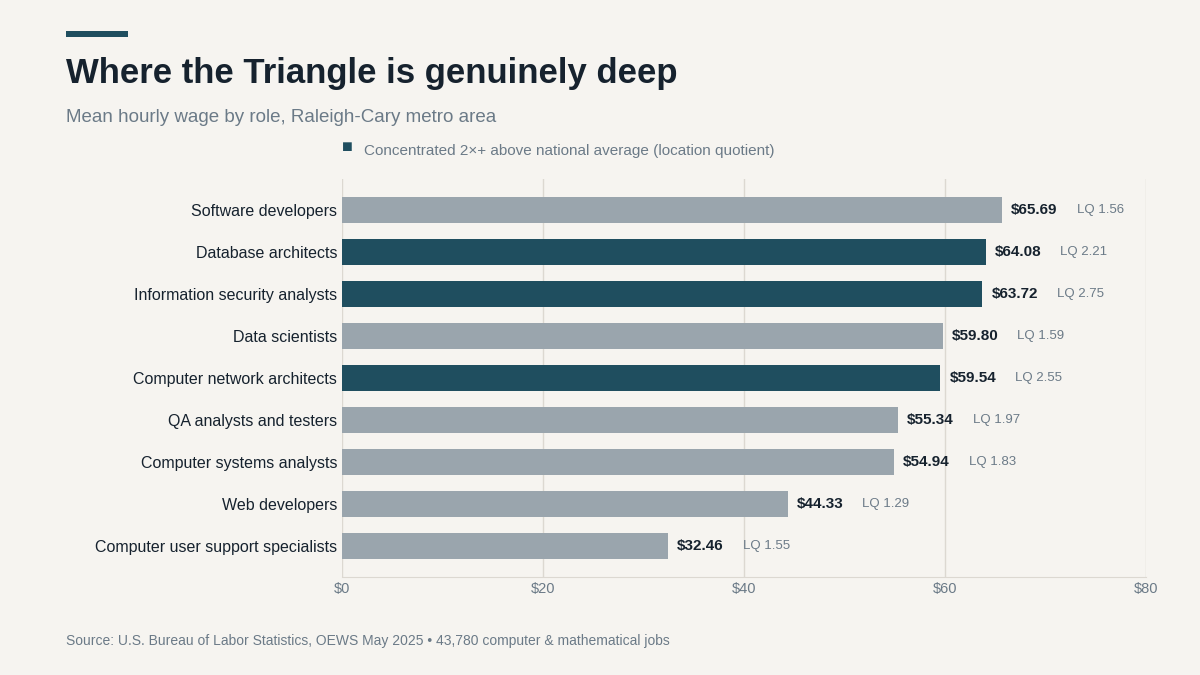
BLS published the full computer and mathematical occupation detail for Raleigh in its May 2025 release. Raleigh had 43,780 computer and mathematical jobs, 5.9% of local employment against a 3.4% national share, at a group mean of $54.71 an hour.
Table 2 Mean hourly wage by role, Raleigh-Cary MSA (BLS OEWS, May 2025)
| Role | Employment | Location quotient | Mean hourly wage |
| Software developers | 12,580 | 1.56 | $65.69 |
| Database architects | 710 | 2.21 | $64.08 |
| Information security analysts | 2,510 | 2.75 | $63.72 |
| Data scientists | 1,990 | 1.59 | $59.80 |
| Computer network architects | 2,190 | 2.55 | $59.54 |
| Computer systems analysts | 4,530 | 1.83 | $54.94 |
| QA analysts and testers | 1,760 | 1.97 | $55.34 |
| Web developers | 430 | 1.29 | $44.33 |
| Computer user support specialists | 5,320 | 1.55 | $32.46 |
The location quotients are the useful column. Information security analysts at 2.75× the national concentration and computer network architects at 2.55× mean the Triangle has genuine depth in security and infrastructure. You will fill those roles faster and negotiate harder there than in most U.S. metros. Support roles at $32.46 an hour set a real floor for tiered helpdesk and NOC work.
For the Raleigh market specifically, the data-side depth is worth noting: with roughly 2,000 data scientists at a 1.59 location quotient, this is one of the more efficient U.S. markets in which to hire data scientists on contract.
A note on Charlotte’s detail: BLS profiled business and financial operations rather than computer occupations in its May 2025 Charlotte release, so equivalent role-level detail for that metro is not in the news release. What the release does publish: Charlotte’s computer and mathematical group mean is $56.88 an hour across 4.6% of local employment, a higher group mean than Raleigh’s $54.71, despite a thinner concentration. Charlotte’s tech workforce skews senior and skews financial. Treat any Charlotte role-level figure you see quoted elsewhere as an estimate unless it is pulled from the OEWS area query directly.
Why Charlotte and Raleigh price differently
The two markets are not competing versions of the same thing. CBRE’s Scoring Tech Talent 2025 ranks Raleigh-Durham #12 among the top 50 North American tech markets, up four places, with a tech workforce of 76,570 that grew 15.4% between 2021 and 2024 and now represents 7.2% of total regional employment. Charlotte ranks #24, and CBRE notes that 28% of Charlotte’s tech talent works in finance, insurance and real estate, one of the highest concentrations on the continent.
That single statistic explains most of the rate behaviour:
- Charlotte prices financial-services engineering. Core banking, payments, regulatory reporting, risk platforms, mainframe integration, and enterprise Java. Bank of America, Wells Fargo, Truist, Lowe’s, Honeywell, and Duke Energy set the local wage floor and they do not compete on equity, they compete on cash. That pushes the bottom of the market up and keeps the top of the market inside a corporate band.
- The Triangle prices product and research engineering. SAS, Red Hat, Cisco, IBM, Epic Games, and a substantial life-sciences software base, alongside NC State, Duke, and UNC producing a continuous graduate supply. Junior talent is abundant and cheap; specialist talent is scarce and expensive.
- Practical consequence: if your stack is regulated-industry backend work, Charlotte will fill it faster at a rate you can defend. If you need to hire Java developers for a payments or core-banking build, Charlotte is the deeper pool. If you need product engineers, ML specialists, or embedded talent, the Triangle is the deeper pool and Durham is where the senior end of it lives.
Charlotte developer rates and Raleigh consultant costs are therefore not two points on one scale. They are two different distributions, and the right question is which distribution your specific role sits inside.
The Core Problem: Nobody Converts Wage Into Bill Rate
Here is where most budgets break. A finance partner searches for a salary figure, divides by 2,080, and books that as the contractor rate. The requisition then sits open for two months because the number is 35–45% below market.
The published wage is the pay rate. What lands on your invoice is the bill rate, and three layers sit between them.
Layer 1 Employer burden. On a W-2 contract, the supplier is the legal employer and carries: employer FICA at 7.65%, federal and North Carolina unemployment insurance, workers’ compensation, ACA-compliant health coverage, and benefits administration. In most engagements this lands somewhere between 15% and 22% of the pay rate, varying with the benefits package and the state experience rate. It is a real cost, not margin.
Layer 2 Supplier margin. This covers sourcing, screening, background adjudication, payroll float (the supplier pays the contractor weekly and waits 30–60 days for your invoice), account management, and replacement risk. Across the U.S. IT contract market, gross markup over pay rate commonly falls between 1.35× and 1.60× all-in, with the lower end reflecting high-volume MSP programs and the higher end reflecting niche or hard-to-fill skills.
Layer 3 Program overhead. Vendor management system fees, MSP administrative fees, and rate-card compliance costs. Usually 2–4% of spend, and usually invisible in the rate conversation until procurement introduces it.
The arithmetic:
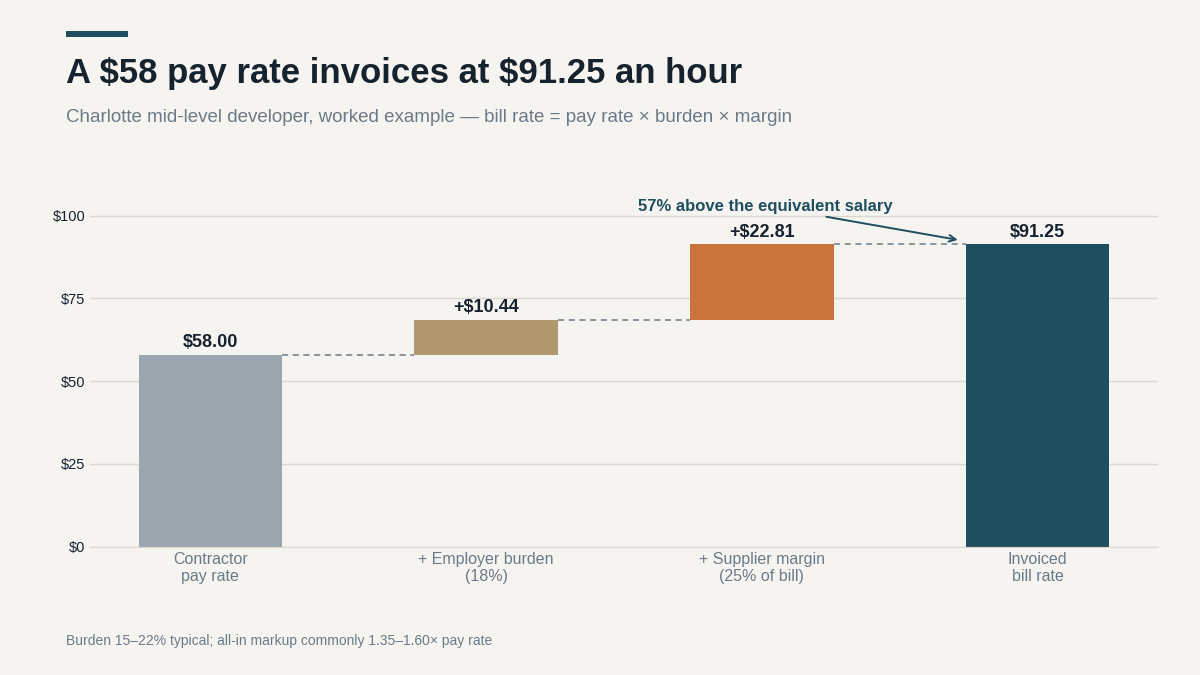
Bill rate = Pay rate × (1 + burden) × (1 + margin)
Worked example, Charlotte mid-level developer at the local 40th percentile:
- Pay rate: $58.00/hour
- Burden at 18%: $58.00 × 1.18 = $68.44
- Supplier margin at 25% of bill: $68.44 ÷ 0.75 = $91.25
- Rounded bill rate: $90–$92/hour
- Annualised at 2,080 hours: ~$189,000
That $58 pay rate corresponds to roughly a $120,000 salary. The contractor costs about 57% more per year than the equivalent employee’s base and that is the correct comparison to make, because it buys speed, flexibility, and no severance exposure. What it does not buy is a discount.
The 3-day rule: if a supplier accepts your first rate without a single counter-question about scope, seniority, or timeline, they are planning to fill it with whoever is on the bench within 72 hours. Rate acceptance without scope interrogation is the earliest available signal of a bad placement.
Table 3 Derived 2026 bill-rate bands by metro and seniority
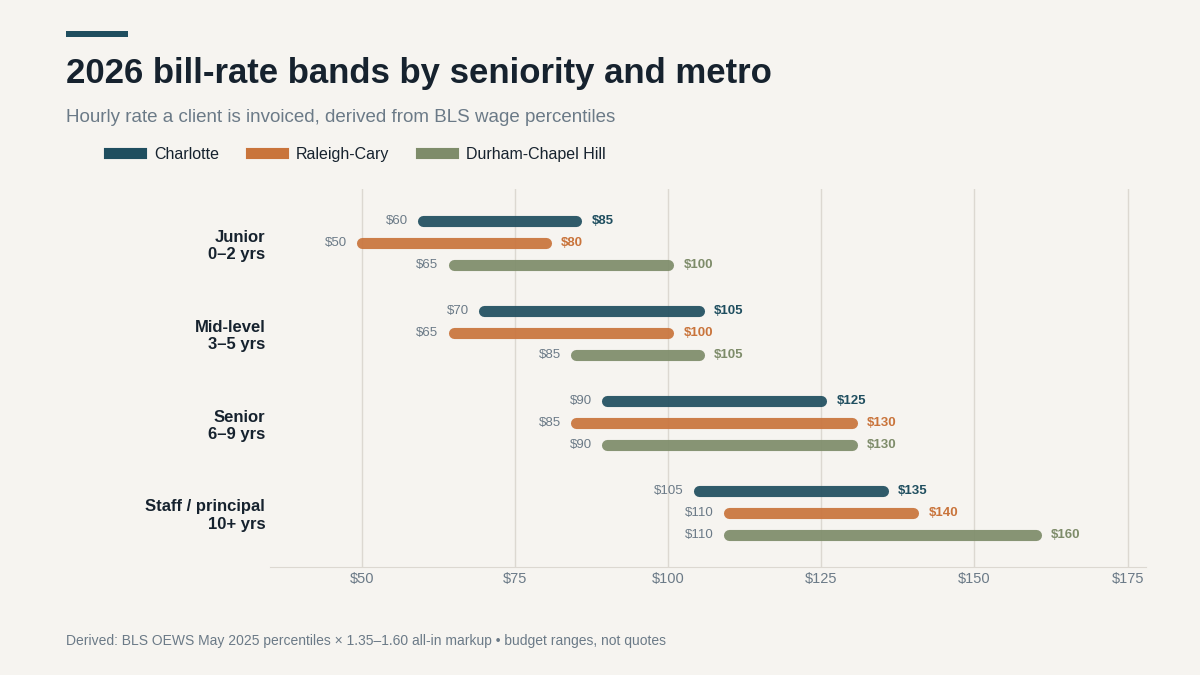
Bands below are derived from the BLS percentiles in Table 1, using a 1.35–1.60× all-in markup over pay rate and rounded to the nearest $5. Treat them as budget-planning ranges, not quotes.
| Seniority (pay-rate band) | Charlotte | Raleigh-Cary | Durham-Chapel Hill |
| Junior, 0–2 yrs (10th–25th %ile) | $60–$85 | $50–$80 | $65–$100 |
| Mid-level, 3–5 yrs (25th–50th) | $70–$105 | $65–$100 | $85–$105 |
| Senior, 6–9 yrs (50th–75th) | $90–$125 | $85–$130 | $90–$130 |
| Staff / principal, 10+ yrs (75th–90th) | $105–$135 | $110–$140 | $110–$160 |
Read the table diagonally, not vertically. Charlotte wins on junior and mid-level cost predictability. The Triangle wins on senior availability. Durham is where you go when the requirement genuinely needs the top decile and you have accepted what that costs.
The Walkthrough: Scoping to Offboarding
What follows is the complete lifecycle, from first scoping conversation to final invoice. Every phase below moves IT contractor rates in North Carolina up or down, and most of them move it further than the choice of metro does. This assumes you have never run a contract engagement before and skips nothing.
Phase 1 Defining requirements and setting the band
Most rate disputes are actually scope disputes wearing a rate costume. Fix the scope first.
- Write the outcome, not the title. “Senior engineer” is not a requirement. “Migrate 14 batch jobs off the on-prem scheduler to manage Airflow, in production, by the end of Q1” is. Titles inflate rates; outcomes anchor them.
- Separate must-have from teachable. For every skill on the list, mark whether a strong engineer could pick it up in two weeks. Anything teachable comes off the must-have list. Each additional non-negotiable skill narrows your candidate pool and pushes you up a percentile band.
- Pick the percentile deliberately. Decide up front whether this role is a 40th, 55th, or 75th percentile hire and write it in the requisition. Undocumented percentile targets are how requisitions drift open for months.
- Set the band, not the point. Give suppliers a $12–$15 range, not a single number. A single number gets you candidates at that number regardless of fit.
- Confirm duration and extension likelihood. A 12-month engagement with a probable extension attracts materially better candidates than a “3-month, maybe more” posting at the same rate. Contractors price uncertainty.
- Budget the burn, not the rate. Multiply band midpoint × expected hours × duration, add 8–10% for onboarding ramp and holidays, and take that number to finance.
Red flag: a requisition listing more than six must-have technologies. In practice this means the internal stakeholders have not agreed on what the role is, and no rate band will fix that. Resolve it before going to market.
Infrastructure roles deserve special care here cloud requirements are the most frequently over-specified category we see. If the actual need is pipeline reliability rather than platform architecture, the decision to hire DevOps engineers at a mid band rather than a principal band can save 25–30% on the engagement with no delivery impact.
Phase 2 Sourcing and vetting
This is where North Carolina hourly rates stop being a market question and start being a supplier-quality question. Two suppliers quoting identical rates can deliver wildly different outcomes, and the difference shows up in the screening process, not the rate card.
What good screening looks like the seven-point check:
- Live technical assessment, not a take-home. Take-homes have been unreliable since generative coding tools became standard. A 45-minute live session where the candidate modifies existing code and explains trade-offs is now the only defensible signal.
- Identity verification against a government ID on camera. Candidate fraud and proxy interviewing have risen sharply across the U.S. contract market. Verify at screening, not at onboarding.
- Reference checks with the direct technical manager, not HR and not a peer.
- Background adjudication matched to the client’s industry. Financial services clients in Charlotte routinely require FINRA-adjacent screening and fingerprinting; a supplier who does not raise this pre-submittal will lose you two weeks post-offer.
- Written scenario response on a problem from your actual domain.
- Availability and competing-process disclosure in writing. Ask what other processes the candidate is in and at what stage.
- Rate confirmation with the candidate directly, not through the supplier’s assumption.
Red flags in a submittal:
- Résumés with responsibilities but no outcomes, quantities, or system scale.
- Three candidates submitted within four hours of the requisition opening. That is a bench, not a search.
- A supplier who will not tell you the pay rate on a W-2 placement. You do not need to dictate it, but a supplier hiding it is usually running a markup they cannot defend.
- Any candidate whose LinkedIn history does not corroborate the resume timeline.
- Reluctance to put the candidate on a live video screen before submission.
Benchmark to hold suppliers to: a job description should produce an interview-ready shortlist in 7–10 working days. That is the standard the Supersourcing delivery team runs to across U.S. and offshore requisitions, supported by AI-assisted sourcing that filters to roughly the top 2% of vetted candidates before a human recruiter reviews. If a supplier needs three weeks to produce three résumés, the bottleneck is their pipeline, not your rate.
Phase 3 Engagement models and contracts
The engagement model changes cost more than the metro does. Four options, and they are not interchangeable.
Table 4 Engagement model comparison
| Model | Who employs the worker | Typical cost position | Best for | Main risk |
| W-2 contract (staff augmentation) | Supplier | Baseline | Ongoing team capacity, regulated industries | Co-employment and tenure limits |
| 1099 independent contractor | Nobody self-employed | 15–25% below W-2 bill rate | Genuinely independent, short, deliverable-based work | Misclassification exposure |
| Corp-to-corp (C2C) | The contractor’s own entity | Similar to W-2, sometimes lower | Experienced specialists with an established LLC | IP assignment gaps, insurance verification |
| Project SOW / fixed fee | Supplier | Priced on outcome, not hours | Well-specified, bounded deliverables | Change orders; scope disputes |
Contract terms that matter more than the rate the six-clause checklist:
- Conversion / right-to-hire fee. Usually a declining schedule against tenure. Negotiate it before you like the contractor, never after.
- Tenure limit. Many enterprises impose 18- or 24-month caps on contractor tenure to manage co-employment risk. Know yours before you scope a two-year program.
- IP assignment and NDA. Confirm assignment flows from the individual, through the supplier entity, to you. C2C arrangements break this chain most often.
- Replacement guarantee. A defined window in which a non-performing contractor is replaced at no cost. A 7–10 day replacement commitment is a reasonable standard to hold a supplier to.
- Rate escalation on extension. Silence here means the supplier can reprice at renewal. Cap it or index it.
- Termination notice. Two weeks is standard. Anything longer converts your flexibility advantage back into a fixed cost.
For teams running more than three or four simultaneous requisitions, a structured contract IT staffing agreement with pre-negotiated rate cards and a single MSA removes most of this friction permanently.
Phase 4 Onboarding and ramp-up
The most expensive two weeks of any contract engagement are the first two, because you pay full rate for partial output. Compress them deliberately.
Day-one readiness checklist complete before start date, not on it:
- Laptop imaged, shipped, and confirmed delivered.
- SSO account, VPN, and MFA enrolment active.
- Repository and CI/CD access provisioned at the correct permission level.
- Ticketing, documentation, and communication tools added.
- Named onboarding buddy assigned with 30 minutes booked daily for week one.
- First deliverable written down and scoped to be completable in week one.
- Timesheet system access and approval chain confirmed.
The friction nobody plans for: access provisioning in regulated environments. In Charlotte financial-services engagements, background adjudication and entitlement provisioning routinely take 10–15 business days after offer acceptance.
Dedicated development teams that start the clock at offer instead of at submittal lose two weeks per hire and blame the supplier for it. Start background checks at final-round, and stage the provisioning tickets before the contractor signs.
The 30-day ramp benchmark: a competent mid-level contractor should ship something small to production inside week two and be at roughly 80% of steady-state output by day 30. If they are not, the cause is nearly always missing access or ambiguous ownership, not capability. Diagnose the environment before you diagnose the person.
Phase 5 Managing delivery
Contract teams fail on management attention more often than on skill.
The delivery cadence that works:
- Daily: contractor participates in the same standup as employees. Separate standups create separate teams.
- Weekly: 30-minute one-on-one with the engineering manager covering blockers, scope changes, and quality feedback. This is the single highest-leverage meeting in a contract engagement.
- Bi-weekly: supplier account manager check-in, with the contractor present for part of it.
- Monthly: rate, utilisation, and burn review against the budget model built in Phase 1.
- Quarterly: extension or exit decision, made early enough to act on.
KPIs to track and the ones to ignore:
| Track | Ignore |
| Cycle time from ticket start to production | Hours logged |
| Escaped defect rate | Lines of code |
| Code review turnaround and participation | Commit frequency |
| Percentage of committed sprint scope delivered | Meeting attendance |
| Documentation left behind for the permanent team | Availability outside contracted hours |
Account management structure to insist on: a named account manager, not a shared queue. Shared-bandwidth models mean your escalation competes with forty other clients for attention, and the practical consequence surfaces exactly when you need a replacement quickly. Dedicated account ownership and NDA-backed IP protection should be contractual, not aspirational.
Phase 6 Scaling, converting, or exiting
Scaling up. Adding contractors to a working team is cheaper and faster than the first hire was, because the vetting profile is proven. Expect a 30–50% reduction in time-to-fill on the second and subsequent hires against the same profile. Add in pairs where possible; a solo contractor on a new workstream carries single-point-of-failure risk that a second person eliminates for far less than the cost of the risk.
Converting to permanent. Contract-to-hire is the most underused instrument in this market. You get a 3–6 month evaluation of real output before committing to severance-bearing headcount. Two rules: negotiate the conversion fee schedule in the original MSA, and tell the contractor conversion is possible on day one. Contractors who know a conversion path exists behave like employees; contractors who find out at month five have usually already lined up their next engagement.
Replacing someone who is not working out. Decide in week three, not week twelve. A defined replacement guarantee the 7–10 working day standard referenced earlier only helps if you invoke it early. The cost of a bad contractor is not their rate; it is the six weeks of team time spent working around them.
Offboarding the five-item exit checklist:
- Knowledge transfer session recorded, not just held.
- Documentation for anything they built merged into the team’s actual repository.
- All access revoked on the final day, verified by a second person.
- Equipment returned and confirmed.
- Final timesheet approved and the invoice reconciled against the PO before the engagement closes.
The Decision Framework: Which Model, Which Metro
Run these four questions in order. The first one that returns a clear answer decides it.
- Is the work bounded and specifiable? If yes and it has a definable acceptance criterion, price it as a fixed-fee SOW and stop reading about hourly rates. If no, you need time-and-materials.
- Will this capability still be needed in 24 months? If yes, you are looking at a permanent headcount with a contract as a bridge, use contract-to-hire and negotiate the conversion fee now. If no, straight contract is correct and you should resist internal pressure to convert.
- What percentile does the role genuinely require? Below the 50th: either metro works, and Raleigh is cheaper at the junior end. 50th–75th: choose on stack fit, not price the metros are within a few dollars of each other. Above the 75th: the Triangle, and specifically Durham, is where the supply is. Charlotte’s distribution runs out.
- Is the stack regulated-industry or product? Regulated backend, payments, risk, core banking: Charlotte. Product engineering, ML, embedded, life sciences: the Triangle.
What Most Teams Get Wrong
Five patterns that show up repeatedly, ranked by how much money they cost.
They benchmark against the wrong geography. A team hiring for “Raleigh” pulls federal data for the Raleigh-Cary MSA, which excludes Durham and most of RTP, then wonders why every strong candidate is out of band. The Triangle is three metros in a trench coat. Price the labor shed you are actually recruiting from, which for most remote-or-hybrid Triangle roles means blending Raleigh-Cary and Durham-Chapel Hill data.
They negotiate the rate and ignore the conversion clause. Saving $6 an hour on a twelve-month engagement is about $12,500. An unnegotiated conversion fee on a $150,000 role can be $30,000. The clause is worth more than the rate and gets a fraction of the attention, because it is invisible at the moment of signature.
They treat the markup as the enemy. Pushing a supplier’s margin below roughly 18–20% does not produce a cheaper contractor. It produces a supplier who fills the role from whoever is available rather than whoever is right, because the economics no longer support a real search. The lever that actually reduces cost is scope discipline in Phase 1, not margin compression in Phase 3.
They over-specify seniority. The reflex is to ask for a senior engineer because seniors are safer. In practice, a large share of contract work feature delivery against an established architecture, test automation, integration work, migration execution is mid-level work. Buying a 75th-percentile engineer to do 45th-percentile work costs roughly $35–$45 an hour extra and frequently produces a bored contractor who leaves at month four.
They start managing on day 31. Contract engagements are treated as fire-and-forget because a supplier is nominally accountable. The supplier cannot see your codebase, your standups, or your ambiguity about who owns what. Almost every contract failure that gets blamed on the supplier was diagnosable in week two by the engineering manager and was not diagnosed because nobody had booked the meeting.
Cost and Timeline Reality Check
Published benchmarks stop at an hourly figure. The line items below are what actually shows up against the budget once you commit to a rate.
What a role actually costs, end to end
| Line item | Typical range | Notes |
| Bill rate, mid-level developer | $65–$105/hr | See Table 3 for metro-specific bands |
| Annualised at 2,080 hrs | $135,000–$218,000 | Before overtime or extension escalation |
| Onboarding ramp cost | 8–12% of first-quarter spend | Full rate, partial output, weeks 1–3 |
| Conversion fee, if converting | Negotiated; declining with tenure | Set it in the MSA, not at conversion |
| VMS / MSP program fee | 2–4% of spend | Often invisible until procurement raises it |
| Replacement cost, if it goes wrong | 4–6 weeks of team disruption | Not the contractor’s rate the team’s time |
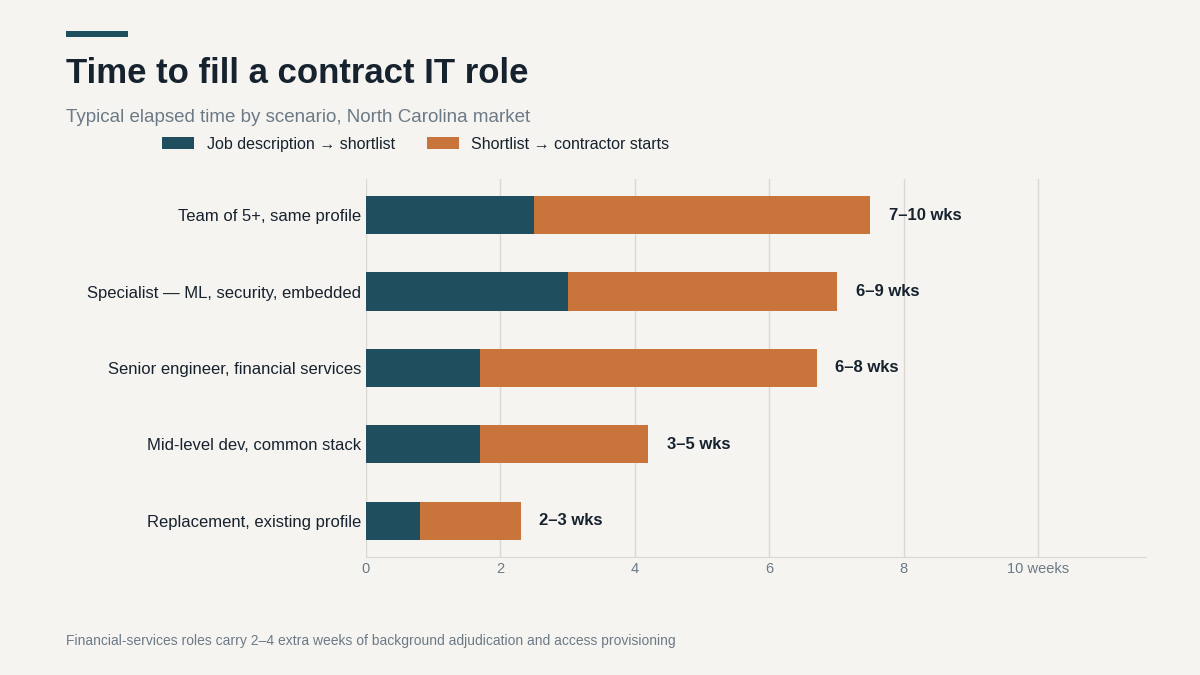
Realistic timelines by scenario
| Scenario | Job description to shortlist | Shortlist to start | Total |
| Mid-level developer, common stack, non-regulated | 7–10 working days | 2–3 weeks | 3–5 weeks |
| Senior engineer, financial services, Charlotte | 7–10 working days | 4–6 weeks (background adjudication) | 6–8 weeks |
| Specialist ML, security architecture, embedded | 2–4 weeks | 3–5 weeks | 6–9 weeks |
| Team of 5+, same profile | 2–3 weeks | 4–6 weeks staggered | 7–10 weeks to full team |
| Replacement against an existing profile | 3–5 working days | 1–2 weeks | 2–3 weeks |
What drives cost up:
- Each additional non-negotiable technology on the requirement list.
- Regulated-industry clearance and fingerprinting requirements.
- On-site or strict hybrid mandates, which shrink the candidate pool to commuting distance.
- Short engagement duration with no extension signal.
- Requisitions opened in Q4, competing with annual budget-flush hiring across the market.
- Skills currently in a demand spike AI/ML engineering and platform engineering have seen the sharpest recent increases in the U.S. market.
What drives cost down:
- Remote or genuinely flexible hybrid, which opens the whole state rather than one metro.
- Longer committed duration, or a credible extension signal.
- A pre-negotiated rate card across multiple roles rather than requisition-by-requisition pricing.
- Buying at the correct percentile instead of defaulting to senior.
- Consolidating suppliers volume earns real rate concessions in a way that per-role haggling never does.
- Blending onshore leadership with offshore delivery capacity where timezone overlap permits.
For organisations running continuous contract demand rather than one-off requisitions, moving to a managed IT staffing services arrangement with fixed rate bands typically removes 20–30% of the administrative cost and most of the timeline variance.
Where to Take This Next
If you are mid-decision, the useful next step is not a vendor call. It is a rate band.
Take the role you are actually trying to fill, decide which percentile it genuinely requires using Table 1 rather than a generic figure for IT contractor rates in North Carolina, apply the burden and margin math from the bill-rate section, and write the resulting range into the requisition before you go to market. That single artefact resolves most of the disagreement between engineering and finance and gives every supplier the same target to hit.
If you would rather pressure-test that band against live market data or you need a shortlist against it in 7–10 working days, in either metro, with a replacement guarantee behind it the Supersourcing team will benchmark the role and tell you where your number sits against current placements. No obligation to hire from it.
Frequently Asked Questions
What is the average IT contractor hourly rate in North Carolina?
For software developers, IT contractor rates in North Carolina run roughly $50–$140 an hour on the bill rate depending on metro and seniority, with mid-level roles clustering at $65–$105. That derives from BLS May 2025 wage percentiles plus standard employer burden and supplier margin. Support and QA roles sit lower; ML, security architecture, and platform engineering sit higher.
Is Charlotte or Raleigh more expensive for tech contractors?
It depends entirely on seniority. Charlotte’s median developer wage is higher ($65.35 vs $63.83 per hour) and its 10th percentile is 17% higher, so junior and mid-level work is cheaper in Raleigh. Above the 75th percentile, Raleigh and especially Durham are more expensive because Charlotte’s local supply thins out around $83 an hour.
How is a contractor bill rate calculated?
Bill rate equals pay rate multiplied by employer burden (typically 15–22%, covering FICA, unemployment insurance, workers’ compensation, and benefits) multiplied by supplier margin. All-in markup over pay rate commonly falls between 1.35× and 1.60×. A $58 pay rate therefore produces a bill rate around $90 an hour.
Should I engage a contractor as W-2, 1099, or corp-to-corp in North Carolina?
Default to W-2 unless the work is genuinely independent and deliverable-based. North Carolina’s Employee Fair Classification Act routes misclassification complaints to four state agencies simultaneously, and the test looks at control over method, hours, equipment, and duration. If you direct the work daily, W-2 is the defensible classification. Have counsel review borderline arrangements.
How long does it take to fill a contract IT role in North Carolina?
A job description should produce an interview-ready shortlist in 7–10 working days for common stacks. Total time to start typically runs 3–5 weeks for non-regulated roles and 6–8 weeks in financial services, where background adjudication and entitlement provisioning add two to four weeks after offer acceptance.
What is a contract-to-hire conversion fee and can it be negotiated?
It is the fee paid to convert a contractor to permanent employment, usually structured as a declining percentage of first-year salary that reduces with contract tenure. It is highly negotiable, but only before the engagement starts. Once you have a contractor you want to keep, your leverage is gone. Fix the schedule in the master service agreement.
How do North Carolina rates compare to hiring offshore?
Offshore dedicated teams typically run 40–60% below U.S. contract rates. The trade is timezone overlap, context transfer overhead, and management attention. The pattern that works most reliably is a blended model: onshore technical leadership in Charlotte or the Triangle, offshore delivery capacity underneath. Supersourcing builds both sides of that model, including a full Global Capability Center setup for organisations moving from project-based offshore work to a permanent captive team.
What happens if a contractor doesn’t work out?
A replacement guarantee should be contractual, with a defined window 7–10 working days is a reasonable standard for a replacement against an already-vetted profile. The important variable is not the guarantee, it is how fast you invoke it. Decide by week three. The cost of a mismatched contractor is the team time spent working around them, which dwarfs the rate.
