

The number that reframes this entire decision
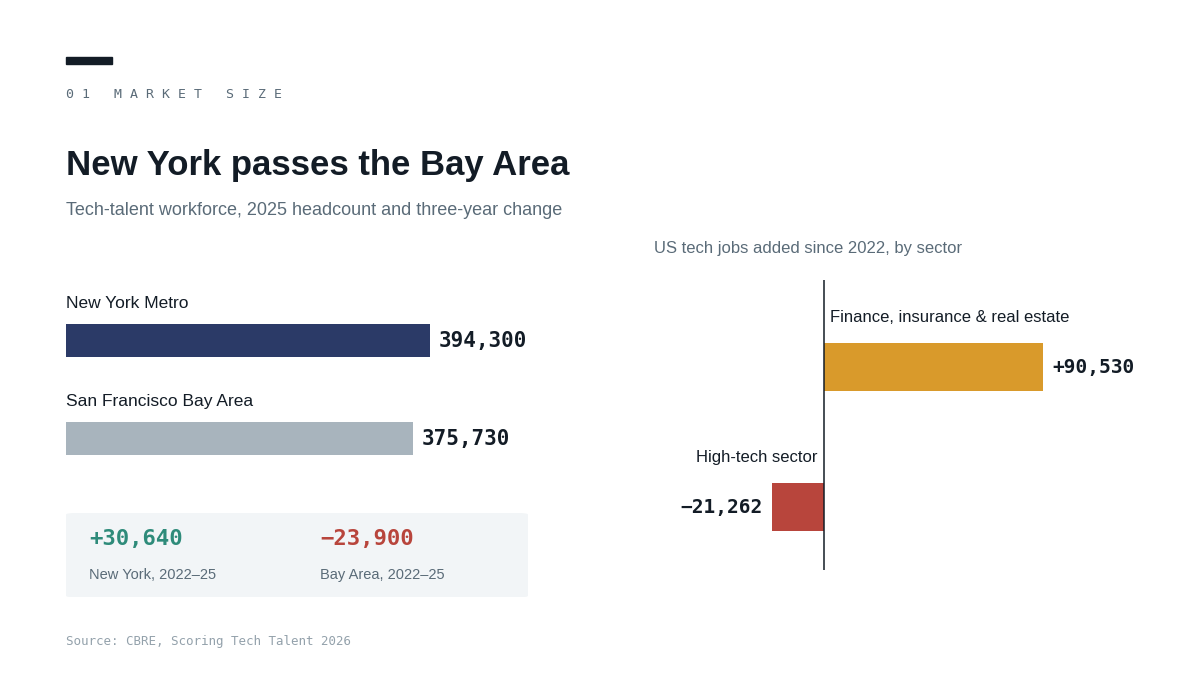
In August 2026, CBRE’s Scoring Tech Talent 2026 report recorded something that had not happened in the study’s thirteen-year history: New York Metro’s tech-talent workforce reached 394,300 workers, passing the San Francisco Bay Area’s 375,730. New York added 30,640 tech workers between 2022 and 2025. The Bay Area lost 23,900.
CBRE also found that finance, insurance, and real estate added 90,530 tech jobs across the US while the high-tech sector shed 21,262. The people setting engineering comp in this region are increasingly banks and insurers, not startups.
That matters for New Jersey vs New York tech hiring in a way most cost comparisons miss. The premium you pay is no longer being set by venture-funded product companies with volatile headcount. It is being set by institutions with stable budgets, long lease commitments, and a structural preference for on-site work. Those employers do not care which side of the Hudson a candidate sleeps on; they compete for the same résumés.
Which means the popular framing of this decision is wrong. Teams treat it as a cheap market versus expensive market and go looking for a salary gap. They find one, usually somewhere between four and nine percent at the median, decide it is not worth the operational hassle, and default to a New York posting.
Then eighteen months later they discover the gap was never in the salary line. It was in payroll tax exposure they did not model, a corporate filing obligation they did not know a single hire would trigger, occupancy cost they benchmarked against the wrong submarket, and an attrition pattern driven entirely by commute geometry.
TL;DR
This guide covers how to decide between New Jersey and New York when building or expanding an engineering team in the tri-state area. It is written for founders, CTOs, and heads of talent who have to defend a headcount budget to a CFO, not for people browsing salary averages.
Here is the single most useful thing in it. The median salary difference between the two states for a comparable software engineer is real but modest a few percentage points inside one shared commuter labor market. The difference in fully loaded cost per head can swing by twenty to thirty percent in either direction once you account for state tax sourcing rules, mandated benefit programs, and office occupancy. The salary line is the smallest variable on the page.
By the end you will be able to build a defensible loaded-cost model for a role in either state, know which tax rule to check before you extend an offer, understand what tri state tech hiring actually costs at each seniority band, and know the specific scenario in which neither state is the right answer.
What is New Jersey vs New York tech hiring?
New Jersey vs New York tech hiring is the evaluation of where to source, employ, and seat technical staff within the New York–Newark–Jersey City metropolitan area, comparing salary bands, state tax treatment, entity and compliance obligations, office occupancy cost, and commute-driven retention across the state line rather than across separate labor markets.
Three things it is commonly confused with:
- It is not a talent-pool comparison. Federal wage data for this region is published for the New York-Newark-Jersey City, NY-NJ-PA metropolitan statistical area, a single unit spanning both states. Economically, this is one labor market with a river through it. Treating it as two competing pools produces bad conclusions.
- It is not a remote-work decision. Where an employee physically sits and where their income is legally sourced are two different questions with two different answers, and the second one is set by statute, not by your HR policy.
- It is not the same as offshore versus onshore. Comparing a Jersey City engineer to a Bengaluru engineer is a different calculation with different cost structures, timelines, and management overhead. Some teams should be running that analysis instead. We cover when, in the framework section below.
Why the tri-state decision matters more than it used to
Three years ago this was a rounding error. Hybrid policy was loose, remote hiring was normal, and the state line was mostly a payroll-provider configuration detail. That has changed, and new jersey vs new york tech hiring is now a line item rather than a logistics footnote. Here is what the decision moves:
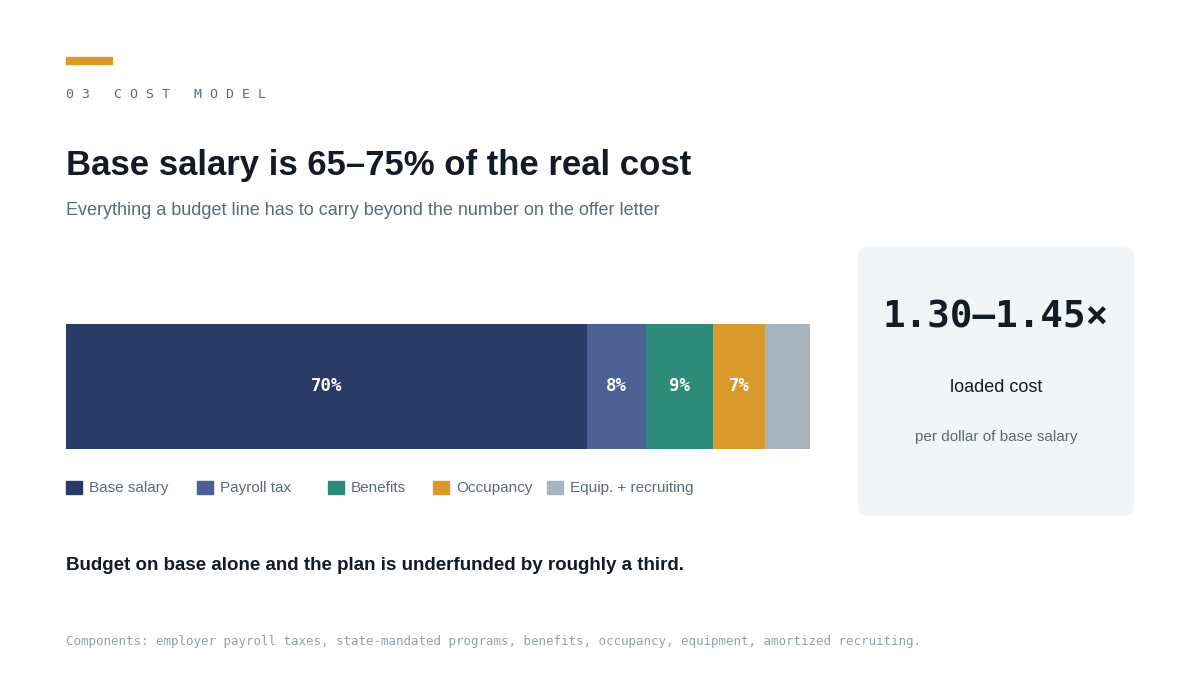
- Fully loaded cost per engineer. Base salary is typically 65–75% of what a head actually costs. The rest employer payroll taxes, mandated state programs, benefits, occupancy, equipment, and recruiting amortization varies materially by state.
- Corporate tax exposure. New Jersey’s top Corporation Business Tax rate is 11.5% once the Corporate Transit Fee is layered on the base 9% rate, currently the highest top corporate rate in the United States. New York’s structure is different and, for many profitable companies, lower.
- Double-taxation risk for your employees. New Jersey and New York have no reciprocal agreement. Pennsylvania and New Jersey do. That asymmetry produces offer-acceptance problems that show up as “candidate went dark after the offer” in your ATS.
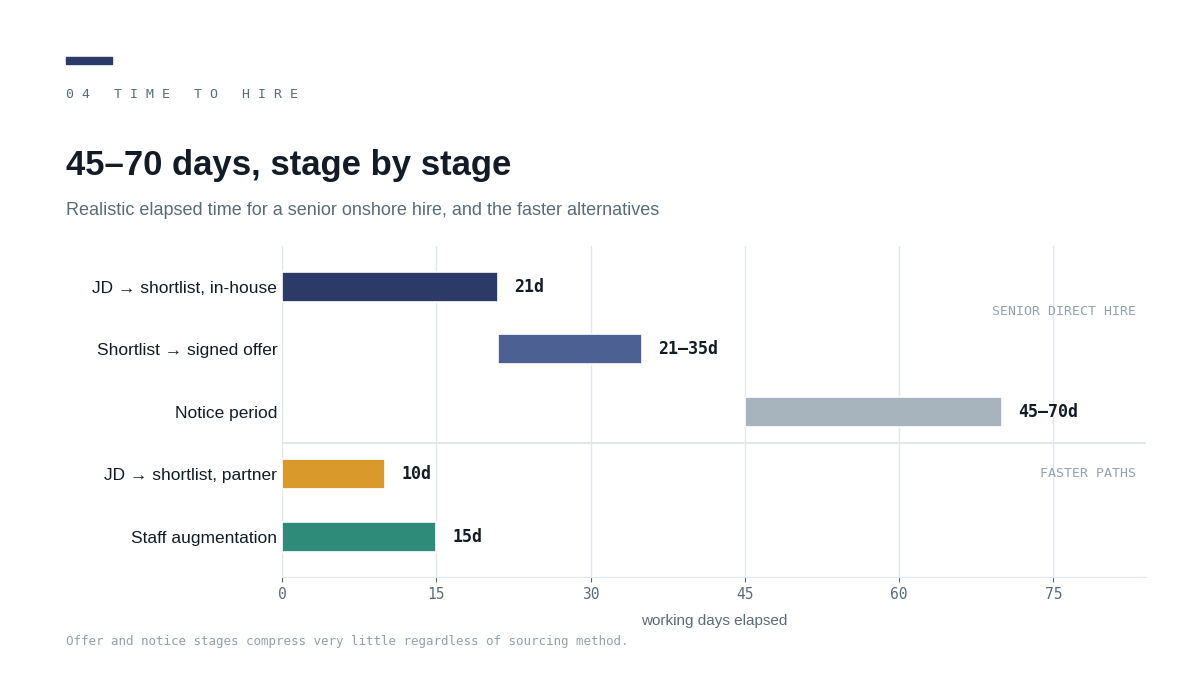
- Speed to hire. Deeper pools shorten sourcing but lengthen decision cycles, because you are competing against more employers per candidate. In this region, senior backend and platform roles routinely run 45–70 days from posting to signed offer when handled in-house.
- Retention. Commute time is one of the most reliable predictors of 12-month attrition in hybrid roles in this market. Not distance transfer count. A candidate 22 miles out with one direct train is more durable than one 9 miles out with two transfers.
- Office commitment. Manhattan office leases are typically 7–10 years. A hiring geography decision made this quarter constrains real-estate decisions for the better part of a decade.
Every one of those is a line a CFO will ask about. Most hiring plans answer one of them.
The core problem: teams model the wrong 8%
The consistent failure pattern in New Jersey vs New York tech hiring is not that teams pick the wrong state. It is that they run the comparison on a single variable and treat the answer as settled.
The typical process looks like this. Someone pulls a salary aggregator, finds a New York software engineer median in the mid-$160,000s against a national median of $133,080 reported by the Bureau of Labor Statistics, pulls a New Jersey figure that lands a few percent lower, and concludes the arbitrage is not worth chasing.
Four things are wrong with that.
The data is not separating the states. The BLS Occupational Employment and Wage Statistics program publishes metro-level wages for New York-Newark-Jersey City, NY-NJ-PA. A large share of the “New York” figures circulating online are metro estimates that already include Newark and Jersey City. Comparing that number to a New Jersey statewide number compares an overlapping set against itself.
The salary gap is the smallest cost variable. In engagements we have run in this region, the delta between the two states on base compensation for equivalent roles is regularly smaller than the delta on employer-side burden. Teams optimize the visible number and ignore the one that compounds.
Nobody prices the tax rule. New York’s convenience-of-the-employer rule can source a New Jersey-resident employee’s entire salary to New York including days they never crossed the river. Most hiring plans do not contain the word “convenience.”
The office benchmark is wrong. Teams compare a Midtown Class A asking rent to a Jersey City average and report a fifty-percent saving. Manhattan submarkets vary enormously Downtown Class A has recently averaged in the high $40s per square foot while Midtown South Class A has run near $105. The intra-Manhattan spread can exceed the interstate spread.
Red flag: if your hiring business case fits on one slide and the only number on it is base salary, it is not a business case. It is a salary lookup with a conclusion attached.
The complete walkthrough: from open req to steady-state team
This is the full lifecycle. If you have never built a dedicated development team across this state line, start at Phase 1 and do not skip Phase 3 it is where the expensive mistakes live.
Phase 1 Defining the requirement before you define the geography
Geography is an output of the requirement, not an input. Teams that pick the state first end up writing a job description backward from a budget.
The 6-question scoping checklist:
- What is the actual seniority band? “Senior” means five different things in this market. Pin it to scope: does this person set architecture, or execute against it?
- What is the on-site requirement in days per week and is it a business necessity or a preference? This single answer changes the tax analysis. Write it down now.
- What stack? This determines which side of the river has depth. More on this below.
- What is the total budget per head, loaded not base? If you cannot state a loaded figure, you are not ready to post.
- What is the latest acceptable start date, and what does a week of delay cost? This sets whether you can run an in-house search or need external capacity.
- What is the expected tenure? A two-year contract role and a five-year platform hire justify completely different cost structures.
Stack composition differs by side of the river. This is the least-discussed and most useful input in the whole decision:
- New Jersey depth: enterprise Java and .NET, data engineering, pharma and life-sciences software, telecom infrastructure, insurance systems, SAP and Salesforce ecosystems, QA and validation engineering. The corridor from Newark through Edison to Princeton has decades of pharma, telecom, and financial back-office density. If your requirement is regulated-industry backend work, this is the deeper pool, and teams looking to hire Java developers at senior levels often find better supply here than across the river.
- New York depth: fintech and trading systems, adtech, media and streaming, consumer product engineering, applied AI and ML product work, design-adjacent frontend. CBRE’s 2026 data showed AI-related roles reaching 31% of open US tech-talent postings, up from 11% in 2022, with New York’s AI hiring concentrated in enterprise and financial applications rather than foundation-model research.
Commuter belt tech talent is the group most teams fail to define properly. It is not “people in New Jersey.” It is people whose realistic daily commute reaches your office node in under 55 minutes door-to-door. That is a transit-graph question, not a map question. Hoboken, Jersey City, Newark, Harrison, Summit, and Metropark reach Midtown or Downtown faster than several outer-borough neighborhoods do.
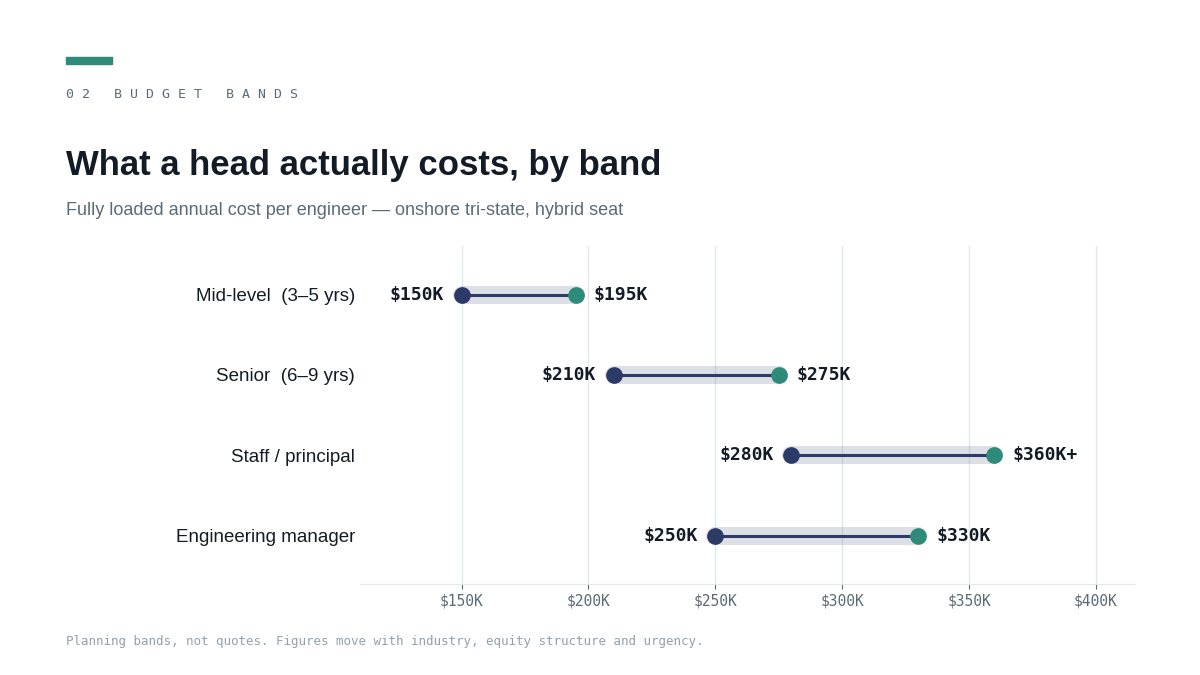
Budget bands to anchor Phase 1 (fully loaded, US, per head, per year see the Cost section for the full model):
| Band | Loaded cost range |
| Mid-level engineer (3–5 yrs) | $150,000 – $195,000 |
| Senior engineer (6–9 yrs) | $210,000 – $275,000 |
| Staff / principal | $280,000 – $360,000+ |
| Engineering manager | $250,000 – $330,000 |
These are onshore tri-state ranges assuming a hybrid seat and standard benefits. Treat them as planning bands, not quotes actual figures move with industry, equity structure, and how badly you need the person.
Phase 2 Sourcing and vetting across one shared market
Because this is functionally one labor market, sourcing strategy does not change much between the states. Evaluation standards should not change at all.
What good technical screening looks like at this level:
- A resume screen against a scorecard, not a gut feel. Three to five weighted criteria, agreed before the first CV is opened.
- A 30-minute structured technical conversation not a puzzle. Ask them to walk through a system they built and where it broke.
- A practical exercise bounded at 90 minutes, ideally paired rather than take-home. Take-homes over two hours suppress senior-candidate response rates badly in a market this competitive.
- A systems-design round scoped to your actual domain, not a generic “design Twitter.”
- A working-style conversation covering cadence, documentation habits, and how they handle disagreement with a PM.
- Two reference calls with people who managed them, not peers they selected.
Red flags in a candidate process at this seniority:
- Cannot describe a failure mode in a system they own. Everyone senior has one.
- Tenure pattern of exactly 11–14 months across three or more roles with no structural explanation.
- Comp expectations that shifted upward mid-process without a competing offer they will name.
- Deflects on why they are leaving. In this market, senior engineers are not shy, vagueness usually means a performance conversation happened.
Red flag on the vendor side, from engagements we have actually run: if an IT staffing partner sends four profiles inside 24 hours of receiving a job description, they did not source them; those CVs were already sitting in a database. Genuine sourcing against a specific requirement takes days, not hours. The tell is whether the profiles are calibrated to your scorecard or merely adjacent to your keywords.
Ask the recruiter to explain, per candidate, why this person over the last one they sent. A partner who cannot answer that is running a volume model, and volume models are how you end up interviewing seven people to hire zero.
Teams running more than four or five open technical roles at once generally cannot sustain this bar internally. That is the point at which recruitment process outsourcing becomes an efficiency decision rather than a capacity one; the standard stays consistent because one team owns the scorecard across every req.
Benchmark to hold yourself to: from a finalized job description to an interview-ready shortlist should take 7–10 working days. Beyond three weeks, either the requirement is unclear or the search is under-resourced.
Phase 3 Engagement models, entity setup, and the contract terms that matter
This is the phase teams skip, and it is the one that generates the six-figure surprises.
The four viable structures:
| Model | Best for | Cost profile | Speed |
| Direct W-2 hire | Long-tenure core roles | Highest loaded cost, lowest per-hour | 45–70 days |
| Staff augmentation | Capacity gaps, defined-duration work | Moderate; no benefits burden | 7–15 days |
| Employer of record (EOR) | One or two heads in a state where you have no entity | Salary + 8–15% platform fee | 10–20 days |
| Project / SOW | Bounded deliverables with clear acceptance | Fixed or milestone-based | 2–4 weeks |
Choosing between direct employment and IT staffing services is usually a function of tenure and predictability, not preference. If the work has a defined end date, employing someone permanently to do it is an expensive way to be tidy.
The entity question everyone gets wrong. Hiring a single W-2 employee resident in New Jersey generally creates obligations there. Depending on your facts, that can mean registering with the state, withholding New Jersey Gross Income Tax, registering for unemployment insurance, and participating in New Jersey’s mandated benefit programs Temporary Disability Insurance (TDI), Family Leave Insurance (FLI), and Earned Sick and Safe Leave (ESSL), which accrues from day one for every employee in the state regardless of company size. It may also create Corporation Business Tax filing exposure.
The 5-point pre-offer compliance checklist:
- Confirm whether the hire triggers registration in the new state, and with which agencies.
- Confirm your payroll provider actually supports that state several do not support NJ TDI/FLI without a configuration change and a lead time.
- Determine income sourcing under both states’ rules before the offer letter goes out, so the net-pay conversation is honest.
- Decide whether an EOR is cheaper than standing up an entity for the first one or two heads. Below roughly five people in a state, it usually is.
- Have your accountant confirm corporate filing implications in writing. This is a two-hour engagement that prevents a two-year problem.
Contract terms worth negotiating hard on (these are the clauses that come up in every engagement, and the ones vendors expect you to skim):
- IP assignment must cover work product, pre-existing materials incorporated into deliverables, and derivative works. Silence on derivative works is the most common gap we see.
- Notice period and replacement window a replacement guarantee is meaningless without a defined turnaround. Ours is 7–10 days; anything above 30 days is a guarantee in name only.
- No shared bandwidth gets it in writing that assigned engineers are not split across accounts. This is the single most common source of delivery slippage in staff-augmentation contracts.
- Rate escalation cap annual increases at signing. Uncapped escalation clauses are where multi-year engagements quietly become expensive.
- Data and NDA scope confirm whether the NDA binds the individual engineer or only the vendor entity. It should bind both.
Phase 4 Onboarding and the first two weeks
Ramp time is a real cost. A senior engineer at a $250,000 loaded cost burns roughly $4,800 per week. Two weeks of avoidable ramp friction is close to $10,000 of nothing.
The 10-day onboarding standard:
- Day 0 (before start): hardware shipped and confirmed delivered, all accounts provisioned, repo access granted, first-week calendar populated.
- Day 1: environment runs locally. If it does not, that is the only priority until it does.
- Days 2–3: first commit merged. Small, real, and shipped documentation fix, test coverage, minor bug. The goal is proving the pipeline works end to end.
- Days 4–5: codebase walkthrough with the person who knows the oldest parts, plus a written architecture overview they can re-read.
- Days 6–8: first scoped ticket with a named reviewer.
- Days 9–10: manager check-in against explicit 30/60/90 expectations, written down and shared.
Onboarding friction specific to this region. Cross-state hires frequently hit a net-pay surprise in the first or second pay cycle, because withholding was configured for one state and their actual liability spans two. It reads to the employee as a payroll error and it damages trust in week two of a five-year relationship.
Brief the candidate on multi-state withholding before the first pay date and offer to cover a session with a CPA who handles NJ–NY returns. It costs a few hundred dollars and it removes the single most common early-tenure irritant we see in tri-state hires.
Communication cadence for a hybrid tri-state team:
- Async daily written standup not a meeting.
- One fixed anchor day per week where the whole team is co-located, chosen for transit reliability rather than convenience.
- Weekly 1:1, 30 minutes, non-negotiable and never cancelled.
- Fortnightly written delivery summary to stakeholders.
Phase 5 Managing delivery once the team is running
The management overhead of a distributed tri-state team is closer to a remote team than a co-located one. Instrument accordingly.
KPIs worth tracking (and the ones that mislead):
| Track this | Not this |
| Cycle time, ticket start to production | Lines of code |
| Change failure rate | Commits per developer |
| Time to restore service | Hours logged |
| Review turnaround time | Story points completed |
| Ramp-to-first-independent-ticket | Meeting attendance |
The reporting cadence that works:
- Weekly written delivery note shipped, slipped, blocked, and what changed about the plan.
- Monthly against-plan review, comparing forecast to actual with a stated reason for variance.
- Quarterly capacity and cost review, including per-head loaded cost drift.
The 3-week rule: if a blocker survives three consecutive weekly notes without movement, it is not a blocker, it is an unmade decision, and it needs to escalate to whoever can make it. Teams lose more months to undecided things than to hard things.
If you are working with an external partner, insist on a dedicated account manager with a name, not a shared inbox. Escalation paths that route through a ticket queue add days to problems that need hours.
Phase 6 Scaling, replacing, and exiting cleanly
Scaling checklist:
- Add the second and third heads in the same state before adding a fourth state. Compliance complexity scales with jurisdictions, not headcount.
- Re-run the loaded-cost model at every fifth hire. Burden rates and mandated program contributions change; your spreadsheet from last year is wrong.
- Reassess entity versus EOR at five heads in a state that is roughly where the fee crossover happens.
- Watch review-turnaround time as a leading indicator. When it lengthens, you have a senior-capacity problem that hiring more mid-level engineers will make worse.
- When adding data-platform capacity, decide whether it belongs onshore or in a capability center before you post teams that hire data engineers reactively in this market and pay a premium for the urgency they created themselves.
Replacement policy what to actually demand. A replacement guarantee is only useful if it is time-bound, covers cultural as well as technical mismatch, and does not restart the fee clock. A 7–10 working-day replacement window is achievable when the partner has a warm bench and your scorecard on file. Anything longer means they are starting the search from scratch, which is the same as having no guarantee.
Offboarding checklist:
- Access revocation on the last working day, not the last calendar day.
- Knowledge transfer session recorded, with a written handover document. Verbal handover is not handover.
- Repository and credential ownership reassigned in writing.
- Confirm IP assignment survives termination check the clause, do not assume.
- Exit conversation conducted by someone who is not their direct manager.
Case studies: what this looks like at volume
The following draws on Supersourcing engagements. Metrics first.
Paytm 100+ engineers hired against an aggressive growth window. A fintech scaling requirement at this volume tends to fail on consistency rather than sourcing: bar drift across dozens of parallel reqs produces uneven hires that surface as attrition six months later. Running a single calibrated scorecard across all requisitions kept evaluation standards constant while the funnel ran wide. The relevant lesson for tri-state hiring is that volume does not require lowering the bar; it requires centralizing who owns the bar.
Swiggy engineering scale-up under compressed timelines. Hyper-growth hiring exposes the gap between time-to-source and time-to-close. Shortlists arriving faster than the interview panel could absorb them created queue congestion, so throughput was capped by panel capacity, not candidate supply. Fixing the bottleneck meant restructuring interview loops before adding sourcing volume, a sequencing lesson that applies directly to any team trying to staff up quickly in a competitive metro.
OkCredit engineering hiring for a fast-moving product org. Smaller teams cannot absorb a bad hire; a single mismatch at a ten-person engineering org is a 10% capacity loss plus the manager time to unwind it. Maintaining a 98% candidate joining rate and under 1% drop-off on contract roles across the wider portfolio is a function of pre-close diligence, not luck specifically, confirming counter-offer risk and start-date reality before the offer goes out rather than after.
The decision framework: four options, not two
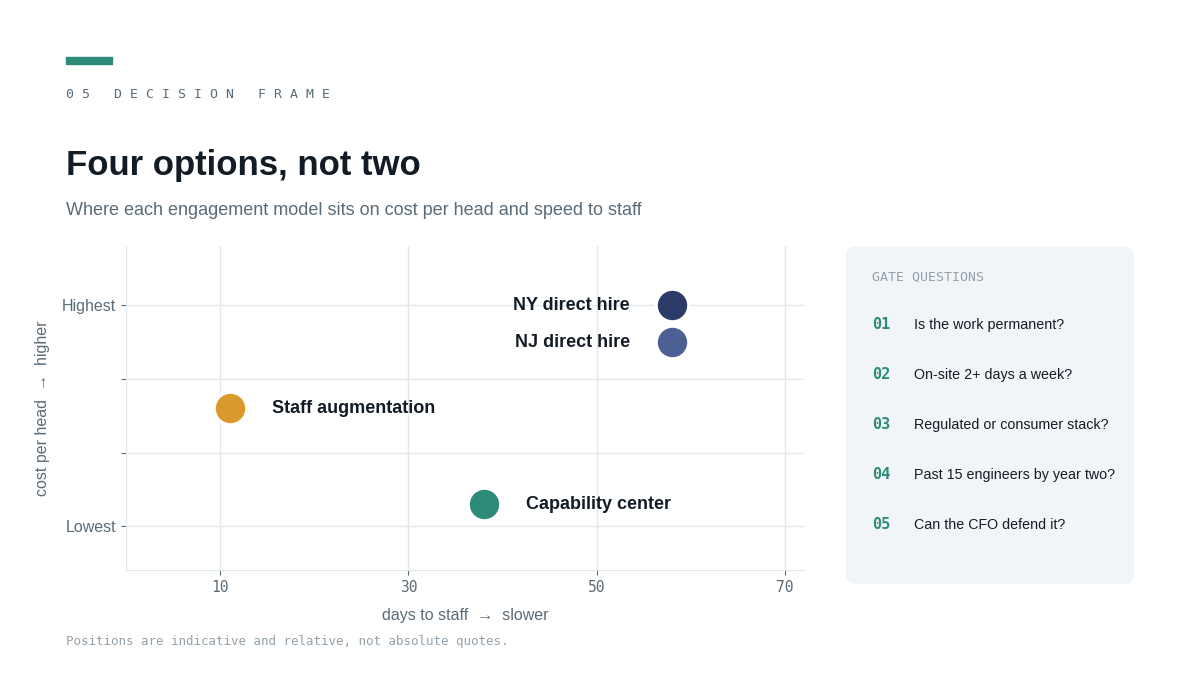
Framed as a binary, new jersey vs new york tech hiring excludes two options that are frequently better than either. Score all four against your actual constraints.
| Option | Cost per head | Control | Speed to staff | Risk profile | Best fit |
| NY direct hire | Highest | Full | Slowest (45–70 days) | Low delivery risk, high fixed cost | Core product, client-facing, dense in-person collaboration |
| NJ direct hire | High (modest salary saving, added compliance) | Full | Slow (45–70 days) | Multi-state tax complexity | Regulated-industry backend, enterprise stacks, cost-sensitive core roles |
| Onshore staff augmentation | Moderate | Shared | Fast (7–15 days) | Vendor-dependent | Capacity gaps, defined-duration work, seasonal surge |
| Offshore team or capability center | Lowest per head | Full at scale | Moderate (3–8 weeks initial) | Setup and timezone overhead | Sustained 15+ engineer needs, 24-hour cycles, long horizons |
How to actually choose the 5-question decision sequence:
- Is this work permanent? No → staff augmentation or SOW. Stop here.
- Does it require in-person collaboration more than twice weekly? Yes → the state line matters and you are choosing between NY and NJ. No → the geography question is largely a tax and compliance question, not a talent one.
- Is the stack enterprise-regulated or consumer-product? Enterprise-regulated → New Jersey’s pool is deeper. Consumer/fintech/AI-application → New York’s is.
- Will this team exceed 15 engineers within 24 months? Yes → run the capability-center math before committing to onshore leases and headcount. A global capability center changes the unit economics enough that it should be modelled explicitly, not dismissed.
- Can you defend the loaded cost per head to your CFO in one sentence? If not, you have not finished the analysis.
What most teams get wrong about NYC metro hiring costs
The single most expensive mistake in tri-state hiring is assuming that where an employee sits determines which state taxes their income. New York’s convenience-of-the-employer rule treats work performed outside the state work that could have been performed at the employer’s New York office as New York-source income unless the remote arrangement exists out of the employer’s necessity rather than the employee’s convenience. A New Jersey-resident engineer working for a Manhattan-headquartered company can be taxed by New York on wages earned on days they never crossed the river.
That has three consequences almost nobody models:
- “Work from New Jersey more days to save tax” does not work. Under the rule, day counts do not reduce New York’s claim. The employee cannot commute their way out of it.
- There is no NJ–NY reciprocal agreement. New Jersey residents working for New York employers generally file in both states, taking a New Jersey credit for tax paid to New York. New Jersey has reciprocity with Pennsylvania which is why teams who successfully navigated a PA hire assume NJ works the same way. It does not.
- New Jersey enacted its own mirror rule. Effective retroactive to January 1, 2023, New Jersey adopted a reciprocal convenience-of-the-employer sourcing rule applying to residents of states that impose such a rule on New Jersey residents. The state also created an incentive for residents who successfully challenge New York’s rule, in the form of a bonus credit. Both states now play this game.
Four more patterns worth naming:
Teams benchmark New Jersey’s corporate tax as the cheap option. It is not. New Jersey’s base Corporation Business Tax tops out at 9%, and a 2.5% Corporate Transit Fee applies to filers with New Jersey allocated taxable net income above $10 million, producing an 11.5% combined top rate, the highest in the country, in effect through the end of 2028. Tax credits cannot be used against the fee. For a profitable company at scale, that can outweigh every dollar saved on salary.
Teams ignore offsetting incentives. NJEDA’s Emerge program awards tax credits usable against Corporation Business Tax, transferable for no less than 85% of value or surrenderable to the Division of Taxation for 90%. Companies creating meaningful headcount in eligible locations frequently qualify and never apply, because nobody on the hiring side knows the program exists.
Teams compare the wrong office submarkets. Recent Manhattan asking rents have ranged roughly from the high $40s per square foot Downtown to well above $100 for Midtown South Class A. Jersey City has averaged in the high $40s with vacancy above 25%, which means real negotiating leverage. The honest comparison is your target submarket against your target submarket not a citywide Manhattan average against a Jersey City one.
Teams treat commute distance as the retention variable. It is transfer count and schedule reliability. In hybrid roles across this region, the pattern we see repeatedly is that a two-transfer commute predicts twelve-month attrition better than an extra fifteen minutes on a single-seat ride. Ask candidates for their actual door-to-door route in the final interview. The answer predicts tenure better than anything on their resume.
Cost and timeline reality check
Most content on nj vs nyc developer salary stops at base compensation. Here is the model that matters.
Building a fully loaded cost per head. Start with base, then add:
| Component | Typical range | Notes |
| Base salary | Varies by band | The number everyone quotes |
| Employer payroll taxes | 7.65% + state unemployment | FICA plus state |
| State-mandated programs | Varies | NJ adds TDI, FLI, ESSL |
| Health and benefits | $12,000 – $24,000 | Per head, per year |
| Equipment and software | $3,000 – $6,000 | First year higher |
| Office occupancy | $8,000 – $22,000 | Highly submarket-dependent |
| Recruiting, amortized | 15–25% of first-year base | Spread over expected tenure |
Rule of thumb: loaded cost typically runs 1.30–1.45× base salary for an onshore hybrid hire in this region. If your plan uses base salary as the budget figure, you are underfunded by roughly a third and any new jersey vs new york tech hiring comparison built on that figure is comparing two numbers that are both wrong.
Timeline by scenario:
| Scenario | Realistic timeline |
| Job description → interview-ready shortlist (partner-run) | 7–10 working days |
| Job description → shortlist (in-house, no dedicated recruiter) | 3–6 weeks |
| Shortlist → signed offer, senior role | 3–5 weeks |
| Signed offer → start date | 2–6 weeks (notice periods) |
| Total, senior onshore hire | 45–70 days |
| Staff augmentation, engineer deployed | 7–15 days |
| First entity registration in a new state | 2–6 weeks |
| Capability center, first cohort productive | 8–14 weeks |
What drives cost up:
- Urgency. Compressed timelines cost 10–20% in comp or fees. Always.
- Niche stack combinations the narrower the intersection, the thinner the pool.
- Four or more interview rounds. Every round past three loses candidates to faster processes.
- Uncapped rate escalation in multi-year vendor contracts.
- Adding a new state for one or two heads without an EOR.
What drives cost down:
- A clear, calibrated scorecard before sourcing starts. This is the highest-ROI hour in the entire process.
- Batching hires within one state and one quarter.
- Longer engagement commitments in exchange for rate caps.
- Choosing a submarket rather than a city for the office benchmark.
- Honest assessment of which roles genuinely need to be in this metro at all.
One thing worth saying plainly: the CompTIA State of the Tech Workforce 2026 report projects New Jersey’s tech workforce growing 1.4% in 2026, adding 4,305 jobs to reach roughly 303,000, after a 0.5% contraction in 2025. That is a market loosening slightly, not tightening. Teams hiring in this window have more leverage than they did two years ago, and should be negotiating like it.
Where to take this next
If you are mid-decision, the most useful next step is not picking a state. It is producing one page that a CFO can sign off: the loaded cost per head for your specific role in each option, the compliance obligations each triggers, and the realistic date the person starts.
That page usually takes about an hour to build if you have the six Phase 1 answers ready. If you do not, that is the work to do first.
For teams who want a second set of eyes on the model particularly on whether a tri-state hire, a staff-augmentation engagement, or a capability center gives you the best cost-per-outcome for what you are actually building a scoping conversation with the Supersourcing team is a reasonable use of thirty minutes. Bring your requirements, your timeline, and your budget band. You will leave with a comparison you can defend internally, whether or not you work with us.
Frequently asked questions
Is it cheaper to hire software engineers in New Jersey than in New York?
On base salary, modestly usually a single-digit percentage at the median for comparable roles, since both states draw from one commuter labor market. On fully loaded cost, it depends entirely on your office footprint, entity structure, and corporate profitability. New Jersey’s 11.5% top corporate rate can erase the salary saving for a profitable company at scale.
Do New Jersey and New York have a reciprocal tax agreement?
No. New Jersey residents working for New York employers generally file a New York nonresident return and a New Jersey resident return, claiming a New Jersey credit for tax paid to New York. New Jersey does have reciprocity with Pennsylvania, which causes frequent confusion; a process that worked for a Philadelphia-area hire will not work here.
If my company is in Manhattan and my engineer lives in New Jersey, which state taxes the salary?
Potentially both, and New York’s claim is broader than most people expect. Under New York’s convenience-of-the-employer rule, remote days worked from New Jersey for the employee’s convenience are treated as New York workdays. Confirm the specific facts with a CPA who handles multi-state returns before the offer letter goes out.
Does hiring one remote employee in New Jersey create a tax nexus there?
Frequently, yes. A single resident W-2 employee can trigger registration, withholding, unemployment insurance, and participation in New Jersey’s mandated TDI, FLI, and ESSL programs, and may create corporate filing exposure. For one or two heads, an employer of record is usually cheaper than standing up an entity.
Is New Jersey’s tech talent pool deep enough for senior engineering roles?
For enterprise Java and .NET, data engineering, life-sciences software, telecom infrastructure, and QA and validation work yes, substantially. CompTIA sizes the state’s tech workforce near 300,000. For applied AI product work, trading systems, and consumer product engineering, New York’s concentration is deeper.
How long does it take to hire a senior engineer in the tri-state area?
Plan for 45–70 days end to end running the search in-house: three to six weeks to a shortlist, three to five weeks to a signed offer, and two to six weeks of notice period. With a dedicated partner and a finalized job description, the shortlist stage compresses to 7–10 working days; the offer and notice stages do not compress much regardless.
Should we open a New Jersey office or hire remotely into New Jersey?
Under five heads, hire remotely through an employer of record and skip the entity. Above five, run the entity math the fee crossover usually lands around there. Only sign a lease once you know your anchor day actually pulls attendance, which takes two quarters of data to establish.
When does neither state make sense?
When the requirement is fifteen or more engineers on a multi-year horizon, the work does not require daily in-person collaboration, and the stack is one with deep global supply. At that scale the comparison stops being new jersey vs new york tech hiring and becomes a capability-center decision. If you are unsure which side of that line you are on, a scoping conversation will resolve it faster than another month of spreadsheets.
