

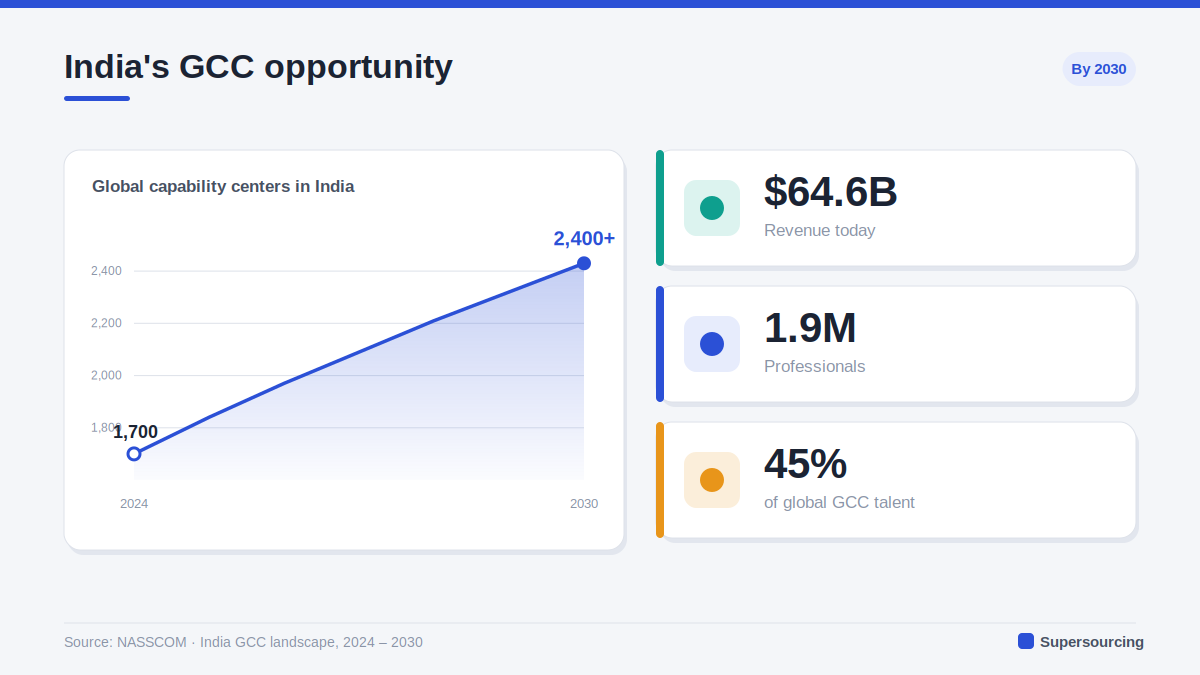
India will add roughly 700 new global capability centers this decade. The market is projected to grow from about 1,700 centers today to more than 2,400 by 2030, backed by a talent base heading toward 4.5 million people. That is the headline every board deck already quotes.
Here is the line those decks leave out: none of that growth happens unless someone actually fills the seats on time, at the right skill level, and without a revolving door six months later.
Forward-looking signal: India already hosts 1,700+ GCCs generating ~$64.6B in revenue and employing 1.9 million professionals, nearly 45% of the entire global GCC talent base.
That is where most captive-center plans quietly break. Setting up the legal entity, the office, and the leadership layer is the visible 20% of the work. The invisible 80% is recruiting and it is the part enterprises consistently under-resource, because they assume the same TA function that hires 30 people a year at headquarters can suddenly hire 150 specialists in a market it has never operated in. It cannot, and the calendar proves it.
This is the exact seam that RPO for GCC hiring is built to close. Recruitment process outsourcing gives a captive center a purpose-built hiring engine sourcing, vetting, scheduling, offer management, and onboarding run by a partner who lives in the local talent market every day. Done well, it compresses time-to-fill, protects hiring quality, and lets the GCC leadership team spend its energy on capability instead of chasing resumes.
This guide is the practitioner’s version of that story: not why GCCs matter (you already decided that), but exactly how to recruit for one using RPO from first requirement to a stable, scaling team.
TL;DR
This is a complete, execution-level guide to RPO for GCC hiring written for GCC heads, founders, and TA leaders who have to staff a captive center in India (or a comparable hub) and want to know precisely how outsourced recruitment works, what it costs, and how to run it. If you have never bought RPO before, you can read this start to finish and run the process yourself.
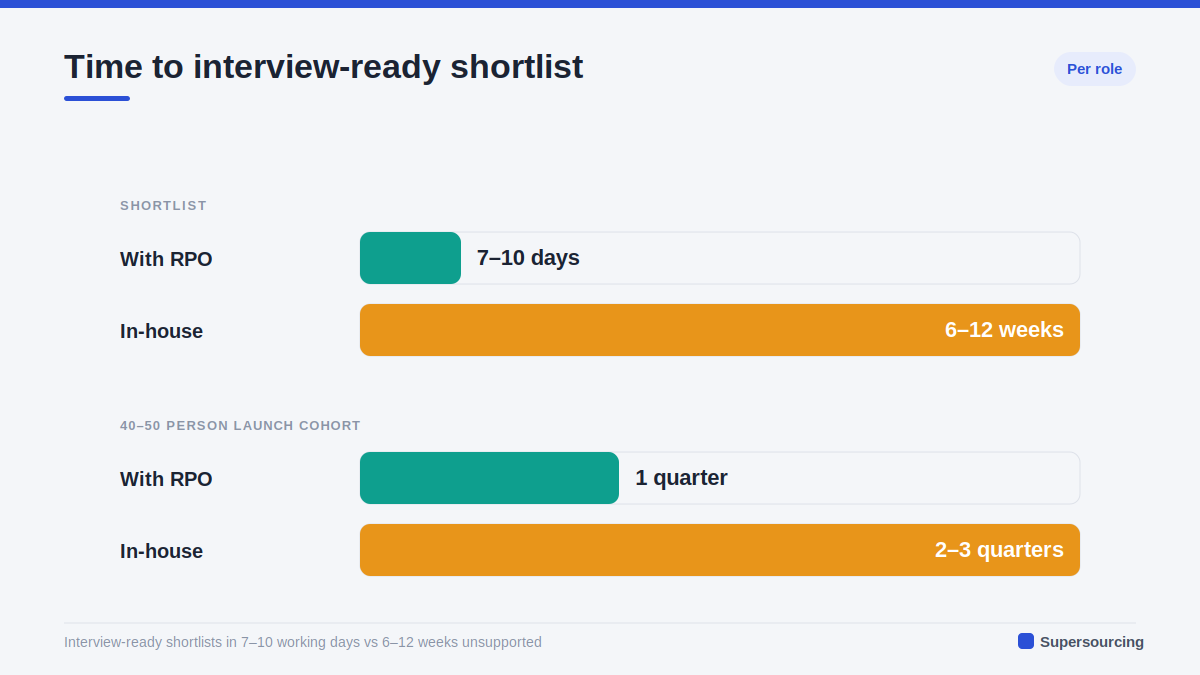
The single number to anchor on: a strong GCC recruitment outsourcing engine surfaces interview-ready shortlists of the top ~2% of vetted talent in 7–10 working days per role, versus the 8–12 weeks an unsupported in-house team typically burns filling niche engineering seats. Speed is not the whole game, but in a market where the best candidates are off the market in days, it is most of it.
By the end you will be able to write a requirement brief an RPO partner can actually act on, evaluate providers against real red flags, pick the right engagement model, negotiate a fair contract and replacement clause, and manage delivery so your headcount scales without quality quietly eroding.
What Is RPO for GCC Hiring?
RPO for GCC hiring is the practice of handing all or part of a captive center’s recruitment sourcing, screening, technical vetting, interview coordination, offer management, and onboarding to a specialized external partner who operates as a dedicated extension of the GCC’s own talent team, working to agreed volumes, SLAs, and quality standards.
It is not the same as three things it gets confused with:
- It is not a staffing agency dumping resumes. A recruitment process outsourcing partner owns a defined slice of the process and is measured on outcomes (joins, quality, time-to-fill), not on volume of CVs forwarded.
- It is not staff augmentation. In staff aug, the vendor’s people do the work of the GCC (they write your code). In RPO, the partner does the hiring and the people they place become your GCC’s own employees.
- It is not a one-time recruitment drive. Good RPO is a standing capability that flexes with your headcount plan, not a project that ends when the first cohort lands.
Why RPO Matters for a Captive Center
The case for hiring for GCC through RPO is not “outsourcing is cheaper.” It is that a captive center’s success is decided in its first 12–18 months, and hiring is the rate-limiter on every other goal. The concrete business outcomes it affects:
- Speed to a working team. Interview-ready shortlists in 7–10 working days per role versus 6–12 weeks unsupported. For a 100-seat GCC, that difference is the gap between being productive in one quarter and slipping into three.
- Hiring quality and stick rate. A rigorous, dual-validated funnel targets the top ~2% of the market and pushes offer-to-join ratios up. In well-run engagements a 98% candidate joining rate and under 1% drop-off on contract roles are realistic the difference between a plan that holds and one that quietly loses 1 in 5 accepted offers to counter-offers.
- Cost predictability. Instead of a fixed in-house TA payroll you must fund whether reqs are open or not, RPO converts hiring into a variable or milestone-based cost that tracks your actual headcount plan.
- Risk transfer. A replacement guarantee (typically re-hire within 7–10 days if a placement isn’t a fit) moves mis-hire risk onto the partner instead of your P&L.
- Focus. Your GCC leaders spend their scarce hours on architecture, product, and stakeholder trust with HQ not on screening 400 resumes for a single platform-engineering seat.
The macro backdrop makes this urgent, not optional. The global market for recruitment process outsourcing is projected to expand by roughly $16.7 billion at a ~20% CAGR through 2030 growth driven overwhelmingly by exactly the scenario GCCs face: needing specialized talent, at scale, faster than internal teams can hit.
There is also a build-versus-buy timing argument that decision-makers miss. To hire in-house, you first have to hire the hirers, recruiters, sourcers, a TA lead who themselves take months to find and onboard in a competitive market, and who are a fixed cost long after your launch spike passes.
RPO gives you a fully-formed hiring engine on day one and lets you dial capacity down when the ramp ends. For a capability center whose credibility with HQ is set by how fast it becomes productive, that head start is the difference between beating the plan and defending a slipped timeline.
The Core Problem Most GCC Buyers Face
Here is the pattern we see repeatedly across captive-center launches: leadership budgets the entity carefully and the hiring casually. The entity gets legal counsel, a dedicated team, and a project plan. Hiring gets “we’ll figure out recruiting once we’re set up.” Then the calendar collides with the market.
Three specific things go wrong, and buyers usually underestimate each by 3–4x:
- The funnel leaks far more than expected. India’s talent pool is enormous but noisy. The first hard drop-off happens at screening because of inflated resumes in high-demand roles, a real and widely reported “resume-reality gap.” Teams that plan for a 3:1 shortlist-to-offer funnel discover they actually need to source 10–15x the target headcount to close it cleanly.
- Notice periods eat the timeline. In India, 60–90 day notice periods are standard for mid-to-senior engineers. A candidate you “hire” in week 4 may not sit down until month 4 and every one of those days is a window for a counter-offer or a competing GCC to poach them. Offer dropout is not an edge case; it is the default risk you are managing against.
- Attrition is highest exactly where it hurts. Independent salary surveys put GCC voluntary attrition in India in the mid-to-high teens overall, spiking to 25–30% for AI/ML and senior engineering roles, as the best people are continuously headhunted. If your hiring process is slow and your EVP is undefined, you are not building a team, you are running a leaky bucket.
There’s a compounding cost buyers rarely price in: the empty-seat cost. Every unfilled senior engineering seat in a GCC isn’t just a delayed hire, it’s stalled roadmap work, overloaded existing staff (which drives their attrition up), and a credibility dent with the HQ stakeholders who approved the center.
A single senior role sitting open for an extra two months can quietly cost more than a full year of that role’s fully-loaded salary once you account for the delayed output it was meant to produce. Slow hiring is not a neutral state; it actively erodes the business case for the GCC.
None of these is solved by “trying harder” with an untooled internal team. They are solved by a process built for this specific market which is what a real GCC talent sourcing partner brings. This is the operating reality behind every Supersourcing GCC engagement, and it is why the walkthrough below starts with requirements, not resumes.
The Walkthrough: Staffing a Captive Center with RPO, Start to Finish
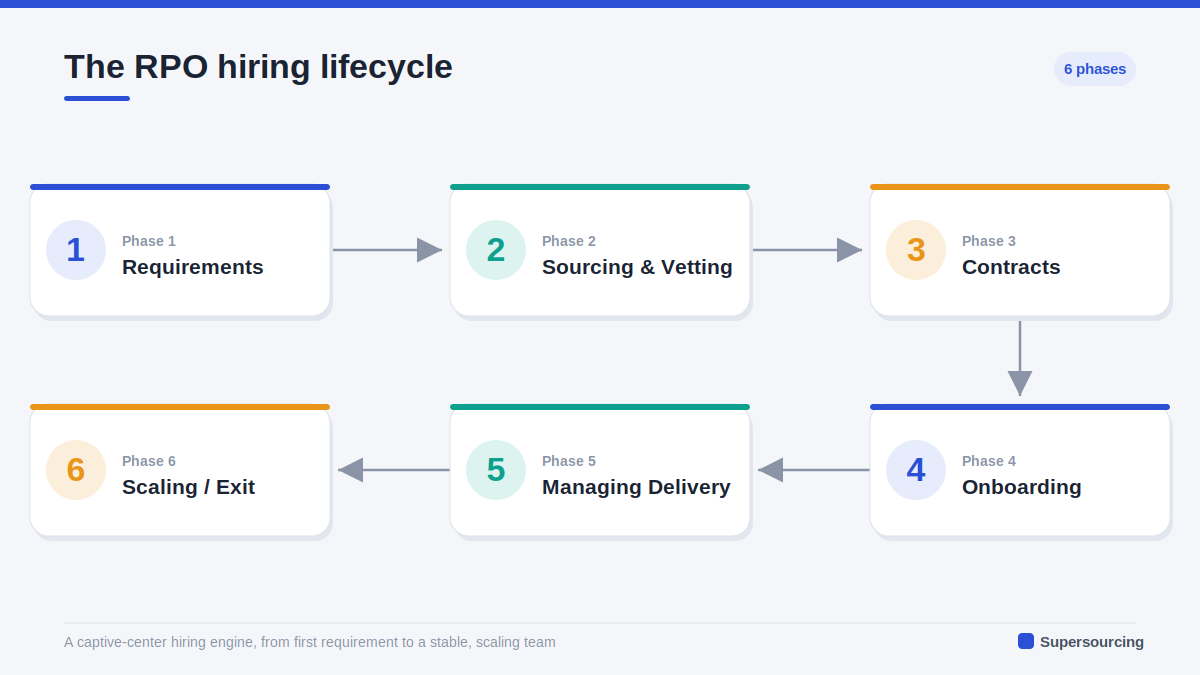
This is the core of the guide. Six phases take you from “we’ve decided we need to hire” to “we have a stable, scaling team.” Each phase has a checklist you can lift directly into your own project plan.
Phase 1 Defining Requirements (scope, skills, timeline, budget)
Bad hiring outcomes are usually bad briefs wearing a costume. Before you talk to any partner, get precise on four things. The quality of your requirement definition sets the ceiling on everything downstream.
The requirement brief build this first:
- Headcount plan by quarter, not by year. “150 engineers in year one” is not a plan. “20 in Q1, 45 in Q2, 55 in Q3, 30 in Q4” is a plan an RPO partner can push against.
- Role definitions with must-have vs. nice-to-have skills. Separate the non-negotiables (e.g., production Kubernetes experience) from the trainable. Over-specified reqs are the single biggest cause of empty pipelines.
- Seniority mix. Junior, mid, and senior have wildly different time-to-fill and cost curves (see Phase 5 and the Cost section). A plan that is 70% senior is a different and far slower animal than one that is balanced.
- Location and work model. Bengaluru, Hyderabad, Pune, and Chennai carry different cost, supply, and attrition profiles; Tier-2 cities trade a thinner senior pool for materially lower attrition and cost. Hybrid vs. in-office narrows or widens your funnel more than most teams expect.
Budget bands to sanity-check against (fully-loaded annual CTC, India, indicative):
| Role band | Typical annual CTC (₹) | Typical annual CTC ($) |
| Junior engineer (0–3 yrs) | ₹6–14 lakh | $7k–17k |
| Mid engineer (3–7 yrs) | ₹15–35 lakh | $18k–42k |
| Senior / staff (8+ yrs) | ₹35–70 lakh+ | $42k–85k+ |
| Niche AI/ML, platform, security | ₹40–90 lakh+ | $48k–110k+ |
The 80/20 rule for briefs: spend 80% of your definition effort on the 20% of roles that are hardest to fill (senior, niche, leadership). Those are where a weak brief costs you months.
A brief that works vs. one that doesn’t: “Senior full-stack developer, 8+ years, expert in React, Node, Python, Go, AWS, Kubernetes, Terraform, GraphQL, and team leadership” is a fantasy req it describes four different people and will return an empty pipeline for a quarter. “Senior backend engineer, 7+ years, must-have: production Node.js + AWS at scale; nice-to-have: Kubernetes, prior startup experience; will mentor two juniors” is a req a partner can source against this week.
If you are early in defining a captive center’s structure and headcount, it’s worth pressure-testing the whole plan against a partner’s market view before you lock roles that’s part of what good GCC setup services include, and it prevents you from writing reqs the local market can’t fill.
Phase 2 Sourcing & Vetting (what good screening actually looks like)
This is where a real GCC recruitment outsourcing partner earns its fee and where the pretenders are exposed. Sourcing is not “post the job and wait.” For senior and niche roles, 70%+ of the best candidates are passive and must be headhunted directly.
What good vetting looks like the sequence:
- AI-assisted sourcing to surface the top ~2% against your must-haves, not keyword matching against your nice-to-haves.
- Recruiter screen for intent, notice period, compensation reality, and counter-offer risk surfaced before you invest interview time.
- Technical validation via a structured take-home or live round scored on a rubric, not vibes. The output your team sees should be a shortlist that is already interview-ready.
- Culture and stakeholder-fit screen critical for a GCC, where the hire must work across time zones with an HQ team they’ve never met.
- Dual validation (technical + behavioral) before the client interview stage, which is what catches mismatches early and protects your hiring managers’ time.
Red flags in a sourcing partner walk away if you see these:
- They lead with “we have 50,000 resumes” instead of a vetting method. Volume is not a signal.
- No structured technical rubric they rely on the client to do all real evaluation.
- They can’t tell you their offer-to-join ratio or their average time-to-fill by seniority. If they don’t measure it, they don’t manage it.
- Shared recruiters spread across many clients (“shared bandwidth”), so your niche reqs sit at the bottom of someone’s queue.
Green flags: a dedicated recruiter pod for your account, a defined SLA on shortlist turnaround, transparent funnel metrics, and named references from comparable GCC builds.
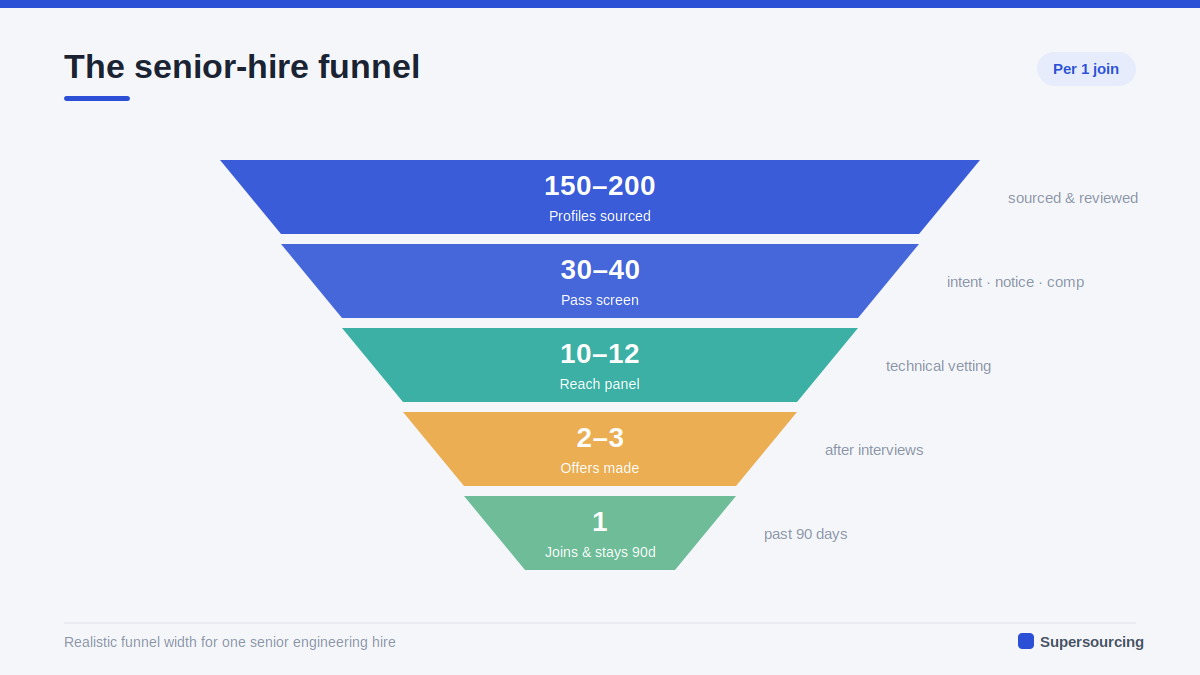
The funnel math you should expect to see. A credible partner can show you the shape of the funnel for a given role, and it is steeper than most first-time buyers assume. For one senior engineering hire, a realistic funnel looks roughly like this:
- ~150–200 profiles sourced and reviewed
- ~30–40 pass recruiter screen (intent, notice, comp reality)
- ~10–12 clear technical vetting and reach your interview panel
- ~2–3 receive offers
- ~1 joins and stays past 90 days
If a partner claims they can hand you interview-ready seniors off a funnel a fraction of that width, they are either sitting on a pre-built pipeline (great ask to see it) or they are skipping vetting (a red flag you’ll pay for at the 90-day mark). Understanding this math is also how you set honest expectations with your own hiring managers about how many panels they’ll need to run.
Phase 3 Engagement Models & Contracts
There is no single “RPO.” Match the model to your headcount shape and how much control you want to retain. This is the phase where you should slow down and read the contract clauses, not just the price.
The three engagement models:
- Dedicated RPO pod (recommended for GCC builds). A ring-fenced recruiter team works only your reqs, to your process, at agreed volume. Best when you’re hiring continuously and at scale. Priced as a monthly retainer per recruiter/pod or a blended per-hire fee.
- Project / burst RPO. A time-boxed engagement to land a specific cohort (e.g., “45 engineers in 90 days”). Best for a launch spike, then dial down. Usually milestone- or per-hire-priced.
- Selective / partial RPO. The partner owns one stage sourcing, or vetting, or offers management while you keep the rest in-house. Best when you already have some TA capacity but a specific bottleneck.
Contract terms to nail down the non-negotiable clauses:
- Replacement guarantee. Get the window in writing (a fair standard is re-sourced within 7–10 days at no additional fee if a hire leaves or fails inside the guarantee period).
- NDA and IP protection. Your req list, comp bands, and roadmap hints are sensitive. Insist on NDA-backed handling and confirm where candidate data lives.
- SLAs with teeth. Shortlist turnaround time, minimum shortlist quality (e.g., interview-to-offer ratio), and remedies if they’re missed.
- No shared bandwidth clause. If you’re paying for a dedicated pod, contract for named recruiters, not a floating team.
- Exit and data-handover terms. How pipelines, candidate data, and in-flight offers transfer back to you if the engagement ends.
A simple rule for picking a model: if you’re hiring more than ~8–10 roles a quarter on an ongoing basis, default to a dedicated pod; the per-hire economics and the pipeline continuity both favor it. If you have one concentrated launch spike and then a long plateau, a project/burst model plus a small retained pod for backfills is usually cheaper.
If your internal team is competent but jammed at one stage (say, they source fine but can’t get fast enough), selective RPO on just that stage is the surgical fix. Don’t buy more models than your headcount curve needs.
A GCC hiring heavily in cloud and platform roles should map its hire DevOps engineers requirements to a dedicated pod early, because that supply pool is thin and moves fast, burst models tend to underperform there.
Phase 4 Onboarding & Ramp-up (the first two weeks)
The offer letter is not the finish line; infant attrition (people who leave inside 90 days) is a real and expensive failure mode. The first two weeks decide whether a hire becomes a contributor or a re-open on your req list.
Pre-join engagement (the notice-period gap):
- Stay in structured contact through the 60–90 day notice window; this is when counter-offers strike. A good partner runs pre-boarding touchpoints, not silence.
- Confirm background verification and documentation early, not on day one.
Day 0–14 onboarding checklist:
- Hardware, system access, and tooling provisioned before day one not requested on day one.
- A named buddy and a 30/60/90-day plan handed over on day one.
- First-week manager 1:1 scheduled in advance, not improvised.
- Clear HQ-collaboration norms (time-zone overlap hours, comms channels, escalation paths) documented for a distributed GCC.
- A first meaningful task inside week two early ownership is the strongest predictor of retention.
The onboarding-friction pattern to watch: the most common infant-attrition trigger in GCCs is not compensation; it is a new hire sitting idle for two weeks waiting on access and clarity, concluding the role is disorganized, and re-activating the offers they’d paused. Fix the boring logistics and you fix most early churn.
Phase 5 Managing Delivery (reporting, KPIs, account structure)
Once hiring is flowing, the job shifts from “get people” to “run the machine.” Manage the RPO relationship like an operations function with a scoreboard.
The KPIs that actually matter:
- Time-to-fill by seniority (junior ~1–3 weeks, mid ~3–6 weeks, senior/niche ~6–10+ weeks are realistic bands beware anyone promising senior hires in days).
- Offer-to-join ratio (target 90%+; below 80% signals comp, speed, or EVP problems).
- Shortlist-to-interview and interview-to-offer ratios (funnel health).
- 90-day retention / infant attrition (the truest quality signal).
- SLA adherence on shortlist turnaround.
Reporting and account cadence:
- Weekly funnel review (open reqs, stage-by-stage, blockers).
- A single dedicated account manager as the accountable owner, not a rotating support queue.
- Monthly quality review: 90-day retention, hiring-manager satisfaction, comp-benchmark drift.
- Quarterly recalibration against the headcount plan.
The dedicated-manager rule: if you can’t name the one person accountable for your delivery, you don’t have a partner, you have a ticket queue. Insist on a named account manager and no shared bandwidth from the first conversation.
Watch your own side of the funnel. In a surprising share of stalled GCC hiring, the bottleneck isn’t the RPO partner it’s the client. Hiring managers who take five days to give interview feedback, panels that can’t align on a scheduling slot, or approval chains that sit on an offer for a week will lose candidates no matter how good the sourcing is, because the best people are fielding multiple offers on a tight clock.
When you review the funnel weekly, track your stage latency (feedback turnaround, offer-approval time) alongside the partner’s. Fixing a slow internal interview loop is often the single highest-leverage change available, and it costs nothing.
Phase 6 Scaling or Exiting
A captive center’s hiring needs are not static; you’ll ramp up, plateau, and occasionally wind a function down. A mature RPO relationship handles all three without renegotiating from scratch.
Scaling up the checklist:
- Give the partner a rolling 2-quarter forward view so pipelines are warmed before reqs open.
- Protect quality while adding volume holds the vetting rubric constant; growth is the moment quality quietly slips.
- Layer in new skill clusters deliberately. As a GCC matures into AI and data work, bringing in a partner to hire machine learning engineers is a distinct supply challenge from generalist backend hiring and needs its own sourcing strategy.
- Revisit location strategy Tier-2 expansion can lower cost and attrition once your core team is stable.
Replacement and offboarding:
- Lean on the replacement guarantee for early exit of a fair term resource within 7–10 days at no extra fee.
- For planned wind-downs, agree data-handover and pipeline-transfer terms up front (Phase 3) so exit is clean.
When to bring hiring back in-house. A healthy end-state for many GCCs is a hybrid: once the center is stable, hiring volume has normalized to a predictable trickle, and you’ve built an internal employer brand and a local TA lead, you may transition to steady-state hiring in-house while keeping a partner on retainer for niche and burst needs.
The signal it’s time to have that conversation is when your ongoing volume drops below the threshold where a dedicated pod earns its retainer. A good partner will tell you this before you do and one who fights a sensible transition is telling you something about the relationship.
Case Studies
Outcome-first, drawn from the public global capability center and hiring work. Where a specific client figure isn’t public, the metric shown is the model’s verified engagement standard, not an invented number.
- Paytm 100+ engineers hired. In a fintech scale-up where speed and quality both mattered, the engagement delivered 100+ engineering hires through a dedicated, vetted pipeline rather than scattered agency sourcing the kind of volume that stalls internal teams for two to three quarters.
- OkCredit engineering scale-up in a talent-tight fintech market. Hiring for a fast-moving fintech means competing against every other startup and GCC for the same senior backend and platform talent. The dedicated-pod model held quality under pressure, sustaining the ~98% candidate joining rate and <1% drop-off on contract roles that Supersourcing engagements are benchmarked to.
- Somnoware recruitment automation for healthtech hiring. For a specialized healthtech firm, an AI-assisted sourcing approach surfaced the top ~2% of relevant talent and produced interview-ready shortlists in the standard 7–10 working day window collapsing a search that a generalist process would have stretched across months.
Comparison / Decision Framework
Use this to decide whether RPO is the right lever for your GCC versus the alternatives. Score each option against what your captive center actually needs in its first 18 months.
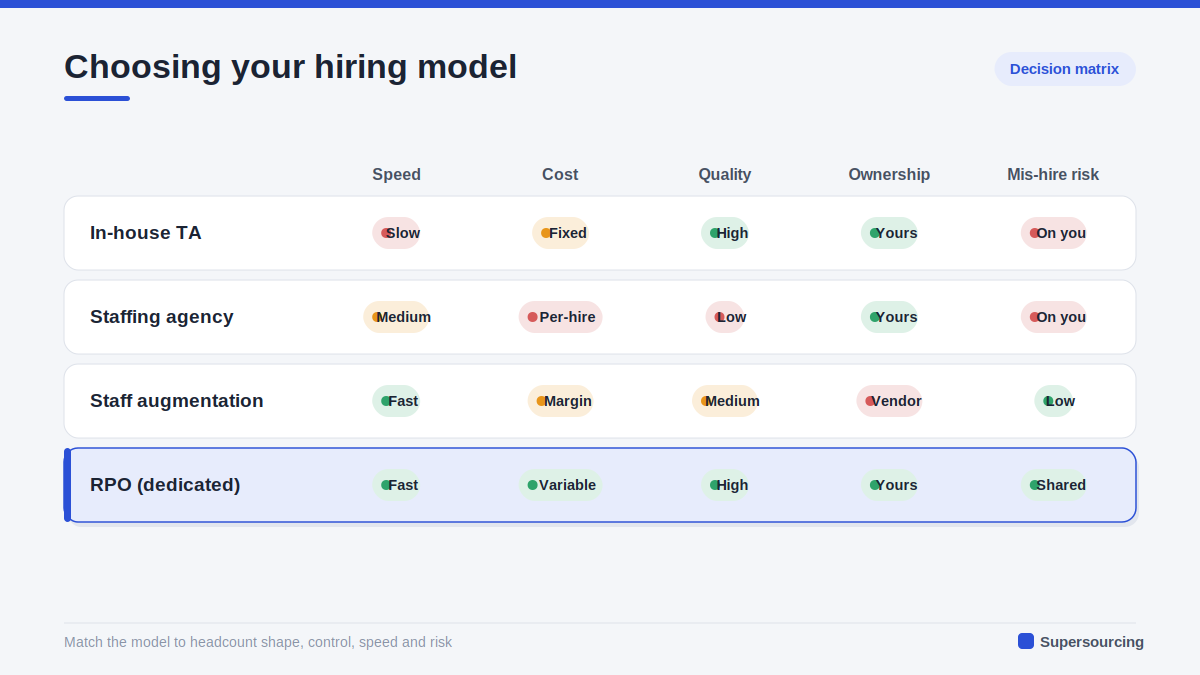
| Factor | In-house TA | Staffing agency | Staff augmentation | RPO (dedicated pod) |
| Speed to scale | Slow (hire the hirers first) | Medium | Fast (but they’re not yours) | Fast |
| Cost model | Fixed payroll, always on | Per-hire, high fees | Ongoing vendor margin | Variable / retainer, plan-linked |
| Control over quality | High | Low | Medium | High (your rubric, their engine) |
| Team ownership | Yours | Yours | Vendor’s people | Yours |
| Best for | Steady, low-volume hiring | One-off fills | Temporary capacity | Continuous, at-scale GCC builds |
| Mis-hire risk | On you | On you | Low (swap out) | Shared (replacement guarantee) |
How to read it: if your GCC is hiring continuously, at volume, in a market you don’t operate in daily, and you want the people to be your employees, RPO is the fit. If you need bodies to do the work temporarily, that’s staff augmentation, not RPO. If you’re filling two roles a quarter, an in-house recruiter may be enough.
What Most Teams Get Wrong
The single most expensive mistake in RPO for GCC hiring is treating recruitment as a procurement decision instead of an operating partnership picking on price-per-hire and discovering that cheap sourcing is the most expensive thing you can buy.
Here are the patterns that quietly wreck GCC hiring, drawn from real engagement history:
- Optimizing for cost-per-hire over cost-per-join. A low per-CV price is meaningless if the offer-to-join ratio is 60%. You pay again in re-opens, delays, and the compounding cost of an empty seat. Measure the cost of a productive hire, not a signed one.
- Buying “shared bandwidth” and expecting dedicated results. If your recruiters are split across ten clients, your niche senior reqs will always lose to someone else’s easy junior reqs. A dedicated pod is not a luxury for a GCC build, it’s the mechanism.
- Under-planning the notice-period gap. Teams celebrate the signed offer and go quiet for 60–90 days. That silence is exactly when the counter-offer lands. Pre-boarding engagement is not a nicety; it’s dropout insurance.
- Over-specifying reqs to feel rigorous. A must-have list with fifteen items produces an empty pipeline and a three-month delay. Rigor is separating the three things that truly matter from the twelve that are trainable.
- Ignoring EVP because “we’re a known brand.” Nearly half of mid-level engineers can’t name three GCCs they’d work for. Global brand recognition at HQ does not automatically translate into an Indian employer brand and if candidates can’t picture the career, they take the startup offer with the equity.
The through-line: the teams that win treat their GCC talent sourcing partner as an embedded operating function with a scoreboard, and the teams that struggle treat it as a vendor they beat down on rate.
Cost & Timeline Reality Check
This is the section competing content skips so here are usable numbers. Treat these as planning ranges to pressure-test any quote, not fixed prices; actual figures move with role mix, seniority, location, and volume.
RPO pricing models and indicative ranges (India GCC hiring):
| Model | How it’s priced | Indicative range |
| Dedicated pod (retainer) | Monthly, per recruiter/pod | ₹1.5–4 lakh / recruiter / month |
| Per-hire (embedded) | % of annual CTC or flat fee | ~8.33–16.67% of CTC (≈ 1–2 months’ salary) |
| Project / burst | Milestone or blended per-hire | Negotiated to cohort size |
| Selective (one stage) | Per-stage or hourly | Scoped to the bottleneck |
Typical time-to-fill by scenario:
- Interview-ready shortlist per role: 7–10 working days with a strong partner.
- Junior/mid roles closed: ~1–6 weeks (plus notice period to join).
- Senior / niche roles closed: ~6–10+ weeks (plus 60–90 day notice).
- A 40–50 person launch cohort: realistically one quarter with a dedicated pod; two to three quarters unsupported.
What drives cost and time up:
- High senior/niche ratio in your headcount plan.
- Over-specified, rigid requirement briefs.
- Tier-1 metro-only location constraints for scarce skills.
- A slow internal interview loop on the client side (often the real bottleneck).
What drives them down:
- A clean, prioritized requirement brief (Phase 1).
- A rolling forward headcount view so pipelines are pre-warmed.
- Openness to Tier-2 locations for suitable roles (lower cost and lower attrition).
- Fast, decisive interview scheduling on your side.
A worked example hiring cost for a 50-person GCC launch. Say your Q1–Q2 plan is 50 hires: 30 mid-level, 15 senior, 5 niche AI/ML. Under a per-hire model at roughly one to two months’ CTC, the recruitment spend lands somewhere in the ₹1.2 — 3 crore range depending on seniority mix and offers economics a real number, but one that tracks your actual joins rather than sitting on the books as fixed payroll.
Under a dedicated-pod retainer, three to four recruiters for two quarters is a more predictable, often lower total for this volume, with the added benefit that the pipeline they build carries into your next cohort.
The point of the exercise isn’t the precise figure, it’s that you can only compare offers sensibly once you’ve translated every quote into cost-per-join against your specific role mix. Anyone who quotes a flat “per developer” price without asking your seniority mix is guessing.
For context on wage pressure: Deloitte’s campus data reported a 15% rise in campus hiring budgets and a 38% jump in GenAI adoption across recruitment compensation and tooling are both climbing, which is precisely why a plan-linked variable cost model beats an always-on fixed TA payroll for a scaling GCC.
Ready to Staff Your Captive Center?
If you’re mid-decision on RPO for GCC hiring you have a headcount plan but not yet a partner, or you have a partner but the funnel is leaking the highest-value next step is not a proposal, it’s a pressure-test. Take your current requirement brief and headcount plan and get a straight read on time-to-fill, cost, and where your funnel is losing candidates before you commit to anything.
That’s a 30-minute conversation, not a sales cycle. Bring your hardest three roles and your Q1 headcount target, and you’ll leave with a realistic timeline and a sourcing approach for each whether or not you decide to work together.
Start here: Talk to a GCC hiring specialist
FAQ
How much does RPO cost for GCC hiring in India?
It depends on model and role mix, but plan against these bands: a dedicated recruiter pod runs roughly ₹1.5 — 4 lakh per recruiter per month, while embedded per-hire pricing is typically 8.33 — 16.67% of annual CTC (about one to two months’ salary). The right comparison isn’t the sticker price, it’s cost-per-join, since a cheap source with a poor join rate costs far more in re-opens and empty-seat time.
How long does it take to fill GCC roles with an RPO partner?
A strong partner delivers an interview-ready shortlist in 7–10 working days per role. Closing then depends on seniority and notice period: junior and mid roles can close in weeks, senior and niche roles in 6–10+ weeks, plus India’s standard 60–90 day notice before the person actually joins. A 40–50 person launch cohort is realistic in one quarter with a dedicated pod.
RPO vs. in-house recruitment for a captive center which is better?
If your GCC hires continuously and at scale in a market you don’t operate in daily, RPO wins on speed and quality-at-volume without a permanent fixed payroll. In-house TA makes sense only when hiring is steady and low-volume. The two aren’t mutually exclusive; many GCCs run selective RPO on top of a lean internal team.
What happens if an RPO hire doesn’t work out?
A fair engagement includes a replacement guarantee if a placement leaves or isn’t a fit inside the guarantee window, the partner resources at no additional fee, with a standard turnaround of 7–10 days. Get the window, trigger conditions, and no-fee terms in writing before signing (see Phase 3).
Can an RPO handle niche AI/ML and senior engineering roles?
Yes, and this is where a real partner separates from a resume forwarder. Niche and senior roles are mostly passive candidates who must be headhunted directly and vetted on a structured technical rubric. Ask any prospective partner for their time-to-fill and offer-to-join ratio specifically for senior roles if they can’t quote it, they haven’t done it.
Does using RPO hurt my GCC’s employer brand?
Not if the partner represents you well and a good one strengthens it. Candidates experience your brand through the recruiter’s professionalism, speed, and communication. A slow, silent, or sloppy process (whether in-house or outsourced) is what damages the employer brand. Insist the partner works to your EVP and candidate-experience standards.
How do you scale GCC headcount without quality dropping?
Hold the vetting rubric constant as volume rises, give the partner a rolling two-quarter forward view so pipelines warm before reqs open, and layer new skill clusters deliberately rather than all at once. Growth is exactly when quality quietly slips, so watch 90-day retention as your early-warning metric.
How do I choose a GCC recruitment outsourcing partner?
Score them on the Phase 2 green flags: a dedicated pod (no shared bandwidth), transparent funnel metrics they can quote from memory, a structured technical vetting method, NDA-backed data handling, and named references from comparable GCC builds. If you want a second opinion on a specific engagement model or a requirement brief before you commit, that’s a good moment to talk to a specialist.
