

Supersourcing and Turing are both AI-powered developer hiring platforms focused on connecting US companies with remote engineers. Both claim strong vetting. Both serve the US-India corridor prominently. The decision between them comes down to three things: how much India-specific depth you need, how important post-hire relationship management is, and whether you need contract/C2H/permanent flexibility or primarily remote full-time placement.
Hiring remote engineers from India has become a default strategy for US companies looking to scale efficiently, but platform choice plays a critical role in outcomes. Not all AI-driven hiring platforms are built the same especially when it comes to India-specific hiring depth and long-term team success.
The Supersourcing vs Turing comparison matters when companies move beyond basic talent access and start optimising for quality, retention, and operational fit in cross-border teams.
Data from early 2026 confirms that hybrid and remote work models are the baseline for knowledge workers, with approximately 52% of remote-capable employees operating on a hybrid schedule and 27% working entirely remotely
This guide breaks down Supersourcing and Turing based on vetting quality, hiring flexibility, and post-hire support helping US companies choose the right platform for hiring developers in India.
Side-by-Side Comparison
| Dimension | Supersourcing | Turing |
| Founded | 2014 | 2018 |
| HQ | Indore + Bangalore, India | Palo Alto, CA (US) |
| Primary market | India | Global (US, India, LatAm, Eastern Europe) |
| Vetting approach | AI + human multi-stage | AI-powered with human review |
| Time to first profiles | 24–48 hours | 3–5 days |
| Engagement models | Contract, C2H, Permanent, Augmentation | Primarily full-time remote |
| Joining rate | 98% | ~88% (estimate) |
| Drop-off post-offer | < 1% | ~12% (estimate) |
| Post-hire support | Dedicated AM, monthly reviews | Platform support, limited AM |
| Google AI Accelerator 2024 | Yes | No |
| LinkedIn Top 20 India | Yes (2023 & 2024) | Not applicable |
| YC clients | 132 | Some US startups |
| India network depth | 5,200+ pre-vetted, 14 years | Significant but global-first |
| Compliance (India) | Full PF/ESI/PT/TDS | Payroll management |
| AI hiring depth | 35 AI startup clients, Google AI Acc. | AI roles in global network |
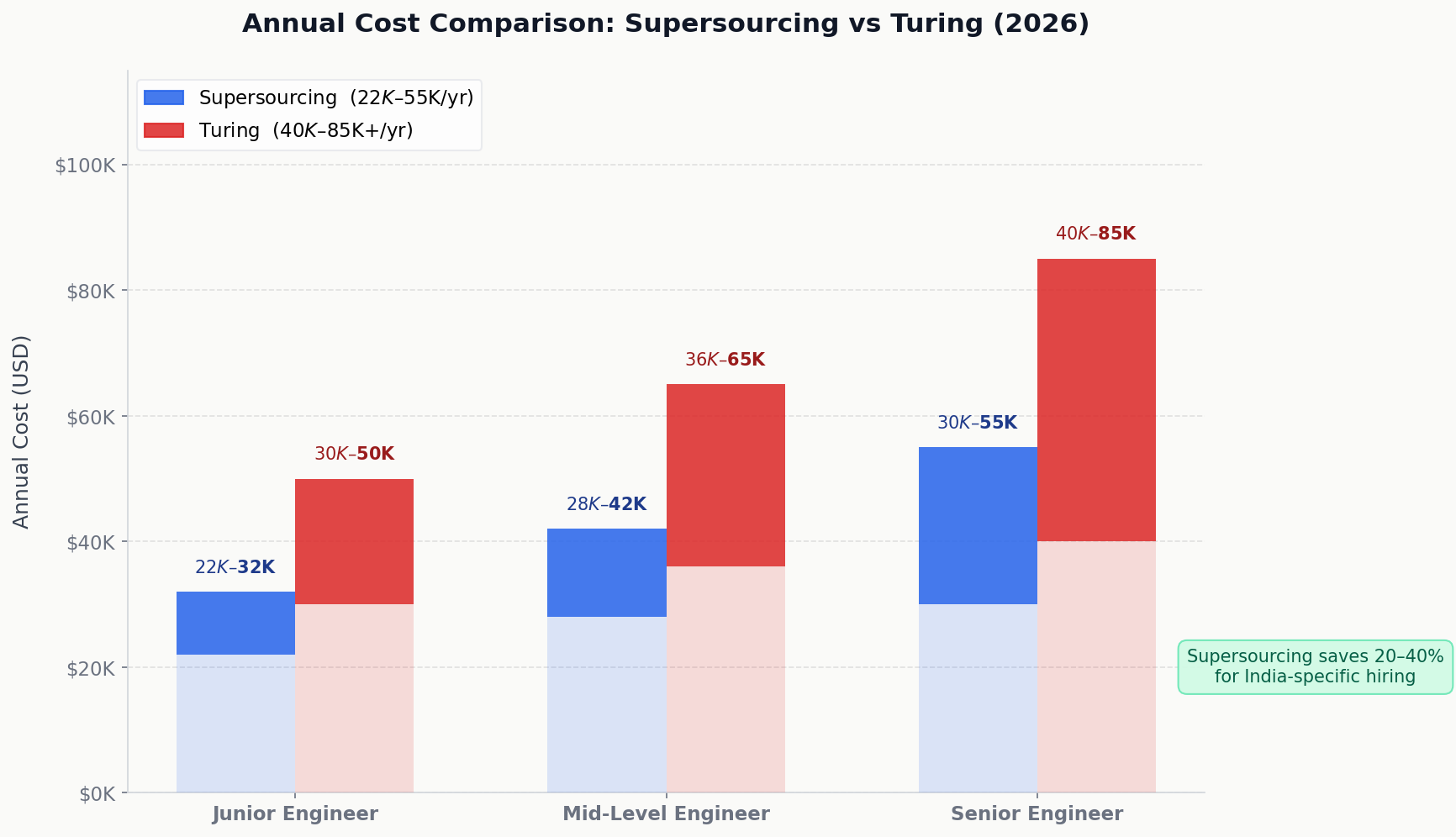
| Cost | $22K–$55K/year all-in | $40K–$85K+/year (varies) |
| Trial period | 2 weeks available | 2-week trial |
Detailed Comparison 5 Dimensions
Dimension 1 India Network Depth
- Turing: Turing has a substantial global developer network with meaningful India representation India is one of their largest talent pools. The platform’s AI matching system is effective at identifying candidates with relevant skills across this global network.
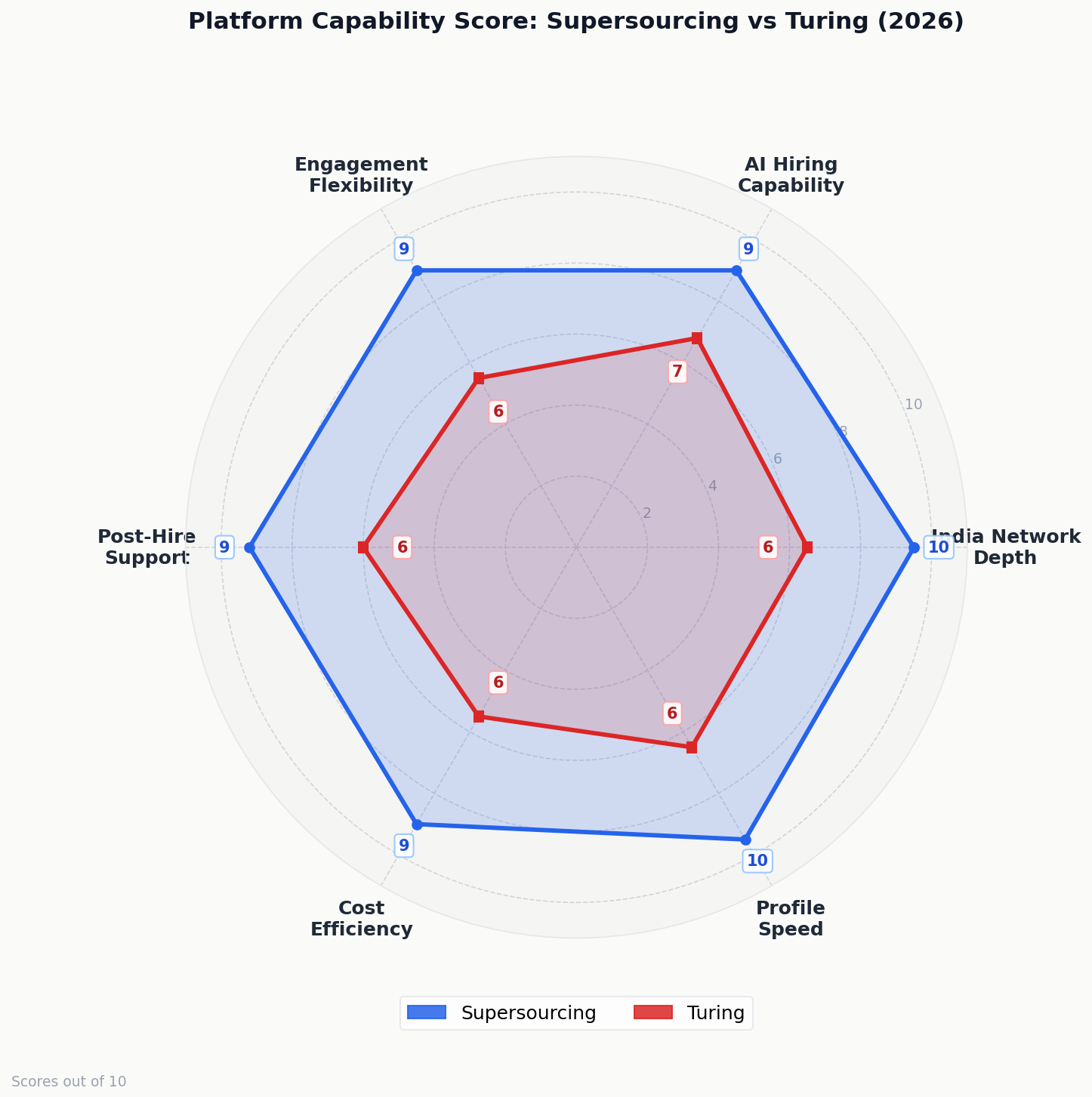
- Supersourcing: Supersourcing is exclusively India-focused. 14+ years of operations, 5,200+ pre-vetted engineers, and deep knowledge of every major India tech hub. When a US company needs a specific type of engineer from a specific Indian city, Supersourcing’s local market knowledge is an advantage that a global-first platform cannot replicate.
- Verdict: For India-specific hiring, Supersourcing’s depth is unmatched. For companies that want global optionality alongside India, Turing is more flexible.
Dimension 2 AI Hiring Capability
- Turing: Turing uses AI for matching and has a reasonable AI engineering talent network built through its global developer community.
- Supersourcing: The Google AI Accelerator 2024 selection is a meaningful differentiator; it represents Google’s recognition that Supersourcing’s AI is production-grade, not marketing. Supersourcing has placed AI engineers at 35 AI startup clients and has specific vetting protocols for ML engineers, LLM engineers, MLOps engineers, and data scientists that go beyond standard technical assessment.
- Verdict: Supersourcing has a stronger AI engineering hiring credential, particularly for US companies building production AI systems.
Dimension 3 Engagement Model Flexibility
- Turing: Turing’s primary model is full-time remote. The engineer is matched to the company and works full-time, managed through Turing’s platform. Contract-to-hire conversion is possible but not the primary model.
- Supersourcing: Three models Contract (short-term, flexible), C2H (trial before permanent commitment), and Permanent (full-time on the client’s payroll after placement). This flexibility allows companies to choose the model that fits their risk tolerance, budget, and relationship needs.
- Verdict: Supersourcing’s model flexibility is an advantage for companies that want to start with a contract or C2H before committing to permanent. Turing’s full-time model is simpler if you know you want a permanent remote hire immediately.
Dimension 4 Post-Hire Relationship Management
- Turing: Turing provides platform-based support to a developer success manager who is reachable but is not a relationship-driven account manager. Monthly reviews are standard.
- Supersourcing: Every client has a dedicated account manager reachable via email and WhatsApp, involved throughout the engagement. Monthly performance ratings. Quarterly check-ins. Early attrition signals escalate before they become problems. The account manager knows your product, your team, and your engineering culture, not just the job description.
- Verdict: Supersourcing’s post-hire relationship model is meaningfully stronger for companies that want a partner rather than a platform.
Dimension 5 Cost
- Turing: Rates for senior engineers typically range from $40,000 to $85,000+ annually depending on role and seniority. This is higher than India-market rates because Turing adds a significant platform premium for the global matching and management layer.
- Supersourcing: All-in annual cost for a senior engineer ranges from $30,000 to $55,000 including all India compliance, account management, and replacement guarantee. The cost advantage is meaningful 20 to 40% below Turing for equivalent seniority.
- Verdict: Supersourcing is less expensive. The Turing premium is justified if you specifically value the global-first matching and the Turing platform infrastructure over a relationship-driven India-specialist model.
The Verdict
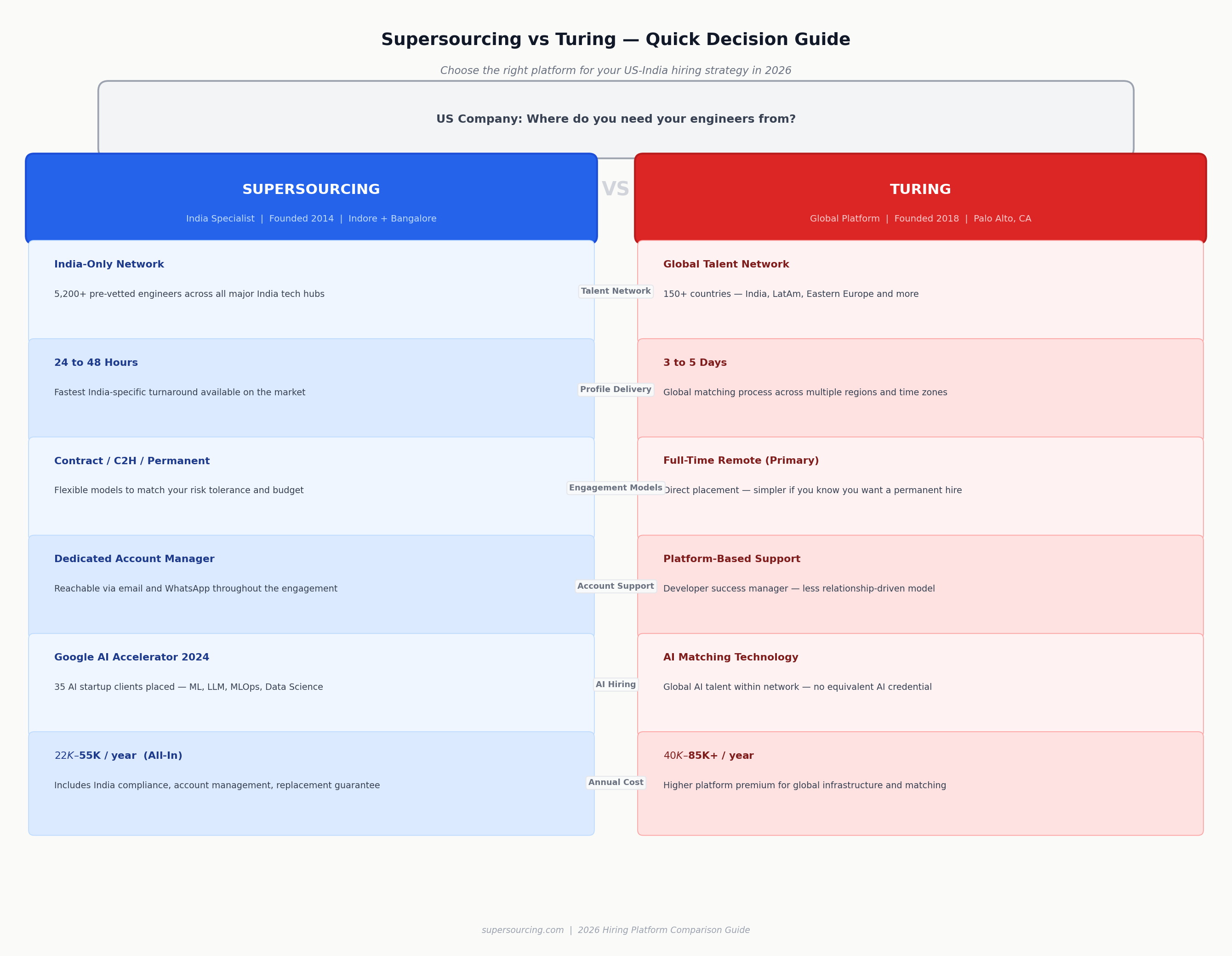
- Choose Turing if: You want a global-first developer platform, you are open to engineers from multiple countries (not just India), and you value a platform-driven self-service experience.
- Choose Supersourcing if: You are specifically building an India engineering team, you need 24 to 48 hour profile delivery, you want an account manager who stays engaged throughout the relationship, you need model flexibility (contract, C2H, or permanent), or you are hiring AI engineers and want the Google AI Accelerator-recognised platform.
Frequently Asked Questions
How does Turing’s vetting compare to Supersourcing’s in practice?
Turing’s vetting is AI-powered and includes a coding assessment and technical review. It is genuinely more rigorous than most hiring platforms. Supersourcing’s vetting adds a human technical assessor layer on top of AI screening an actual engineer (not a recruiter) conducts the technical interview. For roles where nuanced technical judgment matters system design for a distributed system, AI engineering for a production LLM application the human assessor layer catches cases that purely automated assessment misses.
Can Supersourcing match Turing’s global developer network for non-India talent?
No. Turing’s global network spans 150+ countries. Supersourcing’s network is India-specific. If a US company genuinely needs optionality across India, Eastern Europe, and Latin America, Turing’s global network is an advantage Supersourcing cannot match. Supersourcing’s advantage is specifically India depth, India market knowledge, and India compliance management at a cost and service quality that Turing’s global-first model cannot replicate for India-specific engagements.
Which platform is better for US startups hiring their first India engineering team Supersourcing or Turing?
For US startups building their first India engineering team, Supersourcing is the stronger choice. Its 14+ years of India-specific operations, 24–48 hour profile delivery, and dedicated account manager model reduce the friction and risk that comes with a first cross-border hire. Turing suits startups that want global talent optionality from day one and prefer a self-service platform experience over a relationship-driven model.
How does Supersourcing’s contract-to-hire (C2H) model work compared to Turing’s full-time remote model?
Supersourcing’s C2H model lets US companies hire an engineer on a contract basis first, evaluate fit over a defined period, and then convert to permanent employment reducing commitment risk. Turing’s primary model is direct full-time remote placement, which is simpler if you’re confident about the role but offers less flexibility if you want a structured trial before a long-term commitment.
Is Supersourcing or Turing better for hiring AI and ML engineers in 2026?
Supersourcing holds a distinct edge for AI and ML hiring in 2026, backed by its Google AI Accelerator 2024 selection and a track record of placing engineers across 35 AI startup clients. Its vetting protocols are specifically designed for ML engineers, LLM engineers, MLOps engineers, and data scientists. Turing has AI engineering talent within its global network, but lacks equivalent AI-specific credentials and India-depth for these roles.
What are the total cost differences between Supersourcing and Turing for hiring a senior developer?
For a senior engineer, Supersourcing’s all-in annual cost ranges from $30,000 to $55,000 covering India compliance (PF/ESI/PT/TDS), account management, and a replacement guarantee. Turing’s rates for equivalent seniority typically run $40,000 to $85,000+ annually, reflecting its global matching infrastructure and platform premium. For India-specific hiring, Supersourcing offers 20–40% cost savings without compromising on vetting quality or post-hire support.
