

Hyderabad added more new Global Capability Centers in the last two years than almost any other Indian city except Bengaluru, and it is now the single fastest-growing Tier-1 GCC hub in the country. That is not a marketing line, it is the reason engineering leaders in Hyderabad are fighting a harder hiring battle than they were even eighteen months ago.
If you are trying to hire backend engineers, data scientists, or a full GCC team in Hyderabad right now, you are competing with McDonald’s, Vanguard, and every Fortune 2000 company that decided this was the year to build here. That changes what “good hiring” looks like it is no longer about posting a job and waiting. It is about who has the sourcing depth, the vetting rigor, and the delivery discipline to close roles before your competitor’s staffing partner does.
Hiring demand in Hyderabad’s tech ecosystem is accelerating at an unprecedented pace. Recent insights show that India’s GCC hiring is projected to cross 510,000 roles in 2026, marking a sharp increase compared to previous years, with Hyderabad continuing to rank among the top hiring hubs for global companies. This surge is largely driven by demand for AI, cloud, and data talent, making competition for skilled engineers significantly more intense. Hyderabad GCC hiring trends and 2026 job projections highlight why companies are increasingly relying on specialized staffing partners to close roles faster in this high-demand market.
This guide ranks the top 10 IT staffing companies in Hyderabad for 2026, and then goes further than any comparable list: a full walkthrough of how staffing actually works from the moment you define a role to the moment you’re managing a delivery team, real cost bands in ₹ and $, and the mistakes that quietly derail most first-time engagements.
Hyderabad’s IT Staffing Market in 2026: What’s Actually Driving Demand
Hyderabad’s hiring intensity in 2026 isn’t a general “tech is growing” story; it’s driven by four specific, identifiable forces, and understanding them changes how you should approach staffing.
- GCC density is compounding, not plateauing. Hyderabad now hosts 355+ GCC centers and counting, anchored by government-backed initiatives like the Telangana AI Mission (T-AIM) and a startup ecosystem of 940+ firms feeding the talent pipeline. New GCC entrants including large non-tech brands like McDonald’s, which opened its largest GCC outside the US in Hyderabad in 2025 are competing for the same engineering, data, and AI talent pool as your product team.
- The city is shifting from cost arbitrage to specialized capability. Where Hyderabad GCCs were once back-office extensions, they’re increasingly running AI-led and analytics-heavy operations, meaning the demand curve has moved sharply toward AI/ML, MLOps, and platform engineering roles rather than generalist software maintenance.
- State policy is actively accelerating new setups. Telangana is one of ten Indian states that has notified or drafted a dedicated GCC policy since 2024, part of a national push that added 170+ new GCC setups across India in 2025 alone, a meaningful share of which are Hyderabad-based.
- Unlike purely startup-driven hiring markets, Hyderabad is built for platform-scale hiring. Organizations here are staffing teams meant to own products and run for years, not short sprint projects which is why structured, retention-focused staffing consistently outperforms speed-only hiring in this specific market.
Hyderabad’s IT staffing ecosystem, in practice, spans four service types: permanent IT hiring, contract and contract-to-hire staffing, GCC and offshore team setup, and RPO or continuous hiring programs and most engineering leaders will need at least two of these across a single team build-out.
What Is IT Staffing?
IT staffing is the practice of sourcing, vetting, and deploying technology professionals on a contract, contract-to-hire, or permanent basis through a specialized recruitment partner rather than an internal HR team alone. It covers everything from placing a single DevOps engineer to building an entire offshore delivery team.
IT staffing is often confused with:
- General recruitment agencies which typically source across all industries and roles, without deep technical screening capability.
- Recruitment Process Outsourcing (RPO) where a partner runs your entire hiring function (sourcing, screening, offer management) rather than filling individual open roles.
- Freelance marketplaces which connect you directly to independent contractors with no vetting, compliance layer, or replacement guarantee.
Why It Matters: The Business Case for IT Staffing in Hyderabad
Getting hired wrong in a market this competitive is expensive in ways that don’t show up until months later. The business case for a specialized staffing partner comes down to four measurable outcomes:
- Speed to productivity. A structured staffing partner can move from job description to interview-ready shortlist in 7-10 working days, versus 4-8 weeks for a purely internal hiring loop competing against GCC recruiters with dedicated sourcing teams.
- Lower mis-hire risk. Technical mis-hires typically cost 50-150% of the role’s first-year CTC once you account for interview time, onboarding, lost productivity, and re-hiring, a cost that compounds in a market where niche AI/ML and cloud roles are hardest to replace.
- Attrition insulation. GCCs in India have pushed attrition down to historic lows of around 12.6%, while broader IT services attrition sits closer to 13-15% but that gap only holds if your hiring process filters for retention fit, not just technical skill, at the point of hire. (Source: Business Today, citing Aon’s 2026 workforce data)
- Flexible cost structure. Contract and contract-to-hire models let you scale a Hyderabad team up or down without the fixed overhead of a full internal recruitment function useful for GCCs still in “Outpost” or “Satellite” maturity stages that haven’t built local HR infrastructure yet.
The Core Problem Most Buyers Face
Most companies underestimate how different Hyderabad’s hiring market is from what they experienced two or three years ago and that mismatch shows up in three predictable ways.
- Timelines slip by 3-4x. A role budgeted for a 2-week close routinely stretches to 6-8 weeks when internal recruiters are sourcing against GCCs with dedicated talent-acquisition teams and 12-20% salary premiums over traditional IT services pay bands.
- Offer-to-joining ratios collapse. Candidates in high-demand skill clusters (AI/ML, cybersecurity, platform engineering) routinely hold 2-3 competing offers; a slow or generic vetting process loses them before an offer letter is even signed.
- Vetting depth gets sacrificed for speed. Under pressure to close roles fast, many teams skip structured technical assessment and lean on resume keywords and gut-feel interviews which is precisely how a 20-30% early-attrition problem gets built into a new team from day one.
The content gap this guide fills: most roundups stop at company names and specialties. Buyers actually need to know what this costs, how long each phase realistically takes, and what a bad process looks like from the inside, all of which is covered in the sections below.
Skills in Highest Demand Right Now
Not all roles are equally hard to fill. Knowing where the pressure is concentrated helps you budget realistic timelines before sourcing even starts:
- AI/ML and applied GenAI engineering the single hardest category to fill in 2026, with demand consistently outpacing qualified supply across Hyderabad’s GCC and product-company hiring pool
- Cloud and platform engineering (AWS/Azure/GCP, Kubernetes) steady, high-volume demand from both GCCs and product companies scaling infrastructure
- Data engineering and MLOps increasingly bundled with AI hiring, since most AI initiatives now stall on data pipeline maturity, not model quality
- Cybersecurity demand has grown fastest among GCCs shifting from operational to strategic mandates, particularly around cloud security and compliance
- DevOps/SRE consistently in-demand as GCCs and product teams push toward faster release cycles and higher uptime commitments
Roles in these categories should be budgeted at the higher end of any cost or timeline range in this guide generic sourcing processes routinely underperform here.
Top 10 IT Staffing Companies in Hyderabad
1. Supersourcing Best IT Staffing Company in Hyderabad
Supersourcing is built specifically for companies hiring product engineering teams, setting up GCCs, or scaling offshore development centers in markets like Hyderabad, where quality and retention matter more than raw hiring volume.
- Founded: 2014
- Core services: Contract staffing, contract-to-hire, permanent IT staffing, RPO, GCC setup, custom software and app development
- Specialties: AI-driven sourcing that surfaces the top 2% of vetted talent; dedicated account management with no shared bandwidth
- Track record: 527+ IT projects delivered, a 98% candidate joining rate, under 1% candidate drop-off on contract roles, and an 8.5 NPS score
- Industry focus: SaaS, fintech, healthtech, e-commerce, enterprise platforms, AI-driven startups
- Notable clients: Swiggy, Paytm, OkCredit, Dunzo, Chargebee, Razorpay, Yellow.ai, Adani, Apollo Hospitals, Brillio, Open Money, Somnoware
- Recognition: LinkedIn Top 20 Startup (2023 & 2024); part of the Google for Startups AI Accelerator (2024)
- Why it stands out in Hyderabad: A hiring cycle of 7-10 working days from job description to interview-ready shortlist, NDA-backed IP protection, and a replacement guarantee within 7-10 days if a hire isn’t the right fit is the combination that matters most when you’re competing against GCCs for the same candidates.
2. TeamLease Services
TeamLease has a large enterprise footprint in Hyderabad and is a common choice for organizations that need structured, compliance-heavy IT staffing at scale.
- Founded: 2002
- Core services: Temporary staffing, permanent recruitment
- Specialties: Workforce management, high-volume hiring
- Industry focus: IT, BFSI, telecom, public sector
- Highlight: Strong nationwide presence and statutory compliance capability.
3. Adecco India
Adecco India serves enterprise and multinational clients hiring in Hyderabad, pairing global recruitment standards with local execution.
- Founded: 1999 (India operations)
- Core services: Permanent and contract staffing, RPO
- Specialties: Enterprise IT, digital transformation, cybersecurity
- Industry focus: IT services, BFSI, manufacturing
- Highlight: Tech-enabled recruitment backed by global best practices.
4. Randstad India
Randstad is a trusted partner for mid-to-senior technology roles inside Hyderabad’s product and enterprise teams.
- Founded: 2008 (India operations)
- Core services: Contract and permanent IT staffing
- Specialties: Cloud engineering, data platforms, DevOps
- Industry focus: SaaS, enterprise IT, consulting
- Highlight: Strong emphasis on long-term role fit over speed alone.
5. Quess Corp
Quess Corp runs large-scale IT staffing programs for organizations that need speed, scale, and operational consistency in Hyderabad.
- Founded: 2007
- Core services: Contract and permanent staffing, workforce management
- Specialties: Volume hiring, agile recruitment
- Industry focus: IT, telecom, BFSI, manufacturing
- Highlight: Known for operational scale and delivery reliability.
6. ABC Consultants
ABC Consultants brings decades of search expertise to Hyderabad, particularly for leadership and specialized technology hiring.
- Founded: 1969
- Core services: Executive search, IT staffing
- Specialties: Enterprise IT leadership, digital roles
- Industry focus: Technology, consulting, enterprises
- Highlight: Personalized search backed by deep domain insight.
7. Kelly Services
Kelly Services offers customized IT staffing across infrastructure, cloud, and software engineering roles in Hyderabad.
- Founded: Global since 1946; 20+ years of India presence
- Core services: Contract and permanent IT staffing
- Specialties: Cloud, infrastructure, software engineering
- Industry focus: IT, healthcare, engineering
- Highlight: Strong candidate vetting and relationship-driven hiring.
8. Ciel HR
Ciel HR is a fast-growing staffing firm expanding its Hyderabad footprint, known for flexibility and precision in IT hiring.
- Founded: 2015
- Core services: Permanent and contractual IT staffing
- Specialties: Software development, cybersecurity, project management
- Industry focus: IT services, fintech, e-commerce
- Highlight: Speed-focused recruitment without sacrificing accuracy.
9. Sutra HR
Sutra HR supports startups and innovation-led companies in Hyderabad hiring for emerging technologies.
- Founded: 2008
- Core services: Tech hiring for startups
- Specialties: AI, machine learning, blockchain
- Industry focus: Startups, product companies
- Highlight: Strong cultural alignment with startup teams and modern tech stacks.
10. ManpowerGroup India
ManpowerGroup India supports enterprises and GCCs in Hyderabad with staffing solutions that scale across contract and permanent roles.
- Founded: Early 2000s (India operations)
- Core services: Contract and permanent IT staffing
- Specialties: Software development, IT management, data roles
- Industry focus: Enterprise IT, global delivery centers
- Highlight: Global reach paired with strong local execution.
The A-to-Z Walkthrough: How IT Staffing Actually Works in Hyderabad
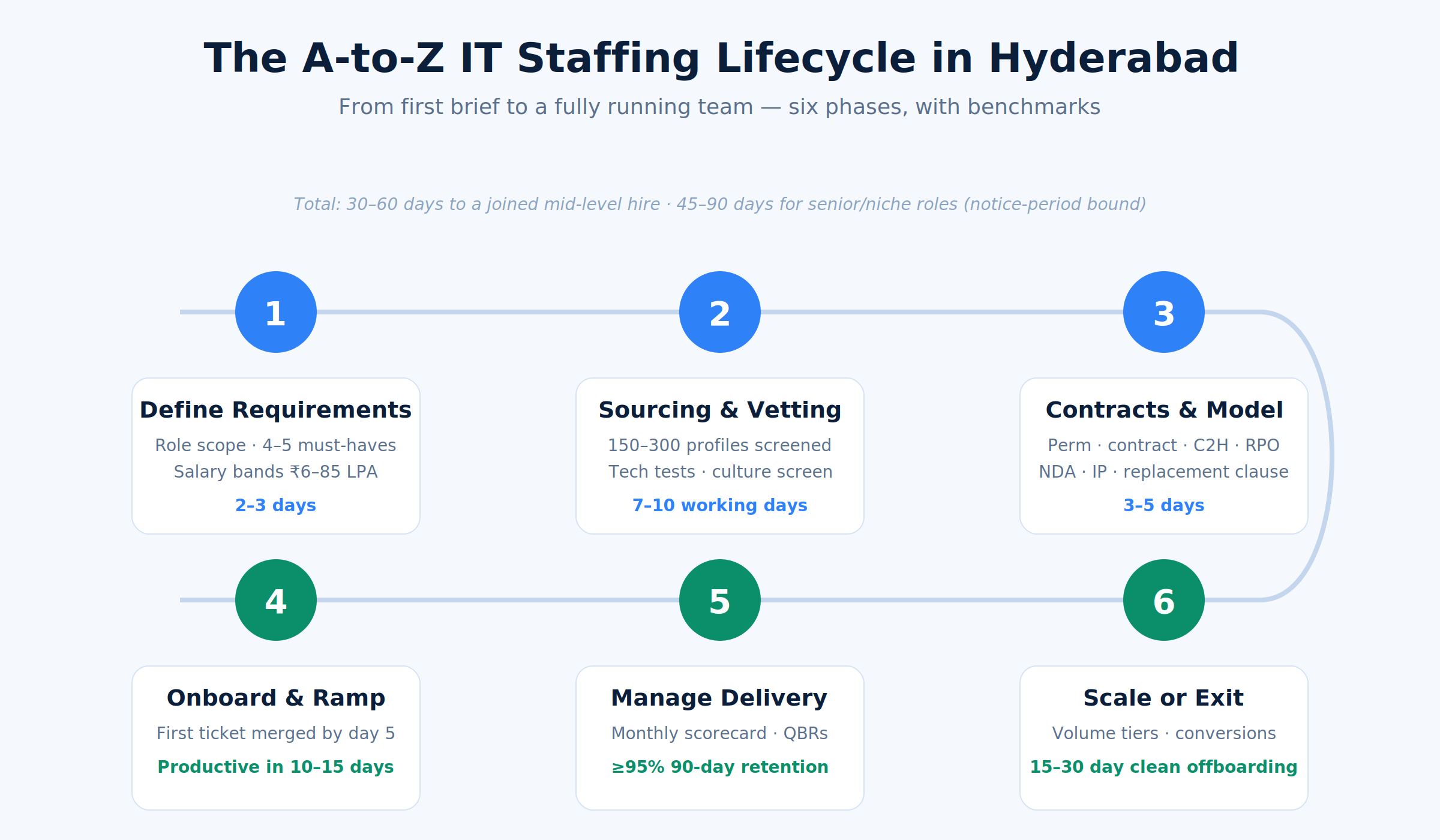
This is the part most guides skip. Here’s the full lifecycle from the moment you realize you need to hire, to the point you’re managing an ongoing team broken into six phases.
Phase 1: Defining Requirements
Before any sourcing starts, get four things locked down. Skipping this phase is the single biggest cause of slow, mismatched hiring.
- Scope is this one role, a pod of 3-5 engineers, or a full GCC build-out?
- Skill specificity list the exact stack (e.g., “Python + Django + AWS” is very different sourcing from “backend engineer”)
- Timeline realistic target: 7-10 working days for a standard mid-level role with a strong partner; 3-6 weeks for niche AI/ML or leadership hires
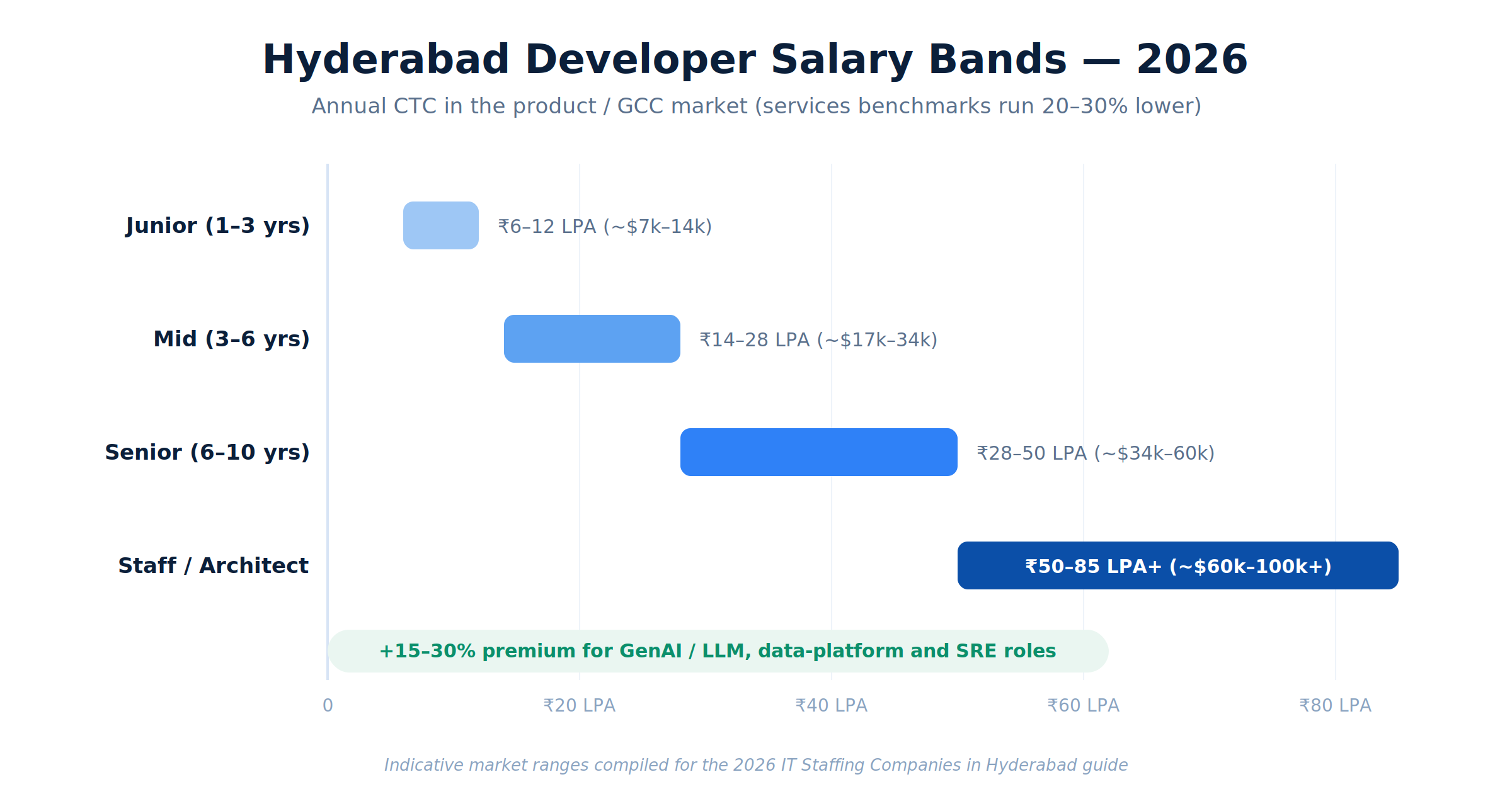
- Budget band set a realistic CTC range up front:
| Role Level | Typical CTC Band (Hyderabad, 2026) | USD Equivalent |
| Junior engineer (0-2 yrs) | ₹6-12 lakhs/year | $7k-14k/year |
| Mid-level engineer (3-6 yrs) | ₹15-30 lakhs/year | $18k-36k/year |
| Senior engineer / lead (7-10 yrs) | ₹30-55 lakhs/year | $36k-66k/year |
| AI/ML, data, cybersecurity specialist | ₹25-60 lakhs/year | $30k-72k/year |
| Engineering manager / GCC lead | ₹50-90 lakhs/year | $60k-108k/year |
Bands vary by specific skill scarcity and GCC salary competition; niche AI and cybersecurity roles regularly price above these ranges in 2026.
Phase 2: Sourcing & Vetting
This is where most engagements are won or lost. What good screening looks like:
- Technical screening: live coding or system-design rounds, not just resume-keyword matching
- Portfolio/code review: for senior roles, a review of actual shipped work, not just a take-home test
- Cultural and retention-fit assessment: structured questions on career trajectory and team-fit, since this is what predicts early attrition
- Background verification: employment history, education, and reference checks completed before offer stage, not after
Red flags to watch for in a staffing partner’s process:
- No technical assessment beyond a phone screen
- Cannot explain their sourcing funnel ratio (how many candidates screened per shortlist submitted)
- No visibility into candidate drop-off rates
- Vague or unwilling to share their average time-to-shortlist
The 3-day rule: if a staffing partner can’t explain why a specific candidate is a fit beyond “strong resume” within three days of submitting a shortlist, their vetting process is thin. Ask for the actual assessment artifacts: coding test scores, system-design notes, or recorded technical interview summaries, not just a verbal endorsement.
Matching assessment depth to role level:
- Junior/mid-level engineers: structured coding assessment (take-home or live), plus a standard behavioral round
- Senior engineers/leads: system-design interview, architecture walkthrough of past work, and a peer technical round with your own team
- AI/ML and data specialists: applied problem-solving on real (anonymized) data scenarios, not abstract algorithm puzzles this is where generic staffing processes fail most often
- Engineering managers/GCC leads: stakeholder-management case studies alongside technical depth, since the failure mode here is usually leadership fit, not raw skill
How to Choose the Right IT Staffing Partner in Hyderabad
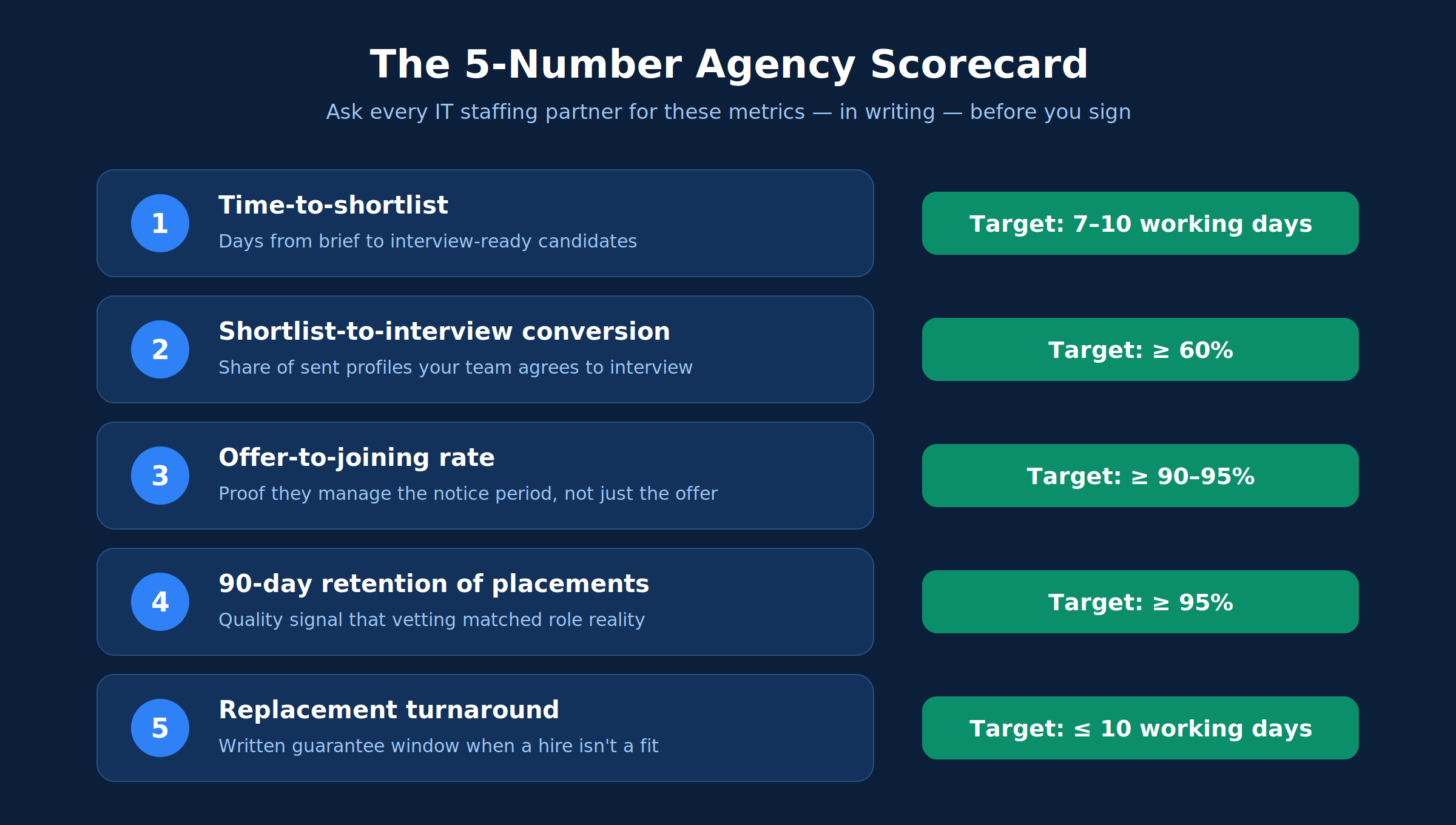
Run any shortlisted partner through this checklist before signing:
- Do they have documented experience with GCC or product-engineering hiring specifically, not just generalist staffing?
- Can they show their technical screening process, not just describe it in a sales call?
- Do they publish or share actual joining-rate and drop-off metrics?
- Is their pricing model (contract markup or placement fee) transparent and confirmed in writing before sourcing starts?
- Does their contract include a clear replacement clause with a defined timeline?
- Do they offer a single dedicated account manager, or will you be routed through a shared support queue?
Benefits of Partnering with an IT Staffing Firm in Hyderabad
- Access to a pre-vetted, product-ready engineering talent pool without building an internal sourcing function
- Faster hiring cycles with materially reduced mis-hire risk
- Flexible engagement models contract, contract-to-hire, or permanent matched to actual team needs
- Built-in support for offshore and GCC-specific hiring, including compliance handling
- Long-term team stability, since retention-focused vetting reduces early attrition compared to speed-only hiring
Phase 3: Engagement Models & Contracts
Choose the model that matches your risk tolerance and team maturity:
- Contract staffing the staffing partner remains the employer of record; best for short-term or fluctuating headcount needs
- Contract-to-hire trial period on contract, converts to your payroll after a defined window; reduces mis-hire risk
- Direct/permanent placement full-time hire from day one; best when the need is clearly long-term
- Dedicated team / staff augmentation an ongoing pod of engineers working exclusively on your product, typically under a Master Service Agreement (MSA) with a per-role Statement of Work (SOW)
Every contract should explicitly cover:
- NDA and IP assignment terms (code, designs, and data belong to you, not the contractor or agency)
- Notice period and offboarding terms
- Replacement clause a strong benchmark is replacement within 7-10 days if a hire isn’t performing, at no additional sourcing fee
Statutory compliance checklist for contract staffing in India:
- Provident Fund (PF) contributions handled by the staffing partner as employer of record
- Employee State Insurance (ESI) coverage where applicable by salary threshold
- Gratuity accrual tracked correctly for contract-to-hire conversions
- Professional tax and TDS deducted and filed per state requirements
- Written confirmation of who bears statutory liability this should never be ambiguous in the MSA
Skipping this checklist is a common, expensive mistake: statutory non-compliance liability generally sits with whoever is legally the employer of record, so confirming this in writing protects you regardless of how informal the sourcing relationship feels.
Phase 4: Onboarding & Ramp-Up
The first two weeks determine whether a hire becomes productive on schedule or drags into month two.
- Week 1: access provisioning (repo, cloud accounts, ticketing system), codebase walkthrough, introduction to the team’s communication cadence
- Week 2: first small, well-scoped ticket assigned; daily check-ins with a designated buddy or lead
- Tools checklist: version control access, CI/CD pipeline access, project management tool login, communication channels (Slack/Teams), documentation wiki access all provisioned before day one, not on day one
Phase 5: Managing Delivery
Once a hire or team is in place, ongoing management structure should include:
- Reporting cadence: weekly status updates at minimum; daily standups for dedicated pods
- KPIs to track: sprint velocity, code review turnaround, defect rate, and critically early attrition signals (disengagement, missed standups, slipping deadlines)
- Account management structure: a single point of contact on the staffing partner’s side who knows your team, not a rotating support queue
Phase 6: Scaling or Exiting
- Adding headcount: a partner with an existing vetted pipeline for your stack should be able to add a second or third hire faster than the first, since sourcing groundwork is already done
- Replacement policy: confirm in writing what happens if a hire exits or underperforms timeline and cost should be defined before you need it, not negotiated after
- Offboarding: access revocation, IP handover, and knowledge-transfer documentation should be a standard checklist item, not an afterthought
Case Studies: Real Outcomes from Hyderabad-Relevant Hiring
Paytm scaling a 100+ engineer hiring effort. The metric that mattered: closing more than 100 engineering roles across backend, mobile, and data functions without diluting technical bar, using structured screening to keep the offer-to-joining ratio high in a competitive fintech hiring market.
OkCredit engineering hiring under startup constraints. The metric that mattered: filling backend and mobile engineering roles fast enough to keep pace with product roadmap commitments, without the multi-week timelines a lean startup team couldn’t absorb internally.
Somnoware recruitment automation for a specialized healthtech stack. The metric that mattered: sourcing niche healthtech and data engineering talent where generic job-board sourcing consistently under-delivered, using targeted technical vetting to close specialized roles that had stalled through other channels.
Comparison Framework: Which Hiring Model Fits Your Situation?
| Factor | Dedicated Staffing Partner | Freelance/Marketplace | Pure In-House Hiring | Traditional Staff Augmentation |
| Cost | Moderate pay for outcome, not headcount overhead | Low upfront, high variance | Highest (fixed HR + recruiter overhead) | Moderate-high |
| Speed | Fast (7-10 days with strong pipeline) | Fast but unvetted | Slow (4-8 weeks typical) | Moderate |
| Control | High you manage the work, partner manages sourcing/compliance | Low limited accountability | Highest | Moderate |
| Risk | Low replacement guarantees, NDA/IP terms built in | High no compliance layer | Moderate mis-hire cost falls entirely on you | Moderate |
| Best for | GCC setup, product teams, scaling with quality bar | Short, low-risk one-off tasks | Long-term core leadership roles | Large enterprises with existing HR infra |
What Most Teams Get Wrong
- They optimize for time-to-fill over time-to-productivity. A fast hire who churns in 90 days costs more than a hire who took two extra weeks to vet properly.
- They treat GCC-level attrition benchmarks as automatic. GCCs report attrition near 12.6% industry-wide, but that number reflects mature retention practices not something a new team inherits by default just because it’s structured as a GCC. (Source: Business Today, citing Aon’s 2026 data)
- They underweight cultural and retention-fit screening. Technical skill gets 90% of interview time; almost none goes to assessing whether a candidate will actually stay past the six-month mark.
- They don’t ask staffing partners for drop-off and joining-rate data. A partner unwilling to share their candidate joining rate or contract drop-off rate is a partner who doesn’t track it which means you’re flying blind on their actual reliability.
- They sign contracts without a clear replacement clause. By the time a bad hire is obvious, it’s too late to negotiate what happens next that term belongs in the original agreement.
- They benchmark salary bands against last year’s data. Compensation in AI/ML, cybersecurity, and platform engineering has moved quickly enough that a 12-month-old salary band will consistently lose candidates to GCC counteroffers.
- They treat onboarding as HR’s problem, not engineering’s. The highest-impact predictor of 90-day retention is whether a new hire shipped meaningful work in their first two weeks which depends entirely on engineering readiness, not paperwork.
Cost & Timeline Reality Check
Typical cost structure:
- Contract staffing: billed monthly, typically 15-25% markup over the contractor’s pay rate, inclusive of compliance and payroll administration
- Permanent placement: one-time fee, typically 8.33%-16.67% of the hire’s annual CTC (roughly one to two months’ salary equivalent), depending on role seniority
- RPO engagements: retainer-based, scaled to hiring volume, most cost-effective above 10-15 roles per quarter
Typical timelines by scenario:
| Scenario | Realistic Timeline |
| Single mid-level engineer, common stack | 7-10 working days |
| Niche AI/ML or cybersecurity specialist | 3-6 weeks |
| Small dedicated pod (3-5 engineers) | 3-5 weeks |
| Full GCC setup (10+ roles, entity/compliance included) | 8-16 weeks |
What drives cost up: niche skill scarcity, urgent (rush) timelines, leadership-level search, and low candidate supply for emerging stacks (agentic AI, specialized MLOps).
What drives costs down: clear, realistic job specs from day one; flexibility on contract vs. permanent structure; and working with a partner that already has a pre-vetted pipeline for your stack rather than starting sourcing from zero.
What to Do Next
If you’re mid-decision on a hiring partner in Hyderabad, the fastest way to de-risk the choice is to ask any shortlisted firm three questions directly: what’s their average time from job description to interview-ready shortlist, what’s their candidate joining rate, and what does their replacement clause actually say in writing. A partner that answers all three with specifics not ranges, not “it depends” is one worth trusting with a real role.
If you’d rather skip the evaluation process and start with a partner that already publishes those numbers, get in touch with Supersourcing to scope your first role or your full GCC build-out.
Frequently Asked Questions
Which are the best IT staffing companies in Hyderabad?
Leading options include Supersourcing, TeamLease Services, Adecco India, Randstad India, and Quess Corp, each suited to different needs from GCC and product-engineering hiring to high-volume compliance-led staffing.
Can staffing agencies help set up GCC teams in Hyderabad?
Yes. Several firms specialize in end-to-end GCC setup, covering entity structuring, compliance, and team build-out alongside core sourcing and vetting.
Do IT staffing companies support AI and data hiring?
Yes, most established staffing partners now run dedicated sourcing tracks for AI/ML, data engineering, and cloud-native roles, given how sharply demand for these skills has grown industry-wide.
How fast can IT roles be closed in Hyderabad?
With a strong staffing partner and a well-defined role, standard positions typically close in 7-10 working days; niche or leadership roles can take 3-6 weeks.
How much does IT staffing cost in Hyderabad?
Contract staffing typically carries a 15-25% markup over the contractor’s pay rate; permanent placements typically cost 8.33%-16.67% of the hire’s annual CTC. Costs rise for niche skills and rush timelines.
What’s the difference between staffing and RPO?
Staffing fills individual open roles on demand. RPO hands your entire recruitment function sourcing, screening, and offer management to a partner, typically for higher-volume, ongoing hiring needs.
What happens if a hired engineer doesn’t work out?
This should be defined in the contract before signing. A strong benchmark is a replacement guarantee within 7-10 days at no additional sourcing cost confirming this explicitly with any partner before engaging them.
Is contract staffing legal and compliant in India?
Yes, when structured correctly through a registered staffing entity that handles PF, ESI, gratuity, and other statutory obligations as the employer of record, this compliance layer is one of the core reasons companies use staffing partners rather than hiring informally.
How is IT staffing different from hiring through a freelance marketplace?
Freelance marketplaces connect you directly to independent contractors with minimal vetting and no compliance or replacement guarantees. A staffing partner adds structured technical screening, statutory compliance handling, and contractual accountability which matters most once a role moves beyond a short, low-risk task.
Do staffing partners handle GCC entity setup, or only hiring?
It varies by firm. Some staffing partners handle sourcing and compliance only, while others including full-service partners support entity structuring, statutory registration, and team build-out as part of an end-to-end GCC setup engagement. Confirm scope explicitly before signing.
