

Artificial intelligence is moving from experimentation to production across enterprises. But building models is only half the problem; running them reliably at scale is where most organizations struggle.
This is exactly why companies are looking to hire MLOps Engineers in India at an accelerating pace. MLOps engineers turn machine learning models into production systems scalable, monitored, and continuously improving.
The demand is rising faster than supply. According to McKinsey Global Institute. The Economic Potential of Generative AI, AI adoption is expected to contribute trillions in value globally, driving a massive need for specialized roles like MLOps to operationalize these systems.
India has emerged as a key hub for this talent, especially for GCCs and AI-driven enterprises. But the real challenge is not finding candidates, it’s hiring engineers who can build production-grade ML infrastructure, not just experimental pipelines.
What Is MLOps and Why It Is a Different Hire From Data Science
The confusion between data scientists and MLOps engineers costs organizations months of productivity and significant model quality degradation.
A data scientist’s primary output is a trained model of statistical analysis, feature selection, algorithm selection, hyperparameter tuning, and model evaluation. The data scientist thinks about model accuracy, precision/recall trade-offs, and feature engineering.
An MLOps engineer’s primary output is a production ML system, the infrastructure that trains models reliably, serves predictions at scale, monitors model performance in production, triggers retraining when performance degrades, and integrates the model’s predictions into downstream applications. The MLOps engineer thinks about pipeline reliability, inference latency, model version management, data drift detection, and deployment rollback procedures.
The skillset overlap is real but partial. A strong MLOps engineer understands ML fundamentals well enough to work effectively with data scientists, feature engineering concepts, model evaluation metrics, the difference between online and batch inference patterns. But the primary skills are infrastructure: containerization (Docker, Kubernetes), CI/CD pipeline design for ML workflows, distributed computing for model training, cloud ML platform configuration (AWS SageMaker, Google Vertex AI, Azure ML), feature store design, and model monitoring architecture.
Many organizations try to make data scientists do MLOps. Some do it well. Most do not because the infrastructure design, the DevOps discipline, and the production reliability mindset are different from the experimental, research-oriented mindset that produces good data science work.
 The MLOps Toolchain: What to Assess For
 The MLOps Toolchain: What to Assess For
ML pipeline orchestration. ML pipelines the automated workflows that handle data ingestion, feature computation, model training, evaluation, and registration are the core of an MLOps engineer’s work. The dominant tools are Kubeflow Pipelines for Kubernetes-native ML workflows, Apache Airflow for general workflow orchestration including ML pipelines, Metaflow (developed at Netflix, popular in fintech and e-commerce ML teams), and ZenML for cloud-agnostic ML pipeline design. Each has different strengths and trade-offs. An MLOps engineer should be able to explain why they would choose one over another for a specific scale and infrastructure context.
Model registry and experiment tracking. MLflow is the dominant open-source tool for experiment tracking (logging parameters, metrics, and artifacts from training runs) and model registry (versioning trained models, managing model lifecycle from staging through production). Weights & Biases (W&B) is widely used in research-intensive AI teams for richer experiment visualization. SageMaker Experiments and Vertex AI Experiments are the managed equivalents on AWS and GCP. An MLOps engineer should have deep MLflow experience and understand when the managed platform equivalents are preferable.
Model serving and inference infrastructure. Models need to serve predictions at low latency for real-time use cases or in batches for offline scoring. The tools and architecture choices here significantly affect production performance and cost. TorchServe and TensorFlow Serving for framework-native serving. Triton Inference Server (NVIDIA) for high-performance multi-model serving on GPU infrastructure. BentoML for framework-agnostic model packaging and serving. KServe (formerly KFServing) for Kubernetes-native model serving with autoscaling. An MLOps engineer should be able to design a serving architecture for a specific latency and throughput requirement, not just deploy a model to an endpoint.
Feature stores. Feature stores solve the problem of feature consistency between training and serving, ensuring that the features used to train a model are computed in exactly the same way when the model makes predictions in production. Feast (open-source), Tecton (managed), Hopsworks, and the cloud-native options (SageMaker Feature Store, Vertex AI Feature Store) each have different architecture patterns for online (low-latency) and offline (batch training) feature access. An MLOps engineer working on a team with multiple ML models that share features should understand feature store design.
Model monitoring and drift detection. Models degrade in production because the distribution of input data changes over time (data drift), because the relationship between inputs and the target variable changes (concept drift), or because upstream data quality issues corrupt model inputs. Evidently AI, Whylogs, Fiddler, and Arize are the primary model monitoring tools. An MLOps engineer should be able to design a monitoring architecture, what metrics to track, what drift detection thresholds to set, and what the retraining trigger logic should be.
Cloud ML platform depth SageMaker, Vertex AI, or Azure ML. Most enterprise MLOps run on a managed cloud ML platform. AWS SageMaker, Google Vertex AI, and Azure Machine Learning each provide end-to-end MLOps capabilities pipeline orchestration, training jobs, model registry, endpoints, feature stores, and monitoring. An MLOps engineer should have deep experience on the specific platform your GCC or enterprise uses and the architectural judgment to know when to use the managed platform’s capabilities versus open-source tools.
MLOps Salary Benchmarks India 2026
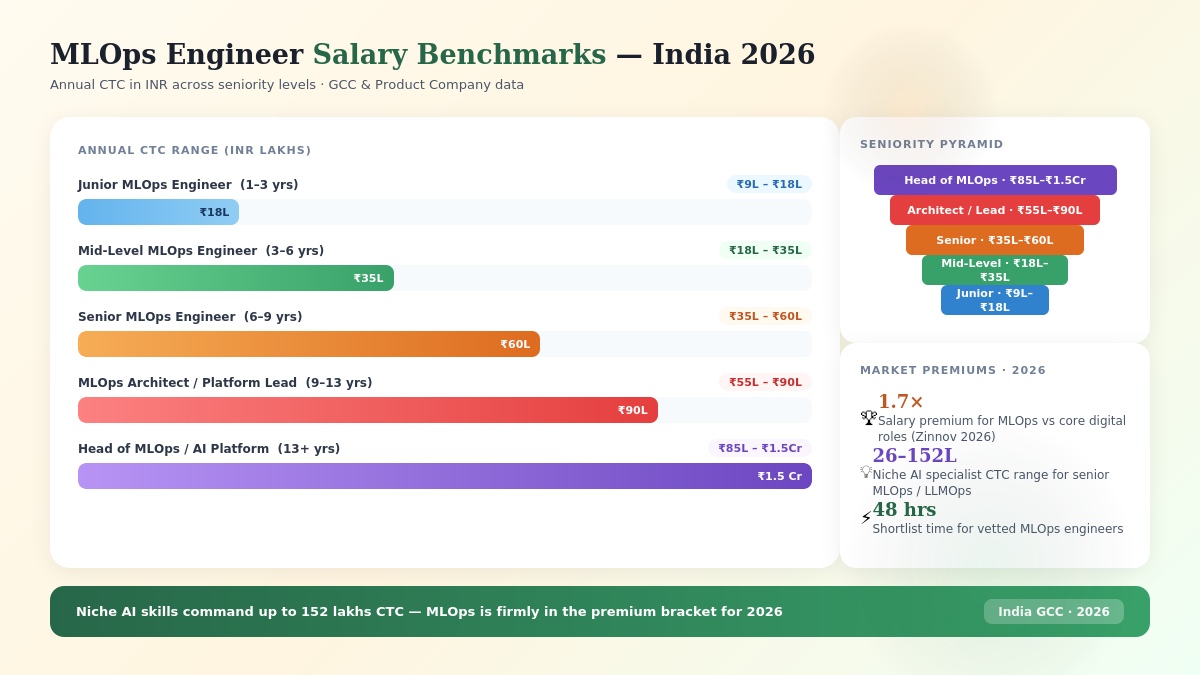 MLOps Salary Benchmarks India 2026
| Level | Experience | Annual CTC (INR) |
| Junior MLOps Engineer | 1–3 years | ₹9L – ₹18L |
| Mid-Level MLOps Engineer | 3–6 years | ₹18L – ₹35L |
| Senior MLOps Engineer | 6–9 years | ₹35L – ₹60L |
| MLOps Architect / Platform Lead | 9–13 years | ₹55L – ₹90L |
| Head of MLOps / AI Platform | 13+ years | ₹85L – ₹1.5Cr |
Niche AI and specialized digital capabilities command 26–152 lakhs per Zinnov’s 2026 GCC compensation data with niche skills commanding 1.7x higher hikes than core digital roles. MLOps at senior level sits firmly in this premium bracket.
Contract and staff augmentation rates are customized to your ML platform (SageMaker vs Vertex AI vs Azure ML), pipeline orchestration tool, model serving requirements, and seniority level. Custom quote within 24 hours of receiving the JD.
What to Assess in an MLOps Engineer Interview
Pipeline design from raw data to deployed model.
Ask the candidate to design an end-to-end ML pipeline for a specific scenario, a recommendation model that needs to be retrained weekly on new user interaction data, with the trained model deployed to a low-latency serving endpoint. How do they structure the pipeline stages? How do they handle feature computation? How do they manage the model evaluation step and the promotion decision from staging to production?
How do they design the rollback procedure if the new model degrades performance metrics? The quality of their answer reveals whether they have designed real production pipelines or worked on toy implementations.
Drift detection and monitoring design.
Ask how they would design a monitoring system for a fraud detection model in production. What metrics would they track? How would they detect data drift in the transaction feature distribution? How would they differentiate between model performance degradation caused by data drift versus a labeling quality issue in the training data? What would trigger an automated retraining job versus a human review? Candidates who can answer this concretely have designed real monitoring systems. Those who give generic answers about “tracking metrics” have not.
Infrastructure as code for ML infrastructure.
Production ML infrastructure should be reproducible and version-controlled defined in Terraform, Pulumi, or cloud-native IaC tools. An MLOps engineer who deploys ML infrastructure manually, without IaC, creates environments that are difficult to reproduce, audit, or recover from failure. Ask how they manage ML infrastructure training clusters, serving endpoints, feature stores as code.
Cost optimization for GPU training and inference.
ML training and inference on GPU infrastructure is expensive. An MLOps engineer working at scale should understand cost optimization: spot instance usage for training jobs, model quantization and distillation for reducing inference cost, multi-model serving for sharing GPU resources across multiple models, and the cost trade-offs between real-time and batch inference for different use case latency requirements. This is increasingly important for GCCs managing large AI infrastructure budgets.
Collaboration model with data scientists.
MLOps engineers do not work alone; they work with data scientists who provide the model code and experiment results, and with platform/DevOps teams who manage the underlying infrastructure. Ask how they have structured the interface between data science and MLOps, how they handle model code handoffs, what standards they enforce for model packaging, and how they give data scientists visibility into production pipeline performance without requiring them to manage infrastructure.
Why GCCs Hire MLOps Engineers in India Before They Hire More Data Scientists
The pattern we see consistently across GCC AI team builds is this: an organization hires 5–10 data scientists, builds several ML models, and then realizes that deploying and maintaining those models consumes more data scientist time than building new ones. The bottleneck is not modeling, it is infrastructure. Hiring one strong MLOps engineer at that point typically unlocks more model deployment velocity than hiring two additional data scientists.
Forward-thinking GCCs are now hiring MLOps engineering capability earlier, sometimes as the first AI infrastructure hire, before significant data science hiring begins. The logic is straightforward: an MLOps platform designed well from the start enables data scientists to work faster, produce more reproducible results, and deploy models to production in days rather than weeks.
For GCCs planning AI capability builds in India, the recommended hiring sequence is: ML platform architect or senior MLOps engineer first to design the infrastructure, then data scientists and ML engineers, then junior MLOps developers to scale the platform team.
The 3 Most Common MLOps Hiring Mistakes
- Hiring data scientists to do MLOps. The skill overlap is real but the mindset overlap is not. Data scientists who are being asked to manage ML infrastructure alongside their modeling work will be less productive at both. The infrastructure discipline CI/CD for ML, IaC for training clusters, and monitoring architecture is a full-time engineering focus.
- Underspecifying the ML platform in the JD. SageMaker, Vertex AI, and Azure ML have different architectures, different feature stores, different serving infrastructure, and different pipeline orchestration models. An engineer deeply experienced on SageMaker will need significant ramp-up on Vertex AI. Specify the platform explicitly in the JD and assess for it specifically.
- Hire MLOps Engineers in India without data engineering skills. ML pipelines are data pipelines plus model training. An MLOps engineer who does not understand data engineering, how to design scalable feature computation pipelines, how to manage data quality in training datasets, and how to handle schema evolution in feature stores will build ML infrastructure that works when the data is clean and fails when it is not.
How Supersourcing Vets MLOps Engineers
 How Supersourcing Vets MLOps Engineers
Our senior AI platform architects who have designed and operated production ML infrastructure on SageMaker, Vertex AI, and Azure ML assess every MLOps engineer shortlist. We evaluate ML pipeline design, model serving architecture, feature store design, drift detection and monitoring strategy, IaC discipline, cost optimization thinking, and collaboration model with data science teams.
We maintain a continuously vetted bench of MLOps engineers across all seniority levels and ML platform specializations. Shortlist in 48 hours. We are a Google AI Accelerator company. AI infrastructure is our domain, not just a hiring category.
Optional Barrister or interview.io technical interviews arranged by us. 5,000+ engineers placed. 8% attrition. 98% joining rate. 14-day free replacement.
FAQ
1. What is the difference between an MLOps engineer and a data engineer?
A data engineer builds and maintains data pipelines that move and transform data for analytics and reporting. An MLOps engineer builds and maintains ML pipelines the infrastructure that trains models, versions them, serves predictions, and monitors performance in production. There is significant overlap in tools (Airflow, Spark, debt), but the MLOps focus on model lifecycle management, serving infrastructure, and drift detection is distinct from data engineering.
2. What ML platforms do you assess MLOps engineers for?
AWS SageMaker, Google Vertex AI, Azure Machine Learning, and open-source stacks (Kubeflow, MLflow, Feast, KServe). We calibrate the assessment to your specific platform. An engineer with deep SageMaker experience is not automatically qualified for a Vertex AI program without specific transition assessment.
3. What is data drift and why does it matter for MLOps hiring?
Data drift is the change over time in the statistical distribution of the features a model uses for predictions. As the real-world data distribution drifts away from the training data distribution, model performance degrades often gradually and invisibly until a business metric reveals the problem. An MLOps engineer who cannot design a drift detection and monitoring architecture is not equipped to maintain model performance in production over time.
4. Can you place MLOps engineers who also have LLMOps experience for large language model deployments?
Yes. LLMOps the operational management of large language model deployments including prompt versioning, model fine-tuning pipelines, RAG pipeline orchestration, and LLM evaluation frameworks is an emerging specialization within MLOps. We assess LLMOps capabilities separately for roles where LLM deployment is the primary scope.
5. What is your replacement policy?
Free replacement within 14 days. No charge, no questions.
6. Do I need a legal entity in India?
No. We act as Employer of Record payroll, PF, ESIC, TDS, all statutory compliance handled by us.
7. What is the realistic timeline to hire a senior MLOps engineer in India without Supersourcing?
8–14 weeks through a standard job posting for a senior MLOps engineer with production ML platform experience. Through Supersourcing: 48-hour shortlist, hire within 7 days.
Talk to Us About Your MLOps Requirement
If you are building an AI infrastructure team in India, a single MLOps engineer to unblock your data science team, a platform to design your ML infrastructure from scratch, or a full MLOps team for a GCC AI capability build, I am usually the one on those calls.
Email: mayank@supersourcing.com Or book a meeting directly at supersourcing.com
Tell us your ML platform, pipeline orchestration tool, model serving requirements, and team composition. Shortlist in 48 hours from there.
No retainer until you hire. Replacement clause on every engagement.
Mayank Pratap Singh · Co-founder, Supersourcing Google AI Accelerator · LinkedIn Top 20 Startups India · 5,000+ Engineers Placed · 1,000+ Companies · 17 Fortune 500s
