

A Microsoft certification badge takes roughly 40–80 hours of preparation and a $165 exam fee to earn. A production incident caused by a developer who memorized exam answers but never configured a real virtual network can cost 100x that in a single weekend. That asymmetry is the entire problem with certification-first hiring.
Yet the opposite extreme, ignoring certifications entirely, is equally expensive. Companies that hire certified Azure developers without any additional vetting get burned by “paper certs.” Companies that dismiss certifications outright spend 2–3 extra interview rounds rediscovering knowledge that an exam already validated. Both approaches waste time because both misunderstand what a certification is: a floor, not a ceiling.
The demand for cloud expertise is only accelerating. According to Statista cloud computing market forecast, the global cloud computing market is projected to exceed $1 trillion by 2028, reflecting a massive surge in demand for cloud-skilled developers through 2026 and beyond. This growth is pushing certifications into the spotlight but not necessarily making them a complete hiring signal.
So the real question isn’t “do certifications matter?” It’s “which certifications matter, what do they actually prove, and what do they leave unproven?” This guide answers that with exam-level specificity what AZ-204 and AZ-400 genuinely test, where their blind spots sit, and a verification process you can run before signing a contract. If you’re deciding between a certified candidate with 1 year of experience and an uncertified one with 5, the frameworks below will make that call defensible rather than instinctive.
What Does It Mean to Hire Certified Azure Developers?
To hire certified Azure developers is to recruit engineers who hold current, role-based Microsoft credentials typically Microsoft Certified: Azure Developer Associate (AZ-204) or Azure DevOps Engineer Expert (AZ-400) validating tested knowledge of Azure services, deployment, and security. Certification confirms baseline platform knowledge; it does not, by itself, confirm production experience.
That 40-word distinction drives every hiring decision that follows. A credential tells you the candidate cleared Microsoft’s knowledge bar on a specific date. It tells you nothing about how they behave when a deployment fails at 2 a.m.
The Core Problem: Certification Inflation in Azure Hiring
Hiring teams face a supply-side distortion. Microsoft has issued millions of role-based credentials since restructuring its certification program in 2019, and exam-dump sites have industrialized the shortcut economy. A motivated candidate can pass AZ-204 in 2–3 weeks of memorization without ever deploying a real application.
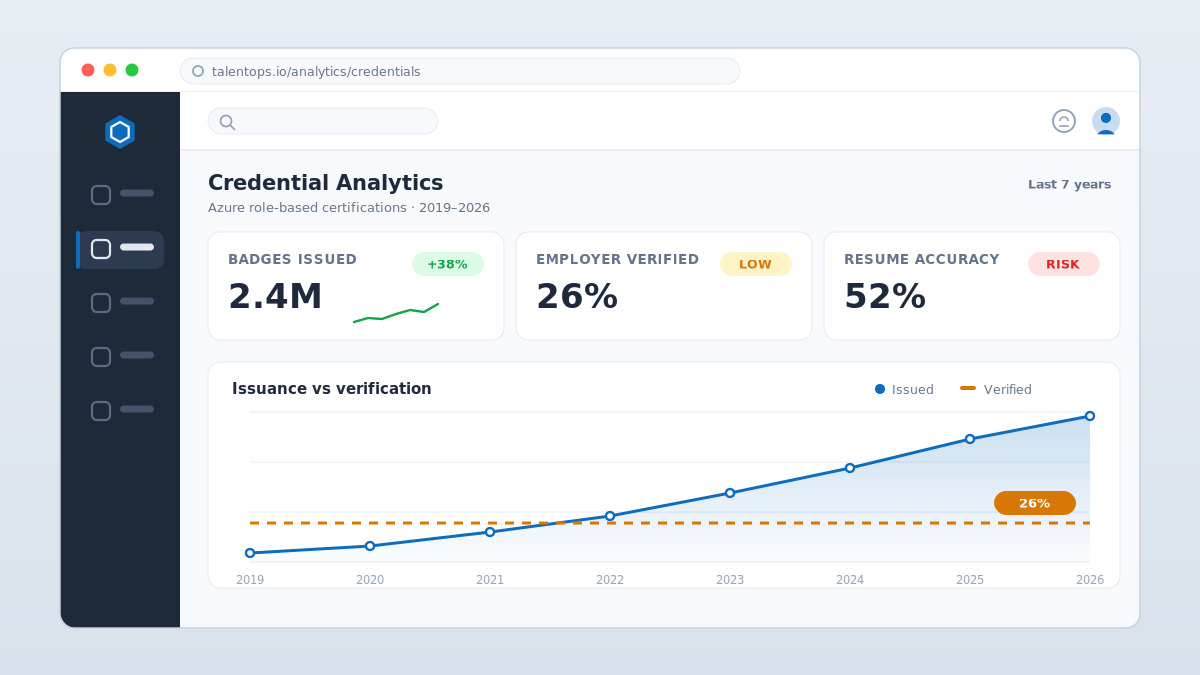
The verification gap makes it worse. Research from TEKsystems found that only 26 percent of IT leaders always or often verify certifications, while just 52 percent of IT professionals say they always or often represent their certifications accurately on their resumes. Roughly half of the credentials on the resumes you’re screening may be embellished, expired, or unverifiable and three-quarters of hiring teams never check.
The cost of getting this wrong is concrete. A mis-hired mid-level Azure developer typically burns 3–4 months before the gap becomes undeniable: one month of onboarding grace, one to two months of underperformance attributed to ramp-up, and a final month of documentation before exit. At $70,000–$120,000 in fully loaded annual cost, that’s $20,000–$40,000 per mis-hire before counting delayed releases or cloud cost optimization mistakes like unbounded autoscaling rules that quietly add 30–40% to a monthly Azure bill.
What Azure Certifications Actually Test (and What They Don’t)
Microsoft’s role-based certifications are scenario-driven, not trivia-driven. That makes them more meaningful than the multiple-choice certs of the 2000s but each exam has a defined scope, and everything outside that scope is unexamined.
AZ-204 Certification Meaning: The Developer Baseline
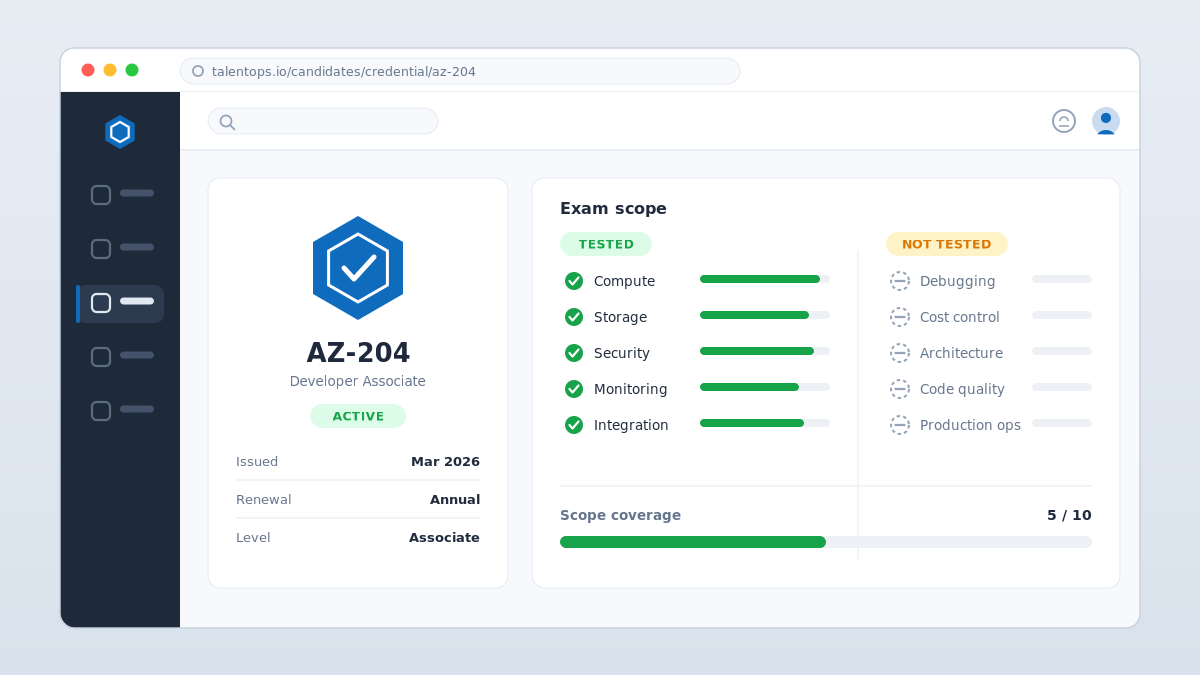
The AZ-204 certification means in practical terms: the holder can develop for Azure’s core PaaS surface. The exam weighs five domains developing compute solutions (Azure App Service, Functions, containers), working with storage (Cosmos DB, Blob), implementing security (Key Vault, managed identities, Microsoft Entra ID), monitoring and optimization (Application Insights), and connecting to services (API Management, Event Grid, Service Bus).
What it tests well: SDK-level fluency, service selection logic, and security fundamentals like using managed identities instead of hardcoded connection strings. What it doesn’t test: writing maintainable application code, debugging distributed systems under load, estimating costs, or making architecture trade-offs across a multi-year product lifecycle. A candidate can hold AZ-204 and still write code your senior engineers will rewrite.
For hiring managers asking is AZ-204 worth it for hiring managers to require yes, as a screening floor for dedicated Azure roles. It compresses your first technical screen. It does not replace your second.
AZ-400 Certification: The DevOps Signal
The AZ-400 certification (Azure DevOps Engineer Expert) targets a different competency: designing and implementing CI/CD pipelines, infrastructure as code (Bicep, Terraform), release strategies, and site reliability practices. Answering the common question does AZ-400 require prior certification, yes: candidates must first hold AZ-104 (Administrator) or AZ-204, which makes AZ-400 a genuinely stronger signal because it stacks on a validated foundation.
An Azure DevOps engineer with AZ-400 has demonstrated knowledge of deployment gates, secrets management in pipelines, and progressive exposure strategies like blue-green and canary releases. The blind spot: the exam can’t measure whether they’ve operated a pipeline serving real traffic, negotiated deployment windows with a business team, or recovered from a failed production rollout.
The Rest of the Ladder
AZ-900 (Fundamentals) is a vocabulary check useful for project managers, nearly meaningless for developer hiring. AZ-305 (Solutions Architect Expert) signals design-level thinking for senior roles. Specialty certs (AI-102, DP-420) matter only when the role touches those workloads. If a resume lists five certifications but no shipped projects, treat that as a yellow flag, not a green one: exam collection and delivery capability are different skills.
For teams wondering how long does it take to get Azure certified: AZ-900 takes 1–2 weeks, AZ-204 typically 6–10 weeks for a working developer, AZ-400 another 6–8 weeks after its prerequisite. Certification renewal is annual via a free online assessment which is why an expired credential on a 2026 resume tells you the candidate stopped maintaining it, a small but real signal.
Azure Certification vs Experience: What Real Projects Show
The Azure certification vs experience debate resolves differently depending on role seniority and two anonymized engagements illustrate the pattern.
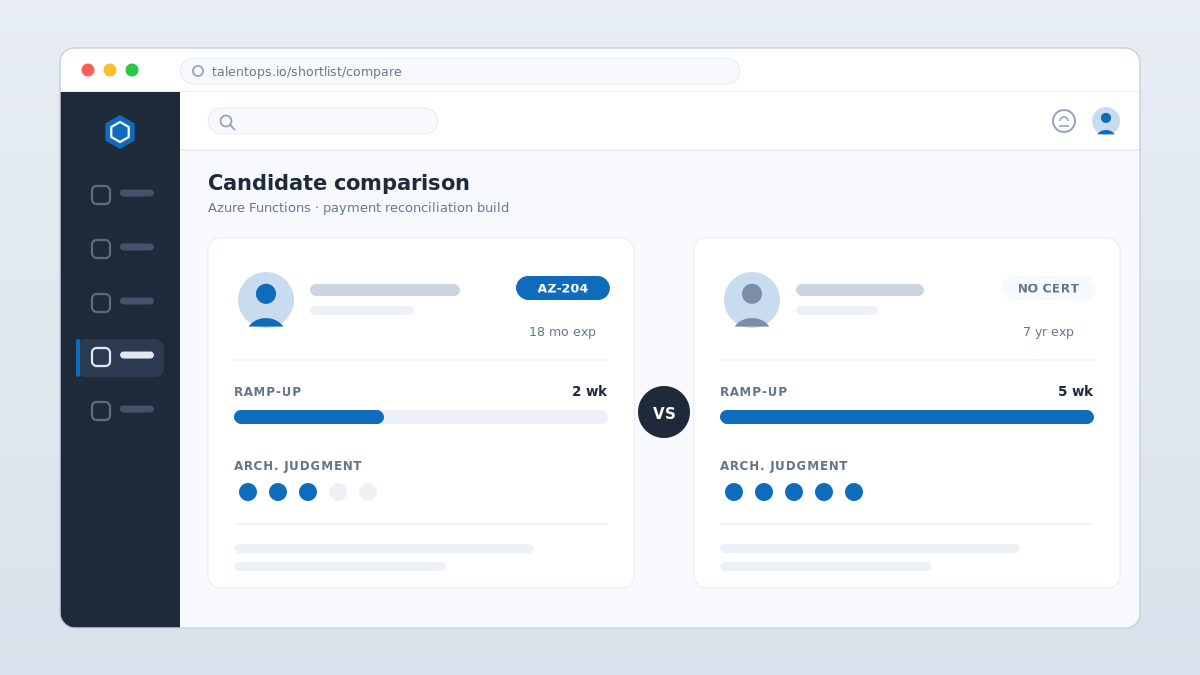
A Series-B fintech needed two developers for an Azure Functions–based payment reconciliation system. The certified-but-junior candidate (AZ-204, 18 months of experience) ramped in 2 weeks because the service landscape was already familiar; the uncertified senior (7 years, mostly AWS) took 5 weeks to unlearn AWS assumptions but then outperformed on architecture decisions. Blending both cut the projected 6-month build to 4.5 months.
A healthcare SaaS company hired purely on certifications for a compliance-heavy migration and reversed course after 6 weeks. The credentialed hires knew the services but had never implemented HIPAA-adjacent audit logging in production. Adding one uncertified engineer with 4 years of regulated-industry Azure work unblocked the project; the migration finished 3 weeks late instead of a projected 2+ months late.
The pattern across engagements: certification predicts ramp-up speed; experience predicts judgment quality. You need both, weighted by role.
When to Hire Certified Azure Developers: A Decision Framework
Use this framework to decide how much weight certification should carry for a specific role. The goal when you hire certified Azure developers is matching signal strength to role risk.
| Scenario | Certification Weight | What to Verify Instead |
| Junior/mid developer, standard PaaS workload | High AZ-204 as screening floor | One live coding assessment on a real Azure task |
| Senior developer or architect | Low-moderate AZ-305 is a bonus | Architecture walkthrough of a past production system |
| DevOps/platform engineer | High AZ-400 filters effectively | Pipeline design exercise with failure scenarios |
| Regulated industry (healthcare, fintech) | Moderate | Evidence of compliance work in production |
| Short-term staff augmentation (under 6 months) | High ramp speed dominates | Reference check on the last comparable engagement |
The general rule: the shorter the engagement and the more standardized the workload, the more a certification is worth. The more architectural judgment the role requires, the more you should weigh shipped systems over badges.
How to Verify Azure Skills Before You Sign
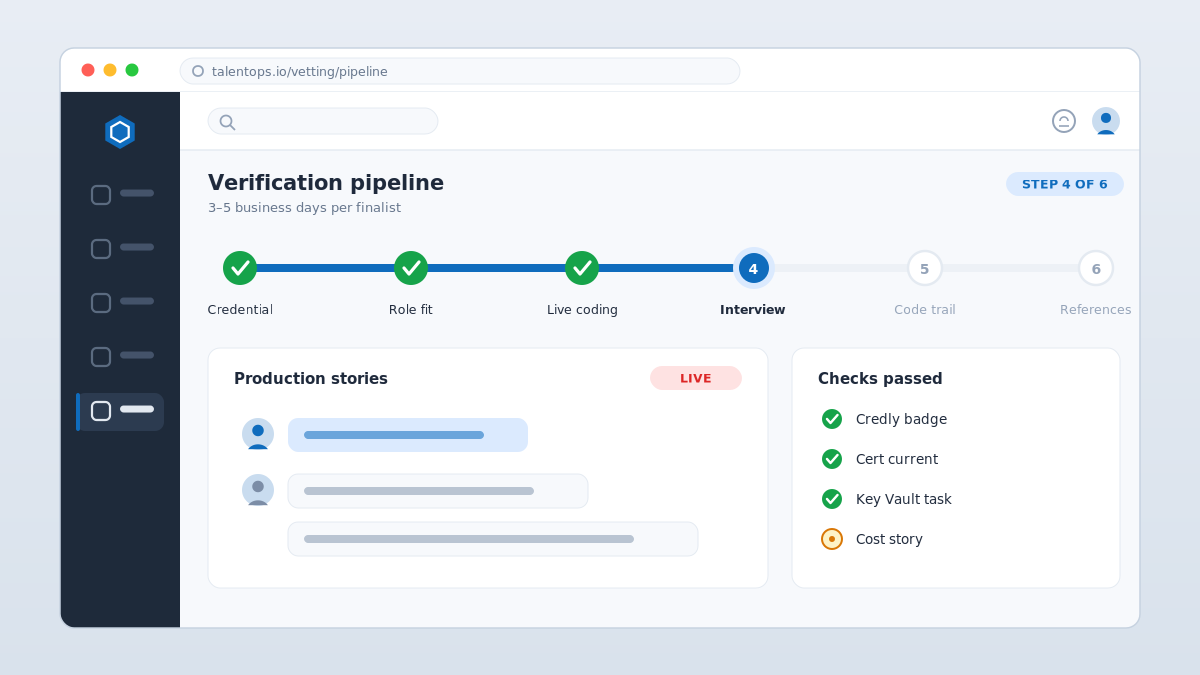
Knowing how to verify Azure skills separates teams that hire well from teams that hire hopefully. The full process takes 3–5 business days per finalist and follows six steps:
- Verify the credential itself. Ask for the candidate’s Microsoft Learn transcript link or Credly badge URL. Confirm the certification is current, not expired. This takes 5 minutes and, per the TEKsystems data above, immediately puts you ahead of ~74% of hiring teams.
- Map the cert to the role. AZ-204 for application development, AZ-400 for pipeline and platform work. A candidate with only AZ-900 applying for a developer role has a fundamentals cert, not a developer cert.
- Run a live coding assessment on real Azure tasks. Not LeetCode. Ask them to deploy a Function with a managed identity accessing Key Vault, or diagnose a misconfigured App Service. 60–90 minutes reveals more than three resume screens.
- Probe production stories. Among the best questions to ask a certified Azure developer in an interview: “Describe an Azure cost problem you found and fixed” and “Walk me through your last failed deployment.” Certified-but-inexperienced candidates go abstract; experienced ones give you resource names and numbers.
- Check the code trail. GitHub repos, IaC templates, or sanitized pipeline YAML. Fifteen minutes of reading real artifacts beats an hour of conversation.
- Reference the last comparable project. One targeted call asking “would you re-engage this person for the same scope?” outperforms generic reference checks.
This is the model hands-on technical vetting platforms have operationalized. Supersourcing, for example, verifies both the certification credential and documented project experience before a developer enters its talent pool, the two-signal approach this entire article argues for, applied at screening scale.
What Most Teams Get Wrong
The most common failure isn’t trusting certifications too much or too little; it’s treating certification as a binary while ignoring recency and context.
A 2021 AZ-204 that was never renewed is materially different from a 2026 one; Azure ships hundreds of service updates a year, and Microsoft moved to annual renewals precisely because knowledge decays. Teams also over-index on cert count: a candidate with six badges and zero production incidents on their record has optimized for exams, and that optimization instinct doesn’t always transfer to shipping.
The second insider pattern: teams run generic algorithm interviews for Azure roles and then wonder why certified hires underperform. The exam already covered service knowledge; your interview’s job is to test everything the exam can’t judge, debugging under ambiguity, and cost awareness. Duplicating the exam wastes your only high-bandwidth evaluation window.
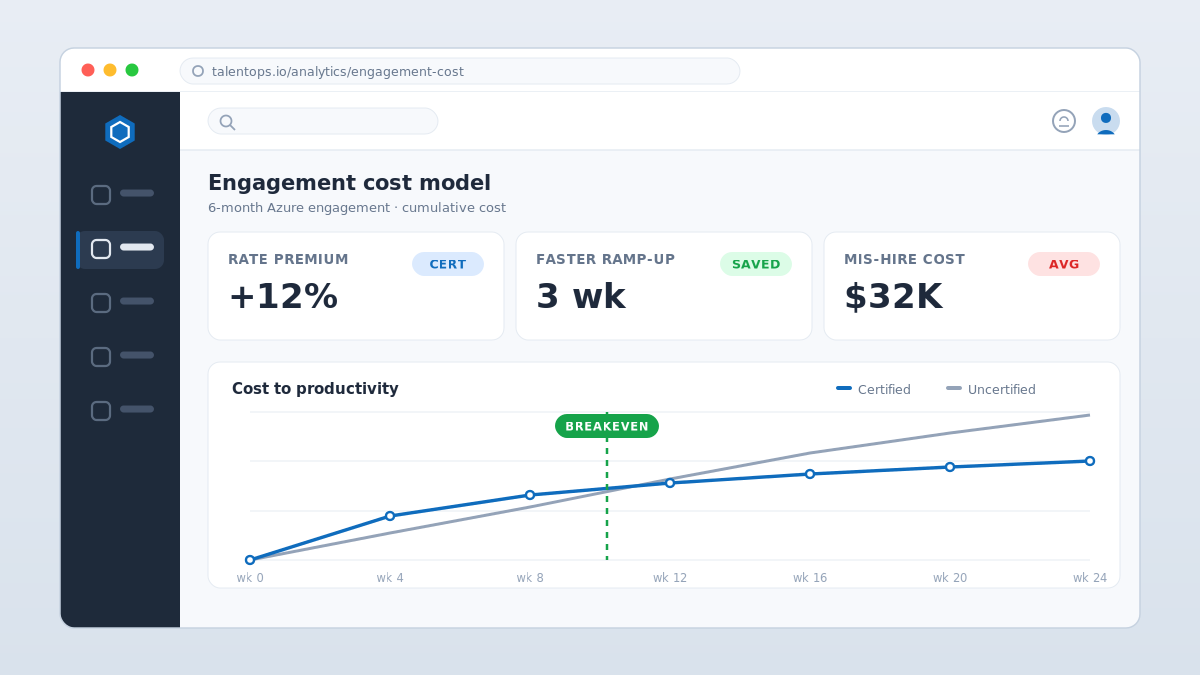
The third: assuming certification means expensive. Certified developers command a 10–15% premium on average, but they typically ramp 2–4 weeks faster on standardized workloads. On a 6-month engagement, the ramp savings usually exceed the rate premium. Remote developer hiring at global scale widens this arbitrage further. Certified talent in secondary markets often costs less than uncertified talent in primary ones.
Pressure-Test Your Next Azure Hire
If you’re weighing a certified junior against an experienced generalist or building a team that needs both don’t make the call on resume signals alone. Supersourcing has run certification-plus-experience vetting across thousands of developer placements, verifying Microsoft credentials directly and validating project history through structured technical assessments before a profile ever reaches a client.
Share your role requirements and current shortlist at https://supersourcing.com/contact-us/ or write to mayank@engineerbabu.com, and get a second opinion on your evaluation criteria before you commit. It’s a 30-minute conversation that routinely surfaces gaps a resume screen missed.
Frequently Asked Questions
Is an Azure certification enough to get a developer job or enough to justify a hire?
No. A certification validates platform knowledge on exam day; it doesn’t validate coding quality, debugging skill, or production judgment. Treat it as a screening filter that earns a candidate your interview time, then verify applied skill through a live technical exercise and project references. Certification plus verified experience is the standard worth hiring against.
What is the AZ-204 certification?
AZ-204 (Developing Solutions for Microsoft Azure) is Microsoft’s associate-level developer credential. It tests computer development with App Service, Functions, and containers; storage with Cosmos DB and Blob; security via Key Vault and managed identities; monitoring with Application Insights; and service integration through API Management and Event Grid. It requires roughly 1–2 years of development background to pass credibly.
Is AZ-400 harder than AZ-204?
Generally yes. AZ-400 is an expert-level exam, requires AZ-104 or AZ-204 as a prerequisite, and covers broader ground CI/CD design, infrastructure as code, release strategies, and site reliability. Most candidates need 6–8 additional weeks of preparation after earning the prerequisite. That stacked structure is why it’s a stronger hiring signal for platform roles.
Do Azure certifications expire?
Yes. Role-based Azure certifications are valid for one year and renew through a free online assessment on Microsoft Learn. An expired certification on a current resume is a mild negative signal: it suggests the candidate hasn’t kept pace with a platform that changes monthly. Always check the credential’s status, not just its presence.
How do I verify a Microsoft Azure certification?
Ask the candidate for their Microsoft Learn transcript sharing link or their Credly badge URL. Both show the credential name, issue date, and current validity, and both take under five minutes to check. Given that most hiring teams skip this step entirely, doing it consistently removes a surprising share of misrepresented resumes from your pipeline.
Are certified Azure developers more expensive to hire?
Expect a 10–15% rate premium over comparable uncertified candidates. Whether that premium pays off depends on engagement length and workload type: for standardized PaaS builds and short engagements, faster ramp-up usually recovers the cost within the first 4–6 weeks. For senior architecture roles, pay for demonstrated production experience first and treat certification as a tiebreaker.
What’s the fastest way to get pre-vetted, certified Azure talent?
Use a sourcing process that checks both signals before you ever see a profile verified current certifications and documented, reference-checked project delivery. If your internal team lacks the Azure depth to run the six-step verification above, outsourcing that vetting layer is usually cheaper than one mis-hire. That’s a reasonable point to book a short consultation and pressure-test your requirements.
