

The Decision Nobody Makes Cleanly
Expanding into India is no longer optional for global companies, it’s a strategic necessity. The real challenge isn’t whether to build in India, but how to structure that expansion for speed, control, and long-term scalability.
India GCC vs Offshore Vendor vs BOT is a decision that directly impacts execution timelines, hiring success, and operational risk. Many companies that rush into setting up a GCC underestimate the complexity of hiring, compliance, and local operations, while others move faster using offshore vendors or BOT models and optimize ownership later.
The scale of the shift is clear: according to India GCC market growth report (Economic Times), India will host over 2,100 Global Capability Centers in 2026, employing more than 2.3 million professionals, with the ecosystem rapidly expanding.
The real question isn’t which model is “best”, it’s which sequence works for your stage. This guide breaks down GCC vs offshore vendor vs BOT with real-world timelines, costs, and decision frameworks so you can scale in India without costly missteps.
TL;DR The Answer Before You Read Further
| Question | Answer |
| What's the fastest way to get 20+ engineers in India? | Staff augmentation through a vendor. 15–45 days to first hire. |
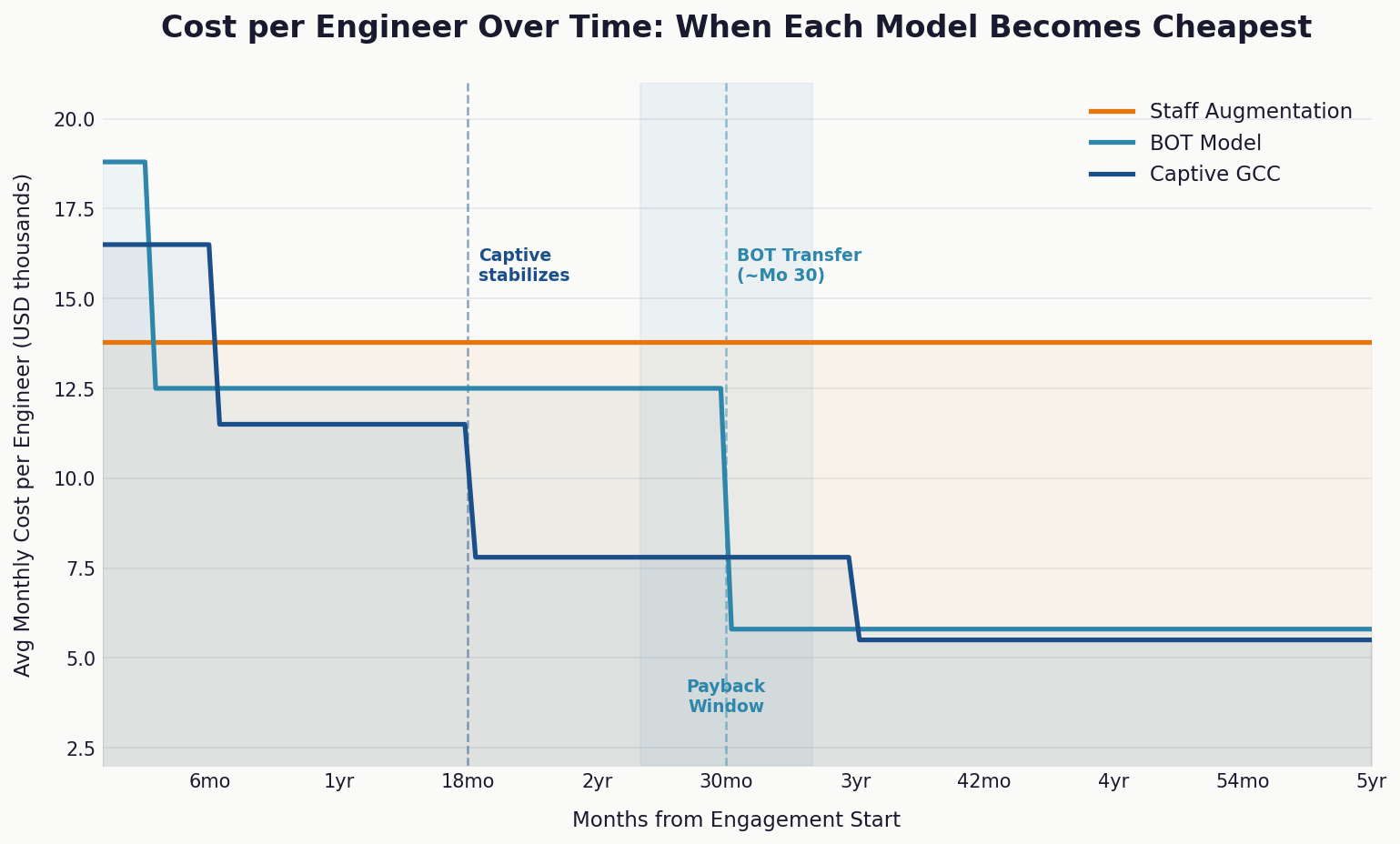
| What's the cheapest model long-term for 100+ engineers? | Captive GCC but only after year 3. Before that, it's the most expensive. |
| What's the BOT model in plain terms? | Vendor builds and runs your India team. You take ownership at year 2–3. Best of both worlds if the transfer clause is written correctly. |
| When does staff augmentation stop making sense? | When you cross 60+ engineers with a 5-year horizon and have internal India management bandwidth. |
| What's the biggest mistake buyers make choosing a model? | Choosing captive GCC too early. The entity setup cost and management overhead kills delivery velocity in years 1 and 2. |
| Can I switch models mid-engagement? | Yes. Most enterprise buyers start with staff aug and evolve to BOT or captive. Section 11 covers the hybrid path. |
| What's the single biggest BOT risk? | The transfer clause. If it doesn't specify exactly what transfers to employees, leases, EPFO accounts, vendor tools you'll negotiate it mid-transfer under time pressure. Section 12 has the language. |
| How do I verify a vendor has actually done a BOT before? | Section 12. There are five specific things to check that separate vendors who've done it from vendors who've read about it. |
What Each Model Actually Is
These three terms get used loosely. Here’s what they actually mean in practice.
Staff Augmentation
You hire engineers through a vendor. They’re employed by the vendor, work under your direction, and are billed to you at an hourly or monthly rate. The vendor handles payroll, compliance, benefits, PF contributions, and attrition replacement. You own the delivery direction. The vendor owns the employment relationship.
This is the default model for most enterprise buyers starting in India. Low setup cost, fast time-to-hire, maximum exit flexibility.
What it isn’t: a managed service. In staff aug, your team manages the engineers. If you don’t have that capacity internally, staff aug becomes expensive chaos.
Build-Operate-Transfer (BOT)
The vendor builds a dedicated delivery center on your behalf, recruits the team, sets up the office, establishes the governance model, and runs delivery then transfers the full operation to you at a pre-agreed date, typically year 2 or 3.
What transfers at the end: the employees (who become your direct hires), the office lease, the EPFO and payroll accounts, the vendor management tools, and if written correctly the institutional knowledge infrastructure: runbooks, onboarding materials, escalation matrices.
What doesn’t automatically transfer: the vendor’s bench, their recruiter relationships, and any proprietary tools the vendor uses to run the operation. These need to be negotiated in the transfer clause upfront.
Captive GCC
You set up your own Indian legal entity, typically a Private Limited company under the Companies Act, 2013 and hire engineers directly as your employees. No vendor delivery layer. You own everything: employment, compliance, office, payroll, and delivery governance.
The cleanest model for IP posture and long-term cost. The hardest to execute in years 1 and 2.
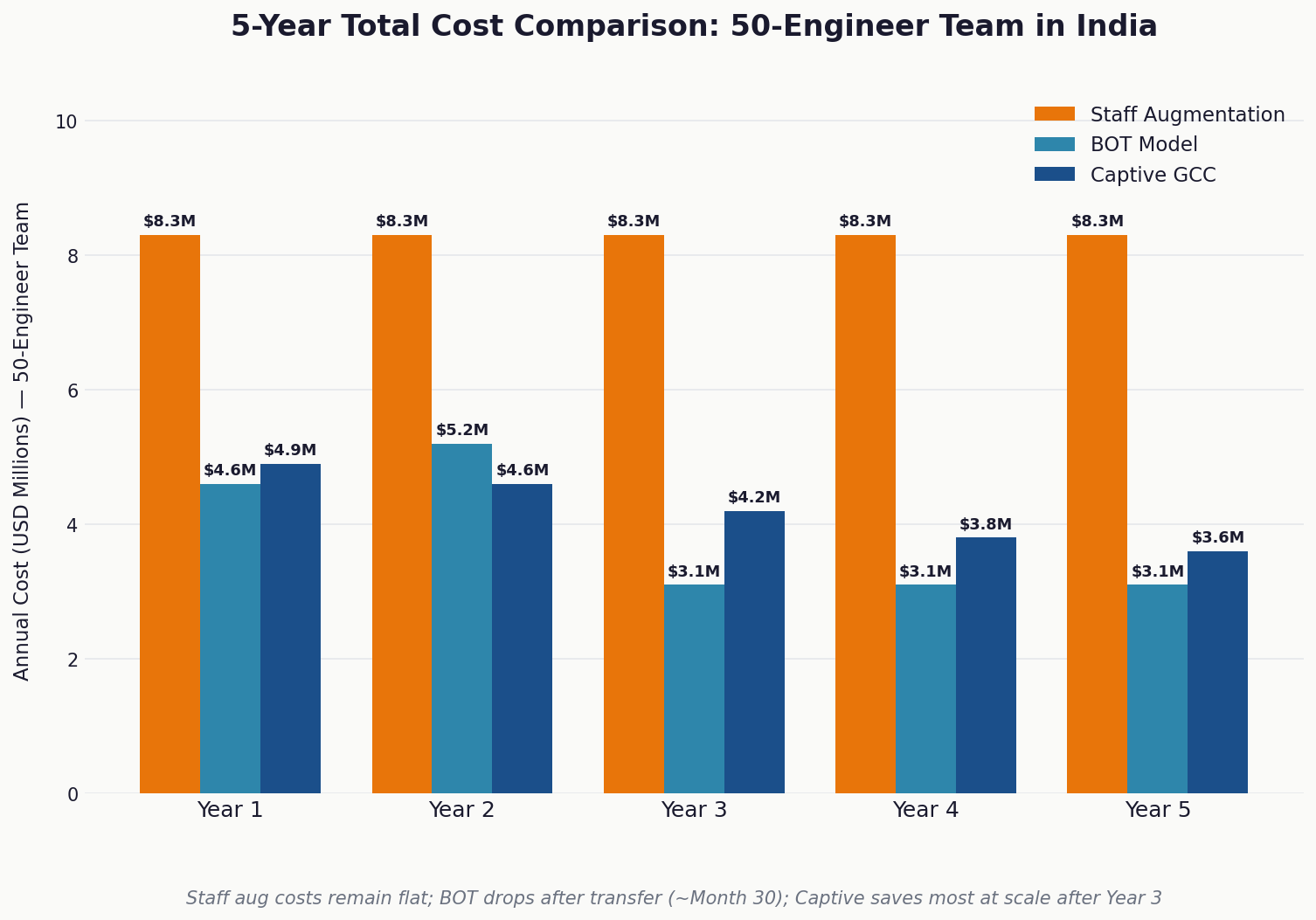
The Real Cost of Each Model
Staff Augmentation Cost Stack
No setup cost. Pure opex from day one.
| Cost Item | Amount |
| Setup cost | $0 |
| Fully-loaded engineer rate (enterprise stack) | $55–135/hr depending on role |
| Annual cost, 10-engineer team (blended $80/hr) | ~$1.66M |
| Annual cost, 50-engineer team (blended $80/hr) | ~$8.3M |
| Annual cost, 100-engineer team (blended $80/hr) | ~$16.6M |
| Vendor margin embedded in rate | 18–24% |
| Exit cost | 30–90 days notice per MSA |
The hidden cost of staff aug at scale: At 80+ engineers, the vendor margin embedded in your billing rate represents $3–4M/year that a captive Global Capability Centers (GCC) would not pay. That’s when the captive math starts to look attractive.
BOT Cost Stack
| Cost Item | Amount |
| BOT setup fee (vendor charges for build phase) | $150K–$400K depending on team size and city |
| Engineer billing rate during operate phase | $48–125/hr (typically 8–12% below pure staff aug lower margin during operate phase) |
| Transfer fee at end of BOT | $0–$80K (negotiated upfront should be zero if deal is structured correctly) |
| Post-transfer cost (direct employment) | Engineer CTC + 20–22% employer burden + your India HR/compliance overhead |
| India entity setup (required at transfer) | $80K–$200K (entity registration, EPFO setup, lease transfer, HR systems) |
| Total Year 1 cost, 50-engineer BOT | ~$4.2M (setup fee + billing rates) |
| Total Year 3 cost, 50-engineer post-transfer | ~$3.1M (direct employment, no vendor margin) |
Supersourcing Index: Across 12 completed BOT engagements in Supersourcing’s portfolio, the average payback period at which the BOT model became cheaper than equivalent staff augmentation was 28 months. Buyers who transferred at month 24 broke even by month 31. Buyers who extended the operating phase to month 36 broke even by month 38.
Captive GCC Cost Stack
| Cost Item | Year 1 | Year 2 | Year 3 |
| India entity setup (PvtLtd registration, EPFO, GST, leases) | $80K–$200K | ||
| Office lease and fit-out (50-seat capacity, Bangalore) | $180K–$350K | $120K–$200K | $120K–$200K |
| GCC Head hire (VP-level, India-based) | $120K–$180K | $120K–$180K | $120K–$180K |
| HR, Finance, Admin headcount | $80K–$150K | $80K–$150K | $80K–$150K |
| Recruiter fees and sourcing costs | $200K–$400K | $100K–$200K | $80K–$150K |
| Engineer CTCs + employer burden (50 engineers) | $2.8M–$3.6M | $3.0M–$3.9M | $3.2M–$4.2M |
| Total annual cost | $3.5M–$4.9M | $3.4M–$4.6M | $3.6M–$4.8M |
Compare year 3 captive cost (~$3.6–$4.8M for 50 engineers) against year 3 staff aug cost (~$8.3M for 50 engineers at $80/hr blended). The captive saves $3.5–$4M/year at scale but absorbs $600K–$1.1M in setup costs in year 1 that staff aug doesn’t.
From the deal floor: A US-headquartered insurance technology company modeled all three options for a 60-engineer ServiceNow practice. Staff aug NPV over 5 years: $41M. BOT NPV over 5 years: $29M. Captive GCC NPV over 5 years: $24M. The captive won on 5-year economics by $5M over BOT. They chose BOT anyway because they didn’t have the internal India management bandwidth to run a captive in years 1 and 2. The right financial answer was the wrong operational answer.
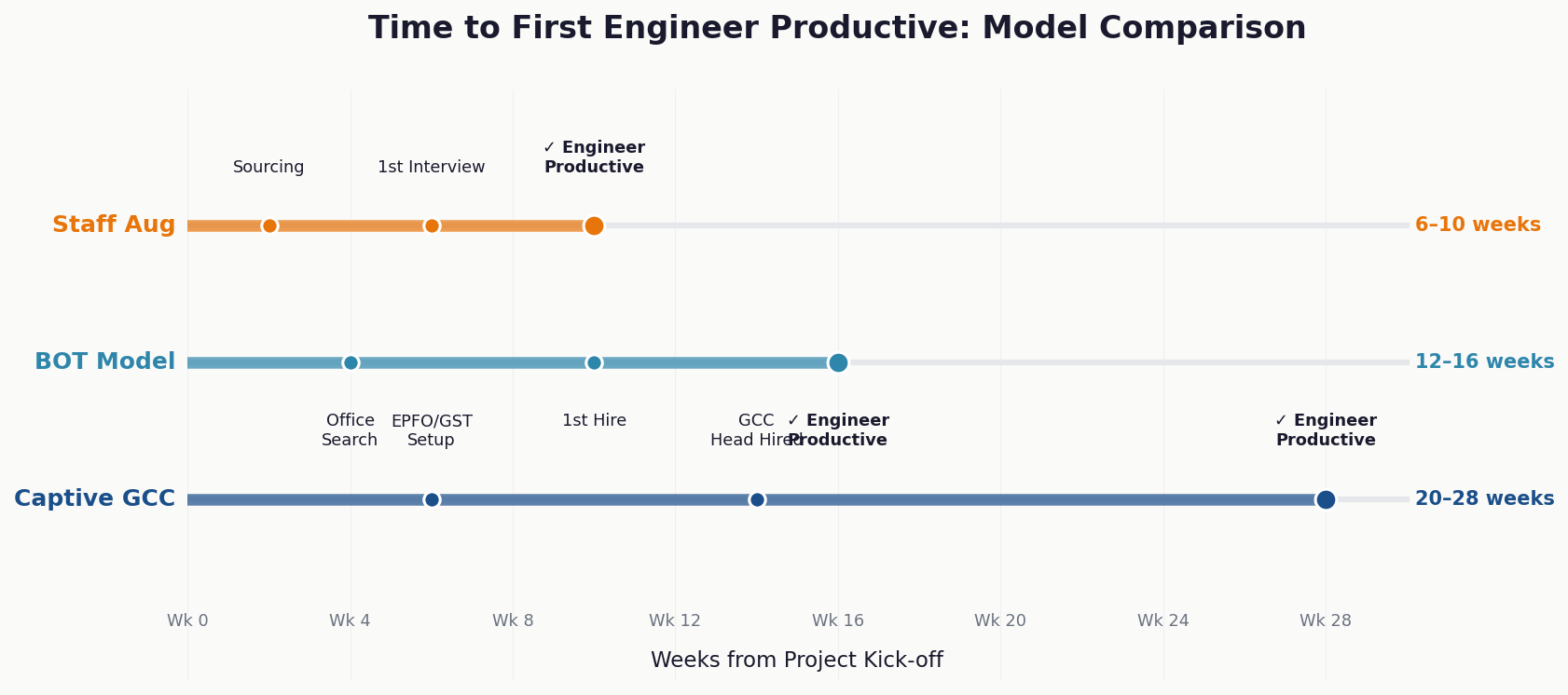
How Long Each Model Takes
Staff Augmentation Timeline
| Milestone | Timeline |
| Vendor selection and MSA signing | 2–4 weeks |
| JD finalization and sourcing kick-off | Week 1 |
| First candidate shortlist | Days 7–14 |
| Client interviews completed | Days 14–28 |
| Offer, acceptance, notice period served | Days 28–60 |
| Engineer on-boarded and productive | Days 60–75 |
| First engineer productive | 6–10 weeks from kick-off |
| 10-engineer team productive | 8–14 weeks |
| 50-engineer team productive | 16–24 weeks |
The notice period is the variable most buyers underestimate. Senior enterprise engineers in India SAP leads, Salesforce architects, ServiceNow CTAs typically serve 60–90 day notice periods at their current employer. A vendor claiming 30-day delivery on a senior architect either has bench inventory or is cutting the notice period short, which creates legal risk for the engineer and the vendor.
Red flag: Any vendor promising a ServiceNow CTA or SAP S/4HANA Solution Architect in under 30 days is either misrepresenting seniority or asking the candidate to breach their notice period. Both are problems you’ll inherit.
BOT Timeline
| Milestone | Timeline |
| Vendor selection and BOT agreement signing | 4–8 weeks |
| Office identification and lease negotiation | Weeks 4–12 |
| First hire (GCC Head / Delivery Lead) | Weeks 8–16 |
| First 10 engineers hired and productive | Weeks 12–20 |
| 50-engineer team at full capacity | Months 6–9 |
| Operate phase (vendor manages delivery) | Months 9–30 |
| Transfer preparation | Months 28–34 |
| Full transfer to client entity | Months 30–36 |
| Time to first engineer | 12–16 weeks |
| Time to full operating capacity | 6–9 months |
Captive GCC Timeline
| Milestone | Timeline |
| India entity registration (PvtLtd) | 4–8 weeks |
| EPFO, GST, professional tax registrations | Weeks 6–12 |
| Office lease signed | Weeks 8–16 |
| GCC Head hired | Weeks 12–20 |
| HR, Finance, Admin team hired | Weeks 16–24 |
| First engineers hired | Weeks 20–28 |
| 10-engineer team productive | Months 6–8 |
| 50-engineer team productive | Months 10–16 |
| Time to first engineer | 5–7 months |
| Time to full operating capacity | 12–18 months |
From the deal floor: A DAX-listed automotive company started captive GCC setup in January 2023 targeting 40 engineers by December 2023. By December they had 18. The GCC Head they hired from TCS quit in month 7. Entity registration took 11 weeks instead of the projected 6. They hit 40 engineers in month 19. The delivery program they were building toward had already slipped two quarters waiting for the team.
IP, Compliance, and Control
IP Posture by Model
| Model | IP Risk | What to Do About It |
| Staff Augmentation | Medium engineers are vendor employees; default IP ownership under Indian Copyright Act §17 is the vendor | Execute individual IP Assignment Deeds per engineer at commencement. Without this, MSA language alone is insufficient. |
| BOT (Operate Phase) | Medium-high same as staff aug during operate phase, plus transfer clause risk | IP Assignment Deeds during operate phase + explicit transfer of all assigned IP in the transfer agreement |
| BOT (Post-Transfer) | Low engineers become your direct employees post-transfer | IP assignment continues as employer standard employment contract language suffices |
| Captive GCC | Low engineers are your direct employees from day one | Standard employment contract IP assignment under Indian law |
Compliance Burden by Model
| Compliance Area | Staff Aug | BOT | Captive GCC |
| Payroll and PF compliance | Vendor’s responsibility | Vendor’s responsibility (pre-transfer) | Yours |
| EPFO and ESIC filings | Vendor | Vendor (pre-transfer) | Yours |
| India entity compliance (ROC filings, board meetings) | N/A | N/A | Yours ongoing |
| DPDP Act §10 obligations | Vendor via DPA | Vendor via DPA (pre-transfer) | Yours directly |
| Transfer pricing | N/A | N/A | Yours Income Tax Act §92 |
| Labour law compliance (Shops & Establishment Act, state-specific) | Vendor | Vendor (pre-transfer) | Yours |
The honest compliance truth: A captive GCC means you become an Indian employer. India’s labour law framework the Industrial Relations Code 2020, the Code on Wages 2019, the Occupational Safety Code 2020, the Social Security Code 2020 is complex, state-specific, and actively enforced. Most global enterprise buyers dramatically underestimate the compliance overhead until their India CFO tells them in month six.
Red flag: Any consultant or vendor who tells you India entity compliance is “straightforward” has never run an Indian payroll. The four Labour Codes replacing 29 legacy laws have not been uniformly notified across all states as of 2026. Karnataka, Maharashtra, and Telangana have different implementation timelines. If you’re setting up a captive budget for a Big 4 India compliance team or a dedicated team local compliance officer from day one.
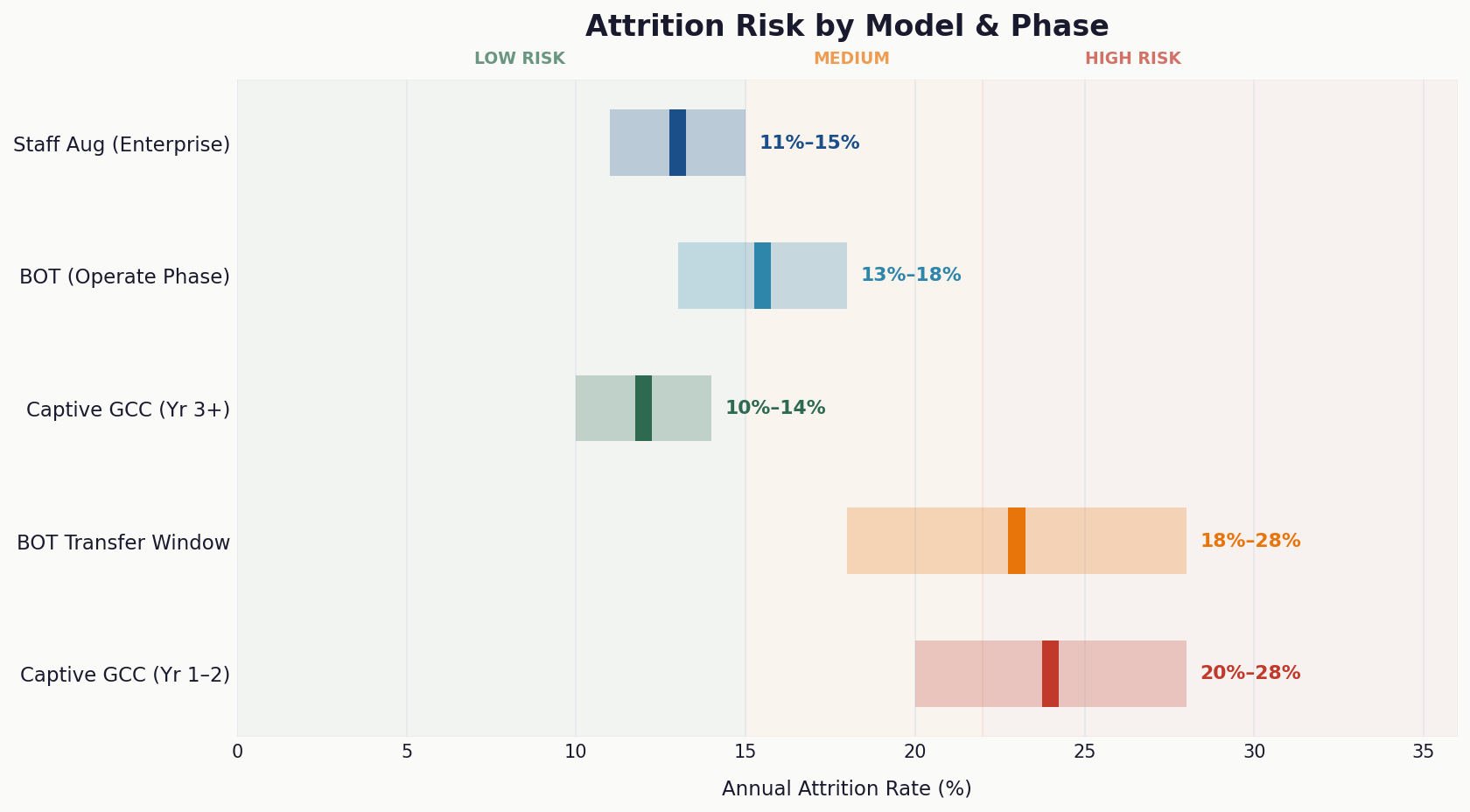
Attrition and Talent Retention by Model
Attrition is where model selection has consequences buyers don’t anticipate.
| Model | Typical Attrition | Why | What It Costs |
| Staff Augmentation (enterprise stack) | 11–15% annually | Vendor has incentive to retain replacement cost falls on them | Replacement cost absorbed by vendor per MSA replacement SLA |
| BOT (operate phase) | 13–18% annually | Team knows transfer is coming uncertainty drives exits, especially in months 18–24 | Replacement cost on vendor, but disruption cost on client |
| BOT (transfer period) | 18–28% spike | Transfer is the highest-risk attrition window engineers evaluate whether to follow the entity or seek new opportunities | Client absorbs full replacement cost post-transfer |
| Captive GCC (year 1–2) | 20–28% | New entity, unproven brand in India, no existing team culture | Client absorbs full cost recruiter fees, ramp time, productivity loss |
| Captive GCC (year 3+) | 10–14% | Brand established, culture set, career progression paths visible | Client absorbs, but normalized to manageable levels |
Supersourcing Index: In Supersourcing’s GCC Benchmark 2026 (n=340 engagements), the BOT transfer window the 90-day period immediately before and after transfer showed average attrition of 23%, versus 13% in the preceding 12 months. Buyers who didn’t plan for this lost 15–22% of their team at the moment of transfer. Those who negotiated a 6-month vendor retention support clause post-transfer saw transfer-window attrition of 11%.
How to retain through the BOT transfer:
- Announce the transfer early 6 months minimum. Engineers who find out informally leave faster than engineers who are told directly with a clear career story.
- Offer retention bonuses tied to 12 months post-transfer tenure. ₹3–5L per engineer at senior level is typical and effective.
- Give the team visibility into the post-transfer org chart before the transfer. Uncertainty about reporting lines and growth paths is the primary departure trigger.
- Negotiate a vendor “retention support” clause the vendor continues to backfill any attrition during the first 6 months post-transfer at their cost.
When Staff Augmentation Wins
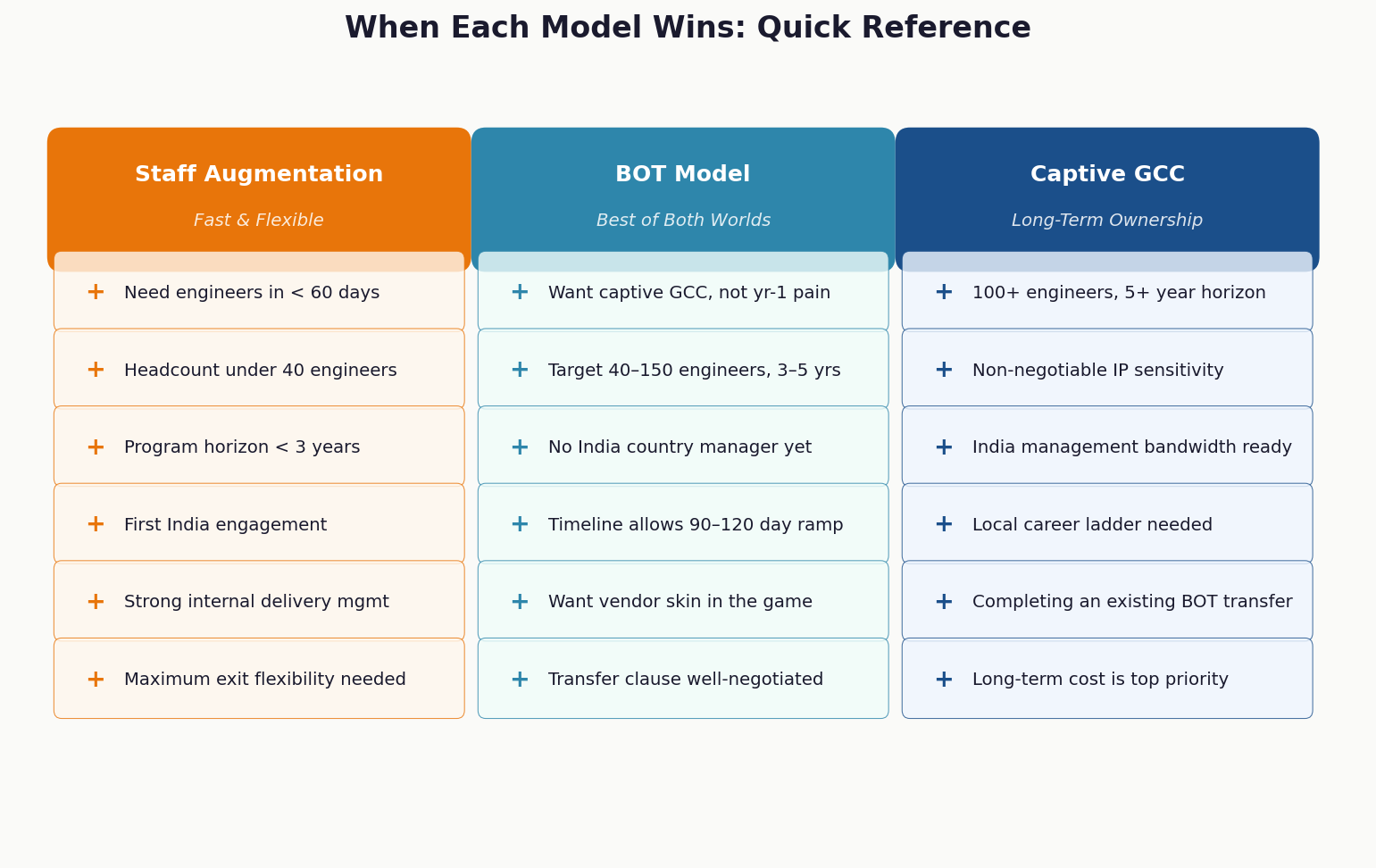
Staff augmentation is the right model when:
- You need engineers in under 60 days. No other model delivers faster. BOT and captive GCC both require months of setup before the first engineer is productive.
- Your headcount requirement is under 40 engineers. Below 40, the vendor margin embedded in billing rates is cheaper than the setup, compliance, and management overhead of a BOT or captive.
- You have delivery governance capacity internally. Staff aug gives you engineers it doesn’t give you a delivery manager, a QA lead, or an escalation framework. If your internal team can run those functions, staff aug is efficient. If they can’t, you need a managed service or a BOT.
- Your engagement horizon is under 3 years. The financial case for BOT and captive only materializes after year 2.5 — 3. If your program timeline is 18–24 months, staff aug wins on economics regardless of headcount.
- You’re on your first India engagement. The learning curve of managing an offshore team is real. Staff aug where the vendor absorbs operational complexity is the right environment to learn before committing to a model that requires you to operate independently.
From the deal floor: A US-based healthcare SaaS company needed 25 Salesforce Health Cloud developers for an 18-month program. They evaluated BOT. The setup timeline alone 12–16 weeks to first engineer would have consumed 20% of their program runway. They went with staff aug, had 25 engineers productive in 14 weeks, delivered the program, and used the engagement to build internal India management capability for their next program.
When BOT Wins
BOT is the right model when:
- You want a captive GCC eventually but not the year-1 pain. BOT lets a vendor absorb the setup complexity while you build conviction, internal capability, and India market knowledge. You arrive at the captive in year 3 with a running team instead of starting from zero.
- Your headcount target is 40–150 engineers over 3–5 years. This is the BOT sweet spot. Below 40, staff aug is more efficient. Above 150 with a long horizon, pure captive setup may be worth the year-1 overhead.
- You don’t have an India country manager or GCC Head. BOT vendors provide operational leadership during the build and operate phases. You don’t need to hire a VP-level India leader before you have a team to lead.
- Your program timeline allows 90–120 days to first engineer. BOT is slower to start than staff aug. If your program can absorb a 3–4 month ramp before the first engineer is productive, BOT’s long-term economics justify the wait.
- You want the vendor’s skin in the game on delivery. Unlike pure staff aug where the vendor’s obligation is to provide resources a BOT vendor is accountable for delivery outcomes during the operating phase. That changes the commercial dynamic significantly.
From the deal floor: A DAX-listed industrial manufacturer running an SAP S/4HANA brownfield migration went BOT with Supersourcing in 2021 65 consultants in Bangalore. Vendor ran delivery for 28 months. Transfer completed Q2 2026. They inherited a 71-person team, a Bangalore lease already negotiated at 2021 rates (significantly below 2026 market), and three years of institutional knowledge captured in runbooks and onboarding materials. Total BOT setup fee: $280K. Equivalent captive setup from scratch at 2026 rates: $1.4M+.
When a Captive GCC Wins
Captive is the right model when:
- You’re hiring 100+ engineers and your horizon is 5+ years. At this scale and duration, the vendor margin saved in years 3–5 materially outweighs the year-1 setup cost.
- IP sensitivity is non-negotiable. If your core IP proprietary algorithms, regulated data, defense-adjacent workloads cannot sit in a vendor employment relationship even with IP Deeds, a captive is the only model that gives you statutory IP ownership from day one.
- You have India management bandwidth. A captive requires a GCC Head, an India HR lead, a Finance/Compliance lead, and operational leadership. If you don’t have these or can’t hire them, you’re not ready for captivity.
- Your India team will eventually need a local career ladder. In a staff aug or BOT model, engineers grow within the vendor’s career framework not yours. At 100+ engineers, the inability to offer promotion paths, equity, and internal mobility becomes a retention liability. Captive solves this.
- You’re already running a BOT and the transfer date is approaching. The cleanest path to capture is via a well-structured BOT. You arrive with a team, a lease, and an operating model. You don’t start from zero.
Red flag: Any buyer setting up a captive GCC without a named, hired GCC Head before entity registration. The entity is the easy part. The operational leader is the hard part. Buyers who register the entity first and hire the GCC Head later average 7 additional months before the team reaches operating capacity per Supersourcing’s GCC Benchmark 2026.
The Hybrid Path Most Buyers Actually Take
The theory is: choose one model. The practice is: most enterprise buyers evolve through models as their India engagement matures.
The most common path:
Year 0–1: Staff Augmentation
↓
Learn how to manage offshore delivery
Build internal India engagement capability
Validate the talent market for your stack
↓
Year 1–2: BOT Initiated
↓
Vendor builds dedicated center
Buyer scales headcount under BOT governance
Internal India leadership hired
↓
Year 3–4: Transfer to Captive
↓
Team, lease, EPFO accounts transferred
Vendor retained for selective staff aug (niche skills)
Captive runs core team, vendor supplements peaks
This path works because each stage builds the capability needed for the next. Buyers who try to skip to captive in year 1 almost always regress either back to vendor dependency or through a painful rebuild.
Supersourcing Index: Among enterprise buyers in Supersourcing’s portfolio who reached 50+ engineers in India, 67% started on staff augmentation, 21% started on BOT directly, and 12% attempted captive from day one. Of the captive-from-day-one group, 8 of 12 engaged a vendor within 18 months to supplement delivery capacity they couldn’t build fast enough internally.
How to Verify a BOT Vendor’s Track Record
BOT is a complex delivery model. Many vendors claim BOT capability. Few have actually completed a transfer. Here’s how to tell the difference.
Check 1 Ask for completed transfer references, not ongoing BOT references.
Any vendor can show you an active BOT engagement. What matters is whether they’ve completed a transfer, handed over a running team, a lease, and EPFO accounts to a client entity. Ask for two completed transfer references and the names of the clients’ India GCC Heads who managed the transfer. Then call those people.
Check 2 Ask for the transfer checklist they use. \
A vendor who has done BOT before has a documented transfer checklist covering: employee consent to transfer (required under Indian law employees must consent to the change of employer), EPFO account transfer process, lease novation process, vendor tool offboarding, and knowledge transfer protocol. A vendor who hasn’t done it before will either not have this document or will produce something generic. The checklist should have 40+ line items.
Check 3 Ask about attrition during their last transfer window.
As covered in Section 7, the transfer window is the highest-risk attrition period. A vendor who has done this before knows their transfer-window attrition number and has a retention protocol. If they can’t answer this question with a specific number, they’ve never managed a transfer.
Check 4 Verify the entity setup they used.
Ask: “What entity type did you use for the client’s India entity at Transfer Private Limited, LLP, or branch office?” Vendors who’ve done real BOTs can answer this immediately, explain why that entity type was chosen, and name the CA firm that handled the registration. Vendors who haven’t done it will say “it depends on the client’s structure” which is technically true but operationally evasive.
Check 5 Check the MCA registry for their claimed BOT clients.
If the vendor names a transferred GCC, the client’s India entity should appear on mca.gov.in. Search by company name or CIN. If the entity doesn’t exist, the transfer didn’t happen.
The BOT Transfer Clause What Must Be in It
The most important document in any BOT is the transfer clause. Most BOT agreements are vague here which creates the conditions for a contested, expensive transfer negotiation in month 30 when both parties are under time pressure.
The transfer clause must specify:
“At Transfer Date, Vendor shall transfer to Client, at no additional cost:
- all Assigned Personnel who consent to transfer under applicable Indian labour law, with continuity of service for the purposes of gratuity calculation under the Payment of Gratuity Act, 1972;
- the office lease agreement, by novation or assignment, with Vendor bearing any landlord consent fees;
- all EPFO and ESIC accounts relating to Assigned Personnel, in accordance with EPFO transfer procedures;
- all vendor-managed tools, licenses, and software used exclusively for Client’s engagement, with transfer of applicable license agreements where permitted;
- all engagement documentation including runbooks, onboarding materials, architecture documents, and RAID logs; and
- all source code repositories, CI/CD pipeline configurations, and infrastructure-as-code templates in Client-controlled version control.”
Any BOT agreement that doesn’t enumerate what transfers is leaving those items for negotiation at transfer. That negotiation never favors the buyer.
The Contract Stack for Each Model
Staff Augmentation
| Document | Key Clauses to Negotiate |
| MSA | IP Assignment Deed requirement, non-solicitation (bidirectional, 24 months, liquidated damages), audit rights, rate escalation cap |
| SOW | Individual resource approval, substitution notice (14 days written), replacement SLA, dedicated team language |
| DPA | GDPR Art. 28(3), DPDP Act §10, CERT-In 6-hour notification, HIPAA BAA if applicable |
| IP Assignment Deed | Per-engineer, individually executed, irrevocable, worldwide, delivered within 5 business days of commencement |
| NDA | Mutual, 3-year post-termination, covers all engagement data and methodologies |
BOT
All of the above, plus:
| Document | Key Clauses to Negotiate |
| BOT Agreement | Transfer clause (enumerate every asset), transfer date (fixed, not “approximately”), attrition retention support (6 months post-transfer), transfer fee ($0 if deal is structured correctly) |
| Employee Transfer Protocol | Consent process, continuity of service for gratuity, new employment contracts from client entity |
| Lease Novation Agreement | Landlord consent, Vendor bears consent fees, no rent reset at transfer |
| Knowledge Transfer Protocol | Minimum 90-day overlap, vendor staff available post-transfer for 30 days at no charge |
Captive GCC
| Document | Key Requirement |
| India entity documents | Memorandum and Articles of Association, board resolutions, share certificates |
| Employment contracts | IP assignment clause, non-compete (note: Indian courts rarely enforce broad non-competes keep it narrow and reasonable), confidentiality |
| Transfer pricing documentation | Intercompany service agreement, benchmarking study, TP policy |
| Lease agreement | Directly in client entity name do not sign under a vendor entity even temporarily |
| State-specific registrations | Shops & Establishment Act registration (state-specific), Professional Tax registration, LWF registration |
The Decision Matrix
Use this to narrow your model choice before entering vendor conversations.
| Criterion | Staff Aug | BOT | Captive GCC |
| Headcount target | 5–60 | 40–150 | 80+ |
| Year 1 budget available | Low (opex only) | Medium ($150K–$400K setup) | High ($500K–$2M setup) |
| Time to first engineer | 6–10 weeks | 12–16 weeks | 20–28 weeks |
| 5-year TCO (50 engineers) | Highest | Medium | Lowest |
| IP sensitivity | Medium | Medium-high (pre-transfer) | Lowest |
| Internal India mgmt bandwidth | Low needed | Medium needed | High needed |
| Compliance burden on buyer | Low | Low (pre-transfer) | High |
| Attrition exposure | On vendor | Shared | On buyer |
| Exit flexibility | High | Low post-transfer | Very low |
| Career ladder for India team | Vendor’s | Vendor’s → yours post-transfer | Yours from day one |
| Engagement horizon | 1–3 years | 3–5 years | 5+ years |
Decision rule:
Score your situation against each row. The model with the most matching cells wins. If BOT and captive tie, choose BOT the year-1 risk is lower and the destination is the same.
The Supersourcing Vendor Scorecard
Use this to evaluate vendors for any of the three models. Weight column is our recommendation.
| # | Criterion | Weight | Score (1–5) | Weighted |
| MODEL CAPABILITY | ||||
| 1 | Confirmed completed BOT transfers (not ongoing) references available | 6% | – | – |
| 2 | Staff aug enterprise stack depth on your target platform | 5% | – | – |
| 3 | Captive GCC setup experience entity registration, EPFO, lease | 4% | – | – |
| 4 | Transfer checklist available and specific (40+ line items) | 5% | – | – |
| 5 | Transfer-window attrition data from prior BOTs | 4% | – | – |
| TALENT QUALITY | ||||
| 6 | Certification verification registry-level | 5% | – | – |
| 7 | Average seniority of bench on target stack | 4% | – | – |
| 8 | Attrition rate on enterprise engagements data not claims | 5% | – | – |
| 9 | Replacement SLA documented in SOW | 3% | – | – |
| 10 | Reference clients in your vertical who will take a call | 4% | – | – |
| COMMERCIAL | ||||
| 11 | Rate transparency CTC + burden + margin visible | 4% | – | – |
| 12 | BOT setup fee fixed, not variable | 3% | – | – |
| 13 | Transfer fee zero, or fixed and capped | 3% | – | – |
| 14 | Rate escalation cap annual, documented | 3% | – | – |
| 15 | Post-transfer billing model clear and pre-agreed | 3% | – | – |
| COMPLIANCE | ||||
| 16 | ISO 27001:2022 current, registry-verified | 4% | – | – |
| 17 | DPDP Act §10 DPA available immediately | 3% | – | – |
| 18 | MCA filing Active, recent annual return | 3% | – | – |
| 19 | CERT-In 6-hour notification in DPA | 2% | – | – |
| CONTRACT | ||||
| 20 | BOT transfer clause enumerates all transferring assets | 5% | – | – |
| 21 | IP Assignment Deed per engineer, at commencement | 4% | – | – |
| 22 | Employee transfer protocol consent, gratuity continuity | 4% | – | – |
| 23 | Lease novation vendor bears landlord consent fees | 3% | – | – |
| 24 | Post-transfer retention support 6 months, vendor-funded | 3% | – | – |
| DELIVERY | ||||
| 25 | Dedicated Delivery Lead not shared | 4% | – | – |
| 26 | RAID log discipline sample available | 2% | – | – |
| 27 | City presence matches your stack concentration | 3% | – | – |
| 28 | Do they tell you what you don’t want to hear? | 2% | – | – |
| TOTAL | 100% |
Above 4.0: preferred vendor. 3.0–3.9: conditional with documented exceptions. Below 3.0: don’t engage.
Questions Buyers Actually Ask
What’s the difference between BOT and managed services?
In managed services, the vendor owns the outcome; they deliver a defined service level and you pay for results. In BOT, you own the delivery direction during the operating phase and the vendor provides the operational infrastructure. BOT leads to ownership transfer. Managed services don’t.
Can I negotiate the BOT transfer date after signing?
Technically yes both parties can agree to amend. In practice, extending the operating phase costs money (you keep paying vendor margins) and compresses the economic benefit of the captive phase. Set a realistic transfer date upfront and hold to it.
What happens to engineers’ gratuity if they transfer from vendor to my entity?
Under the Payment of Gratuity Act, 1972, gratuity is calculated on total continuous service including service with the prior employer if the transfer preserves continuity. Your BOT transfer clause must specify that service continuity is preserved, and your new employment contracts must acknowledge prior service dates. If you break continuity, you’re liable for gratuity immediately at transfer. The vendor should have been accruing this, but verify in their books.
Do engineers have to consent to the BOT transfer?
Yes. Under Indian labour law, employees cannot be transferred to a new employer without consent. In practice, most engineers consent especially if the new employer (your India entity) offers equivalent or better compensation and career prospects. But plan for 5–15% who don’t consent and need to be backfilled post-transfer.
What’s the minimum headcount that makes BOT viable?
20 engineers are on the practical floor. Below 20, the BOT setup fee ($150K–$400K) is too large relative to the margin savings achieved post-transfer. Staff aug is more efficient under 20.
Can I run staff aug and BOT simultaneously?
Yes, and many enterprise buyers do. Core team on BOT (tracking toward captive), specialist skills on staff aug (niche roles where bench availability matters more than model). The contracts need to be structured carefully to avoid non-solicitation conflicts between the BOT vendor and any staff aug vendors.
How do I handle transfer pricing for my captive GCC?
Your India entity will provide services to your parent company. Under India’s Income Tax Act §92, this is a related-party transaction requiring arm’s length pricing. Safe harbor for software development is 17–21% markup on cost (OECD TNMM). Get a Big 4 transfer pricing benchmarking study before setting intercompany rates. The consequences of getting this wrong are tax penalties plus back-interest under §92C.
What city should I set up my GCC or BOT in?
Depends entirely on your stack. Bangalore for Salesforce, Cloud, GenAI, and Platform Engineering. Pune for SAP and Guidewire. Hyderabad for ServiceNow and Microsoft. Gurgaon for capital markets platforms (Murex, Calypso). Don’t choose a city for real estate cost reasons and then try to hire a ServiceNow CTA in Pune the talent isn’t there at the same depth.
Is a branch office or a Private Limited the right India entity for a captive?
Almost always Private Limited. Branch offices of foreign companies have restrictions on retained earnings and require RBI approval. PvtLtd is a separate legal entity, can retain earnings, is easier to convert to a public company later, and is what every Big 4 advisory firm recommends for captive GCCs. The setup cost difference is negligible.
How do I benchmark a BOT vendor’s setup fee?
The setup fee should reflect actual cost office identification, fit-out, recruiter fees, and operational infrastructure. For a 50-engineer build in Bangalore, $200K–$280K is reasonable. Above $400K for the same scope, ask for a line-item breakdown. Some vendors embed 18 months of margin expectation into the setup fee which means you’re pre-paying for delivery margin, not setup cost.
What if the vendor goes bankrupt during the BOT operation phase?
Your BOT agreement should include a step-in right the ability for you to take over the operation immediately if the vendor enters insolvency. This requires the lease to be structured so you can novate it directly, IP Assignment Deeds already executed per engineer, and a code escrow arrangement for any vendor-hosted repositories. Without these, vendor insolvency during the operating phase is a 6-month rebuild.
Can I use an EOR like Deel during the BOT build phase?
Some buyers use EOR to hire key leadership roles: the India GCC Head, a technical anchor while the BOT vendor builds the broader team. This works but creates two parallel employment relationships that need coordination. Make sure the EOR-employed staff are clear that post-transfer, they’ll move to the client’s own India entity.
How much does it cost to shut down a captive GCC if it doesn’t work?
More than you think. Indian employment law provides significant worker protections. Companies with 100+ employees require government permission to retrench workers under the Industrial Relations Code 2020 (permission that may not be granted). For companies under 100 employees, one month’s notice or pay in lieu. Office leases are typically 3–5 year terms. Shut-down cost for a 50-person captive GCC: $400K–$900K in severance, lease break fees, and entity winding-up costs. This is why BOT’s exit flexibility is valuable; you don’t carry those costs if the engagement ends.
What should I ask a reference client for a BOT vendor?
Three questions: Did the transfer happen on the date specified in the agreement? What transferred that you didn’t expect, and what didn’t transfer that you thought would? What was your attrition in the 90 days around transfer and how did the vendor support you through it?
Is Supersourcing right for a captive GCC with no vendor involvement?
If you want no vendor involvement at all, we’d point you to a Big 4 advisory firm for entity setup and an India-based executive search firm for the GCC Head hire. Our model is optimized for engagements where vendor-managed delivery is part of the equation staff aug, BOT, or hybrid. We’d rather tell you that than win a mandate we’re not the right fit for.
Closing
Most buyers spend more time choosing their office furniture vendor than choosing their India engagement model. The engagement model decision is worth more; it determines your year-1 cost, your year-3 economics, your IP posture, and your exit flexibility for the next 5 years.
The right answer is usually not the most sophisticated one. It’s the one that matches your current internal capability, your budget, and your honest assessment of how committed you are to India as a long-term bet.
If you’re not sure, start with staff augmentation. Use the engagement to learn. Then decide.
If you want help running through the decision matrix for your specific situation headcount, stack, geography, timeline that’s a 30-minute conversation. No deck. Just the numbers.
Book a 30-minute Enterprise Discovery Call → https://supersourcing.com/contact-us
