

Why This Guide Exists
A US-headquartered health insurance company signed a $2.8M contract with an Indian vendor to build a Salesforce Health Cloud implementation 14 developers, two architects, 18-month timeline.
By month six, the program was 11 weeks behind. The root cause: nine of the fourteen developers had zero Health Cloud production experience. Their CVs said “Salesforce Health Cloud.” Their actual experience was Sales Cloud with a Health Cloud training badge on Trailhead. The two architects had never led a full Health Cloud go-live. They had supported one, four years prior, in a junior capacity. Over 75% of organizations report a digital skills gap, a number expected to widen further by 2026 as AI-powered CRM adoption accelerates across industries.
The vendor hadn’t lied exactly. They had presented candidates whose CVs were technically accurate. The buyer hadn’t verified. Nobody asked the right questions. The contract said “Salesforce certified resources.” It did not say “Health Cloud production experience, verified.”
That gap between certification and production experience, between what a CV claims and what an engineer has actually built is where most Salesforce hiring in India goes wrong. This guide closes it.
All USD conversions at ₹96.4/$1 current rate as of May 2026.
TL;DR Before You Read Further
| Question | Answer |
| What does a Salesforce CTA-track architect cost from India? | $75–115/hr fully loaded. US equivalent: $175–250/hr. Annual saving per FTE: $187K–$280K. |
| How many Salesforce-certified professionals are in India? | 196,000+. But CTA-track architects number under 2,800 actively available. |
| What's the most common CV inflation on Salesforce resumes? | "Architect" without System Architect or Application Architect credentials. And "Health Cloud experience" from a Trailhead badge, not a live implementation. |
| How do I verify a Salesforce certification is real? | trailhead.salesforce.com/credentials/verification name and credential ID. Takes 90 seconds. |
| Which city in India has the deepest Salesforce talent? | Bangalore. It hosts Google, AWS, and Salesforce's own engineering hubs. Hyderabad is secondary. |
| What's the single most important contract clause for Salesforce hiring? | Individual resource approval in the SOW not just "qualified Salesforce resources." |
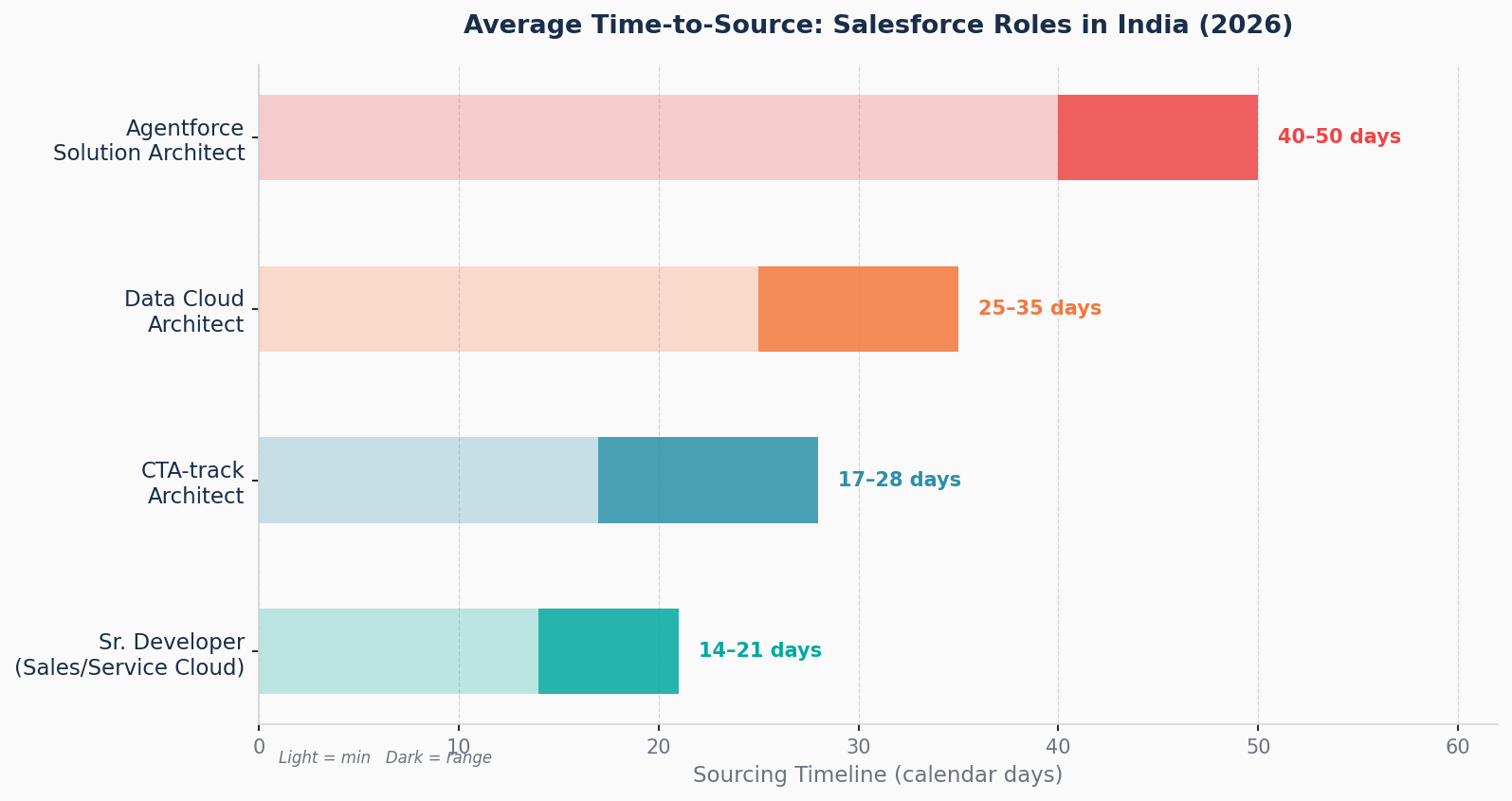
| How long does it take to source a Salesforce CTA in India? | 17–28 days with a pre-qualified bench. 35–55 days sourcing cold. |
| When should I not hire Salesforce talent from India? | Agentforce architect roles require more than 5 at once the certified pool in India is still under 300. |
The Salesforce Talent Market in India
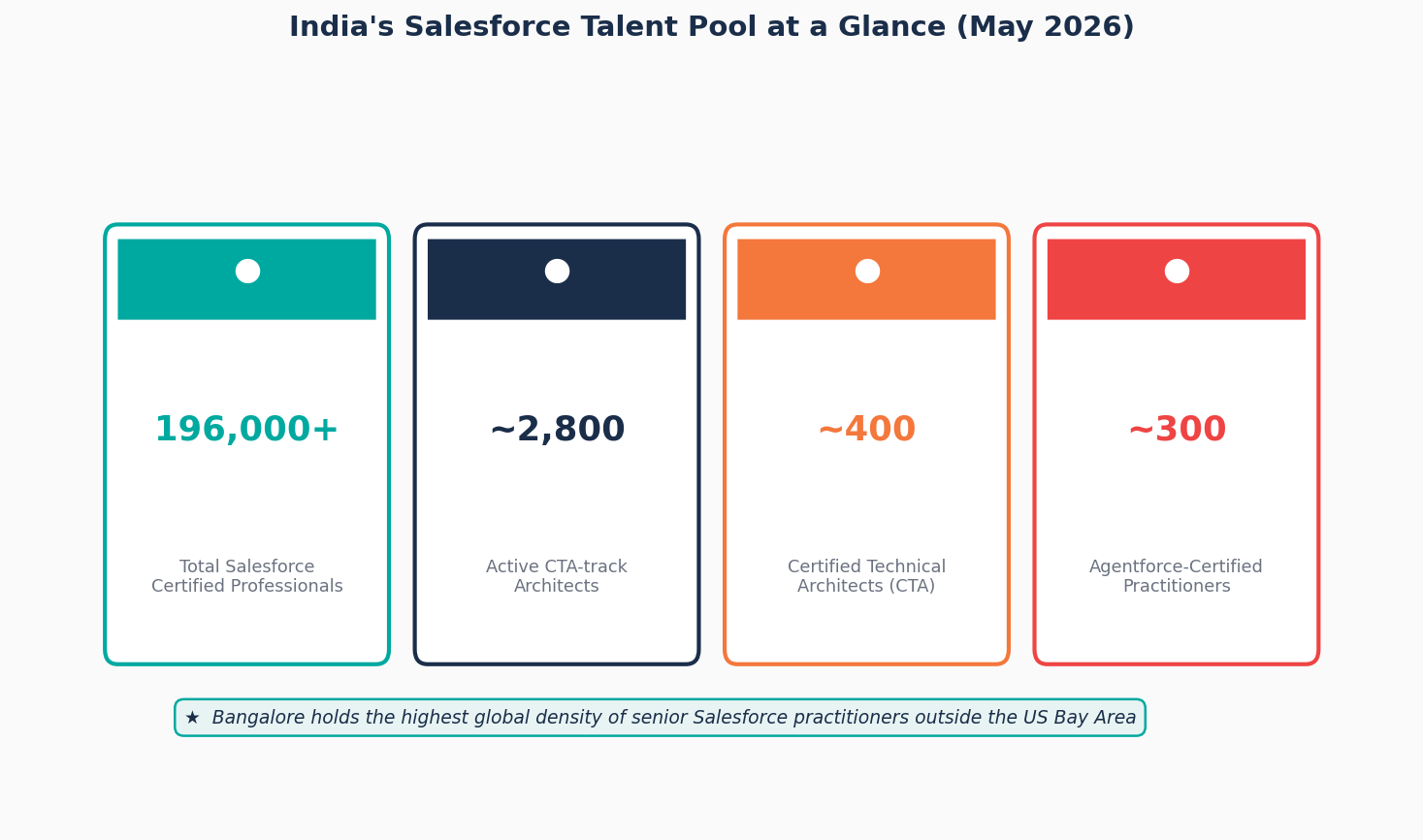
India is the largest Salesforce talent market outside the United States. As of 2026, it has:
- 196,000+ Salesforce-certified professionals
- ~2,800 actively available CTA-track architects (System Architect + Application Architect credentials)
- ~400 Salesforce Certified Technical Architects the top of the pyramid
- ~300 Agentforce-certified practitioners a pool that’s growing fast but still thin
The concentration is in Bangalore. Salesforce has its India engineering hub there. So do AWS, Google, and most of the major Salesforce ISV partners. The result is the highest density of senior Salesforce practitioners anywhere outside the US Bay Area.
Hyderabad is second strongest on Service Cloud and Microsoft-adjacent implementations. Pune has Salesforce talent but it’s shallower at the architect level.
What’s deep: Sales Cloud, Service Cloud, Experience Cloud, Marketing Cloud these have large, well-distributed practitioner communities. Mid-to-senior developers in these clouds are sourceable in 14–21 days.
What’s thin: CTA-track architects, Data Cloud architects, Agentforce solution architects, CPQ configurators with multi-national tax complexity experience, Health Cloud practitioners with real payer/provider go-live experience. These take 25–45 days to source and the pool is small enough that vendor bench quality is highly variable.
Supersourcing Index: Across 1,200+ enterprise placements in Supersourcing’s 2025–26 pipeline, median time-to-fill for a Senior Salesforce Developer (Sales/Service Cloud) in Bangalore was 14 calendar days. For a CTA-track Architect: 22 days. For a Data Cloud Architect: 31 days. For an Agentforce Solution Architect: 44 days.
Red flag: Any vendor promising a Salesforce CTA in under 10 days is presenting an uncertified candidate at CTA rates, poaching from an active client, or lying. The CTA community in India is under 400. They are not sitting on the bench waiting.
Rates: What You Pay and What You Save
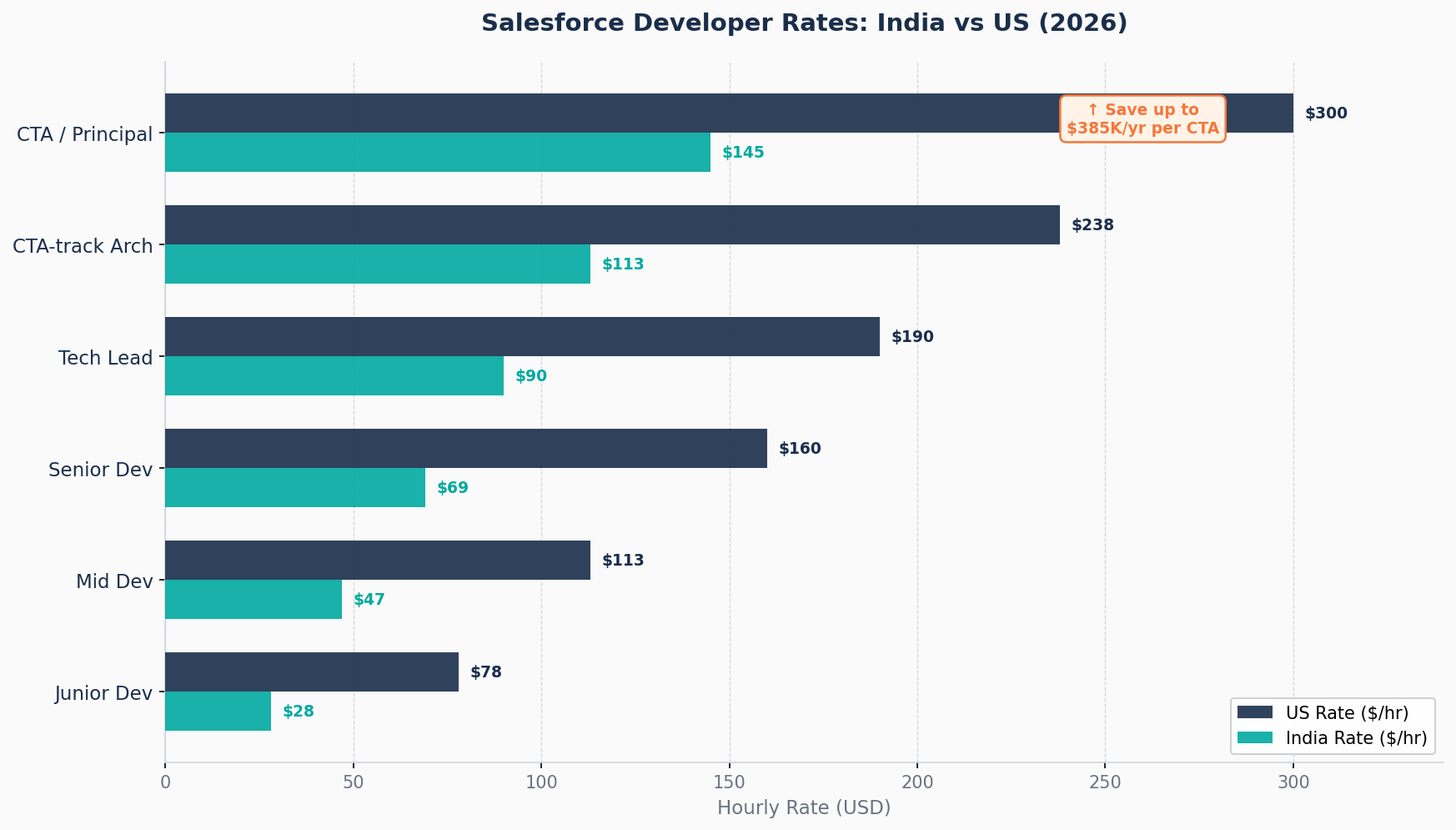
Full Rate Table India vs. US
Supersourcing Index 2026. Based on 1,200+ active placements. USD at ₹96.4/$1.
| Level | Experience | Gross CTC (₹ LPA) | India Rate | US Rate | Annual Saving |
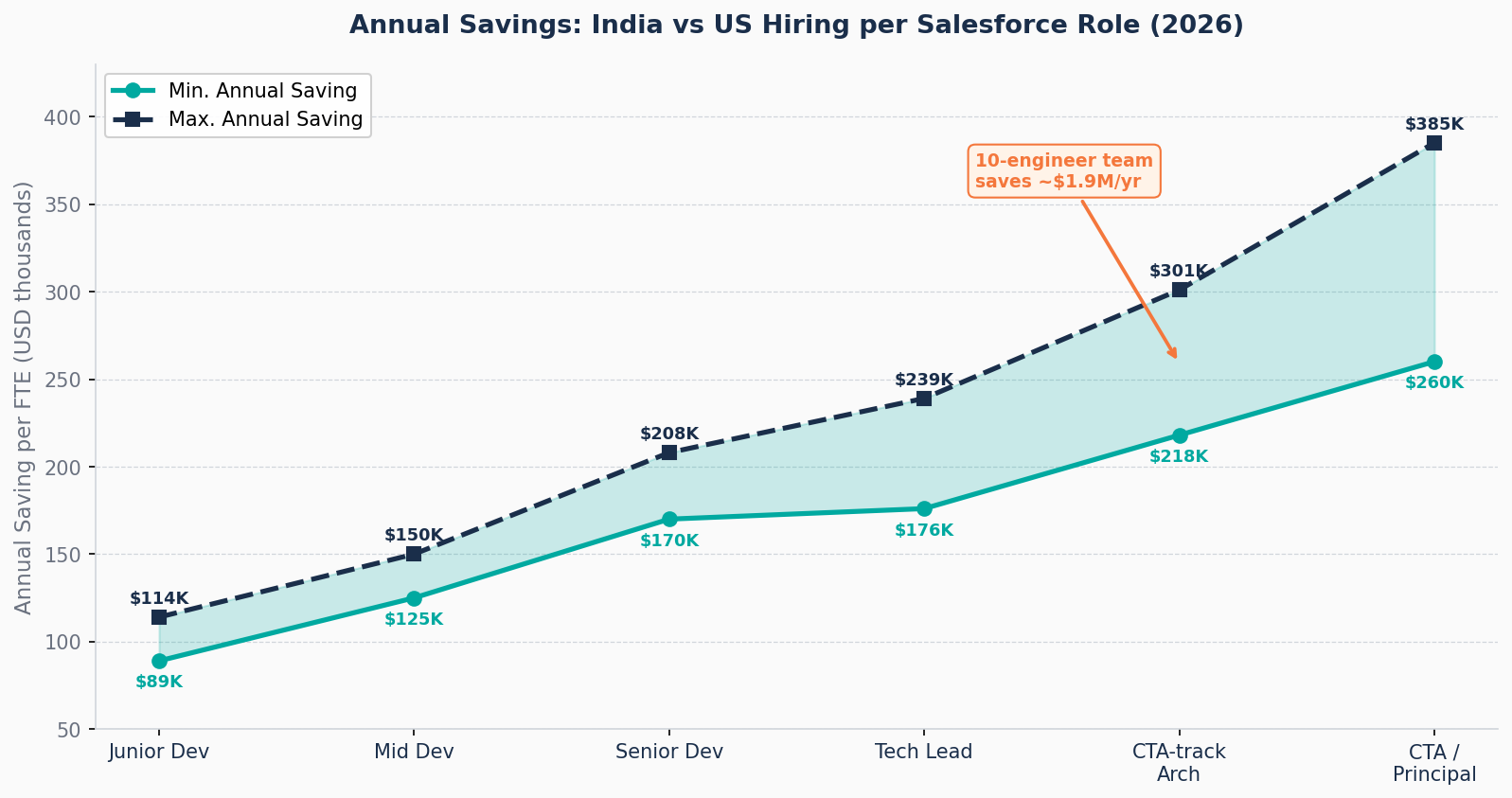
| Junior Developer | 2–4 yr | ₹10–18L | $22–35/hr | $65–90/hr | $89K–$114K |
| Mid Developer | 4–7 yr | ₹18–35L | $35–58/hr | $95–130/hr | $125K–$150K |
| Senior Developer | 7–10 yr | ₹35–52L | $58–80/hr | $140–180/hr | $170K–$208K |
| Tech Lead | 8–11 yr | ₹48–72L | $75–105/hr | $160–220/hr | $176K–$239K |
| Architect (CTA-track) | 10–14 yr | ₹65–95L | $95–130/hr | $200–275/hr | $218K–$301K |
| CTA / Principal Architect | 14+ yr | ₹90–130L | $125–165/hr | $250–350/hr | $260K–$385K |
At a 10-engineer Salesforce team (blended $75/hr), annual saving vs. US hiring: ~$1.9M.
That saving is real. It does not require accepting lower technical quality. It requires accepting a different governance model structured communication, overlapping windows, weekly cadence and doing the experience verification work this guide covers.
Cloud-Specific Rate Premiums
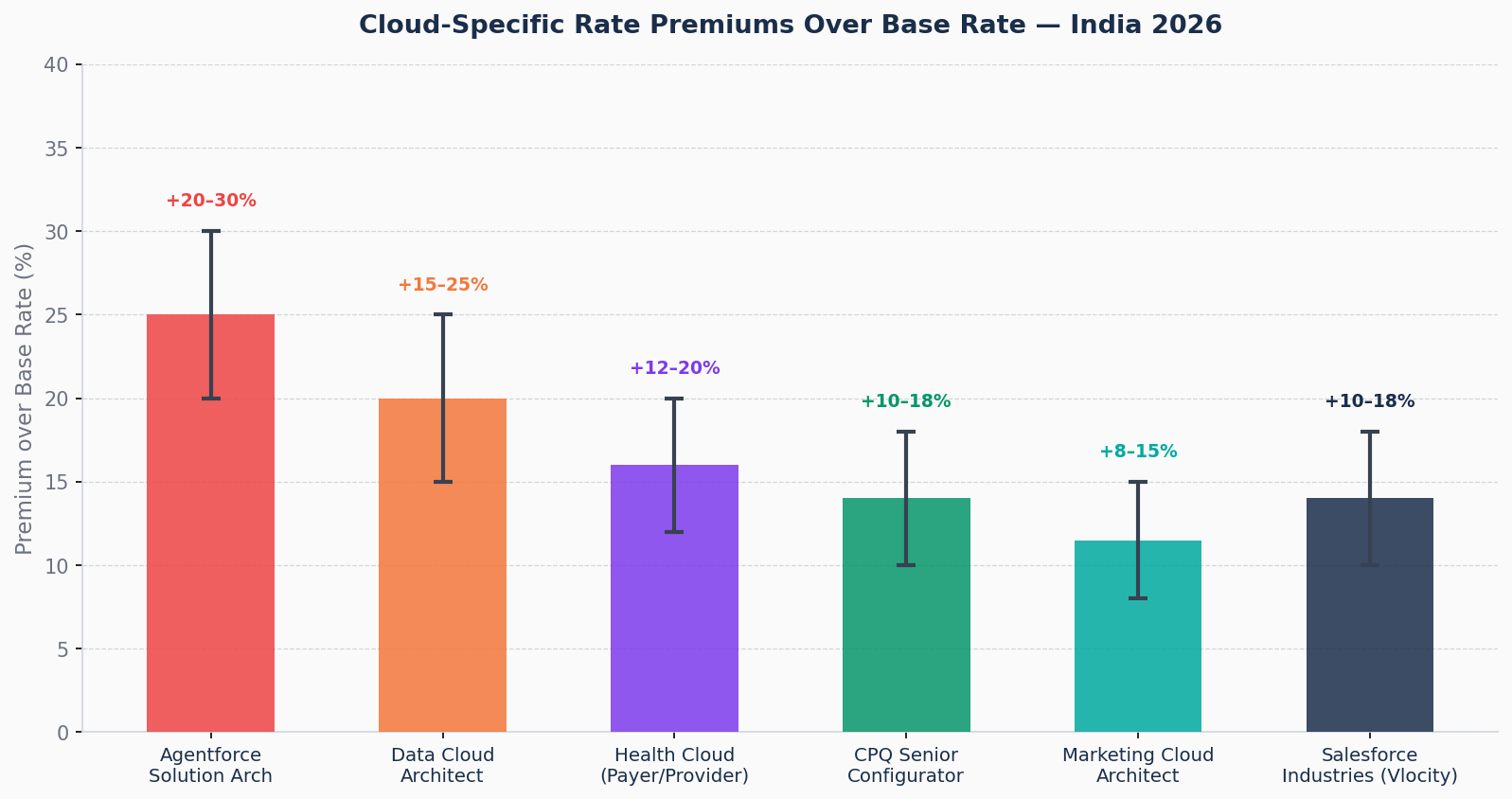
Some Salesforce clouds command a premium over the base rate due to pool scarcity:
| Cloud / Specialization | Premium Over Base Rate | Reason |
| Data Cloud Architect | +15–25% | Launched 2022, certified pool still thin |
| Agentforce Solution Architect | +20–30% | Launched 2024, under 300 certified in India |
| CPQ Senior Configurator (multi-national) | +10–18% | Complex tax/pricing logic is scarce |
| Health Cloud (payer/provider go-live) | +12–20% | HIPAA compliance depth required |
| Marketing Cloud Architect | +8–15% | Separate certification track, smaller pool |
| Salesforce Industries (Vlocity) | +10–18% | Vertical-specific, thin pool outside Bangalore |
From the deal floor: A DAX-listed manufacturing company needed a CPQ architect for a multi-national pricing implementation covering 14 countries. Three vendors presented candidates at $95/hr. Supersourcing’s Layer 7 vetting revealed only one of the three had actually built a multi-national tax configuration in CPQ; the other two had configured CPQ in single-country environments. The genuine multi-national CPQ architect came in at $112/hr. The $17/hr premium over 18 months was $63K. The alternative was a 14-country CPQ rollout led by someone who’d never handled multi-national tax logic.
The Certification Hierarchy What Actually Matters
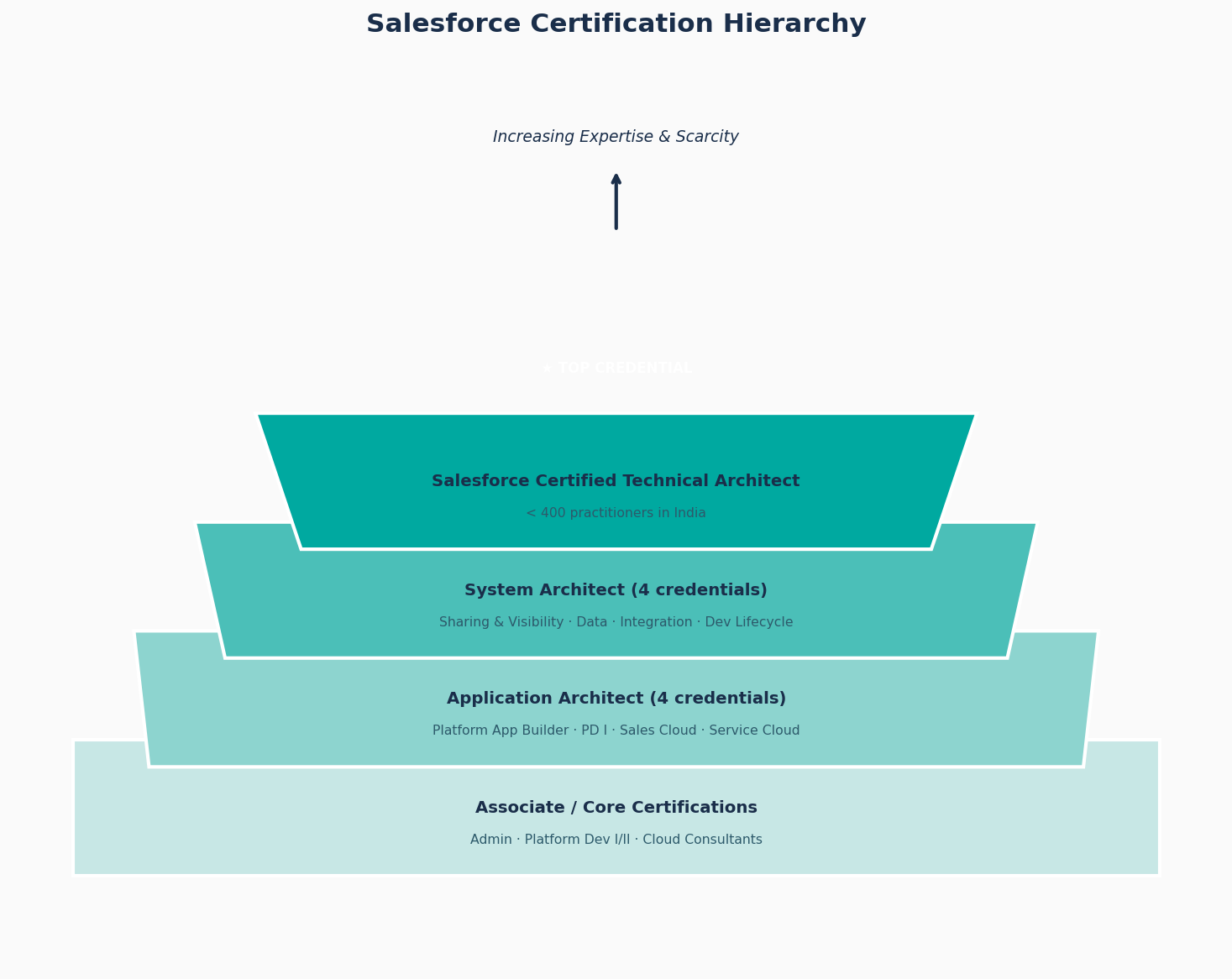
Most buyers treat “Salesforce certified” as a binary. It’s not. Salesforce has a formal credential hierarchy. Understanding it is the difference between hiring an architect and hiring a developer who took the architect exam.
The Credential Pyramid
Salesforce Certified Technical Architect (CTA)
↑
System Architect Credentials (4 required)
– Sharing and Visibility Architect
– Data Architect
– Integration Architect
– Development Lifecycle & Deployment Architect
↑
Application Architect Credentials (4 required)
– Platform App Builder
– Platform Developer I
– Sales Cloud Consultant
– Service Cloud Consultant (or other cloud consultant)
↑
Associate / Core Certifications
– Salesforce Administrator
– Platform Developer I / II
– Cloud-specific Consultants
What this means in practice:
A candidate with “Salesforce Administrator + Platform Developer I” has two credentials. They are not architects. A candidate with all four Application Architect credentials has demonstrated broad platform knowledge. They are not yet a System Architect. A CTA has passed a grueling review board and oral exam before a panel of Salesforce technical leaders that fewer than 400 practitioners in India have cleared.
When a vendor presents a “Salesforce Architect,” ask: which credentials do they hold? System Architect, Application Architect, or CTA? The answer changes the billing rate, the role scope, and the vetting protocol.
How to Verify Every Credential
Go to: trailhead.salesforce.com/credentials/verification
Enter the candidate’s name. Every credential they hold appears with the credential name, status (Active or Expired), and date earned.
Check three things:
- Status is Active Salesforce requires maintenance modules to keep credentials current. An expired credential means the engineer hasn’t maintained their certification. Their knowledge may be current. Their credential is not.
- The specific credentials match the role a “Data Cloud Architect” candidate should have the Data Cloud Consultant credential at minimum. If they don’t, their Data Cloud experience is self-claimed.
- Superbadge completions Superbadges require hands-on configuration in a real Salesforce org, not exam prep. A claimed architect with no Superbadges has likely not done hands-on implementation work recently.
Red flag: Any candidate who cannot provide their Trailhead profile URL within 24 hours of request. Every active Salesforce practitioner has one. Reluctance to share it means the credential stack doesn’t match the CV.
Cloud-Specific Credentials to Require
| Role | Minimum Credential | Ideal Credential |
| Sales Cloud Lead | Sales Cloud Consultant | Sales Cloud Consultant + Platform App Builder |
| Service Cloud Lead | Service Cloud Consultant | Service Cloud Consultant + Field Service Consultant |
| Marketing Cloud Architect | Marketing Cloud Email Specialist | Marketing Cloud Architect credential |
| Data Cloud Architect | Data Cloud Consultant | Data Cloud Consultant + Integration Architect |
| CPQ Lead | CPQ Specialist | CPQ Specialist + Platform Developer I |
| Health Cloud Lead | Health Cloud Accreditation | Health Cloud Accreditation + Service Cloud Consultant |
| Agentforce Architect | Agentforce Specialist | Agentforce Specialist + Platform Developer II |
| CTA-track Architect | All 4 Application Architect credentials | All 4 System Architect credentials |
How to Verify Experience, Not Just Credentials
Credentials tell you someone passed an exam. They don’t tell you whether that person has led a go-live, managed a data migration, or rescued a failing org. Here’s how to verify the experience behind the credential.
Step 1 The Implementation Count Test
Ask directly: “Walk me through every full-cycle Salesforce implementation you’ve led, client vertical, number of users, org complexity, your specific role, and go-live year.”
What strong looks like: Three to five specific implementations named within 60 seconds. Client described by vertical (retail, financial services, healthcare) even if anonymized. Specific role whether they owned the data model, led the integration layer, or managed the entire technical delivery. Go-live year and whether they went live on time.
What inflation looks like: Immediate generalization. “I’ve worked on multiple large enterprise projects across various industries.” No specific implementations. No go-live dates. No specific role. This answer almost always means the candidate supported an implementation in a junior capacity and is presenting it as ownership.
Step 2 The Version Currency Test
Salesforce releases three times per year: Spring, Summer, Winter. A practitioner who’s been on an active engagement for the past 12 months knows what changed in the last two releases that affected their work. One who hasn’t been actively implementing won’t.
Ask: “What’s one thing that changed in a recent Salesforce release that affected how you approached a configuration decision?”
Real answers name a specific feature: the change in Flow behavior, a new Data Cloud activation option, a governor limit adjustment and explain how it changed their approach. Vague answers say something about “Salesforce constantly evolving” without naming anything specific.
Step 3 The Failure Test
Ask: “Tell me about a Salesforce implementation that went wrong after go-live while you were on it. What happened, what was your role in the recovery, and what would you do differently?”
This is the most revealing question in any Salesforce interview. Engineers with real production experience have specific failure stories: they remember the client, the problem, what they did, and what it cost. Engineers without real ownership deflect: “The client changed requirements” or “The project was already in trouble when I joined” or give a theoretical answer about what they would do if something went wrong.
A strong answer involves ownership: “I designed the data migration incorrectly. I didn’t account for duplicate contacts across accounts and we had a data quality issue that took three weeks to resolve post-go-live. Here’s what I’d do differently.”
Step 4 The Technical Depth Test (Role-Specific)
For Senior Developers and above:
“Walk me through your governor limit strategy for a high-volume B2C org processing 500,000 records daily.”
Strong answer: describes async processing via Queueable Apex or Batch Apex, explains their SOQL optimization approach, discusses platform events for event-driven architecture where synchronous limits are a constraint, and mentions how they’d monitor limit consumption in production.
Weak answer: “I follow Salesforce best practices for governor limits” which says nothing.
For Architects:
“A global retailer wants to unify customer data across three Sales Cloud orgs, one Marketing Cloud account, and a Heroku custom app. Walk me through your data architecture.”
Strong answer: immediately identifies the canonical data model question whether to use the Salesforce Customer 360 Data Model, a custom canonical model in Heroku, or a MuleSoft integration layer. Explains the identity resolution challenge across orgs. Describes their approach to the 50K SOQL row limit for cross-org queries. Mentions the Marketing Cloud subscriber key and how it aligns with Contact IDs across orgs.
Weak answer: “I’d use MuleSoft to integrate everything” without explaining why MuleSoft vs. alternatives, or what the data model looks like.
For CTA-track:
“Your executive sponsor wants go-live in 6 weeks. Your technical lead says 14 weeks minimum. The delta is a set of custom integrations the business says are critical. Walk me through how you handle it.”
Strong answer: describes how they’d scope the integrations, which ones could be post-go-live without business impact, how they’d document the risk, get executive sign-off on a phased approach, and structure the technical conversation so the sponsor understands the tradeoffs not just the timeline.
Weak answer: “I’d escalate to the project sponsor and explain the risks.” That’s a sentence, not an answer.
Step 5 The Independent Reference Check
Find two former managers or tech leads not from the list the candidate provides on LinkedIn. People who managed or led the candidate at a previous employer, now at different companies.
Message them directly: “I’m evaluating [name] for a senior Salesforce architecture role. Would you be willing to answer two quick questions about their technical depth and ownership style?”
Ask: “In what situations did they operate independently without senior oversight?” And: “Would you hire them again for an architecture role, and why?”
Former managers of strong engineers always have specific answers to both questions. Former managers of CV-inflated candidates either decline to respond or give suspiciously vague praise.
From the deal floor: A US-based healthcare SaaS company ran an independent reference check on a proposed Salesforce Health Cloud architect. Vendor-provided references gave glowing feedback. An independently found reference to a former tech lead at the candidate’s previous employer said: “She’s a strong developer but I wouldn’t put her in an architect seat. She’s never owned an org design decision from start to finish.” The client adjusted the SOW to Senior Developer level and saved $22/hr over 18 months $91K. The adjustment also prevented a Health Cloud architecture being designed by someone who’d never architected one.
The 7 Most Common Pitfalls
Pitfall 1 Treating “Salesforce Certified” as a Single Category
There are 40+ Salesforce credentials. “Salesforce certified” means nothing by itself. A Salesforce Administrator credential and a Salesforce CTA are both “Salesforce certified.” They are not equivalent. Always ask which specific credentials the candidate holds and verify each one at trailhead.salesforce.com/credentials/verification.
Pitfall 2 Accepting “Health Cloud Experience” Without Specifying Payer vs. Provider vs. Life Sciences
Health Cloud has three distinct implementation tracks: Payer (insurance), Provider (hospital/clinic), and Life Sciences (pharma/medtech). The data models are different. The regulatory requirements are different. HIPAA compliance depth varies by track. A Health Cloud developer who’s implemented a Provider portal has not implemented a Payer claims processing system. Always specify which track your implementation requires and verify the candidate’s experience against that track specifically.
Pitfall 3 Confusing Marketing Cloud and Marketing Cloud Account Engagement (Pardot)
These are different products with different architectures, different certification tracks, and different skill sets. Marketing Cloud is a B2C platform for high-volume email, SMS, and journey automation. Marketing Cloud Account Engagement (formerly Pardot) is a B2B marketing automation tool. Many candidates list “Marketing Cloud experience” without specifying which product. Ask directly. Then verify the specific credential Marketing Cloud Email Specialist, Marketing Cloud Consultant, or Pardot Specialist.
Pitfall 4 Hiring an Integration Developer for an Architecture Role
Salesforce integration experience and Salesforce architecture experience are not the same. An engineer who’s built 20 MuleSoft integrations into Salesforce has deep integration skills. They may have limited knowledge of data modeling, org strategy, governor limit architecture, or release management. Integration depth is valuable. It is not equivalent to architectural depth. When you need an architect, verify architecture experience not just integration experience.
Pitfall 5 Not Specifying the Salesforce Version in the SOW
Salesforce’s three annual releases (Spring, Summer, Winter) introduce changes that affect active configurations. An architect whose last project ended in Winter ’23 is 5 releases behind on a platform that adds significant new capabilities every 4 months. For Data Cloud, Agentforce, and Flow specifically where Salesforce has shipped major architectural changes in every release since the 2023 version currency is a genuine skill gap. The SOW should specify that resources must have production experience on a release within 12 months of project start.
Pitfall 6 Not Including a Resource Substitution Clause
Vendors substitute developers mid-engagement. The reasons are legitimate (attrition, competing client priority) and less legitimate (the approved senior developer gets moved to a higher-margin account). Without a clause requiring 14 days’ written notice and client approval for any substitution, you have no contractual protection. The fix is in Section 10.
Pitfall 7 Skipping the Agentforce Reality Check
Agentforce launched in 2024. It is Salesforce’s biggest platform shift in a decade. Demand for Agentforce architects is outpacing supply globally including in India. The certified Agentforce specialist pool in India is under 300 as of May 2026. Any vendor who tells you they have 5 Agentforce architects on bench is either misrepresenting the certification level or the availability. Source realistically: 1–2 genuine Agentforce architects from India in under 45 days is the realistic ceiling.
From the deal floor: A US retail company told us they needed “10 Agentforce developers in 30 days.” Three vendors said yes. We said the certified pool in India doesn’t support that timeline. The three vendors who said yes delivered 10 developers with Agentforce Specialist Trailhead badges earned from a 4-hour module not production Agentforce experience. The company spent 6 weeks discovering this. We spent 44 days sourcing 4 genuine Agentforce architects. The other 6 roles were converted to Senior Developers who’d be trained on Agentforce under the architects’ supervision. That was the correct solution. It wasn’t the answer the client wanted to hear in week one.
The Interview Loop That Works
For Senior Developers (60 minutes)
Round 1 Technical Screen (30 min) Give them a real scenario: a B2B company running Sales Cloud with 50,000 Accounts, 2M Contacts, and a requirement to implement territory management across 40 sales regions. Ask them to walk through their approach, data model implications, territory hierarchy design, roll-up summary field strategy, and how they’d handle the performance impact of territory assignment rules at this data volume.
Strong developers discuss the Territory Management 2.0 limitations, the performance implications of assignment rules at scale, and whether they’d recommend filter logic optimization or a custom assignment framework.
Weak developers describe the territory management UI without mentioning performance, data volume, or the implications of 2M Contacts on roll-up summary fields.
Round 2 Code Review (30 min) Share a 50-line Apex trigger with 3 embedded anti-patterns: a SOQL query inside a loop, a DML statement inside a loop, and a missing bulkification check. Ask them to identify the issues and explain what they’d do instead.
Every Senior Developer should catch all three within 10 minutes and explain bulkification clearly. If they miss the SOQL-in-loop pattern, they haven’t worked on a high-volume org in production.
For Tech Leads and Architects (90 minutes)
Round 1 Architecture Design (45 min) Multi-cloud scenario: a global financial services company with Sales Cloud in US and EMEA, Service Cloud for a 500-seat contact center, Marketing Cloud for B2C email campaigns to 8M subscribers, and a legacy on-premise CRM in APAC that needs to be sunset over 24 months.
Ask them to: design the integration strategy for the APAC migration, describe their approach to the subscriber key alignment between Sales Cloud and Marketing Cloud, and explain how they’d govern a multi-org deployment across 3 regions with different data residency requirements.
Strong architects immediately raise GDPR implications for EMEA data, the subscriber key alignment problem between Sales Cloud Contact IDs and Marketing Cloud subscriber keys, and the sequencing challenge of sunsetting the APAC CRM without disrupting APAC sales operations.
Weak architects describe the migration at a high level without raising any of those specific challenges.
Round 2 Stakeholder Scenario (20 min) “You’re three weeks from go-live. Your QA lead identifies a data quality issue in the migration 15% of Account records have duplicate Contacts that will create duplicate cases in Service Cloud. Fixing it properly takes 6 weeks. Your business sponsor wants to go live as planned. Walk me through your next 48 hours.”
Strong architects describe exactly how they’d quantify the business impact of the duplicate issue, what a phased fix looks like (go live with a post-go-live cleanup plan), how they’d document the risk formally, and how they’d structure the conversation with the business sponsor so they understand the tradeoff not just hear “we have a problem.”
Round 3 War Story (25 min) Open question: “Tell me about the hardest technical problem you’ve solved on a Salesforce implementation.”
Strong architects have a specific story with a specific problem, a specific solution, and a specific outcome. The best answers involve something that went wrong because real production experience always involves something going wrong.
Cloud-Specific Hiring: Data Cloud, Health Cloud, Agentforce, CPQ
Salesforce Data Cloud
Data Cloud is Salesforce’s most significant architectural shift since Lightning. It’s also the cloud where CV inflation is most aggressive in 2026.
What real Data Cloud experience looks like: The candidate has built a Data Cloud implementation that ingests data from at least two external sources, configured identity resolution rules, created unified profiles, and activated segments to a downstream channel (Marketing Cloud, Sales Cloud, or an external ad platform).
Questions that separate real from read:
- “Walk me through your identity resolution configuration: what match rules did you use and how did you handle conflicting data across sources?”
- “How did you design your data stream schema and what were the implications for your calculated insights?”
- “What was your activation strategy and how did you measure segment quality before going live?”
Candidates who’ve read the documentation answer these at a conceptual level. Candidates who’ve implemented describe the specific configuration decisions and the tradeoffs they made.
What to verify: The Data Cloud Consultant credential at trailhead.salesforce.com/credentials/verification. Not the Data Cloud Accreditation (a simpler partner program credential) the full Consultant certification. Additionally, asking for the specific version of Data Cloud they worked on the product has changed significantly between its 2022 launch and 2026.
Salesforce Health Cloud
Health Cloud requires understanding that goes beyond Salesforce configuration; it requires HIPAA compliance knowledge, healthcare data model familiarity (HL7, FHIR), and payer or provider workflow depth.
What real Health Cloud experience looks like: The candidate has implemented Health Cloud for either a payer (insurance company managing member care) or a provider (hospital or clinic managing patient relationships). They understand the Health Cloud data model Patient, CarePlan, CareProgram and how it maps to clinical workflows.
Questions that separate real from read:
- “How did you handle PHI (Protected Health Information) data in your Salesforce org? What field-level security, sharing rules, and encryption approach did you use?”
- “Walk me through how you implemented a Care Plan for a chronic disease management program, what objects were involved and how did you handle task assignments across care team members?”
- “How did you approach the HL7 or FHIR integration for clinical data, what middleware did you use and how did you handle the data mapping?”
Candidates with genuine Health Cloud experience have specific answers to all three. Candidates with a Health Cloud Trailhead badge cannot answer the PHI question specifically.
What to verify: The Health Cloud Accreditation at trailhead.salesforce.com/credentials/verification. Then ask specifically: payer or provider? Which go-live did they own? What was the patient population size? These details are verifiable and real practitioners answer them without hesitation.
Agentforce
Agentforce is Salesforce’s autonomous AI agent platform, launched in late 2024. It is genuinely new. The certified practitioner pool in India is under 300 as of May 2026.
What real Agentforce experience looks like: The candidate has built an Agentforce agent not a demo, not a Trailhead project, but a production deployment for an actual end user. They understand the Atlas Reasoning Engine, the agent action framework, and how to configure guardrails.
Questions that separate real from read:
- “How did you design the topic classification for your agent, what were the topics, how did you define the scope, and how did you test coverage?”
- “What guardrails did you configure and how did you handle edge cases where the agent couldn’t confidently classify a user request?”
- “Walk me through a case where the agent’s reasoning produced an unexpected output and how you diagnosed and corrected it.”
Candidates with genuine Agentforce production experience answer the third question with a specific example. Candidates with demo experience can’t because demos don’t produce unexpected outputs.
Realistic sourcing: For Agentforce, expect 40–50 days to source one certified architect with production experience. Plan your timeline accordingly.
Salesforce CPQ
CPQ (Configure, Price, Quote) is one of the most technically demanding Salesforce specializations. Multi-national tax logic, complex discount frameworks, subscription pricing with usage-based components CPQ at enterprise scale is a different skill set from standard Sales Cloud.
What real CPQ experience looks like: The candidate has configured a CPQ implementation with at least: a product catalog of 200+ products, a pricing waterfall with multiple discount layers, a quote document template, and an approval workflow. Multi-national experience means they’ve handled multiple currencies and tax jurisdictions in the same org.
Questions that separate real from read:
- “Walk me through your pricing waterfall design. What discount layers did you configure and in what sequence did they apply?”
- “How did you handle subscription amendments in CPQ? What happens to the existing subscription when a customer upgrades mid-term?”
- “How did you approach multi-currency and tax logic for a 14-country deployment?”
The subscription amendment question is the most revealing. CPQ’s amendment logic is one of its most complex and most commonly misimplemented features. Candidates who haven’t implemented CPQ subscriptions cannot describe the co-term logic and prorated pricing.
What to verify: The Salesforce CPQ Specialist credential at trailhead.salesforce.com/credentials/verification. This is a separate credential from core Salesforce. Many “CPQ experienced” candidates don’t hold it.
The Contract Stack
The MSA Four Non-Negotiable Clauses for Salesforce Engagements
- Individual Resource Approval
Don’t accept: “Vendor shall provide Salesforce-certified resources meeting the qualifications in Exhibit A.”
Require: “Vendor shall provide resources who have
- individually passed the vetting process documented in Exhibit B,
- hold current, active credentials as listed in Exhibit C, verified at trailhead.salesforce.com/credentials/verification, and
- been approved in writing by the Client’s Technical Lead prior to commencement.
Approval shall not be unreasonably withheld but shall be based on the specific role requirements in the applicable SOW.”
- Substitution Notice
Don’t accept: no substitution clause or a general “vendor will endeavor to minimize changes.”
Require: “Any substitution of Assigned Personnel requires 14 days’ prior written notice to Client. Clients may reject any proposed substitution within 5 business days of receiving the notice. Unauthorized substitution including any change in Assigned Personnel without required notice and Client approval constitutes a material breach of this Agreement.”
- IP Assignment Deed
Required for every engineer who touches code, configuration, or design. Without it, the default IP ownership under Indian Copyright Act §17 sits with the vendor’s employer, not with you.
Require: “Vendor shall ensure each Assigned Personnel executes an individual Deed of Assignment in the form set out in Schedule A, assigning all right, title, and interest in any work product created in connection with Services to Client, effective as of the date of creation. Deeds shall be delivered within 5 business days of commencement.”
- Org Access and Credential Management
A clause most Salesforce-specific MSAs miss: “Upon termination of this Agreement or any SOW, Vendor shall
- deactivate all Salesforce user accounts for Assigned Personnel within 24 hours of their final day,
- transfer all connected app credentials and OAuth tokens to Client,
- remove any Vendor-controlled sandbox configurations or tools from Client’s Salesforce environment, and
- provide Client with a complete inventory of all Assigned Personnel’s system access within 48 hours of termination notice.”
Salesforce orgs accumulate access. Terminated vendors sometimes retain Connected App access indefinitely. This clause closes that.
The SOW Three Salesforce-Specific Requirements
Version and release currency: “All Assigned Personnel must have active production experience on a Salesforce release within 12 months of the SOW start date. Vendor shall document the specific release version of each Assigned Personnel’s most recent production engagement in Exhibit B.”
Credential maintenance: “Vendor shall notify Client within 5 business days if any Assigned Personnel’s Salesforce credentials expire or lapse during the engagement. Vendor shall ensure all credentials are renewed and active within 30 days of expiry notification.”
Sandbox access protocol: “Vendor shall access Client’s Salesforce environments exclusively through Client-managed user accounts, not via Connected Apps or delegated access. All Vendor activity in Client’s Salesforce environments shall be logged and available to Client on request.”
Running the Salesforce Team at Scale
Pod Structure for Salesforce Programs
| Program Size | Structure |
| 5–12 engineers | 1 Tech Lead + developers by cloud specialization + 1 QA |
| 12–25 engineers | 1 Architect + 2 Tech Leads (Sales/Service split) + developers + 1 QA Lead + 1 Release Manager |
| 25–50 engineers | 1 Principal Architect + 3–4 Tech Leads by cloud + developers + 2 QA Leads + 1 DevOps/Release Lead + 1 Delivery Manager |
| 50+ engineers | Program Architect + multiple architects by cloud + pod structure per cloud |
The Salesforce-specific governance rule: Salesforce orgs become hard to govern when too many developers have System Administrator profiles. Define your org security model before the first developer is onboarded which profiles exist, who can access production, and what the sandbox promotion path looks like. Every developer who’s spent 3 months configuring production directly in sandbox bypass is a governance liability.
Release Management Non-Negotiable at Any Scale
Salesforce environments require structured release management: Development → Integration Sandbox → UAT Sandbox → Production. A Salesforce team without a release manager and a defined change set or CI/CD process (Salesforce DX + GitHub + a pipeline tool like Copado or Gearset) is shipping changes directly to production by month four. That becomes technically unmanageable by month eight.
Require evidence of a release management framework before the engagement starts. Not a theoretical answer, ask for the tools they use, the branching strategy, and how they handle hotfixes.
Overlap Windows That Actually Work
IST to US Eastern: 5.5 hours behind. The practical overlap window for synchronous collaboration is 7:30–11:30am US Eastern (6:00–10:00pm IST). For US Pacific, there’s almost no overlap without someone working outside business hours.
What works: Daily 30-minute stand-ups at 8:00am US Eastern (6:30pm IST). Weekly architecture review at 9:00am US Eastern. Async for everything else detailed written requirements, Loom screen recordings for complex issue descriptions, written design decisions with async review periods.
What doesn’t work: Expecting an India team to be available for real-time Slack responses throughout the US business day. Designing the governance model around synchronous availability that IST doesn’t support creates friction that accumulates into a slow-burn delivery problem.
Attrition Signals Specific to Salesforce Teams
Senior Salesforce developers are among the most actively recruited profiles in India. The Salesforce ecosystem is large enough that alternatives are always visible. Watch for:
- Completion of a new Trailhead Superbadge unrelated to your current project signals they’re preparing for a different role
- Salesforce certification exam registrations engineers invest in cert prep when they’re planning a move
- Trailhead profile activity spike Trailhead is public; a sudden increase in activity after months of dormancy often precedes a job change
The fix is usually not a counter-offer. It’s a conversation about the next challenge. Salesforce engineers leave when the current work stops being interesting. Stretch assignments and technical leadership opportunities retain them more reliably than compensation.
Supersourcing Index: Among Salesforce-specific engagements in Supersourcing’s GCC Benchmark 2026, the average tenure of a Senior Salesforce Developer on an enterprise engagement was 22 months before voluntary departure. The primary reason given in exit interviews: “The work became repetitive. I was maintaining what we’d built, not building anything new.” Engagements that introduced a new cloud (Data Cloud, Agentforce) or a significant architectural challenge after month 12 extended average tenure to 31 months.
When Things Go Wrong
The Most Common Salesforce-Specific Failure Modes
Technical debt from poor org design in months 1–3. The most expensive Salesforce problem is a bad data model that gets discovered in month 10. A poorly designed Account-Contact relationship, a record type structure that doesn’t scale, or sharing rules that create performance problems at 2M records these are invisible early and catastrophic late. The fix is a mandatory architecture review at month 2–3, before the data model is locked.
Governor limits hits in production after go-live. Salesforce governor limits SOQL query limits, DML limits, CPU time limits are enforced per transaction. A system that works in a sandbox with test data fails in production with real volume. The verification questions in Section 6 are designed to surface whether an architect has actually dealt with governor limits at scale. If they haven’t, you’ll find out in production.
Marketing Cloud integration breaks after a Salesforce release. Marketing Cloud integrates with Sales/Service Cloud via Marketing Cloud Connect, which is release-sensitive. Salesforce’s three annual releases sometimes break Marketing Cloud Connect configurations. Without a regression test protocol for each release, this surfaces as a production incident. Require evidence of a release testing framework before going live.
The Recovery Playbook
If the data model is wrong: Don’t try to fix it in place. Design the target model, build a migration script, test exhaustively in a full sandbox, and schedule a maintenance window. A bad data model fix attempted incrementally in production creates more problems than it solves.
If governor limits are hitting in production: Pull the Salesforce Debug Logs for the failing transactions. Identify the specific operation hitting the limit. In most cases the fix is either async processing (Queueable Apex, Batch Apex) or SOQL optimization. Don’t apply hotfixes without regression testing governor limit fixes that don’t account for all callers of the affected code creating new limit hits elsewhere.
If a key architect rolls off: Trigger the substitution clause immediately. The vendor has 14 days to present an approved replacement (if your SOW is structured per Section 10). Use the 14 days to document the departing architect’s design decisions in a formal Architecture Decision Record before they leave. Every day without that documentation is institutional knowledge lost.
From the deal floor: A US-based B2B SaaS company discovered in month 8 that their Salesforce org had 340 custom fields on the Opportunity object, the result of six developers adding fields without a governance process. Salesforce has a soft limit of 800 fields per object, but performance degrades significantly above 200. The org was slow. Reports were timing out. The “fix” required a 12-week data model consolidation effort that consumed the team’s capacity for a quarter. The root cause: no architecture governance in the first 90 days. A $15K architecture review upfront would have prevented a $280K remediation.
The Supersourcing Vendor Scorecard
| # | Criterion | Weight | Score (1–5) | Weighted |
| SALESFORCE-SPECIFIC TALENT | ||||
| 1 | Credential verification at Trailhead registry not self-reported | 6% | – | – |
| 2 | CTA-track architects available verifiable credential stack | 5% | – | – |
| 3 | Cloud-specific depth: Data Cloud, Health Cloud, Agentforce, CPQ | 5% | – | – |
| 4 | Version currency production experience within 12 months | 4% | – | – |
| 5 | Superbadge completions verified evidence of hands-on work | 4% | – | – |
| 6 | Attrition rate on Salesforce engagements data not claims | 4% | – | – |
| EXPERIENCE VERIFICATION | ||||
| 7 | Implementation count validated via direct questioning | 5% | – | – |
| 8 | Failure story elicited and specific | 4% | – | – |
| 9 | Technical depth tested with role-specific questions | 5% | – | – |
| 10 | Independent backchannel reference completed | 4% | – | – |
| COMMERCIAL | ||||
| 11 | Rate transparency CTC + burden + margin visible | 4% | – | – |
| 12 | Cloud-specific premiums documented and justified | 3% | – | – |
| 13 | Rate escalation cap annual, in MSA | 3% | – | – |
| 14 | Volume discount for 10+ Salesforce engineers | 3% | – | – |
| CONTRACT | ||||
| 15 | Individual resource approval clause in SOW | 5% | – | – |
| 16 | Substitution notice 14 days written, client approval | 4% | – | – |
| 17 | IP Assignment Deed per engineer, at commencement | 4% | – | – |
| 18 | Org access termination clause 24-hour deactivation | 4% | – | – |
| 19 | Credential maintenance requirement in SOW | 3% | – | – |
| COMPLIANCE | ||||
| 20 | ISO 27001:2022 current, registry-verified | 4% | – | – |
| 21 | DPDP Act §10 DPA available immediately | 3% | – | – |
| 22 | HIPAA BAA capability (if Health Cloud) | 3% | – | – |
| 23 | MCA filing Active, recent annual return | 3% | – | – |
| DELIVERY | ||||
| 24 | Dedicated Delivery Lead not shared PM | 3% | – | – |
| 25 | Release management framework tools and process | 3% | – | – |
| 26 | Org governance protocol profile management, sandbox process | 3% | – | – |
| 27 | Do they tell you what you don’t want to hear? | 2% | – | – |
| TOTAL | 100% |
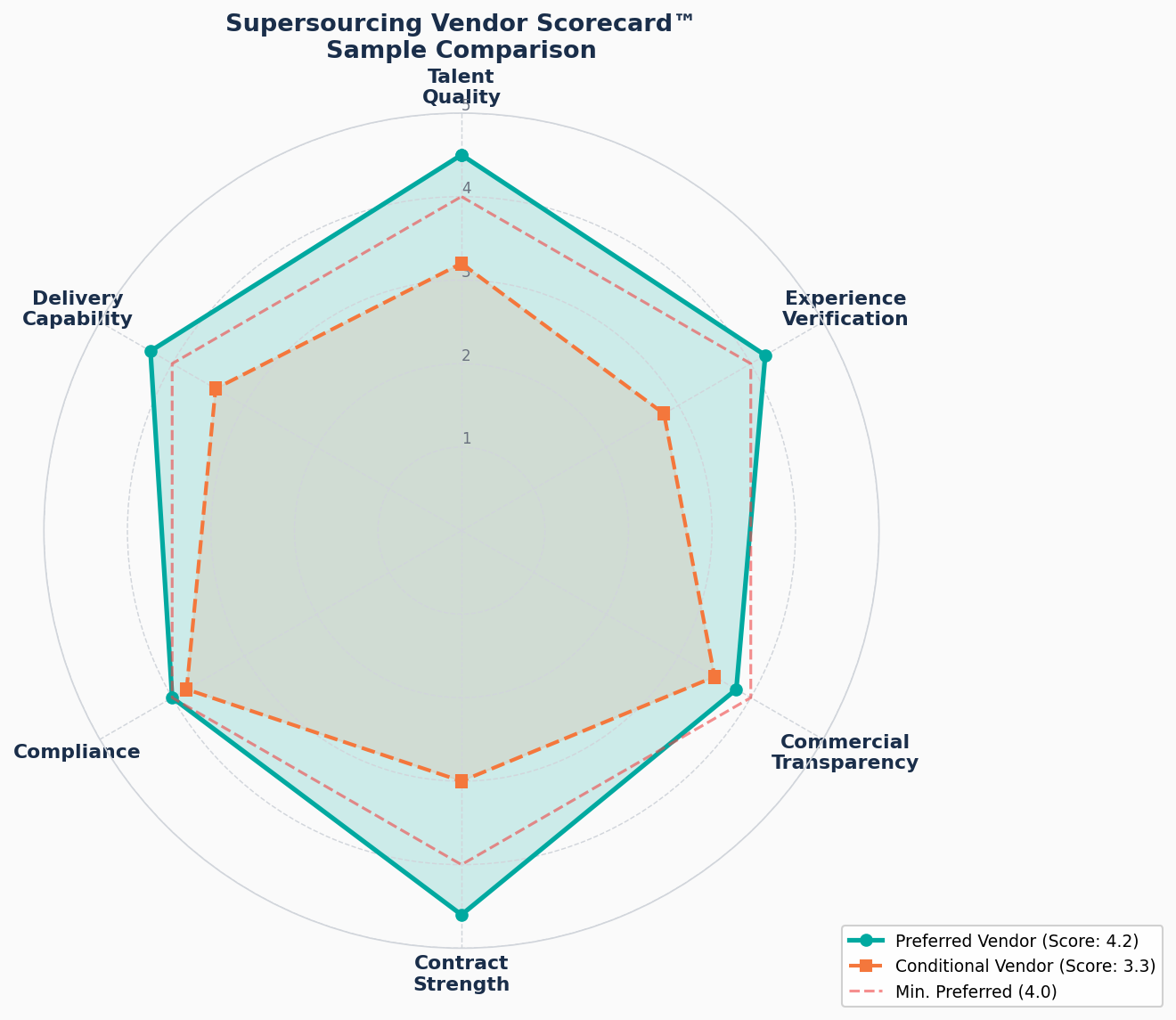
Above 4.0: preferred vendor. 3.0–3.9: conditional with documented exceptions. Below 3.0: don’t engage.
Questions Buyers Actually Ask
How do I know if a candidate actually has Health Cloud experience and not just a Trailhead badge?
Ask three things: payer or provider? Which go-live did they own and what was the patient or member population size? How did they handle PHI field-level security? Real Health Cloud practitioners answer all three immediately. Trailhead badge holders cannot describe PHI security configuration specifically because Trailhead doesn’t cover it at implementation depth.
What’s the difference between a Salesforce CTA and a System Architect?
System Architect is a set of four credentials: Sharing and Visibility Architect, Data Architect, Integration Architect, Development Lifecycle and Deployment Architect. A CTA has passed all four System Architect credentials plus a review board and oral exam before Salesforce technical leaders. The CTA is the highest credential Salesforce offers. Fewer than 400 practitioners in India hold it.
Can I hire a Salesforce developer for a Data Cloud implementation without a Data Cloud Consultant credential?
Technically yes. Practically, you’re taking significant risk. Data Cloud’s architecture is substantially different from core Sales/Service Cloud; the data model, the activation framework, and the identity resolution logic all require product-specific knowledge. A developer without Data Cloud credentials and without recent Data Cloud production experience will have a meaningful ramp period at your expense.
How do I handle the Salesforce release cycle three releases per year with an India team?
Build a release testing protocol into your SOW. Three weeks before each Salesforce release, your team should run regression tests in a Preview Sandbox (Salesforce provides preview access before the release goes live). Any failures are fixed before the release hits production. This is standard practice for any production Salesforce org. If your vendor doesn’t have a release testing framework, build one before you go live.
What’s the right team size for a multi-cloud Salesforce implementation?
A Sales Cloud + Service Cloud + Marketing Cloud implementation for an enterprise client typically requires: 1 Principal/Technical Architect, 1 Sales Cloud Lead, 1 Service Cloud Lead, 1 Marketing Cloud Architect, 3–4 developers per cloud (9–12 total), 1 QA Lead, 1 Release Manager, 1 Data Migration Lead, and 1 Delivery Manager. That’s 17–20 people for a serious multi-cloud program. Buyers who try to run this with 8 engineers end up with either a very long timeline or a technically compromised org.
How do I handle Salesforce org access after an engagement ends?
Run the four-step offboarding checklist: deactivate all vendor user accounts within 24 hours of final day, revoke all Connected App OAuth tokens the vendor used, audit the Setup Audit Trail for any configuration changes made in the final 30 days, and change your System Administrator passwords. Without this, vendor engineers can retain access through Connected Apps even after their user account is deactivated. The org access termination clause in Section 10 makes this contractual.
Should I require all developers to use Salesforce DX and Git?
Yes, for any team of 5+ developers. Without version control and a structured deployment process, your org’s configuration becomes untrackable. By month 6, nobody knows who changed what or why. Salesforce DX plus a Git-based deployment pipeline (Copado, Gearset, or custom GitHub Actions) is the standard for any enterprise Salesforce program. Require it upfront. Retrofitting it after 6 months of unmanaged change sets is a multi-week effort.
What’s a realistic timeline for a Health Cloud implementation for a mid-size payer?
For a payer with 500K–2M members, implementing Health Cloud for care management with integration to a core claims system: 12–18 months for Phase 1 (member 360, care plan, case management), assuming a team of 14–18 engineers and a clean data migration. Vendors who promise this in 6 months are either scoping only a pilot or planning to cut functionality. Get a detailed scope breakdown before evaluating timelines.
How do I protect IP when my Salesforce org contains proprietary business logic?
Three things: IP Assignment Deeds per developer (Section 10), org access revocation at offboarding (Section 10), and code escrow. For orgs with highly proprietary business logic, a custom pricing engine, a proprietary underwriting algorithm, a complex commission calculation, keep a version-controlled copy of all Apex, LWC, and configuration metadata in your own Git repository at all times. The vendor should push to your repository, not theirs.
Is Agentforce worth investing in right now for an India-based team?
Yes but with realistic expectations. The Agentforce platform is genuinely powerful. The certified practitioner pool in India is thin. A realistic 2026 approach: hire 1–2 certified Agentforce architects from India to lead the program, supplement with senior Salesforce developers who’ll be trained on Agentforce under those architects, and plan for a longer ramp period than you’d see with Sales Cloud or Service Cloud. The platform will mature, the practitioner pool will grow, and being early builds organizational capability that compounds.
What’s the best way to handle a Salesforce team where engagement is dropping?
The Trailhead signals in Section 11 are early warning. If you’re seeing them, have a direct conversation about what the engineer wants to work on next. In Supersourcing’s experience, 38% of Salesforce engineer departures are preventable with a role scope change not a compensation change. Offer a technical stretch (a new cloud, an architecture challenge, a tech lead opportunity) before assuming the fix is money.
Can I use the same vendor for Salesforce and SAP on the same program?
Yes, but negotiate separate rate cards and vetting protocols for each stack. A vendor who’s strong on Salesforce may not have equivalent SAP depth, and bundling the rate card creates an incentive to staff the weaker stack with lower-quality talent to protect margin on the stronger one. Separate SOWs with separate approved resource lists give you clean accountability on both stacks.
How do I evaluate whether a vendor’s Salesforce bench is real or theoretical?
Ask for the bench roster: names, specific credentials (verified at Trailhead), current notice periods, and the last project each person worked on. A real bench has people with documented credentials who are currently available either between engagements or on 30–60 day notice. A theoretical bench is “we can source these profiles” dressed up as “we have these people available.” The difference is whether the vendor can produce credential IDs today, not in three weeks.
What should I do if a Salesforce developer we’ve approved gets replaced without notice?
Trigger the material breach process immediately. Send written notice per your MSA’s notice clause citing the unauthorized substitution clause and demanding (1) the original approved developer is returned to the engagement or an approved replacement is presented within 14 days, and (2) any work done by the unapproved replacement is reviewed and validated by a developer you’ve approved. If your MSA has a liquidated damages provision for unauthorized substitution, invoke it. This is the most effective deterrent for repeat violations.
Is Supersourcing the right partner for a 3-developer Salesforce project?
Not our ideal engagement. Our model is built for 10+ engineer programs with enterprise governance requirements. For 3 developers on a defined scope, a Salesforce-specific boutique staffing firm or a Salesforce consulting partner with a staff augmentation offering is a better fit. We’d rather tell you that than win a deal we’ll underserve.
Closing
Salesforce hiring in India works. The talent is real, the credentials are verifiable, and the savings versus US hiring is substantial $187K–$280K per architect, per year. The failure mode is not India. The failure mode is skipping the verification steps that separate 196,000 “Salesforce certified” professionals from the 2,800 who can actually architect your enterprise program.
This guide is those verification steps. The credential check takes 90 seconds. The implementation count question takes 60. The failure story takes 20 minutes. None of it is hard. All of it matters.
If you want Supersourcing to run the verification for a specific role, bring us a JD and we’ll tell you what the talent pool looks like, what the realistic rate is, and how long it’ll take to source someone who passes all seven layers.
Book a 30-minute Salesforce Talent Discovery Call →
No deck. Just the numbers and the bench.
