

HSBC, Lloyds Banking Group, Barclays, NatWest, Standard Chartered these are not the kinds of organizations that adopt technology casually. They run Blue Prism. Not as a side project. As enterprise-wide automation infrastructure with hundreds of robots processing millions of transactions in regulated financial services environments where errors have regulatory consequences.
When enterprises try to Hire Blue Prism Developers in India, they quickly run into the real constraint: developers with genuine production experience in regulated banking environments are far fewer than the market suggests.
According to McKinsey on Intelligent Automation & AI Adoption, more than 70% of organizations are expected to adopt automation and AI at scale by 2026, significantly increasing demand for enterprise-grade RPA talent in financial services.
India is where UK and European banking GCCs are building their Blue Prism automation delivery teams. The combination of India’s cost advantage, strong technical talent pool, and established RPA development community makes India the natural delivery center for the automation programs that UK financial services companies are scaling. The challenge is that Blue Prism talent in India, particularly senior developers with genuine production experience in financial services automation, is genuinely scarcer than UiPath talent.
This guide covers what financial services GCCs and enterprise automation programs need to know about hiring Blue Prism developers in India, what depth actually looks like, what to pay, and how to avoid the most common hiring mistakes.
What Is Blue Prism and How It Differs from UiPath
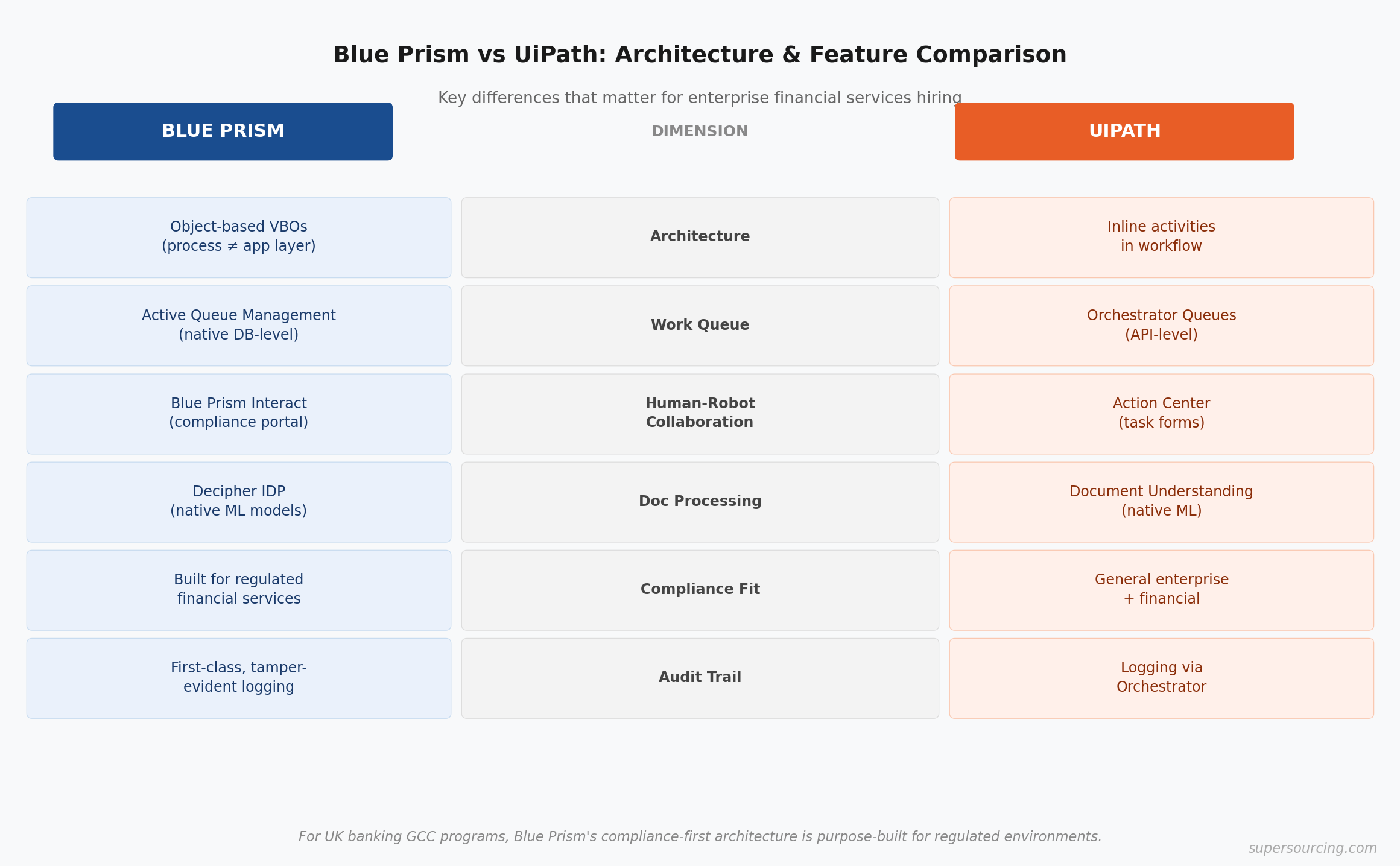
Blue Prism and UiPath are both RPA platforms but their architectural philosophies differ in ways that matter for hiring.
Blue Prism’s object-based architecture separates process logic from application interaction using Visual Business Objects (VBOs). A VBO encapsulates all the interactions with a specific application the actions (start application, navigate, extract data, input data, close) that are reused across multiple automation processes.
This separation means that when an application’s UI changes, only the VBO needs to be updated, not every process that uses that application. It is a more disciplined architecture than UiPath’s approach, which allows developers to embed application interactions directly in process workflows.
The architectural discipline Blue Prism enforces produces more maintainable automation but requires developers who understand and apply the VBO model correctly.
Active Queue management is Blue Prism’s native work queue system. Organizations create queues in the Blue Prism database, populate them with work items (transaction records to process), and robots pull items from the queue to process. Queue management includes locking items during processing, marking completion or exception status, retry configuration, and queue reporting.
Blue Prism’s Active Queue model is more prescriptive and more auditable than UiPath’s Orchestrator queues which suit financial services compliance requirements.
Blue Prism Interact is the human-in-the-loop portal, a web interface where human workers and automated robots collaborate on processes that require human decision-making at certain steps. Interact is important for financial services automation where regulatory requirements mandate human oversight at specific decision points.
Blue Prism Decipher is Blue Prism’s intelligent document processing capability using ML models for OCR, classification, and data extraction from unstructured documents. Decipher is comparable to UiPath’s Document Understanding but uses Blue Prism’s native ML model training and deployment infrastructure.
Blue Prism Process Intelligence recently integrated through the SS&C Blue Prism merger and the addition of TIBCO Nimbus process modelling provides process mining and process modelling capabilities to identify automation opportunities and document processes before automating them.
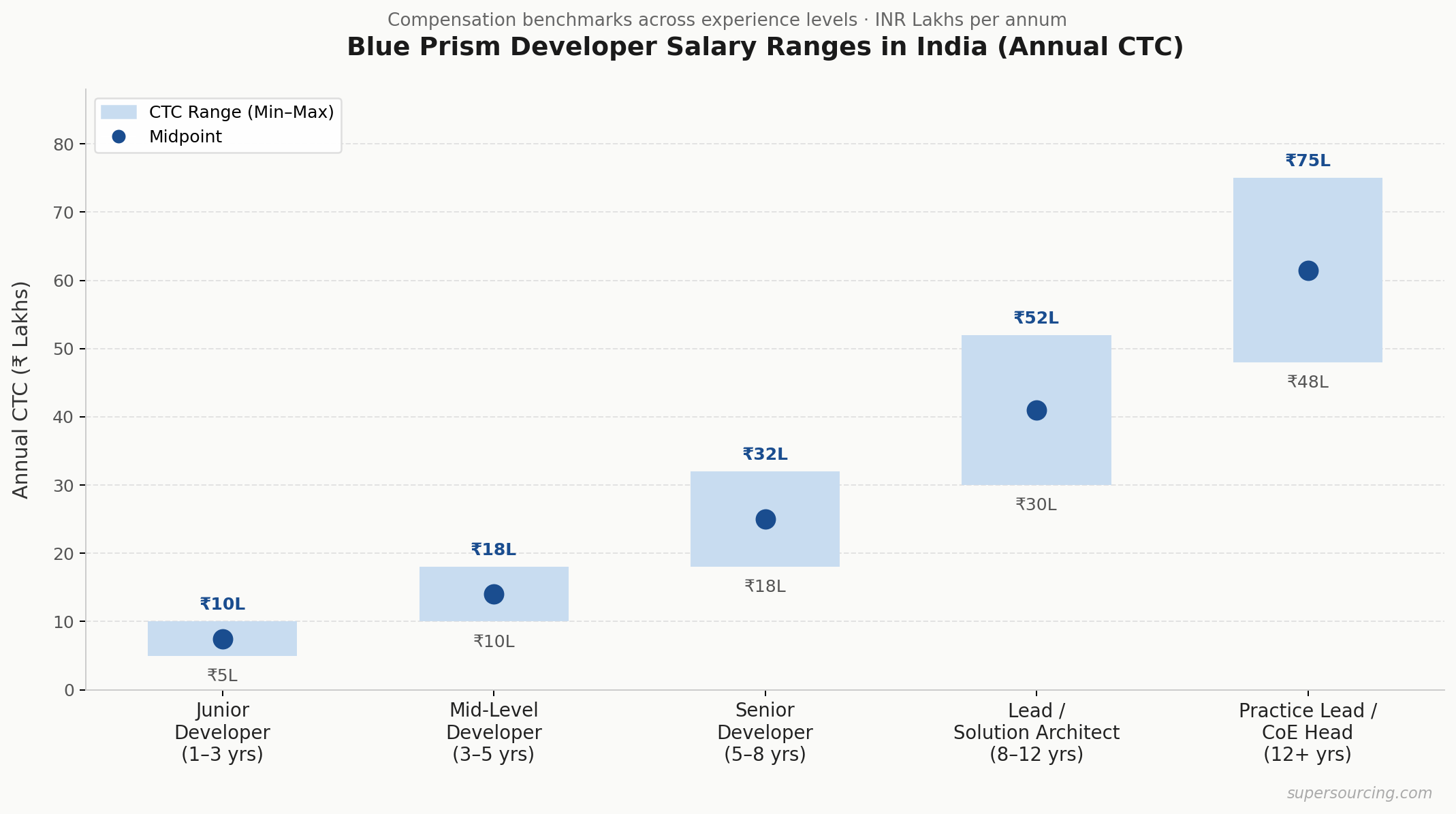
The Blue Prism Talent Market in India
Blue Prism talent in India is significantly smaller than UiPath talent. The platform’s installed base is concentrated in UK and European financial services which means the Indian talent pool developed primarily through IT services firms servicing UK banking clients (TCS, Infosys, Wipro, HCL all have Blue Prism practices developed for their UK BFSI delivery teams).
Blue Prism ROM (Robotic Operating Model) Developer and Professional Developer are the primary certification paths. As with every RPA platform, certification validates training. Production experience specifically automating financial services processes in a Blue Prism environment with Active Queue management, compliance logging, and VBO architecture discipline is the real assessment criterion.
| Level | Experience | Annual CTC (INR) |
| Junior Blue Prism Developer | 1–3 years | ₹5L – ₹10L |
| Mid-Level Blue Prism Developer | 3–5 years | ₹10L – ₹18L |
| Senior Blue Prism Developer | 5–8 years | ₹18L – ₹32L |
| Blue Prism Lead / Solution Architect | 8–12 years | ₹30L – ₹52L |
| Blue Prism Practice Lead / CoE Head | 12+ years | ₹48L – ₹75L |
Contract and staff augmentation rates are customized to your Blue Prism version, automation complexity, Interact and Decipher scope, and seniority. Custom quote within 24 hours of receiving the JD.
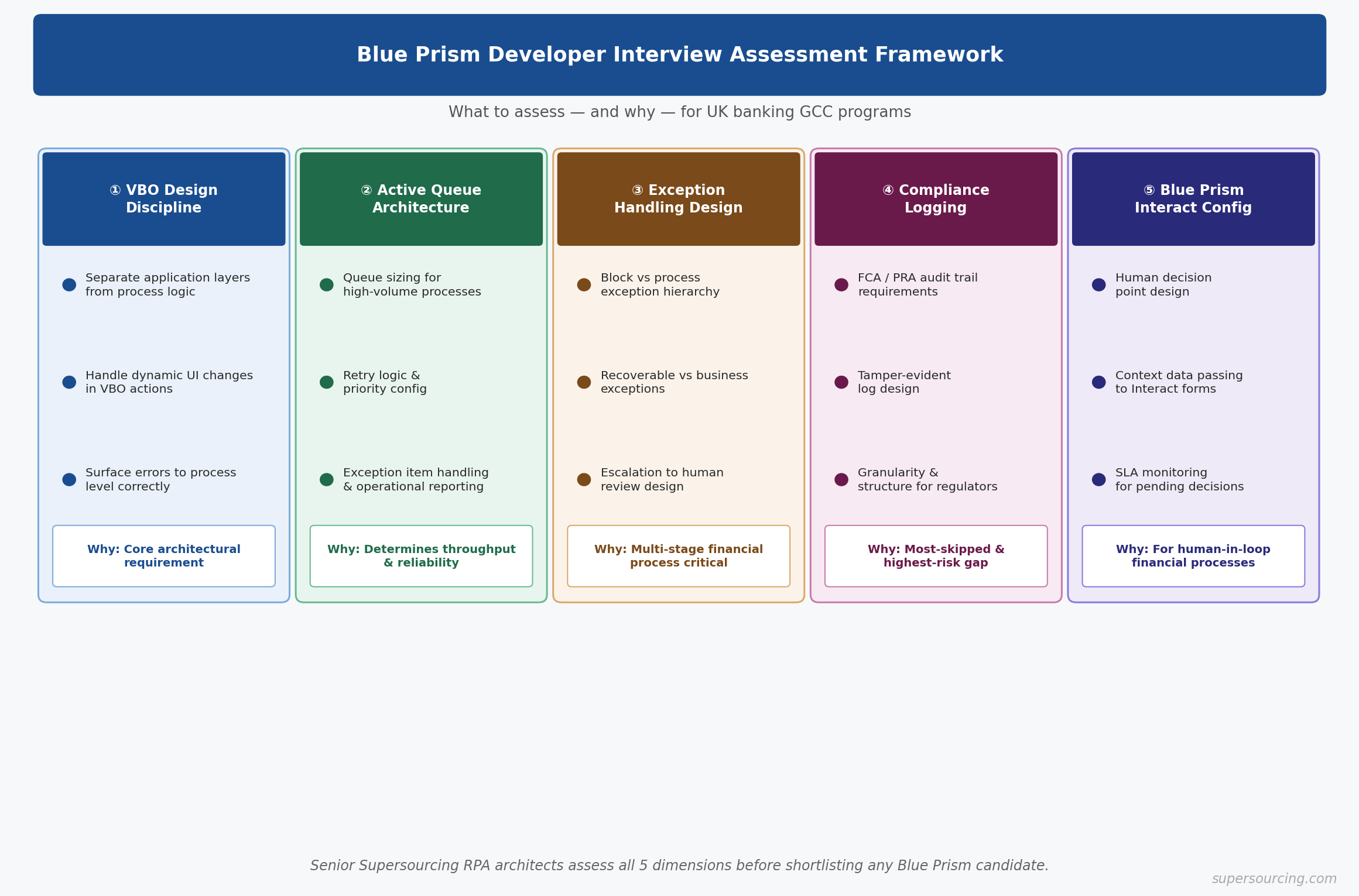
What to Actually Assess in a Blue Prism Developer Interview
VBO design quality and the object separation discipline.
The most important Blue Prism architectural assessment. Ask the candidate to explain how they design a VBO for a web application, how they structure pages as separate actions, how they handle dynamic elements that change between application versions, and how they design the action interface for reusability across multiple processes.
Ask specifically about error handling within VBOs, how they surface application exceptions back to the calling process for handling at the process level. Developers who embed all application interaction logic directly in process flows, who do not apply the VBO separation discipline, are not building to Blue Prism’s architectural standard.
Active Queue design and management.
Ask the candidate to explain how they design an Active Queue for a high-volume financial services process how they size the queue, how they handle queue item priority, how they configure retry logic for items that fail on first attempt, how they design the exception handling that marks items as exceptions with appropriate detail for human review, and how they build the queue monitoring and reporting that operations teams use to track automation performance.
Candidates who have only used queues superficially will give generic answers without the operational detail that real queue management experience produces.
Exception handling architecture Blue Prism specific.
Blue Prism’s exception handling model uses a hierarchical approach to block exceptions (handled within a process block), process exceptions (propagated to the calling process), and unhandled exceptions (visible in the Blue Prism Control Room as pending cases).
Ask the candidate to explain how they design exception handling for a multi-stage financial process how they differentiate between recoverable application exceptions (retry the action) and business exceptions (the transaction data has a validation error), how they log exception detail for audit trail requirements, and how they design the escalation to human review for transactions that cannot be automatically resolved.
Audit trail and compliance logging design.
Financial services Blue Prism programs operate in regulated environments where every robot action may be subject to regulatory audit. Ask the candidate how they design audit logging, what they log, at what granularity, how they ensure logs are tamper-evident, and how they structure logging to meet the specific audit requirements of financial services regulators (FCA, PRA for UK banking).
Developers who do not think about compliance logging as a first-class concern in financial services automation design are not ready for UK banking GCC programs.
Blue Prism Interact configuration for human-in-the-loop processes.
For financial services processes that require human oversight at specific decision points, lending credit decisions, AML alert review, and fraud exception handling, Blue Prism Interact provides the collaboration interface.
Ask the candidate to explain how they have designed an Interact form for a specific human decision point how they pass context data from the automated process to the Interact form, how they configure form validation, how they handle the response back to the automation process, and how they design the SLA monitoring for pending human decisions.
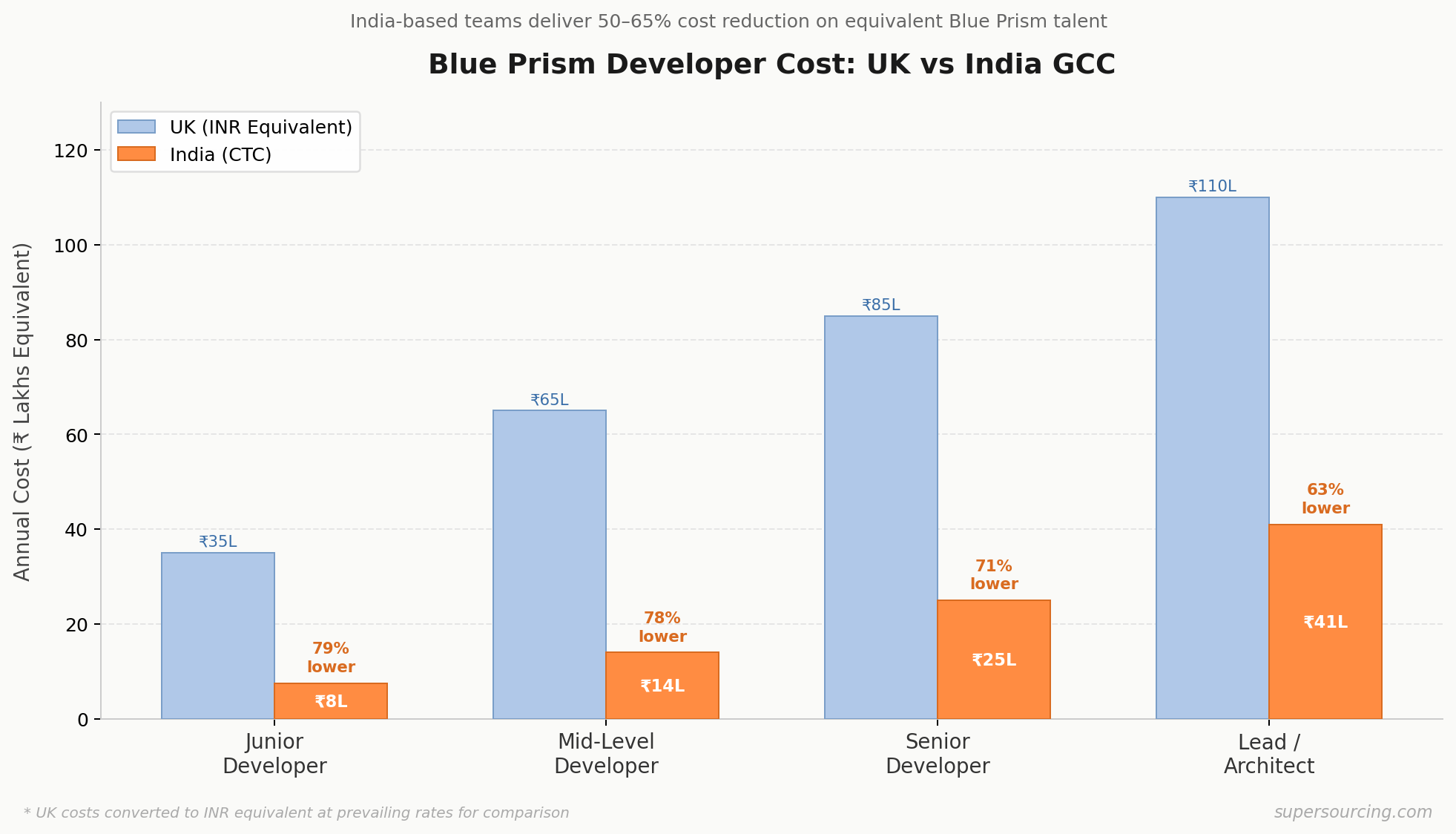
Why UK Banking GCCs Are Building Blue Prism Teams in India
UK banking global capability centers in India primarily Bangalore, Hyderabad, and Pune are building permanent Blue Prism automation teams for several converging reasons.
The cost advantage is real and significant. A senior Blue Prism developer in the UK commands £55,000–£90,000 per year. An equivalent India-based developer with the same depth costs 50–65% less in total employment cost. For programs with 20–50 automation developers, this is a material cost reduction on a long-term program budget.
The operational advantage is growing. India-based Blue Prism teams have demonstrated that they can operate at the quality and delivery standard that UK financial services require: the compliance logging, the VBO architecture discipline, the Active Queue management, and the exception handling design that regulated automation demands. The concerns about quality parity that existed 5 years ago have been resolved by the track record of Indian IT services firms delivering Blue Prism for UK banks over the last decade.
The talent supply is more accessible. UK Blue Prism developers at senior level are genuinely scarce and the competition from financial services automation programs is intense. India-based sourcing through a specialist like Supersourcing, drawing from the India Blue Prism talent pool built through UK banking SI delivery, provides faster access to the right profiles than direct UK market hiring.
The 3 Most Common Blue Prism Hiring Mistakes
Hiring UiPath developers and assuming they can transition to Blue Prism quickly.
The VBO separation discipline, the Active Queue model, and the Blue Prism-specific exception handling hierarchy are architecturally different from UiPath’s approach. A strong UiPath developer joining a Blue Prism program without specific Blue Prism assessment will default to UiPath patterns embedding application interactions in process flows rather than VBOs, not designing to Blue Prism’s queue model and creating technical debt from the first sprint.
Not assessing compliance logging and audit trail design for financial services programs.
This is the assessment dimension most often skipped in Blue Prism hiring for BFSI. Every UK banking GCC Blue Prism program operates in a regulatory environment where automation audit trails may be reviewed by the FCA or PRA. A developer who does not design compliance logging as a first-class concern is not equipped for a UK banking automation program regardless of their Blue Prism technical skills.
Underestimating the Active Queue design as an architecture skill.
Many Blue Prism developers have used queues without having genuinely designed queue architecture sizing, retry configuration, priority management, exception item handling, and operational reporting. For high-volume financial IT services automation, queue design determines throughput, reliability, and the operational team’s ability to manage the automation. Assess Active Queue design depth explicitly for senior roles.
How Supersourcing Sources and Vets Blue Prism Developers
Our senior RPA architects assess every Blue Prism developer shortlist VBO design discipline, Active Queue management design, exception handling architecture, compliance logging design for financial services, Blue Prism Interact configuration, and Decipher IDP pipeline design for document processing automation.
For UK banking GCC buyers specifically, we assess financial services domain awareness of the UK regulatory environment, FCA and PRA compliance implications for automated processes, and the operational governance model that regulated financial services automation requires.
Shortlist in 48 hours. Optional Barrister or interview.io technical interviews arranged by us. 5,000+ engineers placed. 8% attrition. 98% joining rate. 14-day free replacement.
FAQ
What is the difference between Blue Prism and UiPath for hiring?
Blue Prism uses a VBO (Visual Business Object) architecture that separates application interaction from process logic more disciplined and more maintainable but requires developers who apply the separation correctly. UiPath allows embedding application interactions directly in process workflows faster to start but easier to build architectural debt. Blue Prism’s Active Queue model and compliance logging are specifically designed for regulated financial services environments. They are not interchangeable skills.
What Blue Prism certifications should I require?
Blue Prism ROM Developer for mid-level roles. Blue Prism Professional Developer for senior developers. Blue Prism Architect for architecture and practice lead roles. Combine with real VBO design and Active Queue management assessment in every interview.
Can you place Blue Prism developers with UK financial services domain experience?
Yes. UK financial services domain awareness FCA/PRA regulatory context, UK banking process knowledge, compliance logging requirements is assessed for UK banking GCC roles. We calibrate the domain assessment to your specific automation program context.
Can someone outside Supersourcing technically interview the Blue Prism candidate?
Yes. Optional Barraiser, interview.io, or direct round with your own Blue Prism lead arranged by us, zero effort on your side.
What is your replacement policy?
Free replacement within 14 days. No charge, no questions.
Do I need a legal entity in India?
No. We act as Employer of Record payroll, PF, ESIC, TDS, all statutory compliance handled by us.
What is the realistic hiring timeline for a senior Blue Prism developer in India without Supersourcing?
8–12 weeks through standard job postings the talent pool is smaller than UiPath. Through Supersourcing: 48-hour shortlist, hire within 7 days.
Talk to Us About Your Blue Prism Requirement
If you are building a Blue Prism automation team in India for a UK banking GCC, European financial services program, or insurance automation initiative I am usually the one on those calls.
Email: mayank@supersourcing.com Or book a meeting directly at supersourcing.com
Tell us your Blue Prism version, automation program scope, regulatory compliance requirements, and team composition. Shortlist in 48 hours from there.
No retainer until you hire. Replacement clause on every engagement.
Mayank Pratap Singh · Co-founder, Supersourcing Google AI Accelerator · LinkedIn Top 20 Startups India · 5,000+ Engineers Placed · 1,000+ Companies · 17 Fortune 500s
