

Most companies underestimate the skill gap when they set out to hire Snowflake engineer India talent for the first time. They post a JD, screen for SQL knowledge, and assume the rest follows. Six months later, they’re dealing with runaway credit costs, an unoptimized warehouse, and pipelines that break every other Monday.
This is where hiring Snowflake engineer India becomes a strategic decision rather than a routine hiring task. Snowflake is not just a database, it is a cloud-native data platform with its own cost model, compute behavior, and performance tuning requirements.
The urgency is driven by how central data platforms have become to modern businesses. According to Snowflake, its platform processed over 3 billion queries daily across global customers, highlighting the scale at which modern data systems operate and the need for specialized engineering expertise.
For companies, the challenge is not just hiring data engineers but hiring Snowflake specialists who can optimize performance, control costs, and build resilient data pipelines from day one.
Snowflake is not just a database. It’s a distributed, cloud-native data platform with its own cost model, compute architecture, and performance levers and hiring for it requires a fundamentally different evaluation lens than standard SQL or cloud roles.
TL;DR: What You Need to Know Before You Hire Snowflake Engineer India
Snowflake developer salary India ranges from ₹5–10 lakhs for juniors to ₹40–60 lakhs for architects. Add 20–25% for benefits and tooling. Senior profiles take 10–16 weeks to fill on the open market.
The real skill gap is not Snowflake alone. Production teams need dbt, Airflow, Kafka, and Terraform alongside it. Candidates who only know SQL are a ramp cost not a hire.
Most companies make the same five mistakes: treating Snowflake as a SQL skill, skipping DBT in the JD, ignoring cost-optimization questions, over-indexing on certifications, and scoping the stack too late. This blog tells you exactly how to avoid all five.
What Is a Snowflake Engineer?
A Snowflake data engineer India role refers to a professional who designs, builds, and maintains data pipelines, schemas, and transformations on the Snowflake cloud data platform. This includes warehouse configuration, role-based access control, ELT pipeline design, performance tuning, and integration with adjacent tools like DBT, Airflow, Kafka, and Terraform.
Why Hiring Snowflake Talent in India Is Harder Than It Looks
The supply of engineers who have worked deeply on Snowflake is far smaller than the pool of engineers who list it on a resume. Companies building data warehouse modernization teams in India particularly for GCC mandates typically discover this gap within the first hiring cycle.
Here’s the reality: there are roughly three categories of candidates in the market:
- Engineers with 6–18 months of Snowflake exposure in a supporting role
- Mid-level professionals who have built pipelines but haven’t owned architecture decisions
- Senior architects who understand Snowflake virtual warehouse sizing, clustering keys, query optimization, and cost governance end-to-end
The third category is in short supply. Demand from GCC teams, product startups, and global consultancies is competing for the same 3,000–5,000 genuinely senior practitioners across Bengaluru, Hyderabad, Pune, and Chennai.
Timelines reflect this. Filling a mid-senior Snowflake data engineer India role typically takes 6–10 weeks on the open market. A Snowflake Architect with DBT and Airflow experience can take 12–16 weeks if you’re relying purely on inbound JD responses.
Snowflake Developer Salary India: Current Benchmarks
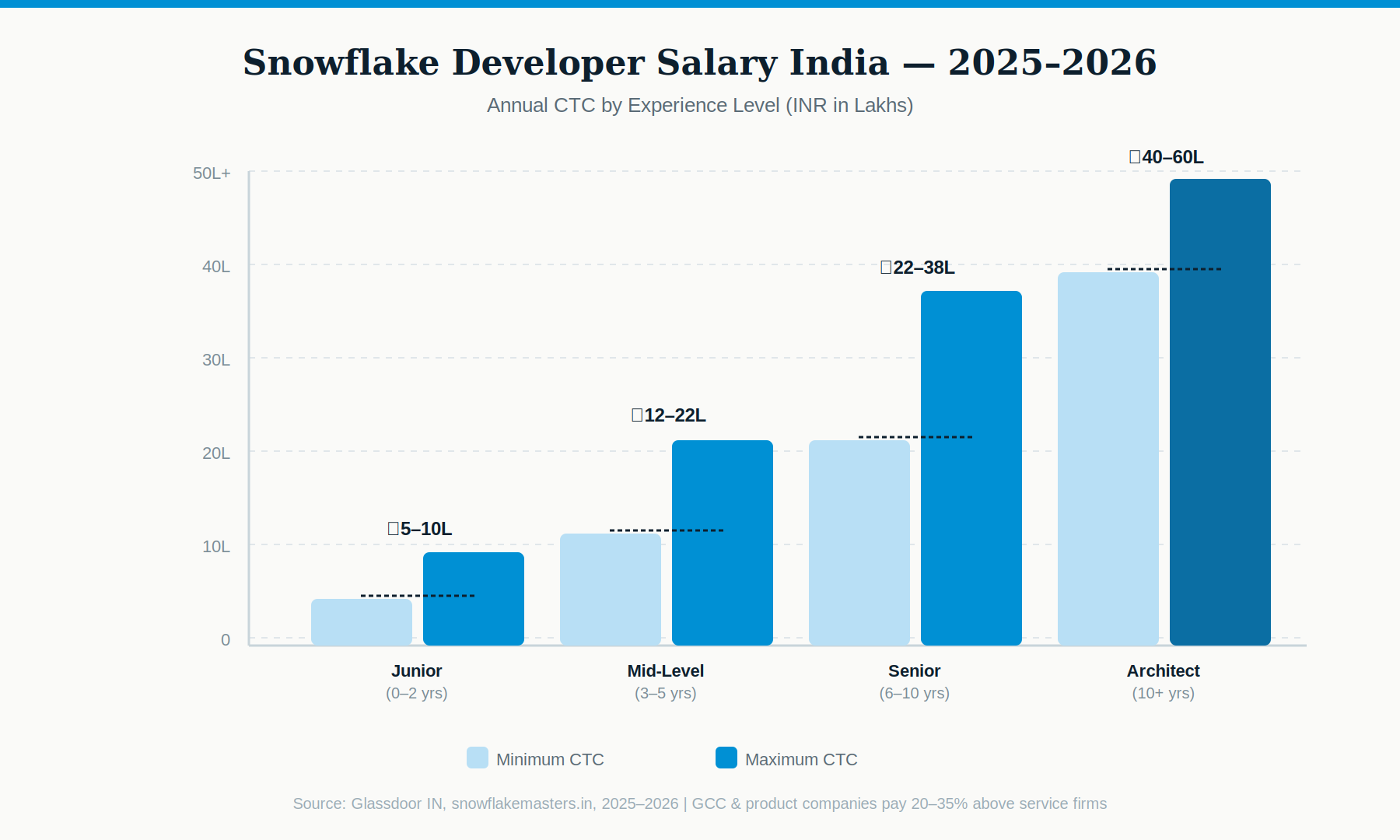
Snowflake developer salary India varies significantly by experience tier, city, and company type. Product companies and GCCs consistently pay 20–35% more than service firms for the same profile.
Current salary ranges as of 2025–2026:
| Experience Level | Annual CTC (INR) | Notes |
| 0–2 years (Junior) | ₹5–10 lakhs | Often SQL + basic Snowflake exposure |
| 3–5 years (Mid) | ₹12–22 lakhs | DBT, pipeline ownership, some tuning |
| 6–10 years (Senior) | ₹22–38 lakhs | Architecture, cost optimization, governance |
| 10+ years (Architect/Lead) | ₹40–60 lakhs | Full-stack data platform ownership |
The Snowflake developer cost for a senior hire is therefore not just the CTC add 20–25% for benefits, infra tooling, and onboarding overhead, and you’re looking at an all-in Snowflake developer cost closer to ₹50–70 lakhs per year for a genuinely experienced engineer.
The Core Technical Stack: What to Look For Beyond Snowflake
Hiring managers often scope the JD around Snowflake and SQL, then discover post-hire that the role demands a broader stack. Snowflake DBT hiring is the most common adjacent requirement; most mature data teams now use DBT for ELT transformation layers on top of Snowflake, and the two tools are deeply interlinked in architecture.
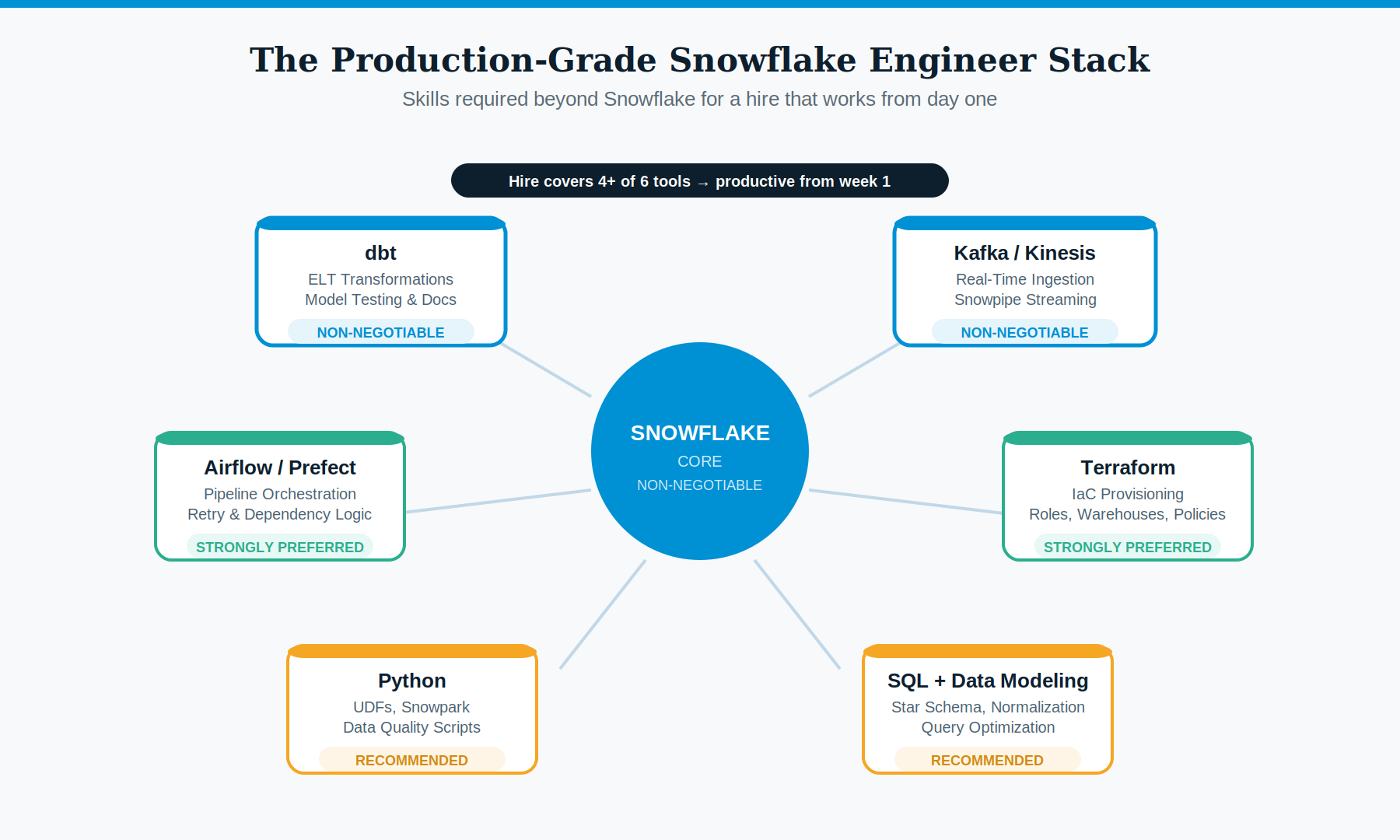
Here is the full stack most production-grade Snowflake data teams require:
- Snowflake core virtual warehouse management, clustering keys, materialized views, data sharing, Snowpipe, streams, tasks
- DBT (data build tool) model structuring, testing, documentation, incremental builds on Snowflake
- Apache Airflow or Prefect orchestration for multi-step pipelines, retry logic, dependency management
- Apache Kafka or AWS Kinesis real-time or near-real-time ingestion into Snowflake via Kafka connector or Snowpipe Streaming
- Terraform infrastructure-as-code for provisioning Snowflake warehouses, databases, roles, and network policies
- Python UDFs, stored procedures, data quality scripts, Snowpark for in-warehouse compute
Candidates who cover at least four of these six with Snowflake and DBT as non-negotiable are the productive hires. Candidates who only cover two are often being upskilled on your budget.
Snowflake DBT Hiring: Technical Vetting Process
Step 1: Screen for Core Snowflake Architecture Knowledge
Ask for a real example of a Snowflake architecture decision they owned. Listen for specifics: warehouse sizes chosen and why, clustering key selection rationale, cost-per-credit optimization strategies. Vague answers about “data pipelines” are a red flag.
Step 2: Test DBT Proficiency with a Practical Task
Give a take-home: a small dataset, a schema design task, and a DBT model to write. Evaluate incremental model logic, ref() usage, and test coverage. Strong analytics engineering candidates will structure this instinctively.
Step 3: Probe Orchestration and Integration Experience
Ask how they’ve handled late-arriving data in Snowflake. How did they use Airflow or Prefect to manage dependencies? What’s their Kafka-to-Snowflake ingestion pattern? These questions differentiate architects from pipeline assemblers.
Step 4: Verify Snowflake SnowPro Certification (Where Applicable)
Snowflake SnowPro certification (Core or Advanced) is a useful signal for mid-to-senior roles, but it’s not a substitute for practical evaluation. Treat it as a filter, not a hiring criterion.
Step 5: Assess Data Governance and Security Awareness
For GCC mandates and enterprise teams, data governance Snowflake competency is critical. Ask how they’ve implemented row-level security, dynamic data masking, or column-level access control. This separates engineers who’ve worked in regulated environments from those who haven’t.
Real-World Application: How GCC Teams Are Hiring Snowflake Engineers in India
Case 1: A US-based fintech built a 12-person data engineering team in Bengaluru for its GCC. They initially hired generalist data engineers and tried to upskill on Snowflake internally. After 9 months, only 3 of 12 were productive on Snowflake architecture decisions. A targeted rehire with Snowflake-specific vetting criteria reduced that ramp time to 6–8 weeks per engineer.
Case 2: A European retail analytics firm setting up a data platform team in Hyderabad underestimated the Snowflake DBT hiring gap. Their initial JD attracted 200+ applicants, but only 11% had hands-on DBT experience on Snowflake. Adding a practical DBT screening task reduced interview cycles from 6 rounds to 3 while improving offer-to-join ratio by 30%.
Full-Time vs. Staffing Firm vs. Dedicated Hiring Partner
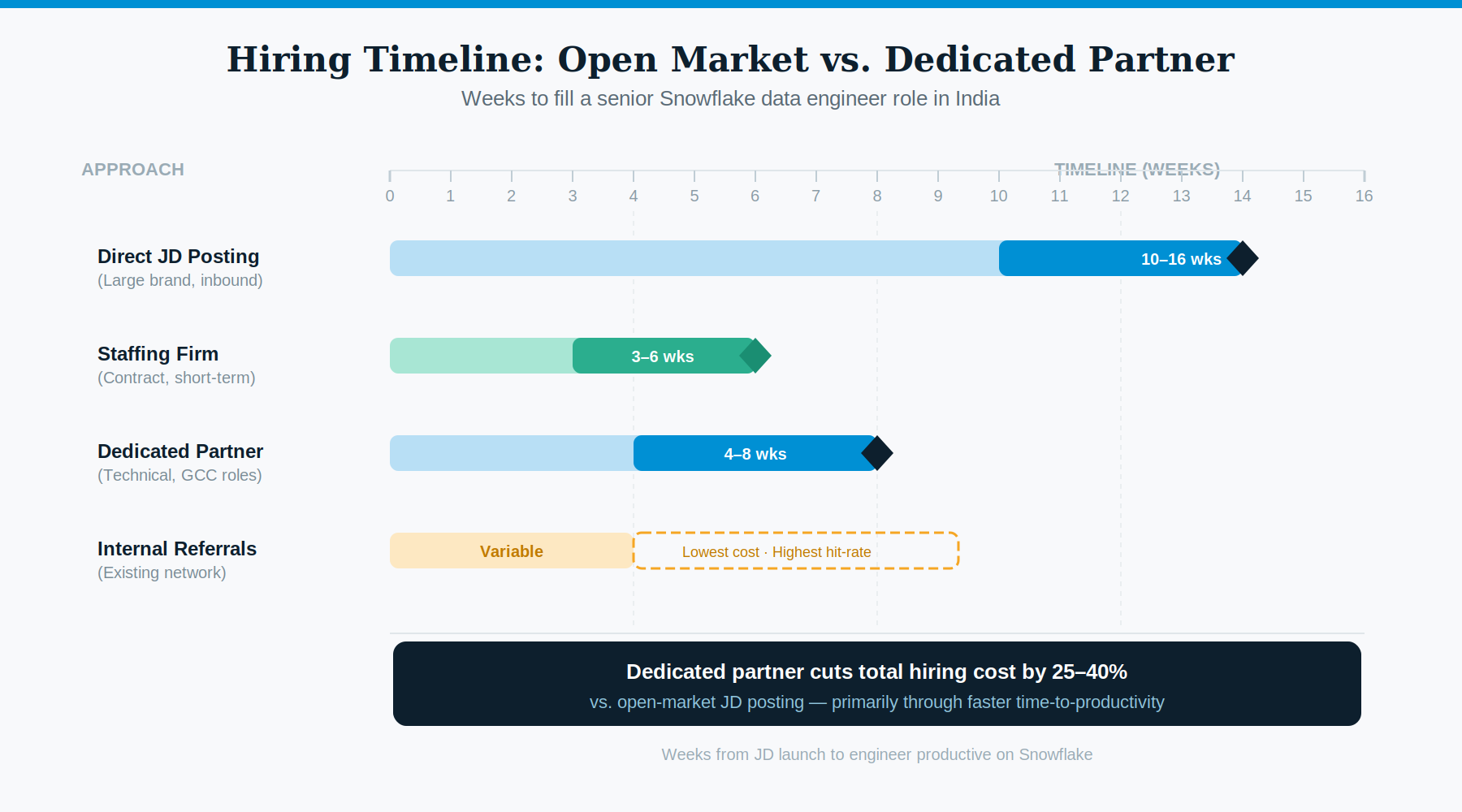
| Approach | Best For | Typical Timeline | Cost Consideration |
| Direct JD posting | Large brands with inbound pull | 10–16 weeks | Low agency fee, high sourcing time |
| Staffing firm (contract) | Short-term or exploratory roles | 3–6 weeks | 15–25% markup on CTC |
| Dedicated hiring partner | Niche technical roles, GCC buildouts | 4–8 weeks | Flat fee or % of CTC, deeper vetting |
| Internal referrals | Existing network with Snowflake exposure | Variable | Lowest cost, highest hit-rate |
For most GCC and product data teams looking to hire Snowflake engineer India at senior levels, a dedicated teams & technical hiring partner with domain-specific vetting reduces total hiring cost by 25–40% compared to open-market JD posting cycles primarily through reduced time-to-productivity.
What Most Teams Get Wrong When They Hire Snowflake Engineers in India
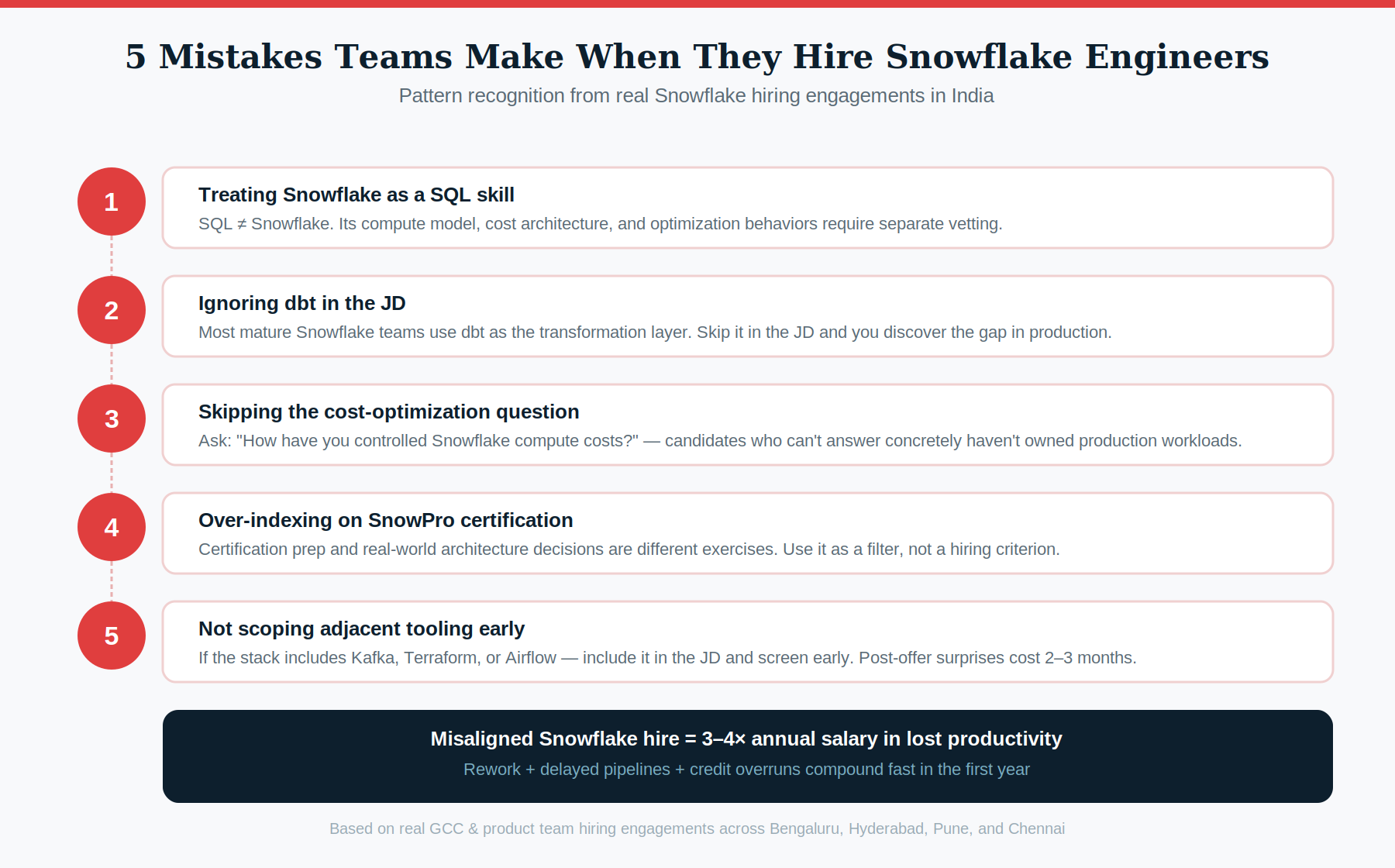
Mistake 1: Treating Snowflake as a SQL skill.
Snowflake has its own compute model, query optimization behaviors, and cost architecture. An engineer who can write complex SQL is not automatically productive on Snowflake. Screen separately.
Mistake 2: Ignoring DBT in the JD.
Most mature Snowflake data teams run DBT as the transformation layer. Hiring a Snowflake engineer without assessing DBT competency is like hiring a React developer without asking about state management. The gap shows up immediately in production.
Mistake 3: Skipping the cost-optimization question.
Credit costs on Snowflake can spiral without proper warehouse sizing and suspension policies. Ask every candidate: “How have you controlled Snowflake compute costs in a production environment?” Candidates who can’t answer concretely have not owned production workloads.
Mistake 4: Over-indexing on certifications.
Snowflake SnowPro certification is a useful baseline, not a capability signal. Multiple candidates with Core certifications have failed basic architecture assessments because certification prep and real-world columnar storage architecture decisions are different exercises.
Mistake 5: Not scoping adjacent tooling early.
If your stack includes Kafka, Terraform, or Airflow, include these in the JD and screen early. Discovering a post-offer that your new hire has never used Kafka adds 2–3 months of ramp time you haven’t budgeted for.
Frequently Asked Questions
What is the average Snowflake developer salary in India?
Mid-level Snowflake developer salary India sits at ₹12–22 lakhs per annum for professionals with 3–5 years of experience and practical DBT exposure. Senior engineers and architects command ₹25–45 lakhs, with GCC and product companies paying at the higher end. All-in Snowflake developer cost including benefits and tooling adds 20–25% to base CTC.
How do I verify a Snowflake engineer’s skills before hiring?
The most reliable method is a structured take-home assessment: give a schema design task, a DBT model to write, and one optimization question (e.g., how to reduce warehouse runtime for a specific query pattern). Combine this with a technical interview focused on real Snowflake architecture decisions they’ve made. Resumes and certifications alone are insufficient.
What is the difference between a Snowflake developer and a Snowflake architect?
A Snowflake developer builds and maintains pipelines, models, and transformations within a defined architecture. A Snowflake architect designs the platform itself, warehouse strategy, cost governance model, data sharing setup, role hierarchy, and integration patterns with upstream and downstream systems. Architects typically have 7+ years of data engineering experience with 3+ years specifically on Snowflake.
What skills should a Snowflake DBT engineer have?
For Snowflake DBT hiring, look for: proficiency in DBT Core or Cloud, experience writing incremental models on Snowflake, knowledge of DBT testing and documentation standards, and understanding of how DBT interacts with Snowflake’s query engine and caching behavior. Python is a strong complement, especially for custom macros and Snowpark-based workflows.
Should I hire a Snowflake engineer full-time or through a staffing firm in India?
For roles that will own production data platforms, full-time hires with equity or performance incentives produce better retention and output. Staffing firms work well for short-term augmentation (3–6 months), skill gap filling during transitions, or when you need to move fast without a defined long-term headcount. For GCC core team buildouts, full-time is almost always the right structure.
How long does it take to hire a senior Snowflake data engineer in India?
On the open market, 10–14 weeks is realistic for a senior profile. With a specialist hiring partner using pre-screened pipelines, that compresses to 4–7 weeks. The critical path is technical vetting: most teams that rush this step make a bad hire and restart the process 3–4 months later.
Is Snowflake experience available in Tier-2 cities in India?
Meaningful Snowflake depth is concentrated in Bengaluru, Hyderabad, Pune, and Chennai. Tier-2 cities like Indore, Jaipur, and Coimbatore have growing data engineering communities but limited senior Snowflake-specific talent pools. Remote-first hiring expands options significantly, and many GCC teams now structure India data roles as a hybrid to access talent beyond the top-4 cities.
Ready to Hire Snowflake Engineers in India Without the Guesswork?
Building a Snowflake data engineering team in India requires a precise hiring process, one that goes beyond job descriptions and LinkedIn filters. The cost of a misaligned hire (rework, delayed pipelines, credit overruns) typically runs 3–4x the annual salary in lost productivity over the first year.
If you’re planning a Snowflake data platform buildout whether for a GCC, product team, or enterprise data function and want a structured vetting approach before committing to headcount, Supersourcing has run this hiring process across multiple engagements. Reach out to pressure-test your current JD, stack requirements, and interview framework before your next hire.
