

The $3.4M Guidewire Program Where the Wrong Product Expertise Arrived
A US-based regional P&C insurer $1.2B GWP, personal and commercial lines, legacy Duck Creek policy administration decided to modernise. The brief: implement Guidewire PolicyCenter for personal lines, Guidewire BillingCenter for premium billing, and Guidewire ClaimCenter for first-party property claims. Twenty months. Thirteen India-based Guidewire developers. $3.4M.
The vendor presented a credible Guidewire practice. Guidewire implementations across multiple carriers. All three InsuranceSuite products. The CVs listed Guidewire certifications and insurance domain experience.
What the program discovered at month five: eight of the thirteen developers had their primary Guidewire experience on ClaimCenter. Three had BillingCenter experience. Two had PolicyCenter experience, one of whom had only worked on ClaimCenter integration with PolicyCenter, not PolicyCenter implementation itself. The program’s largest workstream was PolicyCenter. The smallest was ClaimCenter.
Hiring guidewire developers from India is no longer just about cost efficiency. The real risk lies in hiring teams without the right product alignment for your core implementation workstreams.
This challenge is growing in 2026. According to Statista, global IT services spending is projected to exceed $1.5 trillion, driven by enterprise modernization initiatives, including core insurance platform transformations.
The vendor restructured the team at month seven bringing in PolicyCenter specialists from the US market at significant rate premium. Program extended by 6 months. Additional spend: $720K.
The product-specific experience question which Guidewire InsuranceSuite products, at what depth, in what insurance line would have surfaced this imbalance before a single SOW was signed.
TL;DR 8 Answers Before You Read Further
| Question | Answer |
| What does a Senior Guidewire Developer cost from India? | $52–80/hr fully loaded. A Guidewire Solution Architect runs $100–145/hr. Section 5 has the full rate stack. |
| What's the single most important thing to verify? | Which Guidewire product PolicyCenter, ClaimCenter, or BillingCenter. Each is a different configuration domain. Experience on one does not transfer to the others without specific retraining. |
| Which Indian city has the deepest Guidewire talent? | Pune dominates. The largest Guidewire talent pool in India is in Pune, primarily through TCS, Cognizant, and Wipro's Guidewire practices. |
| What certification actually matters? | Guidewire ACE (Aces Certification for Engineers) program. Product-specific ACE certifications ACE PolicyCenter, ACE ClaimCenter, ACE BillingCenter. Verify the specific product on the certification. |
| Is there a public Guidewire certification registry? | Partially. Guidewire's ACE certifications are visible on Guidewire's partner portal for verified partners. Candidates can share their ACE certification directly. Verify the product name on the certification. |
| How many Guidewire architects are in India? | Approximately 280 Guidewire Solution Architects with production implementation experience across all three products. The total Guidewire-experienced pool is approximately 4,200 but product concentration means most experience is on one or two products, not all three. |
| What's typical attrition for Guidewire specialists? | 10–14% annually. The lowest attrition of almost any stack in this guide series. Guidewire is P&C insurance only specialists that have very limited lateral options outside the insurance technology ecosystem. |
| What's the biggest hiring mistake? | Not specifying which Guidewire product. "Guidewire experience" is as underspecified as "SAP experience" ; the product matters as much as the platform. |
Are You Actually Ready for This?
Guidewire programs are P&C insurance implementations; the regulatory complexity, underwriting rule depth, and claims handling requirements make them among the most domain-intensive technology programs in enterprise software. Buyer readiness requires both technology clarity and insurance domain clarity.
Score each: 0 (not in place), 2 (partially), 4 (done).
| # | Criterion | Score |
| 1 | Named Guidewire program owner with insurance technology domain knowledge | 0/2/4 |
| 2 | InsuranceSuite product scope confirmed PolicyCenter, BillingCenter, ClaimCenter, or combination | 0/2/4 |
| 3 | On-premise vs Guidewire Cloud deployment model decided | 0/2/4 |
| 4 | Insurance line scope defined personal lines, commercial lines, or both | 0/2/4 |
| 5 | Rating engine scope confirmed Guidewire Rating or third-party rating tool | 0/2/4 |
| 6 | Legacy system data migration scope documented policy, billing, and claims history | 0/2/4 |
| 7 | Interview panel with Guidewire product-specific experience available within 5 business days | 0/2/4 |
| 8 | Legal SLA under 15 days for MSA review | 0/2/4 |
| 9 | Guidewire development environment provisioned for offshore team | 0/2/4 |
| 10 | Integration scope documented which external systems (payment, document, compliance) | 0/2/4 |
| 11 | KPIs defined: configuration quality, premium calculation accuracy, claims processing SLA | 0/2/4 |
| 12 | CISO signed off on offshore access to Guidewire environment with policy and claims data | 0/2/4 |
| 13 | Escalation path: vendor PM → your Guidewire Program Lead → your CTO/COO | 0/2/4 |
| 14 | IP ownership for Gosu scripts, PCF customisations, and integration configurations in MSA | 0/2/4 |
| 15 | Finance can process USD-denominated invoices within 30 days | 0/2/4 |
What your score means:
| Score | Tier | Reality Check |
| 48–60 | Scaler | Ready. |
| 34–46 | Builder | Product scope and deployment model ambiguity are the most common Guidewire program killers. Fix before signing. |
| 20–32 | Explorer | Define product scope and insurance line specifics before engaging vendors. |
| 0–18 | Pre-Stage | Guidewire programs require deep internal insurance technology ownership. Build it first. |
From the deal floor: A UK insurer scored 14 on this checklist. The rating engine scope (criterion 5) was undefined; the client hadn’t decided between Guidewire Rating and their existing third-party rater. The offshore team configured Guidewire Rating for 10 weeks before the decision was made to keep the third-party rating. Ten weeks of rating engine configuration was discarded. £210K. One decision point that should have been resolved before the SOW.
The Guidewire Talent Market in India 2026
Guidewire is a specialist platform that serves exclusively the P&C (property and casualty) insurance market. Unlike SAP, Salesforce, or ServiceNow which have broad applicability across industries, Guidewire’s market is strictly insurance. Every Guidewire developer in India has some insurance domain knowledge. This makes the Guidewire pool high-quality relative to its size but also genuinely thin relative to the demand from the global P&C insurance market.
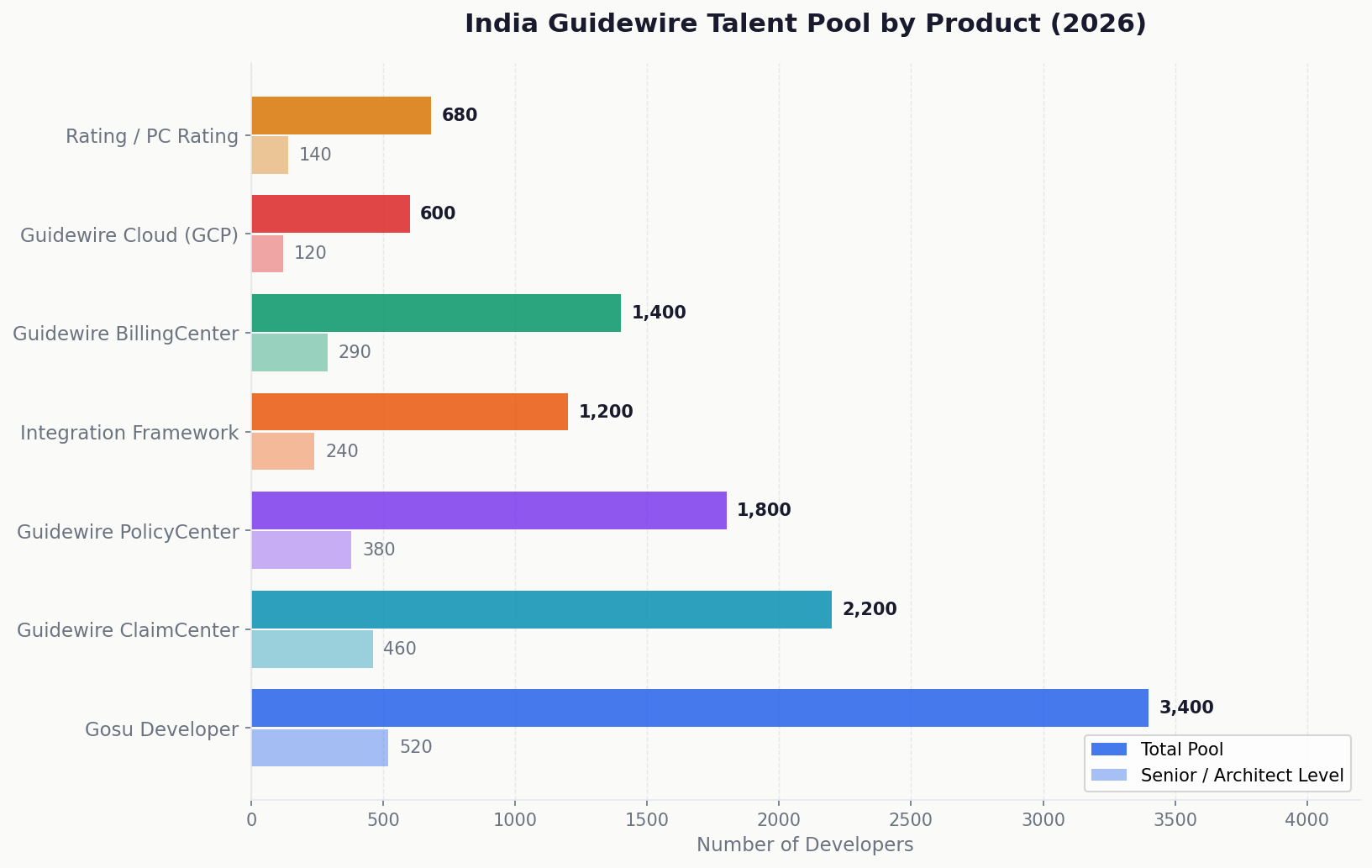
The pool overview:
| Product / Specialisation | Estimated India Pool | Senior/Architect Level |
| Guidewire PolicyCenter | ~1,800 | ~380 |
| Guidewire ClaimCenter | ~2,200 | ~460 |
| Guidewire BillingCenter | ~1,400 | ~290 |
| Guidewire InsuranceSuite (2+ products) | ~800 | ~180 |
| Guidewire Cloud (GCP-hosted) | ~600 | ~120 |
| Guidewire Integration Framework / API | ~1,200 | ~240 |
| Guidewire Rating / PolicyCenter Rating | ~680 | ~140 |
| Gosu Developer (Guidewire scripting language) | ~3,400 | ~520 |
The product specialisation reality:
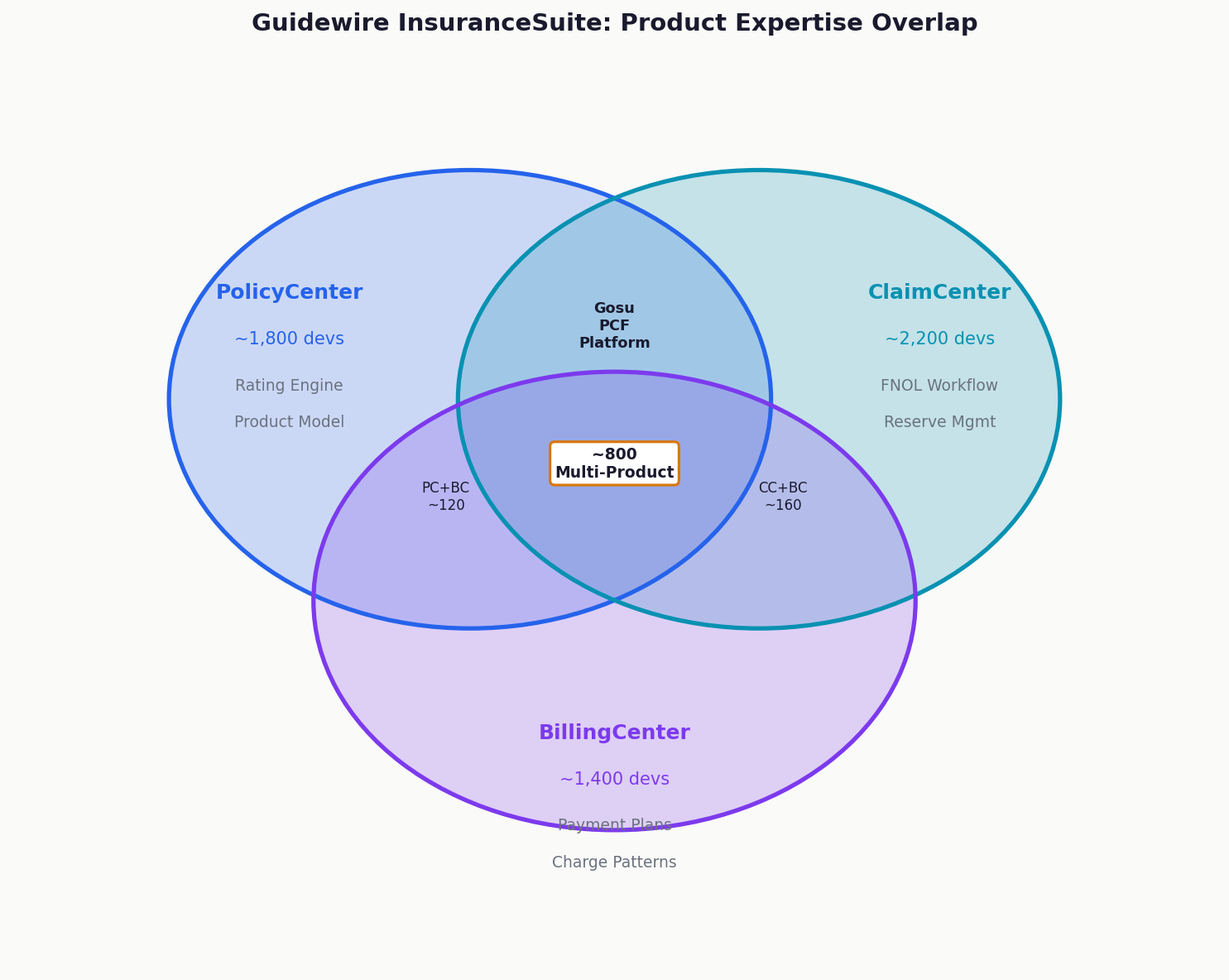
Guidewire’s three InsuranceSuite products PolicyCenter (policy administration), ClaimCenter (claims management), and BillingCenter (billing and payments) have different functional domains, different configuration objects, and different Gosu scripting contexts.
A developer who has spent 6 years on ClaimCenter has deep claims workflow knowledge, FNOL configuration experience, and claims reserve management expertise. They do not have PolicyCenter rating engine knowledge, policy lifecycle management experience, or BillingCenter payment plan configuration depth.
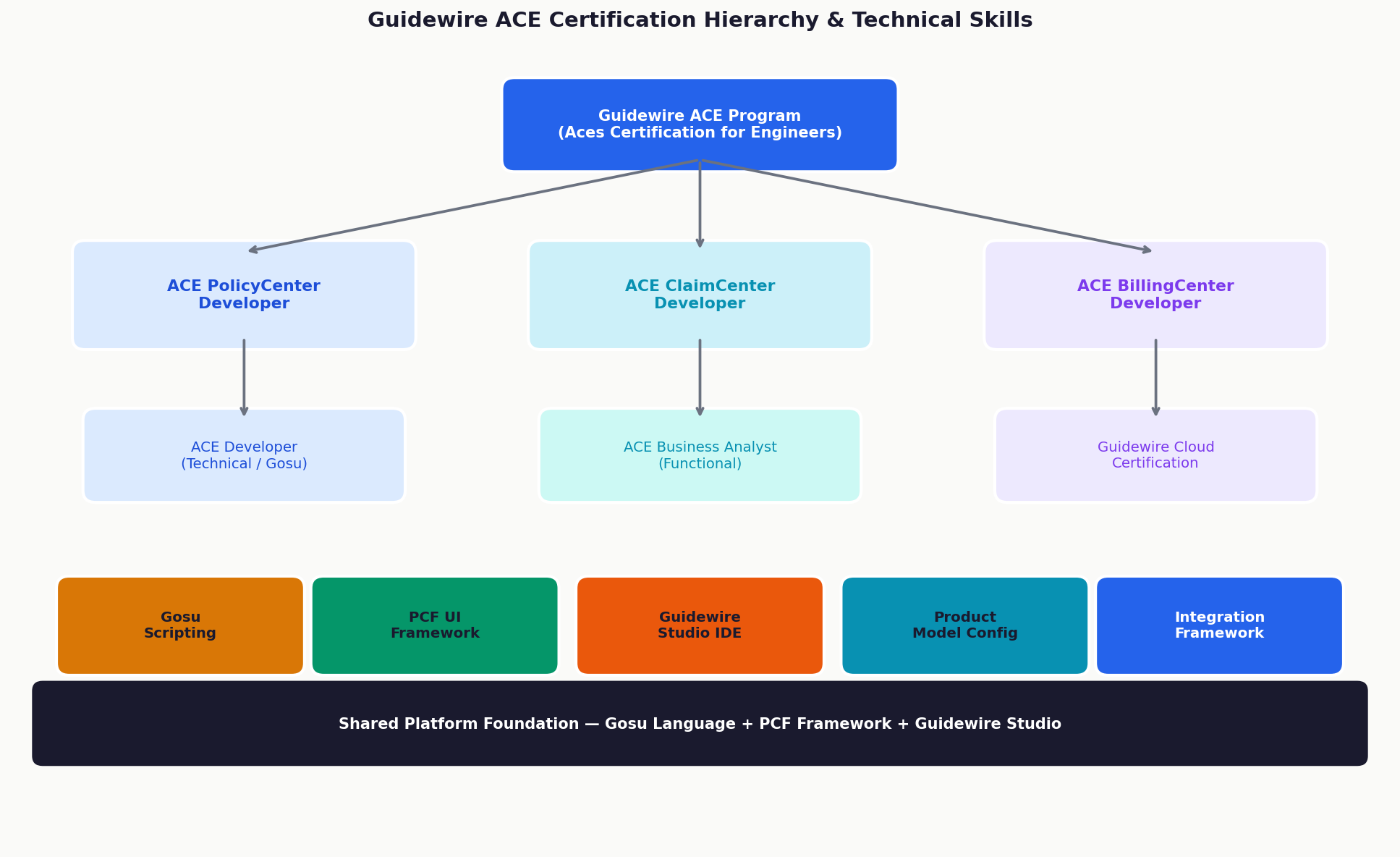
The products share Guidewire’s underlying platform, the Gosu language, the PCF (Page Configuration Files) UI framework, and the Guidewire Studio development environment. A Guidewire developer can switch products, but the business domain knowledge takes 3–6 months to acquire for a new product. For program delivery, require product-specific experience on the products in scope.
The on-premise vs Guidewire Cloud gap:
Guidewire Cloud is Guidewire’s SaaS-delivered InsuranceSuite running on Google Cloud Platform. It is architecturally different from on-premise Guidewire installations:
- On-premise Guidewire allows deep customisation using Gosu scripts and PCF modifications. Guidewire Cloud follows a “cloud-ready” approach and customisations are restricted to designated extension points, with Guidewire managing the core application.
- On-premise Guidewire manages its own upgrade cycles. Guidewire Cloud receives mandatory updates from Guidewire on a scheduled cycle.
- On-premise integration uses Guidewire’s messaging framework and direct database access in some patterns. Guidewire Cloud integrations use Guidewire’s Cloud API and Integration Framework.
A developer with exclusively on-premise Guidewire experience will have a meaningful learning curve on Guidewire Cloud not a complete retraining, but a 2–3 month ramp to understand the cloud-ready constraints and Cloud API integration patterns. For Guidewire Cloud programs, require cloud-specific experience or explicitly plan for a cloud ramp period.
Where the talent lives:
| City | Dominant Guidewire Specialisations | Why |
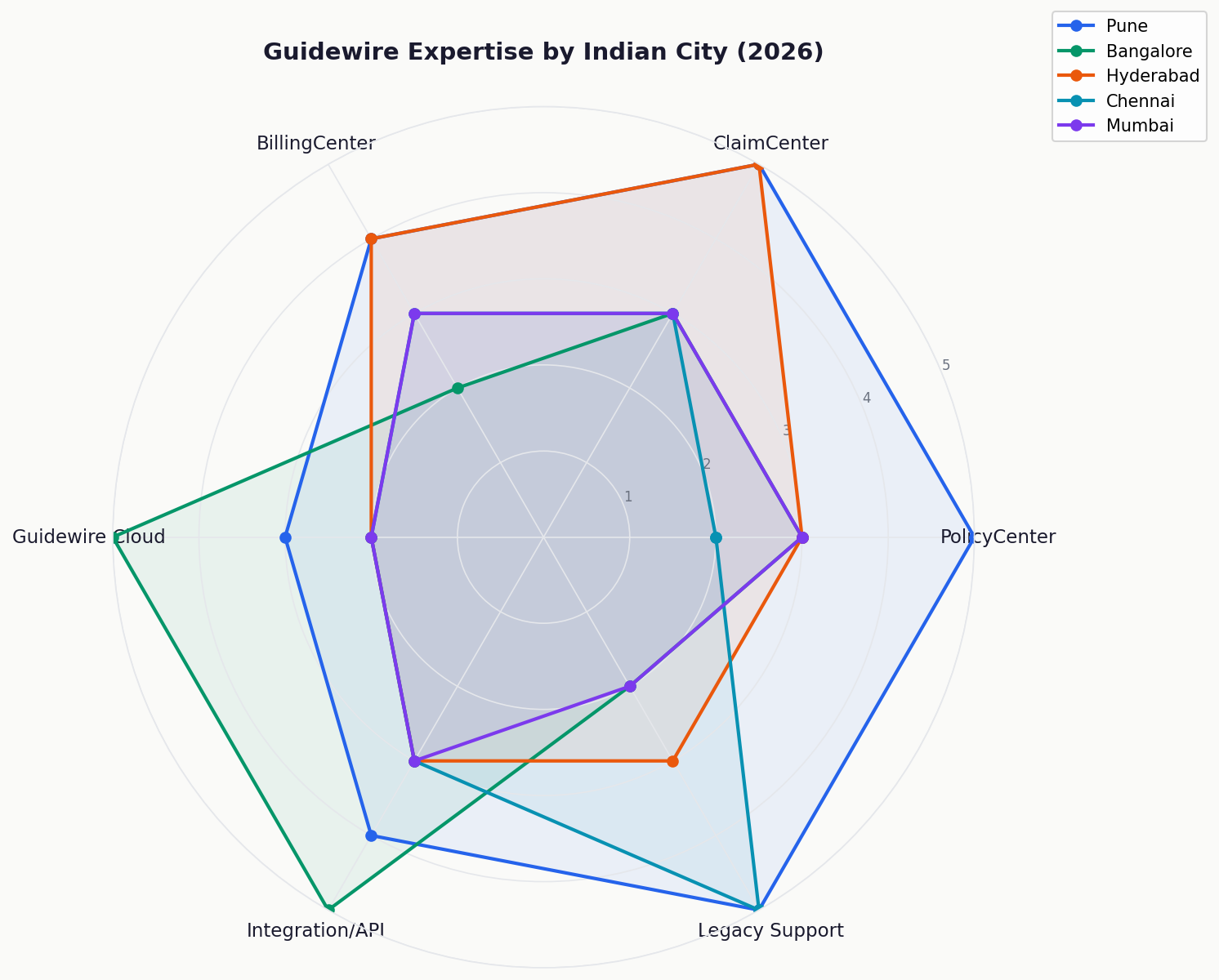
| Pune | All three InsuranceSuite products, Gosu development, data conversion | Largest Guidewire SI delivery center concentration. Cognizant, TCS, and Wipro Guidewire CoEs are in Pune. The most experienced Guidewire delivery city in India by volume. |
| Bangalore | Guidewire Cloud, Guidewire API and integration, cloud-native insurance platforms | Cloud-native technology talent. Guidewire Cloud early adoption programs. |
| Hyderabad | Guidewire ClaimCenter, Guidewire BillingCenter, technical Guidewire developer | Enterprise insurance delivery. Claims and billing-heavy programs. |
| Chennai | Guidewire legacy support and maintenance, on-premise upgrade programs | TCS/Cognizant legacy. Strong in support and upgrade work for existing Guidewire installations. |
| Mumbai | Guidewire for general insurance, commercial lines programs | Proximity to India’s general insurance market. Commercial lines Guidewire programs. |
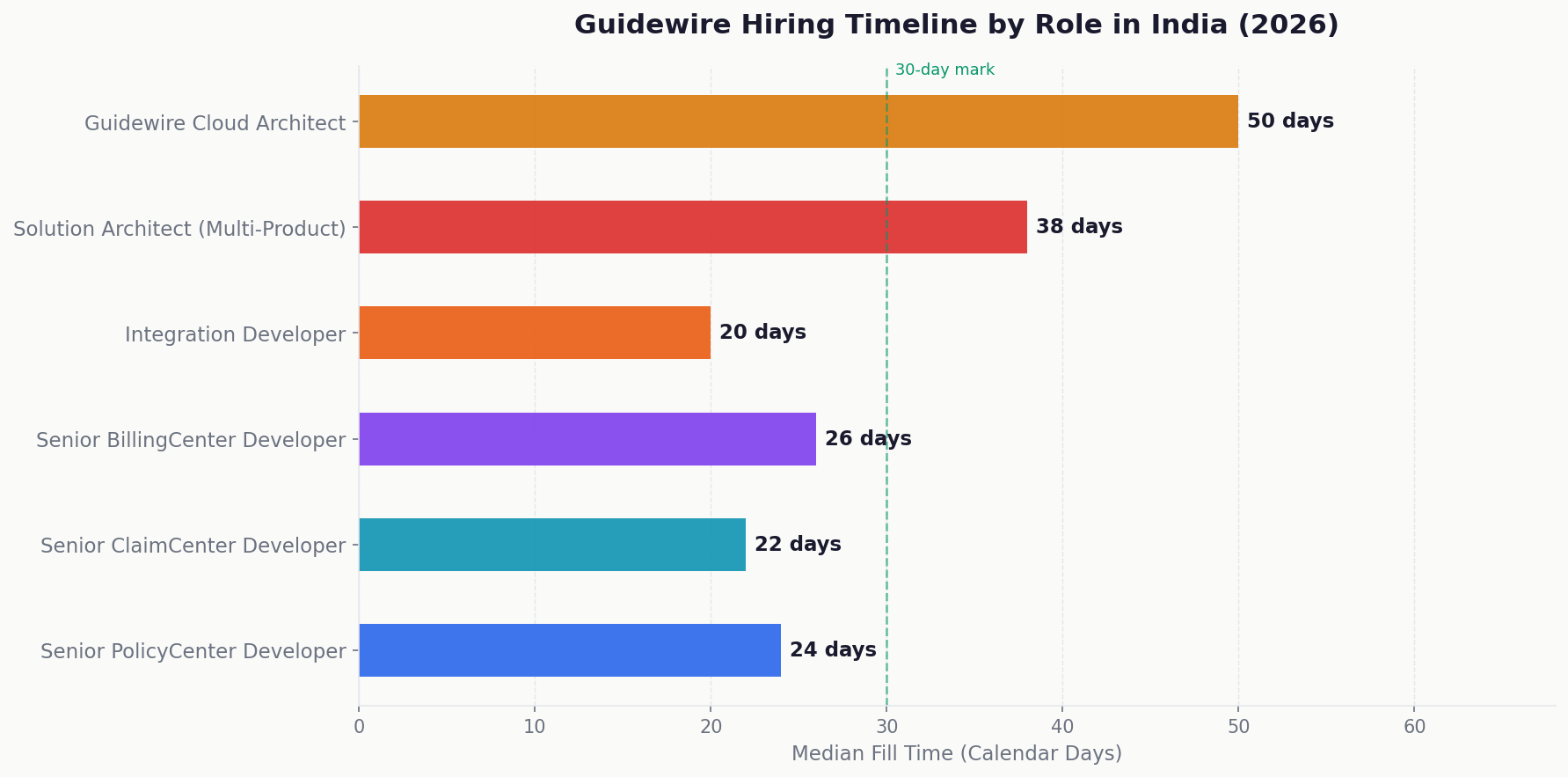
Supersourcing Index: Across 62 Guidewire placements in the Supersourcing GCC Benchmark 2026, median time-to-fill for a Senior Guidewire PolicyCenter Developer in Pune was 24 calendar days. For a Guidewire Solution Architect with PolicyCenter and ClaimCenter depth: 38 days. For a Guidewire Cloud architect with cloud-ready implementation experience: 50 days.
Red flag: Any vendor claiming full InsuranceSuite capability PolicyCenter, ClaimCenter, and BillingCenter equally without being able to produce product-specific senior consultants for each with verified project history. The insurance technology community in India is small enough that vendors with genuine multi-product depth are a small subset of all Guidewire vendors. Ask for the product breakdown of their current bench immediately.
What You’re Really Paying
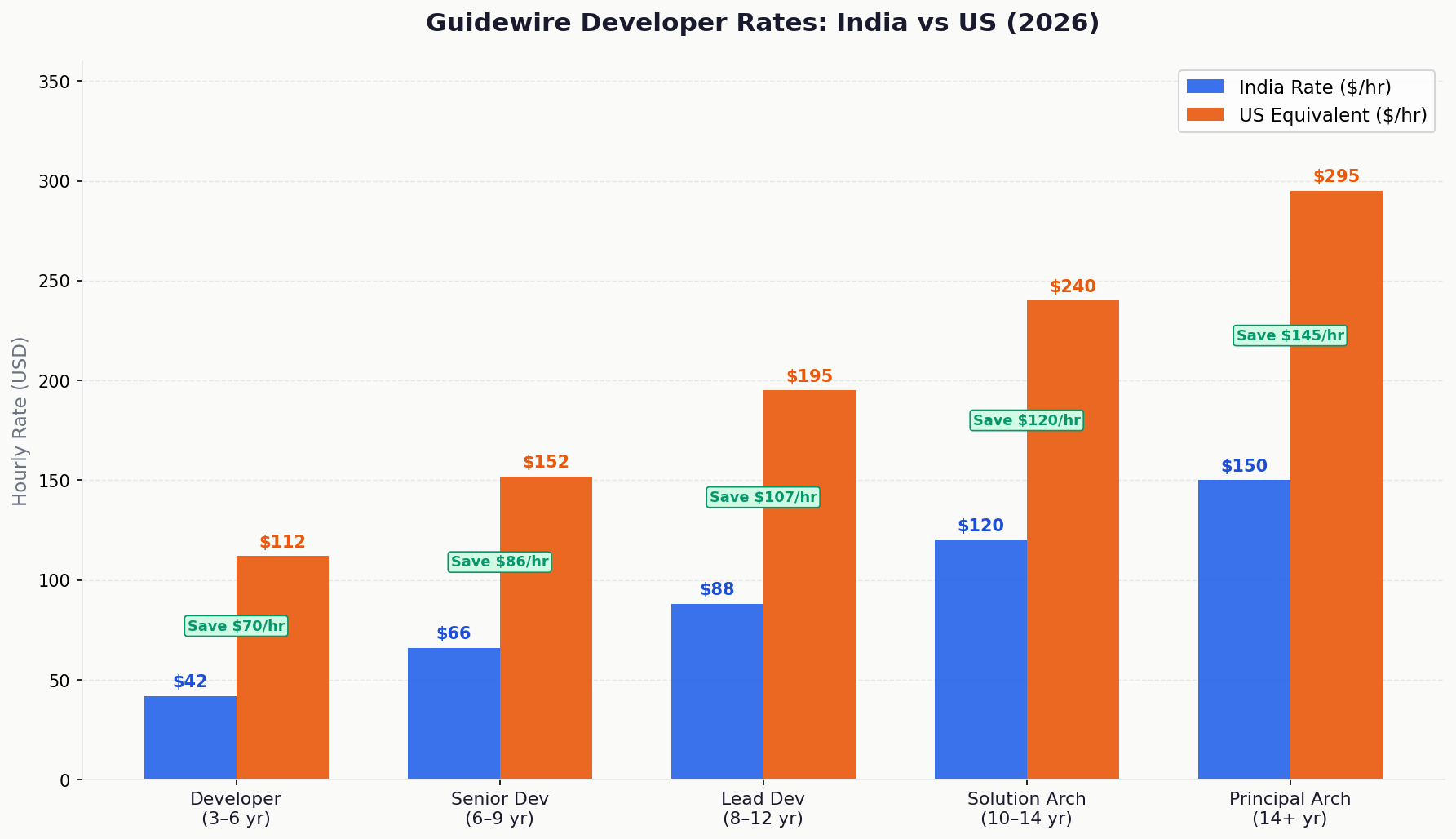
Rate Table by Level
| Level | Experience | India Rate ($/hr) | US Equivalent ($/hr) | Annual Saving ($) |
| Guidewire Developer | 3–6 yr | $32–52 | $95–130 | $135K–$161K |
| Senior Developer | 6–9 yr | $52–80 | $130–175 | $161K–$197K |
| Lead Developer / Technical Lead | 8–12 yr | $72–105 | $160–230 | $182K–$260K |
| Guidewire Solution Architect | 10–14 yr | $100–140 | $200–280 | $208K–$291K |
| Principal Architect / Program Director | 14+ yr | $130–170 | $250–340 | $249K–$354K |
Product premiums:
- PolicyCenter over ClaimCenter: 8–15% premium. PolicyCenter’s rating engine and product model complexity commands a premium. The pool is thinner at senior level.
- Guidewire Cloud over on-premise: 18–25% premium. Guidewire Cloud expertise is genuinely scarce, approximately 120 architects with cloud-specific experience in India.
- Multi-product (2+ InsuranceSuite products): 20–30% premium for architects with genuine production depth across 2+ products.
- Guidewire Rating specialist: 15–20% premium. Rating engine configuration for complex commercial or personal lines products is a specialist skill within the already-specialist Guidewire ecosystem.
The 4 Cost Layers
- Layer 1 Gross CTC Senior Guidewire Developer: ₹32–50 LPA. At ₹96.4/$1: $33K–$52K annually.
- Layer 2 Employer Burden: 22–28% on top of gross CTC.
- Layer 3 Vendor Margin: 20–26%. Guidewire is a thin-pool specialist stack. Vendors with genuine Guidewire bench charge at the high end of margin.
- Layer 4 What Hits Your Invoice Senior Guidewire Developer: $52–80/hr. At 2,000 hours/year, a 10-developer team at blended $68/hr costs $1.36M annually. US equivalent: $3.0–3.5M. Annual saving: $1.6–2.1M.
The Certification Hierarchy What Actually Matters
Guidewire ACE (Aces Certification for Engineers) Program:
Guidewire’s certification program is product-specific. Each InsuranceSuite product has its own ACE certification ACE PolicyCenter, ACE ClaimCenter, ACE BillingCenter. The ACE certification tests implementation knowledge for the specific Guidewire product configuration objects, Gosu scripting in that product context, PCF customisation, and upgrade safety practices.
Guidewire also has certifications for specific roles Guidewire ACE Developer (technical configuration and Gosu development), Guidewire ACE Business Analyst (functional configuration and testing), and the newer Guidewire Cloud certifications for Guidewire Cloud-specific deployment knowledge.
How to verify: Guidewire’s ACE certifications are managed through Guidewire’s partner and customer portal. Candidates who hold ACE certifications can share their certification document or digital credential directly. Ask for the specific certification name “ACE PolicyCenter Developer” vs “ACE ClaimCenter Developer” as the product specificity is the critical verification element.
Guidewire also maintains a community platform (Guidewire Developer Hub / Jutro community) where certified developers have profiles. Active community contributors are verifiable senior practitioners.
The Gosu language the core technical skill:
Gosu is Guidewire’s proprietary scripting language used for all business logic customisation in InsuranceSuite. It is object-oriented, Java-adjacent in syntax, and tightly integrated with Guidewire’s entity model. All Guidewire technical work calculation worksheets, rules, workflow conditions, integrations uses Gosu.
Gosu proficiency is not verified by the ACE certification alone. The ACE certification verifies platform configuration knowledge. Advanced Gosu complex calculation worksheets, performance-optimised queries on Guidewire’s entity framework, custom plugin implementation requires production implementation experience.
Ask for code samples or describe a specific Gosu scenario in the technical interview. A developer who can describe their approach to a complex Gosu calculation worksheet in PolicyCenter’s rating context is demonstrably different from a developer who has configured out-of-the-box Guidewire without custom Gosu work.
The PCF (Page Configuration File) UI framework:
Guidewire’s UI is built on PCF, an XML-based UI framework. All screen customisations in Guidewire use PCF. A Guidewire developer who has only configured business logic without PCF experience cannot make UI changes. For full-stack Guidewire development roles, require PCF experience alongside Gosu.
The JD That Attracts the Right Candidates
JD 1: Senior Guidewire PolicyCenter Developer (5–8 years)
Senior Guidewire PolicyCenter Developer Remote from India Engagement: Staff Augmentation | Duration: 18 months Rate: ₹32–50 LPA CTC equivalent | Billing: $52–80/hr (vendor-facing)
What you’ll own: PolicyCenter configuration for a personal lines P&C implementation, product model design, rating engine configuration, underwriting rules, policy lifecycle workflow, and Gosu calculation worksheets for premium computation. Measured on premium calculation accuracy, policy lifecycle correctness, and configuration quality.
What we require:
- Guidewire ACE PolicyCenter Developer certification (verified by sharing ACE credential directly)
- 5–8 years Guidewire experience, minimum 2 complete PolicyCenter go-lives
- Product model experience LOB and policy object hierarchy design, coverage term configuration, question sets
- Rating engine depth rate table configuration, calculation worksheets in Gosu, rating algorithm design for personal lines auto or homeowners
- Gosu scripting at advanced level complex calculation worksheets, custom rules, business logic beyond standard configuration
- PCF UI customisation experience can modify existing PCF files and build custom PCF views
- Personal lines insurance domain knowledge auto or homeowners, underwriting concepts, state compliance requirements
What disqualifies you:
- ClaimCenter or BillingCenter primary experience with no PolicyCenter production work
- PolicyCenter experience limited to configuration of an existing product model without rating engine or Gosu development
- Guidewire Cloud experience only without on-premise knowledge (if program is on-premise)
- No PCF UI customisation experience for a full-stack development role
Interview process: Insurance domain screen (30 min) → Live Gosu calculation worksheet task (90 min) → PolicyCenter product model design discussion (45 min)
JD 2: Guidewire Solution Architect InsuranceSuite (12+ years)
Guidewire Solution Architect Full InsuranceSuite India GCC or BOT Engagement: GCC Build or BOT | Duration: 24+ months CTC: ₹85–120 LPA | Billing: $105–142/hr (vendor-facing)
What you’ll own: End-to-end Guidewire InsuranceSuite architecture across PolicyCenter, ClaimCenter, and BillingCenter. You will own the product model design, integration architecture (Guidewire Integration Framework / Cloud API), data conversion strategy, Gosu scripting standards, PCF customisation approach, and upgrade safety framework. Technical authority for a team of 12–20 Guidewire developers.
What we require:
- Guidewire ACE certification on minimum 2 InsuranceSuite products (PolicyCenter + ClaimCenter preferred)
- 12+ years Guidewire experience, minimum 3 full InsuranceSuite go-lives as architect of record
- Multi-product architecture can describe the data sharing approach between PolicyCenter, ClaimCenter, and BillingCenter (shared entity model, inter-system integration)
- Guidewire integration architecture Guidewire Messaging (on-premise) or Guidewire Cloud API (cloud), integration with payment gateways, document management, fraud detection
- Data conversion architecture LDTS (Legacy Data Transfer System) approach, conversion sequence across all three products, validation strategy
- Upgrade strategy configurable vs non-configurable customisation classification, PCF compatibility across versions, Gosu API compatibility
Interview process: Architecture scenario (60 min) → Data conversion design (45 min) → Integration architecture discussion (30 min) → Reference call with prior CTO or Insurance Technology Director
What most enterprise JDs get wrong for Guidewire:
They say “Guidewire experience required” which returns the full 4,200-person India Guidewire pool weighted toward ClaimCenter. They don’t specify the product PolicyCenter, ClaimCenter, BillingCenter are completely different functional domains. They don’t specify on-premise vs Guidewire Cloud architecturally different deployment models.
They list “Gosu experience” as a preference rather than a requirement for a senior development role Gosu is the core Guidewire technical skill, not an optional add-on. And they don’t specify insurance lines (personal vs commercial) , different product model complexity, different underwriting domain knowledge.
How to Verify Experience Not Just Credentials
The 3 verification steps before any Guidewire interview:
Step 1: ACE certification product specificity
Ask the candidate to share their Guidewire ACE certification document directly. Verify the product name on the certification ACE PolicyCenter Developer vs ACE ClaimCenter Developer. These are different certifications for different products. A ClaimCenter ACE for a PolicyCenter program is a product mismatch.
Step 2: Product and go-live specificity in writing
Before scheduling, ask: “List your Guidewire InsuranceSuite production implementations which product (PolicyCenter/ClaimCenter/BillingCenter), which insurance line (personal auto, homeowners, commercial property, workers’ compensation), and what role you played.” Real Guidewire developers answer immediately with specific products, lines, and roles. Developers with adjacent insurance experience or single-product depth become vague about multi-product programs.
Step 3: Gosu and PCF depth verification
For developer roles: ask for a code sample, a Gosu calculation worksheet or a custom PCF file they’ve written. Real Guidewire developers have code they’ve written. If a “senior Guidewire developer” cannot share a Gosu snippet or describe a specific custom PCF they’ve built, their technical depth is limited to configuration without custom development.
The 5 interview questions that expose fake seniority:
Q1: PolicyCenter Product Model Design “Walk me through how you’ve designed a PolicyCenter product model for personal auto the LOB hierarchy, the policy object structure, the coverage term configuration, and how you handled state-specific coverage variations.”
Real answer: describes the Guidewire PolicyCenter product model line of business (LOB) entity, policy period, policy graph (vehicles, drivers, coverages), coverage terms (limit, deductible, premium basis), and how state-specific variations are handled either through question sets with state conditions, separate product model branches by state, or rate table state dimensions. They describe specific LOB configuration objects PolicyLine, Vehicle, Driver entities and the relationship structure.
Developers without PolicyCenter product model experience describe auto insurance product structure generally without Guidewire-specific entity names or configuration objects.
Q2: Gosu Rating Calculation “Walk me through how you’ve written a Gosu calculation worksheet for a base rate calculation in PolicyCenter, the structure of the worksheet, how you access policy data, and how you handle multi-vehicle policies with different rate factors per vehicle.”
Real answer: describes the Guidewire rating engine architecture rating worksheet, calculation steps, rate table lookups, and Gosu code for custom factor calculations. Specifically: how they iterate over vehicles in a multi-vehicle policy (using Gosu’s for-each iteration on the policy graph), how they access rate tables (Guidewire’s RateTable entity and lookup functions), and how they structure calculation steps to ensure each vehicle’s premium is calculated independently. They write or describe specific Gosu syntax such as Policy.Vehicles.each(\ v -> …) or equivalent.
Developer without rating engine Gosu experience describes the rating concept. Cannot describe calculation worksheet structure, Gosu iteration syntax for policy objects, or rate table lookup functions.
Q3: ClaimCenter Claims Workflow “Describe how you’ve configured an FNOL (First Notice of Loss) workflow in ClaimCenter the intake steps, the assignment rules, the reserve setting process, and how you handled multi-party claims where both policyholder and third party are involved.”
Real answer: describes ClaimCenter’s claim object structure claim, exposure, incident, activity entities. FNOL workflow: the initial claim intake steps, automatic assignment rules (using Guidewire’s workqueue and assignment configuration), exposure creation for each covered loss (property damage, bodily injury), reserve setting (reserve amounts per exposure, reserve status workflow), and multi-party handling creating exposures for both first and third parties with separate coverage assignments. They describe specific ClaimCenter configuration objects and workflow steps.
Developers without ClaimCenter experience describe insurance claims processing conceptually. Cannot describe ClaimCenter’s claim object model, workqueue assignment, or exposure-level reserve configuration.
Q4: BillingCenter Payment Plan Configuration “Walk me through how you’ve configured a payment plan in BillingCenter for a 12-month annual policy with monthly installment options the charge pattern, the payment schedule, the down payment rules, and how you handled non-sufficient funds (NSF) and reinstatement.”
Real answer: describes BillingCenter’s payment plan structure billing instruction templates, charge patterns (down payment percentage, installment amounts), payment schedules (automatic payment schedule generation), NSF handling (NSF fee assessment, policy status impact, reinstatement workflow with NSF fee waiver conditions), and installment distribution rules. They describe specific BillingCenter entities BillingInstruction, Charge, Payment, Disbursement and the charge pattern configuration.
Developers without BillingCenter experience describe premium billing conceptually. Cannot describe BillingCenter’s charge pattern structure, payment schedule generation, or NSF workflow configuration.
Q5: Guidewire Integration Architecture “Describe how you’ve designed a Guidewire integration with an external payment gateway, the integration pattern, whether you used Guidewire Messaging or the Cloud API, and how you handled payment confirmation, timeout, and retry.”
Real answer for on-premises: describes Guidewire Messaging the message destination configuration, the message transport plugin, the message acknowledgement handling in Gosu, and retry configuration for failed messages. Or describes the direct IT service call approach using Gosu’s WebServiceCallHandler. For cloud programs: describes Guidewire Cloud API integration using REST/GraphQL, the event-driven integration pattern (Guidewire sends events via Cloud API webhooks), and the middleware handling payment gateway callbacks. They describe specific Guidewire integration components.
Developers without integration experience describe payment integration at a conceptual level. Cannot describe Guidewire’s messaging framework, transport plugin configuration, or Cloud API event model.
8 CV red flags:
- “Guidewire experience” without specifying PolicyCenter, ClaimCenter, or BillingCenter
- ACE ClaimCenter certification listed for a PolicyCenter program requirement
- “Full InsuranceSuite experience” claimed by a developer whose project history shows only one Guidewire product
- “Gosu experience” without a code sample or specific calculation worksheet description
- “Guidewire Cloud experience” on a project starting before 2020 Guidewire Cloud reached enterprise availability from 2020
- “Rating engine experience” without being able to name the calculation worksheet structure or rate table configuration
- Multiple “InsuranceSuite implementations” at the same carrier insurers typically do one InsuranceSuite implementation; multiple entries at the same carrier are likely phase extensions
- “Guidewire architect” who has only worked as a senior developer in architect-supervised programs delivery experience under an architect is not architectural design experience
How to Source What’s Working, What Isn’t
What’s working in 2026:
Guidewire partner ecosystem in India.
Guidewire maintains a Global System Integrator (GSI) partner network. In India, the primary Guidewire GSI partners are Cognizant, TCS, Wipro, Infosys, and Capgemini all of which have established Guidewire practices in Pune. Enquiring these partners about available Guidewire benches with product-specific requirements yields the highest-quality sourcing channel for Guidewire in India.
Guidewire Developer Hub and Community.
Guidewire maintains a developer community platform Jutro (UI framework) community and Guidewire Developer Hub for InsuranceSuite. Active community contributors are identifiable senior practitioners. India’s Guidewire community in Pune has regular meetup activity.
3 ready-to-use LinkedIn boolean search strings:
- String 1 (PolicyCenter Senior Developer): “Guidewire” AND “PolicyCenter” AND (“Gosu” OR “PCF” OR “rating”) AND (“Senior” OR “Lead”) AND (“Pune” OR “Bangalore”)
- String 2 (Guidewire Solution Architect): “Guidewire” AND (“Solution Architect” OR “InsuranceSuite”) AND (“ClaimCenter” OR “PolicyCenter” OR “BillingCenter”) AND “India”
- String 3 (Guidewire Cloud): “Guidewire Cloud” AND (“Cloud API” OR “cloud-ready”) AND (“Architect” OR “Lead”) AND “India”
Insurance technology conferences.
InsureTech Connect, ACORD, and regional insurance technology events have India participation. Insurance technology practitioners who present or attend are senior practitioners with verifiable industry standing.
Supersourcing pre-vetted bench. For Senior Guidewire PolicyCenter Developers, median fill time 24 calendar days. For Solution Architects with multi-product depth, 38 days with product-specific experience and ACE certification verification before any CV is submitted.
What isn’t working:
- Generic “Guidewire developer” postings on Naukri. Returns the full Guidewire pool disproportionately weighted toward ClaimCenter (the largest single-product pool). Without specifying PolicyCenter, the posting returns the wrong product mix.
- Accepting single-product Guidewire experience for multi-product programs. The Section 1 story illustrates this precisely. A ClaimCenter-heavy team for a PolicyCenter-led program is the most common Guidewire staffing failure. Specify the product breakdown by developer count in the SOW.
- Treating Gosu as a screening afterthought. Gosu is Guidewire’s core development language. Every non-trivial Guidewire implementation requires Gosu. An interview without a Gosu task is not a complete Guidewire technical screen. The calculation worksheet task in Section 8 (Q2) is the minimum viable Gosu assessment.
The Contract Stack for Guidewire Engagements
Clause 1: Individual Resource Approval with Product, ACE Certification, and Insurance Line
SOW schedule must list: name, Guidewire ACE certification product (ACE PolicyCenter, ACE ClaimCenter, ACE BillingCenter), go-live count per product, and primary insurance line experience. A ClaimCenter developer substituted for a PolicyCenter workstream is a contractual product scope deviation; the product specificity in the approval clause makes this enforceable.
Clause 2: IP Assignment Gosu Scripts, PCF Files, and Integration Configurations
Must cover: custom Gosu scripts and calculation worksheets, PCF customisation files, Guidewire product model configurations exported as XML, integration adapter configurations (Guidewire Messaging transport plugins or Cloud API connector definitions), and data conversion programs. Gosu scripts and PCF files are proprietary code that many standard MSA IP clauses don’t clearly cover.
Clause 3: Configurable vs Non-Configurable Customisation Classification
Guidewire distinguishes between configurable customisations (using Guidewire’s designated extension points calculation worksheets, PCF extensions, Gosu in designated points) and non-configurable customisations (modifying Guidewire base classes or entities directly). Non-configurable customisations create upgrade risk. Require that all customisations be classified at delivery, non-configurable customisations be explicitly approved by your architect, and a plan for remediating non-configurable customisations before each major Guidewire version upgrade.
Clause 4: Upgrade Compatibility Documentation
Guidewire releases major version upgrades every 1–2 years. Every customisation in the system must be documented against Guidewire’s upgrade compatibility guide. Require an upgrade impact assessment at each major Guidewire release which customisations are affected, what remediation is required, and the timeline for remediation. Without this clause, upgrades become crisis-driven events rather than planned activities.
Clause 5: Environment Access Revocation 24 Hours
All vendor developer access to Guidewire production, UAT, and development environments must be revoked within 24 hours of engagement end. Guidewire environments contain policy, billing, and claims data confidential insurance data that requires careful access management at engagement end.
Running a Guidewire Team at Scale
Product workstream separation.
For multi-product programs, separate workstreams by product PolicyCenter workstream, ClaimCenter workstream, BillingCenter workstream with named leads for each. Cross-product integration testing is a separate workstream with representation from all three. Mixing product assignments across developers creates accountability gaps where nobody owns the end-to-end configuration for any product.
Gosu code review standards.
Establish Gosu code review standards before the first sprint naming conventions, query optimisation requirements (Guidewire’s entity queries can be performance-sensitive at scale), error handling patterns, and logging standards. Gosu code written without performance review in a mid-program code review creates technical debt that is expensive to remediate at upgrade time.
PCF version control.
All PCF file modifications must be version-controlled alongside the Gosu scripts. PCF changes are UI-critical; a broken PCF file can make a screen inaccessible to all users. Require peer review for all PCF modifications before deployment to UAT.
Integration testing with external systems.
Guidewire programs have significant external integrations payment gateways, document management, credit scoring, fraud detection, compliance databases. External integration testing requires coordination with third-party system owners. Establish integration testing protocols early on who owns the third-party test environments, what the data masking approach is for test data, and what the escalation path is when third-party systems are unavailable.
Early warning signals:
- Non-configurable customisations appearing in sprint reviews without architect approval
- PCF modifications without code review
- Gosu query performance issues appearing in UAT at scale testing
- Integration test failures consistently attributed to third-party systems without investigation
- LinkedIn activity Guidewire certifications updated, insurance technology connections increasing
Retention levers: Product breadth is the strongest retention lever. A Guidewire developer who adds a second InsuranceSuite product (ClaimCenter experience added to PolicyCenter depth) has doubled their market value in the small insurance technology ecosystem. Guidewire Cloud certification is increasingly valuable as the market moves from on-premise to cloud. Insurance domain depth understanding the business context of underwriting, rating, and claims makes Guidewire developers more valuable and more committed to the insurance technology career path.
When Things Go Wrong
Pattern 1: The Product Concentration Mismatch
Described in Section 1. ClaimCenter-heavy dedicated team for a PolicyCenter-led program. The product breakdown question in the sourcing brief and the product-specific approval clause in the SOW prevent this entirely.
Pattern 2: The Non-Configurable Customisation Upgrade Crisis
A US specialty insurer’s Guidewire implementation had 23 non-configurable customisations direct modifications to Guidewire base classes accumulated over 18 months of offshore development. Nobody flagged them during delivery. The classification process in the upgrade guide wasn’t followed.
Guidewire’s major version upgrade 18 months post-go-live: 19 of the 23 non-configurable customisations were incompatible with the new version. The upgrade required re-engineering 19 customisations to configurable equivalents or accepting that the upgrade would break them. Re-engineering took 11 weeks. $220K. The configurable vs non-configurable classification clause and the upgrade impact assessment would have caught and managed this throughout delivery.
Pattern 3: The Gosu Performance Crisis
A UK composite insurer’s PolicyCenter implementation worked correctly in UAT with 10,000 policies. In production with 800,000 policies, three Gosu calculation worksheets were running database queries in nested loops, a pattern that is acceptable at small scale and catastrophic at large scale. Policy renewal processing that took 2 hours in UAT took 38 hours in production, breaking SLAs.
The performance issue: Gosu entity queries inside loops that load large collections instead of using Guidewire’s optimised query patterns. The fix required rewriting three calculation worksheets using Guidewire’s recommended query patterns. Three weeks. £85K. The Gosu code review standard requiring performance review for all queries on policy collections would have caught this before UAT.
When India Is the Wrong Call
Scenario 1: Guidewire programs for Lloyd’s of London or London market specialty insurance.
Lloyd’s and London market specialty lines marine, aviation, energy, specialty liability have complex program structures, complex cedant and reinsurance arrangements, and London market-specific regulatory requirements (ACORD standards for Lloyd’s, premium trust fund requirements, Lloyd’s systems connectivity). The India Guidewire pool has P&C personal and commercial lines depth. London market specialty insurance experience is concentrated in London and is not widely represented in India’s Guidewire community. For Lloyd’s-specific programs, verify London market insurance domain knowledge specifically.
Scenario 2: Guidewire programs with complex workers’ compensation regulatory requirements.
Workers’ compensation in the US is state-regulated; each state has different benefits schedules, different indemnity calculation rules, and different medical fee schedules. Guidewire ClaimCenter workers’ compensation configuration requires both ClaimCenter technical depth and workers’ compensation regulatory domain knowledge. The India Guidewire pool has ClaimCenter experience. Workers’ compensation regulatory domain knowledge is thinner in India because WC is primarily a US insurance line. For complex WC programs, consider US-based domain consultants for WC regulatory configuration alongside India-based ClaimCenter technical developers.
Scenario 3: Sub-6 developer programs with multiple InsuranceSuite products.
A 4-developer program requiring all three InsuranceSuite products with production-experienced developers per product is too small for enterprise IT staffing economics; the product specialisation requirement creates a team structure where 4 developers cannot cover 3 products at senior level. For small multi-product programs, a Guidewire GSI partner with a staff augmentation offering and pre-assembled multi-product teams is a better fit.
The Supersourcing Vendor Scorecard™ Guidewire Edition
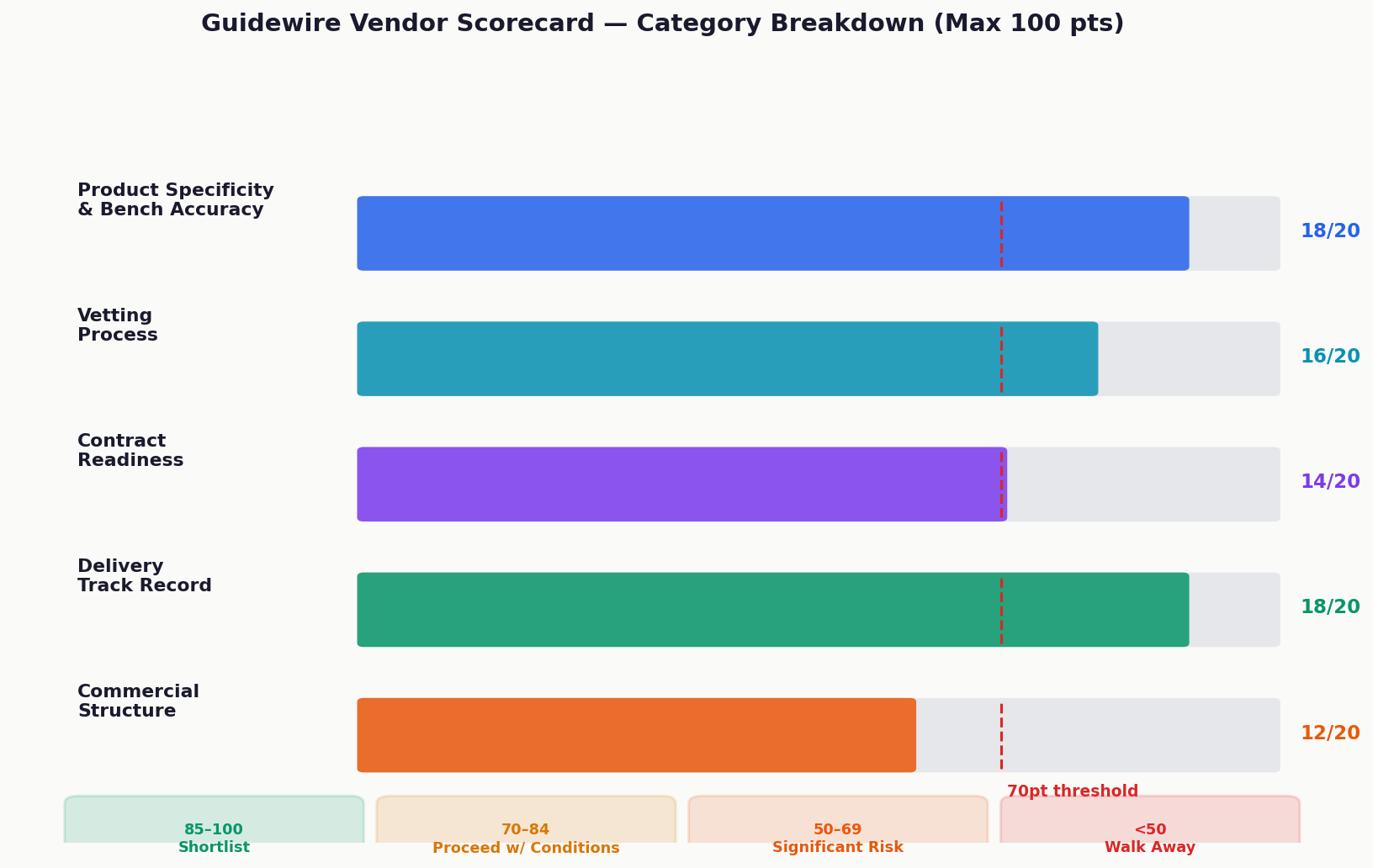
Score your vendor before you sign. Maximum 100 points. Minimum threshold: 70. Guidewire is a specialist, high-consequence stack; the threshold is higher.
Category 1: Product Specificity and Bench Accuracy (0–20 pts)
| Criterion | 0 | 10 | 20 |
| Can produce product-specific ACE certifications and go-live counts per product within 24 hours | Cannot | Some | All bench, all products confirmed |
| Product breakdown of bench matches program scope (PC-heavy for PC program) | Doesn’t match | Partial match | Explicit PC/CC/BC breakdown confirmed |
| Guidewire Cloud vs on-premise distinction confirmed for claimed bench | Conflates them | Distinguishes when asked | Cloud/on-premise verified per consultant |
Category 2: Vetting Process (0–20 pts)
| Criterion | 0 | 10 | 20 |
| Product-specific technical assessment (PolicyCenter ≠ ClaimCenter) | Generic Guidewire | Product-specific written | Live Gosu task in product context |
| Gosu calculation worksheet task required for developer roles | No Gosu task | Conceptual Gosu | Live calculation worksheet task |
| Insurance domain screen for functional roles | None | Generic insurance | Line-specific underwriting or claims questions |
Category 3: Contract Readiness (0–20 pts)
| Criterion | 0 | 10 | 20 |
| IP Assignment covering Gosu scripts and PCF files | Not available | Available on request | Standard, items named specifically |
| Configurable vs non-configurable classification clause | Not present | Best effort | Contractual classification and approval gate |
| Upgrade compatibility documentation requirement | Not present | End-of-engagement | Per-sprint classification maintained |
Category 4: Guidewire Delivery Track Record (0–20 pts)
| Criterion | 0 | 10 | 20 |
| Named Guidewire go-live clients with product and insurance line | None | Logo only | Named contact + product + line + go-live date |
| Multi-product programs (2+ products) verified | None | Claimed | Verified with product breakdown reference |
| Attrition on Guidewire programs | Unknown / >18% | 12–18% | <12% |
Category 5: Commercial Structure (0–20 pts)
| Criterion | 0 | 10 | 20 |
| Rate card by product and cloud vs on-premise | Single Guidewire rate | Product distinction | Product and deployment model matrix |
| Substitution clause with product and ACE certification equivalence | Not present | Available | Standard, product and ACE equivalence |
| SLA on replacement with product match | None | Best effort | Contractual 21-day SLA with product match |
Score interpretation: 85–100 shortlist; 70–84 proceed with conditions; 50–69 significant risk; below 50 walk. The higher threshold reflects Guidewire’s specialisation; a vendor below 70 for a Guidewire program is likely presenting a ClaimCenter bench for PolicyCenter requirements.
15 Questions Buyers Actually Ask
Q: What is Guidewire InsuranceSuite and what are its three products?
Guidewire InsuranceSuite is the leading policy administration, billing, and claims management platform for P&C (property and casualty) insurance. It comprises three core products: PolicyCenter the policy administration system managing the full policy lifecycle from quoting through issuance, endorsements, renewals, and cancellations; BillingCenter the billing and payments system managing premium collection, payment plans, commissions, and disbursements; ClaimCenter the claims management system handling FNOL (First Notice of Loss), claim investigation, reserve management, payment, and closure. Each product is independently deployable but shares Guidewire’s underlying platform, the Gosu scripting language and PCF UI framework.
Q: Does Guidewire experience on ClaimCenter transfer to PolicyCenter?
Partially at the platform level. A ClaimCenter developer knows Gosu (Guidewire’s scripting language), PCF (the UI framework), and Guidewire’s entity model structure. These platform skills transfer. The business domain knowledge of insurance product modeling, rating engine, underwriting rules, policy lifecycle management does not transfer from ClaimCenter. A ClaimCenter developer moving to PolicyCenter needs 3–6 months to acquire PolicyCenter-specific configuration knowledge. For delivery roles on a PolicyCenter program, require PolicyCenter production experience. Do not substitute ClaimCenter experience for PolicyCenter without explicit ramp planning.
Q: What is Gosu and why does it matter?
Gosu is Guidewire’s proprietary scripting language the primary programming language for all business logic customisation in InsuranceSuite. Every non-trivial Guidewire implementation uses Gosu for calculation worksheets, custom rules, workflow conditions, and integration logic. Gosu is Java-adjacent in syntax but specifically designed for Guidewire’s entity model. Advanced Gosu writing performant calculation worksheets for complex rating algorithms, building custom plugins, and optimising entity queries for large policy portfolios requires production implementation experience and cannot be acquired from documentation alone. Test Gosu capability in every technical interview for developer roles.
Q: What is Guidewire Cloud and how is it different from on-premise Guidewire?
Guidewire Cloud is Guidewire’s SaaS delivery of InsuranceSuite running on Google Cloud Platform. Key differences from on-premise: Guidewire manages the application infrastructure and delivers mandatory updates on a scheduled cycle. Guidewire Cloud follows a “cloud-ready” approach where deep customisations are restricted to designated extension points and non-configurable customisations (base code modifications) are not supported. Integrations use Guidewire’s Cloud API (REST/GraphQL) rather than on-premise messaging patterns. For Guidewire Cloud programs, require cloud-specific experience from your architect and senior developers; the cloud-ready constraints and Cloud API integration patterns require specific knowledge.
Q: How do I verify a Guidewire ACE certification?
Ask the candidate to share their Guidewire ACE certification document or digital credential directly. The certification document specifies the product ACE PolicyCenter Developer, ACE ClaimCenter Developer, or ACE BillingCenter Developer. These are different certifications for different products. The product specificity is the critical verification element; the same exam score on ClaimCenter does not indicate PolicyCenter capability. For additional verification, Guidewire partner portal access (available to Guidewire GSI partners) allows partner-level verification of consultant credentials.
Q: What is the realistic timeline to hire a 12-person Guidewire InsuranceSuite team in India?
For a team with PolicyCenter, ClaimCenter, and BillingCenter coverage 1 solution architect (multi-product), 3 PolicyCenter senior developers, 3 ClaimCenter developers, 2 BillingCenter developers, 2 integration developers, 1 QA expect 45–60 days from JD sign-off to full team assembled. The multi-product solution architect (38-day median fill) is the critical path. For individual product developers, 24-day median fill per product. Starting all sourcing simultaneously minimises total assembly time.
Q: What insurance lines should I require experience on for a personal lines auto program?
Personal lines auto is a well-represented insurance line in India’s Guidewire community; many Indian carriers (LIC, New India, HDFC ERGO) use Guidewire for personal auto. Require specific personal auto experience vehicle product model design, state-specific rating, driver factor configuration. Homeowners are also well-represented. Commercial lines programs (commercial auto, general liability, commercial property) require commercial lines domain knowledge that is less universally held. Specialty lines (marine, aviation, workers’ compensation) are the most domain-specialized and have the thinnest India pool.
Q: Can I use the BOT model for a Guidewire Centre of Excellence in India?
Guidewire Centres of Excellence in India are increasingly common for P&C insurers with large Guidewire programs. The BOT transfer for a Guidewire CoE must specify: InsuranceSuite product configuration documentation (exported as XML), Gosu script library and version history, PCF customisation library, upgrade impact assessment documentation, integration architecture documentation, and the ACE certification sponsorship program for the team. A Guidewire CoE where institutional knowledge lives in the SI delivery team and not in documented configuration artifacts is a failed BOT.
Q: What is the difference between configurable and non-configurable Guidewire customisations?
Configurable customisations use Guidewire’s designated extension and configuration points calculation worksheets, PCF extensions, Gosu scripts in designated entry points, product model configuration. These follow Guidewire’s configuration guidance and are upgrade-safe Guidewire explicitly supports these customisation patterns through version upgrades. Non-configurable customisations modify Guidewire’s base classes, base PCF files, or core entity definitions directly. These create upgrade risk Guidewire’s version upgrades may conflict with base code modifications. For any Guidewire program, require that all customisations be classified as configurable or non-configurable, and that non-configurable customisations require explicit architect approval and a remediation plan.
Q: Is Guidewire talent in India comparable to US talent?
For standard InsuranceSuite implementation work on personal and commercial lines P&C products: functionally equivalent for delivery roles. India’s Guidewire community particularly in Pune has delivered InsuranceSuite programs for major US and UK carriers for 15+ years. For the most complex Guidewire programs large commercial specialty lines with intricate product models, workers’ compensation with deep state regulatory compliance, or Guidewire Cloud programs at the bleeding edge of the cloud-ready architecture the deepest experience is distributed between the US (where Guidewire is headquartered and where the largest programs are managed) and India. For standard personal and commercial lines: India talent delivers at global standards.
Q: What’s the hardest Guidewire profile to hire in India?
A Guidewire Solution Architect with production ACE certifications on all three InsuranceSuite products (PolicyCenter, ClaimCenter, BillingCenter), Guidewire Cloud deployment experience, and at least one full InsuranceSuite go-live as architect of record for a mid-to-large P&C carrier. This combination narrows the India pool to under 50 active practitioners. Median fill time: 52+ days. Competition from global Guidewire programs for the same profiles.
Q: Is Supersourcing the right partner for a 5-developer Guidewire program?
Not our ideal engagement. Our model is built for 10+ developer programs. For a 5-developer Guidewire program, a Guidewire GSI partner with a staff augmentation offering Cognizant, TCS, or a Guidewire-specialist boutique is a better fit. We’d rather tell you that than win a deal we’ll underserve.
Closing
Guidewire hiring from India works. The insurance technology depth is real, the product-specific delivery track record in Pune is extensive, and the savings versus US hiring are substantial $135K to $354K per developer per year.
The failure mode is not India. It is “Guidewire experience required” without the four words that follow: PolicyCenter, ClaimCenter, BillingCenter, or some combination. The product determines the talent pool, the certification, the domain knowledge, and the delivery risk. Without product specificity, you are sourcing from the wrong pool before the first CV is reviewed.
The ACE certification document takes 30 seconds to review. The product-specific go-live list takes 5 minutes to review. The Gosu calculation worksheet task takes 90 minutes to run. These three verification steps eliminate the mismatch patterns described in this guide before any engagement begins.
Book a 30-minute Guidewire Talent Discovery Call → No deck. Just the numbers and the bench.
