

Most insurance companies that hire guidewire developer India are making the same mistake. They post a job description, get 200 applications, spend six weeks interviewing, and end up with a developer who has “Guidewire” on their resume and has never configured a ClaimCenter adjudication workflow in their life.
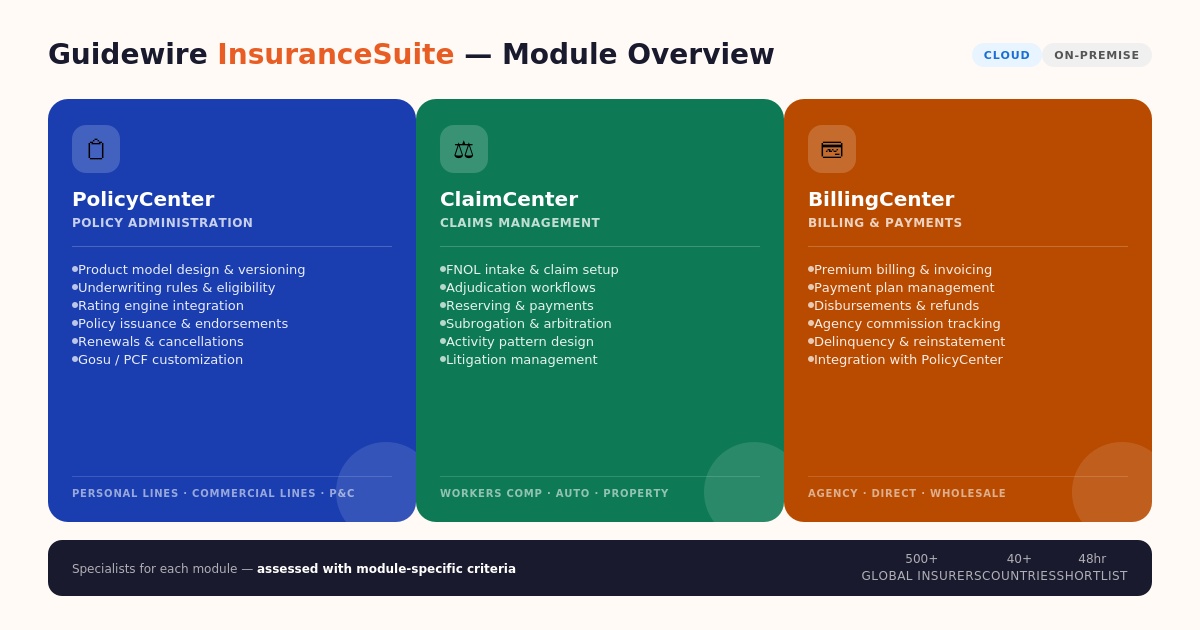
Guidewire is not a skill you can fake for long. It is a deeply specialized insurance platform PolicyCenter for policy administration, ClaimCenter for claims management, BillingCenter for billing and payments. Each module has its own data model, its own Gosu scripting language, its own PCF (Page Configuration Framework) for UI customization, and its own integration patterns. A developer who has built a PolicyCenter product model from scratch for a P&C insurer operates in a completely different technical space from one who has done basic ClaimCenter configuration for a workers’ compensation carrier.
India has world-class Guidewire talent. TCS, Infosys, Wipro, and Cognizant all run Guidewire practices. The talent exists. The problem is finding the ones who actually know the platform and knowing how to tell the difference before you hire them.
According to Guidewire official company overview, over 570 insurers worldwide run on Guidewire, along with 1,700+ successful implementations, highlighting the rapid expansion of the ecosystem and the increasing demand for truly skilled professionals.
This guide covers everything an insurance enterprise or GCC needs to know about hiring Guidewire developers in India: what to assess, what to pay, what hiring model to use, and how to avoid the mistakes that turn a six-month implementation into an eighteen-month one.
What Is Guidewire and Why Does It Require Specialist Hiring
Guidewire Software is the dominant core systems platform for P&C (property and casualty) insurance globally. More than 500 insurers across 40+ countries run Guidewire InsuranceSuite including the largest carriers in the US, UK, Australia, and Europe.
The platform has three core products. PolicyCenter handles the full policy lifecycle product model design, underwriting rules, rating, policy issuance, endorsements, cancellations, and renewals. ClaimCenter manages the claims lifecycle from first notice of loss through adjudication, reserving, payment, and subrogation. BillingCenter handles premium billing, payment plans, disbursements, and agency commission management.
Each product is built on Guidewire’s proprietary technology stack, the Gosu programming language, the PCF (Page Configuration Framework) for UI customization, GXML for data mapping and integration, and Plugins for extending platform behavior. The platform now also runs on Guidewire Cloud Guidewire’s AWS-hosted SaaS offering which introduces a different customization model, more constrained extension approach, and different deployment and upgrade patterns compared to on-premise InsuranceSuite.
What makes Guidewire hiring hard is not the volume of talent. It is the specificity of what you actually need. A Guidewire developer who has configured PolicyCenter product models for personal auto has different skills from one who has built commercial lines products with complex coverage structures. A ClaimCenter developer who has implemented subrogation and arbitration workflows is different from one who has built basic FNOL intake. Generic technical screening misses all of this which is exactly why most insurance GCC hiring efforts for Guidewire produce disappointing results.
 The Guidewire Talent Market in India: What the Data Shows
 The Guidewire Talent Market in India: What the Data Shows
India is the largest source of Guidewire talent outside the United States. TCS has one of the largest Guidewire delivery teams globally. Infosys runs Guidewire implementations for US and European insurers. Cognizant, Wipro, and HCL all have certified Guidewire practices.
This means the talent exists. It also means the competition for it is intense.
Senior Guidewire developers and architects people with 6+ years of real implementation experience across at least two InsuranceSuite modules are among the most difficult technical profiles to hire in India. Annual compensation for a senior Guidewire developer ranges from ₹18 lakhs to ₹45 lakhs depending on seniority, module depth, and whether the candidate has cloud implementation experience. Guidewire architects and practice command command ₹40 lakhs to ₹80 lakhs.
Time to fill for a Guidewire specialist through a standard job posting is 8–14 weeks. Most candidates in this skill category are not actively looking; they are employed at large SIs on long-term insurance programs and need to be sourced proactively from a curated network, not a job board.
The Guidewire Cloud transition has created an additional specialization layer. Cloud-experienced Guidewire developers who understand Guidewire’s App Events, Cloud APIs, the configuration management approach to customization limits, and the quarterly upgrade cadence are a significantly smaller pool and command a 25–40% premium over equivalent on-premise experience.
What to Actually Assess in a Guidewire Developer Interview
 What to Actually Assess in a Guidewire Developer Interview
Most hiring managers assess Guidewire candidates on the wrong things. Certification status and years of experience are the two most common criteria. Neither predicts implementation quality.
Gosu language depth is the first real filter.
Gosu is Guidewire’s proprietary JVM language syntactically similar to Java but with specific Guidewire-platform patterns for entity enhancement, delegates, PCF controller logic, and business rules. A developer who cannot write a clean Gosu enhancement, who does not understand how to use blocks efficiently, who cannot explain the difference between an entity enhancement and a subtype, and who cannot debug a Gosu stack trace is not a Guidewire developer; they are a configuration technician. Ask for a Gosu code sample and have a senior Guidewire engineer review it before you proceed.
Product model design judgment for PolicyCenter candidates.
The product model is the heart of a PolicyCenter implementation line of business structure, coverage terms and pattern definitions, rating integration, underwriting rules, and the eligibility criteria that determine what products can be offered to which risks. A PolicyCenter developer who cannot explain the difference between a coverage pattern and a coverage term, who does not understand how product model versioning affects in-force policies, or who has never designed a complex commercial lines product structure is not ready for a senior PolicyCenter engagement.
ClaimCenter adjudication and workflow design for claims candidates.
Claims is a process-intensive module. The quality of implementation is determined by the activity pattern design, the claim state transitions, the financials configuration (reserves, payments, recoveries), and the contact model design. A ClaimCenter developer should be able to explain how they would design a litigation management workflow, how activity patterns interact with claim state in a multi-party claim, and how they have configured ClaimCenter financials for a complex coverage type.
Integration architecture for technical candidates.
Guidewire integrates with rating engines, data warehouses, fraud detection platforms, regulatory reporting systems, document management platforms, and digital channel applications. A senior Guidewire integration developer should be able to explain the difference between Guidewire Integration Framework (GIF), Guidewire Cloud APIs, and Guidewire Digital and articulate when they would use each for a specific integration requirement.
Cloud versus on-premise experience assessed explicitly.
If your implementation is on Guidewire Cloud, the candidate’s on-premise experience is a starting point, not a qualification. Guidewire Cloud introduces specific constraints customization must stay within App Events and Cloud Extension Points rather than direct platform modification, upgrades happen on Guidewire’s quarterly cadence, and deployment is managed through Guidewire’s CI/CD pipelines. An on-premise developer joining a Cloud implementation without this context will reach for customization patterns that are not supported and create architectural debt from the first sprint.
Guidewire Salary Benchmarks India 2026
| Level | Experience | Annual CTC (INR) |
| Junior / Associate Guidewire Developer | 2–4 years | ₹8L – ₹15L |
| Mid-Level Guidewire Developer | 4–7 years | ₹15L – ₹28L |
| Senior Guidewire Developer | 7–10 years | ₹28L – ₹45L |
| Guidewire Technical Architect | 10–14 years | ₹45L – ₹70L |
| Guidewire Practice Lead / Principal | 14+ years | ₹65L – ₹90L |
For contract and staff augmentation rates, Supersourcing researches the India market rate for your specific Guidewire module, seniority level, and Cloud versus on-premise context and sends a custom quote within 24 hours of receiving the JD. Rates vary significantly based on module (PolicyCenter vs ClaimCenter vs BillingCenter), seniority, and whether Cloud implementation experience is required.
Which Hiring Model Fits Your Guidewire Program
 Which Hiring Model Fits Your Guidewire Program
- Contract / Staff Augmentation is the right model for active implementation programs. The developer works on your team, your processes, your program. Supersourcing handles EOR, payroll, PF, ESIC, TDS, IP assignment, and compliance. You manage the work. Billing starts on joining. No retainer.
- Contract-to-Hire works well when you want to evaluate a Guidewire developer on a real program before making a permanent commitment. Start on a 6-month contract, convert to permanent if the fit is right. Absorption fee: 8.33% of annual CTC on conversion. Replacement clause included as standard.
- Permanent Placement is appropriate for building a long-term Guidewire centre of excellence in your GCC. Placement fee: 8.33%–12% for mid-level developers, 12%–18% for senior developers, 18%–25% for architects and practice leads. Replacement clause on every placement.
The 4 Most Common Guidewire Hiring Mistakes
Hiring for certification without assessing implementation depth.
Guidewire certifications ACE, CPE validate that someone completed training. They do not validate whether that person has designed a PolicyCenter product model for a real P&C insurer or debugged a ClaimCenter financials issue in production. Use certifications as a baseline filter. Build your technical assessment around real implementation scenarios.
Not distinguishing between module specialists and generalists.
A developer with 8 years of ClaimCenter experience is not automatically a PolicyCenter developer. The product models, the business logic, the integration patterns, and the UI customization patterns are significantly different across modules. If your program needs PolicyCenter depth, assess PolicyCenter specifically.
Underestimating the on-premise to Cloud transition.
If you are on Guidewire Cloud or moving to it your on-premise Guidewire bench is not directly reusable without cloud-specific transition assessment. Developers who understand App Events, Cloud API design, and the quarterly upgrade model are a different and smaller pool.
Hiring at the wrong seniority for the program phase.
A Guidewire program in the build servicenow team for ITSM implementation projects and architects who make correct product model and integration architecture decisions. A program in the run-and-maintain phase can leverage more mid-level developers. Hiring senior architects for steady-state maintenance is expensive and creates retention problems.
What Good Guidewire Vetting Actually Looks Like
At Supersourcing, every Guidewire developer shortlist is reviewed by our senior insurance platform architects engineers who have designed and delivered Guidewire implementations across PolicyCenter, ClaimCenter, and BillingCenter.
We assess Gosu language quality, module-specific implementation depth, Cloud versus on-premise judgment, and integration architecture experience. We maintain a continuously vetted bench of Guidewire developers across all seniority levels and module specializations. That is why the shortlist lands in 48 hours rather than 8 weeks.
For clients who want independent validation before committing, we arrange optional technical interviews through Barraiser or interview.io, the platforms used by Amazon and Uber for technical screening. We coordinate the scheduling. You get an independent signal with zero effort on your side.
Our attrition rate is 8% against an industry average of 22%. Joining rate: 98%. Every engagement comes with a 14-day free replacement clause.
FAQ
 FAQ
FAQ1. What Guidewire modules do you place developers for?
All three PolicyCenter, ClaimCenter, and BillingCenter across both on-premise InsuranceSuite and Guidewire Cloud. We assess each module with module-specific criteria. A ClaimCenter specialist is evaluated differently from a PolicyCenter product model developer.
2. How quickly can you deliver a Guidewire developer shortlist?
48 hours from receiving your JD. We maintain a pre-vetted bench. For senior architects and practice leads, we will be transparent in the scoping call if your requirement significantly narrows the available pool.
3. Can an independent expert technically interview the candidate before we commit?
Yes. We arrange Barraiser or interview.io sessions, or a direct round with your own senior Guidewire architect. We handle all scheduling zero coordination efforts on your side.
4. What is the difference between on-premise and Guidewire Cloud for hiring purposes?
On-premise allows direct platform customization in Gosu and PCF. Guidewire Cloud restricts customization to App Events and Cloud Extension Points to ensure upgrade compatibility. On-premise developers need explicit Cloud transition assessment before placement on Cloud programs. We assess this in every interview for Cloud-scope roles.
5. What is your replacement policy?
Free replacement within 14 days on every engagement. No charge, no questions.
6. Do I need a legal entity in India to hire through Supersourcing?
No. We act as Employer of Record payroll, PF, ESIC, TDS, employment contracts, and all statutory compliance handled by us.
7. How does pricing work for Guidewire contract roles?
We research the India market rate for your specific module, seniority, and Cloud versus on-premise context and send a custom quote within 24 hours of receiving the JD. No standard rate card because a senior Guidewire Cloud architect commands very different rates from a mid-level on-premise ClaimCenter developer.
8. What is the realistic hiring timeline for a Guidewire architect in India without Supersourcing?
8–14 weeks through a standard job posting. Through Supersourcing: 48-hour shortlist, hire within 7 days. The difference is preparation: we maintain a vetted bench rather than starting sourcing when your JD arrives.
Talk to Us About Your Guidewire Requirement
If you are building a Guidewire team in India whether it is two developers for a run-and-maintain program or a full implementation pod for a new Cloud program I am usually the one on those calls.
Email: mayank@supersourcing.com Or book a meeting directly at supersourcing.com
Tell us your Guidewire module, implementation phase, Cloud versus on-premise context, and what good looks like for your team. Shortlist in 48 hours from there.
No retainer until you hire. Replacement clause on every engagement.
Mayank Pratap Singh · Co-founder, Supersourcing Google AI Accelerator · LinkedIn Top 20 Startups India · 5,000+ Engineers Placed · 1,000+ Companies · 17 Fortune 500s
