

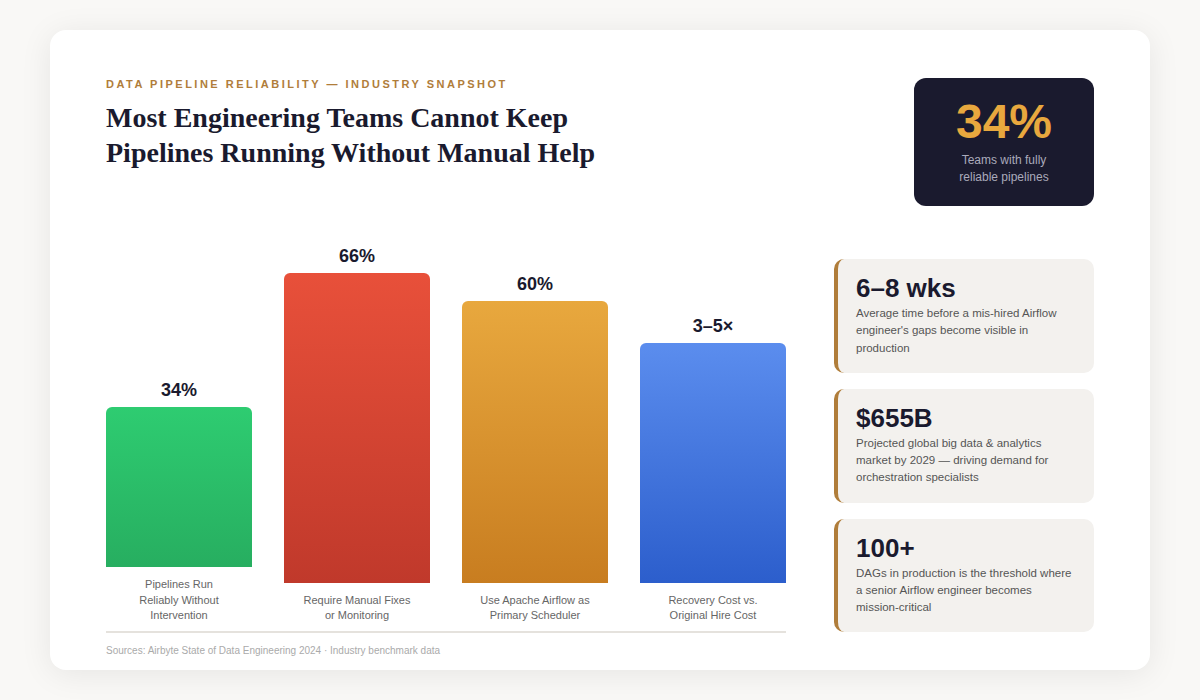
Only 34% of data engineering teams say their pipelines run reliably without manual intervention yet most hiring managers evaluating a hire Airflow engineer India decision don’t have a clear picture of what the role actually covers. The result: misaligned job descriptions, under-leveled hires, and pipelines that break every sprint.
Data pipelines are the backbone of modern analytics but reliability remains a major challenge for most teams. As organizations scale data platforms, orchestration complexity increases, making tools like Apache Airflow critical for managing workflows, dependencies, and scheduling at scale.
Hire Airflow Engineer India decisions are often made without fully understanding what the role actually demandsDAG design, pipeline reliability, infrastructure tuning, and production monitoring. The result is misaligned hiring, under-skilled teams, and pipelines that break under real-world workloads.
This gap is becoming more significant in 2026. According to Statista, global big data and analytics market revenue is projected to reach over $655 billion by 2029, reflecting rapid growth in data engineering and pipeline orchestration demand.
Despite this surge, most hiring processes still fail to benchmark real Airflow expertise.
TL;DR: What You'll Learn in This Guide
Hiring an Airflow engineer without understanding the role is the fastest way to waste 3–5x your hiring budget. This guide breaks down exactly what these engineers own, what separates a strong hire from a weak one, and what the market actually pays.
You'll get a full breakdown of the four core skill domains DAG design, Python operator usage, cloud integrations, and pipeline observability. Plus a seniority-based salary table covering junior to staff-level profiles across Indian markets.
The guide also covers the three mistakes most teams make during screening, a decision framework for picking the right seniority level, and seven interview questions that reveal real Airflow depth, not just syntax recall.
What Is an Apache Airflow Engineer?
An Apache Airflow engineer is a data engineering specialist responsible for designing, deploying, and maintaining DAG-based workflow orchestration systems that schedule and monitor complex data pipelines. They sit at the intersection of data infrastructure, Python development, and cloud operations, not purely a software engineer, not purely a data analyst.
Why Hiring the Wrong Airflow Engineer Costs More Than the Salary
Teams that underestimate this role typically discover the problem 6–8 weeks into onboarding, not during the interview. A generalist data engineer can write Python and read SQL but DAG design for production environments requires a specific mental model: thinking in directed acyclic graphs, managing upstream dependencies, handling partial failures, and architecting retry logic at scale.
When that mental model is absent, the symptoms are predictable: DAGs that run fine in staging but cascade-fail in production, pipelines with no alerting until a business stakeholder notices missing data, and infrastructure that can’t scale without a full rewrite. The recovery cost in engineering time alone typically runs 3–5x the cost of the original hire.
When companies hire data pipeline engineers in India without a structured technical evaluation, this is the most common failure mode.
What an Airflow Engineer Actually Owns: Skills and Responsibilities
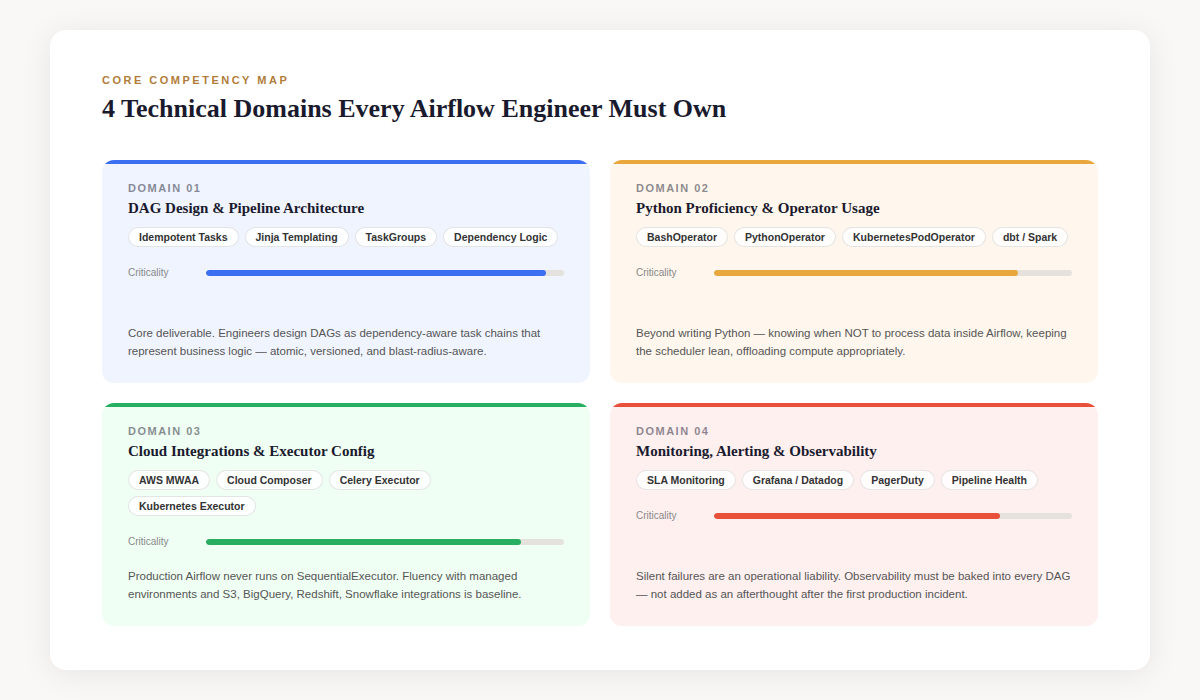
Understanding scope is the first step toward hiring correctly. A qualified hire Airflow engineer India candidate should demonstrate ownership across four technical domains.
DAG Design and Pipeline Architecture
This is the core deliverable. The engineer designs Directed Acyclic Graphs (DAGs) that represent business logic as scheduled, dependency-aware task chains. Good DAG design means:
- Breaking pipelines into atomic, idempotent tasks
- Parameterizing DAGs using Jinja templating and runtime variables
- Structuring task dependencies to minimize blast radius on failure
- Using SubDAGs or TaskGroups appropriately for modular pipelines
- Versioning DAG code alongside infrastructure-as-code
Python Proficiency and Operator Usage
Airflow’s operator ecosystem BashOperator, PythonOperator, BranchPythonOperator, KubernetesPodOperator requires solid Python. More critically, engineers need to know when not to process data inside Airflow itself, keeping the scheduler lean and offloading heavy computation to Spark, dbt, or cloud-native compute.
Cloud Integrations and Executor Configuration
Production Airflow runs on Celery Executor or Kubernetes Executor, not the default SequentialExecutor. Engineers should be fluent with at least one managed Airflow environment: AWS MWAA, Google Cloud Composer, or Astronomer. Integration with S3, BigQuery, Redshift, Snowflake, and Kafka is standard.
Monitoring, Alerting, and Pipeline Observability
Dead pipelines that fail silently are an operational liability. Experienced engineers build SLA monitoring, configure task-level alerts via PagerDuty or Slack, and expose DAG health metrics to Grafana or Datadog. Pipeline observability is not an afterthought; it should be baked into every DAG from day one.
Real-World Application: What Good Looks Like
E-commerce data platform, Series B company: A team struggling with 40+ manually triggered ETL scripts migrated to Airflow with a three-engineer team over 14 weeks. Post-migration, pipeline failures dropped by 68%, and on-call incidents related to data freshness fell from 12 per month to under 2. The critical factor was a lead engineer with deep task dependency management experience who redesigned the execution model from scratch.
Financial services firm, regulatory reporting pipeline: A single senior Airflow engineer rebuilt a legacy cron-based reporting system into a fully orchestrated DAG suite integrated with Snowflake and dbt. End-to-end pipeline runtime dropped from 6 hours to 47 minutes. The engineer’s prior experience with Kubernetes executor configuration was what made the performance gain possible.
Apache Airflow Developer Salary: India Benchmarks by Seniority
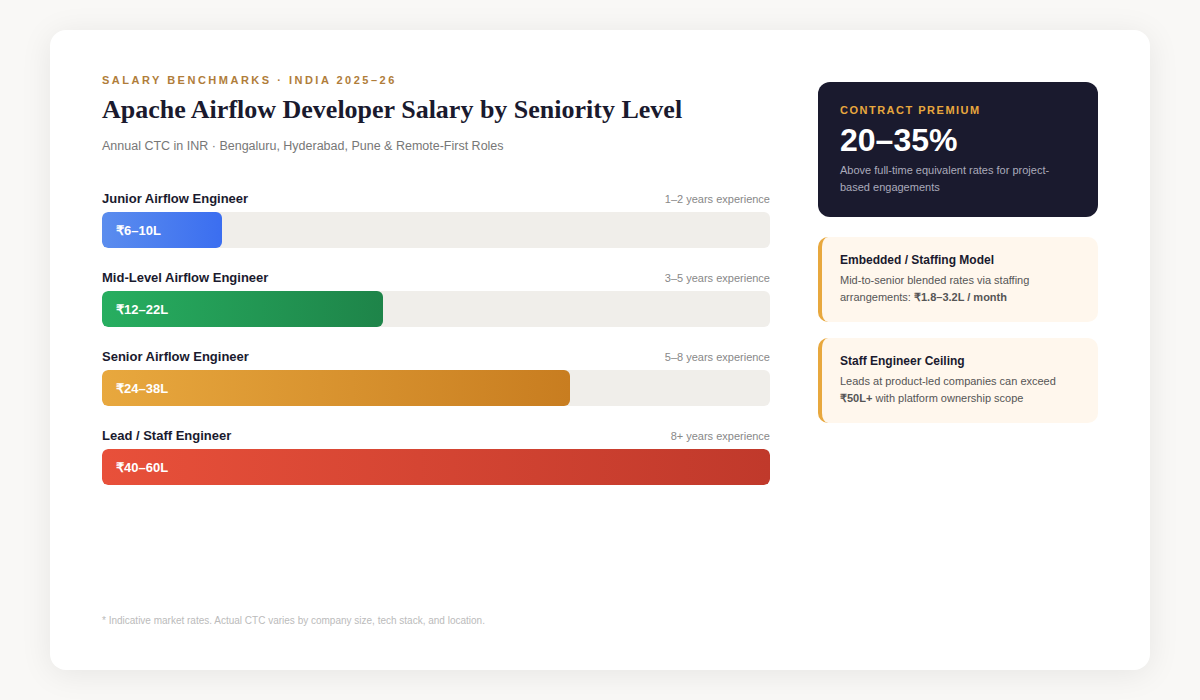
Compensation for Apache Airflow developer salary varies significantly based on seniority, tech stack depth, and cloud platform expertise. The table below reflects current market rates for professionals working in Bengaluru, Hyderabad, Pune, and remote-first engagements.
| Seniority Level | Experience | Annual CTC (INR) | Key Differentiators |
| Junior Airflow Engineer | 1–2 years | ₹6–10 lakhs | Basic DAG writing, guided by senior; limited production exposure |
| Mid-level Airflow Engineer | 3–5 years | ₹12–22 lakhs | Independent DAG ownership, cloud integrations, basic observability |
| Senior Airflow Engineer | 5–8 years | ₹24–38 lakhs | Architecture design, executor tuning, multi-team pipeline governance |
| Lead / Staff Engineer | 8+ years | ₹40–60 lakhs | Platform ownership, hiring, cross-functional data infrastructure strategy |
Contractors and consultants working on project-based engagements typically command a 20–35% premium over equivalent full-time rates. For teams that hire data engineers in India through staffing or embedded model arrangements, blended rates for mid-to-senior profiles generally fall between ₹1.8–3.2 lakhs per month.
Junior vs. Senior: A Decision Framework for Hiring Airflow Engineers
Choosing the wrong seniority level is a common and expensive mistake. Use this framework before opening a role.
- Hire a junior Airflow engineer if: your pipelines are greenfield, you have a senior data engineer who can mentor, and your volume of DAGs is below 20 with low SLA criticality.
- Hire a mid-level engineer if: you need someone to own a portfolio of pipelines independently, integrate with 3–5 cloud services, and handle monitoring without hand-holding.
- Hire a senior engineer if: you’re migrating legacy systems, need executor-level configuration, are operating at scale (100+ DAGs), or require someone who can define standards for a wider team.
- Hire a lead or staff engineer if: Airflow is mission-critical infrastructure and you need platform ownership, not just pipeline execution.
What Most Teams Get Wrong When They Hire Airflow Engineers
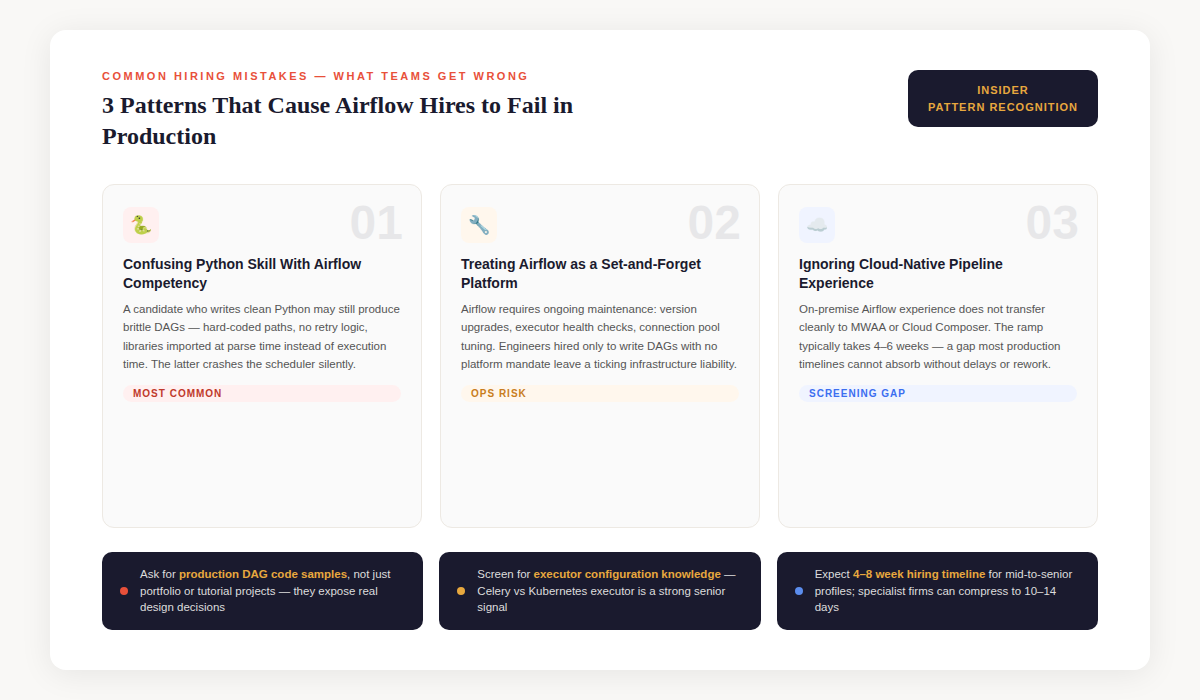
The most consistent mistake is conflating Python proficiency with Airflow competency. A candidate who can write clean Python functions may still write DAGs that are operationally brittle hard-coded paths, no retry logic, DAGs that import business logic libraries at parse time instead of task execution time (which crashes the scheduler).
The second mistake is treating Airflow as a set-and-forget tool. It requires active maintenance: version upgrades, executor health monitoring, database connection pool tuning. Teams that don’t account for this in role scope end up with an engineer who writes DAGs but has no mandate to keep the platform healthy.
Third: ignoring cloud-native data pipeline experience during screening. An engineer with only local or on-premise Airflow experience will face a significant ramp on MWAA or Cloud Composer typically 4–6 weeks that most projects can’t absorb.
FAQ: Hiring an Apache Airflow Engineer in India
What does an Apache Airflow engineer actually do day-to-day?
They design and maintain DAGs that orchestrate data workflows, debug pipeline failures, configure task dependencies and retry logic, integrate Airflow with cloud data platforms, and monitor scheduler and worker health. In mature teams, they also contribute to Airflow platform upgrades and internal developer tooling.
What skills should I look for when evaluating a candidate?
Prioritize: DAG design for production (not just tutorials), Python operator expertise, at least one cloud data platform (BigQuery, Redshift, Snowflake), executor configuration knowledge, and demonstrated experience with monitoring and alerting setups. Ask for code samples of production DAGs, not portfolio projects.
How much does an Apache Airflow developer earn in India?
Mid-level profiles command ₹12–22 lakhs annually; senior engineers range from ₹24–38 lakhs. Compensation varies by city, cloud stack depth, and whether the hire is full-time or contract. The Apache Airflow developer salary for leads and staff engineers can exceed ₹50 lakhs in product-led companies.
Should I hire an Airflow specialist or a general data engineer?
If your team runs more than 15–20 production DAGs, or if pipeline failures have direct business impact (missed SLAs, delayed reporting), a specialist is justified. Generalists are adequate for early-stage pipelines with low complexity and tolerance for occasional manual intervention.
What is the typical hiring timeline to hire Airflow engineer India candidates?
Expect 4–8 weeks for a mid-to-senior profile through direct hiring. Contract or embedded placements through specialist firms can compress this to 10–14 days for pre-vetted candidates.
What screening questions actually reveal Airflow depth?
Ask: “Walk me through how you’d design a DAG for a pipeline with three upstream dependencies and different SLAs per task.” Follow with: “How do you handle a scenario where one task fails but downstream tasks are partially independent?” These reveal DAG reasoning, not just syntax recall.
When should I consider a managed Airflow vendor instead of hiring in-house?
If your team lacks the infrastructure bandwidth to manage scheduler health, database connections, and version upgrades and your pipeline count is below 50 a managed solution (Astronomer, MWAA) with a smaller in-house team is often more cost-efficient than building full ownership internally.
Build Your Airflow Hiring Process on Solid Ground
If you’re planning to hire Airflow engineer India and want to pressure-test your job description, technical evaluation, or compensation benchmarks before going to market the biggest risk isn’t moving too slow. It’s moving fast with the wrong profile.
Most teams that struggle with Airflow hires don’t have a sourcing problem. They have a scoping problem. The job description asks for “Python and data pipelines.” The actual role demands DAG architecture, executor configuration, and production observability. That gap is where bad hires happen and where 6–10 weeks of recovery time gets quietly written off as “onboarding friction.”
Getting the scope right before posting the role changes the entire outcome. It means your technical screening filters for DAG reasoning, not just Python syntax. It means your salary bands reflect real market rates not a LinkedIn search from 18 months ago. It means your shortlist has three strong candidates instead of twelve mediocre ones.
Supersourcing works with engineering and data teams to do exactly this, defining role scope, building evaluation frameworks, and sourcing pre-vetted Airflow engineers across mid, senior, and lead levels. The process is built around your pipeline complexity and team structure, not a generic job template.
If your Airflow pipelines are business-critical, or if a previous hire in this space didn’t work out, that’s worth a direct conversation before the next one. Reach out to Supersourcing to discuss your pipeline scope, team structure, and hiring timeline and get a clear picture of what you actually need before committing to a hire.
