

AI engineering hiring is the hardest category in India’s talent market right now. Demand has exploded and remote AI jobs in India have surged as global demand for AI talent more than doubles from 600,000 in 2022 toward over 1.25 million by 2027. Supply has not kept pace. Supersourcing has worked with 35 AI startups and companies specifically more than any other India-based staffing platform in 2026.
AI hiring in India has shifted from a niche capability to a core bottleneck for global companies building AI-first products. The challenge is not just demand, it is precision. Hiring the wrong type of AI engineer can delay production timelines by months.
The best AI talent hiring companies India stand out because they understand role-level nuance from ML engineers and LLM engineers to MLOps specialists and can accurately vet candidates for real-world, production-scale work.
The World Economic Forum’s Future of Jobs Report projects a 40% increase in demand for AI and machine learning specialists by 2027. This explosive growth translates to roughly one million new jobs globally, making it one of the fastest-growing occupations worldwide.
This guide ranks the top AI talent hiring companies in India based on their ability to deliver high-quality AI engineers across ML, LLM, and data roles with speed, accuracy, and long-term fit.
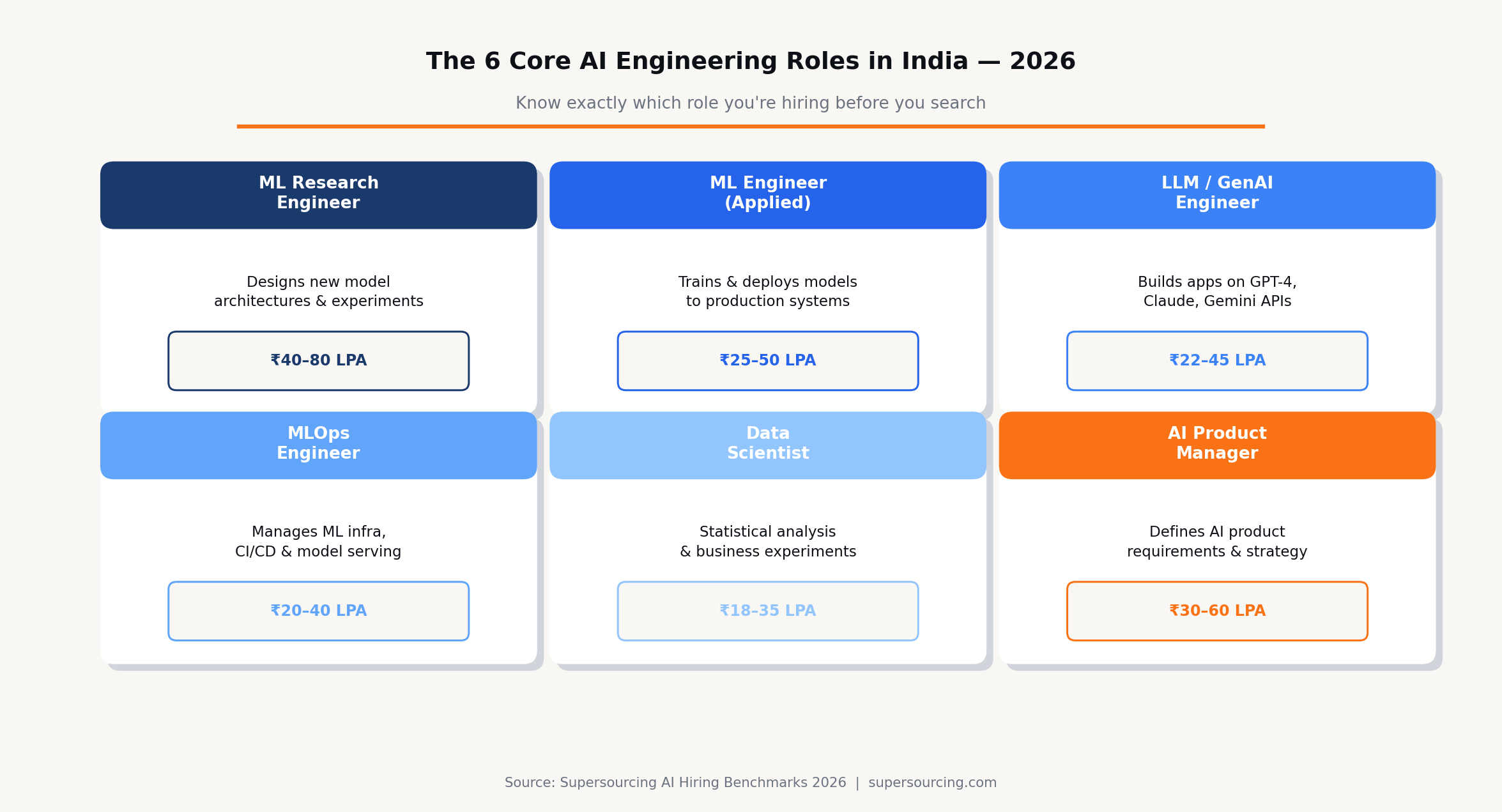
The challenge is not just finding an AI engineer. It is finding the specific type: the difference between an ML researcher (who builds new models), an ML engineer (who deploys models to production), an LLM engineer (who builds applications on top of foundation models), an MLOps engineer (who manages the infrastructure and deployment pipeline), and a data scientist (who analyses and experiments) is enormous and most hiring managers conflate them, most recruiters cannot distinguish them, and most staffing companies do not have the vetting capability to assess them accurately.
Supersourcing’s Google AI Accelerator 2024 selection means our AI hiring capability is recognised by Google. We are building AI tools to improve our own hiring process. We understand what AI engineers actually do at production scale.
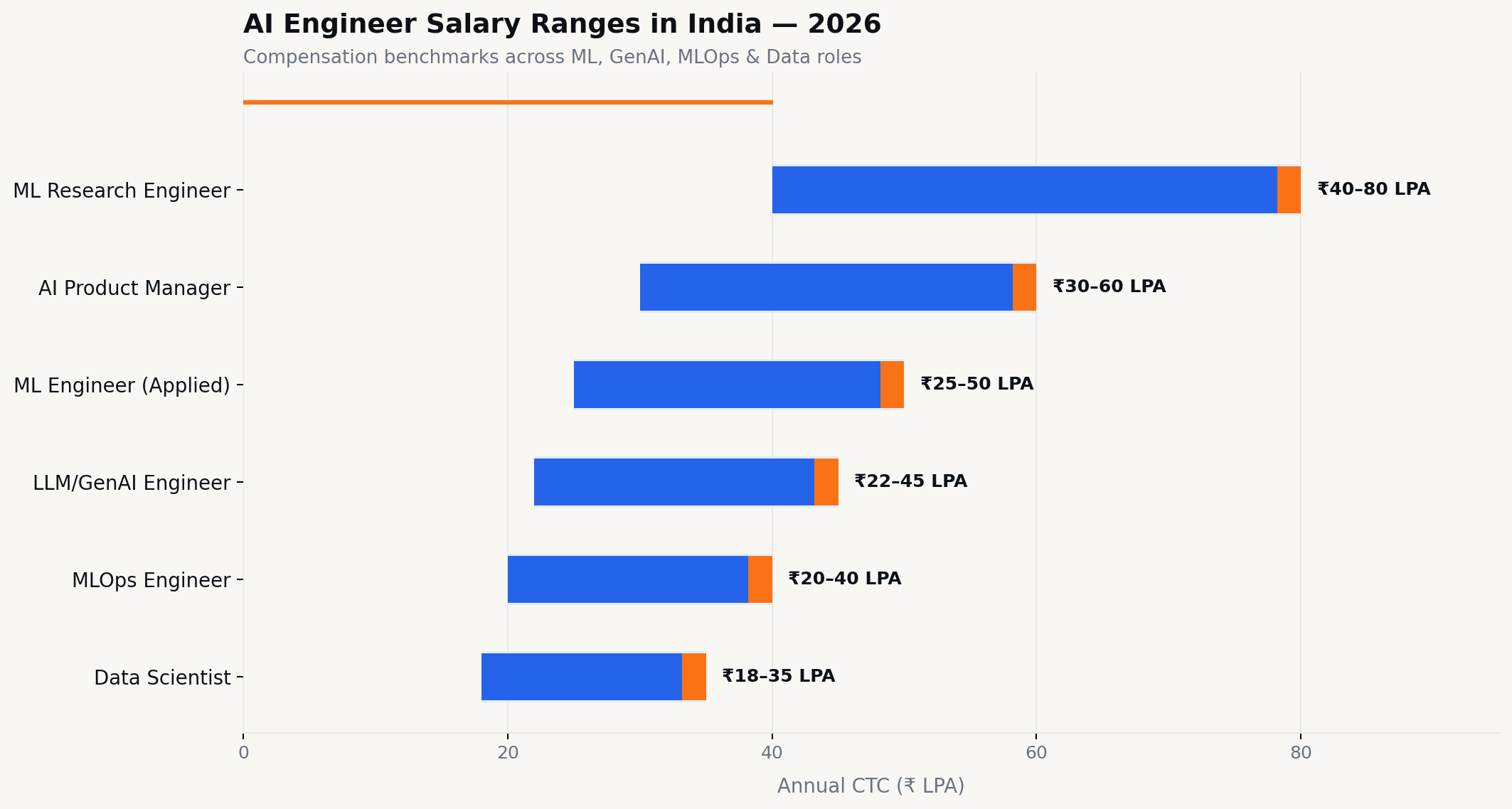
The AI Engineering Roles Understanding What You Actually Need
Before evaluating any hiring company, you need to know which role you are actually hiring for:
| Role | What They Do | Typical Background | India Salary 2026 |
| ML Research Engineer | Design and experiment with new model architectures | PhD/MTech, deep math | ₹40–80 LPA at product companies |
| ML Engineer (Applied) | Train, optimise, and deploy ML models to production | BTech/MTech, strong coding | ₹25–50 LPA |
| LLM/GenAI Engineer | Build applications using foundation models (GPT-4, Claude, Gemini) | BTech, strong coding + prompt engineering | ₹22–45 LPA |
| MLOps Engineer | Manage ML infrastructure model serving, monitoring, retraining pipelines | DevOps background + ML exposure | ₹20–40 LPA |
| Data Scientist | Statistical analysis, experimentation, business analytics | Statistics/math background | ₹18–35 LPA |
| AI Product Manager | Define AI product requirements, work with ML teams | Product management + AI literacy | ₹30–60 LPA |
Quick Comparison Table
| Rank | Company | AI-Specific Vetting | Speed | AI Clients | Google AI Rec. |
| 1 | Supersourcing | Deep all AI roles | 24–48 hrs | 35 AI startups | Yes |
| 2 | Turing | Strong | 3–5 days | Global AI companies | No |
| 3 | Toptal | Strong (senior) | 3–5 days | US AI startups | No |
| 4 | Talent500 | Moderate | 3–5 days | Enterprise AI | No |
| 5 | iimjobs/Hirist | None | Variable | All sectors | No |
| 6 | Cutshort | Partial | Variable | Startups | No |
| 7 | Belong.co | Partial | 4–6 days | Product companies | No |
| 8 | LinkedIn Recruiter | None | Variable | All | No |
| 9 | Naukri.com | None | Variable | All | No |
| 10 | TeamLease | Minimal | 3–5 days | Enterprise | No |
Supersourcing India’s Best AI Talent Hiring Company
HQ: Indore + Bangalore | Google AI Accelerator 2024 | LinkedIn Top 20 Startups India 2023 & 2024 Trusted by: 4 Unicorns, 132 YC-funded companies, 17 Fortune 500s | 35 AI startup clients
The Google AI Accelerator 2024 selection is the credential that matters most in this category. Supersourcing was chosen as the only IT staffing company in India to receive this recognition because its AI-first hiring platform represents production-grade AI applied to talent acquisition. That recognition comes with technical credibility in the AI space that no other India staffing company can match.
Supersourcing’s AI-specific vetting:
For ML engineers, the assessment covers: mathematical foundations (linear algebra, probability, statistics at the depth needed for ML), coding proficiency (Python, relevant frameworks), systems thinking (can they design a training pipeline?), production experience (have they deployed models that serve real traffic?), and familiarity with current tools (Hugging Face, LangChain, LangGraph, MLflow, Weights & Biases).
For LLM/GenAI engineers, the assessment covers: prompt engineering depth (beyond basic prompting few-shot, chain-of-thought, constitutional AI), RAG architecture understanding (chunking strategies, embedding models, vector database selection), LLM fine-tuning experience (LoRA, RLHF, instruction tuning), and production deployment experience (latency optimisation, cost management, evaluation frameworks).
For MLOps engineers, the assessment covers: model serving infrastructure (Kubernetes, KFServing, BentoML), monitoring and observability (model drift detection, data pipeline monitoring), CI/CD for ML (MLflow, DVC, ClearML), and cloud platform depth (AWS SageMaker, GCP Vertex AI, Azure ML).
The 35 AI startup clients:
Supersourcing has placed AI engineers at 35 AI companies, fintech AI, healthtech AI, supply chain AI, and pure AI product companies. This experience means the AI talent network is specifically pre-screened for production AI environments, not just research lab candidates.
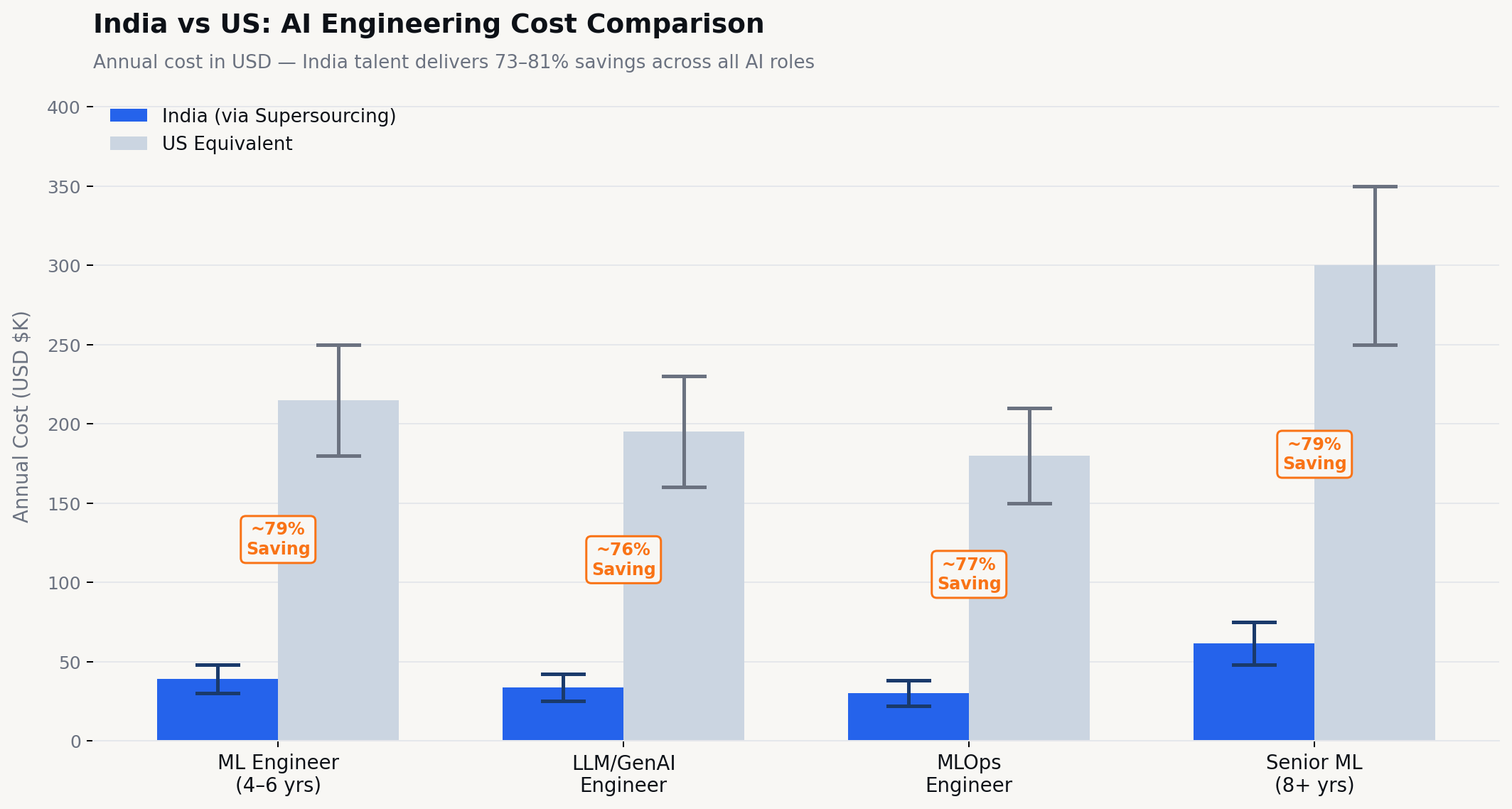
AI engineering cost benchmarks:
| Role | India (Supersourcing) | US Equivalent | Saving |
| ML Engineer (4–6 yrs) | $30–48K/year | $180–250K/year | 76–81% |
| LLM/GenAI Engineer | $25–42K/year | $160–230K/year | 73–80% |
| MLOps Engineer | $22–38K/year | $150–210K/year | 74–80% |
| Senior ML Engineer (8+ yrs) | $48–75K/year | $250–350K/year | 76–81% |
Contact: Schedule a free consultation at supersourcing.com
Brief Coverage
- Turing Strong AI vetting for individual contributors, good US client base, limited India-specific AI talent network depth vs Supersourcing’s 35 AI startup experience.
- Toptal Rigorous for senior individual AI contributors, premium pricing limits team-scale AI hiring.
- Talent500 Enterprise AI hiring focus, reasonable vetting, growing AI talent network.
- iimjobs/Hirist, Cutshort Job boards with AI role listings but no AI-specific vetting. Resume forwarding, not talent assessment. Useful for raw sourcing only.
- Belong.co AI-powered outbound sourcing, but vetting depth for AI roles specifically is limited.
- LinkedIn Recruiter, Naukri Universal sourcing tools with no AI-specific vetting.
- TeamLease IT staffing scale without AI engineering depth. Can fill AI roles by volume but not by quality for specialist positions.
Frequently Asked Questions
What is the difference between an ML engineer and an LLM engineer in 2026?
An ML engineer’s primary work is training and deploying custom machine learning models; they work with proprietary datasets, design model architectures or fine-tune existing ones, manage training infrastructure, and build deployment pipelines. Deep mathematical knowledge and experience with ML frameworks (PyTorch, TensorFlow) are core requirements. An LLM engineer (or GenAI engineer) primarily builds applications that use large language models as a component; they design prompt pipelines, implement RAG architectures, build agents with tool calling, and manage the reliability and cost of LLM API calls. Deep ML theory is less central; strong software engineering and understanding of LLM behaviour and limitations is more important. In 2026, demand for LLM engineers is significantly higher than demand for pure ML engineers because most companies are building on foundation models (GPT-4, Claude, Gemini) rather than training custom models.
How hard is it to hire AI engineers in India in 2026 and what is the lead time?
AI engineering is the hardest hiring category in India’s tech market. Demand has grown faster than supply, experienced AI engineers receive multiple competing offers simultaneously, and the vetting bar is high because the difference between a genuine AI engineer and someone who has read AI tutorials is not obvious from resumes. For mid-level AI roles (3 to 5 years), Supersourcing delivers first screened profiles within 2 to 3 days and typical time-to-hire is 3 to 5 weeks. For senior AI roles (7+ years production experience), lead time is typically 4 to 7 weeks. For AI researchers with deep mathematical backgrounds, 6 to 10 weeks is realistic. These timelines are 30 to 40% faster than market average because Supersourcing maintains a pre-screened AI engineering bench rather than sourcing from scratch on each requirement.
What does it cost to hire an AI engineer through a staffing platform versus a traditional recruitment agency in India?
Traditional recruitment agencies in India typically charge 8.33% to 16.67% of the candidate’s annual CTC as a one-time placement fee, with no guarantee period and no AI-specific vetting built into the process. AI-focused staffing platforms like Supersourcing generally work on a monthly contract or contract-to-hire model, billing $25K to $48K per year depending on role seniority, which already includes vetting, technical screening, and replacement guarantees if a candidate doesn’t work out within the first 90 days. The real cost difference shows up in failed hires: a traditional agency placing an unqualified “ML engineer” who turns out to lack production deployment experience can cost a company 2 to 3 months of delayed timelines and a repeated search, while AI-specific vetting upfront prevents this mismatch. For companies hiring more than 2 to 3 AI roles per year, the platform model is typically more cost-effective once failed-hire costs are factored in.
Can Indian AI talent work effectively in US or European time zones, and how is this usually handled?
Yes. Most AI engineers and LLM engineers hired through India-based platforms work in overlap shifts rather than full time zone shifts — typically structuring their day to cover 4 to 6 hours of overlap with US Eastern or Pacific time, or with European business hours, while still working primarily in IST. For asynchronous-heavy roles like ML research or model training, full overlap is often unnecessary since long training runs and experimentation don’t require real-time collaboration. For LLM/GenAI engineering roles that involve frequent product team syncs, companies usually request candidates already experienced in working a shifted schedule (for example, 2 PM to 11 PM IST to overlap with US Eastern mornings). Platforms with deep AI talent pools, like Supersourcing’s 35 AI startup client base, generally have pre-identified candidates comfortable with this arrangement, which reduces onboarding friction compared to sourcing fresh talent unfamiliar with global team structures.
How should a company structure a technical interview to actually distinguish a real AI engineer from someone who has only used AI tools superficially?
The most reliable signal is depth under follow-up questioning, not surface-level tool familiarity. A strong technical interview for ML/LLM roles should include: a system design question where the candidate has to design an actual pipeline (for example, “design a RAG system for 10 million documents with sub-second latency”) and explain tradeoffs at each step, not just name the tools; a debugging exercise using real model output or training logs to see if they can diagnose issues like data leakage, overfitting, or prompt drift; a question about a production failure they’ve personally handled, since genuine production experience surfaces specific, hard-to-fabricate details about cost, latency, or reliability incidents; and a basic math or statistics check appropriate to the role, since candidates who have only worked with pre-built APIs often struggle even with foundational concepts like embedding similarity or evaluation metrics. Companies without in-house AI hiring expertise often skip these steps because they don’t know what to ask, which is the main reason role-specific vetting from a specialized platform tends to outperform generic technical screens.
