

A Java developer who has shipped three polished consumer apps can still fail spectacularly inside an enterprise codebase. The skills that make someone productive on a greenfield startup projectspeed, framework fluency, comfort with rewrites are not the skills that keep a 2-million-line banking platform stable through a compliance audit. Teams that hire Java developers for enterprise application work using a generic “Java developer” checklist discover this gap in month three, usually in production.
The stakes keep rising. Enterprises are pouring more money into software than ever: Gartner’s July 2026 forecast puts worldwide IT spending at $6.37 trillion for 2026, a 14.2% jump over 2025, with software and IT services among the fastest-growing segments A meaningful share of that spend runs on the JVMcore banking, insurance claims engines, ERP integrations, telecom billing, healthcare records. When the underlying platform carries that much of the business, the difference between an adequate Java hire and an enterprise-grade one is measured in outage hours and audit findings, not story points.
This guide is the checklist we wish more hiring managers used. It defines what “enterprise-suitable” means in concrete, testable termslegacy integration ability, Java scalability experience, security discipline, testing maturity and then walks the entire hiring lifecycle: requirement definition, sourcing, vetting, contracts, onboarding, delivery management, and scaling. It closes with real cost bands and timelines, because a hiring guide without numbers is a brochure.
CTOs, VPs of Engineering, engineering managers, and procurement lead staffing Java roles on systems where downtime, data breaches, or failed audits carry six-to-eight-figure consequences.
TL;DR
This guide explains what separates an enterprise-ready Java engineer from a generally competent one, and how to test for that difference before you sign a contract. It is written for technical and semi-technical leaders who need to hire Java developers for enterprise application platforms with legacy integrations, compliance requirements, and real uptime targets.
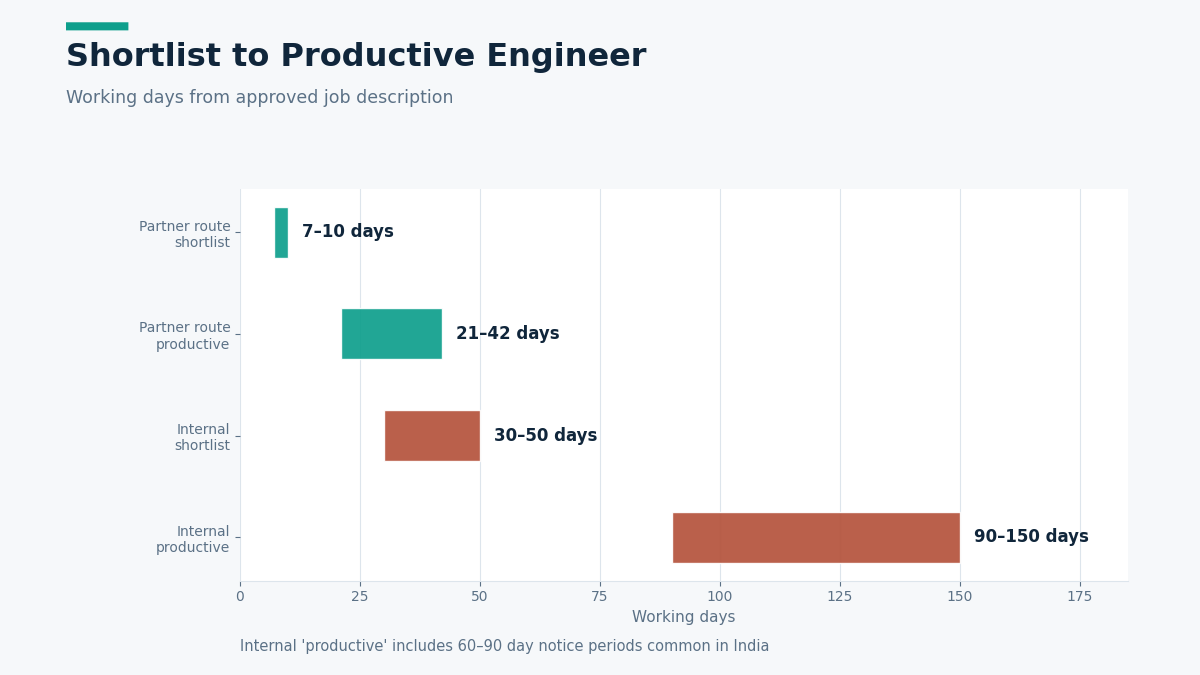
The single most useful number in it: with a structured process, the gap between "job description approved" and "interview-ready shortlist" should be 7–10 working days, not the 6–10 weeks most enterprises tolerate. The guide also gives concrete salary and contract-rate bands for India and the US, by seniority.
By the end, you will be able to write an enterprise-specific role definition, run a Java developer vetting process that filters for production-scale experience, pick the right engagement model, and manage delivery with KPIswithout depending on any vendor to tell you what good looks like.
What Is an Enterprise-Ready Java Developer?
An enterprise-ready Java developer is an engineer who can design, build, and maintain Java systems that operate at organizational scale handling high transaction volumes, integrating with legacy platforms, meeting security and compliance requirements, and staying maintainable across teams and years, not just sprints. The defining trait is accountability for long-lived production systems, not framework knowledge alone.
What this is not:
- Not the same as a senior Java developer. Seniority measures years; enterprise-readiness measures the kind of systems those years were spent on. Eight years of small agency projects can be less relevant than four years inside a payments platform.
- Not a Spring Boot specialist. Framework fluency is table stakes. Enterprise work is defined by what surrounds the framework: data integrity, integration contracts, observability, and failure handling.
- Not an architect-only role. Enterprise-ready engineers exist at mid, senior, and architect levels; the checklist below scales across all three.
The Enterprise Java Skills Checklist: What to Actually Look For
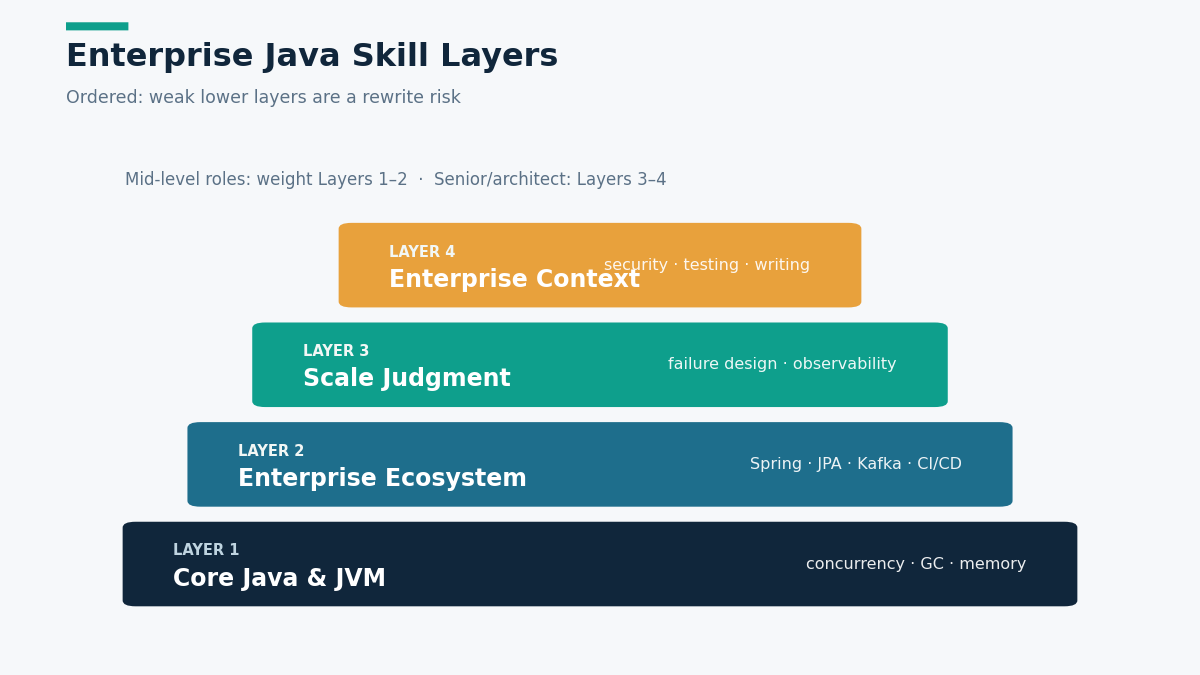
Before any process design, you need the target profile itself. The enterprise Java skills that predict success cluster into four layers and the layers are ordered, because a candidate strong in layers 3–4 but weak in 1–2 is coachable, while the reverse is a rewrite risk.
Layer 1Core language and platform depth:
- Modern Java fluency (17/21 LTS features: records, sealed classes, virtual threads) and comfort in older codebasesMost enterprise estates run mixed versions for years.
- JVM mechanics: memory model, garbage collection behavior, thread dumps, heap analysis. This is what separates “restarted the service” from “found the leak.”
- Concurrency and multithreading beyond synchronized executors, completable futures, backpressure, and knowing when not to parallelize.
Layer 2The enterprise ecosystem:
- Spring Boot and Spring Security in production, including actuator-based health checks and externalized configuration.
- Persistence done properly: JPA/Hibernate plus the SQL literacy to diagnose what the ORM generatedN+1 detection, index awareness, transaction isolation levels.
- Integration patterns: REST design with versioning and idempotency, messaging via Kafka or an equivalent broker, and tolerance for SOAP/XML where the estate demands it.
- Build and delivery: Maven or Gradle, containerized deployment, CI/CD pipeline literacy.
Layer 3Systems-at-scale judgment:
- Designing for failure: timeouts, retries with jitter, circuit breakers, graceful degradation.
- Observability as a habit-structured logging, metrics, tracing because on enterprise platforms, debuggability is a feature.
- Data-volume instincts: pagination, batch processing, archival strategy, what changes when a table crosses a hundred million rows.
Layer 4Enterprise context skills:
- Security reflexes: input validation, secrets handling, OAuth2/SSO flows, and familiarity with at least one compliance regime’s practical demands.
- Testing discipline as identity, not obligation: unit, integration, and contract tests written alongside the change, not after the escape.
- Written communication that survives being forwarded: status updates, design docs, incident summaries.
Weighting rule: for mid-level roles, weight layers 1–2 at roughly 70% of the evaluation; for senior and architect roles, invert it layers 3–4 carry the engagement. The most common calibration error is grilling architects on layer-1 trivia while never testing layer-3 judgment at all.
Why Enterprise-Readiness Matters: The Business Case
Enterprise Java systems sit closest to revenue and regulation, so hiring quality converts directly into business outcomes. The concrete effects worth budgeting around:
- Incident cost avoidance. Downtime on transaction-critical systems is commonly estimated in the thousands of dollars per minute for large enterprises. One engineer who understands connection pooling, backpressure, and graceful degradation can be the difference between a 4-minute blip and a 4-hour outage.
- Speed without rework. Engineers with genuine enterprise application architecture experience make integration and data-model decisions correctly the first time. Teams that don’t typically pay for it later as rework frequently 20–40% of sprint capacity on mature systems goes to fixing earlier shortcuts and servicing technical debt.
- Audit and compliance survival. In fintech, healthtech, and insurance, developers directly produce audit artifacts: access controls, encryption at rest and in transit, logging trails. A hire who has never worked under PCI DSS, HIPAA, or SOC 2 will slow every audit cycle they touch.
- Lower replacement risk. Mis-hires on enterprise systems are expensive to unwind: 4–8 weeks of context is lost with the person, and industry estimates routinely put the fully loaded cost of a failed technical hire at 1.5–3x annual salary.
The business case, compressed: enterprise-grade vetting costs you roughly two extra weeks of process. An enterprise-grade mis-hire costs you a quarter or more.
The Core Problem: Why Most Java Hiring Processes Fail at Enterprise Scale
Most Java hiring pipelines were designed to test general programming competence. Enterprise suitability fails silently through those pipelines because the things that matter most are the hardest to see in a one-hour interview.
The pattern we see repeatedly:
- Teams underestimate vetting depth by 3–4x. A typical process runs one coding round and one conversation. Enterprise-grade vetting needs 4–6 distinct signal checks: coding, system design at scale, legacy integration scenarios, security reflexes, testing discipline, and communication under ambiguity.
- Resume keywords are treated as evidence. “Worked on microservices” appears on the majority of Java CVs. In practice, a large share of those candidates consumed microservices someone else designed. The keyword and the capability are different assets.
- Timelines slip 2–3x against plan. Internal enterprise hiring for niche Java roles commonly takes 6–10 weeks to shortlist and 3–4 months to a productive engineer. Roadmaps get planned around the optimistic number, so projects start late before a line of code exists.
- Scale experience is asserted, never verified. Candidates say “high-traffic system”; interviewers rarely ask for the numbers requested per second, p99 latency, dataset size, or incident history. Without numbers, “scale” is a vibe.
- The post-hire phase is unmanaged. Even good hires underperform when onboarding is ad hoc: no environment access for a week, no architecture walkthrough, no defined first deliverable. The hire gets blamed for a process failure.
Every phase of the walkthrough below exists to close one of these gaps.
How to Hire Java Developers for Enterprise Application Work: The Full Walkthrough
This is the complete lifecycle, from a blank requirements doc to a scaled (or cleanly exited) engagement. Run it in order; each phase’s output is the next phase’s input.
Phase 1Defining Requirements: Scope, Skills, Timeline, Budget
Weak role definitions produce weak shortlists. Before sourcing anyone, produce a one-page role spec with four blocks.
- System context (the part everyone skips). Write down, in plain language:
- What the system does and its criticality tier (revenue-critical, internal-critical, supporting).
- Current stack and versionse.g., Java 11 migrating to 21, Spring Boot 3.x, Oracle 19c, Kafka, on-prem-to-AWS transition.
- The legacy surface: mainframe interfaces, IT services, batch jobs, ESB middleware, stored-procedure-heavy databases. Legacy system integration demands are the single biggest differentiator in who you should hire, so they belong in the spec, not in a surprise during week two.
- Compliance context: PCI DSS, HIPAA, SOC 2, GDPR/DPDP, internal security review gates.
- Skills matrix, split into must-have vs. trainable. A workable default for a senior enterprise role:
- Must-have: Java 11+ (ideally 17/21), Spring Boot + Spring Security, JPA/Hibernate with real query-tuning experience, SQL beyond ORM defaults, REST API design, JUnit/Mockito with integration testing (Testcontainers or equivalent), Git + CI/CD fluency, and demonstrated production ownership on-call, incident response, postmortems.
- Strongly preferred: Kafka or equivalent messaging, Kubernetes/Docker, observability tooling (Prometheus, Grafana, ELK), JVM tuning and garbage collection diagnostics, OAuth2/SSO implementation experience.
- Trainable: your specific cloud vendor, your internal frameworks, your domain vocabulary. Don’t reject strong engineers over trainable items, this single mistake shrinks enterprise shortlists by half.
- Seniority and team shape. Enterprise Java teams typically balance at roughly 1 architect or lead per 4–6 developers, with a senior:mid ratio near 1:1 on critical systems. Hiring five mid-level developers with no anchor senior is a false economy; the anchor hire should be first.
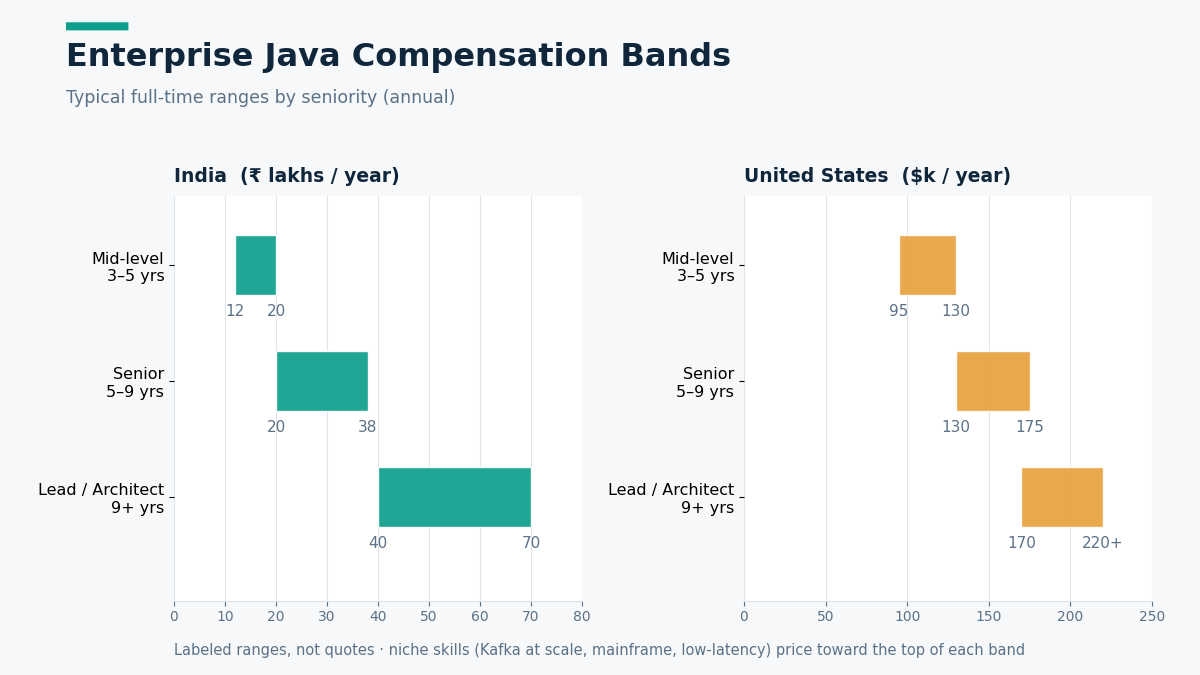
- Budget bands (validate against the Cost section below). As a planning default: mid-level enterprise Java talent in India typically runs ₹12–20 lakhs/year, senior ₹20–38 lakhs/year, and architect-level ₹40–70 lakhs/year; US equivalents commonly land at $95k–130k, $130k–175k, and $170k–220k+ respectively. Contract/staff-augmentation pricing differs see Phase 3.
Timeline rule of thumb: requirement definition done properly takes 2–3 working days of focused effort. Teams that spend zero days here spend extra weeks re-interviewing later.
Phase 2Sourcing and Vetting: What Good Screening Actually Looks Like
Sourcing determines the ceiling of your hire quality; vetting determines whether you reach it. With Java’s enormous candidate pool, your problem is precision, not volumethis is where structured Java developer vetting earns its keep.
Sourcing channels, ranked by signal quality for enterprise roles:
- Referrals from engineers currently working on comparable systems.
- Specialized staffing partners that pre-vet for enterprise experience specifically (ask exactly how the answer separates real vetting from resume forwarding; a partner with a serious IT staffing agency vetting process should be able to show you the rubric).
- Direct sourcing on LinkedIn/GitHub filtered by system type (“payments,” “core banking,” “claims”), not by framework keywords.
- Job boardshighest volume, lowest precision; budget real screening time.
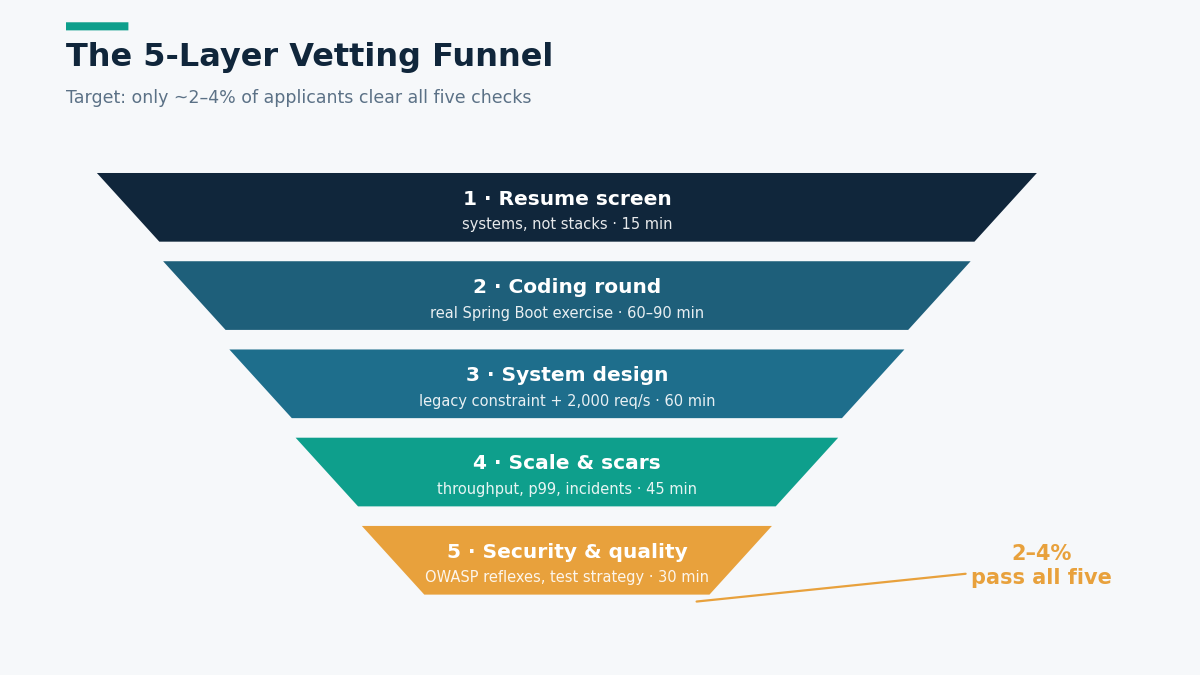
The five-layer vetting funnel (target: ~2–4% of applicants pass all five):
- Structured resume screen (15 min/candidate). Look for systems, not stacks: transaction volumes mentioned, tenure on long-lived products (2+ years per system is a good sign), on-call or incident language, migration projects. Red flag: five jobs in five years, all greenfield.
- Practical coding round (60–90 min). Skip algorithm puzzles. Use a realistic exercise: extend a small Spring Boot service, fix an N+1 query, add idempotency to an endpoint, write the tests. You’re scoring code hygiene and testing reflexes as much as correctness.
- System design at enterprise constraints (60 min). Pose your actual shape of problem: “Design an order-ingestion service that must consume from a 15-year-old SOAP inventory system, handle 2,000 requests/second at peak, and guarantee no duplicate orders.” Enterprise-ready candidates immediately ask about consistency requirements, failure modes, and the legacy contract. Others start drawing microservice boxes.
- Scale-and-scars interview (45 min). Make claims concrete with numbers: What was peak throughput? What was your p99 latency target and did you hit it? Describe your worst production incident and your role in it. What did you change afterward? Candidates with real Java scalability experience answer with specifics and trade-offs; candidates without it answer with architecture vocabulary.
- Security and quality reflexes (30 min, often merged into round 3 or 4). Walk through an auth flow and see if OWASP-class issues get flagged unprompted; ask how they’d test a change to an interest-calculation module (listen for boundary cases, integration tests, and regression strategy that’s the testing discipline enterprise systems live on).
Red flags worth an automatic pause:
- Cannot attach a single number to any “high-scale” claim.
- Dismisses legacy code (“we should just rewrite it”) when asked an integration question.
- No testing beyond “QA handles that.”
- Vague about their individual contribution on every team project.
- Framework-version enthusiasm with no interest in the domain the system serves.
The reference check most teams skip (20 minutes, disproportionate signal). For finalists, one structured call with a former engineering manager or tech lead beats a fourth interview round. Three questions do the work:
- “What class of task would you assign this person without review, and what would you never assign them?”forces a specific competency boundary instead of a recommendation.
- “Tell me about a production issue they handled”cross-check the incident story the candidate told you.
- “On a rehire scale of 1–10, where and why not higher?”The gap between the number and 10 is where the honest feedback lives.
Cultural/communication evaluation is not optional. Enterprise delivery is coordination-heavy: written status updates, cross-team dependencies, stakeholder translation. A 30-minute conversation with a non-engineer stakeholder is one of the cheapest, highest-signal checks available.
Phase 3Engagement Models and Contracts
The same engineer costs and performs differently depending on the wrapper around them. Choose the model before negotiating with the person.
The four models:
- In-house full-time. Maximum control and context retention; slowest to fill (often 8–14 weeks for senior enterprise Java roles) and carries the full cost of benefits, management, and attrition risk. Right for permanent core-platform ownership.
- Dedicated developer via a partner. A full-time engineer who works only on your systems, sourced, payrolled, and backed by a staffing partner. You get in-house-like continuity with a 1–2 week start, plus a replacement guarantee if the fit is wrong. Right for 6+ month enterprise workstreams. If you’re evaluating this route, start with a shortlist request on a dedicated hire Java developers engagement rather than a generic staffing inquiry the role page framing forces specificity on both sides.
- Staff augmentation. Contract capacity added to your existing team, usually billed hourly/monthly. Fastest flex up and down; weakest long-term context retention. Right for surges, migrations, and backfills.
- Project-based outsourcing. You buy an outcome, not people. Right only when scope is genuinely fixed/rare on living enterprise platforms.
Indicative contract pricing (label these as ranges in negotiation, not quotes): offshore India-based senior enterprise Java contractors typically bill $22–45/hour depending on seniority and niche; US-based equivalents commonly run $70–130/hour. Dedicated-developer monthly pricing from Indian partners generally lands between $3,000 and $7,500/month for mid-to-senior profiles.
Contract terms that matter more than the rate:
- IP assignment and NDA signed before any code access work-for-hire language, no ambiguity about repository ownership.
- Replacement clause with a timeline. Credible partners commit to replacing a poor-fit engineer within 7–10 working days; the absence of this clause tells you how confident they are in their vetting.
- No shared bandwidth. For dedicated models, contractually confirming the engineer is not split across clients’ split attention is the silent killer of enterprise delivery quality.
- Notice and offboarding terms: 30 days notice, documented knowledge-transfer obligations, access revocation checklist.
- Data protection annex if the engineer touches regulated data: sub-processor terms, device controls, audit rights.
Phase 4Onboarding and Ramp-Up: The First Two Weeks
Enterprise onboarding is where good hires are made or wasted. The target: a merged, reviewed, production-deployed change (however small) within the first 10 working days. That single milestone forces every access, tooling, and knowledge bottleneck into the open early.
Day 0 (before the start date)the pre-boarding checklist:
- Accounts provisioned: VPN, SSO, repository, CI/CD, ticketing, observability dashboards.
- A written architecture overview or recorded walkthrough (60–90 minutes of someone’s time, reused for every future hire).
- A named onboarding buddy with 3–5 hours/week reserved for two weeks.
- A pre-selected first ticket: real, bounded, low-risk, touching the core codebase.
Week 1: environment running locally by day 2; architecture and domain walkthrough; read the last three postmortems (fastest possible education in how the system actually fails); first ticket in progress.
Week 2: first change deployed; introduced to adjacent teams and the release process; agreed 30/60/90-day expectations in writing.
Communication cadence for distributed/dedicated engineers: a daily 15-minute standup, a weekly written progress summary, and a 4+ hour timezone overlap window agreed in the contract. Cadence gaps, not skill gaps, cause most remote enterprise engagements to wobble in month one.
Onboarding friction pattern to plan around: in most large organizations, access provisioningnot talentis the long pole. If security approvals take three weeks, a 7–10 day shortlist is wasted. Start the access workflow the day the offer is signed, not the day the engineer starts.
Phase 5Managing Delivery: Cadence, KPIs, and Accountability
Enterprise engagements drift when nobody defines “on track.” Instrument the engagement like you’d instrument the system.
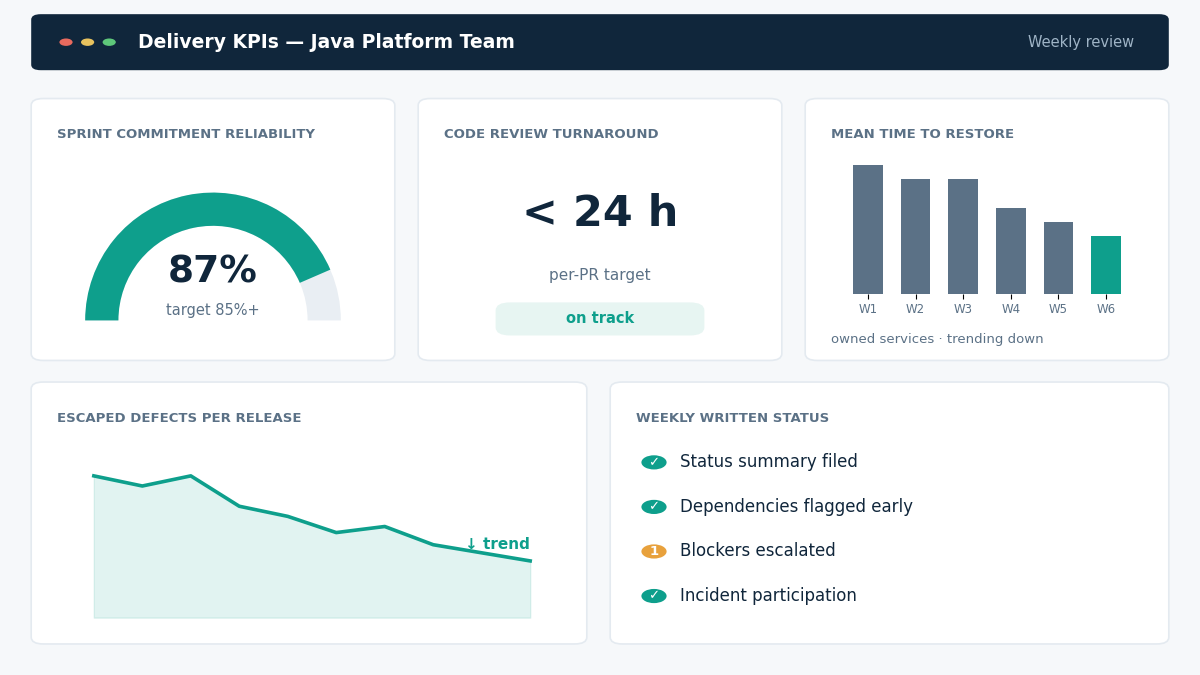
A minimal, non-bureaucratic KPI set:
- Delivery: sprint commitment reliability (target 85%+ of committed scope delivered), cycle time from ticket start to production.
- Quality: escaped defects per release, test coverage direction on touched modules (trend matters more than the absolute number), review turnaround under 24 hours.
- Operations: incident participation, mean-time-to-restore on owned services, alert noise reduction.
- Collaboration: written status quality, dependency flagging before deadlines rather than at them.
Review rhythm: weekly delivery check (30 min), monthly engagement review with the partner’s account manager if you’re using one (scope health, staffing risks, upcoming needs), quarterly roadmap-level review. A dedicated account manager on the vendor side rather than a shared inbox is the practical difference between issues resolved in days versus weeks.
When performance dips, run a two-week correction loop: name the specific gap in writing, agree the support needed (context, pairing, clearer requirements), review in 14 days. If the gap persists, invoke the replacement clause this is exactly what it exists for, and delaying it costs the roadmap more than the reset does. Quality escapes here often trace to thin test coverage rather than the individual; pairing the engineer with strong QA capacity (or deciding to hire QA engineers alongside the dev role) fixes the system, not just the symptom.
Phase 6Scaling Up or Exiting Cleanly
Scaling signals: sustained sprint overflow for 3+ sprints, a roadmap item requiring a skill gap (e.g., the platform is moving to Kubernetes and nobody owns it often the point where teams also hire DevOps engineers rather than stretch the Java team), or a new compliance/market requirement with a deadline.
Scaling rules that keep quality flat:
- Add at most 2 engineers per existing 5 at a time onboarding load is paid by the current team.
- Reuse the exact vetting funnel from Phase 2; “we’re in a hurry” is how standards erode.
- Re-balance seniority as you grow; ten mid-level engineers and one lead is an incident-response bottleneck waiting for a bad weekend.
Exiting or offboarding checklist:
- 30-day knowledge-transfer window with named recipients.
- Documentation debt paid down: runbooks, architecture decision records, credential inventories.
- Access revocation executed against a checklist on the final day, not “soon after.”
- Exit review with the partner: what the next engagement should repeat or change.
A clean exit is a capability, not a courtesyenterprises that offboard well can use flexible capacity aggressively because leaving is cheap.
Case Studies: What This Looks Like at Scale
100+ engineers for Paytm. For one of India’s largest fintech platforms, the mandate was volume hiring without quality dilution across backend-heavy roles. Running a structured, pre-vetted pipeline the same funnel logic described in Phase 2Supersourcing delivered 100+ engineering hires for Paytm, demonstrating that enterprise-grade vetting scales when the rubric is fixed and the sourcing is specialized rather than generic.
Engineering scale-up at Swiggy. High-growth consumer platforms carry enterprise-class traffic with startup-class urgency. Swiggy’s engineering hiring scale-up leaned on pre-vetted shortlists delivered on the 7–10 working day cycle, letting engineering managers spend interview hours only on candidates who had already cleared coding, system design, and scale-verification rounds.
Recruitment automation for Somnoware. For this healthtech company, the bottleneck wasn’t candidate supply but process throughput. Automating sourcing and screening stages compressed the hiring cycle dramatically while keeping human judgment on the final technical rounds, the pattern behind the 98% candidate joining rate and sub-1% contract drop-off across engagements.
Decision Framework: In-House vs. Dedicated vs. Staff Augmentation vs. Freelance
| Criterion | In-house FTE | Dedicated (partner) | Staff augmentation | Freelance |
| Time to productive engineer | 3–5 months | 3–6 weeks | 2–4 weeks | 1–2 weeks |
| Control & context retention | Highest | High | Medium | Low |
| Fully loaded cost | Highest (salary + 25–40% overhead) | Medium, predictable monthly | Medium, flexible | Lowest headline, highest variance |
| Vetting burden on you | Full | Shared (partner pre-vets) | Shared | Full |
| Replacement risk coverage | None | Contractual (7–10 days typical) | Partial | None |
| Best for | Permanent core-platform ownership | 6+ month enterprise workstreams | Surges, migrations, backfills | Bounded, low-integration tasks |
How to apply it in 3 questions:
- Is this system permanent core IP? → anchor in-house, extend with dedicated capacity.
- Is it needed for 6+ months but the headcount is frozen or hiring is too slow? → dedicated model.
- Is it a surge with a defined end? → staff augmentation; avoid freelance for anything touching regulated data or deep legacy integration.
What Most Teams Get Wrong When Hiring Enterprise Java Developers
The consistent failure pattern isn’t hiring bad engineers, it’s testing for the wrong properties. Most interview processes over-weight framework knowledge and algorithm speed, and under-weight the three things enterprise systems actually run on: integration judgment, failure-mode thinking, and testing discipline.
A candidate who has personally untangled a SOAP-to-REST migration, tuned a garbage collector under memory pressure, and written the postmortem for an outage they caused is worth more on an enterprise platform than a faster coder who has only ever worked on clean codebases and almost no standard interview loop can tell them apart.
The specific mistakes, in descending order of damage:
- Treating “senior” as “enterprise-ready.” Years of experience in the wrong class of system don’t transfer. Vet the systems, not the tenure.
- Rejecting trainable gaps. Passing on a proven distributed-systems engineer because they used GCP instead of your AWS is trading a 2-week learning curve for a 10-week search.
- Letting “rewrite it” answers slide. In enterprise contexts, rewrite-first instincts are a risk profile, not a preference. The realistic skill is incremental strangler-pattern migration while the legacy system keeps serving traffic.
- Skipping the numbers interview. If nobody asks for throughput, latency, and incident specifics, resume inflation wins by default.
- Hiring the team bottom-up. Mid-level hires before the anchor senior means the architecture gets decided by whoever arrived first.
- Ignoring the writing sample. Enterprise coordination is written coordination. An engineer who can’t summarize status clearly will cost you cross-team hours forever.
Cost and Timeline Reality Check
The section most content skips, because ranges invite argument. Ranges are still more useful than adjectives. Treat everything below as typical bands observed across engagements, not quotes; niche skills (Kafka at scale, mainframe integration, JVM performance specialization) push toward or past the top of each band.
Annual compensation bands (full-time):
| Level | India (₹/year) | US ($/year) |
| Mid-level (3–5 yrs, enterprise exposure) | ₹12–20 lakhs | $95k–130k |
| Senior (5–9 yrs, production ownership) | ₹20–38 lakhs | $130k–175k |
| Lead / Architect (9+ yrs) | ₹40–70 lakhs | $170k–220k+ |
Contract to hire and dedicated-model pricing: offshore senior contractors typically $22–45/hour; US contractors $70–130/hour; dedicated mid-to-senior engineers via Indian partners commonly $3,000–7,500/month. Add 25–40% to any in-house salary for the fully loaded cost (benefits, hardware, management, real estate/tooling).
What moves cost up: regulated-domain experience (fintech/health commonly +15–25%), on-call obligations, rare combinations (Java + mainframe, Java + low-latency trading), timezone-aligned overlap requirements.
What moves cost down: flexible overlap windows, longer commitment terms (6–12 month contracts typically price 10–15% under month-to-month), hiring the anchor senior first so subsequent roles can be mid-level.
Timeline bands by scenario:
- Dedicated/partner route: 7–10 working days to an interview-ready shortlist; 3–6 weeks from kickoff to a productive engineer.
- Internal hiring, senior enterprise role: 6–10 weeks to shortlist; 3–5 months to be productive (including notice periods, commonly 60–90 days in India).
- Team of 5 (1 lead + 4 devs) via blended approach: 6–10 weeks to full staffing if sequenced lead-first; longer if attempted in parallel without an anchor.
Budget the ramp, not just the rate: even a strong hire runs at partial productivity for 2–4 weeks on a complex enterprise codebase. Plans that assume day-one velocity are the most common source of “the vendor is slow” friction that is actually calendar math.
Next Step: Turn the Checklist Into a Shortlist
If you’re mid-decision, the highest-leverage move is small: write the Phase 1 role specsystem context, must-have vs. trainable skills, seniority shape, budget band. That one page makes every subsequent conversation (internal or with a partner) twice as fast and half as vague.
If you’d rather compress the sourcing and vetting phases entirely, Supersourcing runs this exact funnelAI-assisted sourcing from the top 2% of vetted talent, enterprise-specific screening, and an interview-ready shortlist in 7–10 working days, backed by a like-for-like replacement guarantee. Bring the role spec (or a rough version of it) to a scoping conversation: supersourcing.com/contact-us.
FAQ
What makes a Java developer suitable for enterprise applications?
Demonstrated ownership of long-lived production systems: legacy integration experience, verified work at scale (with real throughput/latency numbers), security and compliance exposure, strong automated-testing habits, and clear written communication. Framework knowledge is necessary but nowhere near sufficientthe differentiator is judgment formed by operating systems that were too important to break.
How do you evaluate a Java developer’s scalability experience?
Ask for numbers and trade-offs, not architecture. Peak requests per second, p99 latency targets, dataset sizes, what broke first under load, and what they changed. Follow with a design exercise mirroring your constraints/legacy dependency included. Genuine scalability experience shows up as questions about consistency and failure modes before any boxes get drawn.
How much does it cost to hire Java developers for an enterprise application?
Typical full-time bands: ₹12–38 lakhs/year in India and $95k–175k in the US for mid-to-senior levels, with architects above that. Dedicated offshore engineers commonly run $3,000–7,500/month; contract rates span $22–45/hour offshore and $70–130/hour in the US. Regulated-domain and rare-skill combinations price 15–25% higher.
How long does it take to hire an enterprise Java developer?
Through a specialized partner: 7–10 working days to an interview-ready shortlist and 3–6 weeks to a working engineer. Internally: expect 6–10 weeks to shortlist and 3–5 months to productivity once notice periods and onboarding are counted. The biggest controllable factor is having the role spec and access provisioning ready before sourcing starts.
Should we hire in-house or through a staffing partner?
Anchor permanent core-platform ownership in-house; use dedicated partner engineers for 6+ month workstreams where speed matters or headcount is constrained; use staff augmentation for bounded surges. If your internal pipeline can’t produce a vetted shortlist inside a month, a partner route for the first roles usually pays for itself in roadmap time alone. A short scoping call is the fastest way to pressure-test which model fits your case.
What are the biggest red flags when vetting Java developers?
No numbers behind any scale claim, reflexive “rewrite it” answers to legacy questions, testing treated as someone else’s job, vagueness about individual contribution, and job histories composed entirely of short greenfield stints. Any one is a pause; two or more is a pass.
Do enterprise Java developers need cloud and DevOps skills?
Working fluency, yes: containers, CI/CD, and enough Kubernetes to deploy and debug their own services. Deep platform engineering, now that’s a separate role, and expecting one hire to cover both usually produces mediocre coverage of each. Cloud-vendor specifics are trainable in weeks and shouldn’t be a rejection criterion.
Is Java still relevant for enterprise applications in 2026?
Emphatically. Java remains among the most-used languages by professional developers globally, the JVM ecosystem (Spring Boot, Kafka, modern LTS releases like Java 21) keeps advancing, and the world’s core banking, insurance, telecom, and ERP workloads still run on it. For enterprise platforms, the question isn’t Java’s relevance, it’s finding engineers suited to Java at enterprise scale.
