

A senior Python engineer in San Francisco and a senior Python engineer in Pune can write the same FastAPI service. The difference in what you pay for it is not 20% or 40%. The decision to hire Python developers USA businesses depend on is a cost-structure decision before it is a talent decision. Measured honestly fully loaded, including the recruiting fee and the ramp period nobody budgets for it is routinely 3x to 5x. That gap is the single largest lever most US engineering budgets have, and most teams pull it badly, because they compare an hourly rate against a salary and call it analysis.
The demand side is not softening. The U.S. Bureau of Labor Statistics projects software developer employment to grow 16% between 2024 and 2034, against 3% for all occupations, with roughly 129,200 openings a year across the developer, QA, and test category.
BLS projects 16% growth in software developer employment through 2034 more than five times the all-occupations rate with about 129,200 annual openings across the developer/QA category.
Python sits at the center of that demand rather than at the edge of it. Stack Overflow’s developer survey put Python usage at 57.9% of respondents, a seven-percentage-point jump in a single year, the sharpest move of any language in the set, driven by AI, data engineering, and backend API work converging on the same runtime. Which means you are not competing for Python talent against other backend teams. You are competing against every company building an AI feature this quarter.
This guide is the process we run. Not the pitch version, the working version, with the cost arithmetic, the vetting rubric, the contract clauses that matter, and the week-one failures that quietly eat the savings you thought you’d locked in.
TL;DR
This is a buyer's guide for engineering and talent leaders who need to hire Python developers USA teams can actually ship with. It covers what the role really costs, how to test for it, which engagement model fits which situation, and how to run the team after the contract is signed.
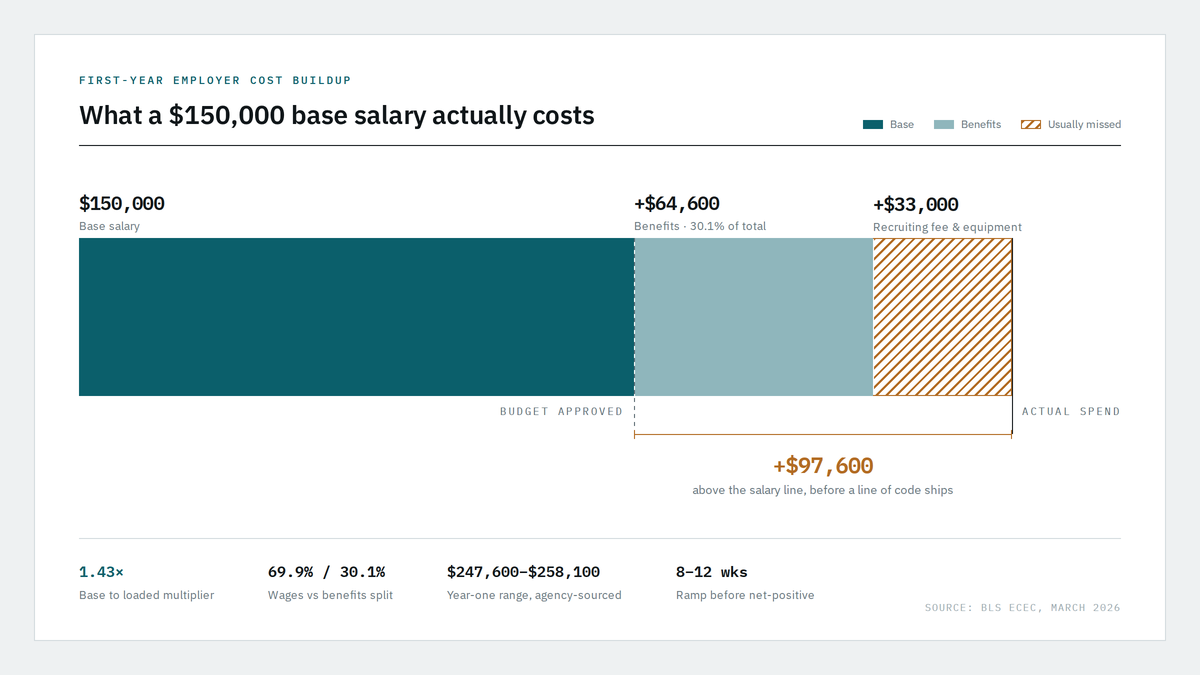
Here is the number that reframes everything: US base salary is only about 70% of what a US employee costs you. BLS data puts benefits at 30.1% of private-industry employer compensation costs, so a $140,000 base is closer to $200,000 fully loaded before the recruiting fee and before the eight to twelve weeks of ramp. Offshore dedicated Python developers at a comparable quality bar land in a different order of magnitude entirely.
By the end you will be able to write a Python job spec that filters correctly, run a technical screen that catches the failure mode most interviews miss, price four engagement models against each other, and know within the first two weeks whether a hire is going to work.
What Are Hiring Python Developers in the USA?
Hiring Python developers in the USA is the process of scoping a Python-specific engineering need, then sourcing, vetting, and contracting engineers to fill it as US-based employees, US contractors, or offshore dedicated engineers and choosing among those models based on fully loaded cost, time-to-productivity, IP exposure, and how much real-time timezone overlap the work requires.
It is regularly confused with three other things:
- It is not the same as buying an outsourced project. Project outsourcing sells you a deliverable against a statement of work. Hiring including staff augmentation gives you engineers who take direction from your leads and work inside your backlog.
- It is not a single role. “Python developer” spans backend API engineers, data/ETL engineers, and ML engineers. The vetting rubric for each is different enough that hiring one when you need another is the most common expensive mistake in this category.
- It is not location-locked to the US. “Hiring in the USA” describes where the demand, the compliance obligation, and the delivery accountability sit. The engineer may or may not be US-based, and that choice is a cost and risk decision, not a default.
Why the Python Hiring Decision Carries More Weight Than It Looks
The business outcomes attached to this one decision are larger than the salary line implies, because a Python hire usually sits on the critical path of something revenue-facing: an API, a data pipeline, a model in production. Teams that hire Python developers USA-side for the first time in two years are often surprised by how little of the total cost the salary line represents.
Concrete outcomes this decision moves:
- Fully loaded cost. BLS puts benefits at 30.1% of private-industry employer compensation costs, wages and salaries at 69.9%. Practically: multiply base by ~1.43 to get true employer cost. A $150,000 senior Python hire is a ~$215,000 line item.
- Recruiting cost on top of that. Contingency agency fees in the US commonly run 20–25% of first-year base. On a $150,000 hire that is $30,000–$37,500 before the engineer writes a line of code.
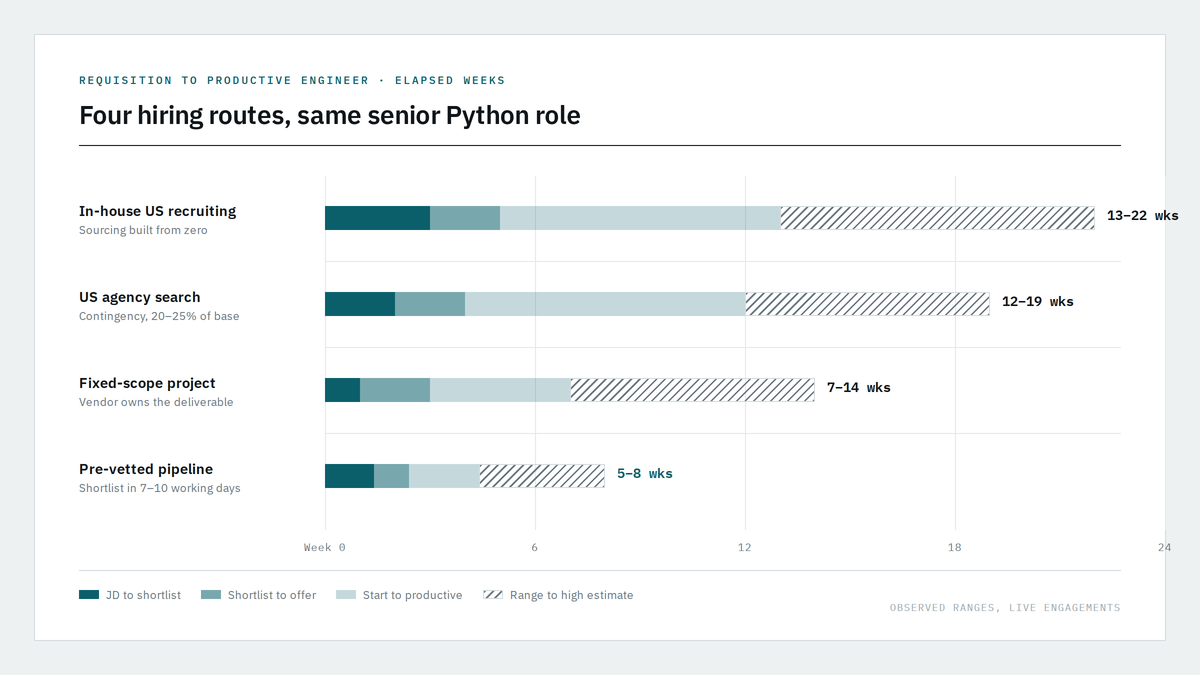
- Time-to-first-commit. In-house US hiring for a senior Python role typically runs 6–10 weeks from approved requisition to signed offer, plus two to four weeks of notice, plus ramp. A pre-vetted pipeline compresses the shortlist stage to 7–10 working days.
- Ramp-to-productive. Budget 8–12 weeks before a senior backend hire is net-positive on a mature codebase. Anything you save on rate is irrelevant if you re-pay this cost twice through a mis-hire.
- Wage-band risk. BLS puts software developer median pay at $133,080, with the 10th percentile at $79,850 and the 90th at $211,450. That 2.6x spread inside one occupation code is why “market rate” is a meaningless anchor without a level definition.
- IP and compliance exposure. Whether IP assignment survives across jurisdictions, and whether your data handling stands up to SOC 2 or HIPAA review, is decided by contract language written before onboarding not after an audit finding.
The Core Problem: The Role Is Three Jobs and the Screen Tests None of Them
Most dedicated teams underestimate the cost of a Python mis-hire by 3–4x, because they count the salary they paid and not the quarter they lost. The pattern is consistent enough to be predictable.
What actually goes wrong, in order of frequency:
- The job description describes a language, not a system. “5+ years Python, Django, REST APIs” matches tens of thousands of people, most of whom have never operated the thing they built. You get applicant volume and no signal.
- The screen tests algorithms; production tests operations. A candidate can invert a binary tree flawlessly and still have never debugged a Celery worker that died mid-task, run a Django migration against a 40-million-row table, or reasoned about why an asyncio service is blocking on a synchronous database driver.
- Three roles get collapsed into one requisition. A backend API engineer, a data engineer who lives in Airflow and dbt, and an ML engineer who ships PyTorch models behind an inference endpoint are three different hires. Notebooks are not a deployment.
- Rates get compared instead of costs. A $65/hour offshore engineer who needs two rounds of rework is more expensive than a $110/hour engineer who ships clean, and neither number tells you which one you have until week six.
- The shortlist goes stale. Strong Python candidates in any market are typically in three processes at once. The 3-day rule: if a shortlisted candidate has not had a first conversation within three working days, the price of losing them.
Red flag: if your last two Python hires both “needed more ramp time than expected,” the problem is almost never the engineers. It is that the screen never tested the work.
How to Hire Python Developers USA Teams Actually Ship With: The Full Walkthrough
Six phases. Run them in order. Skipping Phase 1 is what makes Phase 2 expensive.
Phase 1 Define the requirement before you define the budget
Write the spec around the system the engineer will own, not the skills list. Two teams hiring “a senior Python developer” at the same salary are frequently hiring for jobs that share nothing but the import statement.
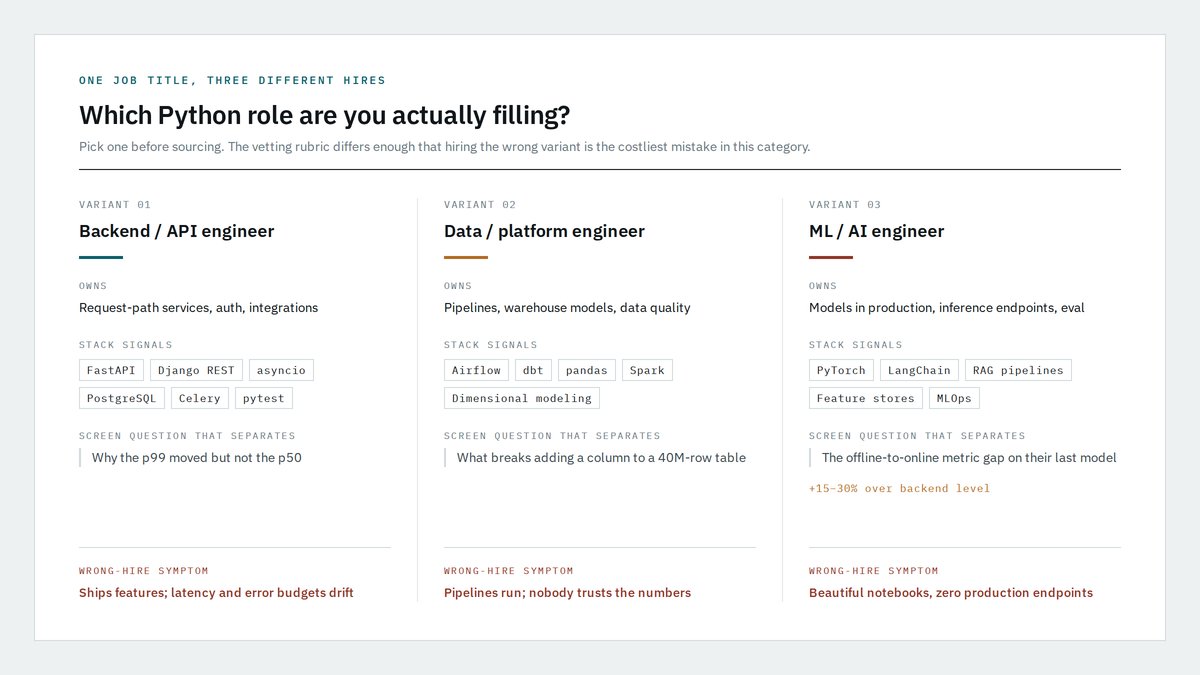
Step one: pick which of the three Python roles you are actually filling.
| Role variant | Owns | Core stack signals | Wrong-hire symptom |
| Backend / API engineer | Request-path services, auth, integrations | FastAPI or Django REST, asyncio, PostgreSQL, Celery, pytest | Ships features; latency and error budgets drift |
| Data / platform engineer | Pipelines, warehouse models, data quality | Airflow, dbt, pandas, Spark, dimensional modeling | Pipelines run; nobody trusts the numbers |
| ML / AI engineer | Models in production, inference endpoints, eval | PyTorch, LangChain, RAG pipelines, feature stores, MLOps | Beautiful notebooks, zero production endpoints |
If the work is production AI rather than backend, treat it as its own requisition the gap between a strong Python generalist and an engineer who can deploy, monitor, and re-train a model is wider than most job descriptions admit, which is why teams increasingly hire machine learning engineers separately from their Python backend roles.
Step two: define the level in behaviors, not years. Years of experience is a weak proxy; scope of ownership is a strong one.
- Mid-level (roughly 3–5 years): ships a well-specified feature end to end, writes tests without being asked, and needs the architecture handed to them.
- Senior (roughly 5–9 years): owns a service, makes schema and dependency decisions others live with, can say no to a bad requirement and explain why.
- Lead / staff: sets standards across services, does the review that raises everyone else’s floor, is accountable for reliability rather than tickets.
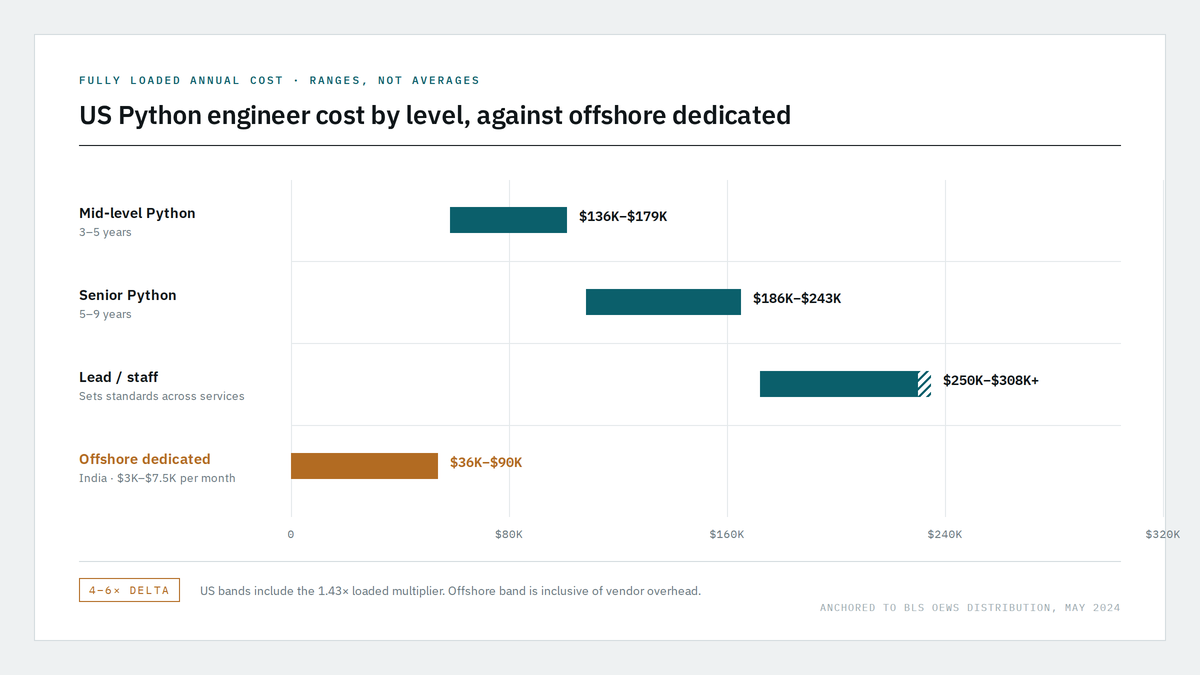
Step three: set a budget band before you see a single résumé. Anchor to BLS distribution data rather than aggregator averages, which disagree with each other by $30,000+ for the same title. Use the 25th–75th percentile band for your metro and level, then apply the 1.43x fully loaded multiplier so the number you carry into the approval conversation is the number you will actually spend.
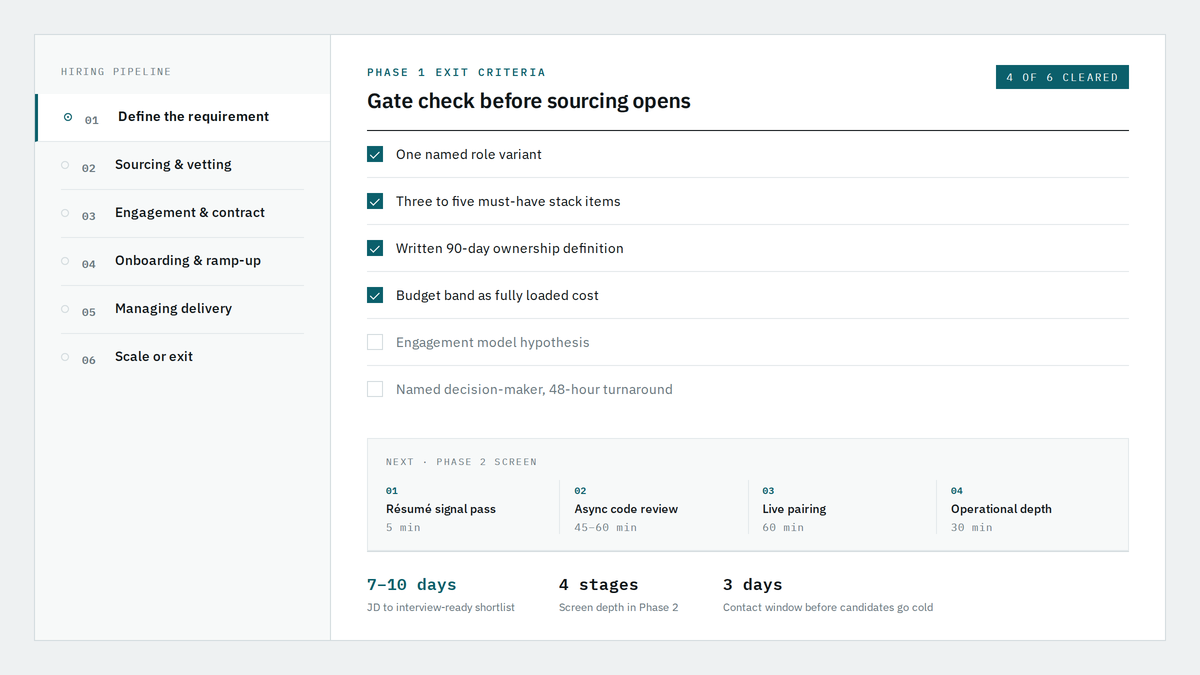
Phase 1 exit checklist:
- One named role variant, not “Python developer”
- Three to five must-have stack items everything else moves to “nice to have”
- A written definition of what this person owns 90 days in
- A budget band expressed as fully loaded annual cost, not base salary
- An engagement model hypothesis (employee / contractor / dedicated offshore)
- A named hiring manager who can make a decision within 48 hours of a final round
When you’re ready to see what a shortlist against that spec looks like, this is the point where teams typically hire Python developers through a pre-vetted pipeline instead of restarting sourcing from zero.
Phase 2 Sourcing and vetting that survives production
Good screening for Python is cheap to run and hard to fake. It looks nothing like a LeetCode round.
The four-stage screen we use, in order, with time budgets:
- Résumé signal pass (5 minutes). Look for systems in production, not tools listed. “Built and operated an ingestion pipeline handling 4M events/day” beats a 30-item skills matrix every time.
- Async code review exercise (candidate: 45–60 minutes; your reviewer: 15). Send a small, deliberately flawed Python service: an N+1 query, a bare exception, a synchronous call inside an async handler, a missing index. Ask them to review it, not rewrite it. Review comments expose seniority faster than any greenfield task.
- Live pairing on their own code path (60 minutes). Have them extend the same service with one requirement and one deliberately ambiguous edge case. What you are testing: do they ask about the ambiguity, or guess and move on?
- Operational depth interview (30 minutes). Purely about failure. How do you find out a Celery task is silently retrying forever? What breaks when you add a column to a 40M-row table under load? Why did the p99 move but not the p50?
What separates real signal from theater:
- Ask for the last production incident they were personally responsible for, and what they changed afterward. Candidates who have owned systems answer in specifics within 20 seconds. Candidates who have not, generalize.
- Weight test discipline heavily. pytest fixtures, type hints and mypy in CI, and a habit of writing the failing test first are the cheapest available predictors of whether the codebase survives them.
- For ML roles, ask what their offline-to-online metric gap was on their last model and how they closed it. Anyone who has only trained models has no answer.
Red flags, ranked by how reliably they predict a bad outcome:
- Cannot describe a system they built end to end without switching to the passive voice
- Explains the GIL fluently but cannot say what happens when a worker process dies mid-task
- Every project was “greenfield” no evidence of ever inheriting someone else’s code
- Timeline in the CV compresses under questioning
- No questions for you about the codebase, the on-call rotation, or the review culture
Realistic Phase 2 timelines: in-house sourcing to interview-ready shortlist runs 3–6 weeks in most US markets for senior Python roles. Working from a pre-vetted talent pool, job description to interview-ready shortlist is typically 7–10 working days, because the vetting has already happened. You are scheduling, not screening.
Phase 3 Engagement models, contracts, and the clauses that decide the outcome
Companies that hire Python developers USA-side and offshore at the same time end up running two engagement models in parallel, and that is usually correct rather than messy. Choosing a model is choosing which risk you would rather hold. Cost, control, and speed are the obvious axes; classification and IP are the ones that generate legal invoices later.
The four models, plainly:
- US full-time employee (W-2). Maximum control and retention, maximum cost, slowest to start. Correct for roles that need deep institutional context and long tenure.
- US contractor (1099 or C2C). Fast, flexible, and the highest classification risk. If you set their hours, supply their tools, and direct their daily work, you are describing an employee regardless of what the contract says, that is co-employment and misclassification exposure, and the penalties are federal.
- Staff augmentation / dedicated offshore engineer. Engineer works inside your sprints, reports to your lead, invoiced monthly by the vendor. Best cost-to-control ratio for sustained work. This is where contract IT staffing structures earn their keep. See how contract IT staffing engagements are typically structured before you negotiate one.
- Project-based / fixed-scope. Vendor owns the deliverable. Right for bounded, well-specified work; wrong for anything where requirements will move, because every change becomes a change order.
Contract clauses to negotiate specifically not boilerplate:
- IP assignment that works in both jurisdictions. US work-for-hire language alone does not reliably assign IP created by a contractor in India. You want present-tense assignment (“hereby assigns”), a moral-rights waiver where applicable, and confirmation that the vendor holds signed assignments from each individual engineer, not just from the entity.
- Notice-period buyout, and who pays it. Indian employment notice periods commonly run 30–90 days. If you want someone to start in two weeks, someone is buying that out. Settle it in the contract, not in week three.
- Conversion fee that decays. If you might later convert an offshore engineer to a direct hire, negotiate a fee that steps down with tenure and reaches zero typically at 12 months. A flat perpetual fee is a trap.
- Replacement terms with a clock on them. “We’ll replace a bad fit” means nothing without a window. A defined replacement guarantee within 7–10 days is a term you can actually plan against.
- Dedicated capacity, in writing. Explicitly prohibit shared bandwidth across accounts. An engineer split across two clients is a 60% engineer on both.
- Data handling and access scope. Name the systems the engineer may touch, the data classes they may see, and whether any production data leaves your environment. This is the clause your SOC 2 auditor will ask for.
- Rate card mechanics. Understand the difference between bill rate and pay rate, and ask what the markup covers. A vendor unwilling to discuss structure is telling you something.
Phase 4 Onboarding and the first two weeks
Nearly every “the offshore engineer was slow to ramp” post-mortem is an access problem misdiagnosed as a talent problem.
The one thing to pre-file: read access to your observability stack. Security teams approve GitHub in a day and Datadog, Sentry, or CloudWatch in three weeks. An engineer who cannot see the traces for the service they own is guessing, and it will look like weakness. File observability access the day the contract is signed, before the laptop ships.
Day-one access checklist all of it, before they log in:
- SSO account, MFA enrolled, group memberships mapped to their role
- Git access with commit rights to the actual repo, not a fork
- Local environment that builds a working docker compose up and a seeded test database
- CI access, including the ability to see why a build failed
- Read access to observability, error tracking, and log aggregation
- Ticket tracker, design docs, and the architecture diagram (even if it’s out of date say so)
- On-call and escalation paths, plus who to interrupt for what
If your environment setup is the bottleneck and for most Python teams with a native-dependency-heavy stack, it is a DevOps problem, and the fix is a person, not a wiki page. Teams that hire DevOps engineers alongside their first two or three Python hires cut ramp time for every subsequent hire.
A two-week ramp plan that works:
- Days 1–2: environment builds locally, first PR merged. Make it deliberately trivial a log message, a docstring, a test. The goal is to exercise the entire pipeline from clone to deploy, not to deliver value.
- Days 3–5: one small bug fix in the service they will own, reviewed by the lead. First real code review conversation happens here, and it sets the standard.
- Week 2: one scoped feature with a known acceptance test. Daily 15-minute sync with the lead, not a weekly one.
- End of week 2: written check-in. Three questions: what’s unclear, what’s slower than it should be, what would you change. Answers to the third question are your best early signal of seniority.
Communication cadence for distributed teams: define required overlap hours explicitly, in writing, in the engineer’s local time. Four hours of overlap is enough for most backend work if standups and reviews sit inside it. Two hours is enough only if the work is genuinely parallelizable. Zero overlap works for nothing that involves debugging together.
Phase 5 Managing delivery once the honeymoon ends
A steady state is where cost arbitrage is either realized or quietly lost. The instrumentation is not complicated, but it has to exist.
Metrics that tell you the truth about a Python team:
- Cycle time from PR open to merge. Rising cycle time is the earliest visible symptom of almost every person’s problem.
- Change failure rate and time to restore the two DORA metrics that survive contact with real backlogs.
- Review pass rate on first submission. Trending down means the spec, not the engineer, is usually the problem.
- Escaped defects per release, tagged by owning service.
- Sprint predictability committed vs. completed, tracked over five sprints. One bad sprint is noise; three is a signal.
Cadence that works without becoming overhead:
- Daily async standup in writing, 15 minutes live only if there’s a blocker
- Weekly 1:1 between the engineer and your lead technical, not status
- Biweekly delivery review with the vendor account manager, against the metrics above
- Monthly commercial review: utilization, invoice accuracy, any scope drift
Insist on a named account manager with authority. The difference between a vendor relationship that works and one that grinds is whether there is one person who can make a decision about replacement, capacity, or escalation without a committee.
Phase 6 Scaling the team, or exiting cleanly
Both directions need to be designed before you need them.
Scaling up without diluting quality:
- Add in pairs where possible a second engineer on a service halves the bus factor and the onboarding burden per head
- Hold the bar constant; the most common scaling failure is quietly lowering the vetting standard to hit a headcount date
- Promote from within the engagement before adding leads from outside someone who already knows the codebase makes a better lead than a stronger engineer who doesn’t
- Cap team growth at roughly 30% headcount per quarter on any single service; above that, onboarding consumes the capacity you just added
- Re-check the engagement model at every doubling what worked for two engineers is often wrong at eight, where a dedicated pod or a GCC structure becomes cheaper per head
Offboarding and replacement, in order:
- Written 30-day handover plan owned services, open work, known landmines
- Documentation and runbook updates as an explicit deliverable, not a favor
- Credential and access revocation on the last working day, verified by a checklist
- Overlap week with the incoming engineer wherever the timeline allows
- Confirm the contractual replacement window and hold the vendor to it a defined 7–10 day replacement term is only useful if you invoke it
What “done well” looks like at the six-month mark: the engineer is reviewing other people’s code, has been paged and resolved something without escalating, and your lead has stopped tracking them differently from the rest of the team. If all three are true, the hire worked. If none are, the problem was Phase 1 or Phase 2, and re-running the process is cheaper than continuing to hope.
Case Studies: What Python Hiring at Scale Actually Produced
Metrics first, story second.
40+ engineers onboarded on short-term contracts, then scaled to Dunzo. Dunzo’s growth outpaced its ability to find reliable senior engineers, specifically in Python, DevOps, and Angular. The Supersourcing team supplied 40+ vetted engineers across those three stacks, screened against Dunzo’s own requirements rather than a generic bar, and structured the initial engagement as short-term contracts so the company could adjust headcount as demand moved. The contract-first structure is the transferable part: it lets a fast-moving team commit to capacity without committing to permanent cost.
100+ engineers hired without a delivery slip Paytm. Paytm needed to add engineers at a volume most in-house recruiting functions cannot absorb, and expected the process to be painful. It wasn’t: the cohort was delivered on schedule, with engineers the team rated as both technically strong and effective communicators, the second half of that sentence being the one that usually fails at volume. The lesson for anyone hiring Python at scale is that communication screening is not a soft nicety; at 100 hires it is the difference between a team and a queue.
Top-2% DevOps talent placed for enterprise infrastructure Adani Group. Supporting digital transformation across energy, logistics, and infrastructure meant Adani needed infrastructure engineers who could work in a regulated, high-scale environment, not generalists. Hiring was drawn from the top 2% of the vetted pool. Relevant to Python buyers for one reason: the Python backend hires you make are only as productive as the deployment platform underneath them, and the two hires are usually sequenced wrongly.
The Decision Framework: Which Model Fits Your Situation
Stop comparing rates. Compare fully loaded cost per productive engineer-month, then check whether the model can hold the risk you care about.
Apply it in four questions:
- Will this work still exist in 18 months? Yes → employee or dedicated engineer. No → contractor or fixed scope.
- Does the work require more than four hours of daily overlap with your team? Yes → onshore or a nearshore/overlap-guaranteed arrangement. No → offshore is on the table.
- Who needs to hold accountability for the outcome, you or a vendor? You → any hiring model. A vendor → fixed-scope project, and write the acceptance criteria very carefully.
- Is your bottleneck money, time, or specific expertise? Money → offshore dedicated. Time → pre-vetted pipeline in any geography. Expertise → pay for the specialist and stop optimizing the rate.
A hybrid answer is usually the right one. The pattern that holds up across most mid-market engineering orgs: one or two senior offshore engineers who own architecture and stakeholder context, with delivery capacity built offshore around them. You pay US rates for judgment and offshore rates for throughput, which is what the arbitrage is actually for.
What Most Teams Get Wrong About US Python Developers Rates
The mistake is treating rate as the variable and quality as the constant. In practice quality is the variable, and a cheap engineer who needs rework twice costs more than an expensive one who ships once. Every conversation about US Python developers rates that starts with an hourly number and not a definition of the work is measuring the wrong thing and the cost only becomes visible three sprints later, in rework you never attributed correctly.
The other patterns we see repeatedly, in rough order of how much they cost:
- Optimizing for the interview instead of the work. Algorithm screens are popular because they scale and produce a score. They also select for people who practiced algorithm screens. If your production failure modes are database contention and queue backpressure, test for database contention and queue backpressure.
- Believing salary aggregators. For the same title in the same country, aggregator averages diverge by $30,000 or more, because each is sampling a different population of job postings, self-reports, or payroll partners. Use the BLS percentile distribution as your anchor and aggregators only as directional colour.
- Budgeting base salary and discovering the other 30%. BLS is unambiguous: benefits are 30.1% of private-industry employer compensation cost. Teams that budget base and then absorb benefits, payroll taxes, equipment, and software licences from an unrelated line item are the same teams that “mysteriously” run over.
- Confusing cheap with arbitrage. Cost arbitrage is real and durable when the quality bar holds constant across geographies. It evaporates the moment you use a lower rate as permission to lower the bar at which point you have not saved money, you have deferred a cost into your delivery timeline.
- Under-specifying, then blaming the engineer. If review pass rate on first submission is falling across multiple engineers, the spec is the defect. Engineers are the last people who can fix an ambiguous requirement, and the first people who get blamed for it.
- Treating timezone as a fixed cost rather than a design parameter. Overlap requirements should be derived from the work pairing-heavy debugging needs overlap, well-bounded feature delivery does not. Teams that set overlap by anxiety rather than by task type pay for hours they don’t use, or lack hours they need.
Cost and Timeline Reality Check
Buyers who hire Python developers USA-wide need three numbers, not one: the loaded employer cost, the recruiting cost, and the ramp cost. This is the section most competing pages skip. All figures below are either sourced from BLS or presented as the bands we see clearly in live engagements where a number is not verifiable, it is a range and labelled as one.
US employer cost, grounded in BLS distribution data:
| Level | Base salary band (US) | Fully loaded at 1.43x | Notes |
| Mid-level Python | ~$95,000–$125,000 | ~$136,000–$179,000 | Below BLS median for the occupation |
| Senior Python | ~$130,000–$170,000 | ~$186,000–$243,000 | Straddles the $133,080 BLS median |
| Lead / staff | ~$175,000–$215,000+ | ~$250,000–$308,000+ | Approaches the BLS 90th percentile of $211,450 |
| ML / AI specialist | Adds roughly 15–30% over the equivalent backend level | Scarcity premium, not a seniority premium |
Add a contingency recruiting fee of 20–25% of first-year base if you use an agency, plus equipment and tooling (commonly $3,000–$6,000 per engineer in year one).
Contract and offshore bands:
- US contract (W-2 through a staffing firm): roughly $75–$130/hour for mid-to-senior Python; $130–$180/hour for production ML and LLM specialists.
- US freelance (1099): $60–$150/hour, wide because the population is wide. Lowest floor, highest variance, most classification risk.
- Dedicated offshore engineer (India): roughly $3,000–$7,500 per engineer per month depending on level and specialization, inclusive of vendor overhead. In Supersourcing placements, dedicated Python engineers on AI/ML work have cleared in the $28,000–$40,000 annual range against $160,000–$220,000 all-in for the equivalent US senior hire, a 4–6x delta that only holds because the vetting bar doesn’t move. An enterprise IT staffing company in India should be able to show you cleared-contract ranges, not aspirational ones.
- Small dedicated pod (3 engineers + tech lead + part-time DevOps): typically $18,000–$32,000 per month depending on seniority, roughly the cost of one senior US hire for a team of four and a half.
Timeline by scenario:
| Scenario | JD to shortlist | Shortlist to offer | Start to productive | Total |
| In-house US recruiting, senior Python | 3–6 weeks | 2–4 weeks | 8–12 weeks | 13–22 weeks |
| US agency / contingency search | 2–4 weeks | 2–3 weeks | 8–12 weeks | 12–19 weeks |
| Pre-vetted pipeline, offshore dedicated | 7–10 working days | 1–2 weeks | 2–4 weeks | 5–8 weeks |
| Fixed-scope project engagement | 1–2 weeks | 2–4 weeks (SOW) | 4–8 weeks to first delivery | 7–14 weeks |
What drives cost up:
- Compliance scope SOC 2, HIPAA, or PCI requirements narrow the eligible pool and raise the rate
- Real-time overlap demands beyond four hours
- Niche stack combinations (Python plus a specific domain trading systems, medical imaging, telecom protocols)
- Urgency inside 14 days, which almost always means paying a notice-period buyout
- Single-engineer engagements per-head cost falls with pod size
What drives cost down:
- A precise spec, which cuts interview cycles and the mis-hire rate
- Pod structures instead of individual placements
- Longer contract terms, which most vendors will price
- Flexibility on overlap hours where the work genuinely allows it
- Willingness to convert a proven contractor rather than re-running a search
Where to Take This Next
If you are mid-decision, the useful next step is not a rate card, it is a calibrated shortlist against a spec you have actually written. Take the Phase 1 exit checklist above and fill it in: one role variant, three to five must-have stack items, a 90-day ownership definition, and a budget band expressed as fully loaded cost. That document is worth more than any comparison of US Python developers rates, because it is the thing that makes the rates comparable.
Once it exists, a conversation about sourcing takes 30 minutes instead of three weeks. Bring the spec to the Supersourcing delivery team and we will tell you plainly which engagement model fits it, what the cleared cost band looks like for that level and specialization, and whether the shortlist can realistically be interview-ready inside 7–10 working days including the cases where the honest answer is that you should be hiring onshore instead.
One next step: book a consultation and bring the filled-in Phase 1 checklist. No spec yet? Bring the problem you’re trying to ship and we’ll help you write one.
FAQ
How much does it cost to hire a Python developer in the USA?
Budget base salary times roughly 1.43 to get true employer cost, since BLS puts benefits at 30.1% of private-industry compensation costs. A senior Python hire at $150,000 base is a ~$215,000 line item, plus 20–25% of base if you use an agency. Offshore dedicated engineers at a comparable quality bar typically run $3,000–$7,500 per month.
How long does it take to hire a Python developer?
In-house US recruiting for a senior Python role runs 13–22 weeks end to end once you include notice periods and ramp. Working from a pre-vetted talent pool, a job description reaches an interview-ready shortlist in 7–10 working days, with a productive engineer in roughly 5–8 weeks total. The compression comes from vetting that already happened, not from lowering the bar.
Is it cheaper to hire Python developers offshore, honestly?
Yes, and durably so but only if the quality bar stays constant. The 4–6x cost delta between US and Indian Python developers talent USA buyers can access is real; what erases it is using a lower rate as license to accept weaker engineers, at which point the savings reappear as rework and missed sprints.
What skills should a senior Python developer actually have?
Beyond the language: one production web framework in depth (FastAPI or Django REST), async behavior and its failure modes, task queues like Celery, SQL and query-plan literacy, pytest discipline, type hints in CI, and container-level comfort with Docker. The senior signal is operational; they can tell you how the system fails, not just how it works.
Should I hire a contractor or a full-time Python developer?
Ask whether the work exists in 18 months. Long-lived architecture ownership justifies a full-time employee and its cost. Bounded or uncertain-duration work fits contract or dedicated models, which scale down without severance. In the US specifically, be careful with 1099 arrangements directing daily work creates misclassification exposure regardless of contract wording.
How do I protect my IP when hiring offshore Python developers?
Use present-tense assignment language (“hereby assigns”) rather than a promise to assign, confirm the vendor holds signed individual assignments from each engineer and not just an entity-level agreement, name the systems and data classes the engineer may access, and specify governing law and dispute venue. NDA-backed engagements with per-engineer assignment are standard; accept nothing looser.
Can I convert an offshore contractor into a direct hire later?
Usually yes, if you negotiated it upfront. Ask for a conversion fee that steps down with tenure and reaches zero at around 12 months, rather than a flat perpetual fee. Converting someone who already knows your codebase is almost always cheaper than a fresh search, so the clause is worth more than it looks at signing.
How many hours of timezone overlap do we really need?
Derive it from work. Debugging and pairing-heavy work needs four or more overlapping hours with standups and reviews inside that window. Well-specified feature delivery functions on two. Nothing that requires joint debugging works at zero. Set the requirement in the engineer’s local time, in writing, before onboarding not after the first missed handoff.
