

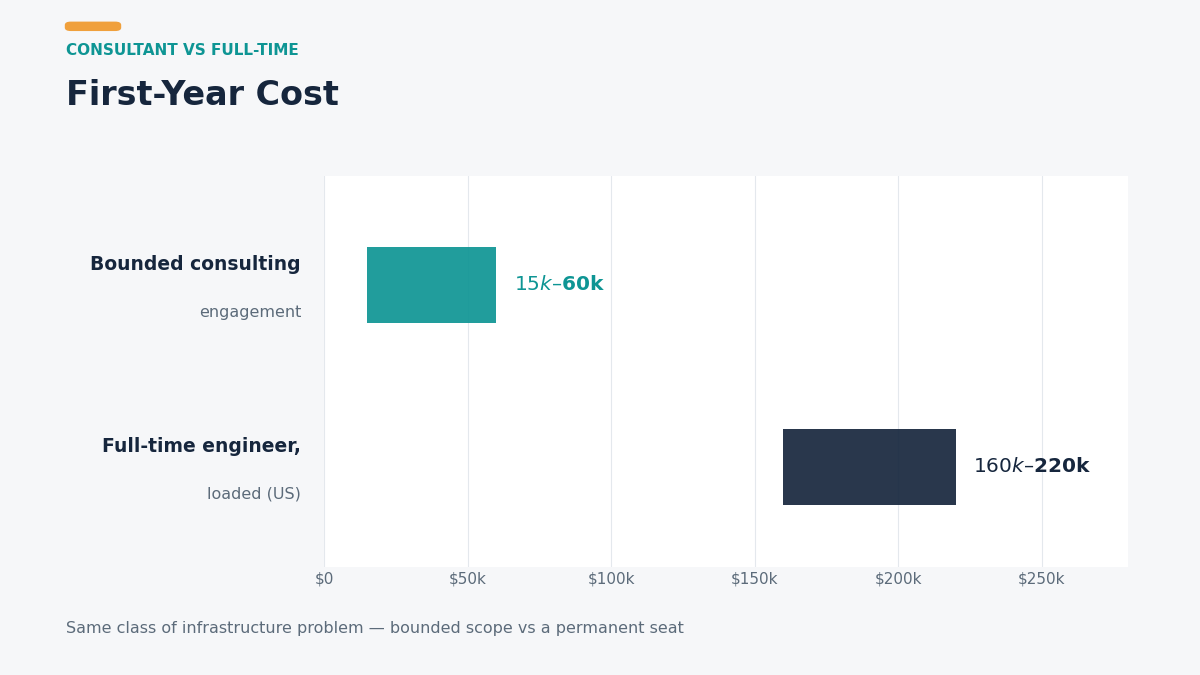
A full-time DevOps engineer in the US costs $160,000–$220,000 a year once you load salary with benefits, equity, and tooling. A focused consulting engagement that fixes the same broken deployment pipeline typically costs $15,000–$60,000 and is over in six to ten weeks.
Yet most engineering leaders default to the full-time job posting then spend three to five months filling it while the pipeline stays broken. For bounded problems, that default is backwards: these are precisely the cases where experienced teams hire DevOps consultants rather than opening a requisition.
The instinct isn’t irrational. Ongoing operations genuinely need an owner who is there at 2 a.m. when the pager fires. But a large share of “we need DevOps help” situations aren’t ongoing operations at all. They are bounded problems: a DevOps audit before a funding round, a one-time Kubernetes migration, a CI/CD pipeline that takes 45 minutes when it should take 8, a cloud bill that doubled without anyone noticing. Bounded problems reward specialists who have solved that exact problem 15 times before and who leave when it’s fixed.
Gartner forecasts worldwide IT spending will hit $6.37 trillion in 2026, up 14.2% year over year, with IT services the single largest segment at more than $1.87 trillion. Infrastructure work is increasingly bought as a service, not only as headcount which is exactly the decision this guide helps you make well.
This guide gives you the decision framework we use internally: which problems belong to a consultant, which belong to a permanent engineer, what each path costs in real numbers, how to run the engagement end to end, and how to exit it without losing the knowledge you paid for.
TL;DR
This guide is for CTOs, VPs of engineering, and founders deciding whether to hire DevOps consultants or recruit a permanent engineer. It walks through the full lifecycle scoping, vetting, contracts, onboarding, delivery management, and exit so you can run the process yourself.
The short version of the framework: audits, one-time migrations, and process fixes go to a consultant; anything with a pager, an on-call rotation, or no natural end date goes to a full-time hire. The cost gap is real; a bounded engagement typically runs $15,000–$60,000, while a loaded full-time salary starts around $160,000 a year in the US and ₹25–55 lakhs in India.
By the end you'll be able to classify your own situation in about 15 minutes, write a scope document a consultant can quote against, and negotiate a contract with the IP, knowledge-transfer, and exit terms that most first-time buyers forget. If you're mid-decision on a short-term DevOps engagement, start with the decision table in the framework section and work backward.
What Is a DevOps Consultant?
A DevOps consultant is an external specialist engaged for a defined period to diagnose, design, or fix a specific part of your software delivery and infrastructure practice CI/CD pipelines, cloud architecture, deployment automation, observability, or team process and to transfer that capability to your team before exiting.
What a DevOps consultant is not:
- Not a freelance DevOps engineer on retainer. A freelancer sells hours of execution; a consultant sells a diagnosis, a plan, and a measurable outcome with an end date.
- Not a managed services provider (MSP). An MSP operates your infrastructure indefinitely; a consultant makes your own team capable of operating it.
- Not a substitute for on-call ownership. Consultants design incident response; they don’t carry your pager for years.
Why This Decision Matters: The Business Case
The consultant-vs-engineer call is a resource-allocation decision with four measurable consequences. Getting it wrong in either direction is expensive, over-hiring burns cash, under-hiring burns uptime.
- Cost. A senior full-time DevOps engineer runs $130,000–$190,000 based in the US (roughly $160,000–$220,000 fully loaded) or ₹18–45 lakhs/year in India. A scoped consulting engagement for the same class of problem typically lands between $15,000 and $60,000 total. If the problem is bounded, the delta is 60–80% of first-year cost.
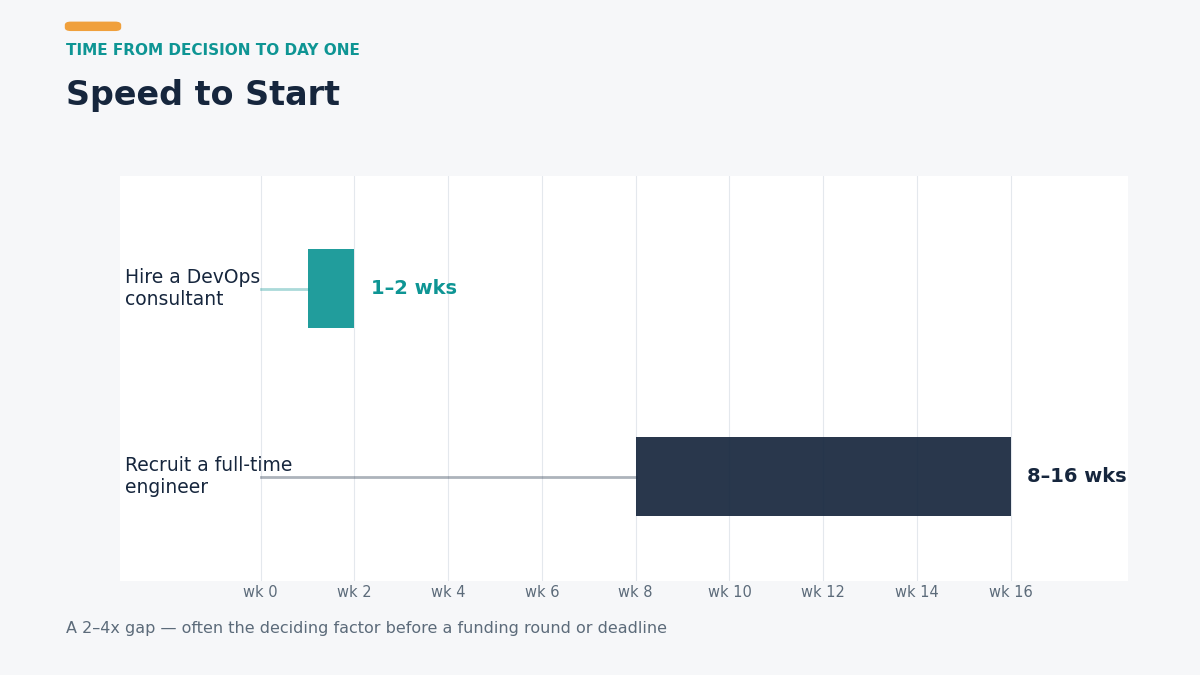
- Speed. Recruiting a permanent DevOps hire commonly takes 8–16 weeks from job description to start date; teams that hire DevOps consultants instead typically start in 1–2 weeks, because consultants are built for fast engagement.
- Risk. A mis-hired full-time engineer costs 6–9 months of salary plus severance and re-recruiting before you’re back to zero. A mis-chosen consultant costs one engagement painful, but capped, and a good contract caps it further.
There’s a fifth, less obvious factor: organizational learning. A well-run engagement leaves behind runbooks, documented architecture decisions, and a trained dedicated team. A badly run one leaves behind Terraform nobody understands. Whether you capture that learning is decided in the contract and the exit phase both covered below.
The Core Problem: Why Most Teams Get This Call Wrong
The failure pattern is remarkably consistent across companies from seed-stage to enterprise, and it starts with a mislabeled problem.
The misdiagnosis loop. A team feels infrastructure pain, slow deployments, flaky environments, a scary cloud bill and translates it directly into a job requisition titled “Senior DevOps Engineer.” Three problems follow:
- The timeline slips 3–4x. Teams budget “a few weeks” to hire; the realistic cycle for a strong infrastructure hire is 8–16 weeks, and the pain compounds daily while the seat is empty. Deploy friction alone can quietly consume 10–20% of total engineering hours during that window.
- The scope was never full-time. Post-fix, many companies discover the actual ongoing workload is 10–15 hours a week of maintenance. The expensive new hire either drifts into unrelated backlog work or leaves within a year for lack of meaningful problems and infrastructure specialists cite “no real ownership” as a leading reason for early exits.
- The vetting was generic. Interview loops built for application developers routinely pass candidates who can discuss Kubernetes developers but have never carried production on-call, never written infrastructure as code under change control, and never been accountable for an SLA. The gap surfaces during your first real incident, which is the worst possible time.
The inverse failure exists too. Teams that hire consultants for open-ended operational ownership get a different disappointment: the consultant optimizes what’s in the SOW, invoices accurately, and exits on schedule while the pager, the patching cadence, and the 2 a.m. incidents still have no owner. Consultants are a scalpel; ops ownership needs a resident.
Red flag that you’re in the loop: if your job description contains both “design our cloud architecture from scratch” and “handle day-to-day production support,” you’ve written two roles into one requisition: a project (consultant-shaped) and an operation (engineer-shaped). The walkthrough below shows how to split them.
The Walkthrough: From “We Need DevOps Help” to a Finished Engagement
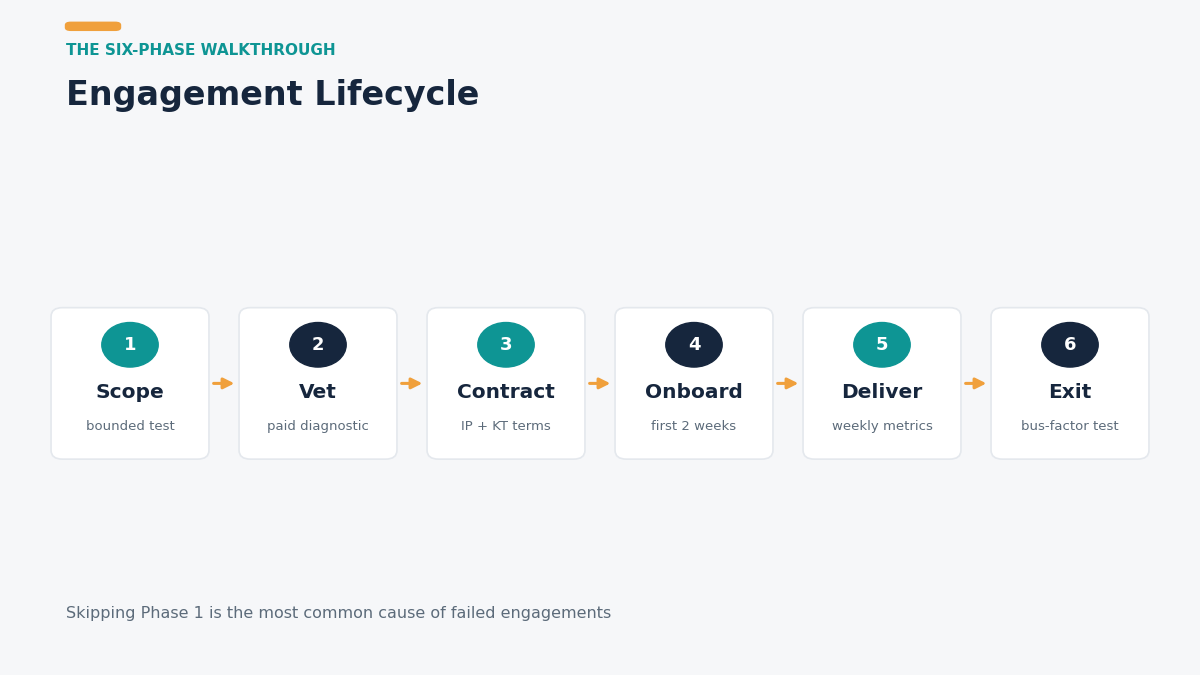
This section is the full lifecycle, the same sequence whether you end up with a consultant, a permanent engineer, or (commonly) a consultant first and a hire later. Work the phases in order; skipping Phase 1 is the single most common cause of failed engagements.
Phase 1 Classify the Problem and Define Requirements
Before any sourcing, decide what kind of problem you actually have. The test is simple and worth writing down.
The bounded-vs-continuous test (apply in this order):
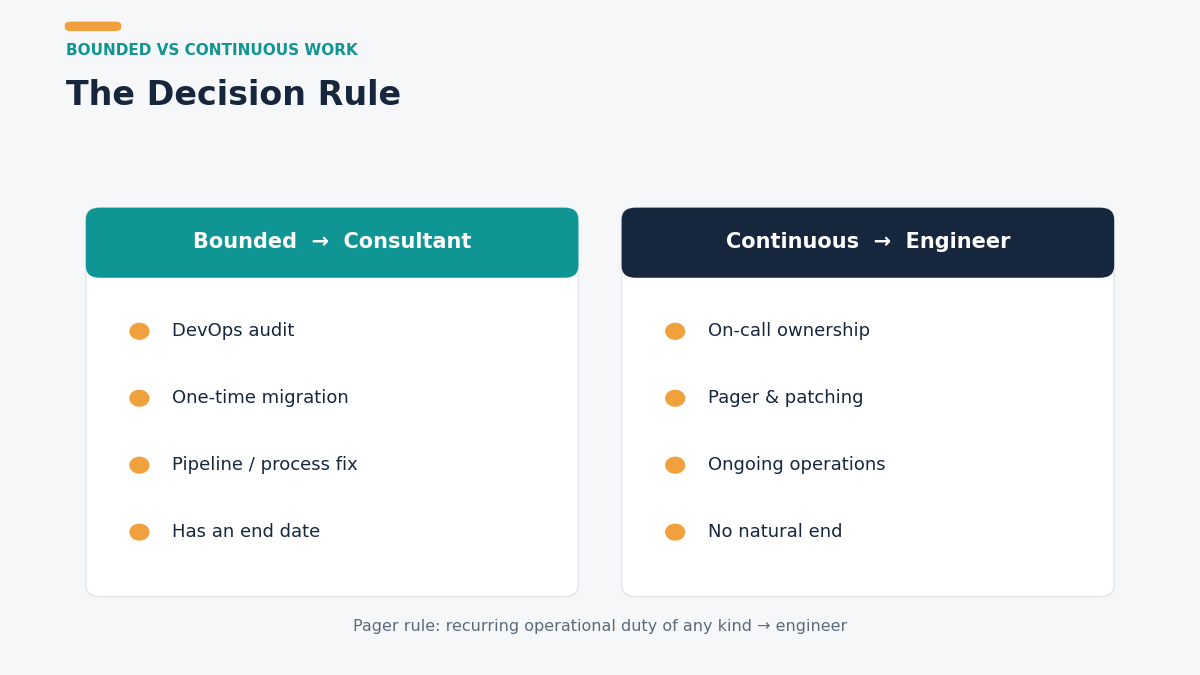
- Does the work have a natural end state? “Migrate from EC2 to EKS” ends. “Keep production healthy” doesn’t. Ended work → consultant.
- Is the skill needed rare-but-brief? You may need deep Terraform module design for six weeks and never again at that depth. Rare-but-brief → consultant.
- Does it involve a pager? On-call, patching, backup verification, incident response ownership, anything recurring weekly forever → full-time engineer (or a managed service, if headcount is frozen).
- Is it diagnostic? “Why is our AWS bill up 60%?” or “Are we ready for SOC 2?” A DevOps audit is consultant work by definition; you’re buying pattern recognition across many companies, which no single in-house hire has.
Typical consultant-shaped problems: cloud migration, CI/CD pipeline rebuild, Kubernetes adoption, cost-optimization audit, SOC 2 / compliance readiness, incident-process design, observability stack rollout, platform engineering roadmap.
Typical engineer-shaped problems: on-call ownership, release management as a permanent function, ongoing cost governance, gradual reliability improvement across quarters, being the human who knows where the bodies are buried.
Once classified, write a one-page scope document containing:
- Problem statement in one sentence, with the metric that proves it (“deploys take 45 min and fail 18% of the time”).
- Target outcome with a number (“sub-10-minute deployments, <5% change failure rate”).
- Constraints: stack (AWS/Azure/GCP, K8s vs. serverless), compliance requirements, freeze windows, team availability for knowledge transfer.
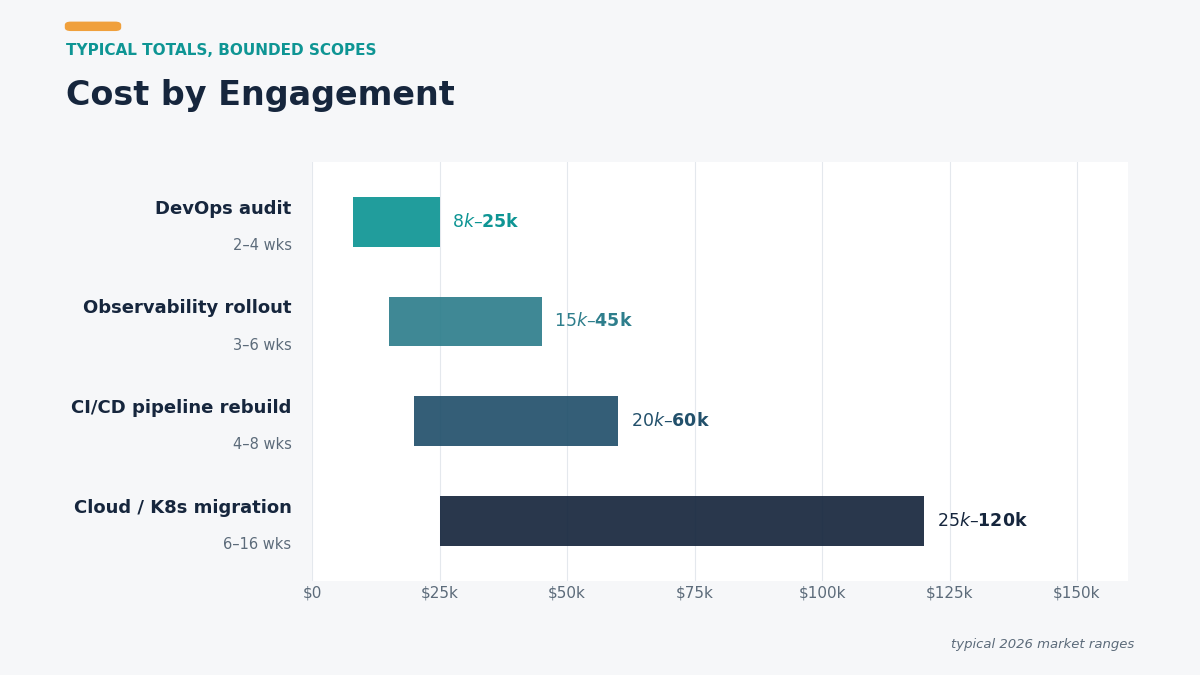
- Budget band: for consulting, typical bands are $8k–$25k for an audit, $25k–$120k for a migration or rebuild; for a permanent seat, ₹18–45 lakhs/year in India or $130k–$190k base in the US. If you’re pricing the permanent path, role pages like hire DevOps engineers list current market rate bands by seniority.
- Timeline: when it must be done and why (funding round, contract renewal, peak season).
The 3-day rule: if you can’t write this page in three days, you need a paid discovery/audit first, a 1–2 week diagnostic engagement that produces the scope document for you. That’s a legitimate first purchase, not a failure.
Phase 2 Sourcing and Vetting
Where you look to hire a DevOps consultant depends on which path Phase 1 produced, but the vetting bar is the same: evidence of having done this exact thing, in production, with consequences.
Sourcing channels, roughly in order of signal quality:
- Referrals from CTOs who bought the same fixed highest signal, slowest to gather.
- Specialist staffing and consulting partners pre-vetted benches move fastest; a good partner turns a scope document into interview-ready profiles in about 7–10 working days, versus the 4–6 weeks cold sourcing usually takes.
- Boutique DevOps consultancies strong for large fixed-scope programs; watch for junior delivery behind a senior sales call.
- Open marketplaces widest reach, weakest vetting; budget your own screening time accordingly.
What good screening looks like (run all five):
- Artifact review before any call. Ask for a sanitized architecture diagram, a Terraform module, or a postmortem they authored. Ten minutes of reading beats an hour of talk.
- A scenario interview, not trivia. “Walk me through the last pipeline you cut from 40 minutes to under 10. What did you try first, what failed?” Specific memories of failure are the strongest authenticity signal.
- A paid mini-diagnostic (2–4 hours). Give read access to one real pipeline or one month of cloud billing and ask for three findings. You learn more from this than from three interviews.
- Reference calls that ask about the exit. “What did the team keep after they left?” separates consultants who transfer capability from those who create dependency.
- Cultural mechanics check. Time-zone overlap of at least 3–4 working hours, written-communication quality, and comfort presenting to non-engineers consulting is 40% communication.
Running the paid mini-diagnostic well (step 3 above): pay for 2–4 hours at their normal rate, grant read-only access to one bounded artifact (a single pipeline definition, one month of billing exports, or your monitoring dashboards), and ask for exactly three findings in writing with a severity and a fix estimate each.
You’re evaluating three things: whether they find real issues, whether they resist the temptation to pitch a rebuild, and whether their written output could be forwarded to your CFO unedited.
Vetted-marketplace models Supersourcing’s screening for its top-2% talent pool works this way and applies the same artifact-first principle at scale, which is why partner-sourced shortlists tend to survive technical interviews at much higher rates than cold applicants.
Red flags, in the order they usually appear:
- Quotes a price before reading your scope document.
- Proposes a full platform rebuild in the first conversation (“rip out Jenkins, adopt my preferred stack”) before diagnosis.
- Can’t name a project that failed and why.
- Won’t agree to written deliverables or measurable acceptance criteria.
- Insists all work happens in their accounts, their repos, or their tooling.
Phase 3 Engagement Models and Contracts
The commercial structure shapes behavior more than the person’s talent does. Pick the model that matches your scope certainty.
| Model | Best for | Typical pricing | Risk profile |
| Fixed-bid project | Well-defined scope (audit, single migration) | $8k–$25k audits; $25k–$120k migrations | Scope disputes if Phase 1 was sloppy |
| Time & materials | Evolving scope, discovery-heavy work | $75–$250/hr US/EU; ₹2,500–₹8,000/hr ($30–$95) senior India-based | Budget creep without weekly caps |
| Monthly retainer | Part-time ongoing advisory (10–40 hrs/mo) | $3k–$12k/month | Drift into unmanaged staff augmentation |
| Staff augmentation | A consultant embedded full-time for a quarter | Monthly rate ≈ 1.3–1.6x loaded salary equivalent | You manage delivery; they supply skill |
Most DevOps consulting services and broader IT consulting services arrangements map to one of these four structures as well, so the contract checklist below travels.
Contract terms that separate professionals from problems:
- IP assignment and NDA: everything produced code, Terraform, diagrams, runbooks is work-for-hire owned by you, stated explicitly. NDA signed before repo access, not after.
- Deliverables and acceptance criteria written as verifiable statements (“pipeline completes in <10 min on the main branch, demonstrated across 20 consecutive runs”).
- Access and security clause: least-privilege access via your SSO, your repos, your cloud accounts; access revocation on end date is a contract event, not an afterthought.
- Knowledge-transfer obligation with hours attached (see Phase 6) typically 10–15% of total engagement hours.
- Exit and replacement terms: notice period (2 weeks is standard for T&M), and if you’re going through a partner, a replacement guarantee of 7–10 days to swap a mis-fit is a reasonable market standard to demand.
- Payment gates: for fixed-bid, milestone-based billing (30/40/30 is common); never 100% upfront.
Phase 4 Onboarding and Ramp-Up (The First Two Weeks)
Consultant onboarding process is compressed: every unproductive day is a billed day. The goal is context in week one, first visible output by day 10.
Day 1–3 checklist (prepare before the start date):
- Provision least-privilege access: repos, CI system, cloud console (read-only where possible initially), observability dashboards, ticket tracker.
- Share the “context pack”: architecture diagram (even a rough one), the scope document from Phase 1, last three months of incidents/postmortems, and the current cloud bill.
- Introduce one named internal counterpart, a single engineer who answers questions and, critically, absorbs knowledge throughout (not just at the end).
- Agree the communication cadence in writing: a 15-minute daily async update in week one, dropping to twice-weekly once trust is established.
Day 4–10: the consultant should produce a written findings-and-plan memo of what they’ve verified, what surprised them, what the sequence of work will be, and any scope corrections.
Red flag: no written output by day 10 on any engagement longer than three weeks.
Green flag: they found something you didn’t know was wrong.
Common onboarding frictions to pre-empt:
- Security review of the consultant’s devices/accounts stalls access for a week, starting it at contract signing, not day 1.
- VPN, SSO, and license seats each owned by different internal teams assign one internal owner for “consultant access” as a category.
- Nobody scheduled the counterpart’s time knowledge transfer fails at the exit because it was never resourced at the start.
Phase 5 Managing Delivery
You’re not managing hours; you’re managing convergence toward the acceptance criteria. Keep the mechanics light but non-negotiable.
The operating cadence that works for most engagements:
- Weekly 30-minute review against the plan memo: done, in progress, blocked, and most importantly “anything that changes the scope or the estimate?”
- Metrics dashboard, not status prose. Track the 2–3 numbers from your Phase 1 outcome statement: deployment frequency, pipeline duration, change failure rate, MTTR, or monthly cloud spend. If the engagement is working, a line on a chart is moving.
- Demo, don’t describe. Every second week, the consultant demonstrates working changes on your infrastructure: a pipeline run, a failover drill, and a cost report in front of the team who will own it.
- Change-control discipline: all infrastructure changes flow through your normal review process (pull requests, plan/apply reviews). Consultants get no cowboy lane; it protects both sides.
KPIs by engagement type:
- Audit: findings delivered on schedule; each finding has severity, effort estimate, and expected impact; leadership can act on the report without a translator.
- Migration: milestone dates hit within ±1 week; zero unplanned downtime events attributable to migration work; rollback tested, not just documented.
- Process/pipeline fix: the target metric (e.g., lead time for changes) improves and stays improved 30 days after handover.
If the engagement expands into building out a standing infrastructure team, say the audit reveals you genuinely need two platform seats, treat that as a separate hiring workstream with its own vetting, whether you hire cloud engineers permanently or extend the consulting bench. Don’t let a diagnostic engagement silently become an unmanaged headcount.
Phase 6 Scaling, Converting, or Exiting
Every engagement ends one of three ways. Decide which, deliberately, around the two-thirds mark not in the final week.
Option A Clean exit (most audits and one-time projects). Run a structured offboarding:
- Knowledge-transfer sessions (recorded): architecture walkthrough, runbook review, “what breaks first and why” budget 10–15% of total engagement hours here.
- Documentation acceptance: runbooks tested by your engineer executing them cold, without the consultant in the room. A runbook that only its author can follow is a liability, not a deliverable.
- Access revocation on the end date cloud, repos, SSO, VPN with a checklist, the same day.
- 30-day question window (usually included or cheap to negotiate) for clarifications, not new work.
Option B Convert to a permanent hire. Common and often smart when Phase 1 misjudged and the work turned out continuous. Expect a conversion/placement fee if a partner introduced them (typically 10–20% of first-year salary, often discounted after 6+ months of engagement); factor it against the 8–16 weeks of recruiting you’re skipping. Firms offering combined consulting and IT staffing services handle this transition as a standard motion, which avoids renegotiating from scratch.
Option C Scale the engagement. Adding a second consultant or extending scope is fine if it goes through Phase 1 again: new scope document, new acceptance criteria, new end date. The failure mode is the perpetual consultant for three years of renewals doing work that became operational in year one, at 1.5x the cost of an employee.
The bus-factor test before anyone leaves: can your team deploy, roll back, restore from backup, and interpret the monitoring with the consultant unreachable for a week? If no, the engagement isn’t done, regardless of what the SOW says.
Case Studies: What Bounded and Continuous Look Like in Practice
These outcomes come from Supersourcing’s delivery history across 527+ IT projects, where the consulting-vs-hiring line shows up constantly in client engagements.
Hyper-growth marketplace (Swiggy) continuous work, hiring motion. Scaling engineering during aggressive growth was a continuous-capacity problem, not a bounded project exactly the situation where permanent hiring beats consulting. AI-driven sourcing from a pre-vetted top-2% talent pool produced interview-ready shortlists in 7–10 working days per role, sustaining a 98% candidate joining rate across the ramp versus the 8–16 week cycles typical of cold recruiting.
Fintech scale-up (Paytm) volume hiring where consultants would have failed. Building out 100+ engineers is the clearest possible engineer-shaped problem: the value is in retained, compounding team knowledge. Running it as an RPO-style pipeline kept drop-off on contract roles under 1% a metric no rotating bench of consultants can match, because continuity was the deliverable.
Recruitment-automation platform (Somnoware) bounded process fix. Automating a recruitment workflow is a classic bounded engagement: defined current state, defined target state, natural end date. Delivered as a scoped project rather than a permanent hire, it validated the framework’s core rule that the client kept the improved process without carrying the cost of the seat.
The Framework: Hire DevOps Consultants, an Engineer, or Both
Run your situation through the table, then apply the tiebreakers. Most teams reach a defensible answer in 15 minutes.
| Dimension | DevOps consultant | Full-time engineer | Staff augmentation |
| Best for | Audits, migrations, pipeline/process fixes | On-call, ongoing ops, long-horizon reliability | Full-time skill for 3–9 months |
| Cost | $15k–$60k typical bounded engagement | $160k–$220k/yr loaded (US); ₹25–55L loaded (India) | ~1.3–1.6x salary-equivalent monthly |
| Speed to start | 1–2 weeks | 8–16 weeks | 1–3 weeks |
| Control | Outcome-based; light management | Full managerial control | You direct daily work |
| Knowledge retention | Only what you deliberately transfer | Compounds in-house | Partial; leaves with the person |
| Risk if wrong | One capped engagement | 6–9 months of cost to unwind | Medium; easy to end |
Tiebreakers when the table is ambiguous:
- Pager rule: recurring operational duty of any kind → engineer. No exceptions survive contact with production.
- Repeat rule: if you’ll need the skill again within 12 months (second migration, quarterly audits), lean engineer or retainer; one-and-done → consultant.
- Teacher rule: if the real goal is leveling up your existing team, a consultant with an explicit training mandate beats both alternatives.
- Both is a strategy, not a compromise: the highest-ROI pattern we see is consultant-designs → engineer-operates. The DevOps consultant vs engineer question is often sequencing, not either/or: the consultant’s exit criteria include hiring and onboarding their permanent successor.
Scenario Playbook: Five Common Situations, Classified
Abstract frameworks are easier to apply after seeing them run. Here are the five situations that generate most of the “should we hire DevOps consultants or recruit?” conversations we see, with the classification and the reasoning.
- “Our AWS bill jumped from $18k to $41k a month and nobody knows why.” Consultant a cost-optimization audit, 2–3 weeks. This is pure pattern recognition: rightsizing, orphaned resources, egress traps, savings-plan gaps. A specialist who has read 50 companies’ bills finds in days what an in-house generalist finds in a quarter. Payback is often measured in weeks; a 20–35% reduction on a $40k/month bill funds the audit several times over in year one.
- “We’re raising a Series B and the data room asks about SOC 2 and disaster recovery.” Consultant compliance-readiness audit plus a bounded remediation sprint, 4–8 weeks. There’s a hard external deadline, a defined evidence checklist, and no recurring workload once controls are in place (a lighter-weight internal owner maintains them afterward). Hiring a full-time engineer for this is the classic 3–4x timeline mistake: the seat fills after the round closes.
- “Deployments take 45 minutes, fail constantly, and developers have stopped shipping on Fridays.” Consultant first, then reassess. The pipeline rebuild is bounded (4–8 weeks). But measure what’s underneath during the engagement: if the failures trace to nobody owning environments and releases week to week, the audit has just discovered an engineer-shaped hole, and the consultant’s exit plan should include specing that role.
- “We’re at 25 engineers, on-call is informal, and last month’s outage took 9 hours to resolve.” Engineer this is the pager rule in its purest form. A consultant can (and often should) design the incident process, the observability stack, and the on-call rotation in a 3–6 week engagement, but a 9-hour MTTR at that team size means production needs a resident owner, not a visitor. Sequencing: consultant designs, permanent hire operates, overlap of 2+ weeks.
- “We need Kubernetes expertise for a migration, and then probably ongoing.” Both, sequenced and honest about the word “probably.” Run the migration as a fixed-scope engagement with one added exit criterion: by week 4, the consultant delivers a written estimate of the steady-state operational load (hours/week, skill level). If it’s 10 hours a week, a retainer or a trained internal developer covers it. If it’s 30+, start the permanent search at the migration’s midpoint so the overlap happens naturally.
What Most Teams Get Wrong
Pattern-matched across hundreds of engagements, the expensive mistakes are rarely technical. They’re procurement and management mistakes wearing technical costumes.
They buy execution when they need diagnosis. The most common failed engagement starts with “we need someone to move us to Kubernetes” when the honest problem statement was “deploys are painful and we assume Kubernetes fixes that.” Roughly half the time, a two-week audit would have found a cheaper answer pipeline caching, environment parity, artifact reuse and saved a six-figure migration nobody needed. Pay for the diagnosis first; it’s the cheapest line item in this entire guide.
They evaluate consultants like employees. Culture-fit interviews, whiteboard algorithms, five-round loops all optimized for a 4-year tenure, all nearly useless for a 8-week engagement. For a short-term DevOps engagement, the only predictive signals are artifacts from identical past work and a paid mini-diagnostic on your real systems. Everything else is theater that delays your start date by weeks.
They skip the knowledge-transfer budget, then blame the consultant. Handover fails in the first week of the engagement, not the last: no internal counterpart was assigned, so there was never anyone to transfer knowledge to. If no engineer on your team has hours allocated to shadow the work, you are purchasing a dependency, not a capability and the renewal invoice will arrive to prove it.
They let the retainer become a shadow employee. A $6k/month advisory retainer quietly becomes 120 hours of hands-on ops work, unmanaged, with no acceptance criteria and no end date, the worst of both models. Every quarter, re-ask the Phase 1 question: is this still bounded work, or did it become a job? If it becomes a job, hire the job.
They negotiate rate instead of scope. Shaving $25/hr off a rate saves ~$4k on a typical engagement; a sloppy scope that adds three weeks costs $15k–$30k. Senior buyers spend their negotiating capital on acceptance criteria, knowledge-transfer hours, and exit terms and pay the rate.
Cost & Timeline Reality Check
The numbers below are typical market ranges as of 2026, deliberately wide because seniority, geography, and compliance overhead move them. Treat them as sanity bands, not quotes.
DevOps consulting cost by engagement type:
| Engagement | Typical duration | Typical total cost |
| DevOps audit (pipeline, cloud spend, or SOC 2 readiness) | 2–4 weeks | $8k–$25k |
| CI/CD pipeline rebuild | 4–8 weeks | $20k–$60k |
| Cloud/Kubernetes migration | 6–16 weeks | $25k–$120k+ |
| Observability / incident-process rollout | 3–6 weeks | $15k–$45k |
| Ongoing advisory retainer | monthly, 10–40 hrs | $3k–$12k/month |
Hourly-rate bands (senior, hands-on):
- US / Western Europe independent consultants: $100–$250/hr; boutique firms often $175–$300/hr with delivery mixed across seniority levels.
- Senior India-based consultants: ₹2,500–₹8,000/hr (~$30–$95/hr) the arbitrage is real, but discount it for time-zone overlap and communication design, not quality; the top of the India band routinely outperforms the middle of the US band.
- Rule of thumb: contract IT staffing rates for embedded full-time consultants run roughly 1.3 — 1.6x the loaded monthly cost of an equivalent employee; the premium buys speed and exit flexibility.
Full-time engineer, fully loaded:
- US: $130k–$190k base for seniors; $160k–$220k loaded with benefits, equity, and tooling.
- India: ₹18–45 lakhs/year base for senior DevOps/SRE; ₹25–55 lakhs loaded.
- Add recruiting: 8–16 weeks of vacancy, plus agency or internal sourcing cost if applicable.
What moves cost up: compliance regimes (HIPAA, PCI, SOC 2 evidence work adds 20–40% to scope), legacy sprawl (undocumented snowflake servers), multi-cloud, hard freeze windows, and mid-engagement scope changes are the most expensive items on this list.
What moves cost down: a crisp Phase 1 scope document (consultants price uncertainty), read-only diagnostic access granted before day 1, an assigned internal counterpart, and modern-ish tooling (some IaC beats none, even if it’s messy).
A quick budgeting formula for the comparison: take your loaded annual cost for the full-time seat, divide by 2,000 hours, and you have the true internal hourly rate ($160k loaded ≈ $80/hr; ₹30 lakhs loaded ≈ ₹1,500/hr).
A consultant at 2–3x that internal rate breaks even whenever they deliver the outcome in less than a third to a half of the time an internal hire would need including recruiting time which, for bounded specialist work, they almost always do. The math flips for continuous work, which is the entire framework in one equation.
Timeline honesty: from “we have a problem” to “engagement started,” well-run buyers take 2–4 weeks (scope week, vetting week, contract week). From the same starting point to a full-time engineer’s first day: 10–20 weeks. That 2–4x gap is, by itself, the deciding factor for teams with a funding round, a compliance deadline, or a peak season on the calendar.
If You’re Mid-Decision: Do This Next
You now have the full playbook: classify the problem with the bounded-vs-continuous test, write the one-page scope document, and price both paths against the bands above. That 15-minute exercise resolves most cases on its own.
If yours is the ambiguous kind part project, part permanent seat the fastest tiebreaker is to put the scope document in front of a team that runs both motions daily. Supersourcing’s delivery team will review it, tell you which half is consultant-shaped and which half is a hire, and only if a hire is warranted put vetted, interview-ready candidates in front of you within 7–10 working days, backed by a replacement guarantee. Share your scope document here: https://supersourcing.com/contact-us/ worst case, you leave with a sharper document.
FAQ
What does a DevOps consultant actually do?
They diagnose and fix specific delivery-infrastructure problems: auditing pipelines and cloud spend, designing CI/CD and infrastructure-as-code, running migrations, setting up observability and incident processes, and training your team to operate the result. The defining features are a bounded scope, measurable acceptance criteria, and a planned exit as opposed to open-ended operational ownership.
What is the difference between a DevOps consultant and a DevOps engineer?
Scope shape and time horizon. An engineer owns systems continuously on-call, patching, gradual reliability work and their knowledge compounds inside your team. A consultant owns an outcome temporarily and transfers capability before leaving. Same technical skill set in many cases; completely different commercial structure, management model, and failure modes.
How much do DevOps consultants charge?
Typical 2026 market bands: $100–$250/hr for senior US/EU independents, ₹2,500–₹8,000/hr (~$30–$95) for senior India-based consultants, with audits landing at $8k–$25k total and migrations at $25k–$120k+. Fixed-bid pricing suits well-defined scopes; time-and-materials with a weekly cap suits discovery-heavy work.
How long does a DevOps audit take?
Two to four weeks for most companies under ~150 engineers: a week of access and evidence gathering, one to two weeks of analysis, and a week for the written report and readout. Output should be prioritized findings with severity, effort estimates, and expected impact decision-ready without a translator.
Do startups need a full-time DevOps engineer?
Usually not before roughly 10–15 engineers, unless the product is infrastructure itself or uptime obligations are contractual. Below that, the highest-leverage pattern is a consultant to set up sane foundations (CI/CD, IaC, monitoring) plus developers sharing lightweight operational duty then a first dedicated hire when the pager load becomes real.
What should be included in a DevOps consulting contract?
Six essentials: explicit work-for-hire IP assignment, an NDA signed before access, deliverables with verifiable acceptance criteria, a least-privilege access-and-revocation clause, knowledge-transfer hours (10–15% of the engagement), and exit terms notice period plus, if via a partner, a 7–10 day replacement guarantee. Milestone-based billing for fixed-bid work; never 100% upfront.
When should I convert a consultant into a full-time hire?
When the work fails the bounded test in retrospect it keeps regenerating monthly, needs a pager owner, or the “temporary” engagement is heading into a third renewal. Budget a conversion fee (commonly 10–20% of first-year salary through a partner, often reduced after six months) and weigh it against skipping an 8–16 week recruiting cycle.
Is it worth talking to someone before deciding which path fits?
If your situation straddles the framework, say, a migration and an emerging on-call need a short scoping conversation with a firm that does both consulting and permanent placement will settle it faster than more research. You’ll get a rate-band reality check and a scope critique in under an hour, before any commitment.
