

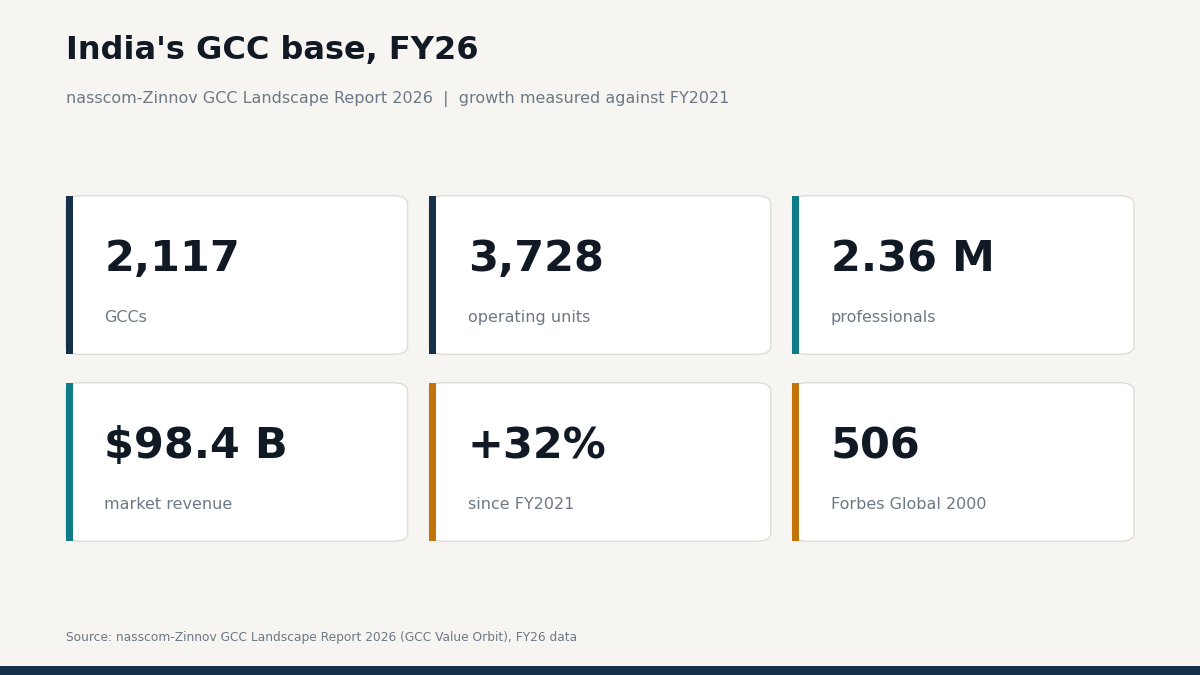
India crossed 2,117 Global Capability Centres in FY26 3,728 units, 2.36 million professionals, USD 98.4 billion in revenue. Almost none of them started as a GCC. They started as three contractors, a shared Slack channel, and a manager who kept saying “just until we hire properly.”
That progression is the actual subject of this guide. GCC vs staff augmentation is usually argued as ideology control versus speed, ownership versus flexibility when it behaves far more like arithmetic with a crossover point. There is a headcount, a mandate type, and a time horizon at which owning the capability becomes cheaper and better than renting it. Below that line, ownership is an expensive way to buy the same engineers.
The number of GCCs in India has grown 32% since FY2021, and 506 Forbes Global 2000 companies now run operations from the country but the ecosystem still adds far more augmented headcount each year than captive headcount, because most companies need engineers before they need an entity.
Most comparison content treats these as competing philosophies. In practice they are sequential. Roughly speaking, teams that get this right rent capability while the mandate is still uncertain, then own it once the roadmap is stable enough that a three-year commitment is not a gamble. Teams that get the gcc vs staff augmentation call wrong pick a model based on what their board finds impressive, then spend eighteen months paying for the mismatch.
This guide covers the gcc vs staff augmentation arithmetic, the compliance load you inherit, the break-even logic, and the specific failure patterns that show up in the second year rather than the first.
TL;DR
This is a decision guide for founders, CTOs and heads of engineering choosing between an owned offshore capability centre and a rented, vetted engineering team. It is written for people who have already read the generic comparisons and want the numbers underneath them.
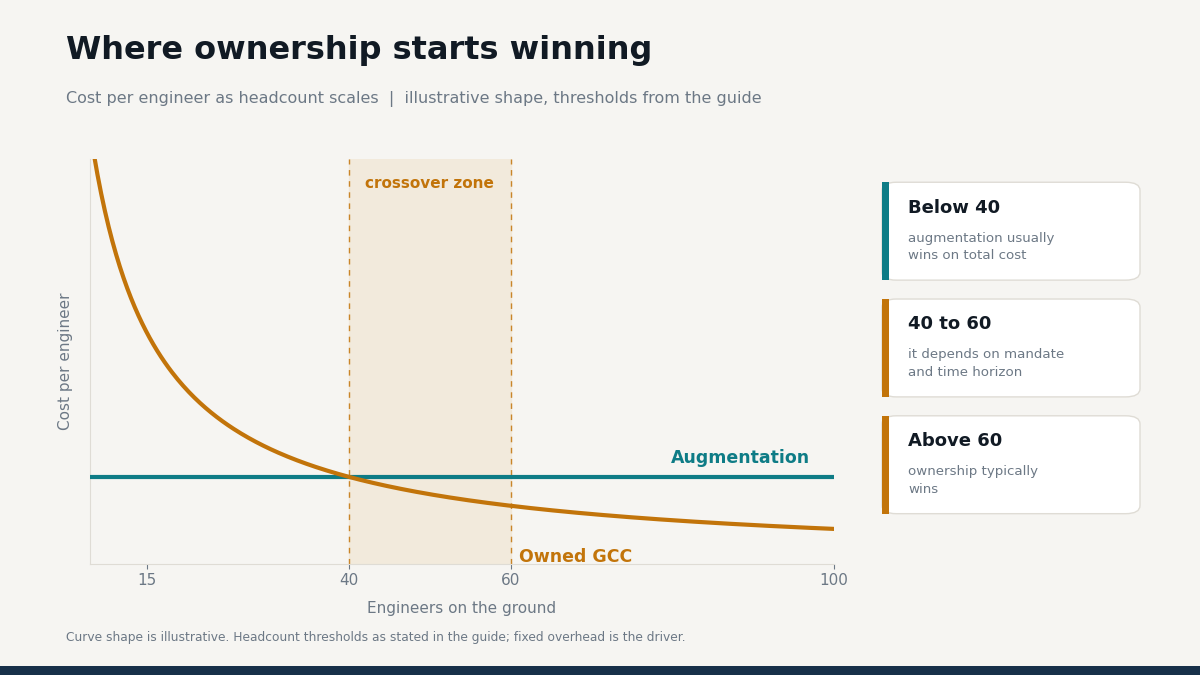
Here is the number that matters. The gcc vs staff augmentation crossover is not a philosophy; it sits somewhere around 40 to 60 engineers with a multi-year mandate, because that is roughly where fixed overhead stops dominating cost per head. Below it, a capability center vs staff augmentation comparison almost always favours augmentation. Above it, ownership starts winning on both cost and capability depth.
By the end you will be able to place your own team on that curve, price the compliance load you would be inheriting, and decide whether to build now, rent now and build later, or run both.
What GCC vs staff augmentation actually means
GCC vs staff augmentation is the choice between owning an offshore capability and renting one. A Global Capability Centre means your legal entity, your payroll, your leadership, your IP. Staff augmentation means vetted engineers working inside your team while a partner carries employment, replacement and statutory risk. One buys control. The other buys speed and reversibility.
Both models produce engineers sitting in your standups. The difference is who holds the risk, and how quickly you can reverse the decision when the roadmap changes. Every practical gcc vs staff augmentation argument reduces to those two things.
In house vs augmented team: the comparison most teams run is structurally wrong
Nearly every evaluation we see compares a monthly rate card against a salary. That comparison is not wrong so much as incomplete; it puts a fully-loaded price on one side and a partial one on the other. Run the gcc vs staff augmentation numbers that way and ownership will always look artificially cheap.
An augmented engineer’s rate includes sourcing, vetting, replacement risk, payroll, compliance, and the partner’s margin. A captive engineer’s salary includes none of that. The in-house vs augmented team delta looks enormous right up until you add the site lead, the HR and finance function, the office, the audit, and the recruiting cost of every backfill.
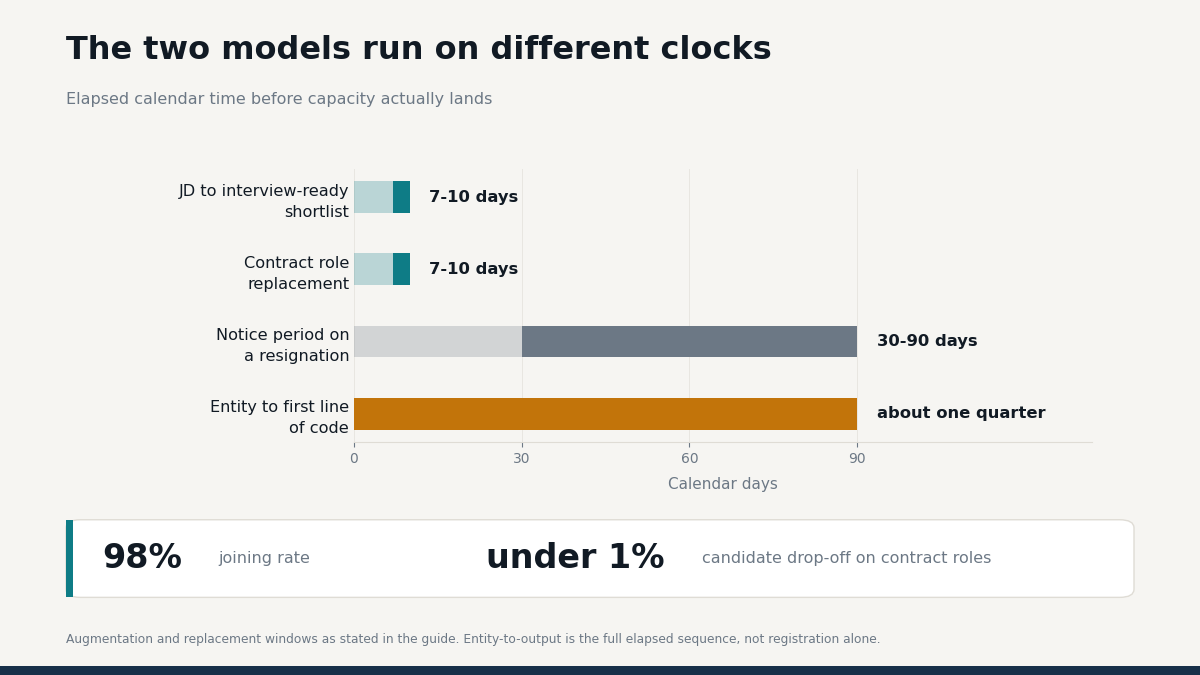
The second error is the timeline. A private limited company can be incorporated quickly. The sequence that makes an entity actually hireable: bank account, PF and ESI registrations, payroll vendor, a transfer-pricing position, an offer letter template that survives legal review is what stretches the calendar. In most engagements we have run, that is a quarter of elapsed time before a single engineer writes code, and the first hire on the ground has to be the site leader, who is the hardest role in the entire plan to fill.
Compare that to a contract IT staffing motion where a job description converts to an interview-ready shortlist in 7–10 working days. The two models are not just priced differently. They resolve on completely different clocks, and gcc vs staff augmentation decisions made without modelling that gap are the ones that get revisited within a year.
Capability center vs staff augmentation: how the decision actually gets made
Below the surface of the model choice sit five variables. Make these explicit and the gcc vs staff augmentation answer usually stops being debatable.
Offshore GCC setup: how long does it take to set up a GCC in India?
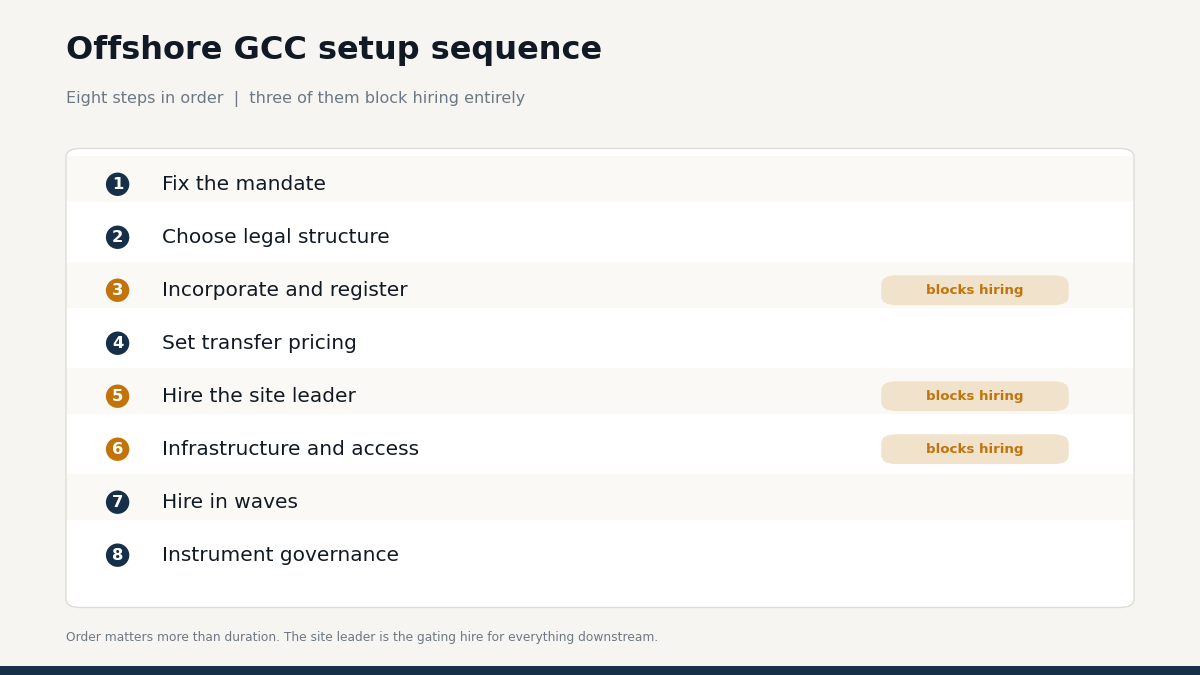
Treat setup as a sequence, not a project plan. The order matters more than the duration, because three of these steps block hiring entirely and the rest do not. This is the part of the gcc vs staff augmentation comparison that no rate card shows you.
- Fix the mandate first. Write down what the centre owns: a product, a platform, a function. Centres set up without an owned mandate default to vendor-mode thinking, and that is very hard to reverse later.
- Choose the legal structure. Wholly-owned subsidiary, LLP, or a build-operate-transfer arrangement where a partner runs it and hands over the entity later.
- Incorporate and register. Company incorporation, PAN/TAN, GST, and the statutory compliance registrations PF, ESI, professional tax, shops and establishments.
- Take a transfer pricing position before the first invoice, not after the first audit letter.
- Hire the site leader. This is the gate. Everything downstream inherits whoever you put in this seat.
- Stand up infrastructure and access control. Devices, VPN, identity, repository permissions, data residency. This is usually the first place a new centre needs to hire DevOps engineers rather than product developers.
- Hire in waves, not in one block. Each wave needs ramp time before it produces output equivalent to your parent-country team.
- Instrument governance in the first quarter. SLAs, reporting lines, review cadence. Retrofitting governance after an attrition spike takes years.
What is the break-even headcount for a GCC?
Fixed overhead is the whole game. Legal, compliance, HR infrastructure, finance, facilities and the leadership layer cost roughly the same whether you run 15 people or 50, so cost per head falls steeply as you scale and then flattens.
That is why the honest answer to “is GCC cheaper” is: not at 15 engineers, usually yes at 60, and it depends at 40. Add a span of control to the model one site leader can carry perhaps 25 to 40 engineers across three or four pods before you are paying for a second management layer that produces no code.
The cost to hire offshore developers in India through augmentation scales linearly. A captive scales as a step function. Anyone running gcc vs staff augmentation on a single-year view will systematically favour the wrong one, because year one is when a captive looks worst and year three is when it looks best.
The compliance and tax load you inherit on day one
This is where gcc vs staff augmentation stops being an HR question and becomes a finance one. Own the entity and you own its tax position permanently.
The most consequential recent change: Union Budget 2026 consolidated software development, ITeS, KPO and contract R&D into a single “IT services” safe harbour category with a 15.5% cost-plus margin, raised the eligibility threshold from ₹3 billion to ₹20 billion of transaction value, and made approval automatic and rule-based for up to five consecutive years.
For most captives that is a genuinely good trade: a slightly lower margin in exchange for five years without benchmarking studies or disputes. It is also a decision best made at incorporation, because retrofitting intercompany pricing after two years of invoices is expensive. The transfer pricing safe harbour simply does not exist as a line item in an augmentation model; your partner’s entity carries it.
Add the DPDP Act obligations if you process personal data, and the practitioner-grade version of the gcc vs staff augmentation question becomes: do you want a permanent India finance and compliance function, or do you want to rent one?
IP assignment is the risk nobody prices correctly
The instinct is that a captive protects IP better. Directionally true, and also not where the actual losses happen. It is the one part of the gcc vs staff augmentation comparison where the honest answer is “neither, by default.”
Real exposure comes from unassigned IP in badly written contractor agreements, and from repository permissions nobody has audited in a year. A GCC with sloppy offer letters is more exposed than an augmented team on NDA-backed contracts with explicit IP assignment and least-privilege repo access. The model does not protect you. The paperwork and the access control do.
One specific red flag worth checking on any augmentation contract before you sign: confirm the IP assignment runs from the individual engineer to you, not merely from the vendor to you. If an engineer’s own employment contract does not assign a work product to the vendor, the chain to you is broken and that gap surfaces during due diligence, at the worst possible moment.
Notice periods, attrition, and who eats the backfill
India’s 30 to 90 day notice period norms cut both ways. They give you warning before a resignation lands, and they mean every backfill has a structural lag.
In a captive, that lag is yours: your recruiters, your time-to-hire, your delivery slip. In augmentation it is contractual. Our own contract roles run under a replacement guarantee inside 7–10 days and hold a candidate drop-off rate below 1%, with a 98% joining rate numbers that only mean something because the attrition rate is what actually erodes cost arbitrage over a three-year horizon, not the rate card. Backfill lag, compounded across three years, moves the gcc vs staff augmentation total more than any per-hour negotiation will.
If your roadmap depends on a specific cluster of skills you need to hire cloud engineers and platform specialists in the same quarter the backfill question deserves more weight than the price question.
What this looks like in practice
Two engagements where the gcc vs staff augmentation question surfaced mid-roadmap rather than at the planning stage.
A fintech scaling payments infrastructure. The team needed senior backend and infrastructure capacity faster than an entity could be registered, and were being pushed toward a captive by their board. They ran augmentation for the first build cycle, kept the roadmap moving, and revisited the captive question once the platform mandate was stable. Time from job description to interview-ready shortlist stayed inside the 7–10 working day window across the engagement.
A healthtech platform with a compliance-heavy roadmap. Data residency and audit requirements made an owned entity the right end state, but the hiring could not wait for it. The team staffed the first cohort through augmentation with NDA-backed IP assignment and scoped repository access, then converted the core group as the entity came online a build-operate-transfer pattern in everything but name.
When to build a GCC: the decision framework
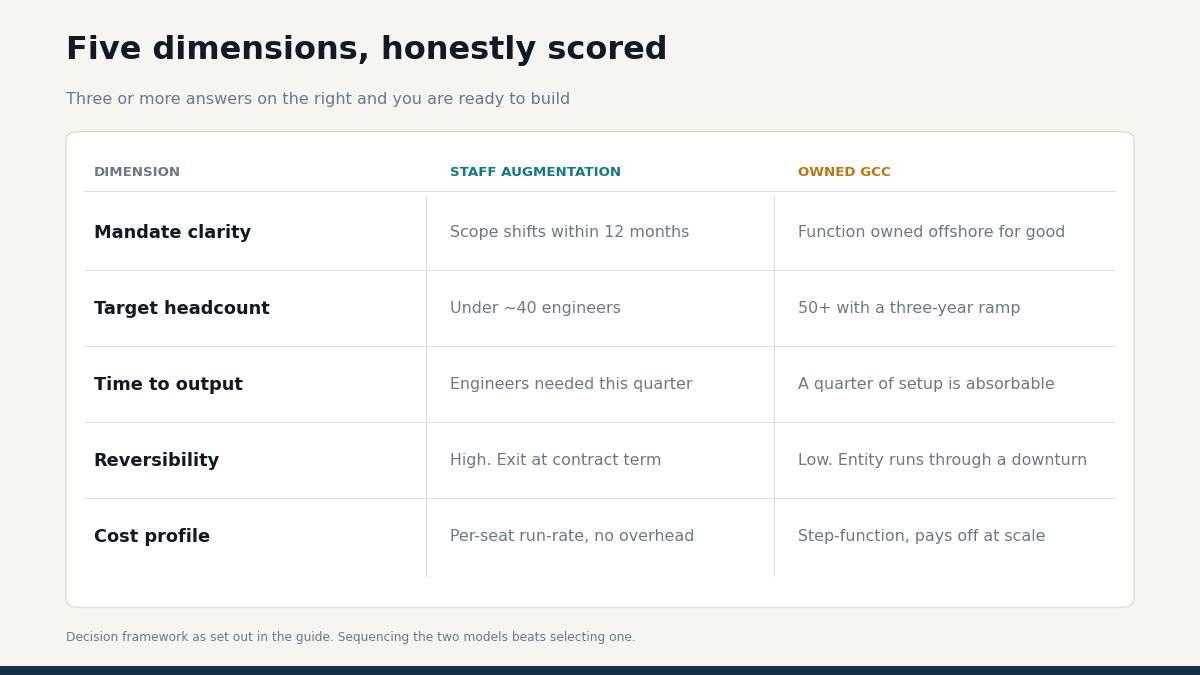
Five dimensions, honestly scored. If three or more of your answers sit in the right-hand column, you are ready to build; if not, you are ready to rent.
| Dimension | Staff augmentation fits when… | A GCC fits when… |
| Mandate clarity | Scope will likely change within 12 months | A product, platform or function is permanently owned offshore |
| Target headcount | Under ~40 engineers | 50+ with a credible three-year ramp |
| Time to first output | Weeks; you need engineers this quarter | You can absorb a quarter of setup before code ships |
| Reversibility needed | High contract-term exit, no wind-down | Low you are prepared to run an entity through a downturn |
| Cost profile | Predictable per-seat run-rate cost, no fixed overhead | Step-function economics that only pay off at scale |
The when to build a gcc answer that holds up in a board review is rarely “now” or “never.” It is usually “after we have proven the mandate with a rented team.” Sequencing beats selecting, and it is the single most useful reframe available in the gcc vs staff augmentation debate.
GCC or outsourcing: what most teams get wrong
The most expensive mistake in gcc vs staff augmentation is treating it as a one-time, irreversible choice. It is a sequence. Rent capability while the mandate is uncertain, own it once the roadmap justifies a three-year commitment. Teams that pick a model based on board optics rather than headcount arithmetic spend their second year paying for a decision made in their first.
Three failure patterns show up repeatedly:
Building the entity before the mandate exists. A centre with no owned product becomes a ticket queue, and the best engineers leave within two cycles. The gcc or outsourcing framing invites this error by making it sound like a procurement decision.
Treating augmentation as a permanent state. If the same augmented pod has owned your core service for three years, you are paying rental economics for something that has become institutional knowledge. That is the signal to convert. It is also the most common way a gcc vs staff augmentation decision gets made by default rather than on purpose.
Underweighting the site leader. In a captive, this hire determines everything downstream, and hiring it slowly to save a quarter’s salary is the most expensive saving in the plan.
One more thing worth naming, because it is where gcc vs staff augmentation conversations most often go quiet: nobody wants to say out loud that the captive is being built because someone’s mandate requires a captive. Governance built six months late is usually the symptom.
Before you commit to either model
If you are running the gcc vs staff augmentation decision right now and want it pressure-tested before it reaches your board, that is a conversation we have had several hundred times across a decade of building both 527+ delivered IT projects, augmented teams and global capability center builds, plus the recruitment process outsourcing work that sits underneath both.
Bring your target headcount, your mandate, and your three-year roadmap. We will tell you which model the arithmetic supports, including when the answer is “neither yet.”
Talk to our team · mayank@engineerbabu.com
FAQ
Is a GCC cheaper than staff augmentation?
Not at a small scale. Fixed overhead legal, compliance, HR, finance, facilities, leadership is roughly constant whether you run 15 engineers or 50, so cost per head only becomes competitive as you scale. Augmentation scales linearly with no fixed base. Below roughly 40 engineers, augmentation usually wins on total cost; above 60 with a stable mandate, ownership typically does. That crossover point is the entire gcc vs staff augmentation question.
What is the minimum team size to justify a GCC?
There is no universal floor, but the arithmetic rarely works below 40 to 50 engineers with a multi-year mandate. The binding constraint is not salary; it is that a site leader, an HR and finance function, and an audit trail cost the same at 15 heads as at 50. If your three-year plan does not credibly reach that scale, rent the capability.
How to transition from staff augmentation to a gcc?
Run them in parallel rather than switching. Keep the augmented team delivering while the entity is registered, hire the site leader early, then convert the core engineers who already hold context. A build-operate-transfer arrangement formalises this: a partner operates the centre and transfers the entity once it is stable, so hiring never pauses for compliance. Handled this way, gcc vs staff augmentation stops being a choice and becomes a sequence.
What legal documents are required for GCCs in India?
At minimum: incorporation documents (MOA/AOA), PAN and TAN, GST registration, PF and ESI registrations, professional tax and shops-and-establishments registration, an intercompany services agreement with a documented transfer pricing position, and employment contracts with explicit IP assignment. If you process personal data, add DPDP Act compliance documentation.
Which model protects IP better?
A captive gives stronger structural control, but that advantage disappears if the paperwork is weak. Losses come from unassigned IP in contractor agreements and unaudited repository permissions, not from the operating model. An augmented team under NDA-backed contracts with engineer-level IP assignment and least-privilege access can be materially safer than a sloppily papered captive.
How do I pressure-test my own decision before committing?
Model both options over three years, not one year one flatters augmentation and year three flatters ownership. Then stress the model: what happens if the mandate shrinks 30%, or attrition runs 25%? Most gcc vs staff augmentation models we are shown survive the first question and break on the second. If you want the model reviewed by a team that has run both sides, that is a conversation worth having before you sign anything.
