

Ninety-six percent of Global Capability Centres established in India after FY2021 launched with a product or portfolio mandate on day one. The crawl-walk-run sequence that defined two decades of offshoring is gone not because the gcc maturity model stages stopped mattering, but because the clock attached to them collapsed.
That distinction is where most enterprise GCC strategies go wrong. Leadership reads the headline, assumes the gcc maturity model stages are optional, and greenlights a “Stage 3 charter” for a center with no site leader, no local hiring engine, and no IP assignment framework. Eighteen months later, it is closing tickets and reporting utilization.
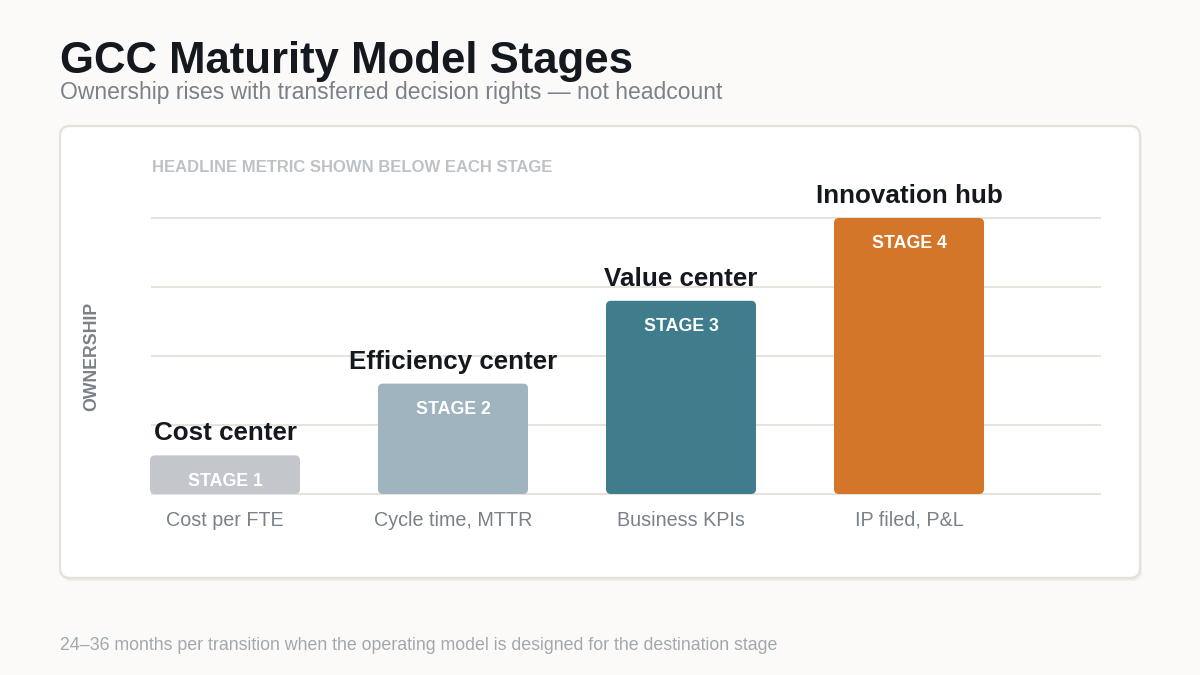
The stages are still sequential. Capability compounds in a fixed order: you cannot own an outcome you have never executed, or a product whose failure modes you have never debugged at 2 a.m. What changed is that a center that needed eight years to reach product ownership in 2012 can do it in 24-36 months if the operating model, hiring velocity, and decision rights are designed for the destination stage rather than the starting one.
This guide maps the four gcc evolution stages as they actually play out: what work each stage owns, what the leadership structure looks like, which signals prove a center has crossed a threshold versus merely renamed itself, and where progression stalls. It draws on a decade of setting up and staffing capability centers across fintech, healthtech, and enterprise SaaS including why your first engineering manager hire determines your Stage 3 timeline more than your business case does.
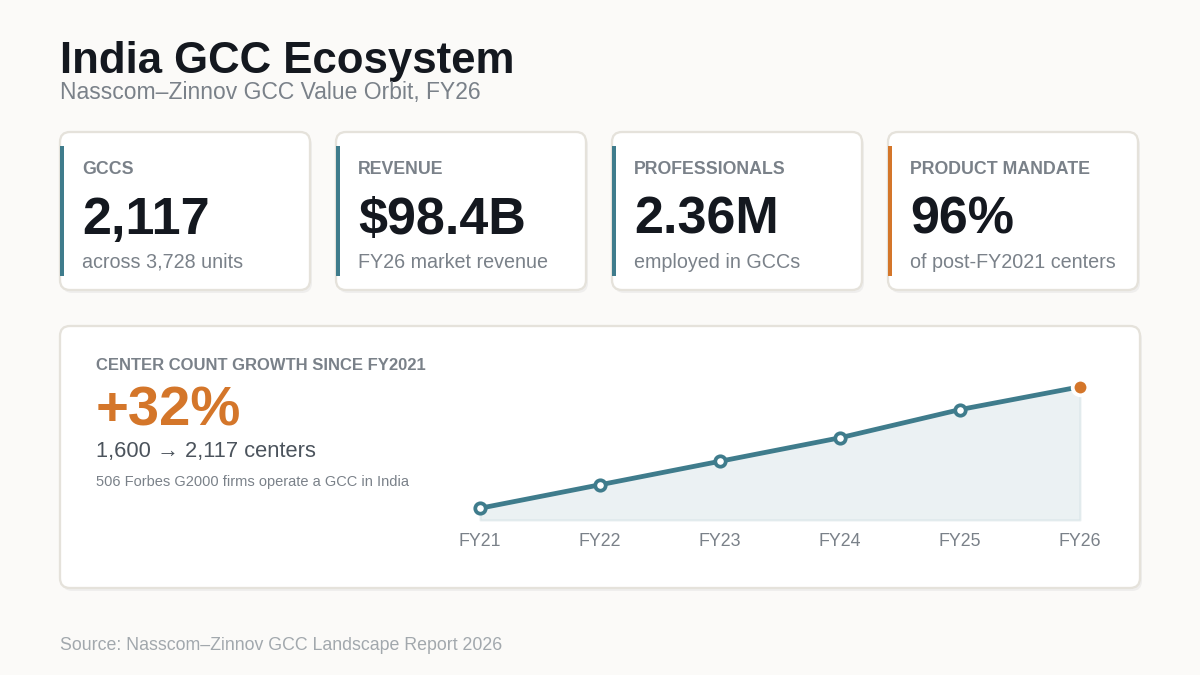
India now hosts 2,117 GCCs across 3,728 units, employing 2.36 million professionals and generating $98.4 billion in revenue in FY26 32% growth in center count since FY2021. Critically, 96% of centers set up after FY2021 launched with product or portfolio mandates rather than support scopes.
TL;DR
This guide breaks down the four gcc maturity model stages cost center, efficiency center, value center, and innovation hub and is written for the executive or engineering leader who owns a capability center's charter and has to defend its budget.
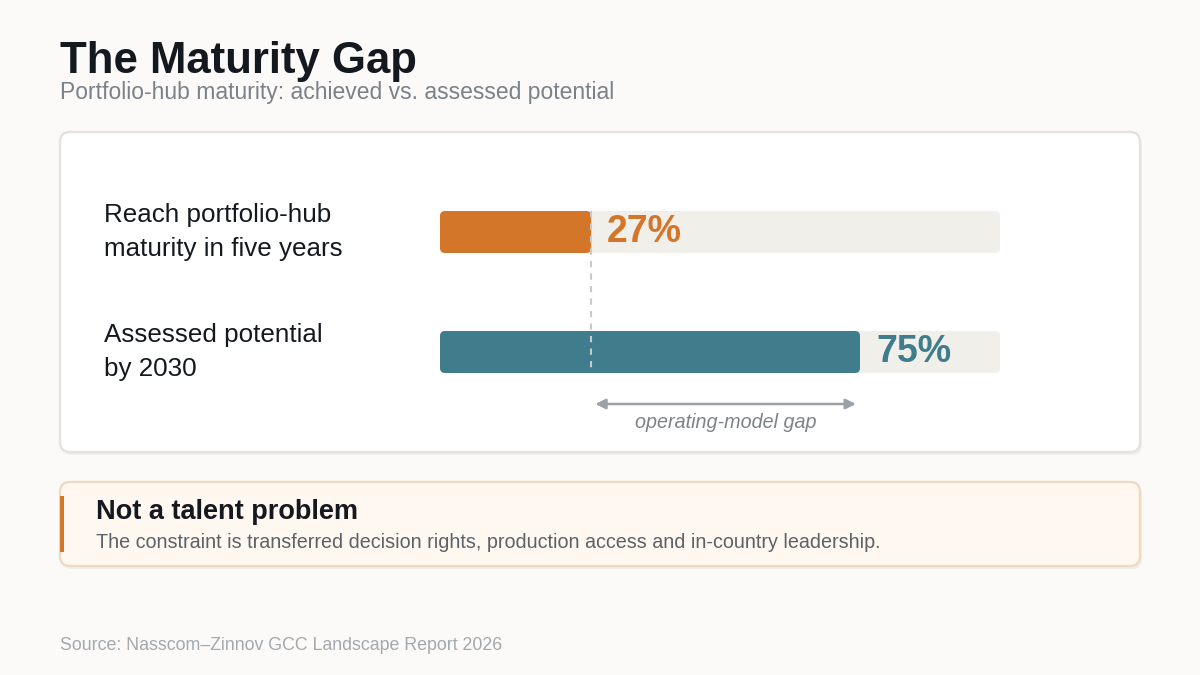
The number that matters: only about 27% of India's centers reach full portfolio-hub maturity within five years, yet Nasscom and Zinnov estimate three-quarters have the potential to get there by 2030. The gap between those two figures is almost entirely an operating-model problem, not a talent problem.
By the end, you will be able to place your own center on the capability center maturity curve using observable signals rather than self-reported labels, identify the specific constraint blocking your next stage, and price the move.
What Are the GCC Maturity Model Stages?
The gcc maturity model stages are the four sequential levels of ownership a global capability center moves through: cost center (executing defined tasks), efficiency center (owning processes end-to-end), value center (owning business outcomes), and innovation hub (owning products, IP, and P&L). Each stage is defined by decision rights, not headcount.
That last clause is the one buyers skip. A 400-person center taking HQ direction on every prioritization call is a Stage 1 center with a large payroll. A 60-person center that owns a roadmap, hires its own leaders, and files patents is Stage 4. Size correlates with maturity; it does not cause it.
The Real Problem: Everyone Claims Stage 3, Almost Nobody Can Evidence It
Ask any GCC head where their center sits on the gcc maturity model stages and most will say “value center, moving toward innovation.” Ask for evidence of a product with a P&L line owned in-country, a hiring decision made without HQ sign-off, a roadmap item the center killed and the conversation usually stops.
The reason is structural. A center’s stated stage is set by its charter; its actual stage is set by its escalation path. In most engagements we have scoped, the fastest diagnostic is to ask who approves a ₹40-lakh tooling spend and how many days that takes. If the answer involves three HQ signatures and six weeks, the center is Stage 1 or 2 regardless of what the slide says.
This matters commercially because the arbitrage argument is expiring. Cost differentials that once sat comfortably in the 50-60% band have compressed for senior and AI-adjacent roles, where India-based staff engineers and ML lead command packages within reach of secondary US markets. A center whose only justification is cost center to value center language in a slide deck becomes a restructuring candidate the moment the parent’s margins tighten.
McKinsey’s read on global operating models is blunt on this point: as generative AI automates low- and mid-complexity work, the role of global centers is shifting away from low-cost efficiency toward distinctive capability. The work that Stage 1 centers were built to absorb is precisely the work being automated first.
The Four GCC Maturity Model Stages, Decoded
What follows is the capability center maturity curve as it behaves in practice. Read these as diagnostic criteria, not aspirational descriptions.
Stage 1: Cost Center Task Execution and Arbitrage
The first of the gcc maturity model stages executes work defined elsewhere. Scope covers L1/L2 support, QA execution, data operations, finance back-office, and maintenance engineering. Headcount commonly sits between 30 and 150, with a span of control of 8-12 per lead and no in-country leadership above manager grade.
The dominant metric is cost per FTE, sometimes utilization. Success is measured as savings against a baseline, which creates the first trap: every efficiency gain reduces the center’s own reported value.
Setup mechanics matter more here than anywhere else because they set the ceiling. Private limited incorporation runs roughly 2-4 weeks through SPICe+, but the sequence that gates go-live is PAN/TAN, GST, Shops & Establishment, and PF/ESIC registration, then transfer pricing documentation. India’s safe harbour rules benchmark operating margins for software development and ITES captives in the high teens, with higher bands for knowledge-process work confirm against the current year’s notification, because a cost-plus markup set at the wrong band quietly caps what the center can be measured on for years.
Exit signal: the center starts catching defects and process gaps that headquarters missed, and someone in-country begins proposing fixes rather than filing tickets.
Stage 2: Efficiency Center Process Ownership
The center owns end-to-end processes and their SLAs. Release management, tier-2/3 engineering, regression automation, cloud operations, and reconciliation cycles move in-house. Headcount typically ranges from 150 to 500, and the first genuine senior hires arrive: engineering managers, an SRE lead, a finance controller.
Metrics shift to cycle time, defect escape rate, MTTR, and automation coverage. This is where most centers get genuinely good and then stop, because Stage 2 is comfortable, the center is trusted, HQ is happy, and nobody’s bonus depends on going further.
Two build decisions determine whether Stage 3 is reachable. First, tooling parity: in a mirrored environment with restricted production access, outcome ownership is architecturally impossible. Second, whether platform roles are hired locally. Teams that leave infra with the parent’s vendor and only hire cloud engineers in-country later find the platform knowledge and the ability to own reliability outcomes never localizes.
Stage 3: Value Center Outcome and Domain Ownership
The center owns business outcomes rather than deliverables: conversion on a checkout flow, fraud loss rate, claims-processing accuracy, model precision in production. Product managers, architects, and data scientists are hired locally. Headcount often sits between 400 and 1,500, but the defining change is that the site leader carries global functional responsibility, not just site responsibility.
That pattern is now the norm 64% of GCC site leaders hold dual roles combining a global function with site leadership, often in cybersecurity and AI governance. It is the clearest structural marker of gcc value chain progression, because a leader with a global function has standing in HQ prioritization forums.
Compliance work gets heavier here. Outcome ownership means production data access, so the center sits inside SOC 2, HIPAA, GDPR, or DPDP scope directly rather than adjacently. In most engagements we have run, the underestimated line item is not tooling but the security review and background-verification cycle for every hire touching regulated data days that leadership has usually already promised away.
Stage 4: Innovation Hub IP, Products, and P&L
The center originates work. It owns products end-to-end, files IP in its own right, runs centres of excellence that other geographies consume, and in the strongest cases carries a P&L. Talent density matters more than headcount: staff-plus engineers, principal researchers, and domain specialists who are hired for judgment.
The gating constraints here are rarely technical. They are the IP assignment clause in employment contracts, the transfer pricing treatment of locally created intangibles, and whether the promotion architecture lets an India-based principal engineer outrank an HQ director. Fix the first two, skip the third, and senior talent leaves within 18 months.
Only about 27% of India’s centers reach the last of the gcc maturity model stages within five years of establishment, per the Nasscom–Zinnov dataset, even as three-quarters are assessed as having the potential to get there by 2030.
How to Move Up One Stage in 12 Months: A Seven-Step Sequence
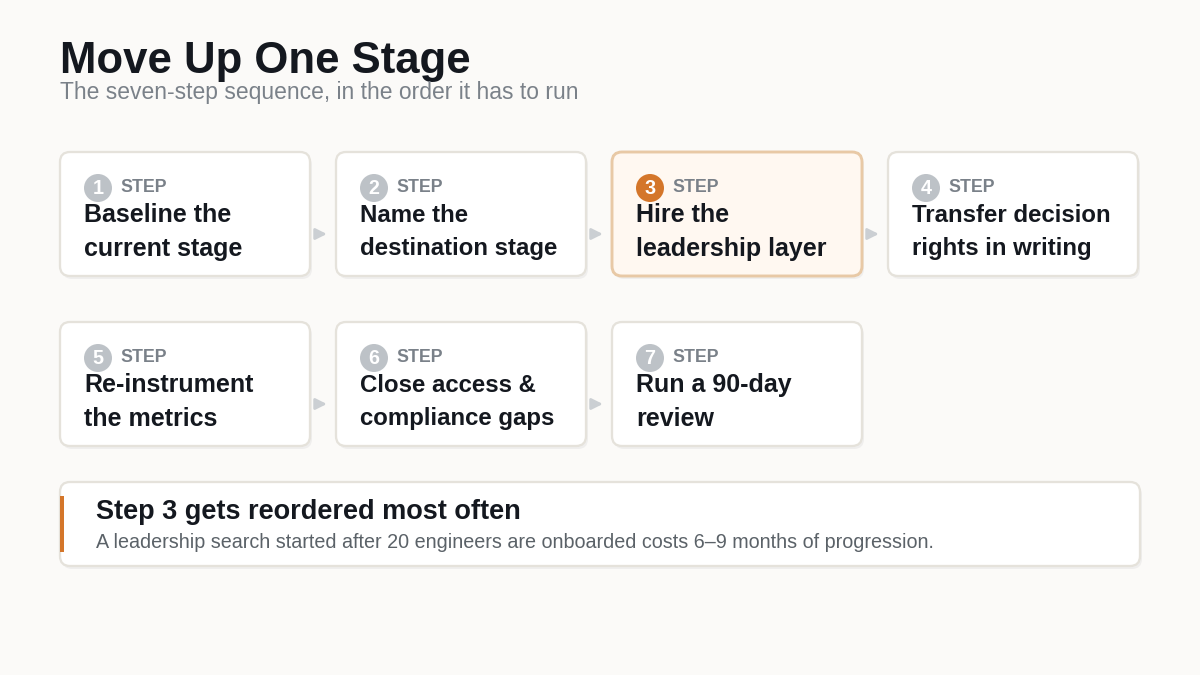
Movement between gcc maturity model stages is a design exercise, not a maturity that accrues with time. The sequence below is the order we run it in:
- Baseline the current stage against observable evidence, decision rights, approval latency, and metric set, not the charter document.
- Name the destination stage and pick one flagship scope to move, rather than migrating everything at once.
- Hire the leadership layer before the delivery layer. The senior hire defines the ceiling; hiring 20 engineers under an HQ-based manager reinforces the current stage.
- Transfer decision rights explicitly and in writing spend thresholds, hiring approvals, roadmap veto, incident command.
- Re-instrument the metrics to the destination stage. If cost per FTE is still the headline metric, the center is still a cost center.
- Close the access and compliance gaps production access, security clearance, data residency because these block outcome ownership silently.
- Run a 90-day review against the new metrics and publish it to HQ. Unreported progression does not survive the next budget cycle.
Step 3 gets reordered most often and is the most expensive to get wrong. Our own hiring cycle runs 7-10 working days from job description to interview-ready shortlist, with a 98% joining rate on accepted offers but a leadership search started after 20 engineers are onboarded costs 6-9 months of stage progression no matter how fast the pipeline moves.
What Stage Progression Looks Like in Practice
A fintech platform running a 60-person India center in support mode wanted product ownership within a year. We inverted the hiring order: two engineering managers and a platform architect first, then squads underneath them, with tooling parity and production access negotiated into the plan before the first engineer joined. The center was running its own release cycle inside three quarters, having crossed from Stage 1 to Stage 2 without the usual 18-month plateau.
A healthtech company took the opposite route and hired the first 40 engineers in eight weeks under HQ-based managers. Throughput looked strong for two quarters, then flattened, because every prioritization decision still routed through a time zone 11 hours away. The correction cost a leadership retrofit and roughly two quarters of progression. It is now the first thing we check in a gcc stage assessment.
Across 527+ delivered IT projects spanning fintech, healthtech, e-commerce, and enterprise SaaS, the correlation holds across gcc maturity model stages: centers that hire the leadership layer first move up the curve; centers that hire for headcount first stall in Stage 2.
How to Diagnose Your Current Stage
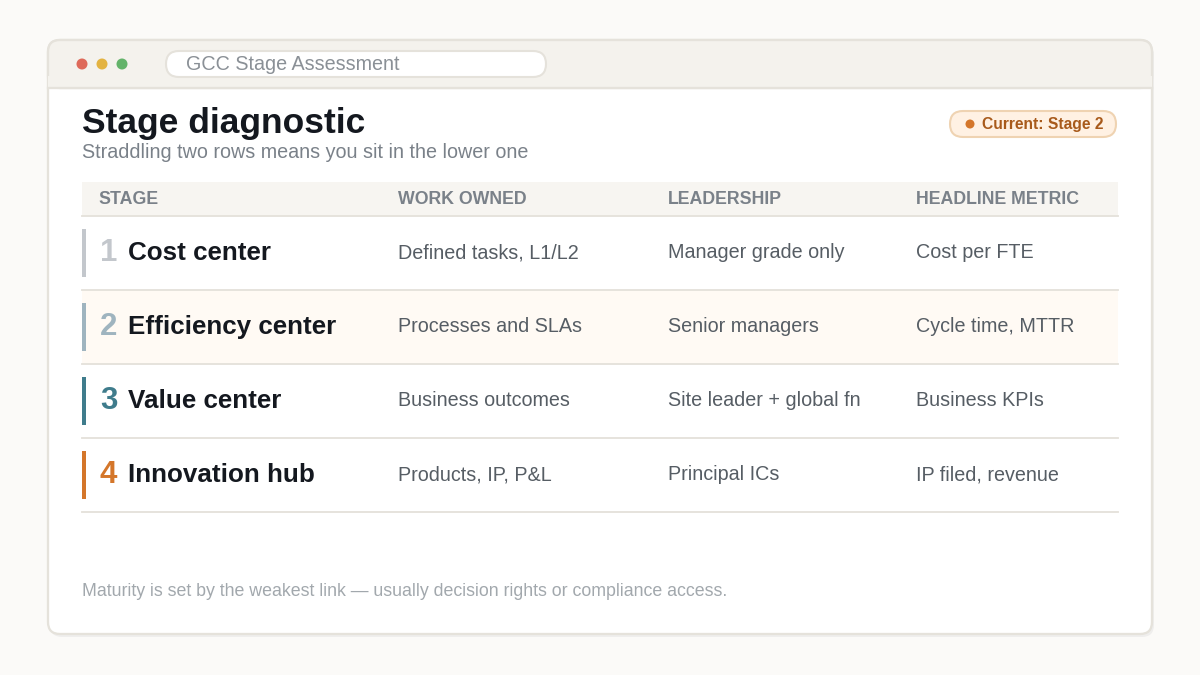
Placing a center on the gcc maturity model stages requires observable evidence, not self-description. The table below is the short version of the diagnostic we run.
| Stage | Work owned | Leadership in-country | Headline metric | Exit signal |
| 1 Cost center | Defined tasks, L1/L2 support, QA execution | Manager grade only | Cost per FTE | Center proposes fixes HQ missed |
| 2 Efficiency center | End-to-end processes, SLAs, release management | Senior managers, first directors | Cycle time, MTTR, automation coverage | Center asked to own an outcome, not a process |
| 3 Value center | Business outcomes, domain P&L inputs | Site leader with a global function | Business KPIs (conversion, fraud loss, precision) | Center originates roadmap items HQ adopts |
| 4 Innovation hub | Products, IP, CoEs, P&L | Global function owners, principal ICs | Revenue influenced, IP filed, capability exported | New capability requests route to the center by default |
If a center’s answers straddle two rows, it sits in the lower one. Maturity is set by the weakest link, usually decision rights or compliance access, rarely skills. That is also why partner selection matters at Stage 2 and 3: a staffing or recruitment process outsourcing model built on shared bandwidth and generalist recruiters cannot supply principal-grade talent, and that failure surfaces two quarters later as attrition.
What Most Teams Get Wrong About GCC Maturity
The most common error is treating the gcc maturity model stages as a function of tenure and headcount. They are not. They are a function of transferred decision rights, and decision rights are transferred deliberately or never at all. A center can run for six years, triple in size, and remain Stage 1 throughout if every prioritization call still originates at headquarters.
Three specific failure patterns show up repeatedly across engagements:
Renaming without rewiring. The charter is updated to “innovation hub,” the metrics stay as cost per FTE and utilization, and HQ keeps its veto. Nothing changes except the slide.
Hiring the ceiling last. Volume hiring under HQ-based management is the single most common cause of a Stage 2 plateau. The first senior in-country hire sets the maximum stage the center can reach for the next two years.
Treating attrition as an HR metric. In the upper gcc maturity model stages, losing your top decile is a capability-loss event, not a replacement cost. One principal engineer who owns a production model can set a roadmap back a quarter which is why replacement guarantees, ours run 7-10 days, matter less at senior grades than scope and promotion architecture do. The negotiation point buyers miss with any IT staffing partner: ask for the drop-off rate on contract roles specifically, in writing.
One more, less discussed: 60-90 day notice periods are standard for senior India hires, so any plan assuming a Q1 start for a leader identified in Q1 is already a quarter behind. Building global capability center roadmaps without that buffer is why 12-month plans quietly become 18-month plans.
Pressure-Test Your Stage Plan Before You Commit
If you are drafting a capability center charter, or you suspect your center has been Stage 2 for longer than the plan allowed, the useful next step is not a vendor pitch, it is a diagnostic. Bring the escalation path, the current metric set, and the leadership org chart, and we will tell you which of the gcc maturity model stages the evidence actually supports, and what the next transition costs.
Supersourcing has run this across a decade of capability center builds and IT consulting services engagements, from first-entity setup to principal-grade hiring. Reach us at mayank@engineerbabu.com or via supersourcing.com/contact-us.
FAQs
What are the four stages of GCC maturity? \
The four gcc maturity model stages are cost center (task execution), efficiency center (process and SLA ownership), value center (business outcome ownership), and innovation hub (product, IP, and P&L ownership). Progression is defined by decision rights transferred to the center, not by headcount or years in operation.
How long does it take a GCC to move from cost center to value center?
Historically 5-8 years; in current builds, 24-36 months is achievable when leadership hiring, decision-rights transfer, and production access are designed upfront. Centers that hire delivery headcount before in-country leadership typically add 6-9 months per stage transition. The constraint is almost never talent availability.
How do you measure GCC maturity?
Score four things against the gcc maturity model stages: approval latency on spend and hiring, whether the headline metric is cost or business outcome, the seniority and functional scope of in-country leadership, and whether the center originates work HQ adopts. Charters are unreliable; escalation paths are not.
Why do GCCs fail to move beyond cost savings?
Because the reporting structure rewards the current stage. When cost per FTE is the only metric reported upward, every improvement is framed as savings, and no budget exists for the senior hires and platform access that unlock the next of the gcc maturity model stages. It is a measurement problem before it is a capability problem.
What functions should a Stage 1 GCC own first?
Start with work that has clear acceptance criteria and low blast radius: QA execution, L1/L2 support, data operations, regression automation, and finance back-office. Avoid anything requiring production access or same-day HQ collaboration that needs the tooling and compliance groundwork Stage 2 builds.
Is a GCC or an offshore vendor better for AI and ML capability?
For durable capability and IP retention, a captive center wins provided you can hire machine learning engineers at principal grade and offer scope they cannot get elsewhere. Vendors win on speed to first output. Most enterprises we advise run a hybrid for 12-18 months, then insource model ownership.
How much does it cost to set up a GCC in India?
Costs vary too widely by city, function mix, and real-estate model to quote one honest figure. Budget for entity setup and registrations, transfer pricing advisory, leadership compensation at market, compliance tooling, and a 60-90 day hiring lag. Ask any partner to break those out separately, bundled quotes hide the leadership cost, the largest variable.
