

Search volume for RPO pricing models is low for a reason: almost nobody looks this up out of curiosity. If you’re reading this, you’re either evaluating vendors right now or you got burned by a contract that didn’t match your hiring reality. Both are the right reason to be here.
Here’s the uncomfortable part. Most Indian RPO providers quote a single number “15% of CTC” or “₹40,000 per hire” without explaining which pricing structure that number sits inside, or how it behaves as volume changes. That’s not an accident. A flat quote is easier to sell and harder to compare against a competitor’s flat quote, because the underlying RPO cost structure is never shown.
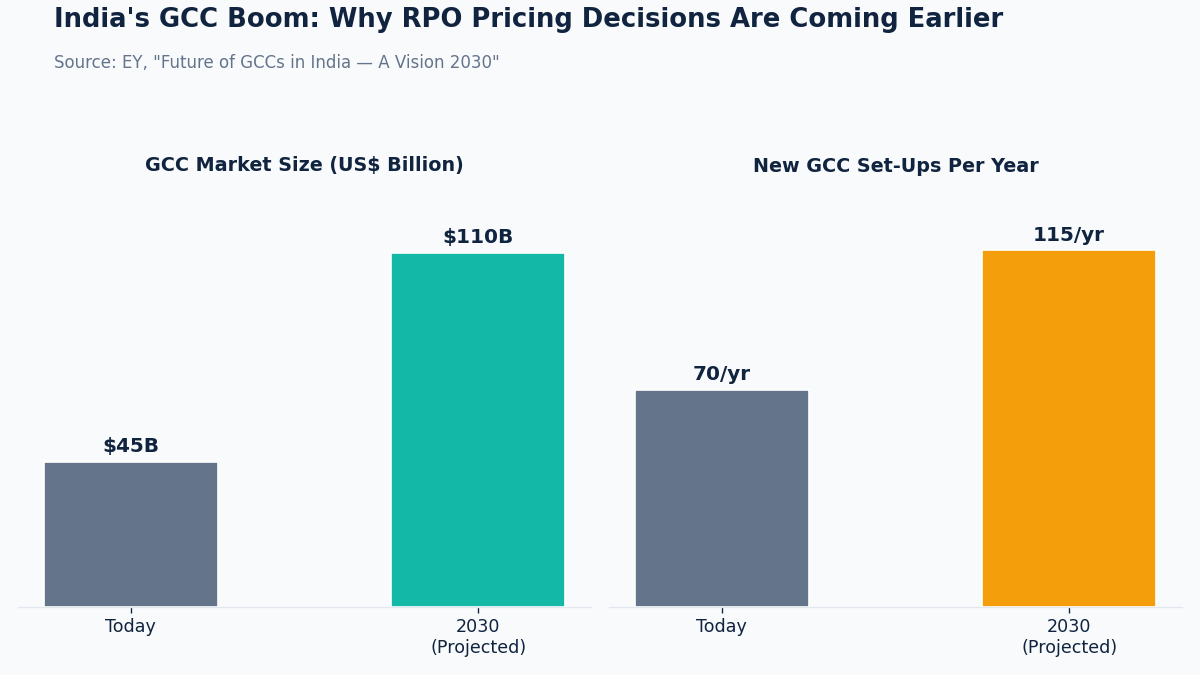
India’s domestic GCC market is projected to reach roughly $110 billion by 2030, up from about $45 billion today, with new GCC set-ups climbing to an estimated 115 a year from the current 70, according to EY’s “Future of GCCs in India
A Vision 2030″ report and every one of those incoming centers will need a hiring engine before it needs anything else, which means an RPO pricing decision lands earlier in a center’s life than most first-time GCC leads expect. The volume of hiring almost always changes faster than the contract does, and that mismatch is where most of the wasted spend happens.
This guide fixes the information gap by publishing actual working numbers not “affordable,” not “competitive,” but rupee figures at three real hiring volumes. Very few Indian RPO firms publish this. We are, because the reader deciding between vendors deserves the same math the vendor already has.
TL;DR
This guide breaks down the four RPO pricing models used in India cost-per-hire, dedicated FTE, management fee plus per-hire, and hybrid and shows what each one actually costs at 20, 50 and 200 hires a year. It's built for founders, TA heads and CHROs who are about to sign an RPO contract and want the math before the sales call, not after.
The single number that changes everything: at low volume, cost-per-hire looks cheap on paper but often costs 30–40% more per hire than a dedicated FTE model once you cross 40–50 hires a year. Almost no vendor volunteers that crossover point; it's the first thing this guide calculates.
By the end, you'll know which of the four pro fee models fits your hiring pattern, what a fair pro management fee looks like in the Indian market, and which questions to ask before a vendor locks you into the wrong structure for a year.
What Are RPO Pricing Models?
RPO pricing models are the fee structures recruitment process outsourcing providers use to charge for hiring services typically cost-per-hire, dedicated FTE/recruiter, management fee plus per-hire, or a hybrid blend of these. Each ties cost to a different variable: successful hires, recruiter time, or a mix of both, which changes how the total bill moves with volume.
The Real Problem: Nobody Is Comparing Apples to Apples
Most hiring teams evaluate RPO vendors by asking “what’s your rate?” That question alone guarantees a bad comparison, because the four dominant pro fee models are structured so differently that a lower headline number can easily cost more at your actual volume.
Consider a team hiring 20 roles a year that signs on how RPO is priced using a flat per-hire fee. The provider profits handsomely because the fixed cost of running a channel (job boards, screening tools, a part-time recruiter’s attention) barely moves whether they deliver 20 hires or 22. That same team, if it scales to 200 hires a year, is now paying full per-hire economics on volume that should have earned a dedicated-team discount three-quarters of the way through the year and most contracts don’t auto-renegotiate at volume thresholds unless it’s written in.
The mismatch compounds because Indian tech hiring timelines have stretched, not shortened. In most engagements we’ve run, mid-level IT roles in India typically take 35–60 days to fill, and senior or niche technical roles routinely run 80–120 days. Every extra week a role sits open under a per-hire model is a week the vendor has no incentive to compress, because they’re paid on outcome, not on speed. Under an FTE model, the opposite problem shows up: you’re paying for recruiter time whether or not roles are moving.
Most teams underestimate this by 2–3x when they first budget an RPO engagement, because they model the headline rate against last year’s hiring plan instead of this year’s actual pipeline of open roles.
The Four RPO Pricing Models, With Real Numbers
This is where most vendor pitches stop and where this guide starts. Below are the four structures used across the Indian market, what each one assumes about your hiring pattern, and a worked comparison at 20, 50 and 200 hires a year.
1. Cost-Per-Hire (Pure Transactional)
You pay only when a candidate joins and clears the agreed guarantee period, typically a flat fee or a percentage of the hire’s annual CTC (commonly 8.33% — 16.67%, i.e., one to two months’ salary). No hire, no fee.
Illustrative math (assuming an average CTC of ₹12 lakh and a 12.5% fee, i.e., ~₹1.5 lakh per hire):
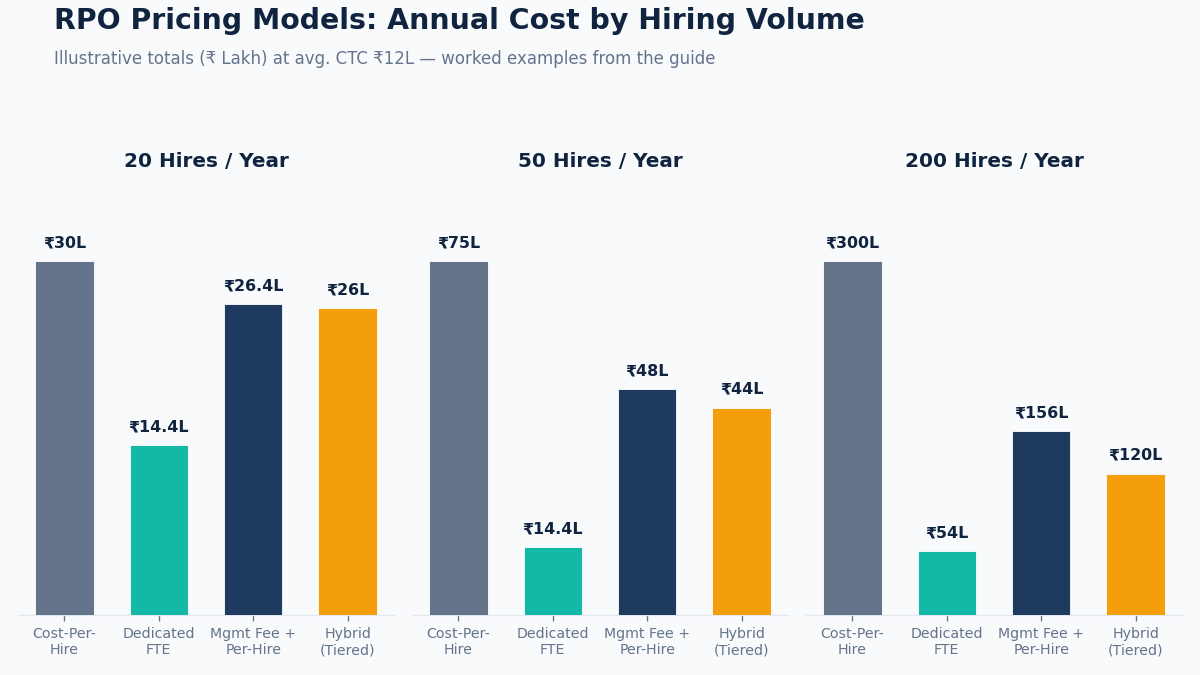
- 20 hires/year: ₹30 lakh
- 50 hires/year: ₹75 lakh
- 200 hires/year: ₹3 crore
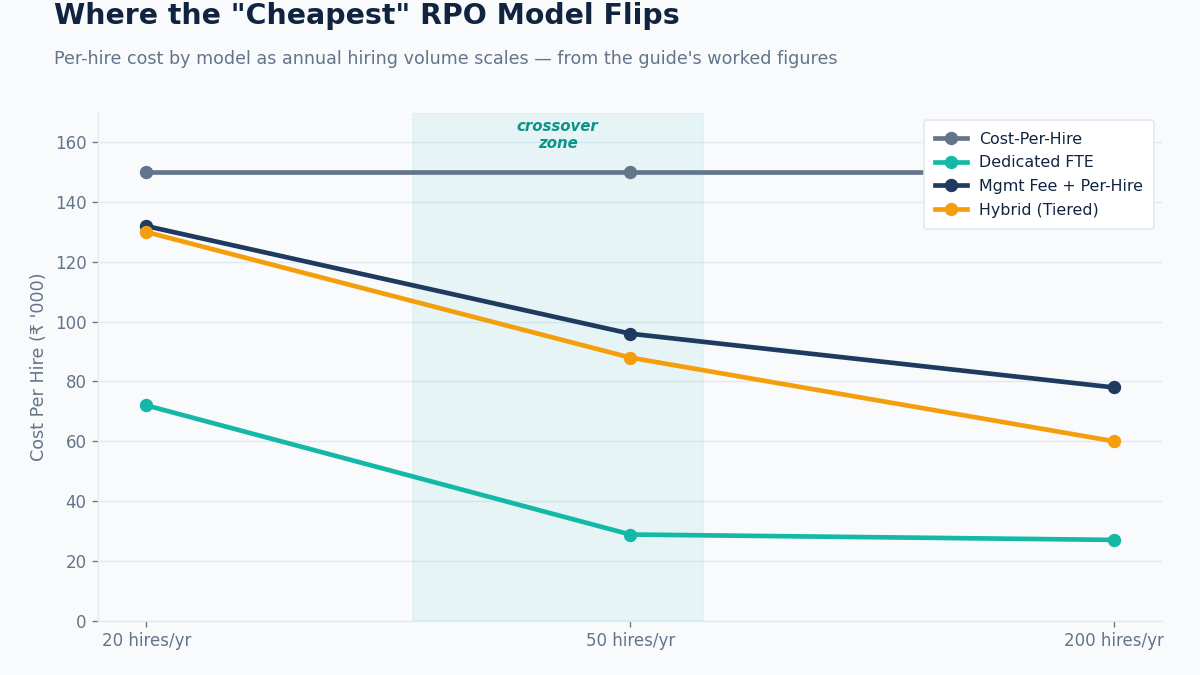
The cost-per-hire never changes with volume; you get zero economies of scale, which is exactly why this model quietly becomes the most expensive option once hiring volume climbs past roughly 40–50 hires a year.
2. Dedicated FTE / Recruiter Model
You pay a fixed monthly or annual fee for one or more dedicated recruiters (or a recruiter pod) assigned exclusively to your account, regardless of how many hires close in a given month. This is the standard structure behind most RPO pricing India quotes for mid-to-high volume accounts.
Illustrative math (assuming ₹1.2 lakh/month fully-loaded cost per dedicated recruiter, and one recruiter closing roughly 4–6 hires/month at steady state):
- 20 hires/year (needs ~0.5 FTE equivalent, often billed at a minimum 1 FTE): ~₹14.4 lakh/year → ₹72,000 per hire
- 50 hires/year (roughly 1 FTE): ~₹14.4 lakh/year → ₹28,800 per hire
- 200 hires/year (roughly 3–4 FTEs): ~₹50–58 lakh/year → ₹25,000–29,000 per hire
The FTE model punishes low volume (you’re paying for capacity you don’t use) and rewards high, steady volume hard. This is the inverse curve of cost-per-hire, and the crossover between the two models typically sits between 35 and 55 hires a year, depending on average CTC and role complexity.
3. Management Fee + Per-Hire (Retainer-Plus)
You pay a smaller fixed RPO management fee to cover program management, reporting, tooling, and account governance, plus a reduced per-hire fee (usually 5–8% of CTC, roughly half of the pure transactional rate) for each successful close.
Illustrative math (₹3 lakh/quarter management fee = ₹12 lakh/year, plus 6% CTC per hire on ₹12 lakh average CTC = ₹72,000/hire):
- 20 hires/year: ₹12L + (20 × ₹72,000) = ₹26.4 lakh → ₹1.32 lakh per hire
- 50 hires/year: ₹12L + (50 × ₹72,000) = ₹48 lakh → ₹96,000 per hire
- 200 hires/year: ₹12L + (200 × ₹72,000) = ₹1.56 crore → ₹78,000 per hire
This structure smooths the worst extremes of both pure models: it’s cheaper than transactional at almost every volume and cheaper than FTE at low volume, because the fixed component is smaller than a full recruiter’s salary.
4. Hybrid (Volume-Tiered Blend)
A hybrid model combines a base management fee with a per-hire rate that steps down at pre-agreed volume tiers for example, full rate for the first 25 hires, a 20% discount from hire 26–75, and a further discount past 75.
This is the structure most Global Capability Centers and Series B+ scale-ups end up negotiating once their hiring plan is confirmed, because it rewards volume without requiring the client to commit to a fixed FTE headcount upfront.
How the four models compare directly:
| Hires/Year | Cost-Per-Hire | Dedicated FTE | Mgmt Fee + Per-Hire | Hybrid (tiered) |
| 20 | ₹30L | ₹14.4L | ₹26.4L | ₹25–27L |
| 50 | ₹75L | ₹14.4L | ₹48L | ₹42–46L |
| 200 | ₹3Cr | ₹50–58L | ₹1.56Cr | ₹1.1–1.3Cr |
These figures are illustrative ranges built from typical Indian market rate cards, not quotes for any specific engagement; your CTC bands, role mix, and geography will shift every number here. The pattern, not the exact rupee figure, is the takeaway: the cheapest model flips at least twice as volume scales.
What This Looks Like in Practice
A Series C fintech running roughly 45–60 tech hires a year switched from a pure cost-per-hire vendor to a management-fee-plus-per-hire structure after realizing their per-hire spend had grown almost linearly with headcount for two straight years with no volume discount built in. The restructured contract brought blended cost per hire down by approximately 22%, with no change in the sourcing quality bar.
A healthtech GCC scaling from 15 to 120 hires within 18 months started on a dedicated-FTE model sized for their year-one plan. When hiring accelerated faster than forecast, the fixed recruiter capacity became the bottleneck rather than the cost lever; the fix was renegotiating into a hybrid structure with a recruiter-pod floor and per-hire ceiling, which let capacity flex with actual requisition load instead of a fixed monthly number.
Which RPO Pricing Model Fits Which Hiring Pattern
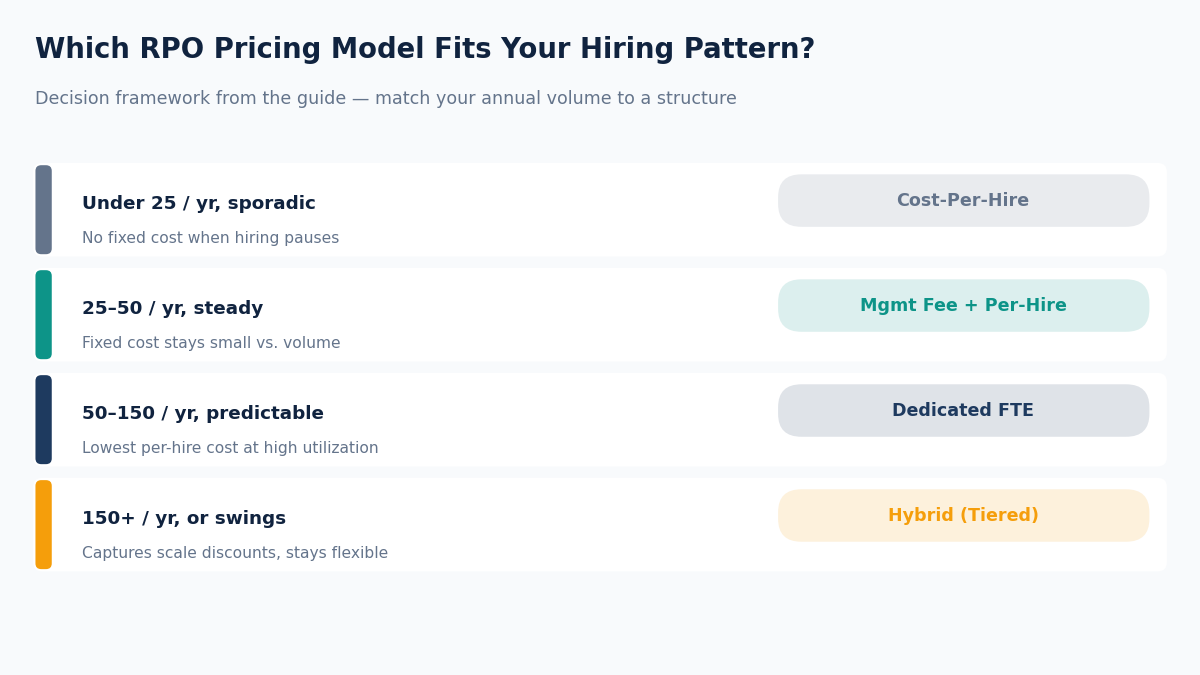
| Hiring Pattern | Best-Fit Model | Why |
| Under 25 hires/year, sporadic | Cost-per-hire | No fixed cost when hiring pauses |
| 25–50 hires/year, steady | Management fee + per-hire | Fixed cost stays small relative to volume |
| 50–150 hires/year, predictable | Dedicated FTE | Lowest per-hire cost once utilization is high |
| 150+ hires/year, or volume that swings | Hybrid, tiered | Captures scale discounts without a rigid headcount commitment |
If your hiring plan spans two of these bands within the same year common for GCC setups and post-funding scale-ups, negotiate re-tiering triggers into the contract at signing, not after volume changes.
What Most Teams Get Wrong
The mistake we see most often isn’t picking the wrong model, it’s signing a 12-month contract on last year’s hiring volume with no re-tiering clause. An RPO pricing agreement in India that made sense at 30 planned hires becomes badly mispriced the moment a funding round or a new product line pushes the actual number to 90, and most standard contracts don’t automatically renegotiate; the client has to notice and ask.
The second pattern: dedicated development teams compare the headline rate (cost-per-hire percentage, or FTE monthly cost) without asking what’s included in the management fee line reporting cadence, ATS/tooling costs, background verification, and replacement guarantees are sometimes bundled and sometimes billed separately, and that difference alone can shift the real cost by 10–15%.
The third, quieter pattern: providers who don’t publish a replacement or guarantee window at all. A pricing model without a stated replacement guarantee typically 7–10 days if a hire doesn’t work out within the probation window is a pricing model that has priced risk entirely onto the client, whether the vendor says so or not.
Getting the Structure Right Before the Number
The four RPO pricing models aren’t interchangeable quotes for the same service; they’re four different bets on how your hiring volume will move over the next 12 months. Cost-per-hire bets you’ll stay sporadic. Dedicated FTE bets you’ll stay steady and high-volume. Management-fee-plus and hybrid structures hedge that bet, at a small premium over the “cheapest” option in any single month.
The vendor quoting you a single rate has already made that bet on your behalf, usually in their own favor. The only real defense is knowing which model you’re being sold, running your own hiring plan through it the way this guide just did, and building re-tiering triggers into the contract before you sign not six months in, when the mismatch has already cost you.
If you’re evaluating RPO pricing models for an upcoming hiring plan and want a second set of eyes on whether the structure you’re being offered actually fits your volume, Supersourcing’s delivery team has priced and run this comparison across dozens of engagements spanning fintech, healthtech and enterprise SaaS hiring. Send your current quote and hiring plan to mayank@engineerbabu.com, or start at supersourcing.com get in touch here if you’d rather talk it through first.
Frequently Asked Questions
What is the average cost per hire in an RPO model in India?
It typically ranges from ₹25,000 to ₹1.5 lakh per hire depending on the pricing structure, role seniority, and hiring volume pure cost-per-hire models sit at the higher end, while high-utilization FTE models can bring blended cost per hire below ₹30,000 at scale.
Is FTE or cost-per-hire cheaper for RPO?
It depends entirely on volume. Cost-per-hire is cheaper below roughly 30–40 hires a year; a dedicated FTE model becomes cheaper once volume and utilization are high enough to justify a full-time recruiter’s fixed cost, usually somewhere past 40–55 annual hires.
How is an RPO management fee calculated?
It’s usually a fixed quarterly or annual amount covering program governance, reporting, and tooling, charged alongside a reduced per-hire fee. It’s calculated as a flat retainer rather than tied to hire count, which is what keeps the per-hire rate lower than a pure transactional model.
Can RPO pricing models be renegotiated mid-contract?
Yes, and they should be if actual hiring volume diverges meaningfully from the plan the pricing was built on. Build re-tiering triggers into the contract upfront most vendors will agree to volume-based renegotiation clauses if asked before signing, far fewer will offer them unprompted afterward.
What happens if a hire from an RPO engagement doesn’t work out?
A well-structured contract includes a replacement guarantee, commonly a 7–10 day window from flag to replacement candidate, at no additional per-hire cost. If a vendor’s pricing model doesn’t mention this at all, asking directly before signing its absence usually means the risk sits entirely with you.
Which RPO pricing model works best for GCC setups?
Most GCC ramp-ups start with a hybrid or dedicated-FTE structure, because hiring volume in the first 12–18 months is typically front-loaded and predictable enough to justify committed recruiter capacity, then shift toward volume-tiered hybrid pricing as the center matures past its initial ramp.
Do RPO providers in India disclose their pricing models publicly?
Rarely. Most quote a single blended rate without breaking down the underlying structure, which makes vendor comparison difficult unless you ask each provider to itemize cost-per-hire, FTE, and management-fee components separately before comparing bids.
