

Massachusetts biopharma employment actually shrank 3.1% in 2025 the first annual drop in more than two decades of tracking while the same companies raised $3.45 billion in venture capital in the first half of 2026 alone, up 25% year over year. That’s not a contradiction. It’s the exact shape of the market a hiring manager has to navigate right now: fewer wet-lab and general R&D roles, but sharply rising demand for the engineers who turn biological and clinical data into something a regulator, a physician, or an investor can act on.
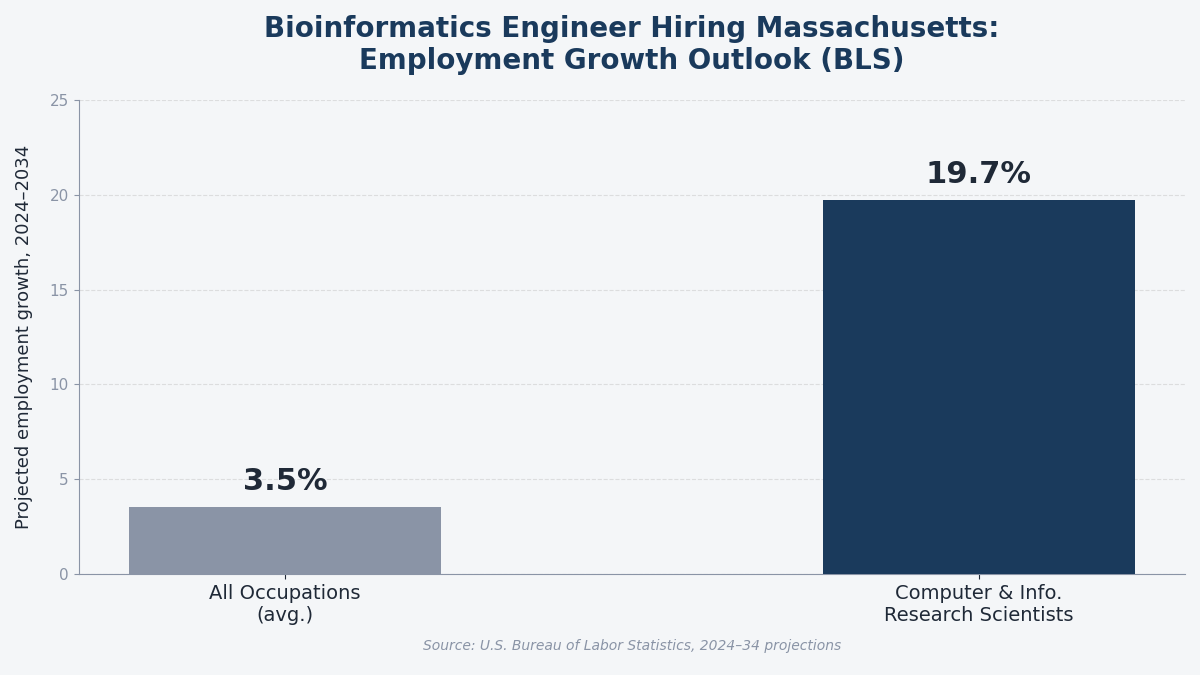
If you’re a bioinformatics engineer hiring Massachusetts searches this quarter, you’re not imagining the difficulty. Computer and information research scientists, the BLS category that best captures advanced bioinformatics and computational biology engineering, are projected to grow employment 19.7% from 2024 to 2034, with health- and biotechnology-related R&D explicitly named as one of the strongest demand drivers behind that number. Supply hasn’t caught up.
Most teams are competing for the same few hundred candidates across Kendall Square, the Longwood Medical Area, and the Route 128 corridor.
Computer and information research scientists in the U.S. Bureau of Labor Statistics category that best captures advanced bioinformatics and computational biology engineering are projected to grow employment 19.7% from 2024 to 2034, with health- and biotechnology-related R&D explicitly named as one of the strongest demand drivers behind that number.
This guide is the process our delivery team actually runs when a biotech or healthtech company needs a computational biologist, a genomics data engineer, or a clinical software engineer who can pass a technical round and a compliance review.
TL;DR
This guide covers everything involved in bioinformatics engineer hiring Massachusetts teams need in 2026 role definitions, real cost ranges, a step-by-step sourcing process, and where healthtech developers' boston searches typically go wrong. It's written for founders, VPs of Engineering, and TA leads at Series A–C biotech and digital health companies.
The single biggest number to know going in: a qualified bioinformatics or clinical software engineer in the Boston-Cambridge corridor now takes 6–10 weeks to hire through a generalist job posting, against a 7–10 working-day benchmark when sourcing is run through a specialized, pre-vetted pipeline.
By the end, you'll be able to build a realistic hiring timeline, price the role correctly for 2026 market rates, and decide whether to build in-house, staff augment, or stand up a dedicated GCC function in Massachusetts.
What Is a Bioinformatics Engineer Hiring in Massachusetts?
Bioinformatics engineer hiring in Massachusetts is the process of sourcing, vetting, and onboarding engineers who build software and data pipelines for genomic sequencing, clinical trial data, and biological research typically for biotech, pharma, and digital health companies concentrated in the Boston-Cambridge life sciences cluster. It differs from general software hiring because it layers domain fluency on top of core engineering skills.
The Core Problem: Why This Hiring Cycle Is Harder Than It Looks
Most engineering leaders underestimate this search by 3–4x on time and 20–30% on comp. Two forces are colliding at once in Massachusetts specifically.
First, the talent pool is genuinely small and geographically concentrated. Genomics data engineers who can move fluently between a Nextflow or Snakemake pipeline and a production AWS or GCP environment are a narrow slice of an already narrow computational biology labor market; most of them are already employed inside the 1,700+ life sciences organizations MassBio tracks in the state.
Second, hiring managers frequently write job descriptions for the wrong role. A posting that asks for “bioinformatics scientist” skills (R, Bioconductor, statistical genomics) but is actually a software engineering hire building a production LIMS or a patient-facing platform will get applicants who can’t ship code at production standard or none at all. This mismatch alone adds 3–4 weeks to most searches we’ve reviewed.
Third, Massachusetts biopharma employment contracted even as investment surged, which means displaced R&D talent is competing directly with software-first candidates for the same computational roles, a dynamic that didn’t exist two years ago and changes how job descriptions should be written and where sourcing should happen.
Building the Team: Roles, Process, and Real Cost
This is the part most guides skip. Below is how the role actually splits, the process that gets it filled in days instead of months, and what it costs.
Genomics Data Engineers vs. Clinical Software Engineers: Two Different Hiring Tracks
These two titles get conflated constantly, and it’s the single biggest source of mis-hires.
- Genomics data engineers build and maintain the pipelines that move raw sequencing output (FASTQ, BAM, VCF) through alignment, variant calling, and annotation at scale. Core stack: Python or Nextflow/WDL, Spark or Dask, cloud object storage, and workflow orchestration (Airflow, Cromwell). They rarely touch patient-facing systems directly.
- Clinical software engineers build the systems that sit closer to the patient or the regulator EHR/EMR integrations (HL7v2, FHIR), clinical trial data capture, or patient engagement platforms. Core stack: standard backend languages (Python, Java, Node), plus deep familiarity with HIPAA-compliant architecture and, for some roles, FDA software-as-a-medical-device (SaMD) documentation practices.
A company building a diagnostics or precision medicine product usually needs both, on separate reporting lines, not one person wearing both hats.
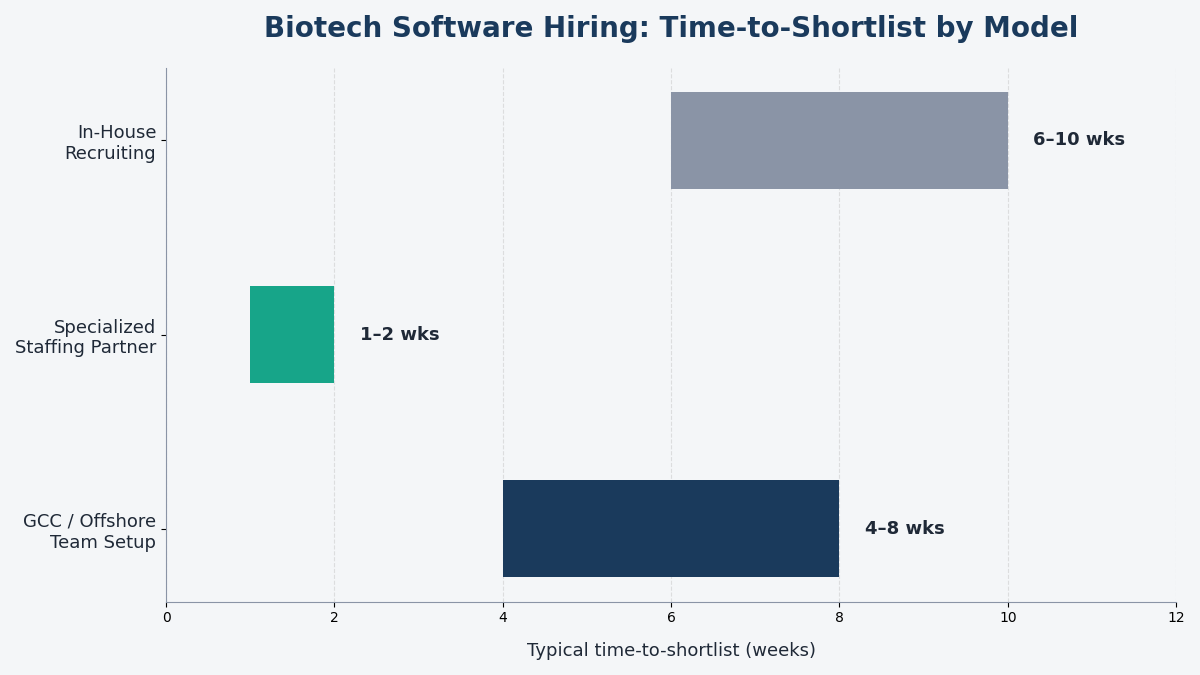
The 7-Step Bioinformatics Engineer Hiring Massachusetts Process
- Separate the role before writing the JD. Decide genomics data engineer, clinical software engineer, or computational biologist the compliance and stack requirements diverge sharply.
- Set a realistic comp band using 2026 Boston-market data, not national averages Massachusetts life sciences comp typically runs 10–18% above national benchmarks for equivalent titles.
- Screen for domain fluency before syntax. A 20-minute technical conversation on genomic file formats or HL7/FHIR filters out 60–70% of otherwise-qualified generalist software engineers.
- Run a take-home or paired exercise on real (anonymized) pipeline or integration logic, not a generic LeetCode-style test; it’s the strongest predictor of on-the-job performance for this role type.
- Loop in a compliance-literate technical reviewer for any role touching PHI or FDA-regulated systems that catches red flags a general engineering manager will miss.
- Move to offer within 5 business days of the final interview. Strong bioinformatics candidates in this market hold 2–3 competing offers on average; delay is the top reason companies lose finalists.
- Structure onboarding around a 30-day compliance and codebase ramp, since most of these roles inherit legacy pipelines or partially documented clinical systems.
Compliance, Compensation, and Cost Realities
Budget realistically. A mid-level genomics data engineer in the Boston-Cambridge corridor typically lands $130,000–$165,000 base; senior clinical software engineers with HIPAA/FHIR depth run $150,000–$195,000; staff-level computational biologists with production ML experience can clear $210,000+ in total comp.
Contract and staff-augmentation engagements through a specialized partner typically run 20–35% below the fully loaded cost of an in-house hire once recruiting time, benefits, and ramp are factored in.
Compliance adds real cost, not just process. Any engineer touching PHI needs HIPAA training built into onboarding, and any role supporting a regulated device or diagnostic pipeline needs documentation practices aligned to FDA 21 CFR Part 11 this is usually the single most underestimated line item in a first-time biotech engineering budget.
Real-World Application: Two Massachusetts HealthTech Hiring Scenarios
A Cambridge-based precision oncology startup needed a genomics data engineer to rebuild a variant-calling pipeline that had outgrown its original architecture. The role had been open for 11 weeks through a generalist job board with zero qualified applicants.
Restructuring the JD around Nextflow and cloud-scale variant annotation, then sourcing against a pre-vetted computational biology pool, produced an interview-ready shortlist in 8 working days and a signed offer within three weeks.
A digital health company building a patient engagement platform for a Boston hospital network needed two clinical software engineers with FHIR integration experience under a tight go-live date. In-house recruiting had sourced strong generalist backend engineers who lacked healthcare interoperability experience, risking a compliance review failure.
A domain-specific screen against FHIR and HL7v2 fluency identified two contract-to-hire engineers who passed the compliance review on the first attempt and converted to full-time roles after a six-month trial.
In-House vs. Staffing Partner vs. GCC: A Decision Framework for Biotech Software Hiring
Choosing how to structure biotech software hiring matters as much as who you hire. Each model fits a different stage and risk profile.
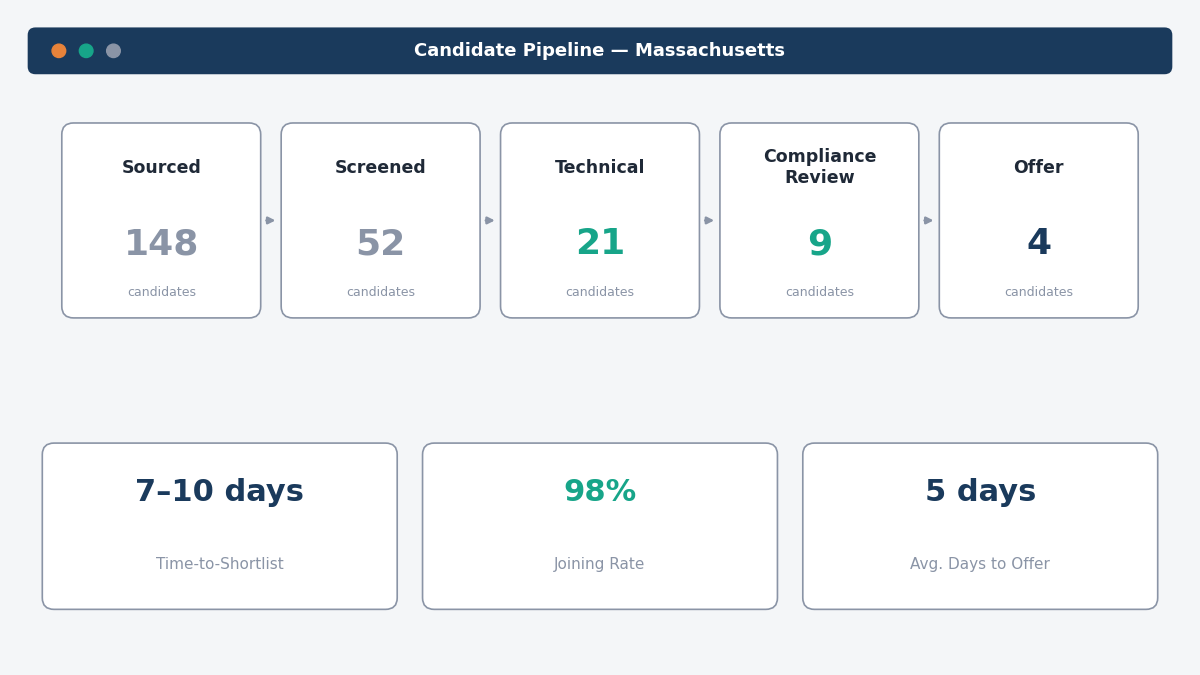
| Model | Best fit | Typical time-to-shortlist | Key trade-off |
| In-house recruiting | Series C+ with an established TA function and employer brand | 6–10 weeks | Deepest cultural fit, slowest for niche skills |
| Specialized staffing partner | Series A–C needing speed and domain-specific vetting | 7–10 working days | Fastest ramp, requires clear scope definition upfront |
| GCC / dedicated offshore team | Companies scaling multiple engineering functions long-term | 4–8 weeks to stand up | Highest long-term cost efficiency, needs governance investment |
For a single specialized hire under time pressure, an IT staffing partner wins on speed. For a company planning to build out a genomics or clinical engineering function of 8+ people over 12–18 months, a GCC model typically pays for itself in cost efficiency by month six.
What Most Teams Get Wrong When Hiring Healthtech Developers in Boston
The most common failure pattern isn’t sourcing, it’s scoping. Teams write a single job description trying to capture “bioinformatics,” “clinical,” and “data engineering” in one req, then wonder why the applicant pool is both small and mismatched. Split the role before you post it.
The second pattern: treating HIPAA and FHIR knowledge as a “nice to have” rather than a hard filter. We’ve seen otherwise strong engineering hires fail a compliance review three months into the role because interoperability standards were never actually tested in the interview loop.
The third, and most costly: optimizing purely for Boston-based, on-site candidates when the realistic talent pool for genomics-specific pipeline engineering is national and substantially remote-friendly. Companies that widen geography while keeping domain-specific screening tight consistently close roles in half the time of companies that hold both location and skill constraints simultaneously.
Next Step
If you’re evaluating a bioinformatics engineer hiring Massachusetts options and want to pressure-test your job description, comp band, or sourcing timeline before committing to a vendor or a headcount plan.
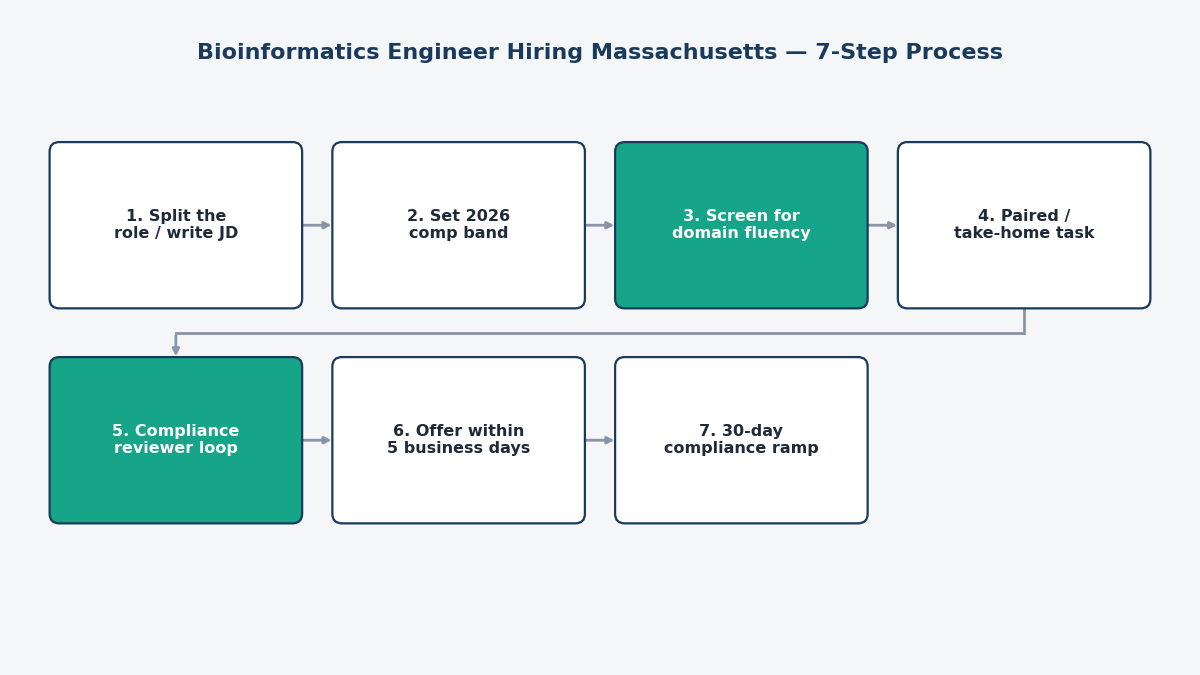
Supersourcing has run this exact process across biotech and healthtech engagements with a 7–10 day shortlist benchmark and a 98% candidate joining rate. Reach out at mayank@engineerbabu.com or start at https://supersourcing.com/contact-us/.
FAQ
What does a bioinformatics engineer actually do at a biotech company?
A bioinformatics engineer builds and maintains the software and data pipelines that process biological data, genomic sequencing output, clinical trial datasets, or lab instrument data at production scale. The role blends software engineering with enough domain knowledge in genomics or clinical data standards to make the output scientifically and regulatorily sound.
How much does bioinformatics engineer hiring in Massachusetts cost in 2026?
Mid-level genomics data engineers typically run $130,000–$165,000 base salary in the Boston-Cambridge market; senior clinical software engineers with compliance experience run $150,000–$195,000. Contract or staff-augmentation models generally cost 20–35% less than a fully loaded in-house hire once recruiting and ramp time are included.
Why is hiring healthtech developers in Boston so competitive right now?
The talent pool for engineers who combine software skill with genomics or clinical data fluency is narrow and largely already employed inside the 1,700+ life sciences organizations concentrated in the state. Rising VC investment in 2026 increased hiring demand even as overall biopharma headcount contracted, intensifying competition for computational roles specifically.
Should a startup outsource bioinformatics hiring or build it in-house?
For a single urgent hire, a specialized staffing partner is usually faster and lower-risk. For companies planning to scale a genomics or clinical engineering function past 8–10 people over 12–18 months, standing up a dedicated team or GCC function typically becomes more cost-efficient after roughly six months.
How long does bioinformatics engineer hiring in Massachusetts typically take?
Through a generalist job posting, 6–10 weeks is common, often longer for niche genomics roles. Through a specialized, pre-vetted sourcing process, an interview-ready shortlist is realistic within 7–10 working days.
What’s the difference between a clinical software engineer and a general backend engineer?
A clinical software engineer has the same core backend skill set plus working fluency in healthcare interoperability standards (HL7v2, FHIR), HIPAA-compliant architecture, and often FDA software documentation practices for regulated products knowledge a general backend engineer usually has to be trained into from scratch.
