

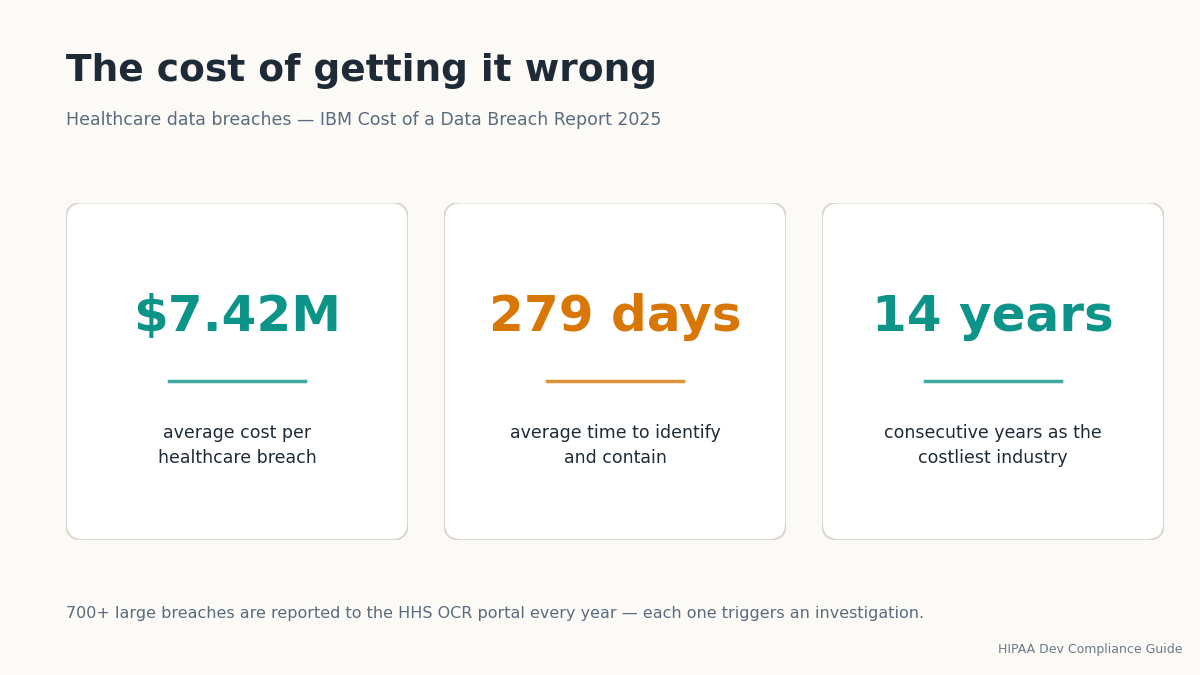
Healthcare has been the most expensive industry in the world to suffer a data breach for 14 consecutive years. Not banking. Not defense. Healthcare because a stolen medical record sells for many multiples of a stolen credit card number, and because regulators treat every exposed patient record as a compliance failure with a paper trail. It is also why the decision to hire HIPAA compliant software developers has moved from an HR task to a board-level risk conversation.
Here is the part most engineering leaders miss: the majority of HIPAA violations that reach the HHS Office for Civil Rights don’t start with a sophisticated attack. They start with ordinary development decisions. A staging database seeded with production patient data. An S3 bucket with a misconfigured policy. A contractor whose access nobody revoked after the engagement ended. A logging library that quietly wrote names and diagnoses into plaintext application logs.
In other words: your compliance posture is not decided in your legal department. It is decided in your pull requests, your infrastructure configs, and before any of that in who you hire to write the code.
The average healthcare data breach now costs $7.42 million, and healthcare breaches take an average of 279 days to identify and contain the longest of any industry.
That 279-day detection window is the forward-looking warning in the data. Breaches contained in under 200 days cost dramatically less; the gap between a compliant team and a non-compliant one is measured first in engineering discipline, and only later in fines.
This guide breaks down, in plain operational language, what HIPAA actually demands from the people building your software and how to hire developers who won’t learn those demands at your expense. It is not legal advice. It is the practical playbook: the rules that touch code, the vetting process, the contracts, the costs, and the failure patterns we see repeatedly across healthtech engagements.
TL;DR
This guide is for founders, CTOs, and engineering leaders building software that touches protected health information patient apps, provider platforms, health data pipelines, or anything integrating with an EHR. It explains what HIPAA requires from a development team in practice, then walks through a six-phase process to hire HIPAA compliant software developers, from defining requirements to offboarding.
The single most important fact in the guide: HIPAA has no official developer certification and no "HIPAA compliant" software stamp. Compliance lives in how your team handles PHI data security day to day encryption, access control, audit logging, and signed business associate agreements and the average failure now costs $7.42 million per breach.
By the end, you will be able to judge whether a developer, vendor, or hosting provider is genuinely compliance-ready, know the real cost bands for compliant development, and run a vetting and onboarding process that would survive an OCR audit. Budget 20–30 minutes; the checklists alone are worth bookmarking.
What Is HIPAA Compliance in Software Development?
HIPAA compliance in software development is the practice of designing, building, and operating software so that protected health information (PHI) is created, stored, transmitted, and accessed only under the administrative, physical, and technical safeguards required by the HIPAA Privacy, Security, and Breach Notification Rules with every person and vendor touching PHI bound by a business associate agreement.
Three things it is not, because these confusions cause real damage:
- It is not a certification. HHS certifies nothing and nobody. Any developer or vendor claiming to be “HIPAA certified” by an official body is describing third-party training at best, and misrepresenting the law at worst.
- It is not a property of tools. AWS, Azure, and GCP are not “HIPAA compliant” out of the box; they offer HIPAA-eligible services under a signed BAA. Your architecture and configuration determine compliance.
- It is not a one-time audit. Compliance is a continuous state, re-evaluated with every deployment, every new hire, and every access grant. OCR enforcement focuses on whether you run a living risk-management program, not whether you once passed an assessment.
Why It Matters: The Business Case
HIPAA readiness in your development team is not a legal nicety it moves four hard business numbers:
- Breach cost avoidance. At an average of $7.42 million per healthcare breach, and with civil penalties ranging from roughly $140 to over $71,000 per violation (annual caps above $2.1 million per violation category, inflation-adjusted yearly), a single engineering mistake can exceed a seed round.
- Regulatory exposure. More than 700 large breaches (500+ individuals) are reported to the HHS OCR Breach Portal every year, and every one triggers an OCR investigation. In 2024 alone, over 289 million individuals had PHI exposed, a number inflated by one vendor breach (Change Healthcare), which is precisely the point: your vendors’ developers are your risk.
- Sales velocity. Hospital systems, payers, and enterprise healthtech buyers will not sign until you pass security review. Teams that can produce a risk assessment, BAA chain, and audit-log evidence close enterprise deals months faster than teams that scramble to retrofit.
- Rework avoidance. Retrofitting encryption, access controls, and audit logging into a live product typically costs 3–5x what building them in from sprint one costs and forces migration work on production PHI, which is itself a risk event.
The inverse is also true: over-engineering compliance where it doesn’t apply (a wellness app with no covered-entity relationship, fully de-identified analytics) burns budget. Knowing where HIPAA starts and stops is worth real money in both directions.
HIPAA Developer Requirements: What the Law Actually Asks of Engineers
Three rules generate every real obligation here, and only one of them the Security Rule reads like an engineering spec. Below is the plain-language mapping of HIPAA developer requirements from regulation to codebase.
The Privacy Rule: what your code is allowed to do with PHI
The Privacy Rule governs use and disclosure. For a development team, it translates to:
- Minimum necessary by design. Every feature, API response, and internal tool should expose only the PHI required for its function. A support dashboard that returns full patient records when the agent needs an appointment status is a Privacy Rule problem written in code.
- PHI is broader than you think. Names, dates, device identifiers, IP addresses tied to health data, full-face photos 18 identifier categories. If your analytics pipeline touches any of them alongside health information, it is handling PHI.
- De-identification is an engineering task. The Safe Harbor method (strip all 18 identifiers) or Expert Determination are the only two recognized paths. Hashing an email address does not de-identify a record.
The Security Rule: the engineering spec
The HIPAA Security Rule defines administrative, physical, and technical safeguards for electronic PHI (ePHI). The technical safeguards are where developers live:
- Access control: unique user IDs for every human and service account, automatic session timeout, emergency access procedures, and encryption. In practice: RBAC or attribute-based access, no shared logins, no “admin” service account used by six microservices.
- Audit controls: hardware, software, and procedural mechanisms that record activity in systems containing ePHI. In practice: immutable, centralized audit logs answering who accessed which record, when, and what changes were retained and reviewable, with PHI itself kept out of general application logs.
- Integrity controls: mechanisms to confirm ePHI hasn’t been improperly altered or destroyed checksums, versioning, write-ahead logs, tamper-evident storage.
- Transmission security: encryption in transit. In practice: TLS 1.2+ everywhere, including internal service-to-service traffic; no PHI in URLs or query strings; secure APIs replacing any flow that ever suggests email or SFTP-with-shared-password.
- Encryption at rest: formally an “addressable” specification today, but treat it as mandatory AES-256 for databases, object storage, backups, and snapshots. If a lost laptop or leaked snapshot is encrypted, it may not even qualify as a reportable breach.
Forward flag the rules are tightening: In January 2025, HHS published a proposed overhaul of the Security Rule (90 FR 800) that would eliminate the “addressable” category entirely and make encryption, MFA, network segmentation, asset inventories, and annual penetration testing explicitly mandatory.
As of mid-2026 it remains a proposed rule final action has slipped on the federal agenda to 2027 but it is the clearest signal available of where OCR expects mature programs to already be. Teams building today should build to the proposal, not the 2013 floor.
The Breach Notification Rule: what happens when code fails
Developers shape breach outcomes twice: before (encryption can render an incident non-reportable) and after (your logs determine whether you can even scope an incident). Obligations include notifying affected individuals within 60 days, HHS reporting, and media notice for breaches over 500 individuals.
A dedicated team that cannot reconstruct which records were accessed from its audit trail is forced to assume the worst-case scope and disclose accordingly.
BAAs and HIPAA compliant hosting: the paper chain behind the stack
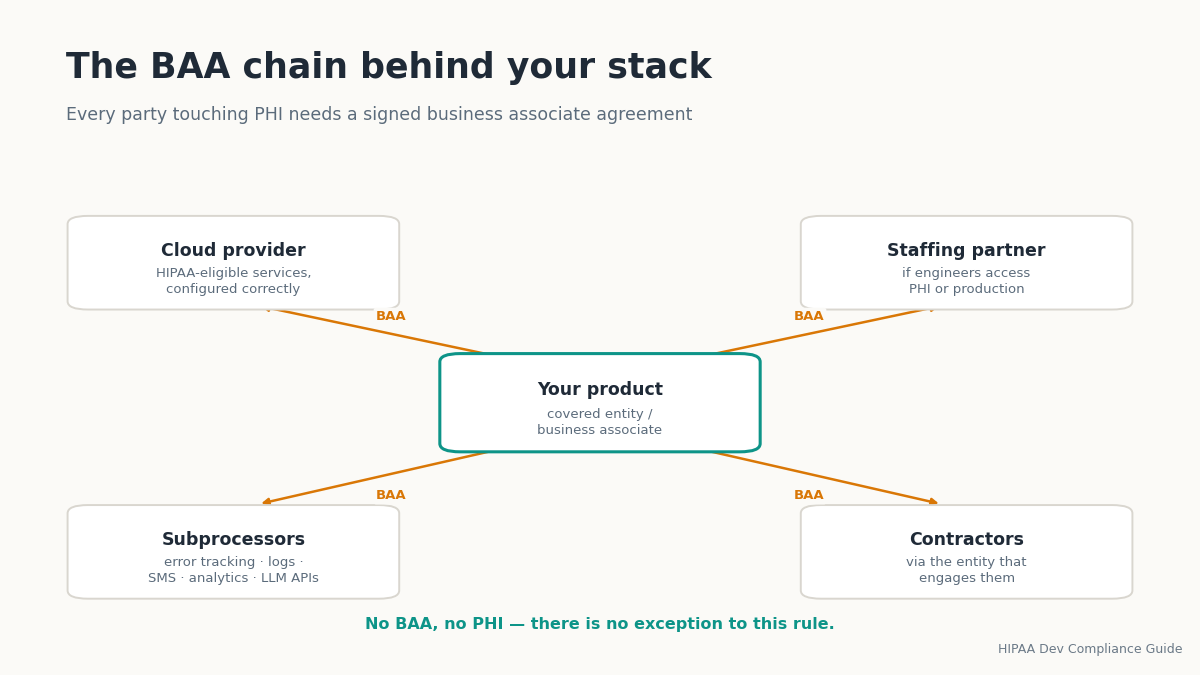
Every non-employee party that creates, receives, maintains, or transmits PHI on your behalf is a business associate and must sign a business associate agreement (BAA) before touching PHI. That chain runs deeper than most teams map:
- Your cloud provider (HIPAA compliant hosting means: BAA signed + only HIPAA-eligible services used + configured correctly all three, not any one).
- Your staffing partner or dev agency, if their engineers access PHI or production systems.
- Your subprocessors: error tracking, log aggregation, email/SMS providers, analytics, LLM APIs. Sentry capturing a stack trace with a patient name in it makes Sentry part of your PHI surface.
- Individual contractors, via the entity that engages them which is why the BAA question belongs in procurement, not in week three of the engagement.
Red flag: a hosting or SaaS vendor that says “we’re HIPAA compliant” but will not sign a BAA. No BAA, no PHI there is no exception to this rule. This is also where infrastructure hiring matters: engineers who have configured BAA-covered environments before, the kind you get when you hire DevOps engineers with prior healthtech exposure, will architect around HIPAA-eligible services by default instead of discovering an ineligible one at security review.
The Core Problem: Why Most Teams Get This Wrong
The failure pattern is consistent across the healthtech engagements we’ve supported, and it has little to do with bad intent:
Teams underestimate the compliance surface by 3–4x. They budget for “encrypt the database and sign the AWS BAA” and discover late that audit logging, access reviews, subprocessor BAAs, workforce training, incident-response runbooks, and offboarding controls were all in scope. Each discovery arrives mid-sprint, priced at retrofit rates.
The skills gap is invisible at hiring time. A senior engineer with ten years of e-commerce experience will pass every algorithm interview and still seed a test environment with production PHI in week two because nothing in their career ever made that dangerous. Generic technical vetting does not surface compliance instincts, and most hiring processes never ask.
Compliance knowledge concentrates on one person. A single “security-aware” lead becomes the de facto compliance function. When they leave, the institutional knowledge leaves with them, and OCR does not accept key-person risk as a mitigating factor.
The offshore question gets answered wrong in both directions. Some teams assume offshore developers can’t work on PHI systems (false HIPAA follows the data and the contracts, not passports). Others assume distance dilutes obligation (also false, your BAA chain and your liability extend to every engineer with access, in any time zone). The correct answer is structural: BAAs, access controls, and training that don’t care about geography.
The common thread: HIPAA readiness is treated as a legal review at the end instead of a hiring criterion at the beginning. The rest of this guide fixes that ordering.
The Walkthrough: How to Hire HIPAA Compliant Software Developers, From Scratch
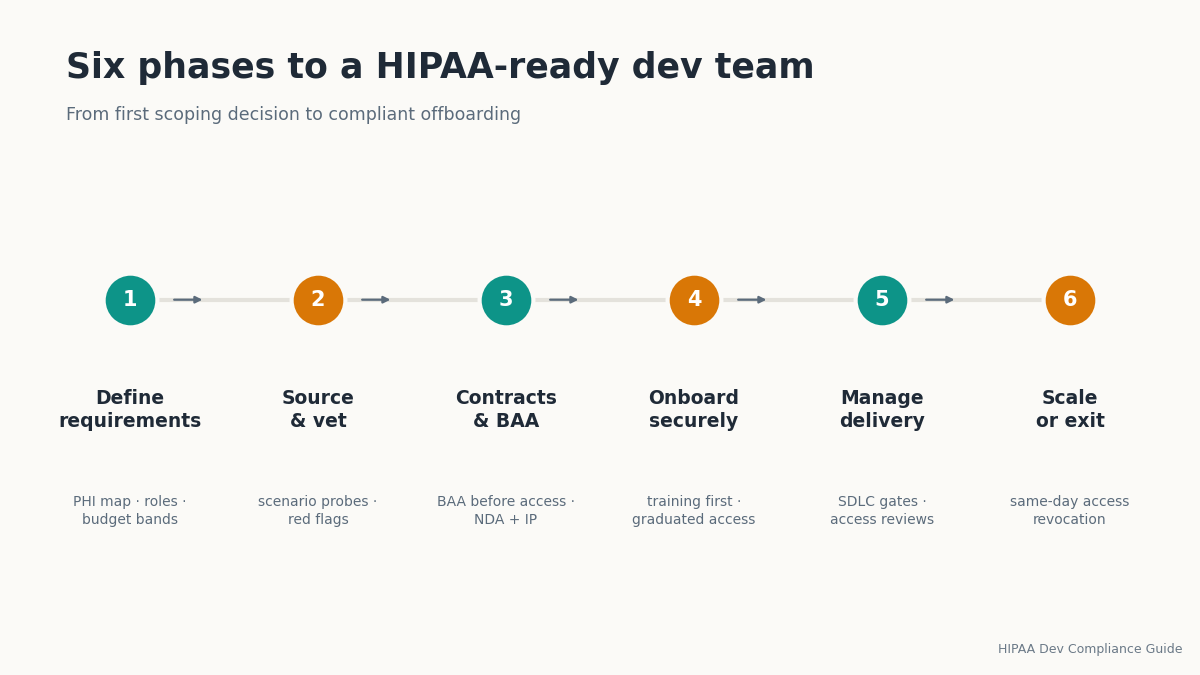
This is the full lifecycle from the day you realize your product touches PHI to the day you scale the team or wind an engagement down. Skip nothing, even the phases that feel obvious; every one of them corresponds to a violation category on the OCR portal.
Phase 1 Define requirements: scope, roles, budget bands
Before a single job description is written, answer four questions in writing.
- Are you a covered entity, a business associate, or neither? Providers, health plans, and clearinghouses are covered entities. If you build software for them and handle PHI on their behalf, you are a business associate with direct liability under the Security and Breach Notification Rules. If your app collects health data directly from consumers with no covered-entity relationship (a standalone fitness tracker), HIPAA may not apply at all though FTC Health Breach Notification rules might. This single classification determines your entire compliance budget.
- Map your PHI surface. List every system, pipeline, and third party that will create, store, transmit, or display PHI. This becomes the backbone of your risk assessment and tells you which roles need HIPAA depth versus general competence.
- Define the roles honestly. A typical early HIPAA-ready product team: one backend engineer with prior regulated-data experience, one DevOps/cloud engineer to own the BAA-covered infrastructure, one QA engineer with security-testing exposure, plus your existing product engineers who will be trained up. Not everyone needs a healthtech résumé; the people designing data flows and infrastructure do.
- Set budget bands with compliance overhead included. Typical market ranges: a senior HIPAA-experienced engineer runs $120k–$180k/year in the US, or ₹25–60 lakh/year ($30k–$75k) for dedicated senior talent in India. Then add the program costs, most budgets omit third-party risk assessment (typically $5k–$25k), annual penetration testing ($10k–$40k), BAA-covered hosting and tooling premiums (often 15–30% over consumer-tier equivalents), and training. Plan for compliance overhead of roughly 10–20% on top of raw development cost for a first HIPAA product.
Treat the block below as the opening entries of your HIPAA compliance checklist each later phase extends it.
Checklist you’re ready to leave Phase 1 when:
- Covered entity / business associate status determined (in writing)
- PHI data-flow map drafted, including third parties
- Role matrix: which seats require prior PHI experience
- Budget includes assessment, testing, hosting premium, and training lines
- Timeline includes a compliance gate before any production PHI is touched
Phase 2 Sourcing and vetting: what “HIPAA-aware” looks like in an interview
There is no license to check, so vetting has to probe applied knowledge. Resume screens select for the word “HIPAA”; interviews must select for instincts.
Five interview probes that separate real exposure from keyword matching:
- “Walk me through how you handled test data in your last healthcare project.” Strong answer: synthetic data generation or rigorous de-identification, never production PHI in lower environments. Weak answer: “we used a copy of prod with restricted access.”
- “A stack trace with a patient name just landed in your error tracker. What happens next?” Strong answer: treat as potential incident, scope via logs, scrub, check whether the tracker is under BAA, fix the logging pattern. Weak answer: “delete it.”
- “How would you design audit logging for a records API?” Listen for: who/what/when at the record level, immutability, log storage that itself excludes PHI content, retention.
- “What’s the difference between HIPAA-eligible and HIPAA-compliant on AWS?” Anyone with real experience answers this instantly.
- “When is encryption at rest not enough?” Strong candidates mention access control and key management encrypted data with over-broad IAM roles is theater.
Red flags, in rough order of severity:
- Claims of an official “HIPAA certification” presented as a government credential
- Portfolio healthcare projects they can’t discuss in data-handling terms
- No opinion on secrets management or key rotation
- Visible irritation at the premise that compliance constrains design the attitude ships bugs
Structured sourcing compresses this. Vetting pipelines that pre-screen for regulated-industry exposure the model platforms like Supersourcing run, where AI-driven sourcing surfaces roughly the top 2% of screened candidates and a shortlist lands in 7–10 working days mean your interviews spend time on the five probes above rather than on basic competence filtering. If the role itself is domain-specific, it is usually faster to hire healthcare software developers who have already shipped under a BAA than to train a generalist on a live PHI system.
Cultural evaluation matters more here than in most hiring. HIPAA discipline is mostly the willingness to slow down: to ask before granting access, to flag a sketchy data flow, to document. Probe it with behavioral questions (“tell me about a time you pushed back on a shortcut”), because the technical safeguards are only as strong as the person deciding whether to bother.
Phase 3 Engagement models and contracts: where the BAA chain gets built
How you engage the team determines who signs what. The three common models:
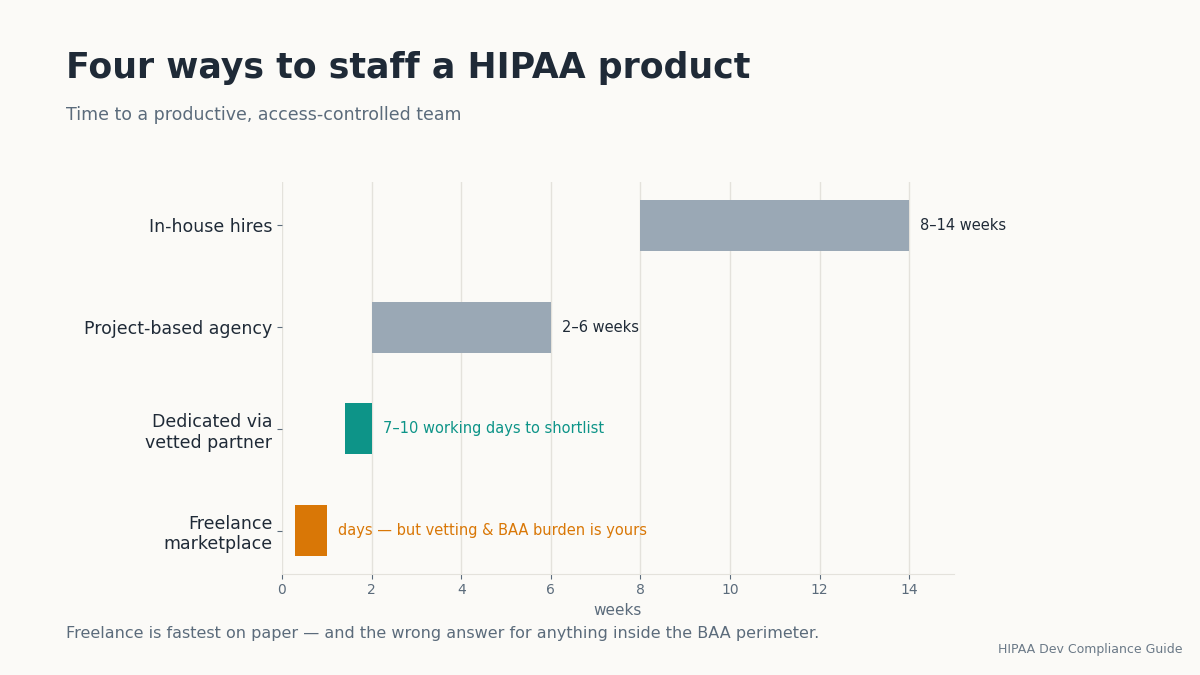
- Direct hire / in-house: Employees are your workforce, not business associates no BAA needed, but they fall under your training and sanction policies from day one. Slowest to assemble (8–14 weeks for senior healthtech talent is typical), highest control.
- Dedicated developers via a staffing partner: The partner’s engineers work exclusively on your systems under your processes. The staffing entity signs a BAA (if its people access PHI) plus NDA and IP-assignment terms; you control the environment. This is the standard model offered by IT staffing services with regulated-industry practices look specifically for no-shared-bandwidth commitments (an engineer splitting weeks across three clients is an access-control risk, not just a productivity one) and a replacement guarantee, because a mis-hire on a PHI system is a risk event, not merely a delay.
- Project-based agency: The agency owns delivery and typically hosts nothing, but if its staff touch PHI or production, the BAA is still mandatory. Highest abstraction, weakest visibility into individual engineer discipline acceptable for greenfield builds with synthetic data, risky for live-system work.
Contract terms that actually matter (negotiate these, in order):
- BAA before access, no exceptions including breach-notification timelines from the vendor to you (48–72 hours is a reasonable ask; the statutory clock is yours, not theirs).
- NDA + IP assignment covering code, data models, and derived datasets.
- Named-individual access, the contract should let you approve and revoke specific people, not “the vendor team.”
- Training attestation vendor certifies HIPAA training for every assigned engineer, with records available on request.
- Replacement and offboarding SLAs determine how fast a departing engineer’s access is revoked and confirmed (same business day is the right answer), and how fast a replacement is fielded (7–10 working days is a defensible market standard).
Phase 4 Onboarding and secure ramp-up: the first two weeks
Most access-related violations trace to onboarding shortcuts. Run the first two weeks as a controlled sequence:
Week 1 before any system access:
- HIPAA training completed and documented (role-appropriate: engineers need Security Rule depth, not billing-privacy trivia)
- Signed confidentiality and acceptable-use acknowledgments on file
- Managed or hardened workstation confirmed: full-disk encryption, screen lock, EDR, no PHI on local disks as policy
- Accounts provisioned with unique IDs, MFA enforced, least-privilege roles starting with no production access
Week 2 graduated access: 5. Development environment access with synthetic data only 6. Architecture and data-flow walkthrough with the PHI map from Phase 1 7. Read-only production observability access if the role requires it, logged 8. First code contributions through mandatory review by a PHI-experienced engineer
The two-approval rule: production PHI access requires sign-off from both the engineering lead and whoever owns compliance. It adds a day of latency once, and it is the control OCR auditors ask about first.
Communication cadence gets set here too: a dedicated account manager on the vendor side, a named security contact on yours, and an agreed incident-escalation path before the first incident.
Phase 5 Managing delivery: making compliance a KPI, not a vibe
Once the team is shipping, compliance either becomes measurable or it decays. Instrument it:
- Secure SDLC gates: threat-model note on any feature touching PHI; dependency and secret scanning in CI; infrastructure-as-code review for any change to storage, networking, or IAM.
- Access reviews on a clock: quarterly recertification of every human and service account against current roles. Track “orphaned access findings” as a metric the target is zero.
- Audit-log health: alerting on log pipeline failures. An audit trail with a three-week gap is, for breach-scoping purposes, barely an audit trail.
- Testing that includes abuse: security test cases in the definition of done authorization bypass attempts, PHI-in-logs checks, direct-object-reference probes. This is where it pays to hire QA engineers with security-testing backgrounds rather than treating pen-testing as an annual outsourced ritual.
- Reporting cadence: weekly delivery reviews include a standing compliance line, open findings, access changes, incidents/near-misses. Five minutes a week keeps the risk register honest.
KPIs worth tracking: time-to-revoke access on departure (same-day target), % of PHI-touching stories with threat-model notes (target 100%), audit-log coverage of PHI stores (target 100%), findings aging (nothing critical older than 30 days).
Phase 6 Scaling or exiting: the phase where breaches actually happen
Departures and transitions are over-represented in real-world incidents because access outlives need.
Scaling up: repeat Phases 2–4 per hire, no abbreviations the fifth engineer gets the same two-week ramp as the first. Update the risk assessment when the team structure or PHI surface changes materially, not just annually.
Offboarding a single engineer (same business day):
- Revoke SSO, VPN, cloud console, repo, and database access; rotate any shared secrets they could have seen
- Collect or remote-wipe managed devices
- Written attestation from the vendor (for contract staff) that access is terminated
- Review their recent access logs for anomalies routinely, not accusatorially
Ending a vendor engagement: the BAA’s termination clause activates return or destruction of PHI, certified in writing. Keep the certification; OCR asks for it years later.
If the relationship includes a replacement guarantee, exercising it is a compliance action as much as a staffing one: an underperforming engineer on a PHI system is a risk you’re paying for.
Case Studies: What Compliance-Aware Hiring Looks Like at Scale
Somnoware (healthtech, sleep diagnostics): a US healthcare SaaS platform operating squarely in PHI territory sleep-study data flowing between labs, physicians, and devices used Supersourcing to automate and accelerate its engineering recruitment. The operative lesson: in a PHI-heavy product, the vetting bar and the hiring speed have to move together; the engagement paired pre-screened, regulated-industry-aware candidates with the standard 7–10 working-day shortlist cycle, so compliance screening added rigor without adding weeks.
Apollo Hospitals (enterprise healthcare): one of Asia’s largest hospital systems, and a working example of the covered-entity side of the table where every external engineering resource is evaluated as a data-access decision first and a delivery decision second. Engagements at this tier run on named-individual access, NDA-backed IP protection, and dedicated (non-shared) staffing precisely because hospital security review treats shared-bandwidth contractors as an audit finding in waiting.
Anonymized pattern US telehealth scale-up (composite of engagements): a Series B telehealth company needed to triple its backend team ahead of an enterprise payer deal, with the payer’s security review as the hard deadline. The structural fixes that carried the review: a BAA executed at the staffing-partner level before sourcing began, offboarding SLAs written into the contract, and interview loops that used data-handling scenarios (the Phase 2 probes above) as pass/fail gates. The review surfaced zero access-management findings the category that most commonly stalls payer deals and the delta versus their previous vendor process was contractual and procedural, not technological.
Decision Framework: Four Ways to Staff a HIPAA Product
| Criterion | In-house hires | Freelance marketplace | Dedicated via vetted partner | Project-based agency |
| Compliance control | Highest workforce rules apply | Lowest BAA/vetting on you, per person | High BAA at partner level, named individuals | Medium depends on agency maturity |
| Speed to productive | 8–14 weeks typical | Days, but vetting burden is yours | 7–10 working days to shortlist | 2–6 weeks to mobilize |
| Cost profile | Salary + benefits + overhead | Lowest hourly, highest hidden risk | Mid premium over freelance, below US agency | Highest blended rates |
| Key risk | Slow; key-person concentration | Untracked access, no accountability chain | Partner quality varies audit their vetting | Low visibility into individuals |
| Best for | Long-term core team | Non-PHI workstreams only | Scaling PHI-touching teams fast | Greenfield builds on synthetic data |
How to use it: classify each workstream by PHI exposure first. Freelance marketplaces are a legitimate answer for the marketing site and internal tools that never see PHI; they are the wrong answer for anything inside the BAA perimeter, where the accountability chain (who trained this person, who revokes their access, who is liable) must be contractual.
What Most Teams Get Wrong
These are pattern-level observations from regulated-industry engagements, not hypotheticals. Each one is quotable because each one is contrarian to how most teams actually behave.
They vet for HIPAA vocabulary instead of HIPAA behavior. The word “HIPAA” on a resume predicts almost nothing. The predictive signal is whether a candidate has reflexes, synthetic test data, least-privilege defaults, discomfort with PHI in logs. Teams that interview with scenario probes hire compliant engineers; teams that keyword-match hire people who once sat near a compliant project.
They treat the BAA as the finish line. Signing the AWS BAA feels like an accomplishment and covers perhaps 20% of the actual surface. The subprocessor tail error trackers, log aggregators, messaging APIs, analytics, and now LLM providers is where uncovered PHI flows actually live. Inventory every tool that could conceivably see PHI, then check each for a BAA. The list is always longer than expected.
They secure production and forget everything adjacent. Staging seeded from prod, database snapshots in an unencrypted bucket, PHI in a Slack thread pasted “just to debug,” CSVs on a contractor’s laptop. OCR’s enforcement history is disproportionately about the adjacent copies, because that is where controls are weakest.
They design offboarding last, if at all. Access provisioning gets a process because it blocks work; access revocation blocks nothing, so it gets someday. The correct mental model: every credential is a liability with a decay schedule, and offboarding is the control that enforces it.
They confuse “we’ve never had a breach” with “we’re compliant.” OCR fines organizations for absent risk assessments and missing safeguards regardless of whether data leaked. Compliance is the presence of a program, not the absence of an incident and with healthcare breaches averaging 279 days to detection, “never had a breach” often means “haven’t found it yet.”
They let compliance make them slow instead of making them structured. The best regulated-industry teams ship as fast as consumer teams. The difference is that their guardrails are automated CI checks, IaC policies, templated threat models rather than meeting-based. If compliance is slowing releases, the implementation is wrong, not the requirement.
Cost and Timeline Reality Check
The section competing articles skip. All figures are typical market ranges; your regulatory posture, geography, and product surface move them.
People costs (annual, senior level):
- US in-house, HIPAA-experienced senior engineer: $120k–$180k base, plus 25–35% loaded costs
- US agency blended rates: $100–$200/hour
- Dedicated offshore senior developer (India), vetted and BAA-covered: ₹25–60 lakh/year ($30k–$75k), typically $25–$60/hour the arbitrage survives compliance overhead, but only through partners who carry the vetting and contractual chain
Program costs (mostly annual):
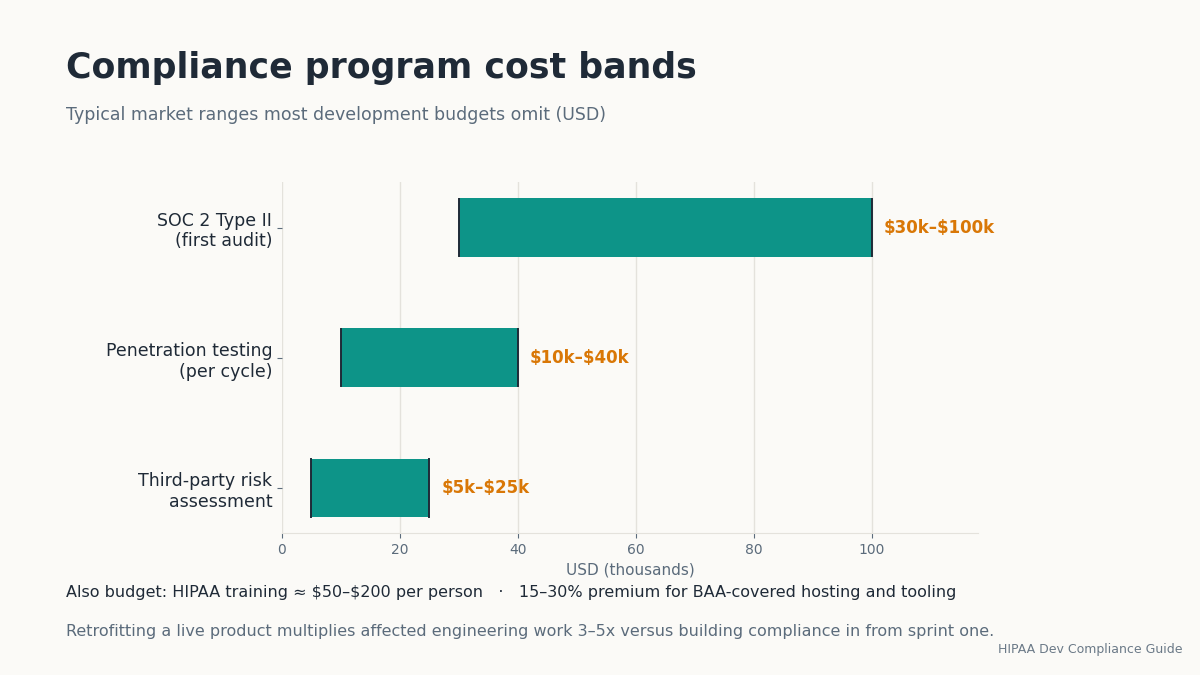
- Initial third-party risk assessment: $5k–$25k
- Penetration testing: $10k–$40k per cycle
- HIPAA training: $50–$200 per person for credible third-party courses
- BAA-covered hosting/tooling premium: commonly 15–30% over consumer tiers
- SOC 2 Type II (often demanded alongside HIPAA by enterprise buyers): $30k–$100k all-in for a first audit; HITRUST certification, if a large payer requires it, can run well into six figures
What drives cost up: live PHI migration from a non-compliant architecture (the 3–5x retrofit multiplier), multi-region data residency, legacy EHR integrations (HL7v2 especially), and buyer-mandated certifications.
What drives costs down: greenfield builds, aggressive de-identification that shrinks the PHI perimeter, and hiring even one engineer who has done this before pattern reuse is the single cheapest control.
Timelines by scenario:
- Standing up a vetted, BAA-covered dedicated team: 7–10 working days to interview-ready shortlist; 3–4 weeks to a fully onboarded, access-controlled team
- In-house hiring for equivalent roles: 8–14 weeks per senior seat
- First-time compliance program (risk assessment → policies → technical controls → training): 2–4 months alongside development for a focused startup; 6–12 months for a retrofit on a live product
- Enterprise security review readiness (documentation, evidence, pen test report): budget 4–8 weeks after the program exists
If You’re Mid-Decision: The Next Step
You now have the full map: the rules that touch code, the vetting probes, the contract terms, the onboarding sequence, and the real cost bands. The gap between reading it and running it is usually one thing: access to engineers who have already worked under these constraints, on a timeline that doesn’t stall your roadmap.
That’s a solvable, specific problem. Supersourcing runs compliance-aware vetting on top of its standard screening regulated-industry scenario probes, BAA-ready contracting, named-individual access terms, and a 7–10 day replacement guarantee across a bench that has delivered 527+ IT projects with a 98% candidate joining rate.
If you’re staffing a PHI-touching build in the next quarter, bring your Phase 1 role matrix (or just the product brief) to a consultation and pressure-test the plan before you commit the budget: supersourcing.com/contact-us.
FAQ
Do software developers need to be HIPAA certified?
No official certification exists HHS certifies neither people nor products. What HIPAA requires is documented, role-appropriate training for everyone in your workforce (and attested training for vendor staff) plus demonstrable adherence to your policies. Third-party training certificates are useful evidence of that training, but treat any “certified HIPAA developer” claim as marketing language, and vet actual data-handling behavior instead.
Does HIPAA apply to offshore development teams?
Yes. HIPAA obligations attach to the data and the contractual chain, not to geography. An offshore engineer accessing PHI must be covered by the same BAA chain, training, unique credentials, and access controls as a domestic one. What changes offshore is enforcement practicality, which is why the contract terms named individuals, revocation SLAs, audit rights carry more weight, and why the staffing partner’s own controls deserve scrutiny.
Is AWS, Azure, or Google Cloud HIPAA compliant by default?
No. All three will sign a BAA and designate specific services as HIPAA-eligible, but compliance depends on your configuration: using only eligible services for PHI, encrypting at rest and in transit, restricting IAM, and enabling audit logging. A signed BAA with a public S3 bucket behind it is a breach waiting for a security researcher to find it.
What encryption does HIPAA require?
The current Security Rule makes encryption “addressable,” meaning you must implement it or document why an alternative is reasonable in practice, implement it: AES-256 at rest, TLS 1.2 or higher in transit, with real key management. Properly encrypted data that leaks may fall under the breach safe harbor and not be reportable at all, and the proposed Security Rule update would make encryption explicitly mandatory.
What happens if a developer causes a PHI breach?
Liability lands on the covered entity or business associate of the organization not personally on the engineer. The organization faces OCR investigation, civil penalties tiered by culpability (roughly $140 to $71k+ per violation, capped above $2.1M annually per category), breach notification costs, and contractual fallout. Internally, your sanction policy applies; contractually, this is why vendor breach-notification and indemnity clauses exist.
How much does HIPAA compliance add to development cost?
For a team building it from the start, plan roughly 10–20% overhead on development cost, plus $20k–$75k in first-year program costs (assessment, pen test, training, tooling premiums) for a typical startup. Retrofitting an existing product typically multiplies the affected engineering work 3–5x. The comparison point is a $7.42M average breach compliance is the cheap side of the ledger.
How do I vet a developer for HIPAA knowledge before hiring?
Use scenario probes, not trivia: how they handled test data on past projects, what they’d do about PHI in an error log, how they’d design record-level audit logging, and whether they can distinguish HIPAA-eligible from HIPAA-compliant cloud services. Strong candidates answer from experience in under a minute. If you lack the in-house expertise to run those loops credibly, that is the strongest argument for a partner whose vetting already includes them; it is usually the fastest path to a shortlist you can trust.
