

Fifteen percent of organisations run software engineering at a small-team scale today. Gartner projects that it will be 60% by 2029 and is explicit that the driver is not cost-cutting but a structural rewiring of how product work gets divided between people and AI agents.
That forecast quietly settles a long-running argument. The team shape that wins is not the biggest one; it is the smallest one that still holds every function it needs to ship. Which makes composition who is in the team, and what each of them owns the decision that determines delivery speed for the rest of this decade.
By 2029, 60% of organisations will adopt smaller software engineering teams at scale, up from 15% in 2026. Gartner puts today’s “tiny team” at 4–5 people, sometimes 2–3, and names the composition directly: a product manager, a UX/agent-experience designer, and at least one AI-native software engineer, supported by a strong platform engineering team.
Building cross functional product teams is the org-design answer to that constraint: instead of a product department that writes specs, a design department that produces mockups, and an engineering department that receives tickets, you form small, persistent, end-to-end units that own an outcome. The industry calls them pods, squads or stream-aligned teams. The naming is not the interesting part. The ratios, the reporting lines, the decision rights and the staffing plan are.
This guide is the operator’s version. It covers what a pod actually contains, how the composition changes at seed versus Series C versus enterprise scale, who each person reports to and why the answer is “both,” how long it takes to fill the roles you’re missing, what it costs in real numbers, and the specific structural failure modes that surface 60–90 days after the reorg long after the announcement Slack message has scrolled away.
TL;DR
This is a build guide for anyone standing up or repairing a product pod founders past their first ten engineers, VPs of Engineering inheriting a functional org, and heads of product being asked to ship faster without more headcount. It covers the pod's roles, the ratios that hold at each company stage, reporting lines, cost, and how to fill the gaps.
The number worth holding onto: three out of four cross-functional teams are dysfunctional by their own organisation's measures, and the single strongest predictor of which quarter a team lands in is not talent density, it is whether one named person holds end-to-end decision rights. Teams with that governance succeed about 76% of the time. Teams without it succeed 19% of the time.
By the end you will be able to draw your own cross functional team structure on a whiteboard with defensible ratios, name every role you're missing, budget the pod in ₹ or $, and know which of the six common failure modes you are currently sitting inside.
What Is a Cross-Functional Product Team?
A cross-functional product team is a small, persistent group, typically a product manager, a product designer, four to eight engineers and a quality specialist that owns a customer problem end to end, from discovery through delivery to the production metric it moves. It is funded as a standing team, not assembled per project, and it holds the decision rights to ship without external approval.
Three things it is regularly confused with:
- It is not a project team. Project teams disband at launch and take their context with them. Pods persist against a problem area, which is why they get faster in month nine than they were in month two.
- It is not a matrix reporting change. Adding dotted lines to an org chart without changing where funding, roadmap authority and hiring approval sit produces the diagram of a pod and the behaviour of a department.
- It is not the Spotify model. Spotify’s own engineers have publicly said the tribes-and-guilds framework was a snapshot of one moment, never fully implemented and not something to copy. Copying the vocabulary without the underlying autonomy is the most common way teams get this wrong.
Why It Matters: The Business Case
Operating-model maturity turns out to be a financial variable, not a cultural one. McKinsey’s Operating Model Index, built on a survey of senior leaders across more than 400 publicly traded companies, found that the bottom-half companies.
What that maturity actually buys, in the terms an engineering budget is defended in:
- Cycle-time compression. Removing a single cross-department handoff product writes spec, design queues it, engineering estimates next sprint typically strips 1–3 weeks off the front of every feature. That is not a productivity gain; it is a calendar gain, and it compounds across every item in the roadmap.
- Lower coordination overhead. A pod that contains its own design and QA capacity resolves most decisions inside a Slack channel. A functionally split team resolves the same decisions in a scheduled meeting with three managers, which is why “we need a sync” is a structural symptom, not a personality one.
- Rework avoidance. Requirements that are written without an engineer in the room and designs signed off without a QA lead reading them produce the two most expensive defect classes: the feature that works as specified but not as intended, and the edge case discovered in staging on the last day of the sprint.
- Retention economics. Engineers who can name the metric they moved last quarter leave less often than engineers who can name the tickets they closed. Replacing a mid-level engineer costs 3–6 months of salary in recruitment fees, ramp time and lost delivery which makes structure a retention lever with a directly calculable return.
- Forecastability. A persistent team accumulates a real velocity signal. A team reshuffled every quarter never produces one, which is why roadmap commitments in reshuffled orgs are guesses wearing a Gantt chart.
The Core Problem: Why Most Reorgs Produce Pods That Don’t Work
Three out of four cross-functional teams fail. That is not a rhetorical opener, it is the finding from a study of 95 teams across 25 corporations published in, where teams were scored against five criteria: budget, schedule, specification adherence, customer expectations, and alignment with company goals. Nearly 75% failed at least three of the five.
The failure is almost never talent. It is structural, and it repeats in a predictable pattern:
- The team is announced before it is staffed. A pod is declared with a PM, six engineers, and “design support from the shared design team.” The pod is now a feature team with extra steps, and every design decision re-enters a queue it was supposed to escape.
- Decision rights are never written down. The single strongest predictor in the HBR data was governance: projects with a clearly accountable end-to-end owner succeeded around 76% of the time, against 19% for those without. Most reorgs change reporting lines and skip this entirely.
- The ratios are wrong by 2–4x. One designer supporting fifteen engineers across three pods is not a designer; it is a rendering service. The most common under-count in a first pod design is quality dedicated teams routinely assume QA is 10% of the effort when in most product orgs it is closer to 20–25% once regression, release verification and automation maintenance are counted.
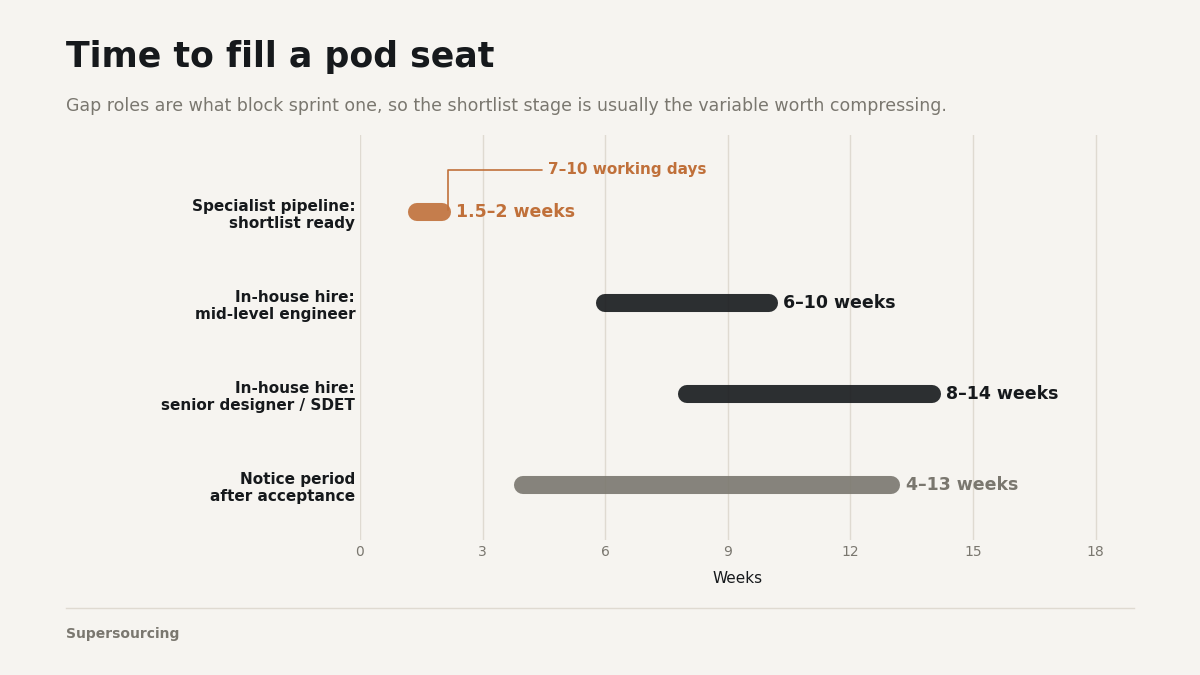
- Nobody plans for the hiring lag. The pod design assumes eight people. Six exist. The other two are a designer and an SDET, both of which take 8–12 weeks to hire through a standard in-house process in a competitive market and in India, an accepted offer still carries a 60–90 day notice period on top. A pod that is 75% staffed for its first two quarters will be judged on output it was never resourced to produce.
- The dependency map is ignored. A pod that cannot deploy without a platform team’s release window has autonomy on paper and a ticket queue in practice. Dependencies are the tax that determines whether the structure delivers anything, and they are almost never audited before the reorg.
The pattern in one line: most organisations treat this as an org-chart exercise when it is a staffing, governance and dependency exercise wearing an org chart.
The Walkthrough: Standing Up a Product Pod From Scratch
Everything below assumes you are starting from a functional org separate product, design and engineering groups and moving to persistent cross-functional units. If you are repairing an existing pod, Phase 2 and Phase 5 are where the defects usually live.
Phase 1 Define the pod’s mission before its headcount
Most teams begin with “how many engineers can we afford,” which guarantees a team in search of a purpose. Building a product pod starts with a boundary: one problem area, one metric, one set of surfaces the team owns.
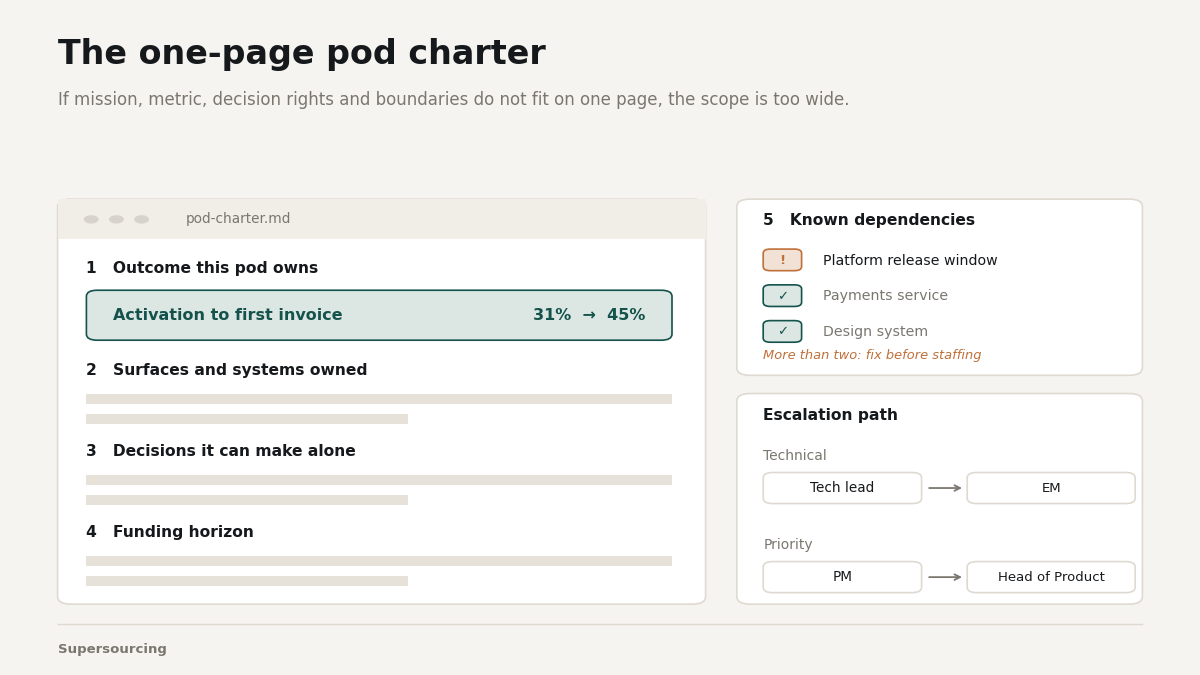
Work through these five questions in order, and write the answers down in a single page the whole pod can see:
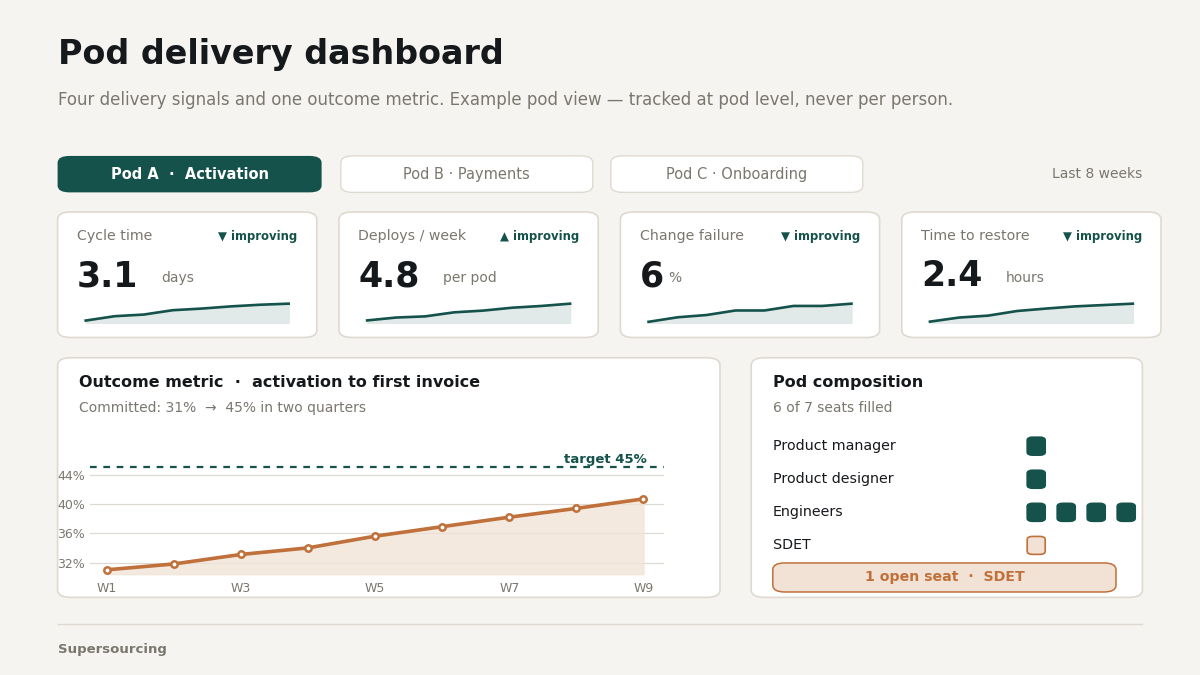
- What outcome does this pod own? Not a feature list. A metric with a current value and a target: “activation rate from signup to first invoice, currently 31%, target 45% in two quarters.”
- What surfaces and systems does it own? Name the repositories, services and screens. Anything unnamed will become a dependency argument in month three.
- What decisions can it make alone? Pricing copy? Schema changes? Third-party vendor selection? Write the list of what requires escalation; everything not on that list is the pod’s to decide.
- What is its funding horizon? A pod funded for one quarter behaves like a project team. Two to four quarters of committed funding is the minimum for the compounding effect to appear.
- What are the known dependencies? List every team whose approval or release window the pod needs. If the list has more than two entries, fix that before IT staffing.
The one-page rule: if the pod’s mission, metric, decision rights and boundaries do not fit on a single page, the scope is too wide and you are designing a department. Split it.
Budget bands to hold in your head at this stage (fully loaded, per pod, per year verify against current local benchmarks before committing):
- India, in-house pod of six: roughly ₹1.4–2.6 crore/year
- India, contract or dedicated-team pod of six: roughly ₹1.6–3.0 crore/year, with no long-term liability
- US/Western Europe, in-house pod of six: roughly $700k–1.1M/year
Phase 2 Design the structure: roles, ratios and reporting lines
A pod’s composition is where cross functional team structure stops being a philosophy and becomes arithmetic. The composition below is the baseline that holds across most B2B and consumer product orgs; adjust for domain, not for convenience.
Roles every pod needs the checklist
- Product manager (1) owns the problem, the metric and prioritisation. Not a backlog administrator; if the PM’s week is 80% ticket grooming, the pod has a project manager and no product manager.
- Product designer (1) owns interaction and visual design, and ideally does their own lightweight research. Under-resourcing here is the most common structural defect; if you are running lean, hire UI/UX designers on a dedicated basis before adding a sixth engineer.
- Tech lead (1, counted inside the engineer headcount) owns architecture and technical sequencing, holds code-review standards, and is the pod’s escalation point for engineering decisions.
- Engineers (4–8) the mix depends on the surface. A customer-facing pod typically runs 2–3 frontend, 2–3 backend, or 4–5 full-stack engineers where the stack allows it.
- Quality specialist / SDET (1) owns the test strategy, automation suite and release verification. When this seat is missing, quality does not disappear; it migrates into the engineers’ sprint capacity at roughly 20%. Teams that treat it as optional discover the cost as slipped releases, which is why it is usually cheaper to hire QA engineers than to absorb the drag.
- Data analyst (shared, 1 per 2–3 pods) instrumentation, experiment readouts, metric definitions. Shared is acceptable; absent is not, because a pod that cannot measure its own metric is a feature factory with an OKR.
- DevOps / platform support (shared) CI/CD, environments, deploy access. Provided as a self-service platform wherever possible, not as a ticket queue.
- User researcher (shared, 1 per 3–4 pods) optional below Series B, valuable above it.
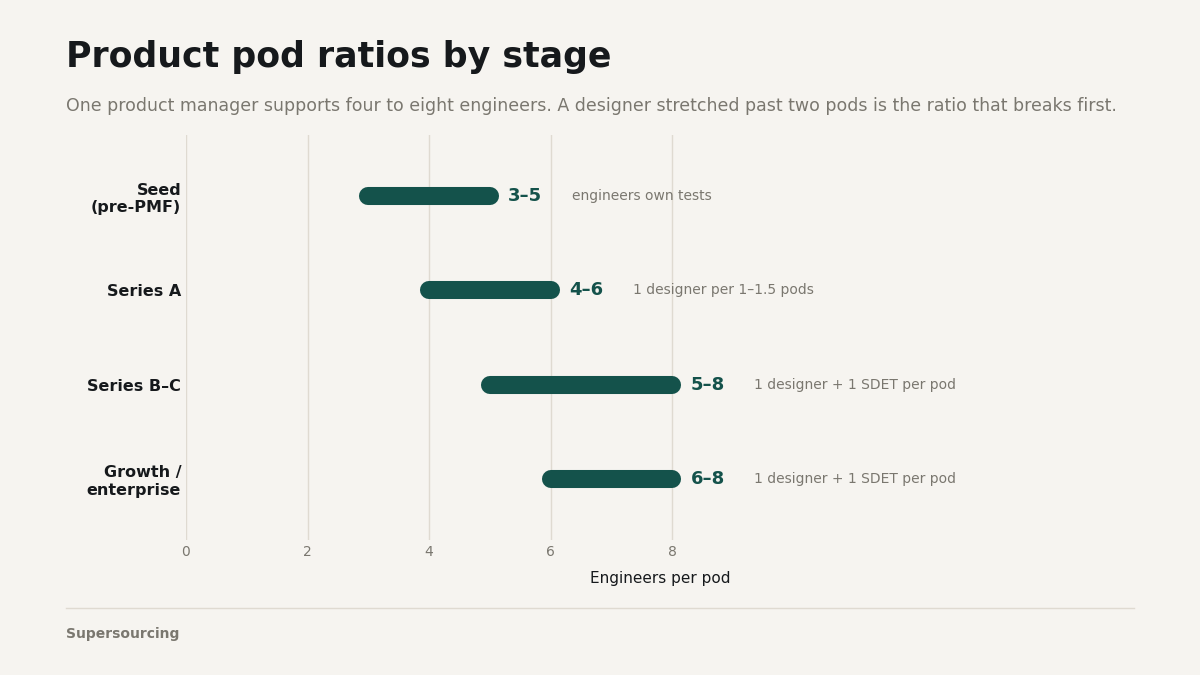
Ideal ratios by company stage
| Stage | PM | Designer | Engineers | QA/SDET | Shared roles | Engineers per EM |
| Pre-seed / seed (pre-PMF) | 1 (often the founder) | 1 across the company | 3–5 | 0 engineers own tests | None | n/a founder-led |
| Series A | 1 per pod | 1 per pod (or 1 per 1.5 pods) | 4–6 | 1 per 1–2 pods | Analyst shared | 6–8 |
| Series B–C | 1 per pod | 1 per pod | 5–8 | 1 per pod | Analyst 1:2, researcher 1:3 | 6–8 |
| Growth / enterprise | 1 per pod, plus group PM per 3–4 pods | 1 per pod, plus design lead per 4–6 | 6–8 | 1 per pod + shared automation guild | Analyst 1:2, researcher 1:3, platform pod per 5–8 product pods | 8–10 |
These are observed industry norms rather than laws. The two that break most visibly when violated: a designer stretched past two pods, and an EM carrying more than ten engineers.
Reporting lines the answer is both, and the order matters
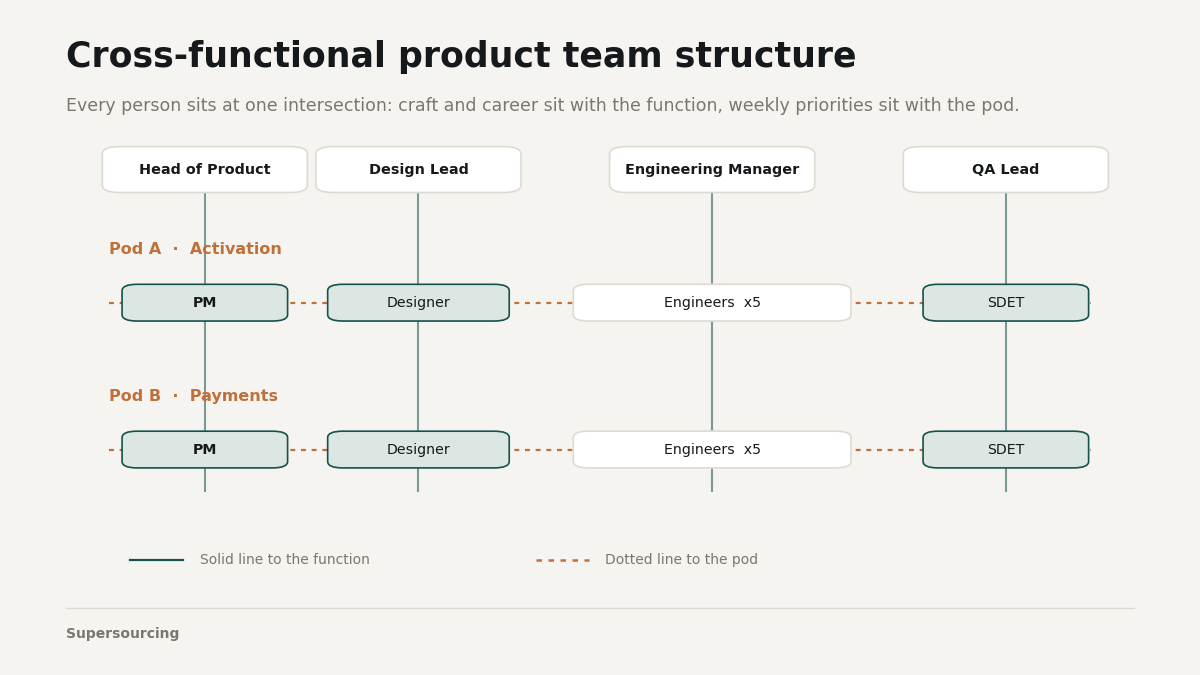
The infographic version of this: draw each pod as a horizontal row containing PM, designer, engineers and SDET. Draw each function as a vertical column Head of Product, Design Lead, Engineering Manager, QA Lead. Every person sits at one intersection.
- Solid line to the function. Career path, performance review, craft standards, compensation and hiring bar live with the functional manager. A designer whose review is written by a PM optimises for compliance, not craft.
- Dotted line to the pod. Day-to-day prioritisation, ceremonies, sequencing and delivery accountability live with the pod. The pod controls what gets worked on this week; the function controls how good it has to be and where the person goes next.
- One named accountable owner per pod. Usually the PM for outcome, tech lead for technical execution, EM for people. The HBR governance finding is the reason this is non-negotiable: without a single end-to-end accountable owner, success rates collapse from roughly 76% to 19%.
- The escalation path is written down. Two-line rule: technical disagreement escalates to the tech lead, then the EM. Priority disagreement escalates to the PM, then the group PM or Head of Product. If a disagreement can escalate two different ways, it will escalate to whoever is loudest.
Phase 3 Source and vet the roles you’re missing
Almost no company arrives at this exercise fully staffed. The gap roles are consistently the same: the product designer, the SDET, and one senior engineer with domain depth.
A staged sourcing plan:
- Sequence the hires against the pod’s first three months. The designer and tech lead are needed before sprint one. The second and third engineers can land in weeks 4–8 without stalling the pod. Hiring in headcount order rather than dependency order is how pods spend their first month blocked.
- Write the scorecard before the job description. Four to six observable competencies per role, each with an evidence question and a “what a weak answer sounds like” note. Interviewers without a scorecard default to culture-similarity judgements.
- Vet for the pod, not the function. For engineers: a work-sample or paired debugging session on a realistic problem, not a whiteboard algorithm. For designers: a portfolio walkthrough where they defend a trade-off they got wrong. For a PM: a written exercise prioritising a backlog with incomplete data.
- Test collaboration explicitly. Add one exercise where the candidate has to disagree with a stakeholder. Cross-functional pods fail on unresolved disagreement far more often than on capability, and this is the single most predictive 30 minutes in the loop.
- Decide build-versus-augment per role, not per team. Roles tied to institutional knowledge and long-term architecture are worth the 10–14 week in-house hire. Roles that are capacity-limited additional engineers for a defined push, a specialist you need for two quarters are usually better filled through dedicated staffing, where an AI-assisted sourcing pipeline can produce an interview-ready shortlist in 7–10 working days rather than 8–12 weeks. This is where Supersourcing’s model tends to be used: a vetted shortlist from the top 2% of screened talent, with a replacement window of 7–10 days if a hire turns out to be the wrong fit.
Red flags in a candidate loop for a cross-functional pod:
- Describes past work exclusively in first-person singular. Nobody shipped a product alone; this usually signals either exaggeration or a genuine inability to work inside shared ownership.
- Cannot name the metric their last team was measured on. Common, and disqualifying for pod roles specifically outcome ownership is the job.
- Treats QA, design or PM input as a downstream approval step in how they describe their process.
- For senior engineers: no examples of changing their mind based on a design or user-research input.
If the pod’s stack is the constraint rather than the seniority a React front end with nobody senior enough to own it, for example filling that specific seat by hiring ReactJS developers on a dedicated basis is usually faster than a generalist search, because the screening signal is much sharper.
Phase 4 Engagement models and contract terms
The moment part of a pod is contracted rather than employed, the structure develops legal edges. These are the terms that matter in practice, not in theory.
| Model | Best for | Typical commitment | Watch-out |
| Dedicated team (full pod, one vendor) | Standing up a new product line or a remote pod fast | 6–12 months, monthly per-seat | Ensure no shared bandwidth one engineer split across two clients breaks pod ceremonies |
| Staff augmentation (individual seats into your pod) | Filling 1–3 gap roles inside an existing pod | 3–12 months, per seat | The augmented engineer must attend the same standups and hold the same definition of done |
| Project / fixed-scope | Well-specified builds with a hard boundary | Milestone-based | Structurally incompatible with a pod that owns an evolving metric |
| In-house FTE | Roles carrying institutional knowledge | Permanent | 8–14 weeks to fill, plus 60–90 day notice periods in India |
Contract clauses to read closely:
- IP assignment must cover work product, derivative work, and design files. Design assets are the most frequently missed asset class; get Figma file ownership named explicitly, not just “code and documentation.”
- NDA scope should extend to subcontractors and cover post-termination duration.
- Named-person continuity the right to approve any substitution, with a notice period. Without it, the senior engineer you interviewed can be rotated out in month four.
- Replacement terms a defined window (7–10 days is achievable) and whether the replacement’s ramp time is billable. This clause is where money is quietly lost.
- Notice and exit 30 days is standard; confirm knowledge-transfer obligations and repository access revocation are specified.
- Data and access boundaries which environments, which PII, whose devices, which jurisdiction. Non-negotiable in fintech and healthtech.
The negotiation point most buyers miss: ask what happens to the ramp-up period if a replacement is required. Vendors will usually concede an unbilled ramp on a replacement if you raise it before signature, and almost never after.
Phase 5 Onboarding and ramp-up: the first 14 days
A new pod’s first two weeks determine whether it becomes a team or a group of individuals sharing a Jira board. Access and context, in that order.
Days 1–2 remove the friction that eats week one
- Laptop, SSO, VPN, repository access, CI access, staging environment, and the one that is always forgotten a paid seat on the design tool. Contract designers routinely lose two to three days waiting for a Figma seat and edit permissions on the design system library, because procurement treats it as a licence request rather than a blocker.
- Read-only production access with the analytics dashboard the pod’s metric lives on.
- Add every pod member to the same channel, the same standup invite and the same on-call rotation view.
Days 3–5 shared context
- A 60-minute mission walkthrough by the PM: the metric, its current value, and the three hypotheses about how to move it.
- A codebase and architecture tour from the tech lead, ending with a deliberately small first ticket already picked out.
- A design system and interaction-pattern walkthrough from the designer.
- Five recorded or live user calls. Everyone, including engineers and QA. This is the single highest-leverage onboarding activity and the first thing cut when the calendar tightens.
Days 6–14 first delivery loop
- Ship something small to production in week two. The goal is to exercise the full pipeline review, test, deploy, verify not to deliver value.
- Write the definition of done together, in the pod’s own words. Inherited definitions of done get ignored.
- Run the first retro on week two, on the process, not the output.
The two-week rule: if a new pod has not deployed anything to production within 14 days, the blocker is environmental or organisational, not skill-related. Find it before sprint three, because at that point it hardens into “that’s just how long things take here.”
Phase 6 Managing delivery: cadence, metrics and account structure
Autonomy without a reporting rhythm reads as opacity to leadership, and opacity is what gets pods re-centralised.
The cadence that holds up:
- Daily 15-minute standup, blockers only. Async written standup is fine for distributed pods; skipping it is not.
- Weekly 30-minute metric review. Where is the pod’s number, what moved it, what is the next bet.
- Bi-weekly sprint boundary: demo, retro, next-increment planning.
- Monthly dependency and risk review with adjacent pods and platform teams.
- Quarterly outcome review against the committed metric, plus a funding and scope confirmation.
What to measure four delivery signals and one outcome signal:
| Metric | Healthy pattern | What a bad reading actually means |
| Cycle time (first commit → production) | Days, not weeks | Review queues, environment scarcity, or oversized batches |
| Deployment frequency | At least weekly per pod | Release process is centralised outside the pod |
| Change failure rate | Low and stable | Test coverage or review depth is thin |
| Time to restore | Hours | The pod does not own its own operations |
| The pod’s outcome metric | Moving in the committed direction | Everything else can look green while this is flat that is the tell that the pod is busy, not effective |
Track delivery metrics at the pod level and never at the individual level. The moment cycle time becomes a personal performance input, it stops being a diagnostic and becomes a number people manage.
Account and management structure for a partially contracted pod: a single named account manager on the vendor side, a single named EM on yours, one weekly 30-minute call and a shared metrics view. Where clients route contracted engineers through a separate vendor manager instead of the pod’s own EM, delivery quality tends to diverge within two sprints the augmented engineers optimise for the vendor’s reporting rather than the pod’s definition of done.
Phase 7 Scaling, splitting or dissolving the pod
Pods have a natural size ceiling. Past nine or ten people, communication paths grow faster than output, and the team begins to self-organise into two sub-teams whether you sanction it or not.
Signals it is time to split:
- Standup exceeds 15 minutes consistently, and half the room is not listening.
- The backlog has two distinct themes that rarely share code.
- Two informal tech leads have emerged organically.
- The pod’s single metric has become two metrics that trade off against each other.
How to split without losing velocity:
- Split along the system boundary, not the seniority ladder. Conway’s Law works in both directions: the team boundary you choose will become the architecture boundary you live with.
- Keep each side above the minimum viable pod: one PM, one designer, three engineers, and quality coverage. Splitting into two under-staffed halves is worse than one crowded pod.
- Give each new pod its own metric on day one. Two pods sharing one metric will duplicate work and argue about attribution.
Scaling beyond a handful of pods introduces a different problem: five product pods sharing infrastructure will each rebuild the same CI, observability and environment tooling. This is the point at which a platform pod earns its cost.
For organisations scaling past three or four pods offshore, consolidating this under a global capability center is usually cheaper than replicating platform capacity inside each pod.
Offboarding and dissolution, done properly:
- Two weeks of documented knowledge transfer with a named receiver, not a wiki dump.
- Ownership transfer of every service, dashboard and on-call rotation, recorded in writing.
- Access revocation on the last day repositories, cloud, design tools, analytics.
- A written post-mortem on the pod’s outcome metric, whether it succeeded or not. This is the artefact that makes the next pod design better, and it is the one almost every company skips.
Case Studies: What Pod Staffing Looks Like Under Real Constraints
Outcome first, story second. These are drawn from Supersourcing engagements across fintech, consumer tech and healthtech, where the constraint was pod composition rather than headcount alone.
Paytm 100+ engineers placed into existing squads without diluting the delivery bar. The requirement was not a single team but sustained multi-squad expansion inside a fintech environment with strict compliance boundaries. Engineers were sourced and screened against the client’s own scorecards and slotted directly into functioning pods rather than assembled into a parallel vendor team, which is what preserved the existing definition of done. The reason volume hiring of this kind usually degrades quality is that the vendor’s team becomes a separate delivery unit with its own standards; the structural fix is per-seat integration into the receiving pod.
Swiggy engineering capacity scaled through a hypergrowth phase against a 7–10 working day shortlist cycle. In consumer platforms at that growth rate, the binding constraint is calendar, not budget: a pod waiting eight weeks for its third backend engineer simply ships less that quarter. Compressing time-to-shortlist to 7–10 working days is what allowed pod composition to keep pace with roadmap commitments instead of trailing them by a quarter.
OkCredit early-stage pods filled where a single wrong hire is a material percentage of the team. At sub-30 engineering headcount, a mis-hire is not a 2% capacity problem; it is a structural one, and replacement cycles eat a full quarter. Two figures matter more than speed at this stage: a 98% candidate joining rate, and under 1% drop-off on contract roles, both of which exist to protect the pod’s composition from re-opening a seat it just closed.
Somnoware recruitment workflow automation in a regulated healthtech context. Where hiring for a pod involves compliance-sensitive roles, the bottleneck is usually the screening and documentation loop rather than sourcing. Automating that layer shortens the loop without loosening the bar relevant to any org where the pod’s quality specialist and data roles carry regulatory exposure.
The Decision Framework: Pod, Feature Team, Matrix or Project
Not every organisation should run pods. Four structures, compared to what actually differs.
A four-question test to apply to your own org:
- Is the work outcome-shaped or output-shaped? An evolving metric needs a pod. A defined integration with a fixed spec does not.
- Can you afford a designer and a quality specialist per team? If not honestly yes for at least two teams, run feature teams well rather than pods badly.
- Can the team deploy without another team’s approval? If not, fix the dependency before the structure otherwise you are creating a pod that reports to a queue.
- Will you fund the team for at least two quarters? If funding is per-project, you will get project behaviour regardless of what you call the team.
Three yeses and a funding commitment means pods. Two or fewer means the squad model product teams conversation is premature, and the higher-return move is removing handoff latency inside the structure you already have.
What Most Teams Get Wrong
Effective dev design PM collaboration is not produced by seating people together, adding a shared Slack channel, or renaming teams as squads. It is produced by three things: shared ownership of one metric, written decision rights, and enough capacity in every role that nobody is a bottleneck by default.
Almost every dysfunctional pod is missing at least two of the three and the missing one is nearly always capacity, because it is the only one that costs money.
The six structural failure modes, in order of how often they show up:
- The Fake Pod. People are assigned to two or three pods simultaneously. Fractional membership destroys the thin pods that exist to create shared context while adding the ceremony overhead of three teams. If someone is on two pods, they are on neither.
- The Handoff Pod. Design works a sprint ahead and delivers finished specs into the sprint boundary. The org chart says cross-functional; the workflow is a waterfall with a shorter cycle. The tell: engineers first see a design in refinement rather than during exploration.
- The Ticket Pod. The PM’s week is grooming and status reporting, with problem definition owned by someone outside the pod. This produces teams that ship exactly what was asked for and move no metric, the most expensive form of being on time.
- The Orphan Pod. No executive sponsor, no named decision-maker, escalations that die in a manager’s DMs. This is the failure the HBR governance data quantifies most starkly, and it is invisible until a genuine trade-off arrives.
- The Dependency Pod. Autonomy on the org chart, three external approvals to deploy. Audit this before the reorg: list every external gate between a merged pull request and production. More than one and the pod’s velocity is not its own.
- The Metric-less Pod. Measured on velocity, story points or ticket throughput. Teams optimise what is measured, so this reliably produces high-throughput teams that shipped a quarter of features nobody used.
The uncomfortable pattern: in most engagements, the pod that “isn’t working” is not badly managed. It is under-staffed in exactly one role, usually design or quality and the organisation has spent two quarters diagnosing culture, communication and process instead of counting seats. Before the offsite, count the seats.
The second uncomfortable pattern: adding AI tooling to a structurally broken pod makes the symptoms worse, not better. Faster individual production flowing into the same broken review, handoff and release path just makes the queue longer.
Cost and Timeline Reality Check
Most guides on this topic stop before the numbers. These are the ranges that matter, with the caveat they deserve: they are market bands as of 2026 and should be validated against current local benchmarks before they enter a budget.
Annual fully loaded cost per role
| Role | India (₹/year) | US (USD/year) |
| Product manager (5–8 yrs) | ₹25–45 lakh | $130k–180k |
| Senior engineer / tech lead | ₹28–50 lakh | $150k–200k |
| Mid-level engineer | ₹18–32 lakh | $110k–150k |
| Product designer | ₹18–35 lakh | $110k–160k |
| SDET / QA automation | ₹14–28 lakh | $95k–135k |
| Data analyst (shared) | ₹12–25 lakh | $90k–130k |
A standard six-person pod 1 PM, 1 designer, 3 engineers (one senior), 1 SDET therefore runs roughly ₹1.4–2.6 crore/year in India or $700k–1.1M/year in the US, before tooling, cloud and the 15–30% overhead that employment carries in most jurisdictions. Contract or dedicated-team equivalents typically price 10–20% above in-house salary cost per seat while removing severance exposure, notice-period risk and recruitment spend which is why the comparison should always be run on total cost of the seat over the engagement, not on monthly rate.
Timelines by scenario
| Scenario | Realistic timeline | What drives it |
| Interview-ready shortlist via a specialist staffing pipeline | 7–10 working days | Pre-vetted pool depth |
| In-house hire, mid-level engineer | 6–10 weeks to offer | Sourcing and loop scheduling |
| In-house hire, senior designer or SDET | 8–14 weeks to offer | Thin senior supply |
| Notice period after acceptance (India) | 30–90 days | Employer policy; 60–90 days is common at mid-size and larger firms |
| New pod’s first production deploy | 14 days from full staffing | Access provisioning and environment readiness |
| Pod reaching stable velocity | 8–12 weeks | Codebase familiarity, shared standards |
| Full pod at genuine autonomy | 2 quarters | Dependency removal, decision-rights maturity |
What drives cost up: fractional staffing across pods (paying for coordination twice), a missing quality role (paid later in slipped releases), senior-heavy composition where a mid-level engineer would do, and dependency-driven idle time the most expensive line item in any pod, and the one that never appears in a budget.
What drives cost down: deciding build-versus-augment per role rather than per team, hiring the designer and tech lead first so nobody waits, self-service platform tooling instead of a platform ticket queue, and keeping pods persistent so the ramp cost is paid once rather than every quarter.
Where to Start If You’re Mid-Decision
If you are partway into this decision, the useful next step is not another framework, it is a gap count. Take your intended pod design, list every seat, mark the ones you can fill internally in the next 30 days, and look at what remains. In most cases the remainder is one designer, one quality specialist and one senior engineer, and those three seats are what determine whether the structure works or quietly reverts within two quarters.
That gap is worth a specific conversation rather than a generic hiring plan, because the right answer differs per seat: some roles justify a 10–14 week in-house search, and others are better filled on a dedicated basis in 7–10 working days so the pod can start functioning now. If you want a second opinion on which is which for your specific composition and what the realistic timeline and cost bands look like for the seats you are missing talk to the Supersourcing team. Bring your pod design; the conversation is more useful than a role list.
FAQ
What roles does every product pod need?
At minimum: one product manager, one product designer, three to eight engineers including a tech lead, and dedicated quality coverage. Data analysis, user research and platform support can be shared across two to four pods. If quality or design is absent rather than shared, the pod will absorb that work into engineering capacity at roughly 20% and miss its committed dates.
How many engineers should one product manager support?
Four to eight in most product organisations. Below four, the PM tends to drift into project management; above eight, prioritisation quality drops and the PM becomes a routing layer. Domains with heavy compliance, research or stakeholder load sit at the lower end. Past eight engineers, add a second pod rather than a second PM to the same team.
What is the difference between a squad and a pod?
Nothing structurally both describe a small, persistent, cross-functional team owning an outcome. “Squad” comes from Spotify’s 2012 write-up, “pod” is the more common term in consulting and enterprise contexts, and “stream-aligned team” is the Team Topologies term. Pick one word and use it consistently; the vocabulary drift itself causes confusion in larger orgs.
Who should the designer report to in a cross-functional team?
Solid line to a design lead, dotted line to the pod. The functional manager owns craft standards, career growth and performance review; the pod owns weekly priorities and delivery. Inverting this, a designer reviewed by a PM reliably degrades design quality within two quarters, because the incentive shifts toward shipping the requested screen rather than solving the problem.
How long does it take to stand up a new cross-functional product team?
If you are fully staffed, two weeks to first deploy and 8–12 weeks to stable velocity. If you are hiring, add 6–14 weeks per gap role through an in-house process, plus notice periods. A specialist pipeline can compress the shortlist stage to 7–10 working days, which usually matters more than any other single variable because gap roles are what block sprint one.
Can you build a product pod with contractors or offshore engineers?
Yes, and it works when the contracted engineers are inside the pod rather than beside it with the same standup, same definition of done, same repository standards, same EM. It fails when they are managed as a separate delivery unit with a parallel reporting line. Insist on named-person continuity and no shared bandwidth in the contract; a seat split across two clients cannot hold pod context.
How much does a cross-functional product team cost per year?
A six-person pod runs roughly ₹1.4–2.6 crore in India or $700k–1.1M in the US, fully loaded, before tooling and overhead. The variance is driven mostly by seniority mix rather than location. The cheapest structural error is over-indexing on senior engineers; the most expensive is omitting the quality role and paying for it in release slippage.
When should a pod be split into two?
When standup consistently runs past 15 minutes, the backlog has two themes that rarely share code, two informal tech leads have emerged, or the single metric has become two metrics that trade off. Split along the system boundary and give each new pod its own metric and only split if both halves clear the minimum viable composition of PM, designer, three engineers and quality coverage.
Is this worth doing at fewer than 15 engineers?
Usually not as formal pods. Below that headcount, one well-run team with clear ownership beats two under-staffed pods. The higher-return move at that size is eliminating handoff latency getting engineers into discovery, giving design and QA a voice before the sprint boundary which delivers most of the benefit without the overhead.
