

The hiring model you choose determines your flexibility, your cost, your legal risk, and how quickly you can respond when something goes wrong. In India’s engineering talent market, where notice periods run 30 to 90 days and attrition is a structural challenge, model choice is a strategic decision, not just an HR preference.
When evaluating contract staffing vs permanent hiring vs C2H India, the decision comes down to flexibility versus long-term stability. Companies today are increasingly shifting toward agile workforce models to stay competitive.
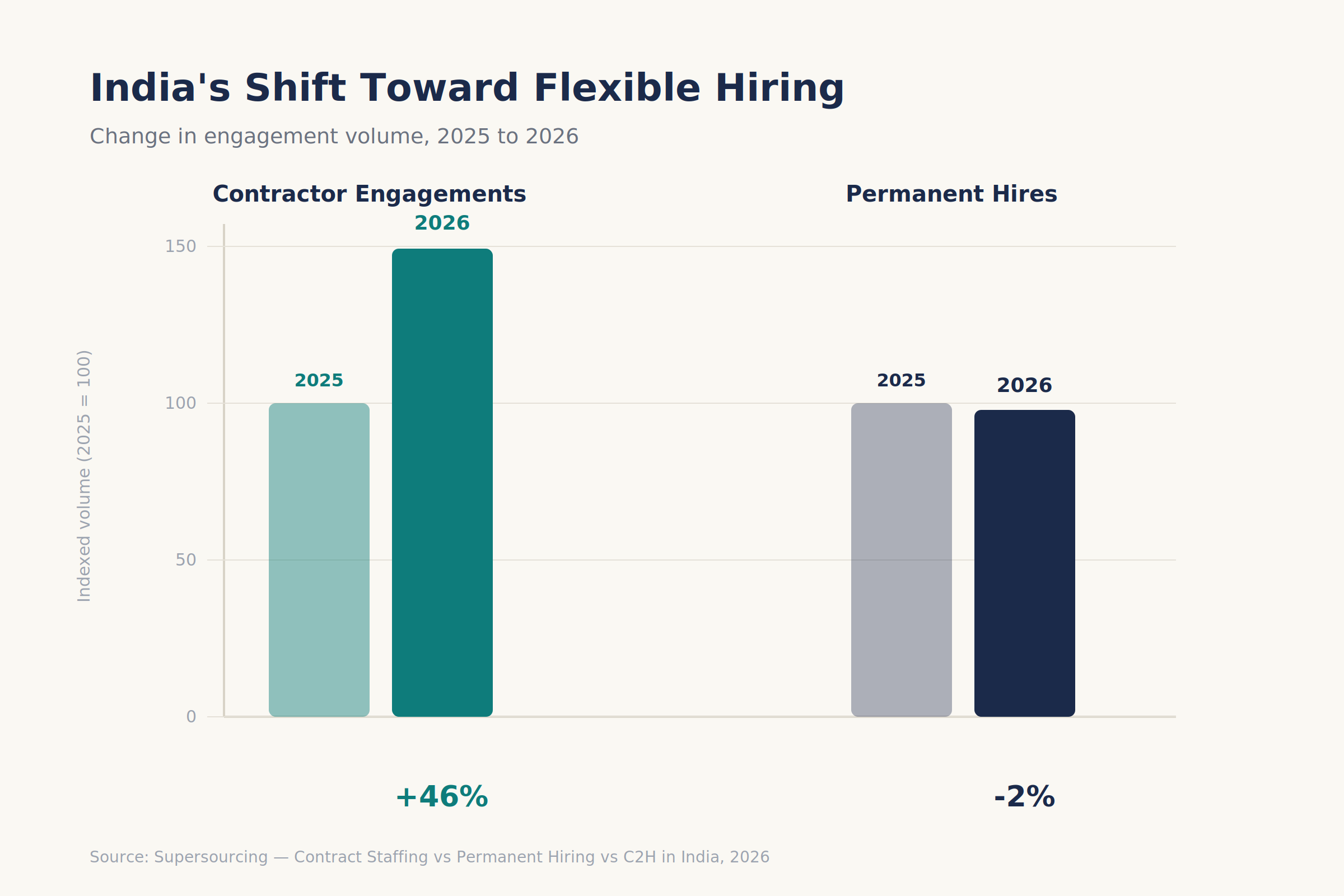
Contractor engagements in India increased 46% between 2025 and 2026 while permanent hires declined 2%. This is not a coincidence; it reflects a structural shift in how both companies and engineers think about work. Understanding the trade-offs of contract staffing vs permanent hiring vs C2H in India is the foundation of a good hiring strategy, whether you are a five-person startup making your first technical hire or a 200-person engineering org scaling a new product line.
The global staffing industry continues to expand steadily, projected toward an estimated US$538+ billion market. Flexible staffing models are gaining widespread adoption across high-skill sectors like IT and engineering, reflecting a structural shift toward contract and hybrid hiring strategies as organizations navigate economic uncertainty and rapid technological change.
This guide breaks down how each model actually works on the ground in India, when to use each one, what it costs over a two-year horizon, and how to avoid the most common mistakes companies make when they pick the wrong model for their stage.
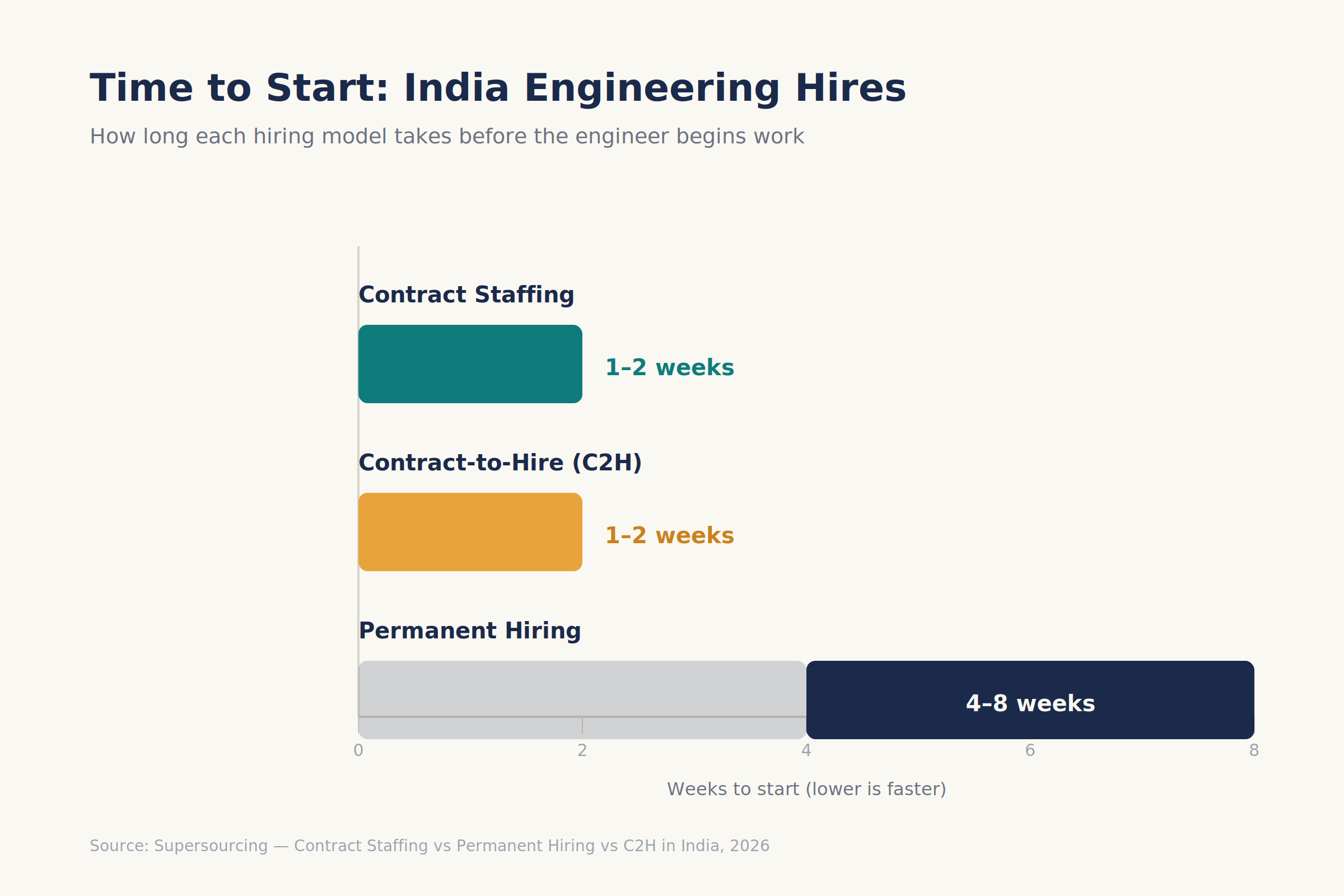
The Three Models How They Work in India
- Contract Staffing: The engineer is employed by the staffing company (Supersourcing) and deployed to your company for a defined period typically 3 to 12 months, renewable. You pay a monthly rate that includes the engineer’s salary, statutory benefits (PF, ESI, PT), and the staffing company’s fee. No notice period obligation on your side you can end the engagement with the contract’s notice period (typically 30 days). All compliance is managed by Supersourcing.
- Permanent Hiring: The engineer joins your company’s payroll directly. You pay their salary, manage all statutory compliance, and are bound by India’s labour laws regarding notice periods (typically 30 to 90 days) and, for larger companies, retrenchment provisions. Full control, full cost, full compliance obligation.
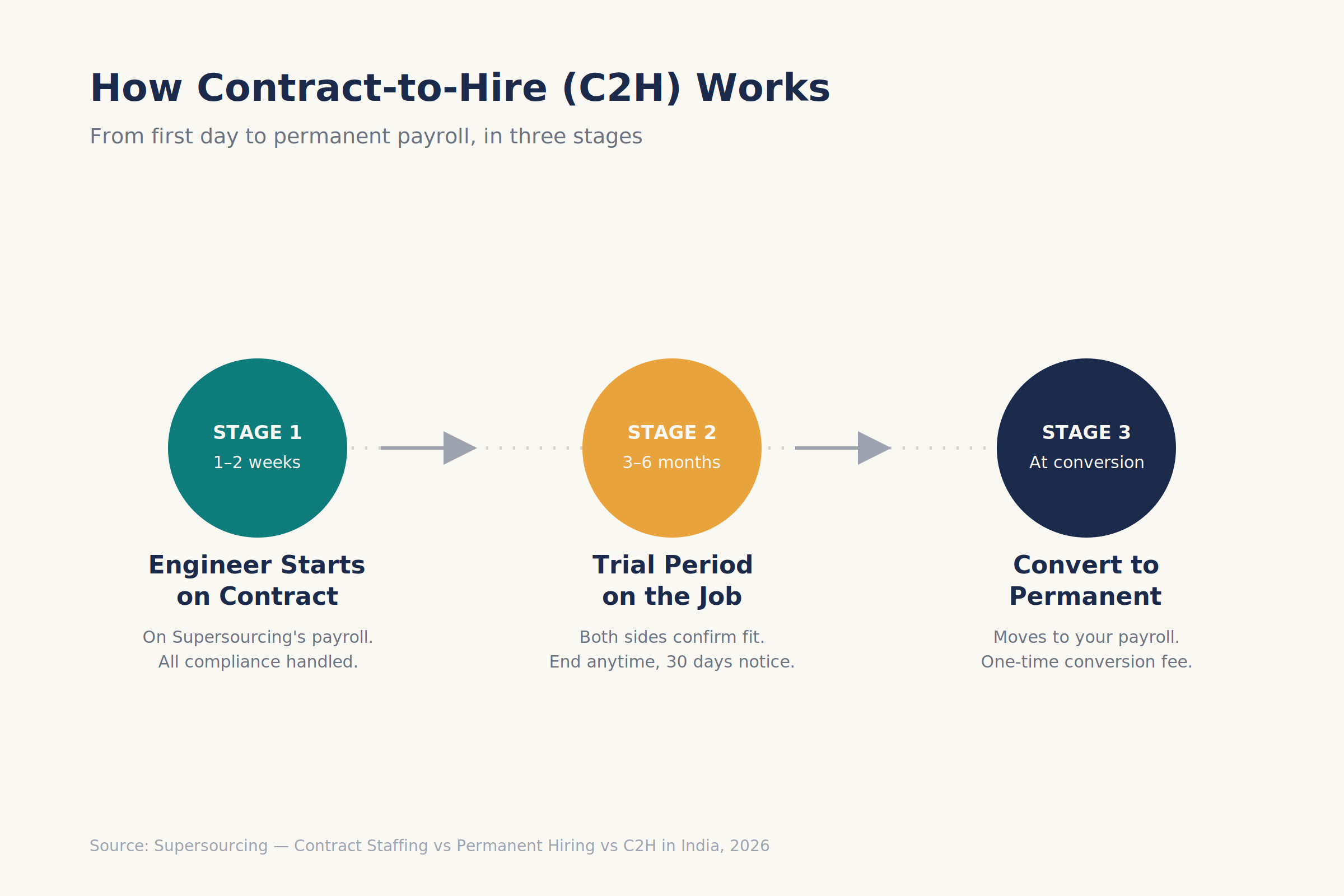
- Contract-to-Hire (C2H): The engineer starts on contract (same as contract staffing on Supersourcing’s payroll). After a defined trial period (typically 3 to 6 months), you have the option to convert them to permanent employment on your own payroll. The trial period allows both sides to confirm fit before making a permanent commitment. Supersourcing charges a placement fee at conversion in Supersourcing’s model, this is structured to make conversion cost-effective after the trial period.
Master Comparison Table
| Dimension | Contract | Permanent | C2H |
| Time to start | 1–2 weeks | 4–8 weeks (notice period) | 1–2 weeks (starts on contract) |
| Compliance responsibility | Staffing company | You | Staffing company (pre-conversion), You (post-conversion) |
| Exit flexibility | High 30 days typically | Low 30–90 days notice | High during trial, Low after conversion |
| Cost | Monthly rate (salary + fee) | Salary + statutory + benefits | Trial: monthly rate; Post-conversion: salary + placement fee |
| Risk if hire fails | Low end contract | High notice period + replacement time | Low during trial |
| Long-term retention | Lower engineers want stability | Higher employment security | High conversion creates commitment |
| India labour law compliance | Staffing company handles | You handle | Staffing company (trial), You (permanent) |
| Best for | Project-specific, uncertain roles | Core team, long-term roles | New roles with fit uncertainty |
When Contract Staffing Is the Right Model
Use contract staffing when:
The role is project-specific with a defined end date. You are uncertain whether you will need this skill set long-term. You want to avoid the notice period risk if the engineer does not perform, you can end the contract without 60 or 90 days of obligation. Your company size or revenue stage makes permanent headcount commitments risky. You need the engineer to start in 1 to 2 weeks rather than the 4 to 8 weeks it takes for a permanent hire to exit their current role.
The India-specific contract staffing advantage:
In India, permanent employees have notice periods of 30 to 90 days. Releasing a permanent employee who is not working out means 1 to 3 months of paying someone while managing the underperformance. Contract staffing eliminates this you can end the contract with the standard contractual notice (typically 30 days) without any ongoing obligation. For companies hiring 10+ engineers per year, eliminating this risk has significant financial value.
Contract staffing also suits scenarios where the skill itself is short-lived: a migration project, a compliance-driven build with a hard deadline, or a proof-of-concept that may or may not become a funded product line. In these cases, tying up a permanent headcount budget and the legal obligations that come with it rarely makes sense.
When Permanent Hiring Is the Right Model
Use permanent hiring when:
The role is core to your product and the knowledge should live in your organisation for the long term. You have a clear picture of what you need and have vetted the candidate thoroughly. The role is senior enough that stability is critical. A principal engineer who leaves after 6 months on a contract creates more disruption than the flexibility is worth. The engineer’s motivation requires ownership signals (ESOP, stability, career development) that a contract engagement cannot provide.
The permanent hiring challenge in India:
The average time from job posting to joining an employee for a senior engineering role in India is 45 to 60 days including notice period. If the hire does not work out within 6 months, you are looking at another 30 to 90 days of notice period plus a new 45 to 60 day hiring cycle. Total cost of a failed permanent hire: 6 to 9 months of salary plus re-hiring cost. This is why many companies are shifting to C2H as a risk mitigation.
Permanent hiring remains the default for founding engineers, engineering leadership, and anyone who will own architecture decisions that persist for years. The trade-off is that you are committing to India’s full compliance and notice-period framework from day one, with no built-in trial mechanism.
When C2H Is the Right Model and Why It Is Growing
Use C2H when:
You want the engineer to eventually be on your permanent payroll but want a trial period before committing. The role is new enough that you are not 100% certain of the exact requirements; the trial period allows you to refine the role definition based on what you observe. The candidate is strong but you have not been able to verify all dimensions of fit through the interview process.
Why C2H is growing:
Contractor engagements increased 46% between 2025 and 2026 precisely because C2H solves the fundamental problem with both pure contract (lower retention because engineers want stability) and pure permanent (high risk if the hire does not work out). C2H gives companies a real-world trial period and gives engineers a path to stability. Both sides commit with more confidence because both sides have had a chance to verify fit.
Supersourcing’s C2H model:
The engineer starts on Supersourcing’s payroll. You pay a monthly contract rate that covers the engineer’s compensation and all statutory compliance. After the agreed trial period (typically 3 to 6 months), you can convert the engineer to your own payroll. Supersourcing charges a conversion fee structured to be cost-effective after the trial period. If the engineer does not work out during the trial, you end the contract with 30 days notice no placement fee, no long-term obligation.
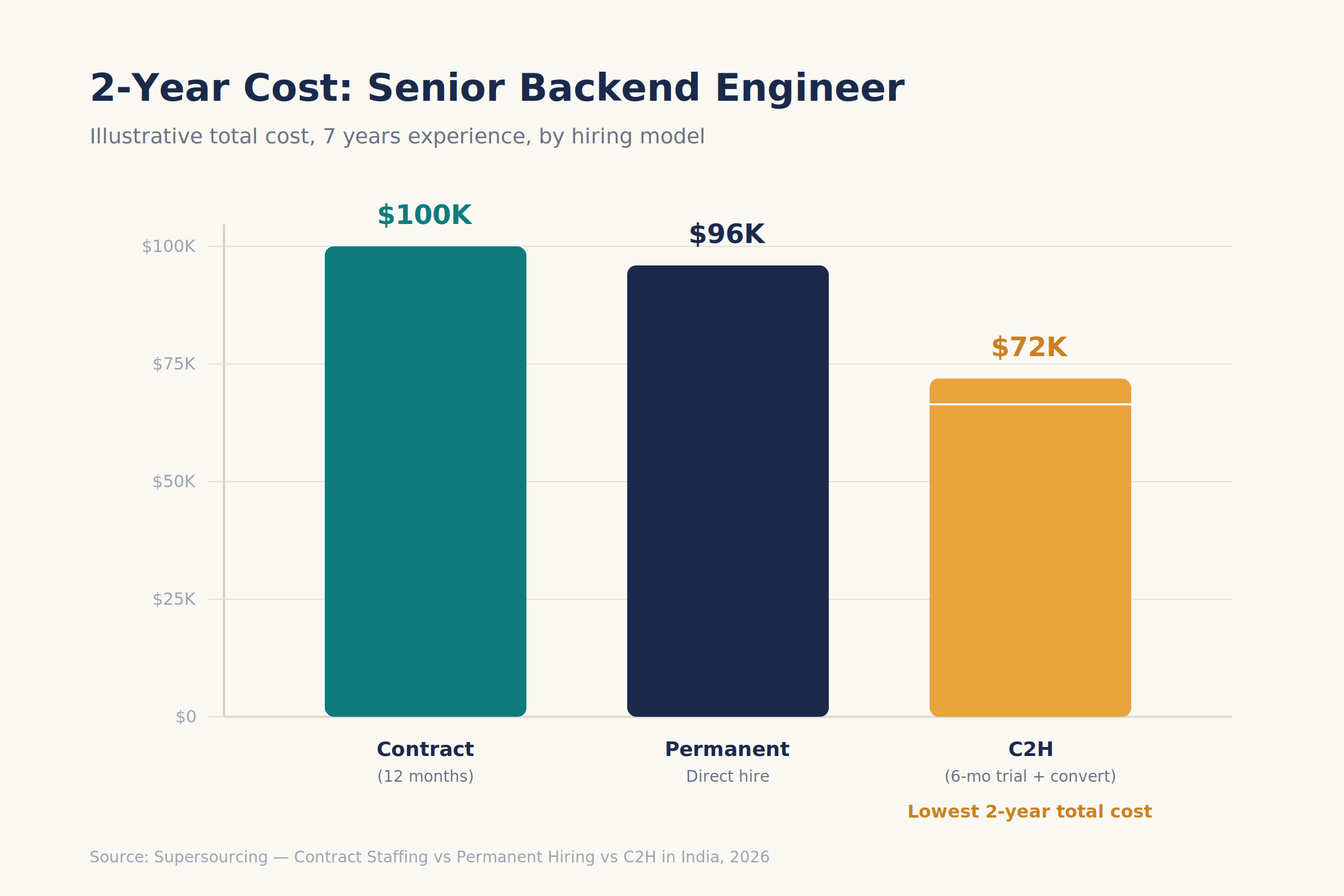
Cost Comparison (Illustrative Senior Backend Engineer, 7 Years Experience)
| Model | Year 1 Cost | Year 2 Cost | Total 2-Year | Notes |
| Contract (12 months) | $48K | $52K | $100K | No conversion pure contract |
| Permanent hire | $42K salary + $5K benefits | $44K salary + $5K benefits | $96K | Direct employment costs in India |
| C2H (6-month trial, convert) | $26K contract + $2K fee | $44K salary | $72K | Conversion fee at month 6 |
C2H is often the most cost-effective model when accounting for the reduced risk of failed permanent hire.
A Decision Framework: Matching the Model to Your Hiring Situation
Rather than picking a model in the abstract, it helps to run each open role through a short set of questions:
How confident are you in the role definition?
If you have hired for this exact role successfully before and the scope is well understood, permanent hiring carries less risk. If this is a new function, a new tech stack, or a role you are defining as you go, C2H or contract staffing reduces your downside.
How urgent is the start date?
Contract and C2H engineers can typically start in 1 to 2 weeks. Permanent hires are constrained by their current employer’s notice period, which is commonly 30 to 90 days in India for experienced engineers. If a project deadline cannot absorb a two-month wait, contract or C2H is the practical choice.
What is your company’s stage and runway?
Early-stage companies with 12 to 18 months of runway generally benefit from contract or C2H arrangements, since they preserve the ability to scale down without notice-period exposure. Later-stage companies with stable revenue and a defined headcount plan can absorb the commitment of permanent hiring more comfortably.
How central is this role to long-term IP and culture?
Roles that shape architecture, own critical customer relationships, or define team culture are usually better suited to permanent hiring or C2H-with-conversion, since continuity matters more than flexibility here.
What is your tolerance for compliance overhead?
Every permanent hire adds to your obligations under India’s Industrial Disputes Act, Shops and Establishments Act, and related statutes. Contract and pre-conversion C2H hires shift this obligation to the staffing partner, which matters most for companies without an in-house HR or legal function managing India compliance.
Common Mistakes Companies Make When Choosing a Hiring Model
- Defaulting to permanent hiring for every role.
Many companies treat permanent hiring as the “serious” option and contract IT staffing as a fallback. In practice, this often means taking on 30 to 90 days of notice-period risk for roles that did not need that level of commitment, particularly for project work or roles with genuine fit uncertainty.
- Using pure contract staffing for core, long-term roles.
The opposite mistake is just as costly. Contract engineers who know there is no path to stability are more likely to leave for a permanent offer elsewhere, which is disruptive for roles that require continuity architecture ownership, long-running customer integrations, or team leadership.
- Not communicating the C2H path clearly to candidates.
C2H only works well when the engineer understands, from the first conversation, that there is a genuine conversion path tied to a trial period. Without that clarity, C2H roles can be perceived as lower-status contract work, which affects both acceptance rates and engagement during the trial.
- Ignoring the true cost of a failed permanent hire.
Companies frequently underestimate the two-year cost of a permanent hire that does not work out, factoring in notice period, replacement hiring cycle, and lost productivity during onboarding. When this full cost is modeled against a C2H trial period, C2H is frequently the lower-risk and lower-cost option for roles with any meaningful fit uncertainty.
How Company Stage Should Influence the Model
Seed and early-stage startups (fewer than 20 engineers) typically benefit most from contract staffing and C2H, since headcount flexibility directly protects the runway. Series B and later companies with a defined product roadmap tend to shift toward more permanent hiring for core roles, while continuing to use IT services for time-boxed projects and C2H for new or unproven role types. Larger, stable organisations (100+ engineers) generally use all three models simultaneously, segmenting by role criticality rather than company-wide policy.
Choosing the Right Model for Your Stage
There is no universally “correct” model; the right choice depends on role criticality, fit certainty, urgency, and your company’s compliance tolerance. Many companies end up running all three models in parallel: permanent hiring for core, long-term roles; contract staffing for project-based or short-term needs; and C2H for new roles where fit needs to be verified before commitment. Supersourcing supports all three models under one process, so you can match the model to the role rather than forcing every hire through a single hiring pathway.
Frequently Asked Questions
What happens to an engineer’s career in India if they are on contract vs permanent?
Engineers in India increasingly accept contract roles without career stigma particularly at senior levels (5+ years experience), where contract rates are competitive with permanent salaries and the work variety is appealing. Junior engineers (0 to 3 years) typically prefer permanent employment for the career development structure and ESOP eligibility. The exception is when a company offers a strong C2H path engineers who understand the trial-to-permanent trajectory are generally comfortable with the contract phase. Supersourcing communicates the C2H path clearly to every candidate before they accept, which is one reason the joining rate is 98% even on contract roles.
What India labour laws apply to contract staff vs permanent employees?
Contract staff on a staffing company’s payroll (like Supersourcing’s employer-of-record model) are employed by Supersourcing, not by you. India’s industrial employment laws (Industrial Disputes Act, Shops and Establishments Act, Contract Labour (Regulation and Abolition) Act) apply between Supersourcing and the engineer. You have no direct obligation under these laws for contract staff. Permanent employees on your own payroll are subject to all applicable India employment laws notice period obligations, statutory benefit requirements (PF, ESI), and for companies above defined employee thresholds, retrenchment provisions. For most tech companies hiring fewer than 100 engineers, the practical implications are manageable, but the notice period obligation (30 to 90 days) is the most significant operational difference between contract and permanent.
Can a C2H engagement be extended if I need more time before converting?
Yes, most C2H trial periods can be extended by mutual agreement if a company needs more time to evaluate fit or the role scope changes mid-trial. This is worth clarifying with your staffing partner upfront so extension terms are not negotiated under time pressure.
Does switching models mid-engagement cause disruption for the engineer?
Generally no, provided the transition is planned. Converting from contract to permanent under a C2H structure is usually seamless for the engineer, since day-to-day work does not change only the payroll and compliance arrangement shifts. What matters most is transparent communication about the timeline and compensation at conversion.
Which model is best for a first technical hire at a pre-seed startup?
For a first technical hire, contract staffing or C2H is generally lower-risk than permanent hiring, since role requirements are often still evolving at the pre-seed stage and runway is limited. C2H is worth considering if the founder has high confidence in the candidate and wants a path to a committed co-builder once fit is confirmed.
