

The same backend engineer can cost you ₹8 lakh or ₹85 lakh in India this year, and both numbers are correct. That 10x spread is why most hiring budgets built on a single “average developer salary” figure are wrong before the first offer goes out.
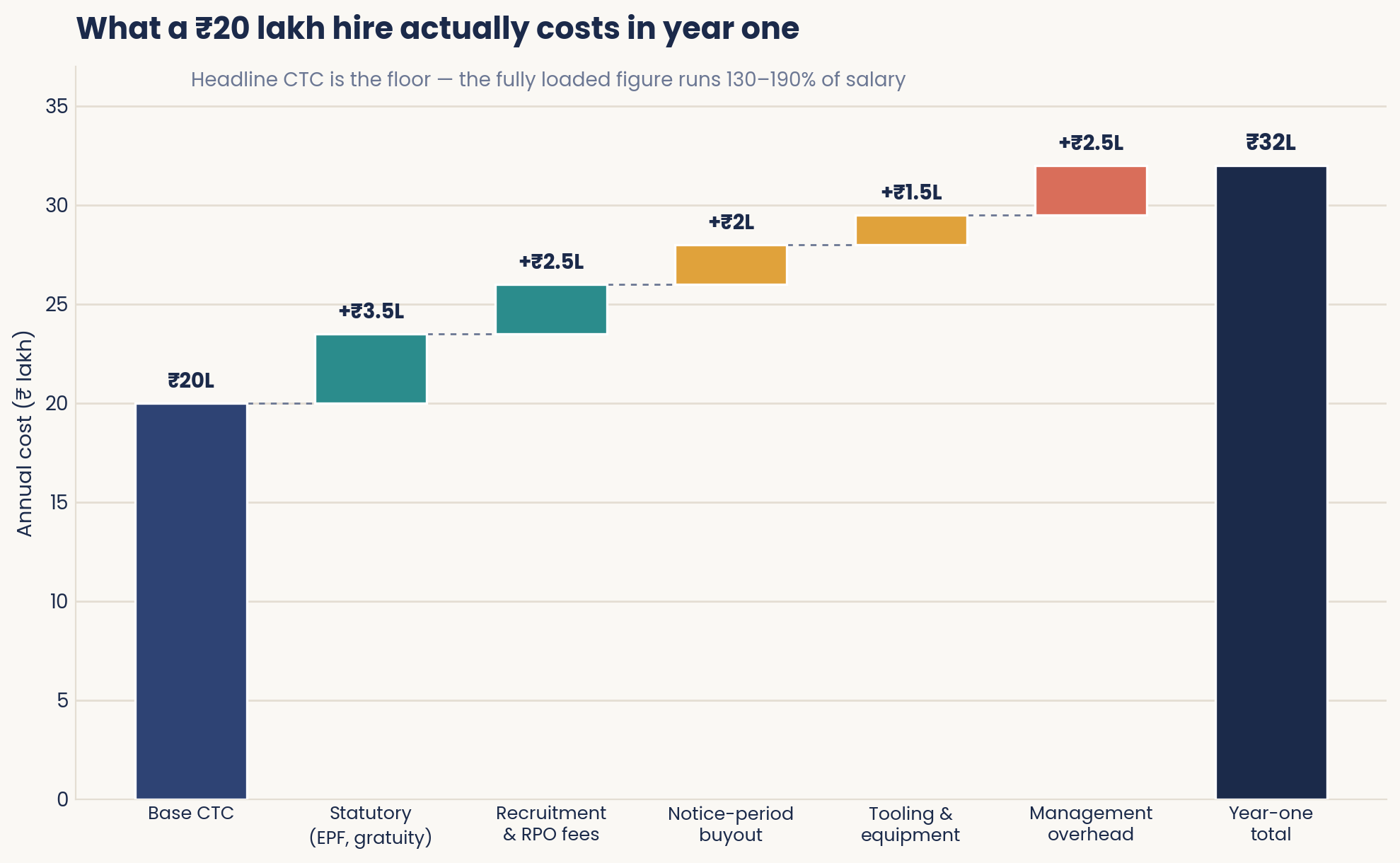
A second number makes it worse: the ₹20 lakh developer you budgeted for actually costs ₹23–24 lakh once statutory contributions land, and closer to ₹32–38 lakh once you add recruiter fees, notice-period buyouts, tooling, and management overhead. The tech hiring cost India 2026 reality is not a salary line; it is a stack of line items that compound. Teams that treat the headline CTC as the budget routinely undercount by 50–90%.
Hiring tech talent in India is no longer about quoting a salary range, it’s about understanding the true cost behind every hire. From compensation inflation to recruitment overheads, hiring budgets are becoming harder to predict.
In fact, tech hiring cost India 2026 is being driven by rising demand for skilled engineers, especially in high-demand domains like AI, cloud, and cybersecurity.
India Inc. compensation projections for the 2025–2026 cycle are officially landing at an average of roughly 9.1%. While this sits slightly below the upper threshold of 10%, it still maintains India’s position as one of the highest projected average pay hikes globally. This sustained compensation growth directly increases the overall cost of hiring across roles and experience levels.
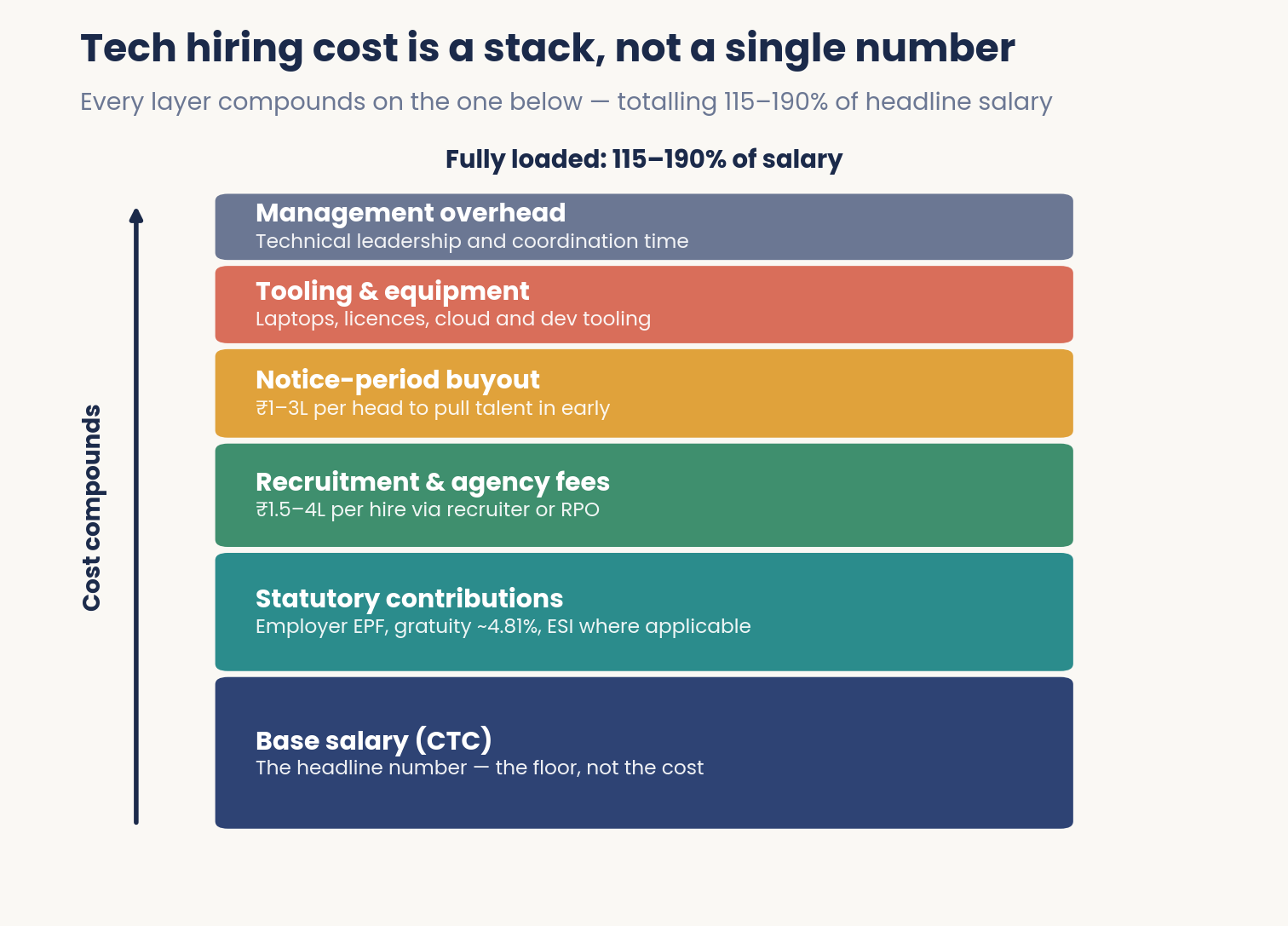
The takeaway is simple: relying on base salary benchmarks alone leads to underestimating real hiring costs. In 2026, the actual cost of a tech hire is a stacknot a single number.
This is meant to be the reference you bookmark. It breaks down salary bands for 50+ technology roles across experience levels, separates product-company pay from IT-services pay, converts everything to offshore hourly equivalents, and shows where the hidden costs sit. The goal is simple: let you walk into a vendor conversation or a board budget review already knowing what a number should be and what it should not be.
The arbitrage is real but uneven. A senior Java engineer in Bengaluru earns roughly 20–30% of a San Francisco equivalent and ships the same software. But that gap compresses sharply for scarce skills AI, cloud architecture, security where India now competes globally on price. Knowing exactly where the gap is wide and where it has closed is the difference between a defensible budget and an expensive surprise.
What Tech Hiring Cost Actually Means
Tech hiring cost is the total amount an employer spends to source, onboard, and retain a technology hire not the salary alone. It includes gross CTC, employer-side statutory contributions (EPF, gratuity, ESI where applicable), recruitment and agency fees, notice-period buyouts, tooling, and ongoing management overhead. The fully loaded figure typically runs 115–190% of the headline salary.
The Core Problem: The Budget You Set Is Not the Cost You Pay
Most teams anchor on one number from a salary aggregator and treat it as a plan. The structural problem is that Indian compensation is split across two parallel markets that share the same talent pool but pay completely differently.
IT-services firms hire freshers at ₹3.5–6 lakh. Product companies, funded startups, and Global Capability Centres hire the same graduate profile at ₹8–25 lakh. Quoting a services-firm number for a product-grade hire understates your budget by 2–4x. That single confusion is the most common costing error.
The second problem is the gap between CTC and what the role truly costs. As a budgeting rule, total employer cost in India is roughly 115–120% of CTC for tech roles above the ESI threshold, once you add the employer EPF share, gratuity accrual at ~4.81% of basic, and payroll processing.
Then come the line items that wreck budgets quietly. Indian engineers serve 1–3 month notice periods; pulling someone in early often means a buyout of ₹1–3 lakh per head. Recruiter and RPO fees run ₹1.5–4 lakh per hire. Attrition forces re-hiring on roles you thought were closed.
The timeline cost is just as real. A traditional in-house hire takes 60–90 days to sit. Every open week on a sprint-critical role has a delivery cost that rarely appears in a spreadsheet but always appears in the roadmap.
Developer Salary Benchmarks India 2025–2026: The Full Role Map
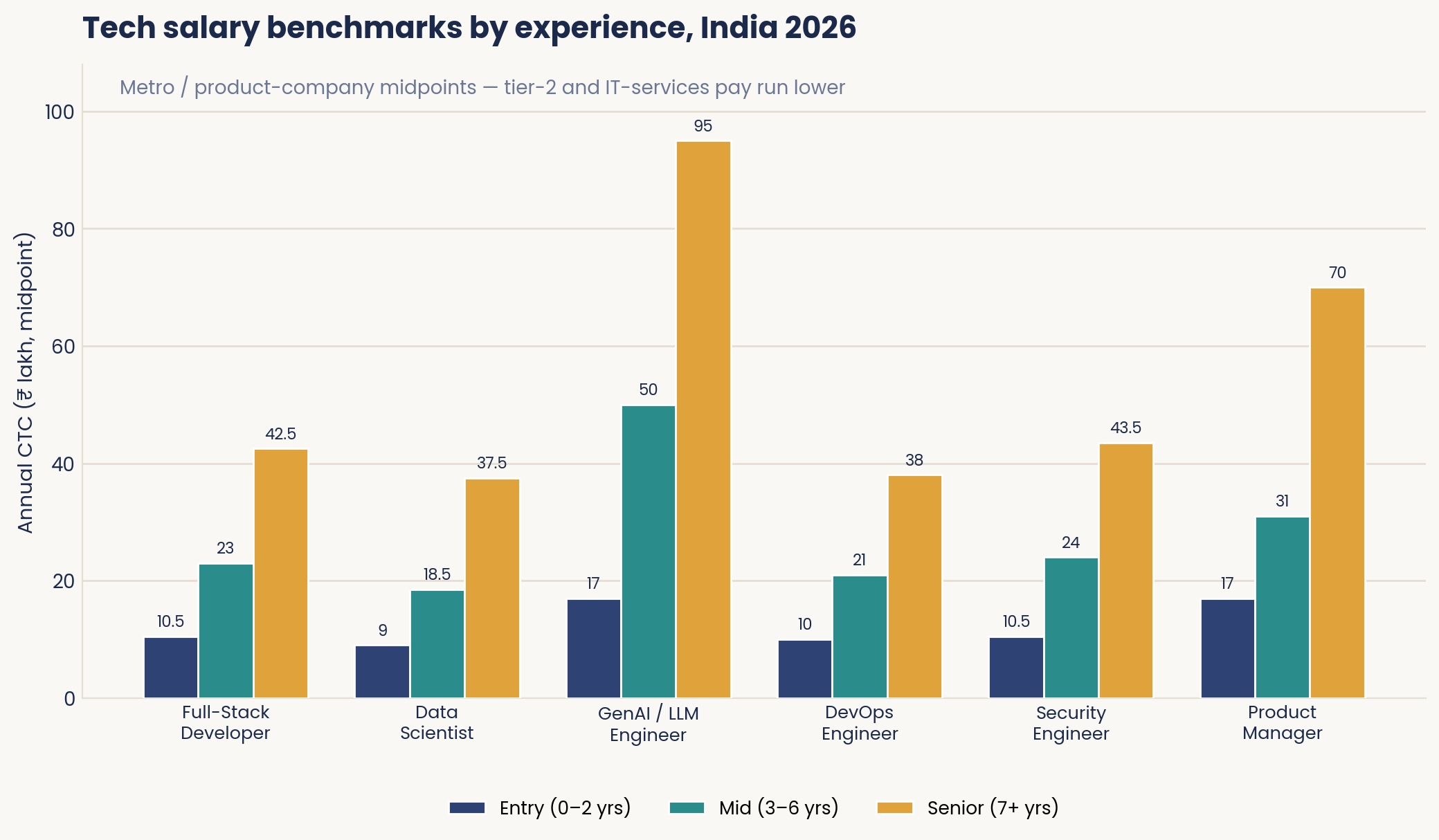
This is the core of the resource. All figures are annual CTC in ₹ lakh, weighted toward metro and product-company hiring (the band most international and growth-stage employers actually compete in). Tier-2 cities typically run 20–30% lower; IT-services pay runs lower still. Offshore hourly equivalents reflect vendor or staff-augmentation rates, not freelance.
These developer salary benchmarks India 2025 trends continued into 2026 with one shift: niche-skill premiums widened, while commoditized roles saw only single-digit hikes.
Software Engineering & Development Roles
| Role | Entry (0–2 yrs) | Mid (3–6 yrs) | Senior (7+ yrs) |
| Frontend Developer (React/Vue) | ₹6–11 | ₹14–26 | ₹28–48 |
| Backend Developer (Java/Node/Go) | ₹7–13 | ₹16–30 | ₹30–55 |
| Full-Stack Developer | ₹7–14 | ₹16–30 | ₹30–55 |
| Java Developer | ₹6–12 | ₹15–28 | ₹28–50 |
| Python Developer | ₹6–13 | ₹15–30 | ₹30–55 |
| Node.js Developer | ₹6–12 | ₹14–28 | ₹28–50 |
| .NET Developer | ₹5–11 | ₹13–25 | ₹26–46 |
| PHP / Laravel Developer | ₹4–9 | ₹10–20 | ₹20–38 |
| Golang Developer | ₹8–15 | ₹20–35 | ₹35–60 |
| Ruby on Rails Developer | ₹6–12 | ₹15–28 | ₹28–50 |
| Android Developer | ₹6–12 | ₹14–28 | ₹28–50 |
| iOS Developer | ₹6–13 | ₹15–30 | ₹30–52 |
| React Native / Flutter Developer | ₹6–12 | ₹14–27 | ₹27–48 |
| Embedded / IoT Engineer | ₹5–11 | ₹13–26 | ₹28–50 |
| Game Developer (Unity/Unreal) | ₹5–11 | ₹12–24 | ₹24–45 |
Data, AI & Machine Learning Roles
This cluster carries the steepest premiums in 2026. GenAI and LLM engineers earn 25–40% more than generalist ML engineers at every level, and senior LLM engineers at frontier labs cross ₹1.5 crore in total compensation.
| Role | Entry (0–2 yrs) | Mid (3–6 yrs) | Senior (7+ yrs) |
| Data Analyst | ₹4–9 | ₹8–16 | ₹16–28 |
| BI Developer | ₹5–10 | ₹10–20 | ₹20–35 |
| Data Engineer | ₹8–16 | ₹18–32 | ₹32–55 |
| Analytics Engineer | ₹7–14 | ₹15–28 | ₹28–48 |
| Data Scientist | ₹6–12 | ₹12–25 | ₹25–50 |
| ML Engineer | ₹8–15 | ₹25–50 | ₹50–80 |
| AI Engineer | ₹8–16 | ₹25–50 | ₹50–85 |
| GenAI / LLM Engineer | ₹12–22 | ₹35–65 | ₹70–120+ |
| MLOps Engineer | ₹10–18 | ₹25–45 | ₹45–65 |
| Computer Vision Engineer | ₹8–16 | ₹22–42 | ₹42–70 |
| NLP Engineer | ₹8–16 | ₹22–42 | ₹42–70 |
| Prompt Engineer | ₹4–8 | ₹12–25 | ₹25–45 |
| Data Architect | – | ₹28–45 | ₹45–75 |
Cloud, DevOps & Infrastructure Roles
| Role | Entry (0–2 yrs) | Mid (3–6 yrs) | Senior (7+ yrs) |
| DevOps Engineer | ₹7–13 | ₹14–28 | ₹28–48 |
| Site Reliability Engineer (SRE) | ₹9–16 | ₹20–38 | ₹38–65 |
| Cloud Engineer (AWS/Azure/GCP) | ₹7–14 | ₹16–32 | ₹32–55 |
| Cloud Architect | – | ₹30–50 | ₹45–75 |
| Platform Engineer | ₹9–16 | ₹22–40 | ₹40–65 |
| Kubernetes / Infra Engineer | ₹8–15 | ₹20–38 | ₹38–60 |
| Database Administrator (DBA) | ₹5–11 | ₹12–24 | ₹24–42 |
| Network Engineer | ₹4–9 | ₹9–18 | ₹18–35 |
Security, Quality & Reliability Roles
| Role | Entry (0–2 yrs) | Mid (3–6 yrs) | Senior (7+ yrs) |
| Security / SOC Analyst | ₹5–10 | ₹12–22 | ₹22–40 |
| Security Engineer | ₹7–14 | ₹16–32 | ₹32–55 |
| Security Architect | – | ₹30–55 | ₹50–85 |
| Penetration Tester | ₹6–12 | ₹14–28 | ₹28–50 |
| GRC / Compliance Analyst | ₹5–10 | ₹11–22 | ₹22–40 |
| Manual QA Engineer | ₹3–7 | ₹5–10 | ₹10–18 |
| Automation QA / SDET | ₹5–9 | ₹8–18 | ₹18–32 |
| Performance Test Engineer | ₹6–11 | ₹12–24 | ₹24–42 |
Product, Design & Leadership Roles
| Role | Entry | Mid | Senior / Lead |
| Associate Product Manager | ₹12–22 | – | – |
| Product Manager | – | ₹22–40 | ₹40–60 |
| Senior / Group PM | – | – | ₹50–90 |
| Product Owner | ₹10–18 | ₹18–32 | ₹32–55 |
| Business Analyst | ₹5–10 | ₹10–20 | ₹20–38 |
| UX Designer | ₹5–11 | ₹12–25 | ₹25–45 |
| UI Designer | ₹4–9 | ₹9–20 | ₹20–38 |
| Product Designer | ₹6–12 | ₹14–28 | ₹28–50 |
| UX Researcher | ₹6–12 | ₹13–26 | ₹26–45 |
| Scrum Master / Agile Coach | ₹7–13 | ₹14–26 | ₹26–45 |
| Engineering Manager | – | ₹35–55 | ₹55–95 |
| Tech Lead / Technical Architect | – | ₹30–50 | ₹50–90 |
| Solutions Architect | – | ₹28–48 | ₹48–80 |
| Technical Program Manager | – | ₹25–45 | ₹45–80 |
| Blockchain Developer | ₹8–16 | ₹20–40 | ₹40–70 |
| Salesforce Developer | ₹5–11 | ₹12–24 | ₹24–45 |
| SAP / ERP Consultant | ₹5–11 | ₹14–28 | ₹28–55 |
Translating to Offshore Developer Cost 2026
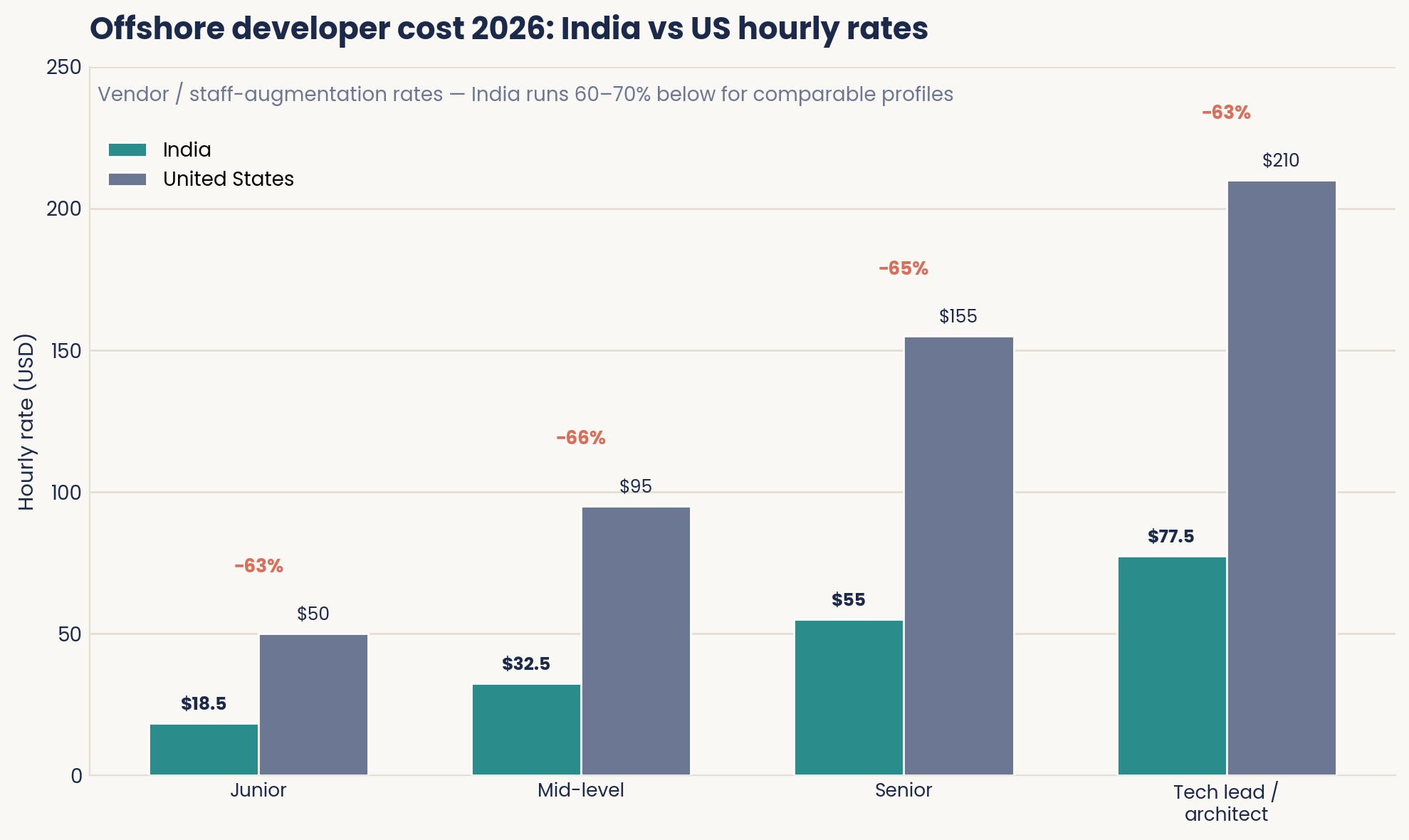
For finance teams budgeting in dollars, the offshore developer cost 2026 picture is cleaner in hourly terms. Based on ~1,920 billable hours a year and vendor or staff-augmentation engagement:
- Junior developer: $15–22/hr (~$28,800–42,000/yr)
- Mid-level developer: $25–40/hr (~$48,000–76,800/yr)
- Senior developer: $45–65/hr (~$86,400–124,800/yr)
- Tech lead / architect: $65–90/hr (~$124,800–172,800/yr)
That lands India roughly 60–70% below the US equivalent for comparable mid-to-senior profiles. The advantage compresses for scarce senior specialists and it is never infinite.
The Fully Loaded Cost of an Indian Engineer
The headline CTC is the floor, not the cost. To get the fully loaded cost of an Indian engineer, layer in the components that never reach the employee’s bank account but always reach your budget. Employer EPF is 12% of basic (capped, since EPF is computed on basic, typically 40–50% of CTC). Gratuity accrues at ~4.81% of basic from day one. Add payroll, insurance, and, for foreign employers, an Employer of Record management fee.
The practical multipliers: ~115–120% of CTC for the statutory-and-payroll layer; 130–190% of CTC once recruitment fees, buyouts, tooling, and management overhead are included on a per-hire, first-year basis. A ₹20 lakh developer realistically costs ₹26–38 lakh in year one.
Case Studies: What the Numbers Look Like in Practice
A US-based SaaS company replaced a planned five-person Bay Area team (projected fully loaded cost ~$1.1M/year) with a blended India team of two senior engineers in Bengaluru and three mid-level engineers in Pune and Indore for roughly ₹2.4 crore (~$255K) all-in. The savings on the tier-2 mid-level seats funded the premium needed to secure the two scarce senior architects, producing a blended cost far below hiring the whole team at metro product-company rates.
A European fintech scaling its compliance stack budgeted ₹18 lakh per mid-level engineer and was blindsided in month one: two notice-period buyouts at ₹2 lakh each, RPO fees of ₹3 lakh per hire, and a gratuity-and-EPF layer they had not modelled pushed the effective per-head cost past ₹26 lakh. The build still cost less than a local hire but the variance, not the average, was what nearly stalled approval.
IT Staffing Rates India: A Decision Framework
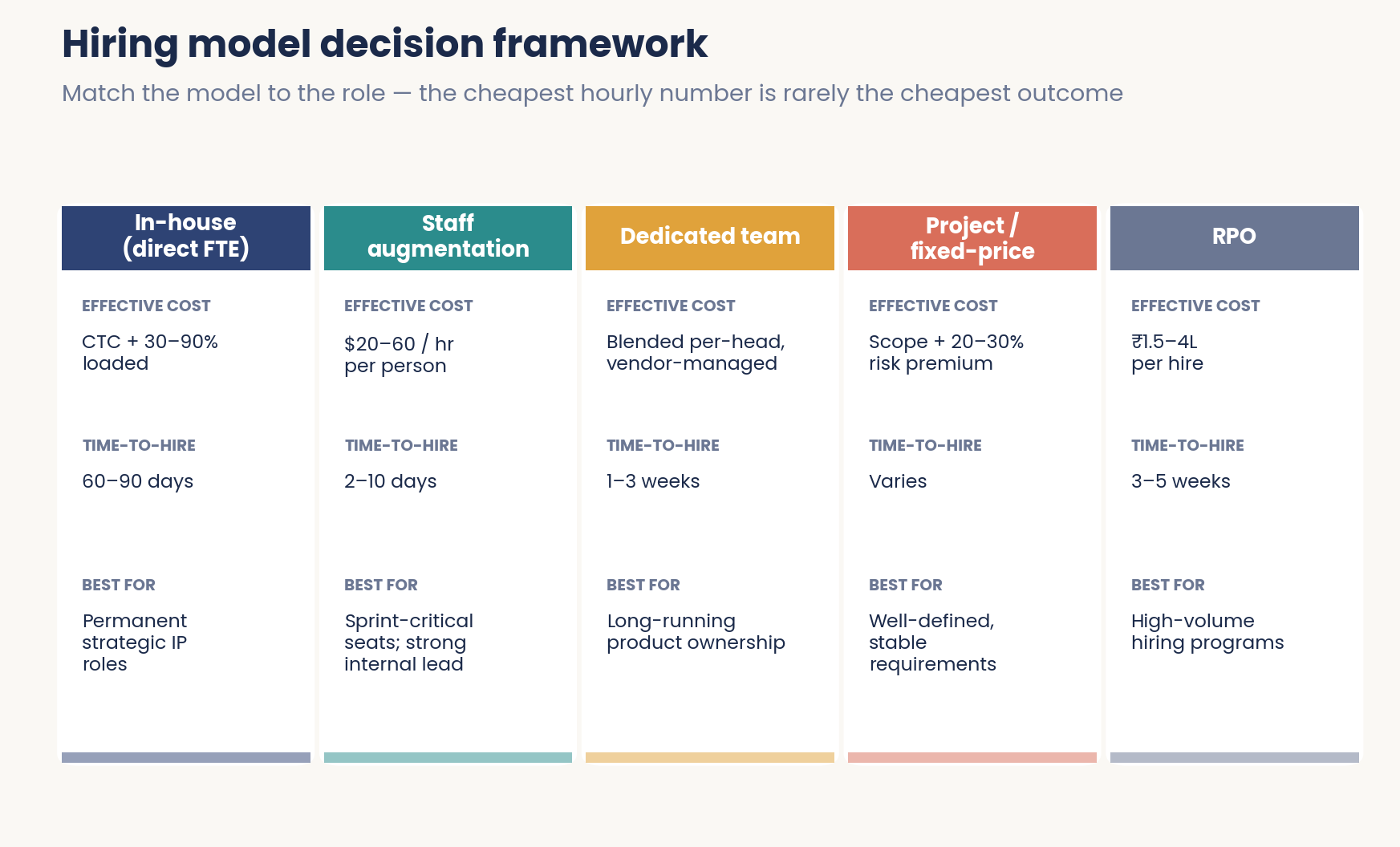
The right engagement model changes the IT staffing rates India employers ultimately pay more than city or seniority does. Use this to match the model to the situation rather than chasing the lowest hourly number.
| Hiring model | Effective cost | Time-to-hire | Best for |
| In-house (direct FTE) | CTC + 30–90% loaded | 60–90 days | Permanent strategic IP roles |
| Staff augmentation | $20–60/hr per person | 2–10 days | Sprint-critical seats; strong internal tech lead |
| Dedicated team | Blended per-head, vendor-managed | 1–3 weeks | Long-running product ownership |
| Project / fixed-price | Scope + 20–30% risk premium | Varies | Well-defined, stable requirements |
| RPO | ₹1.5–4L per hire | 3–5 weeks | High-volume hiring programs |
The cheapest line item is rarely the cheapest outcome. A $4/hr saving across a three-person team over six months is ~$14,400 less than one month of rebuild caused by a single misaligned hire.
What Most Teams Get Wrong
The most expensive mistake is optimizing for the wrong roles. Teams negotiate hard on a QA engineer or a generalist frontend developer accessible roles where they hold leverage and then lose three weeks and a premium candidate haggling over a senior ML engineer in a genuine scarcity market. The discipline is the inverse: optimize for value on accessible roles, move fast and pay the premium on scarce ones, and let the savings on the former fund the latter.
The second pattern is confusing cost arbitrage with value creation. Hiring in India is most powerful as talent access securing a senior architect with ten years of domain depth who does not exist in your local market at any price not as a pure cost-reduction play. That reframing changes vendor selection entirely.
The third is the “direction premium.” Mid-to-senior Indian engineers are technically excellent, but many are not trained to define scope or drive product decisions. An engagement model that expects an offshore team to self-direct with minimal guidance produces output that is technically correct and directionally wrong. Budget for technical leadership, or buy it from the vendor.
The last is treating salary benchmarks as a static table. India Inc hikes were projected around 9.1% for 2026, but niche AI, cloud, and security skills pulled 15–25% at competitive employers while commoditized roles saw 6–8%. A benchmark you pulled twelve months ago is already wrong for the roles that matter most.
Frequently Asked Questions
How much does it cost to hire a software developer in India in 2026?
A mid-level developer costs ₹16–30 lakh CTC in metro product companies, or roughly $25–40/hr through staff augmentation about 60–70% below the US equivalent. Fully loaded, including statutory contributions, recruitment, and tooling, the first-year cost runs 130–190% of headline salary. Tier-2 cities run 20–30% lower for comparable skill.
What is the difference between CTC and in-hand salary?
CTC (Cost to Company) is the total annual figure including base, employer EPF, gratuity accrual, and bonuses. In-hand is what the employee actually receives after employee PF, income tax, and professional tax typically 65–75% of CTC. For international employers, the gap between CTC and what the role costs you is the more important number, since loaded cost sits above CTC, not below it.
What is the fully loaded cost of an Indian engineer?
Plan for roughly 115–120% of CTC for the statutory-and-payroll layer (employer EPF, gratuity, ESI where applicable, payroll processing), rising to 130–190% in year one once recruiter or RPO fees, notice-period buyouts of ₹1–3 lakh, equipment, software licences, and management overhead are included. A ₹20 lakh hire realistically costs ₹26–38 lakh.
Why is hiring in India cheaper than the US or UK?
The gap reflects cost of living and labour-market conditions, not a skill gap. A senior engineer in Bengaluru earns 20–30% of a San Francisco peer while building the same software. The arbitrage is real; the “lower quality” narrative is not. It does compress sharply for scarce senior specialists in AI, cloud architecture, and security, where India competes globally on price.
Is offshore development in India still cost-effective in 2026?
Yes, when the engagement structure is right. The risks people associate with offshore work unclear contracts, no IP protection, anonymous developers, no replacement process are structural, not geographic. A vendor engagement with clear contracts, named placement, direct developer access, and a replacement guarantee removes them while preserving the cost advantage.
Which tech roles in India are getting more expensive fastest?
GenAI and LLM engineers, MLOps engineers, cloud and platform architects, and security architects. NASSCOM data shows AI demand growing ~40% year-on-year while qualified senior supply grows under 15%, keeping upward pressure on those bands through the decade. Commoditized roles, generic backend, manual QA are flat to single-digit by comparison.
Should I budget for a Bengaluru team or a tier-2 distributed team?
A common 2026 pattern anchors senior technical leadership in Bengaluru and distributes mid-level engineers across tier-2 cities like Pune, Indore, or Jaipur, saving ₹4–6 lakh per mid-level engineer annually while accessing a less-competed talent pool. With the right async tooling, the productivity difference is negligible. If you want this modelled against your specific role mix, that is worth a short benchmarking conversation before you commit headcount.
Before You Commit a Budget
If you are sizing a build and want to pressure-test the numbers before a vendor quote anchors you to theirs, start by separating your roles into “scarce” and “accessible,” then attach the bands above to each. The blended figure that falls out is usually far lower than a flat metro rate and far more defensible than a single average.
The sequence that holds up under scrutiny is short. Map your role mix against these benchmarks. Model the loaded cost at 130–190% of CTC for year one, not the headline salary. Decide your engagement model per role rather than for the whole team staff augmentation for sprint-critical seats, dedicated team for long-running ownership, in-house only where the role is permanent strategic IP. Do that, and you will walk into procurement already knowing which numbers are fair and which are padded.
What the benchmark cannot tell you is where your specific build sits inside these ranges. A fintech compliance team and a consumer-app frontend team can both be “five mid-level engineers” on paper and land ₹15–20 lakh apart per head once skill scarcity, city mix, and notice-period realities are priced in. That gap is the part worth modelling carefully, because it is the part that moves your total by tens of lakhs.
The benchmarks here come out of running this exercise across hundreds of engagements at Supersourcing, where the recurring lesson is that variance, not the average, is what breaks a budget. If it is useful to compare your own role mix against current placement data before you talk to a vendor, the numbers above are a starting point you can build on, and a short conversation can sharpen them against what the market is actually clearing today. Mayank and the team are reachable at mayank@engineerbabu.com and the wider hiring playbooks live at supersourcing.com. Either way, the discipline matters more than the contact: benchmark before you negotiate, and the negotiation gets a great deal easier.
