

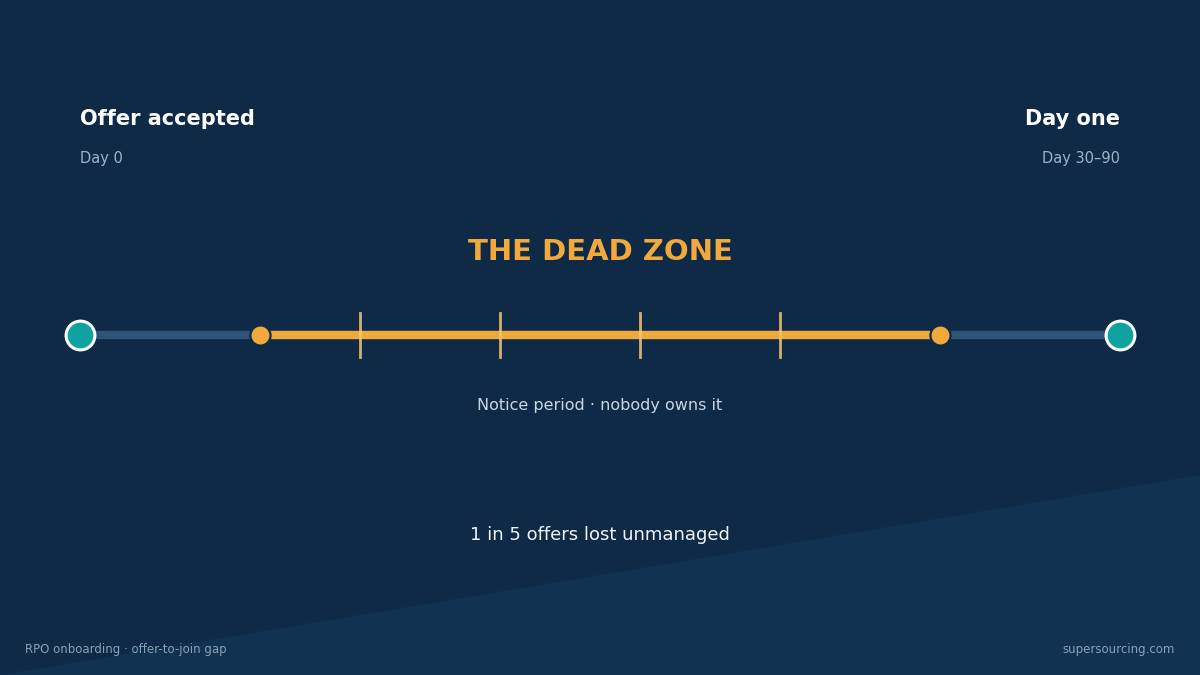
Yet almost every hiring playbook internal or outsourced treats “offer accepted” as the finish line. Recruiters get their credit, the ATS status flips to “closed-won,” and the candidate enters a 30-to-90-day silence during which nobody owns the relationship. That silence is where offers die.
This is exactly the window a mature post-offer program is built to control. In a well-run recruitment process outsourcing engagement, the provider’s accountability doesn’t end at offer rollout. It extends through document collection, background verification (BGV), pre-boarding engagement, IT and compliance readiness, and in the strongest contracts through the first 30 to 90 days of employment, with the joining ratio written into the SLA.
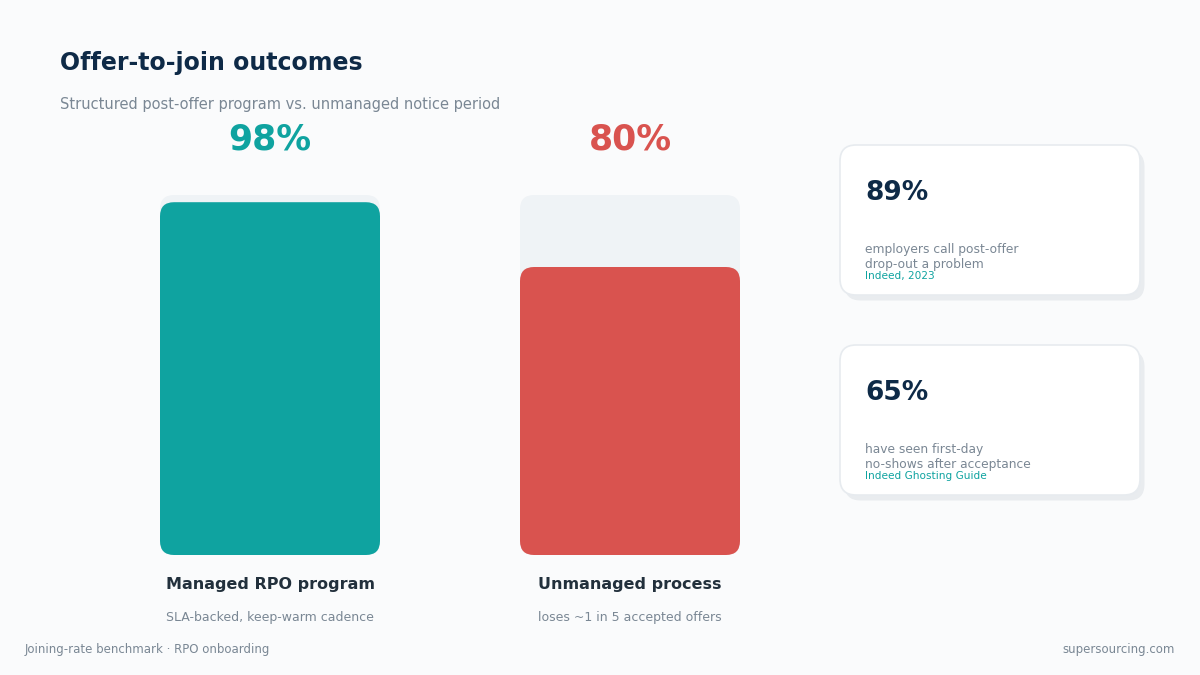
The difference in outcomes is not marginal. Industry-wide, first-day no-shows and pre-joining drop-offs are common enough that a majority of employers track “ghosters” in their systems. Meanwhile, RPO programs that run a structured post-offer process routinely hold joining rates in the mid-to-high 90s Supersourcing’s own engagements run at a 98% candidate joining rate, with under 1% drop-off on contract roles.
An accepted offer is not a hire. In tech recruiting, it is closer to a non-binding letter of intent and the data proves it. In Indeed’s cross-market employer survey, 89% of employers said candidates dropping out of the process or failing to show up on day one is a real problem for their business. In an earlier Indeed study, 65% of employers reported having candidates accept an offer and then never appear for their first day. Closing that gap reliably, at scale, with someone accountable for it is the entire job of a disciplined RPO onboarding process.
Indeed’s employer research found 57% of employers believe candidate ghosting is more common than before, and 89% now call post-offer drop-out a business problem. The offer-to-day-one gap is getting riskier, not safer which is why post-offer ownership is becoming a standard line item in RPO contracts.
This guide walks through the entire journey of what happens in the hours after acceptance, what a compliant document and BGV workflow looks like, how pre-boarding engagement is actually run week by week, and how to measure whether your provider is doing any of it well.
TL;DR
This guide covers everything between "I accept" and a productive first month and who does what at each stage. It maps the full RPO onboarding process across six phases, from offer paperwork through background checks to day 30. It is written for CTOs, HR heads, and talent leaders evaluating post-offer onboarding RPO ownership and wanting to know what "done well" looks like.
The single most important number in this guide: structured post-offer programs convert 95–98% of accepted offers into joined employees, while unmanaged processes routinely lose one candidate in five during the notice period. The gap between those two outcomes is not luck; it is a six-phase process with owners, timelines, and SLAs.
By the end, you will be able to map every step from offer acceptance to day 30, assign ownership between your team and your provider, spot the red flags in a weak onboarding operation, and benchmark the costs and timelines you should expect at each stage.
What Is the RPO Onboarding Process? {#definition}
The RPO onboarding process is the structured workflow a recruitment process outsourcing provider runs between offer acceptance and full productivity covering offer documentation, background verification, pre-boarding engagement, compliance and IT readiness, day-one induction, and early-tenure tracking with the provider contractually accountable for the candidate actually joining and ramping.
What it is not:
- Not day-one orientation. Induction is one phase of onboarding; the highest-risk work happens in the weeks before day one.
- Not just paperwork automation. Document workflows are the visible layer; drop-off prevention and compliance are the substance.
- Not the same as staff augmentation onboarding. In staff aug, the vendor deploys its own employee to you. In RPO, the provider onboards a hire onto your payroll, under your policies.
Why the Offer-to-Join Window Decides Your Hiring ROI
Everything you spent to reach an accepted offer sourcing hours, interview panels, assessments, negotiation is sunk the moment a candidate ghosts. Candidate onboarding outsourcing exists because this window has a measurable, compoundable cost profile:
- Cost recovery. Every pre-joining drop-off forces a full restart: re-sourcing, re-interviewing, re-negotiating. Total cost of a lost tech hire typically lands at 1.5 — 2x the role’s monthly salary once panel time is counted, before you add the delivery cost of a seat sitting empty for another hiring cycle.
- Speed. A restart adds a full cycle with an AI-assisted sourcing engine that is 7–10 working days back to a shortlist, plus interviews, plus another notice period. Without one, it is often 6–10 weeks of lost delivery time per dropped candidate.
- Quality erosion. Backfilling under deadline pressure is where hiring bars quietly drop. Teams that lose a signed candidate two days before joining routinely settle for the #2 or #3 choices they had earlier rejected.
- Retention. Onboarding quality predicts tenure. Gallup finds only 12% of employees strongly agree their organization does a great job of onboarding, and the same research notes turnover can reach 50% inside the first 18 months of employment. A weak first 90 days converts a hiring cost into a recurring hiring cost.
- Employer brand. Candidates who drop off after a poor pre-boarding experience talk on Glassdoor, on LinkedIn, in referral networks. The impact of RPO on employer brand runs through exactly these touchpoints: response time, communication cadence, and how professional the document and BGV experience feels.
The blunt version: your real hiring metric is not offers extended or even offers accepted. It is the offer-to-join ratio and it is the one number most TA dashboards don’t show.
The Core Problem: The 30–90 Day Dead Zone
Between acceptance and joining sits a structural gap that is uniquely dangerous in Indian and offshore tech hiring, where 30, 60, and 90-day notice periods are standard.
What actually happens in that gap when nobody owns it:
- Week 1: The candidate resigns. Their current employer opens a counter-offer conversation often 20–30% above your offer, plus an immediate promotion narrative.
- Weeks 2–4: Your side goes silent. The recruiter has moved on to the next requisition; HR won’t engage until the joining date is close. Competing recruiters, meanwhile, are calling a candidate who just accepted one offer as the warmest lead on the market, and every sourcer knows it.
- Weeks 4–8: Document requests arrive late and in fragments. The candidate is asked for the same payslips twice by two different teams. BGV kicks off sequentially instead of in parallel, so a single slow employment check pushes the joining date.
- Week before joining: Confidence wobbles become decisions. The counter-offer, the competing offer, or plain cold feet wins and you find out via a one-line email, or via silence on day one.
The underestimation problem: most teams budget for interview-stage rejection but assume near-zero loss after acceptance. In practice, unmanaged pipelines in high-demand tech skills routinely lose 15–25% of accepted offers during the notice period teams underestimate their true post-offer risk by 3–4x.
The longer the notice period, the worse it gets: drop-off risk compounds roughly week over week, which is why 90-day-notice candidates need a fundamentally different engagement plan than 30-day ones.
Red flag: if your current process cannot tell you, today, your offer-to-join ratio for the last two quarters split by notice-period length, you do not have visibility into your biggest hiring leak.
This is the problem the six-phase process below is designed to close.
The Full Walkthrough: Offer Accepted to Day 30 {#walkthrough}
What follows is the operating sequence a mature provider of recruitment process outsourcing runs the moment a candidate says yes. Timelines assume an Indian tech hire on a 30–60 day notice period; adjust proportionally for immediate joiners or 90-day notices.
Phase 1 Offer Confirmation & Documentation Kickoff (Day 0–3)
The first 72 hours after verbal acceptance set the tone for everything that follows. Speed here is a trust signal.
The 24-hour rule: the formal offer letter should be in the candidate’s inbox within 24 hours of verbal acceptance, e-signature enabled. Every day of delay between “yes” on a call and paper in hand is a day the candidate’s current employer or a competing recruiter can use.
The Phase 1 checklist:
- Release the digital offer letter (compensation breakup, joining date, role, reporting line, benefits summary) via e-signature no print-scan-email loops.
- Confirm acceptance in writing and lock the joining date; flag anything beyond 45 days for an enhanced engagement track (see Phase 3).
- Trigger the document request once, as a single list. Typical India tech-hire set: PAN, Aadhaar, educational certificates and final-semester marksheets, last 3 months’ payslips, last 2 employers’ relieving and experience letters, UAN number, bank proof, passport-size photos. For US hiring, this is where I-9 documentation and E-Verify prep begin.
- Collect BGV consent forms in the same packet so verification can start immediately, not after a second round of chasing.
- Assign a single point of contact (SPOC) one named person the candidate messages for everything until day one.
Red flag: document requests arriving in 3–4 separate emails from different teams. It signals internal chaos to the candidate and typically adds 5–7 days to the timeline.
- Owner in an RPO model: provider runs the workflow and chases documents; client approves the offer terms and signs.
- Exit criteria for Phase 1: signed offer + complete document set + BGV consent, all inside 5 working days.
Phase 2 Background Verification, Run in Parallel (Day 3–15)
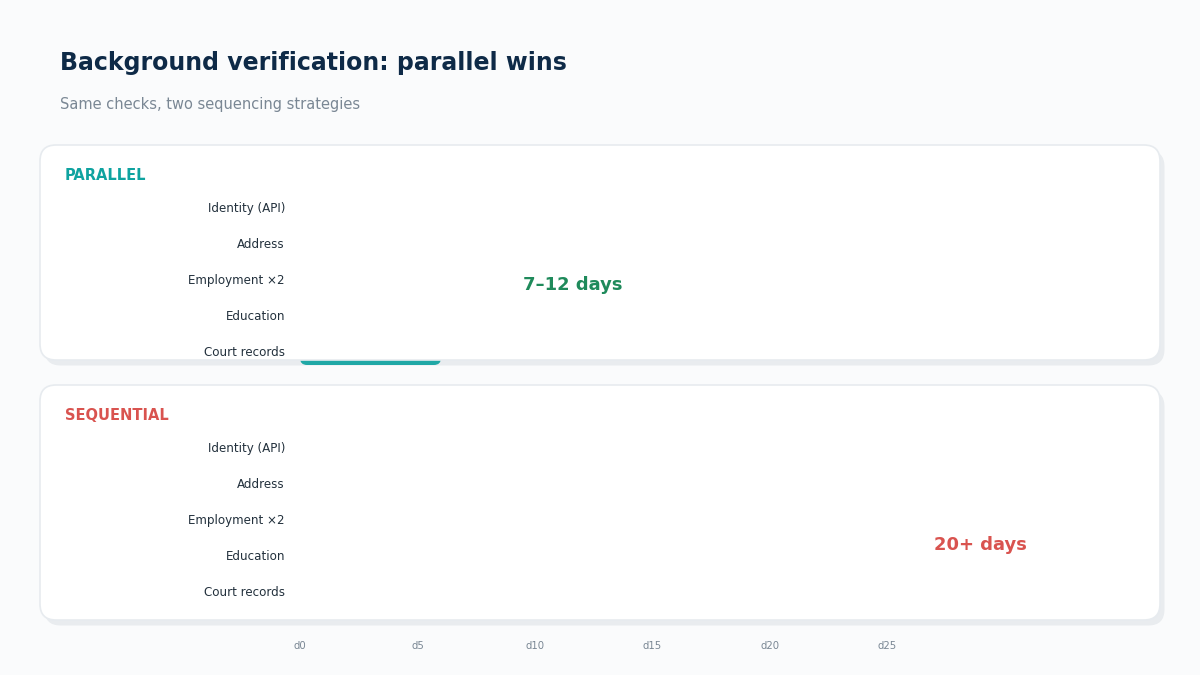
How does an RPO handle background verification? The short answer: in parallel, with a tiered scope, and with discrepancies handled by protocol instead of panic.
Standard BGV components for a tech hire:
- Employment verification last 2 employers: dates, designation, reported compensation, exit status (typically 3–7 working days per employer; the long pole in most timelines)
- Education verification highest degree via university/board records (2–10 working days; some Indian universities take longer)
- Identity verification PAN/Aadhaar match (near-instant via API)
- Address verification digital or physical (2–5 working days)
- Criminal record / court-record check district and high-court database search (3–7 working days)
- Optional tiers by role sensitivity: credit check (fintech), global watchlist/sanctions screening, drug screening (US clients), CV-claim deep verification for senior roles
The parallel principle: every check above starts on the same day. Sequential BGV waiting for employment checks before starting education is the single most common cause of joining-date slips. Run in parallel, a full standard package closes in 7–12 working days; run sequentially, the same package takes 20+.
Handling discrepancies without losing the hire:
- Classify: minor (a 15-day date mismatch in employment history, a designation worded differently) vs. material (fake experience letter, unverifiable degree, criminal record).
- For minor flags, give the candidate 48 hours to clarify with evidence most minor flags are explainable and shouldn’t stall the process.
- For material flags, the client makes the call against a pre-agreed adjudication matrix decided when the program was set up, not improvised per case.
- Insurance-grade practice: allow a provisional joining on interim BGV (identity + latest employer verified) with final report to follow, for roles where time-to-seat matters more than full clearance with the policy documented and client-approved.
Red flag: a provider who treats every BGV flag as a binary reject. Discrepancy rates on Indian employment history checks are high enough that a zero-tolerance-without-adjudication policy silently kills good hires.
Phase 3 Pre-Boarding Engagement: Winning the Notice Period (Day 3 to Day -1)
This phase is where drop-off is actually prevented, and it is the phase most in-house processes skip entirely. Pre-boarding engagement is a scheduled, owned communication program that runs from offer signature to the evening before day one.
How to reduce candidate drop-off before joining the working cadence:
- Week 1: resignation support. Confirm the candidate has resigned and received acknowledgment. Coach them on the counter-offer conversation before it happens candidates who have pre-decided their response to a counter rarely flip.
- Every 7–10 days: a structured touchpoint. Rotate the channel and the voice SPOC check-in call, a note from the hiring manager, a dedicated team introduction, a “what your first two weeks look like” document. Never let 14 days pass in silence.
- Day 30 (for 60–90 day notices): a mid-notice milestone. A video call with the future manager or a team member. This is the highest-leverage single touchpoint in the entire process; it converts an abstract offer into a relationship.
- Two weeks out: logistics confidence. Confirm joining date, location/remote setup, day-one agenda, dress/equipment expectations. Uncertainty reads as disorganization.
- 48 hours out: the final confirmation call. Explicit verbal reconfirmation. If hesitation surfaces here, you still have time to respond; on day-one morning, you don’t.
Counter-offer defense, specifically:
- Ask directly in week one: “Your current employer will likely counter. What would make you consider it?” Naming it removes its power.
- Re-anchor on the reasons they chose to move growth, stack, role scope not on money. A counter-offer only ever fixes the money.
- If a genuine competing offer appears, escalate to the client within 24 hours with a recommendation (match, sweeten non-cash terms, or release). Slow escalation is how providers lose candidates they knew were wobbling.
The RPO pre-boarding checklist for new hires the one-page version:
- Offer e-signed; joining date locked and entered in the tracker
- Resignation confirmed and acknowledged by current employer (ask for the acknowledgment a resignation email that hasn’t been accepted isn’t a started notice period)
- Counter-offer conversation pre-empted in the week-one call
- Touchpoint calendar generated for the full notice period, owners assigned
- Mid-notice manager/team video call booked (60–90 day notices)
- Documents complete; BGV in flight with expected clear date visible to the client
- Two-weeks-out logistics email sent: date, location/remote setup, agenda, equipment
- 48-hour reconfirmation call done, verbal confirmation logged
- Risk signals reviewed: zero open flags, or escalation active
Nine boxes. Any candidate with more than one unchecked box inside two weeks of joining is a rescue case, not a routine one and should be treated that way that day.
The escalation trigger: any missed call, delayed document, or postponement request is logged as a risk signal. Two signals inside 14 days moves the candidate to a high-touch track and notifies the client. Drop-offs almost never come without warning unmanaged processes just aren’t listening.
Phase 4 Compliance, IT & Day-One Readiness (Day -14 to Day 0)
While engagement runs, the operational rails get built. The goal is simple to state and rare in practice: the candidate is productive before lunch on day one.
The readiness checklist, in three tracks:
Statutory & payroll (India-context):
- EPF: Form 11 collected, UAN transferred or generated
- ESIC registration where applicable; professional tax mapping by state
- Payroll master created bank details, PAN, tax regime declaration, investment declaration forms issued
- Appointment letter (distinct from the offer letter) prepared for day-one signature
IT provisioning:
- Laptop/assets ordered by day -10, imaged and shipped by day -3 for remote hires teams that hire remote developers across cities learn quickly that courier time is part of the onboarding timeline
- Email, SSO, VPN, repo access, and license seats created day -2, activated day 0
- Access mapped to a role-based template, not improvised per hire
People readiness:
- Day-one agenda published to the candidate in advance
- Buddy assigned and briefed; first-week meetings pre-booked in the manager’s calendar
- 30-60-90 plan drafted by the hiring manager before joining, not during week two
The day-minus-one gate: a formal go/no-go check the evening before joining offer signed, BGV clear or provisionally cleared, assets delivered, access live, agenda sent.
Any red item gets fixed that evening or communicated proactively. Surprising a new joiner with a missing laptop is how “committed” becomes “second thoughts” retroactively.
Phase 5 Day One to Day 30: Induction & Ramp (Day 0–30)
New hire onboarding through RPO doesn’t hand over at the door. The first 30 days are where joining converts into retention and where the provider’s early-warning role continues.
The first-month structure:
- Day 1: identity and access working by mid-day; appointment letter signed; induction covering org, policies, tools; buddy lunch. No eight-hour policy-slideshow marathons.
- Week 1: environment set up and first small commit/deliverable shipped (engineering roles ramp fastest against a real, low-stakes task); intro meetings with every stakeholder on the 30-60-90 plan.
- Day 7 and Day 21: structured check-ins run by the provider’s SPOC, separately from the manager’s 1:1s. New hires disclose friction to a neutral third party that they hide from their new boss; this is one of the quiet advantages of the outsourced model.
- Day 30: formal review against the 30-day slice of the plan; early-attrition risk score logged; feedback loop back into sourcing (if three consecutive hires flag the same gap, the vetting rubric gets updated).
Numbers to hold the process to: time-to-first-deliverable under 10 working days for engineering roles; 100% of hires with a written 30-60-90 plan; week-one friction tickets (access, assets, payroll) resolved inside 48 hours.
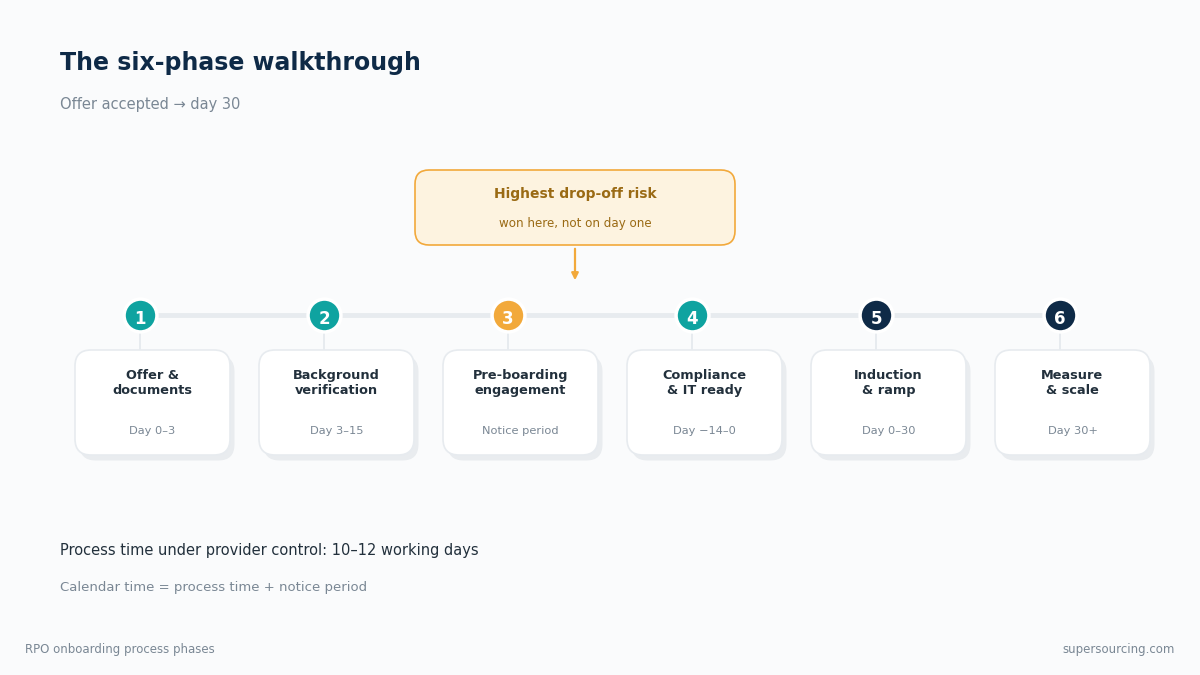
Phase 6 Measure, Scale, or Exit (Day 30+)
The last phase turns onboarding from an activity into a managed system.
The metrics that matter (and their healthy ranges):
- Offer-to-join ratio: 95%+ is achievable with a managed process; below 85% means the notice-period program is failing
- Onboarding cycle time: offer acceptance to fully-provisioned day one, net of notice period target under 10 working days of process time
- BGV turnaround: 7–12 working days for a standard package
- 30/90-day early attrition: under 5% at 90 days for permanent tech roles
- Candidate onboarding NPS: surveyed at day 30 this is a leading indicator for referral flow
Scaling: a documented onboarding playbook is what lets a program absorb a 3x hiring spike without a 3x coordination cost the marginal hire rides existing rails. This is where mature IT RPO services engagements differ most visibly from transactional recruiting: the asset being built is the process, not just the hires.
Exiting or replacing: every contract should specify what happens when a hire doesn’t work out a defined replacement window (a 7–10 working day replacement guarantee is a reasonable market standard to demand for early-tenure misfits), plus offboarding support that recovers assets and revokes access on a checklist, not from memory.
If the engagement itself ends, the playbook, templates, and data leave with the client that clause belongs in the MSA on day one.
The Program Layer Standing Up RPO Onboarding in the First 30 Days
The six phases above describe the per-candidate journey. But before the first candidate flows through it, the program itself has to be stood up and how well this setup month goes predicts everything downstream. If a provider proposes to “start onboarding candidates next week” with no setup phase, that is a red flag in itself.
A credible program setup, in sequence:
- Week 1 RACI and adjudication matrix. Every step in Phases 1–6 gets an owner: provider, client HR, hiring manager, or IT. The BGV adjudication matrix (which discrepancies auto-clear, which escalate, which reject) is agreed in writing now never candidate by candidate.
- Week 2 templates and rails. Offer letter and appointment letter templates approved by legal; the consolidated document-request list finalized; role-based IT provisioning templates built; BGV vendor scoped with turnaround SLAs on paper.
- Week 3 cadence and comms. The keep-warm calendar is templated by notice-period length (30/60/90-day tracks), touchpoint owners assigned, and escalation triggers defined with named recipients on the client side.
- Week 4 dashboard and dry run. The metrics from Phase 6 get a live dashboard, and one pilot candidate (or a simulated one) runs the full pipeline end to end to surface the handoff gaps no document review catches.
What to demand in the SLA itself: a joining-ratio commitment (with the measurement definition spelled out), BGV turnaround by package tier, document-collection cycle time, day-one readiness rate, and a review cadence weekly during ramp, monthly at steady state. An SLA that only commits to “submitting profiles” is a sourcing contract wearing an RPO label.
Data ownership, decided now: candidate documents, BGV reports, and consent records sit in whose system? Under whose data-protection obligations? Portable in what format if the engagement ends? These three questions take ten minutes to answer in week one and months to untangle later.
Case Studies: What a Managed Post-Offer Process Delivers
100+ engineers, hyper-growth timeline Paytm. Scaling an engineering org past the 100-hire mark compresses every weakness in a post-offer process, because dozens of candidates sit in notice periods simultaneously. Running document collection, parallel BGV, and a standardized keep-warm cadence as one pipeline rather than per-recruiter improvisation is what kept joining dates predictable enough for delivery teams to plan sprints around start dates. The operating principle: at volume, onboarding is a logistics problem, and logistics problems are solved with SLAs, not heroics.
High-frequency hiring with delivery-critical start dates Swiggy. In consumer-tech hiring cycles, a slipped joining date isn’t an HR inconvenience, it’s a missed feature deadline. A single-SPOC model with a 48-hour pre-joining confirmation call and escalation triggers on every wobble signal is what protects start dates when candidates are fielding multiple competing offers. Across engagements run on this model, Supersourcing sustains a 98% candidate joining rate and under 1% drop-off on contract roles numbers that only exist because the post-offer window is actively managed.
Recruitment automation end-to-end Somnoware. For a lean healthtech team, the win wasn’t just filled roles; it was removing the founders from onboarding administration entirely. Automated document workflows, BGV vendor coordination, and templated day-one provisioning turned a process that previously consumed leadership hours per hire into an exception-only review. The pattern generalizes: below ~50 employees, the true cost of in-house onboarding is senior-leader attention, not HR salary.
Decision Framework: Who Should Own Post-Offer Onboarding?
There are three viable ownership models. The right one depends on volume, internal HR bandwidth, and how expensive a slipped joining date is for your delivery plan.
| Dimension | In-house | RPO-owned | Hybrid (RPO to day 1, client after) |
| Best at volume of | <5 hires/quarter | 10+ hires/quarter or spiky demand | 5–15 hires/quarter |
| Offer-to-join accountability | Diffused (recruiter → HR handoff) | Contractual, SLA-backed | Contractual to day one |
| Drop-off risk | Highest the dead zone is usually unowned | Lowest dedicated keep-warm program | Low pre-joining; depends on client post-joining |
| Process cost per hire | Hidden in salaries and manager time | Explicit line item | Explicit pre-joining, hidden after |
| Compliance (EPF/ESIC, I-9, BGV consent) | Depends on internal HR maturity | Provider-managed, audit-trailed | Provider-managed to day one |
| Speed to stand up | Immediate but unstructured | 2–4 weeks program setup | 2–3 weeks |
| Candidate experience consistency | Varies by recruiter | Standardized cadence | Standardized until handover |
| Culture integration depth | Strongest | Needs deliberate client involvement | Strong (client owns weeks 1–12) |
How to choose in four questions:
- Can you name your offer-to-join ratio for last quarter? If no → you need process ownership before you need more sourcing. Start with RPO-owned or hybrid.
- Is hiring volume spiky? Bursts of 15+ simultaneous notice-period candidates overwhelm in-house cadences → RPO-owned.
- Is your bottleneck pre-joining drop-off or post-joining attrition? Pre-joining → hybrid is sufficient. Both → full-cycle RPO with 90-day tracking.
- Do you have a dedicated onboarding owner in-house (not “HR, among other things”)? If yes and volume is low → in-house with this guide as the playbook is genuinely fine.
One boundary worth restating: this framework covers hires on your payroll. If the people joining are a vendor’s employees deployed to you, that is a different motion. The staff augmentation onboarding process is shorter, skips most statutory steps on your side, and shifts compliance to the vendor.
What Most Teams Get Wrong
Patterns from watching hundreds of offer-to-joining windows succeed and fail:
They celebrate at acceptance. The dashboard counts “offers accepted” as wins, incentives paid out, attention moves on. The correct mental model: an accepted offer is a candidate entering the highest-risk stage of your funnel, not exiting it. Teams that re-badge acceptance as “notice period started” in their ATS behave measurably differently.
They confuse contact with engagement. A monthly “hope you’re doing well!” email is not a keep-warm program. Engagement that works is specific and forward-pulling: the team intro call, the architecture doc shared early, the day-one agenda. Generic check-ins signal process; specific ones signal belonging.
They run BGV sequentially or worse, after joining. Sequential checks add 1–2 weeks for nothing. Post-joining BGV is a compliance time bomb: discovering a material discrepancy in week three of employment creates a termination problem instead of a hiring decision.
They treat every counter-offer as a betrayal instead of a certainty. In-demand engineers on notice will be countered planning for it is table stakes. The teams that lose the fewest candidates are the ones that raise the topic first, in week one, on their own terms.
They under-communicate logistics. Candidates rarely say “I’m dropping off because nobody told me what day one looks like.” But disorganized pre-boarding is a leading indicator candidates read fluently: if you can’t manage my paperwork, what is working here like? Gallup’s 12% figure exists because most organizations genuinely are this disorganized which also means a merely competent pre-boarding experience is a differentiator.
They measure the recruiter’s funnel and nobody’s dead zone. Time-to-fill, cost-per-hire, interview-to-offer all tracked. Offer-to-join ratio, drop-off by notice length, BGV turnaround, day-one readiness rate usually nowhere. You fix what you measure; the dead zone stays dead because it has no metric and therefore no owner.
They design onboarding for the office and copy-paste it to remote. Remote hires need assets shipped a week earlier, access tested before day one, and roughly double the deliberate human touchpoints the ambient absorption of an office doesn’t exist over Slack.
Cost & Timeline Reality Check
The section most content skips, with the caveat every honest one carries: ranges below reflect typical market patterns for India-centric tech hiring; your quotes will vary with volume, role seniority, and scope.
What the RPO offer to joining process typically costs:
| Pricing model | Typical structure | Best for |
| Per-hire success fee | 6–12% of annual CTC for tech roles (onboarding bundled); lower at committed volume | Predictable, moderate volume |
| Management fee + success fee | Fixed monthly program fee + reduced per-hire fee | High volume, embedded RPO teams |
| Per-process fees (unbundled) | Onboarding-only or BGV-only administration priced per candidate | Companies keeping sourcing in-house |
| BGV pass-through | Standard India package (identity + 2 employers + education + address + criminal) commonly runs ₹1,500–₹5,000 per candidate; premium tiers (global watchlist, credit) higher | Everyone insist on pass-through pricing, not marked-up bundles |
What drives cost up: 90-day notice markets (longer engagement programs), senior/leadership BGV tiers, multi-country compliance (I-9/E-Verify, right-to-work checks), physical asset logistics across cities, notice-period buyouts (typically 1–3 months of the candidate’s current salary budget it as a negotiation lever, not a surprise).
What drives cost down: volume commitments, role-based provisioning templates, e-signature and API-led identity verification, a single BGV vendor with negotiated turnaround SLAs.
How long does onboarding take through an RPO? The honest timeline:
- Offer release after verbal yes: 24 hours
- Document collection, complete: 3–5 working days
- Standard BGV package, run in parallel: 7–12 working days
- Notice period (the dominant variable): 0–90 days immediate joiners exist, 30–60 is the Indian norm
- Day-one readiness build (compliance + IT): overlaps the notice period; 10 working days of work
- Time to first deliverable (engineering): under 10 working days post-joining
- Time to full productivity: typically 8–12 weeks for mid-level engineering roles anyone promising two weeks is redefining “productive”
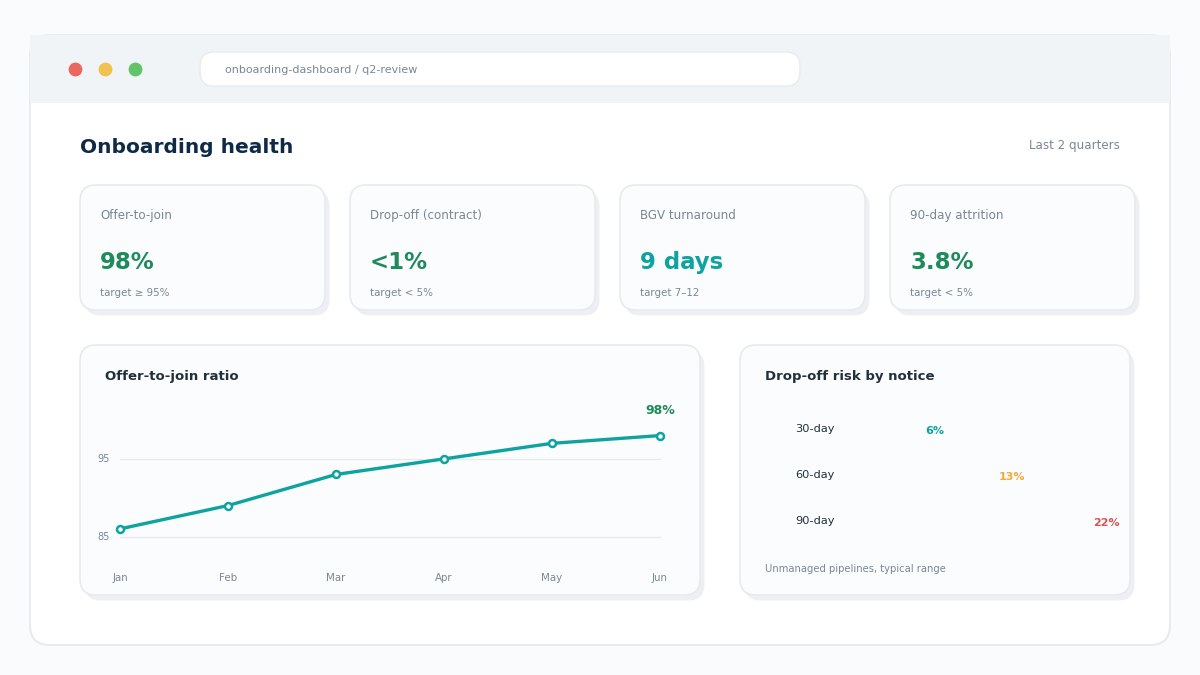
The planning rule: process time (everything the provider controls) should fit inside 10–12 working days. Calendar time is process time plus notice period. Conflating the two is how joining dates get promised to delivery teams and then missed.
If You’re Mid-Decision: The Next Step
You now have the complete map of the six phases, the checklists, the metrics, and the cost bands. If you’re running post-offer onboarding in-house at low volume, take the Phase 1–3 checklists from this guide and implement them as-is; they work without a vendor attached.
If you’re heading into a hiring spike, fighting a joining ratio below 90%, or spending leadership hours chasing payslips and BGV vendors, the faster path is a working session on your actual funnel numbers. Supersourcing runs these as structured consultations, bring your last two quarters of offer and joining data, and leave with a gap analysis against the benchmarks in this guide and a view of what an SLA-backed program would look like for your volume.
Start here: https://supersourcing.com/contact-us/
FAQ: The RPO Onboarding Process
What is the onboarding process in RPO?
It is the provider-managed sequence between offer acceptance and early tenure: releasing and e-signing the offer, collecting documents, running background verification in parallel, engaging the candidate through their notice period, preparing payroll, statutory, and IT readiness, running day-one induction, and tracking the first 30–90 days with joining and ramp metrics written into the SLA.
What happens immediately after a candidate accepts an offer?
In a well-run program, three things inside 72 hours: the formal offer letter goes out for e-signature within 24 hours, a single consolidated document-and-consent request follows, and a named point of contact introduces themselves to the candidate. BGV is triggered as soon as consent lands; everything else in the timeline touches off that first burst of speed.
How do RPO companies reduce candidate drop-off before joining?
Through a scheduled pre-boarding program: touchpoints every 7–10 days across rotating channels, a mid-notice call with the future manager, proactive counter-offer coaching in week one, a logistics confirmation two weeks out, and a final verbal reconfirmation 48 hours before joining with every wobble signal logged and escalated. Managed this way, joining rates of 95–98% are realistic; unmanaged, one in five accepted offers can evaporate.
How long does background verification take in India?
A standard package identity, address, education, two employment checks, and a court-record search closes in 7–12 working days when all checks run in parallel. Employment verification is usually the long pole at 3–7 working days per employer. Sequential processing, slow-responding past employers, or older university records can stretch the same package past 20 working days.
What documents are collected after offer acceptance?
For an India tech hire: PAN and Aadhaar, educational certificates, the last three months’ payslips, relieving and experience letters from recent employers, UAN details, bank proof, and photographs plus signed BGV consent. US hiring adds I-9 documentation and E-Verify processing. The mark of a good process is that this arrives as one consolidated request, once.
Who is responsible for onboarding in an RPO model the provider or the employer?
Ownership splits by layer: the provider runs the workflow documents, BGV coordination, engagement cadence, compliance prep, day-one logistics while the employer owns decisions (offer terms, BGV adjudication calls) and relationships (manager touchpoints, team integration, the 30-60-90 plan content). The division should be written into the SOW as a RACI, not assumed.
What is a good offer-to-join ratio for tech hiring?
Above 95% indicates a genuinely managed post-offer process. 85–95% is common for teams with partial pre-boarding discipline. Below 85% means the notice-period window is effectively unowned, and fixing that leak will return more hires than any increase in sourcing spend. Measure it split by notice-period length; the 90-day cohort is where weak processes show first.
How do we know if our current post-offer process needs outsourcing?
Run a two-quarter audit: your offer-to-join ratio, average days from acceptance to complete documentation, BGV turnaround, and day-one readiness rate (access + assets live by noon). If you can’t produce these numbers at all, that absence is the answer. If you can, and the joining ratio sits below 90% at meaningful volume, a structured external program typically pays for itself on the recovered hires alone, a conversation worth having with a provider before your next hiring spike, not during it.
