

The cloud is no longer a future bet; it is the foundation of how modern enterprises operate, scale, and compete. By 2026, the global cloud market is projected to reach approximately $762 billion, with public cloud accounting for nearly 75% of all deployments. This shift is not just about infrastructure it reflects a fundamental change in how organizations build, deploy, and manage technology.
From AI-driven applications to real-time data processing and global digital platforms, businesses are increasingly relying on cloud ecosystems to move faster and innovate at scale. As adoption accelerates, companies looking to hire Pulumi DevOps Engineer India are seeing rising demand for infrastructure-as-code expertise, especially for managing multi-cloud environments with greater automation and control.
For organizations aiming to stay competitive, the question is no longer whether to invest in cloud, but how to build the right teams that can fully leverage its potential across DevOps, cloud engineering, and modern infrastructure platforms.
TL;DR: What This Blog Covers
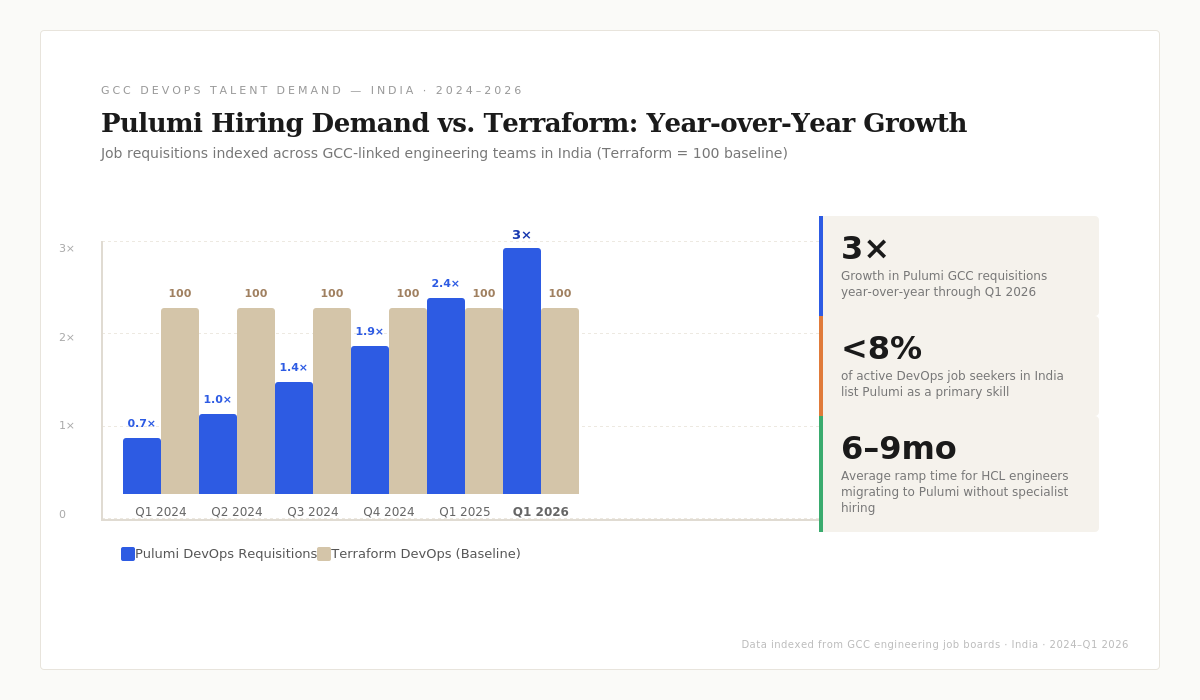
Pulumi is replacing Terraform as the infrastructure tool of choice inside GCCs and the engineers who know it are scarce. Fewer than 8% of active DevOps job seekers in India list Pulumi as a primary skill. Demand is already outpacing supply.
This blog breaks down exactly what a production-ready Pulumi DevOps engineer looks like, what skills to screen for, and how much it costs to hire Pulumi DevOps engineer India across three models: FTE, contract, and staff augmentation.
If your GCC has a cloud migration on the roadmap for 2026, this is the hiring decision you need to make before it becomes urgent. The cost comparison, skills checklist, and hiring timeline data are all here.
What Is Pulumi?
Pulumi is an open-source infrastructure as code platform that lets engineering teams define, deploy, and manage cloud resources using general-purpose programming languages Python, TypeScript, Go, and Java rather than domain-specific configuration syntax. Unlike HCL-based tools, Pulumi integrates directly into existing software development workflows, enabling loops, conditionals, unit tests, and package reuse across multi-cloud environments.
Why GCCs Can’t Staff This Role Off a Generic DevOps JD
Most GCC infrastructure teams were built on a Terraform-first assumption. That assumption is now creating measurable drag. When a platform team needs to extend provisioning logic, dynamic resource graphs, policy-as-code, cross-account dependency management Terraform’s declarative ceiling becomes a hard constraint. Engineers work around it with brittle workarounds that accumulate as technical debt.
The gap between “DevOps engineer” and “engineer who can write production-grade Pulumi programs” is not cosmetic. It is a 6–9 month skills gap on average for an engineer migrating from HCL-only backgrounds. GCCs running quarterly delivery cycles cannot absorb that ramp internally without stalling cloud migration timelines. This is precisely why demand to hire Pulumi DevOps engineer India has moved from exploratory to urgent across sectors including BFSI, SaaS, and enterprise software.
The compounding factor: fewer than 8% of active DevOps job seekers in India list Pulumi as a primary skill on their profiles as of early 2026. Demand is outpacing supply by a ratio that justifies proactive sourcing over reactive posting.
The Technical Profile: What a Pulumi DevOps Engineer Actually Needs
This is where most hiring briefs fall short. A qualified candidate is not simply someone who has used Pulumi once on a side project. For GCC-grade infrastructure work, the skills baseline is specific.
Core Infrastructure as Code Skills
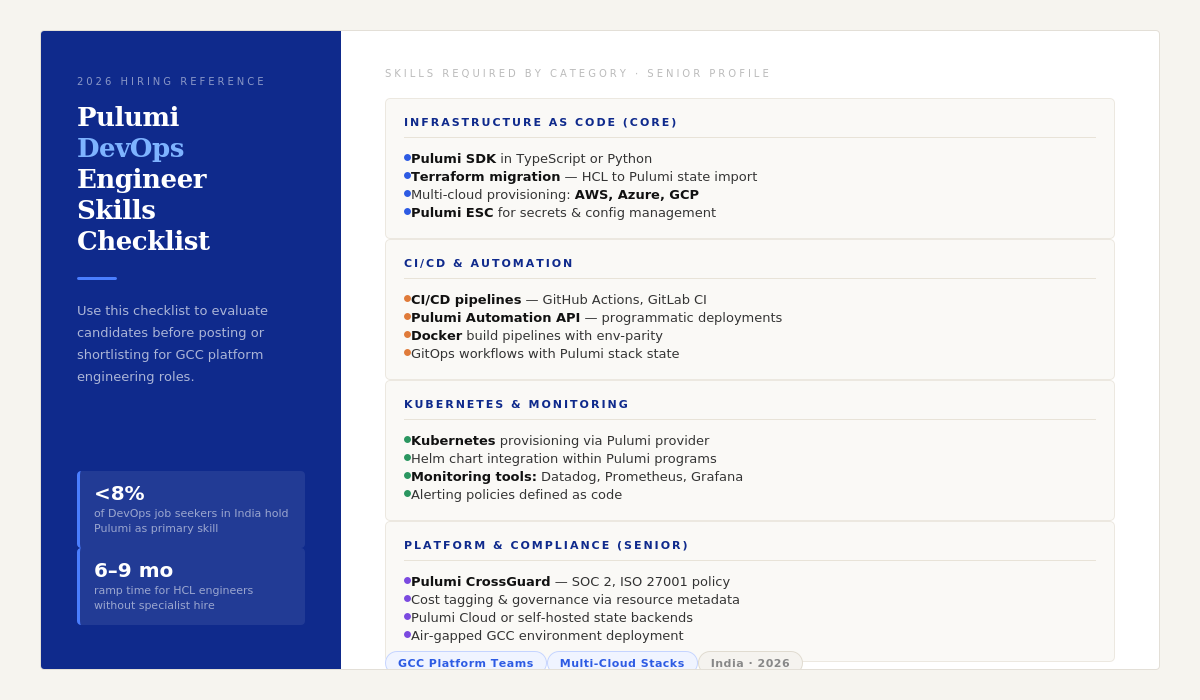
- Pulumi SDK proficiency in at least one general-purpose language (TypeScript or Python preferred for most GCC stacks)
- Terraform migration experience the ability to import existing state and refactor HCL into Pulumi programs without downtime
- Multi-cloud provisioning across AWS, Azure, and GCP using Pulumi’s native providers
- Pulumi ESC (Environments, Secrets, and Configuration) for secrets management at scale
CI/CD and Automation
- CI/CD pipeline design using GitHub Actions, GitLab CI, or Azure DevOps integrated with Pulumi Automation API
- Docker image build pipelines with environment-parity across dev, staging, and production
- GitOps workflows with Pulumi stacks as the source of truth for infrastructure state
Container Orchestration and Monitoring
- Kubernetes cluster provisioning and configuration management via Pulumi’s Kubernetes provider
- Helm chart integration within Pulumi programs
- Observability stack integration Datadog, Prometheus, Grafana configured and deployed as Pulumi resources
- Monitoring tools alerting policies defined as code, not as manual console configurations
Platform and Compliance Depth
- Pulumi CrossGuard for policy enforcement (compliance-as-code for SOC 2, ISO 27001 environments)
- Cost tagging and governance using Pulumi resource metadata
- Experience with Pulumi Cloud or self-hosted backends for state management in air-gapped GCC environments
Real-World Application: GCC Teams That Made the Shift
Financial Services Platform Engineering Team (India GCC, ~1,200 engineers): Migrated 340 Terraform modules to Pulumi TypeScript over 14 weeks. Outcome: 40% reduction in provisioning errors, CI/CD pipeline runs dropped from 22 minutes to 9 minutes on average. The enabling factor was a 4-person Pulumi-specialist team sourced via staff augmentation.
Enterprise SaaS Product Company (GCC, Hyderabad): Needed multi-region AWS infrastructure for a new product line with a 10-week go-live deadline. Hired two niche DevOps skills 2026-aligned engineers on a 6-month contract. Infrastructure was production-ready in week 8. Extending to FTE was straightforward because skills documentation was built into the Pulumi codebase from day one.
Pulumi vs Terraform Hiring: Three Models, Real Cost Comparison
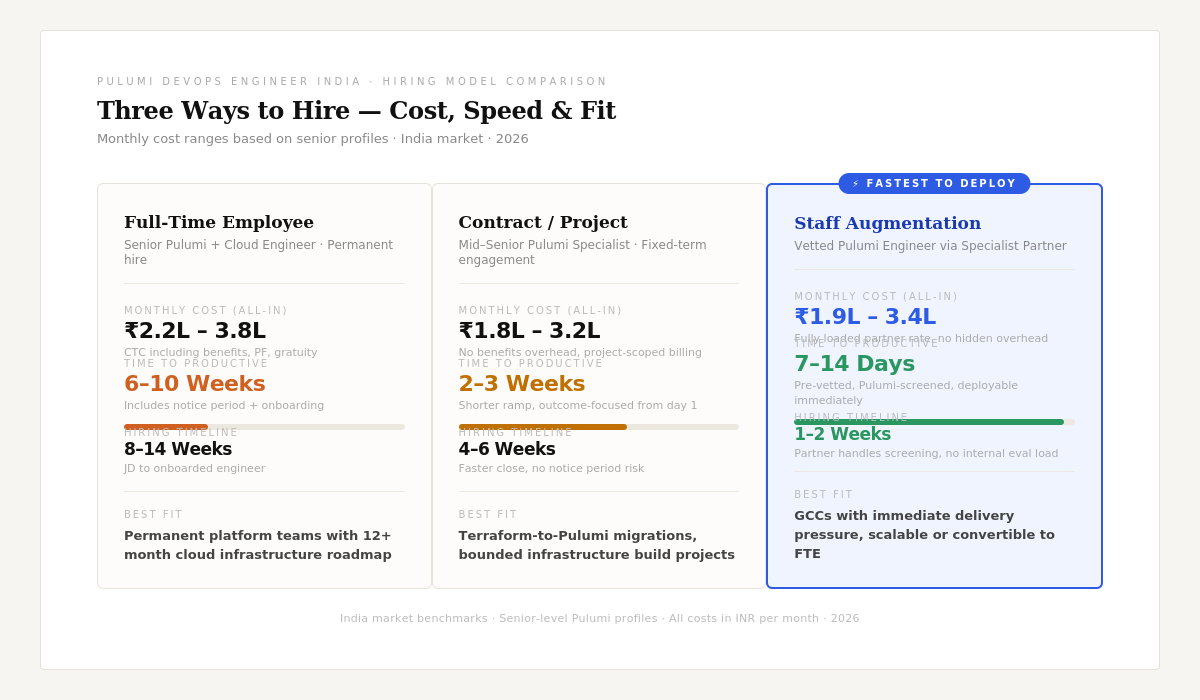
Pulumi vs Terraform hiring conversations almost always surface as a cost question. Here is an honest breakdown across the three models relevant to GCCs.
| Hiring Model | Typical Profile | Monthly Cost (India) | Time to Productive | Best Fit |
| Full-Time Employee (FTE) | Senior Pulumi + cloud engineer | ₹2.2L – ₹3.8L/month | 6–10 weeks (onboarding) | Long-term platform teams |
| Contract / Project-Based | Mid–Senior Pulumi specialist | ₹1.8L – ₹3.2L/month | 2–3 weeks | Defined migration projects |
| Staff Augmentation | Vetted Pulumi engineer via partner | ₹1.9L – ₹3.4L/month (all-in) | 1–2 weeks | Speed-to-deploy, scalable capacity |
Staff augmentation consistently wins on time-to-productive for GCCs with immediate delivery pressure. FTE wins on total cost of ownership when the role is permanent and the team is stable. Contract hiring is optimal for bounded migration work Terraform-to-Pulumi transitions being the clearest example.
One cost factor most hiring managers omit: the internal sourcing and interviewing overhead for a niche profile. A Pulumi-specific technical screen requires a current practitioner to evaluate candidates. If that expertise doesn’t exist internally, the screening process either fails silently or delays hiring by 4–8 weeks.
What Most Teams Get Wrong When They Hire Pulumi DevOps Engineer India
The most common mistake is writing a Terraform JD with “Pulumi” inserted into the skills list. These two tools require fundamentally different engineering instincts. Terraform engineers optimize for declarative correctness; Pulumi engineers need to reason about program state, side effects, and async execution concepts native to software development, not configuration management.
The second mistake is underspecifying the cloud context. A Pulumi engineer with deep AWS experience and shallow Azure exposure will not be effective on a multi-cloud GCC stack without a 3–4 month ramp. Specify the primary cloud provider in the JD. It narrows the candidate pool usefully.
The third mistake: skipping Pulumi Automation API as an evaluation criterion. Teams that don’t assess this are hiring for yesterday’s use cases. The Automation API is what enables Pulumi to power internal developer platforms, self-service infrastructure portals, and programmatic deployment pipelines the exact workloads GCCs are scaling toward in 2026.
Frequently Asked Questions
What is Pulumi and how is it different from Terraform?
Pulumi is an infrastructure as code platform that uses general-purpose programming languages (Python, TypeScript, Go) to define cloud infrastructure. Terraform uses its own declarative language, HCL. The core difference is that Pulumi programs can use loops, conditions, functions, and unit tests natively making them more maintainable for complex, dynamic infrastructure requirements.
Why are GCCs specifically looking to hire Pulumi DevOps engineer India talent now?
GCCs are scaling cloud-native platforms rapidly, and Terraform’s declarative limitations are surfacing in production. Pulumi enables reusable infrastructure libraries, policy-as-code enforcement, and tighter CI/CD integration. India has the largest pool of available cloud engineers globally, making it the most efficient sourcing market for this niche DevOps skills 2026 profile.
How much does it cost to hire a Pulumi DevOps engineer in India?
Depending on experience and model: FTE senior engineers cost ₹2.2L–₹3.8L per month in total compensation. Contract specialists run ₹1.8L–₹3.2L per month. Staff augmentation all-in rates sit between ₹1.9L–₹3.4L per month. Mid-level profiles with 2–4 years of Pulumi experience come in at the lower end of each range.
What is the realistic hiring timeline for this profile?
For a direct FTE hire, expect 8–14 weeks from JD to onboarded engineer longer if the internal technical screen isn’t calibrated for Pulumi specifically. Staff augmentation through a specialized partner can reduce that to 7–14 days for a vetted, deployable engineer.
Is staff augmentation or FTE better for Pulumi DevOps hiring in GCCs?
It depends on the horizon. For a bounded migration Terraform to Pulumi, a new product infrastructure build staff augmentation delivers faster and at lower risk. For permanent platform engineering roles, FTE provides better knowledge retention and team cohesion. Many GCCs use staff augmentation to build and document the Pulumi foundation, then convert or hire FTEs once the stack is stable.
What should a Pulumi DevOps skills checklist include for 2026 hiring?
At minimum: Pulumi SDK in Python or TypeScript, Terraform migration experience, Kubernetes provider proficiency, CI/CD pipeline integration via Automation API, Docker build pipeline experience, monitoring tools integration (Prometheus, Datadog), and Pulumi CrossGuard for policy enforcement. For senior roles, add Pulumi ESC and multi-cloud provider depth.
How do we evaluate candidates if we don’t have Pulumi expertise internally?
Use a structured take-home task: ask candidates to convert a provided Terraform module into a working Pulumi TypeScript program with at least one dynamic resource (e.g., a loop-based multi-AZ deployment). Evaluation criteria should include code structure, state management approach, and error handling not just whether it runs.
Build the Pulumi Capability Before You Need It
GCCs that wait for a blocked migration or a failed deployment to start sourcing Pulumi talent will spend 3–4 months catching up to teams that built this capability proactively. The infrastructure as code India talent market for Pulumi specialists is tightening not because supply is shrinking, but because demand is compressing the available pool faster than it can be trained.
Whether the right model is FTE, contract, or staff augmentation DevOps, the decision framework is the same: match the hiring model to the project horizon, specify the cloud context precisely, and evaluate on Pulumi-native competencies not generalist DevOps proxies.
If you’re building a GCC platform engineering team and need to pressure-test your Pulumi hiring approach before committing to a model, our team has run this exact process across 30+ GCC engagements. Reach out to discuss scope, timelines, and the right sourcing strategy for your infrastructure roadmap.
For GCC teams navigating this decision, Supersourcing offers a direct path pre-vetted Pulumi engineers, transparent cost structures, and a sourcing process built around niche DevOps profiles, not generic job boards. The capability gap is real. The window to address it proactively is narrowing.
