

ServiceNow implementations fail not because of the platform they fail because the wrong developer profile was hired for the wrong module. When Tanium is in the stack, that mismatch becomes expensive fast.
Most hiring briefs for a ServiceNow developer treat the role as a single job description. In practice, a developer building incident workflows in ITSM operates in an entirely different technical layer than one configuring vulnerability response pipelines for a ServiceNow Tanium integration. Conflating the two adds 3–4 months to project timelines and inflates rework costs by 40–60%.
Organizations that choose to hire ServiceNow developer India have a clear cost and talent-pool advantage but only when the hiring brief is built around module-specific skills, not a generic “ServiceNow experience” requirement.
Hire ServiceNow developer India is where many enterprises gain a cost and talent advantage but only when hiring is aligned to module-specific expertise like ITSM, SecOps, and Vulnerability Response, not a generic ServiceNow skillset.
The urgency is rising. According to Gartner IT spending forecast, global IT spending is projected to surpass $5 trillion and continue growing into 2026, with security and IT operations platforms driving a significant share of that investment.
The takeaway: in ServiceNow–Tanium environments, precise skill alignment isn’t optionalit’s the difference between scalable automation and months of costly rework.
What Is a ServiceNow Tanium Integration?
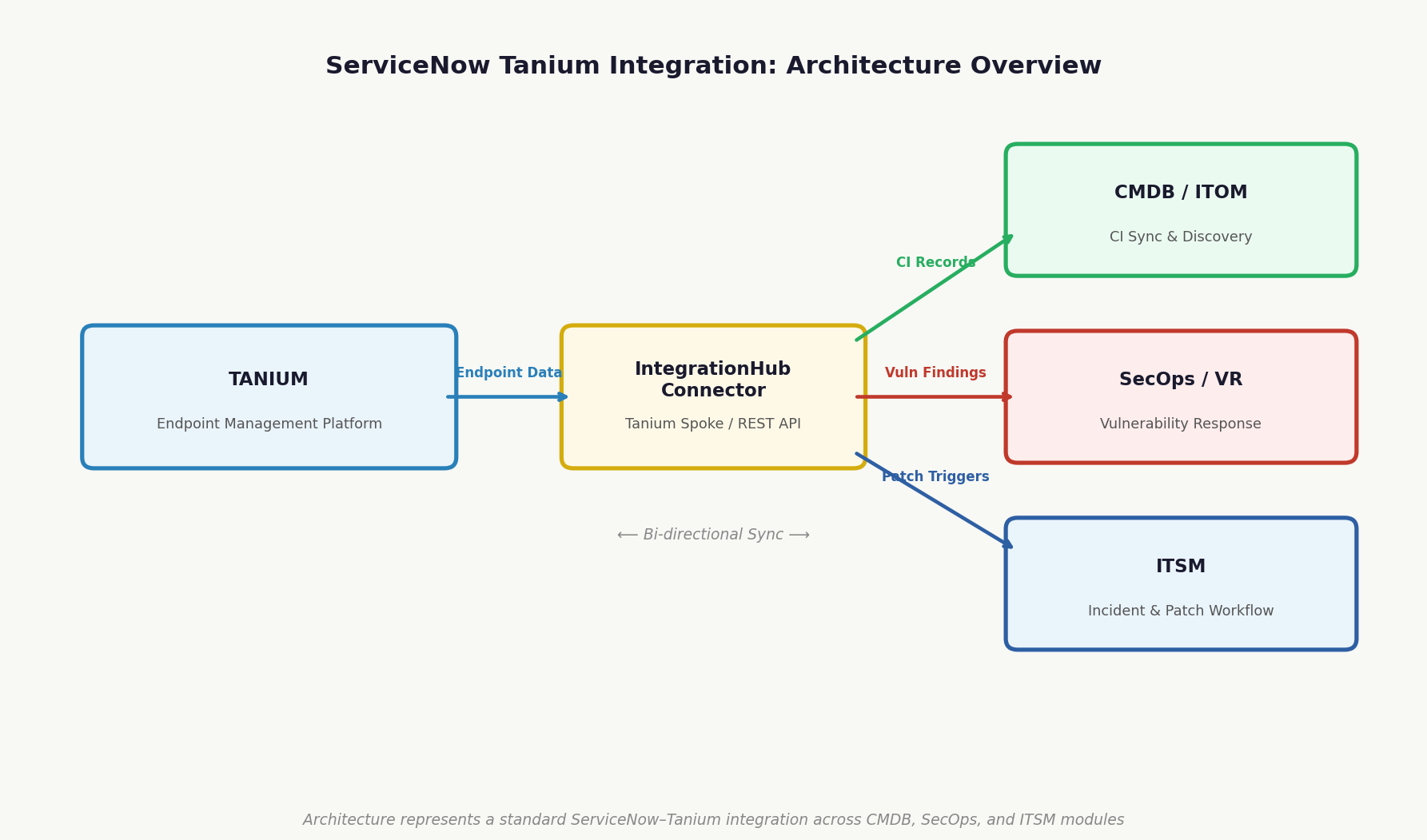
A ServiceNow Tanium integration is a bi-directional data sync between Tanium’s endpoint management platform and ServiceNow’s CMDB, SecOps, or ITOM modules enabling automated CI population, real-time vulnerability discovery, and patch orchestration without manual handoffs between security and IT operations teams.
The Real Cost of Hiring the Wrong ServiceNow Developer
The market to hire ServiceNow developer India has expanded significantly but so has the variance in skill depth. A developer with 3 years of general platform experience and a CSA certification is not equipped to architect a Tanium connector integration, configure bi-directional CMDB sync, or write transformation maps that maintain CI integrity across concurrent data sources.
The business cost is specific:
- A misconfigured CMDB due to Tanium CI conflicts can trigger false-positive incidents at a rate of 200–400 per week in mid-enterprise environments
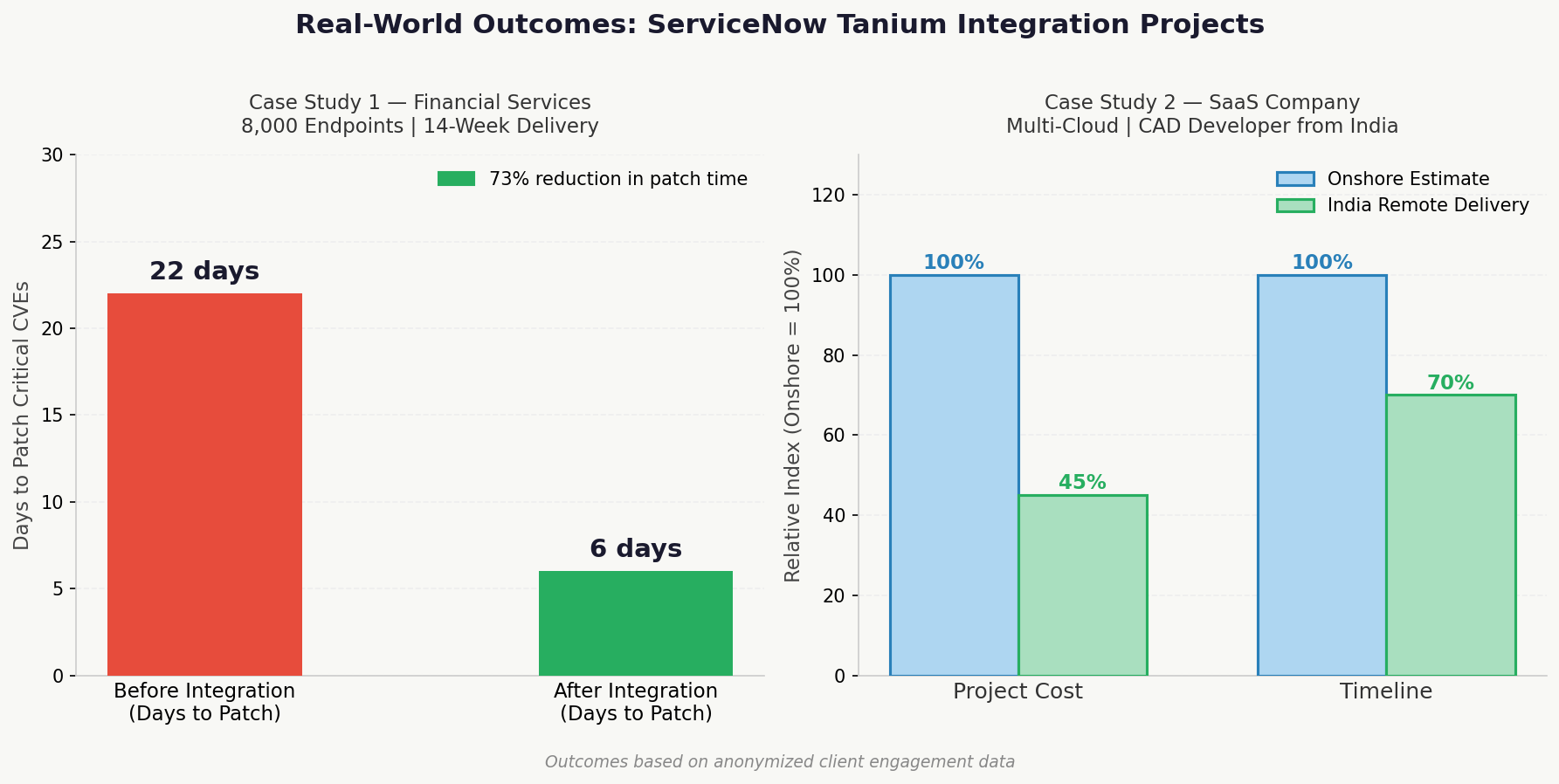
- Rearchitecting a flawed ServiceNow Tanium integration post-go-live typically costs 1.8–2.5x the original build cost
- Average timeline slippage from under-scoped developer hiring: 10–14 weeks on a 20-week program
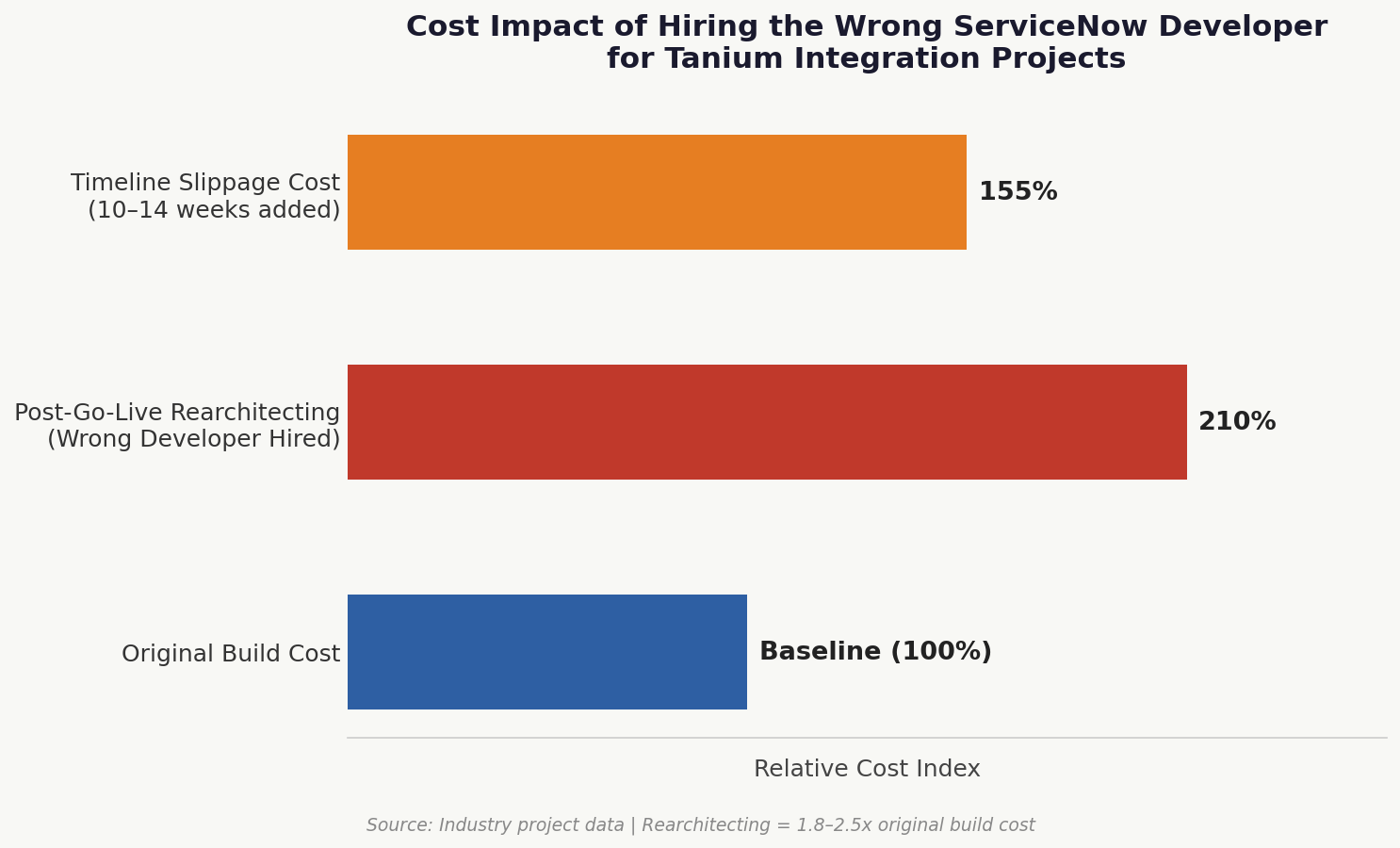
The ServiceNow developer salary India range also varies sharply by module depth. A developer working on standard ITSM workflows commands ₹10–16 lakhs annually. One with certified SecOps and integration architecture experience commands ₹22–35 lakhs a gap that reflects genuine skill differentiation, not market inflation.
Module-Specific Skills: ITSM, CSM, and SecOps Are Not Interchangeable
ITSM Developer India: Workflow and Process Automation
An ITSM developer India profile centers on incident, problem, change, and request management. Core competencies include Flow Designer, Service Catalog configuration, SLA policy design, and Business Rule scripting. For Tanium integration at the ITSM layer, the developer must understand how Tanium sensor data maps to CI attributes and how to prevent duplicate CI creation during automated discovery syncs.
Certifications that matter here: ServiceNow Certified System Administrator (CSA) and Certified Application Developer (CAD). These are baseline, not differentiators; what separates candidates is hands-on experience with IntegrationHub spokes and REST API orchestration.
ServiceNow CSM Module: Customer-Facing Complexity
The ServiceNow CSM module requires a different orientation agent workspace configuration, case routing logic, SLA escalation paths, and customer portal development. Tanium data rarely enters CSM directly, but when asset ownership is linked to customer accounts (as in managed services environments), the developer needs to understand how IT services management automation flows from Tanium into account-linked CIs within CSM.
Hiring for CSM without clarifying this dependency creates integration gaps that only surface 6–8 weeks into UAT.
ServiceNow SecOps Developer: The Tanium-Native Skill Set
This is where specificity matters most. A ServiceNow SecOps developer working on Tanium integration must be capable of:
- Configuring the Tanium Connector for ServiceNow (available via ServiceNow Store)
- Mapping Tanium vulnerability findings to VR (Vulnerability Response) records
- Setting up automated patch management workflow triggers based on CVSS score thresholds
- Maintaining CMDB accuracy through scheduled CI reconciliation jobs
- Building security operations center (SOC) integration handoff logic between Tanium alerts and ServiceNow SecOps cases
- Validating endpoint visibility data integrity across concurrent discovery sources
Fewer than 15% of developers who list “ServiceNow SecOps” on a CV have built this stack end-to-end. When you hire ServiceNow developer India for this profile, require a technical screen that includes a live CMDB reconciliation scenario not just a portfolio review.
Real-World Application: What These Projects Look Like in Practice
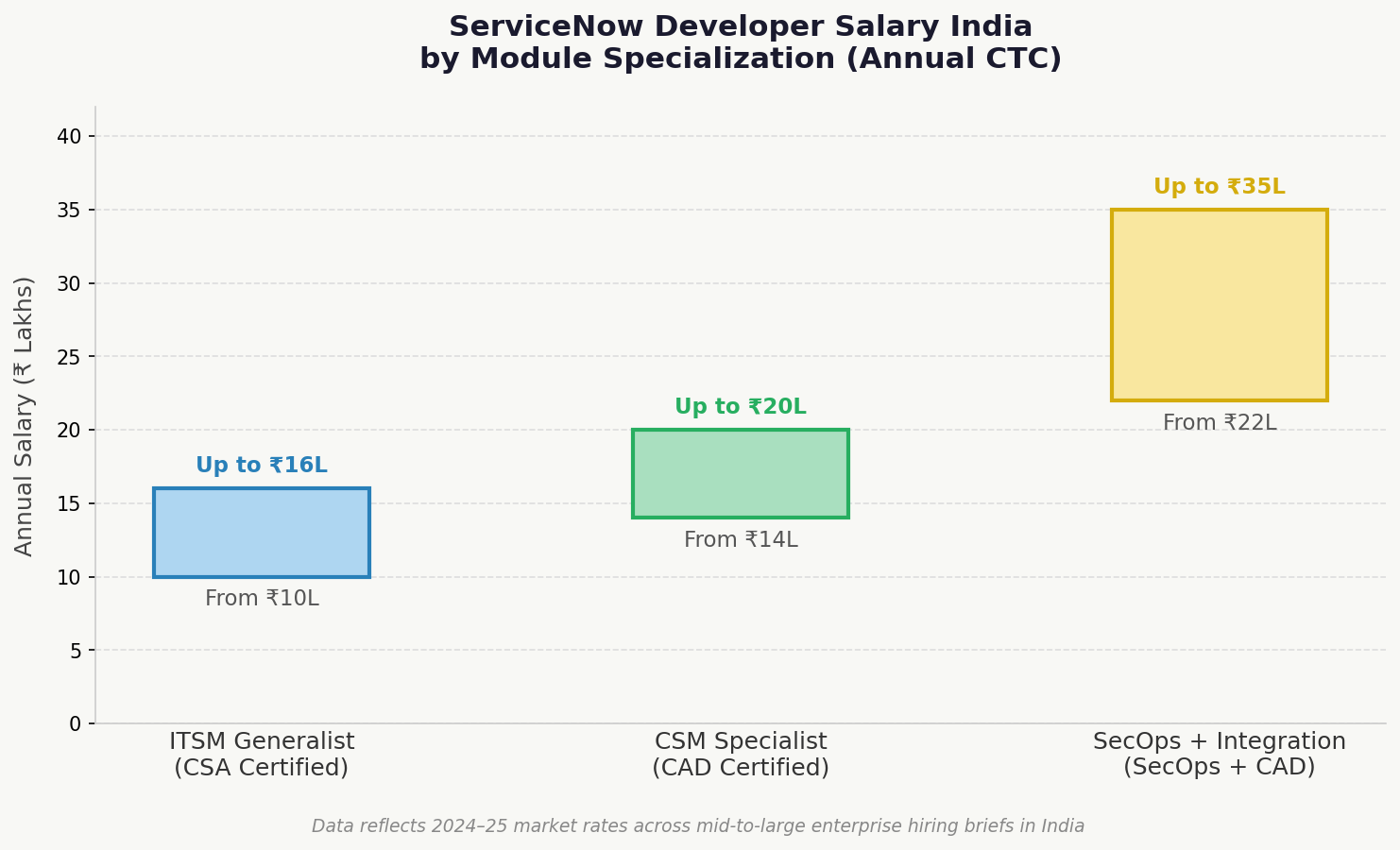
Case Study 1 Financial Services Firm, 8,000 Endpoints: A regional bank running Tanium for endpoint compliance needed its vulnerability data surfaced inside ServiceNow SecOps for automated ticket creation and SLA tracking. An ITSM developer India team of two developers, one SecOps-specialized, one integration-focused, completed the connector configuration, CI sync logic, and VR workflow build in 14 weeks. Post-deployment, mean time to patch for critical CVEs dropped from 22 days to 6 days.
Case Study 2 SaaS Company, Multi-Cloud Environment: A mid-market SaaS firm needed the ServiceNow CSM module linked to Tanium-sourced asset data for customer-facing incident reporting. The integration required custom transformation maps and a scheduled CI refresh that didn’t disrupt live case workflows. One certified CAD developer, engaged remotely from India, delivered the solution in 9 weeks 30% faster than the initial onshore estimate, at 55% of the projected cost.
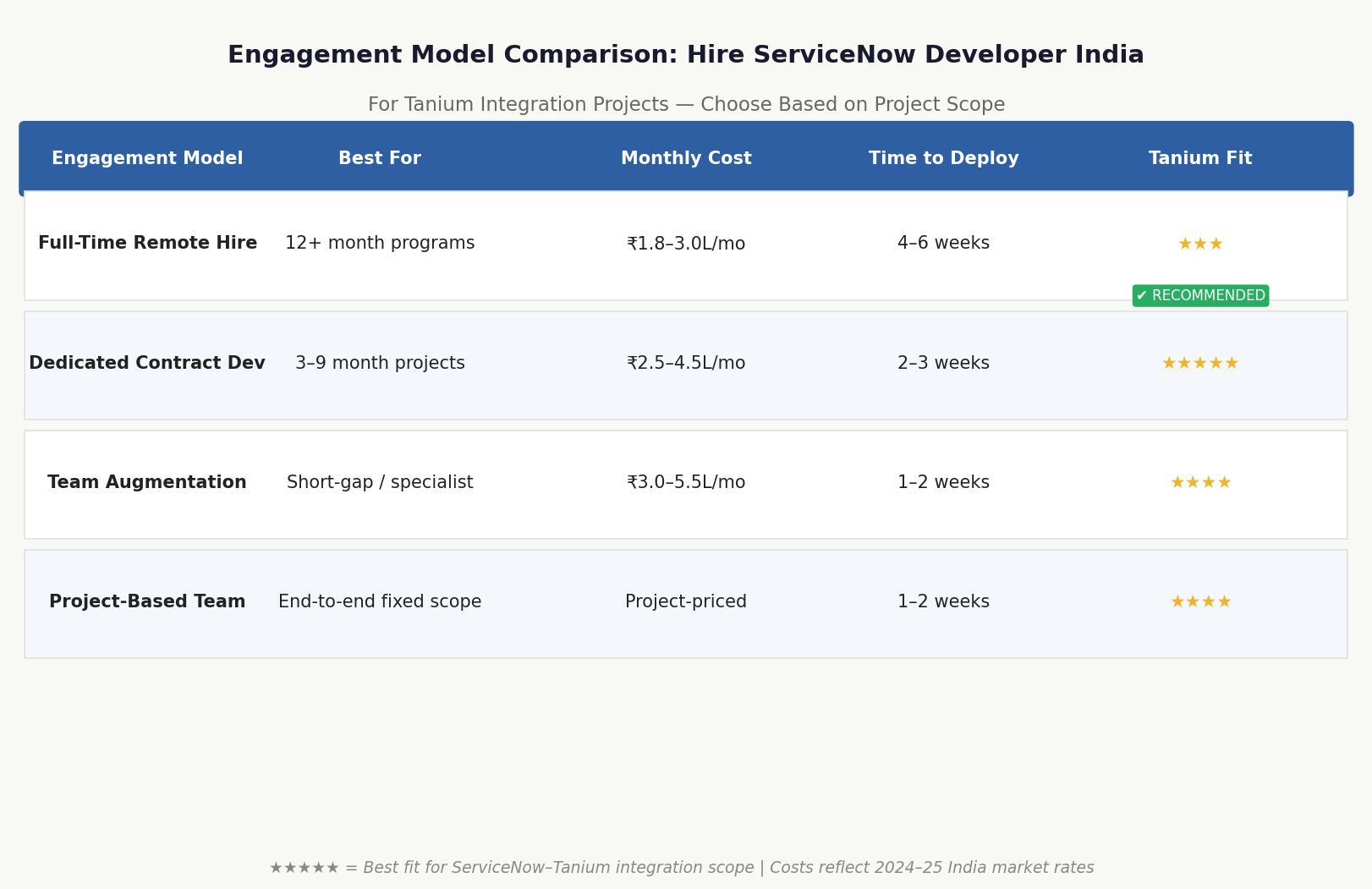
Comparing Engagement Models to Hire ServiceNow Developer India
| Engagement Model | Best For | Typical Cost (Monthly) | Time to Deploy |
| Full-time remote hire | 12+ month programs, complex integrations | ₹1.8–3.0L/month | 4–6 weeks |
| Dedicated contract developer | Defined-scope projects, 3–9 months | ₹2.5–4.5L/month | 2–3 weeks |
| Augmentation to existing team | Short-gap or specialized module work | ₹3.0–5.5L/month | 1–2 weeks |
| Project-based delivery team | End-to-end build, fixed deliverables | Project-priced | 1–2 weeks |
The best engagement model to hire ServiceNow developer India for a Tanium integration is typically a dedicated contract developer for the initial 4–6 month build, transitioning to a part-time support model post-deployment. Full-time hires make sense only when ongoing platform ownership is part of the roadmap.
What Most Teams Get Wrong When Hiring for Tanium Integration Projects
The most consistent mistake is scoping the developer role around the ServiceNow platform rather than the integration architecture. Teams post for a “ServiceNow developer” and evaluate candidates on platform breadth, how many modules they’ve touched, whether they know Flow Designer, whether they’ve done portal work.
None of that predicts success on a ServiceNow Tanium integration project.
The actual predictors are: familiarity with Tanium’s data model, experience with high-volume CI reconciliation (10,000+ records), and the ability to write transformation logic that handles dirty or incomplete endpoint data without corrupting the CMDB. These are integration engineering skills that happen to live inside ServiceNow not ServiceNow skills that extend into integration.
Hiring briefs that conflate the two will consistently produce candidates who are capable on the platform and lost in the architecture.
FAQ: Hiring ServiceNow Developers for Tanium Integration
What skills should a ServiceNow developer have for Tanium integration?
Beyond core ServiceNow scripting (JavaScript, GlideScript), the developer needs hands-on experience with the Tanium Connector, IntegrationHub, CMDB reconciliation rules, and Vulnerability Response module configuration. Experience with REST API data ingestion and transformation mapping is non-negotiable for any ServiceNow Tanium integration project of meaningful scale.
How much does it cost to hire a ServiceNow developer in India?
The ServiceNow developer salary India ranges from ₹10–16 lakhs annually for ITSM generalists to ₹22–35 lakhs for SecOps and integration specialists. On a contract basis, monthly rates range from ₹1.8L to ₹5.5L depending on specialization, engagement model, and project complexity.
Is a ServiceNow CSA certification enough for enterprise integration projects?
No. The ServiceNow Certified System Administrator (CSA) is a prerequisite, not a qualification. Enterprise integration work particularly anything involving Tanium, CMDB, or SecOps requires CAD-level certification at minimum, plus demonstrated project experience. Screening for certifications without evaluating integration-specific competency is one of the most common hiring errors in this space.
How long does a ServiceNow Tanium integration project typically take?
A standard ServiceNow Tanium integration covering CMDB sync, vulnerability discovery mapping, and patch workflow automation takes 12–20 weeks depending on environment complexity, number of endpoints, and existing CMDB data quality. Projects where CMDB remediation is required before integration add 4–8 weeks.
What is the difference between CSM, ITSM, and SecOps developer skills in ServiceNow?
ITSM developer India profiles focus on process automation and workflow configuration. CSM developers specialize in customer-facing case management and portal development. SecOps developers work on vulnerability response, threat intelligence ingestion, and security workflow automation. Each requires distinct scripting patterns, data models, and integration touchpoints treating them as interchangeable adds significant project risk.
What engagement model works best when hiring ServiceNow developers remotely from India?
For Tanium integration projects, a dedicated contract model (3–9 months) provides the best balance of cost efficiency and accountability. It allows for full-time focus on a defined integration scope without the overhead of a permanent hire, and it’s structured enough to maintain IT operations management (ITOM) continuity post-delivery.
How do I evaluate a candidate’s actual Tanium integration experience?
Request a technical walkthrough of a previous CMDB reconciliation project specifically how they handled CI conflicts from multiple discovery sources. Ask about their approach to endpoint visibility gaps when Tanium data is incomplete or stale. Candidates with genuine experience will describe specific edge cases; those without will describe platform features.
Pressure-Test Your Hiring Brief Before You Commit
Most failed ServiceNow Tanium integration projects aren’t platform problems; they’re hiring problems that surface six weeks into delivery. The developer profile, the engagement model, and the technical screening criteria need to be aligned to the specific integration architecture before a single CV is reviewed.
Hiring for platform breadth when the project demands integration depth is a pattern that repeats across engagements and it’s entirely avoidable with the right scoping process upfront. The difference between a 14-week delivery and a 28-week rework cycle often comes down to whether the hiring brief was built around the architecture or around a generic job title.
If your team is preparing to hire ServiceNow developer India for a Tanium integration and wants an independent review of your hiring brief, technical requirements, or vendor shortlist, our practice has structured this process across multiple SecOps and ITSM integration engagements. We work with technology teams at Supersourcing to match integration-specific developer profiles to project scope not just platform experience to a job description.
For a focused 45-minute scoping conversation before your next hire, reach out directly at mayank@engineerbabu.com. No lengthy intake forms, just a direct conversation about your integration architecture, timeline, and what the right developer profile actually looks like for your environment.
