

Demand for hiring Databricks engineer India talent has outpaced supply by a measurable margin and the gap is widening. Between 2022 and 2024, Databricks grew its enterprise customer base from 5,000 to over 10,000 globally, and a significant share of that implementation work is landing in Indian engineering hubs. The result: compensation benchmarks have fractured across three distinct hiring channels GCCs, IT services firms, and the open startup/product market and most organizations are using the wrong number when they budget.
Hire Databricks Engineer India decisions are now influenced by three very different markets GCCs, IT services firms, and startups each paying significantly different salary bands for similar skill sets. Most organizations still benchmark against outdated or irrelevant data, leading to under-leveled hires or offer drop-offs.
This gap is widening in 2026. According to Statista, the global big data and analytics market is projected to reach over $655 billion by 2029, reflecting accelerating demand for platforms like Databricks and the engineers who can operationalize them.
Despite this growth, most hiring strategies fail to account for how compensation actually differs across hiring channels.
TL;DR: What This Blog Covers
GCC, IT services, and startup markets pay Databricks engineers very differently. Most organizations benchmark against the wrong channel and overpay or underhire as a result. The gap between channels can be ₹10–25 LPA for the same job title.
Certified Databricks talent in India is scarce. Demand grew 67% in FY2024. Supply grew less than 20%. If you're hiring now without a structured approach, you're already 3–6 months behind.
This blog breaks down exact pay bands by channel, which Databricks certifications actually matter, how GCCs are structuring hires in 2025, and the two mistakes that derail most data lakehouse hiring India efforts before they start.
What Does It Mean to Hire Databricks Engineer India?
Hiring a Databricks engineer refers to recruiting a data engineering professional with hands-on proficiency in the Databricks Lakehouse Platform covering Delta Lake architecture, Apache Spark optimization, Unity Catalog, and typically at least one cloud provider (AWS, Azure, or GCP). These engineers design, build, and maintain large-scale data pipelines and analytical infrastructure, and they operate at the intersection of data engineering, cloud infrastructure, and increasingly, ML/AI workflows.
The Real Problem With Data Lakehouse Hiring India
The supply-demand imbalance is only half the problem. The deeper issue is that the three hiring channels GCCs, IT services firms, and the startup/product market operate with completely different compensation logic, and organizations frequently benchmark against the wrong one.
An IT services firm paying a Databricks developer ₹12–18 LPA is not competing with a GCC offering ₹22–35 LPA for the same profile. And neither is competing with a well-funded product startup offering ₹35–50 LPA plus ESOPs. These aren’t slight variations; they represent fundamentally different talent pools with different retention rates, skill depths, and delivery expectations.
Teams that conflate these three markets when scoping headcount budgets routinely underestimate hiring costs by 2–3x or end up hiring the wrong tier of engineer for the problem they’re trying to solve.
GCC Pay Bands vs Open Market: Databricks Developer Salary India
What GCCs Are Currently Paying
GCC talent acquisition India for Databricks roles has settled into a relatively consistent band, though it varies by parent company geography and sector.
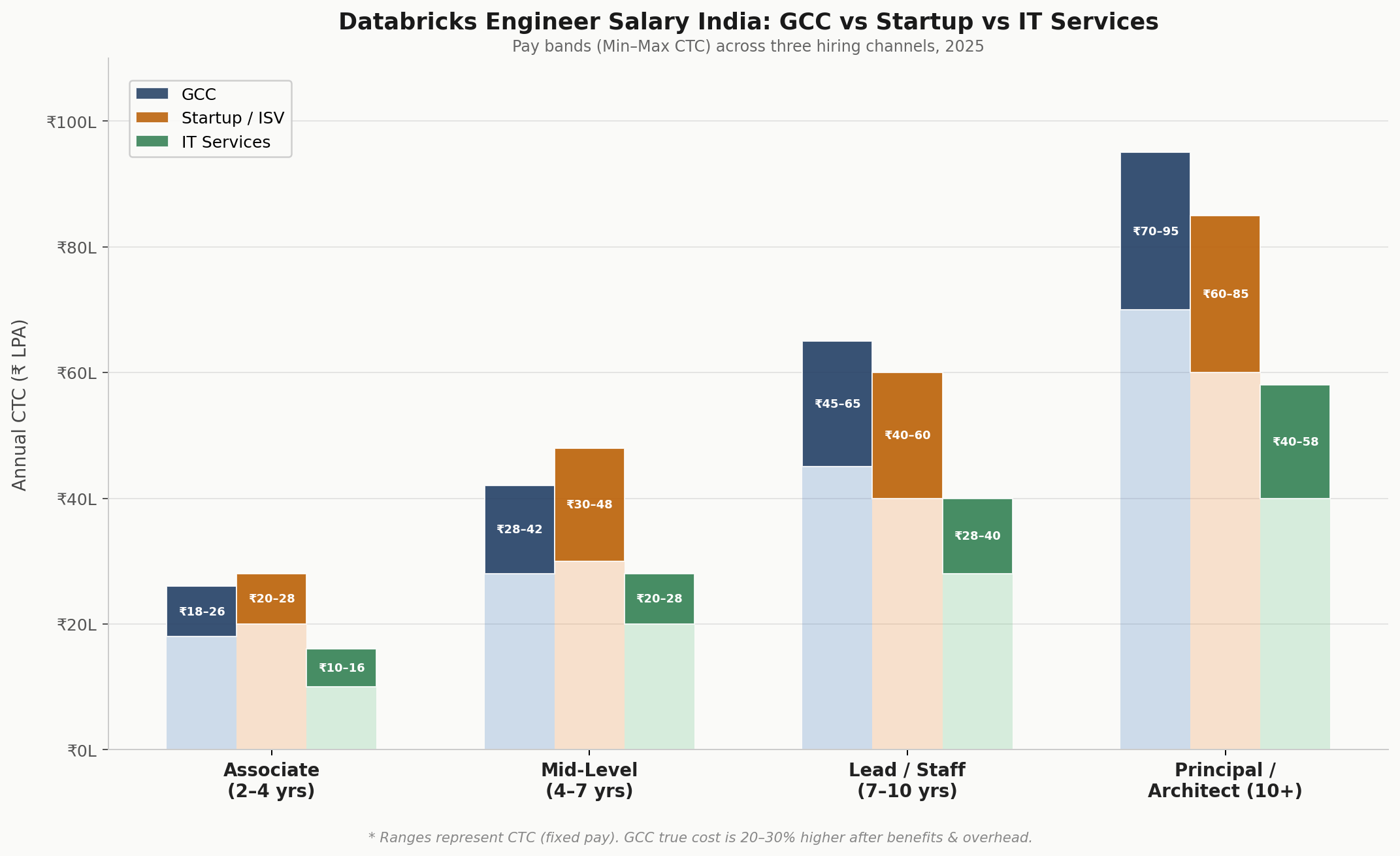
- Associate Data Engineer (2–4 years, Databricks exposure): ₹18–26 LPA
- Data Engineer / Senior DE (4–7 years, Delta Lake + Spark): ₹28–42 LPA
- Lead / Staff Engineer (7–10 years, Unity Catalog, architecture ownership): ₹45–65 LPA
- Principal / Architect (10+ years, platform design): ₹70–95 LPA
GCCs typically add 20–30% on top of fixed compensation in benefits, infrastructure, and compliance overhead, bringing the true cost significantly higher than the CTC number alone.
What the Open Market Is Paying
The open market startups, ISVs, and consulting firms actively building lakehouse architecture practices runs on different economics:
- Mid-level Databricks engineer (4–6 years): ₹30–48 LPA at funded startups; ₹20–28 LPA at IT services
- Senior Databricks engineer with MLflow or streaming experience: ₹45–60 LPA
- Contract / Staff Augmentation rates: ₹8,000–₹14,000 per day (project-based)
The gap between IT services and GCC rates for equivalent profiles is typically ₹10–15 LPA at mid-senior levels. That gap reflects tenure expectations, project complexity, and the degree of ownership the engineer is expected to carry.
Databricks vs Snowflake Engineer Cost: A Direct Comparison
This comparison comes up in nearly every data platform team cost conversation, and the numbers are closer than most hiring managers expect.
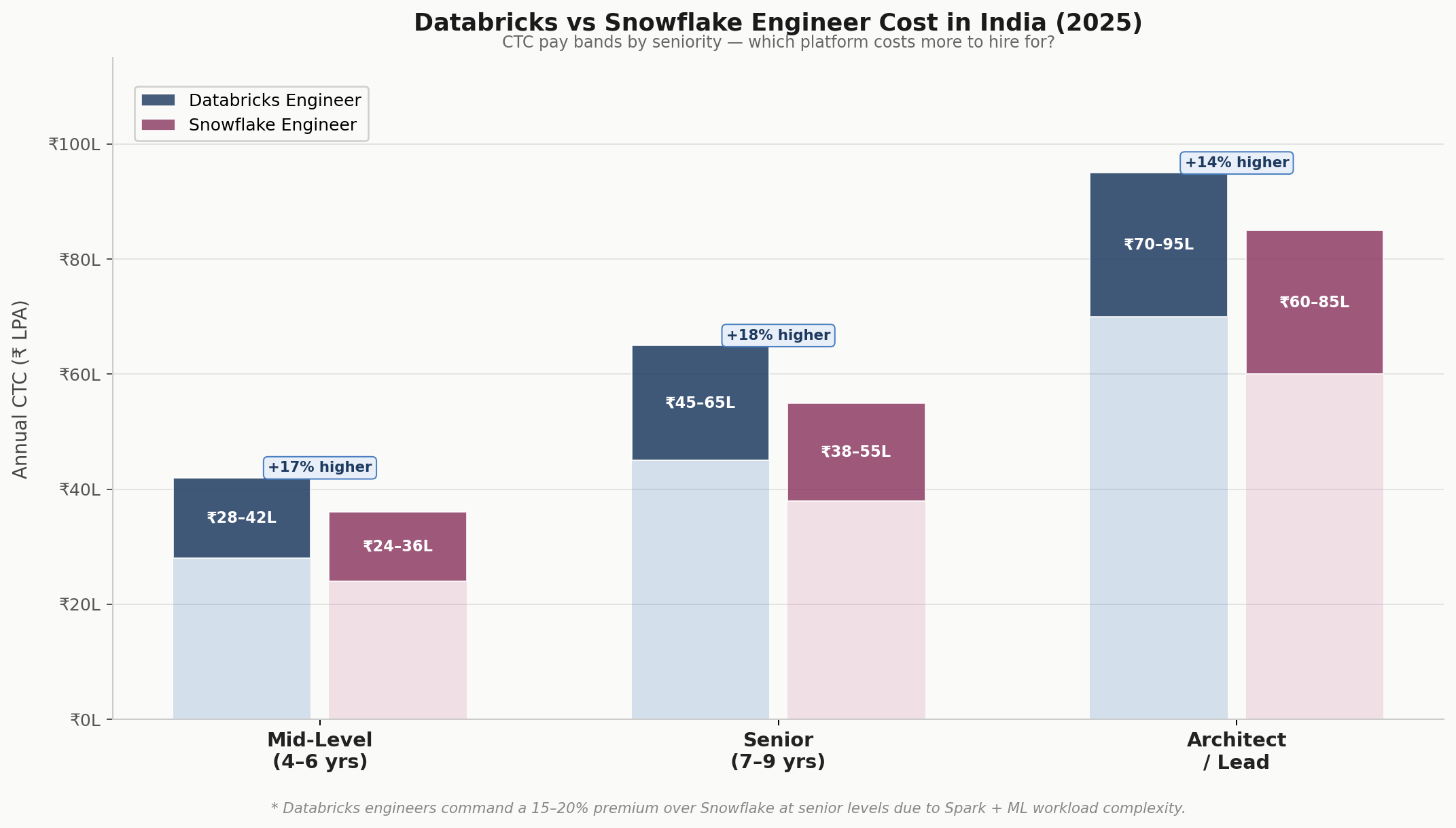
| Profile | Databricks Engineer (India) | Snowflake Engineer (India) |
| Mid-level (4–6 yrs) | ₹28–42 LPA | ₹24–36 LPA |
| Senior (7–9 yrs) | ₹45–65 LPA | ₹38–55 LPA |
| Architect / Lead | ₹70–95 LPA | ₹60–85 LPA |
| Availability (2025) | Moderate scarcity | Moderate scarcity |
| Certification ecosystem | Databricks Associate / Professional / Specialist | SnowPro Core / Advanced |
Databricks vs Snowflake engineer cost differences of 15–20% at senior levels are real but not decisive. The more important variable is fit-to-architecture: organizations running heavy Apache Spark optimization and ML workloads will extract significantly more value from a strong Databricks engineer than a comparable Snowflake hire, regardless of the ₹5–8 LPA cost difference.
Databricks Certifications Worth Prioritizing When You Hire
Not all Databricks certification India credentials carry equal weight in a hiring context. Here’s what to look for:
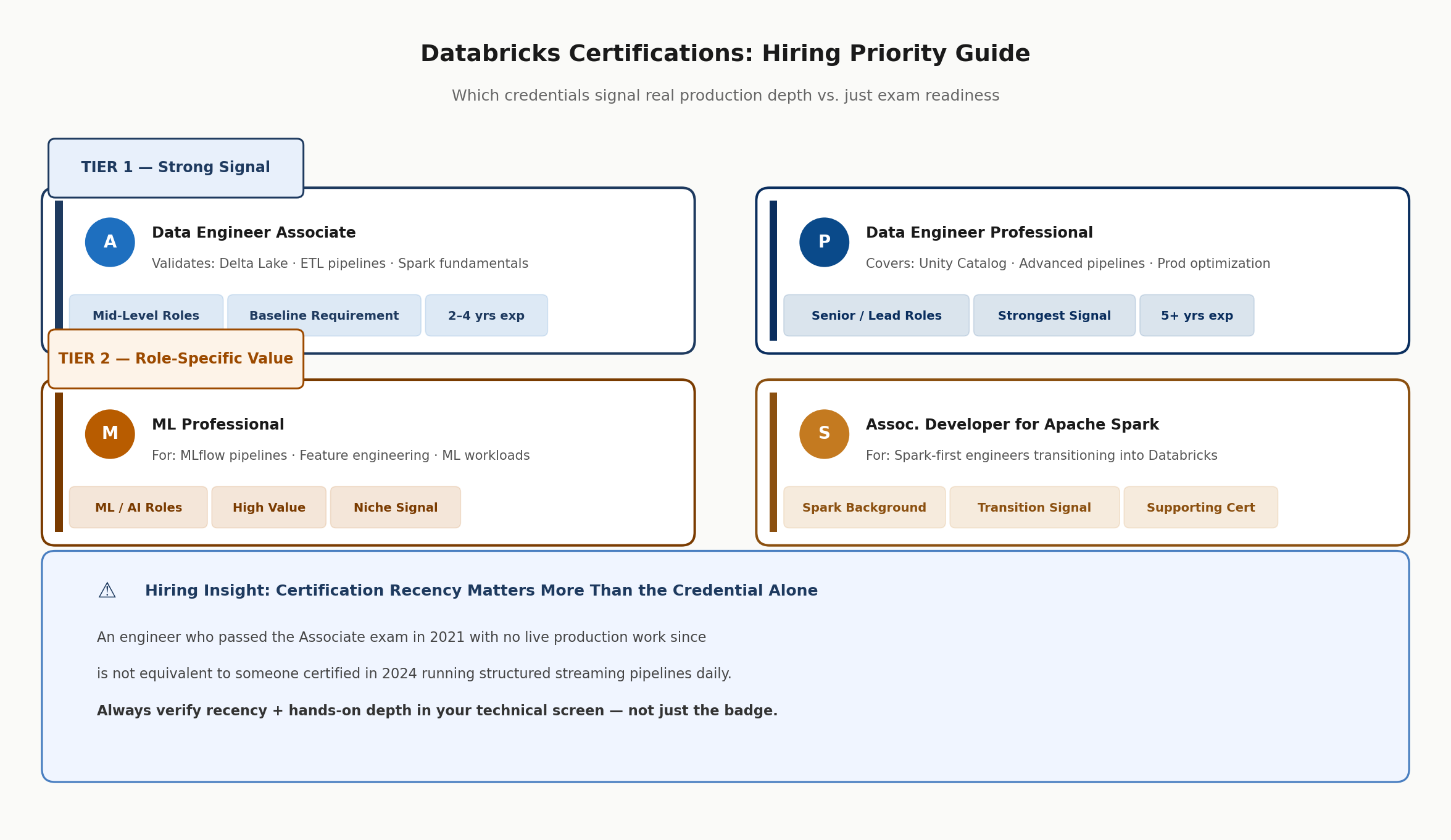
Tier 1 Strong Signal
- Databricks Certified Data Engineer Associate validates core Delta Lake, ETL pipeline engineer skills, and Spark fundamentals. The baseline requirement for mid-level roles.
- Databricks Certified Data Engineer Professional covers advanced pipeline design, Unity Catalog, and production-grade optimization. Relevant for senior and lead profiles.
Tier 2 Role-Specific Value
- Databricks Certified Machine Learning Professional critical if the role involves MLflow pipeline management or feature engineering for ML workloads.
- Databricks Certified Associate Developer for Apache Spark useful signal for engineers coming from a pure Spark background transitioning into Databricks.
A note on over-indexing on certifications: engineers who passed the Associate exam in 2021 and haven’t worked on a live structured streaming Databricks implementation since then are not equivalent to someone who passed it in 2024 while running production workloads. Recency and hands-on depth matter more than the credential alone.
How GCCs Are Actually Structuring These Hires
Two patterns that reflect how cloud data platform hiring is playing out inside GCCs in 2025:
Pattern 1 The Embedded Build:
A European fintech GCC in Pune built a 14-person data lakehouse team over 11 months by hiring 4 senior Databricks engineers at ₹45–58 LPA and building out the rest through a structured upskilling program for mid-level engineers. Total platform cost at 24 months: approximately 40% lower than equivalent offshore contracting through an SI partner.
Pattern 2 The Hybrid Augmentation:
A US healthcare GCC in Hyderabad couldn’t find enough certified data engineering talent India locally and used a staff augmentation model for 6 engineers on a 12-month engagement while building an internal pipeline. The augmented team delivered the Unity Catalog implementation on schedule; 3 of the 6 were converted to full-time at end of contract.
Both patterns involve realistic timelines 3–5 months to hire and onboard a senior Databricks engineer, 6–9 months to build a functional team from scratch.
What Most Teams Get Wrong When They Hire Databricks Engineers India
The most consistent mistake is treating data lakehouse hiring India as a resume-matching exercise rather than an architecture-alignment problem. Organizations shortlist candidates based on years of Databricks experience without first defining what the platform actually needs to do.
A candidate with 6 years of batch ETL on Databricks is not the same as one with 4 years of experience building real-time structured streaming pipelines with complex SLA requirements. The job description “5+ years Databricks” captures both and the interview panel often can’t tell the difference until 3 months into the engagement.
The second most common mistake: hiring a senior engineer for a role that actually requires an architect. Senior engineers execute well within defined patterns. Architects define the patterns. If your platform doesn’t exist yet, or you’re migrating from a legacy warehouse, you need the latter and the compensation gap between them (₹20–30 LPA at senior GCC levels) is often not budgeted.
FAQ: Hire Databricks Engineer India
How much does a Databricks engineer cost in India?
Mid-level Databricks developer salary India ranges from ₹28–42 LPA in the open market and ₹30–45 LPA in GCCs for 4–6 years of experience. Senior engineers with Unity Catalog and MLflow experience command ₹45–65 LPA. Contract rates via staff augmentation data engineering run ₹8,000–₹14,000 per day depending on specialization.
How long does it take to hire a Databricks engineer in India?
For a senior-level role in a GCC or product company, expect 10–16 weeks from job posting to joining. The bottleneck is rarely sourcing it’s the multi-stage technical evaluation and notice period (typically 60–90 days for experienced engineers). Budget 3–5 months for the full cycle.
How to evaluate Databricks engineer skills India what does a good technical screen look like?
A strong screen should include a live coding component on Spark transformations, a scenario-based question on Delta Lake ACID guarantees, and at minimum one architecture discussion covering ingestion patterns and partition strategy. Asking candidates to walk through a past pipeline failure and how they diagnosed it is one of the highest-signal interview formats.
Which Databricks certifications should I prioritize when hiring?
For mid-level engineers, the Databricks Certified Data Engineer Associate is the baseline. For senior roles, the Professional certification combined with demonstrable production experience is a stronger signal. For ML-adjacent roles, the Machine Learning Professional certification is directly relevant.
Is it cheaper to run GCC vs open market Databricks hiring India?
It depends on the time horizon. GCC hiring carries higher fixed costs upfront (compensation, infrastructure, compliance overhead) but delivers 30–40% cost advantage over 24–36 months compared to ongoing SI or staff augmentation. For short-duration builds (under 12 months), the open market or contract model is often more efficient.
What is the difference between a Databricks engineer and a Snowflake engineer for an India-based team?
Both profiles sit at similar compensation levels, but the skill sets diverge meaningfully at the senior level. Databricks engineers are stronger on Spark internals, streaming workloads, and ML integration. Snowflake engineers typically bring stronger SQL-layer optimization and warehouse-native analytics skills. The right choice depends on your architecture, not the cost differential.
How to evaluate Databricks engineer skills for a GCC vs a startup hire?
GCC roles typically require engineers who can operate in a governed, process-heavy environment with cross-functional stakeholders. Startup hires need faster iteration cycles and comfort with ambiguity. The technical bar is similar; the behavioral and operational fit differs significantly. Structure your evaluation to test for the environment match, not just the technical skills.
Build the Right Team, Not Just a Headcount
If you’re mapping out a hire Databricks engineer India strategy for a GCC build-out, a platform migration, or a new lakehouse practice, the compensation data above is a starting point not the decision. The variables that actually drive outcomes are role scoping accuracy, evaluation rigor, and whether your hiring process can identify production-depth experience versus certification-only profiles.
Organizations that have run this process across multiple GCC and product engagements can materially reduce your time-to-hire and eliminate the most common sourcing mistakes before they cost you 4–6 months of delays.
If you’re at the scoping stage and want to pressure-test your hiring plan against current market realities, [connect with our data engineering talent team: mayank@engineerbabu.com] for a no-commitment benchmarking conversation.
