

Around 60% of companies that run recruitment process outsourcing programs eventually ask their provider the same question: “Can you also fill our VP of Engineering role?” The honest answer is more complicated than most providers admit. RPO for executive hiring works remarkably well in a defined band of seniority and fails predictably above it.
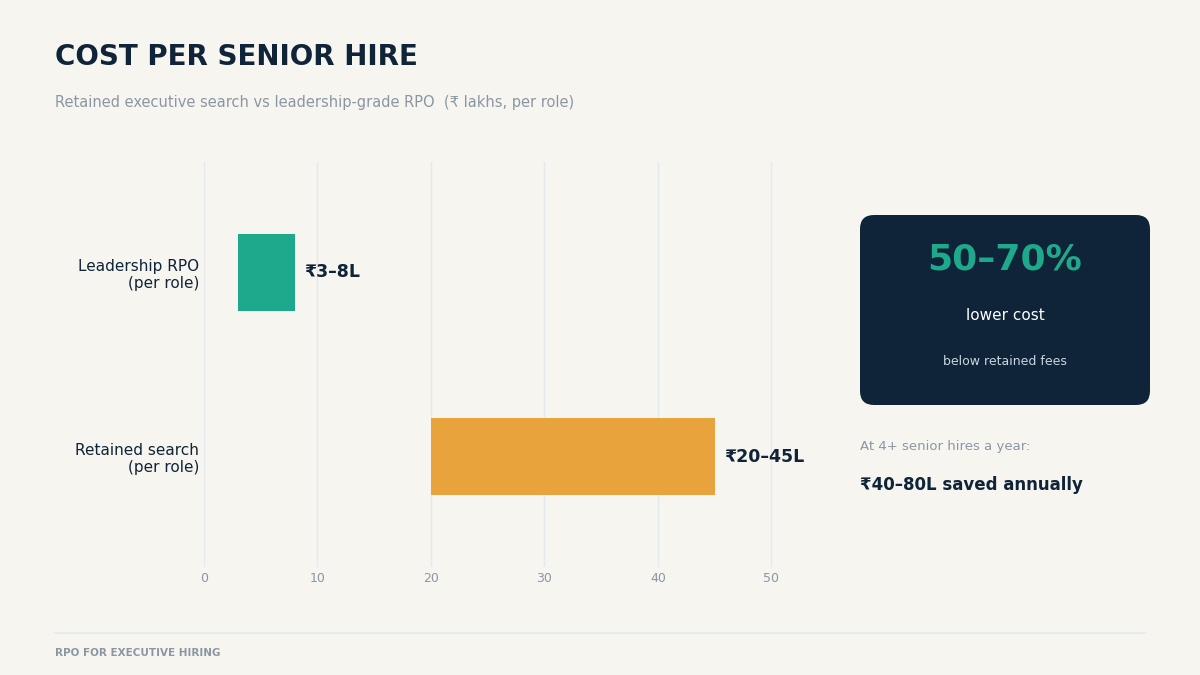
The economics explain why the question keeps coming up. A retained executive search firm typically charges 25–33% of first-year compensation. For a leadership role paying ₹80 lakhs to ₹1.5 crore, that is a ₹20–45 lakh fee for a single hire, paid in three installments whether the search succeeds quickly or drags for 6 months. Meanwhile, the RPO team already embedded in your hiring process costs a fraction of that per role and knows your culture, your compensation bands, and your interview panels.
So finance teams push to route director and VP searches through the existing RPO engagement. Sometimes that decision saves 40–60% per hire and cuts time-to-fill by weeks. Other times it produces a 5-month stalled search for a CFO, a burned candidate pool, and a retained firm brought in anyway now working a market that has already been picked over.
The shift toward outsourced hiring is accelerating. According to Grand View Research RPO Market Report, the global RPO market is projected to grow at a CAGR of over 17% through 2030, reflecting increasing adoption by enterprises looking to scale hiring efficiently into 2026 and beyond. This growth is pushing RPO into leadership hiring conversations but not always successfully.
The difference between those two outcomes is not vendor quality. It is a role type. This article maps exactly where the boundary sits, what senior hiring through RPO can genuinely deliver, and which searches should never leave the retained model so you can make the call before a critical role sits open for two quarters.
TL;DR: RPO Works for Leadership Hiring, But Not All of It
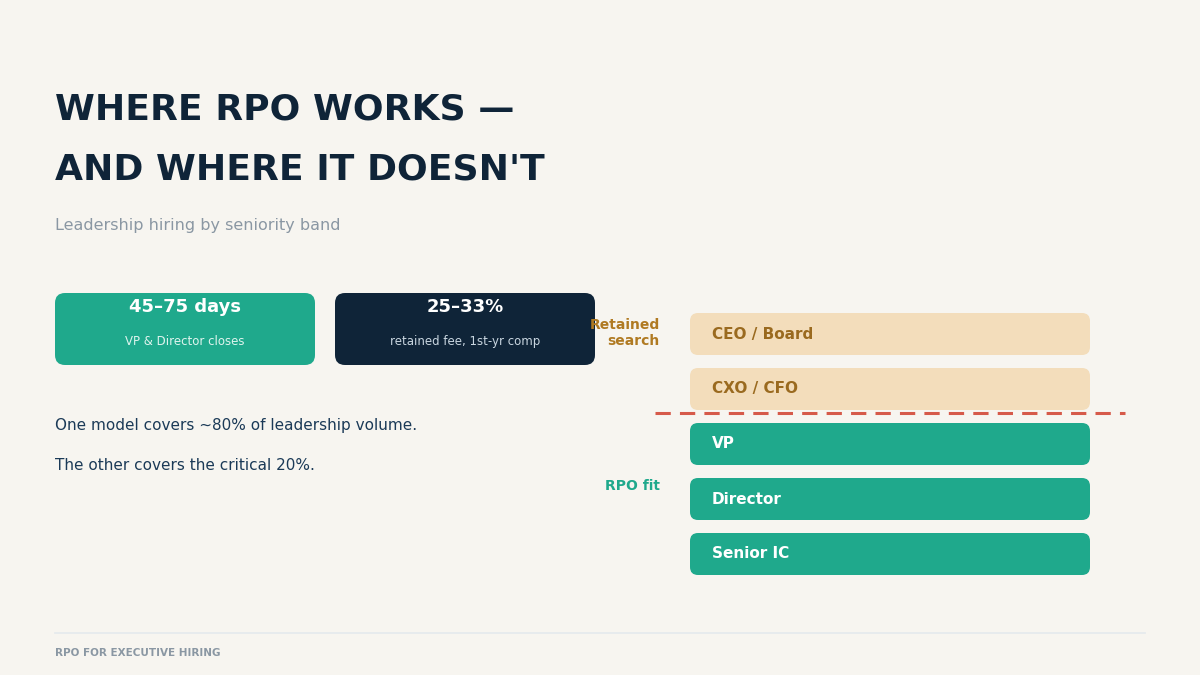
RPO is great for Director and VP roles. Think engineering, sales, marketing, ops leaders. These roles have large talent pools. They're rarely confidential. RPO delivers them in 45–75 days at 50–70% lower cost than retained search.
RPO breaks down at the C-suite. CEO, CFO, and board-level searches need deep confidentiality, exclusive candidate access, and one-shot assessment rigor. Push these through a standard RPO pipeline and you risk a stalled search, a burned candidate pool, and a retained firm brought in anyway months later than it should have been.
The fix isn't picking one model. It's routing each role correctly using four factors: seniority, talent pool size, confidentiality, and hiring volume. Score high on all four? Use RPO. Score low? Pay for retained search. Get this routing decision wrong, and it costs far more than the fee you tried to save.
What Is RPO for Executive Hiring?
RPO for executive hiring is a model where a recruitment process outsourcing provider manages senior-level searches, typically director, VP, and senior individual-contributor roles using dedicated recruiters embedded in the client’s process. It replaces per-hire search fees with a subscription or per-role pricing model, and works best below the true C-suite level.
The Core Problem: Senior Roles Break Standard Recruiting Pipelines
Most companies discover the gap the hard way. Their leadership hiring outsourcing decision gets made in one of two flawed ways: either every senior role defaults to retained search (expensive and slow for roles that don’t need it), or every role gets pushed through the volume-hiring engine (which was never designed for leadership searches).
The numbers show why neither default works. A standard RPO recruiter carries 15–25 open requisitions at once and closes roles in 30–45 days. A leadership search needs a recruiter carrying 3–5 requisitions, running 60–90 day timelines, and spending 70% of their time on outbound sourcing rather than processing applicants. Those are structurally different jobs.
The cost asymmetry cuts the other way at the top. Boards routinely pay ₹40 lakh retained fees for searches where 80% of the qualified market is reachable on LinkedIn and actively open to conversations. Most teams overpay for search by 3–4x at the director level and underinvest in process rigor at the C-suite level, where a failed hire costs 10–15x salary in lost momentum, team attrition, and restarted strategy.
The real challenge is not choosing a vendor. It is building a talent acquisition strategy that routes each role to the right engagement model based on market dynamics, confidentiality needs, and assessment depth before the search opens.
How Senior Hiring Through RPO Actually Works
Done properly, senior hiring through RPO is not the volume model with a bigger salary band attached. Providers who do this well run a separate practice with different recruiters, different SLAs, and different economics. Here is what the architecture looks like when it is built correctly.
The Engagement Model: Embedded Recruiters, Not Resume Pipelines
The unit of delivery changes at senior levels. Instead of a shared sourcing pod, you get 1–2 embedded recruiters dedicated to leadership requisitions, usually with 8–12 years of search experience themselves. They sit inside your ATS, join your leadership meetings, and represent your employer brand directly which matters, because passive senior candidates judge a company by the first recruiter conversation.
Pricing shifts too. Expect a monthly subscription of ₹2.5–5 lakhs per dedicated recruiter, or per-role pricing of ₹3–8 lakhs for director and VP searches still 50–70% below the cost of executive search vs RPO on a retained basis, but 2–3x standard RPO rates.
When to Use RPO for Senior Leadership Roles
The model fits when three conditions hold. First, the talent pool is large and mappable: VP-level hiring in engineering, sales, marketing, and operations usually qualifies, because hundreds of credible candidates exist in-market. Second, the role is not board-visible: no investor sign-off, no public announcement risk. Third, you are hiring more than one senior role in a 12-month window, which is where subscription economics beat per-hire fees decisively.
A useful volume threshold: if you expect 4+ director/VP hires in a year, the RPO model typically saves ₹40–80 lakhs against equivalent retained fees while holding time-to-fill to 45–75 days.
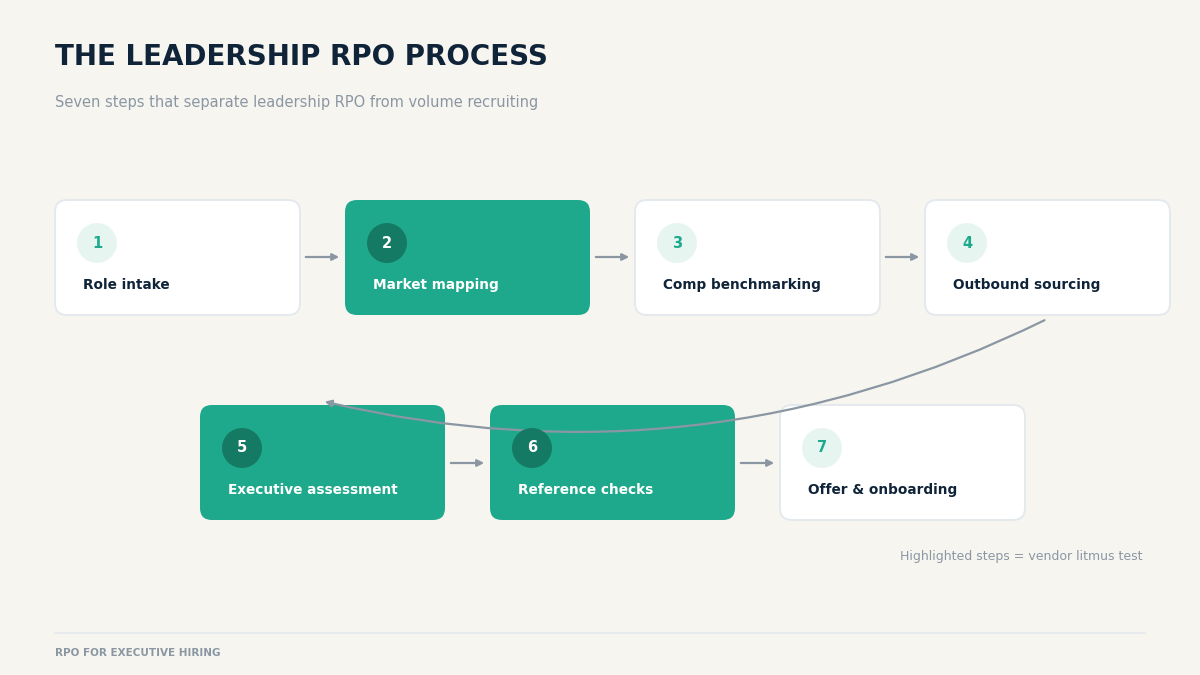
The Process: Seven Steps That Separate Leadership RPO from Volume RPO
- Role intake with the executive sponsor, not just HR, a 90-minute calibration covering business context, first-year success metrics, and dealbreakers.
- Market mapping before outreach a documented scan of 80–150 target profiles across competitor and adjacent companies, delivered in week 1.
- Calibrated compensation benchmarking validated against 3+ live data sources, because a band that is 15% off market kills senior searches silently.
- Structured outbound sourcing 60–70% of senior placements come from passive candidates; inbound applications alone will not close these roles.
- Multi-stage executive assessment structured scorecards, work-sample or case discussions, and at least one calibrated panel debrief per finalist.
- Reference and track-record verification minimum 3 references per finalist, including at least one not supplied by the candidate.
- Offer negotiation and 90-day onboarding support senior offers collapse at 2–3x the rate of mid-level offers without active close management.
That numbered sequence is also your vendor-evaluation checklist. If a provider cannot describe steps 2, 5, and 6 in operational detail, they are selling volume recruiting with a senior label.
Compliance, Confidentiality, and Integration Considerations
Leadership searches carry obligations that volume hiring does not. Replacement searches where the incumbent has not been told require a confidential search protocol: blind job descriptions, NDA-gated candidate disclosures, and outreach that never touches your careers page or ATS notifications. Verify that your provider can run searches entirely outside your standard systems when required, and that their data handling meets DPDP Act and GDPR standards if candidate data crosses borders.
Integration matters in the other direction too. Senior searches generate market intelligence compensation data, competitor org structures, candidate perceptions of your brand that should feed your succession planning and workforce planning cycles rather than dying in a recruiter’s notebook.
Real-World Applications: Two Anonymized Outcomes
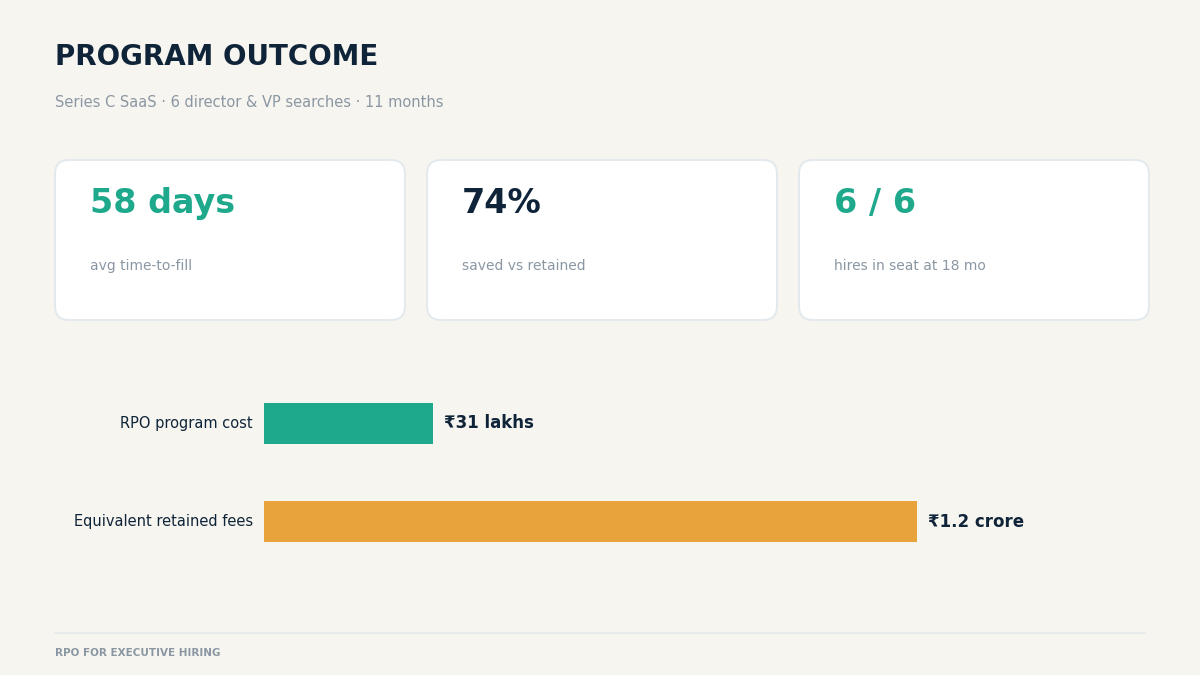
A Series C SaaS company (400 employees) routed 6 director and VP searches through a dedicated leadership RPO pod over 11 months. Average time-to-fill was 58 days, total program cost was ₹31 lakhs, and equivalent retained fees would have exceeded ₹1.2 crore a 74% saving with all 6 hires still in place at the 18-month mark.
The counter-example is equally instructive. A mid-market fintech attempted a CFO search through its existing RPO engagement to avoid a ₹35 lakh retained fee. After 5 months, 4 declined finalists, and one leaked approach that reached the sitting CFO, the board mandated a retained firm which closed the search in 14 weeks but had to rebuild credibility with candidates the earlier outreach had mishandled. Total elapsed time: 9 months for a role budgeted at 3.
RPO vs Executive Search: A Decision Framework
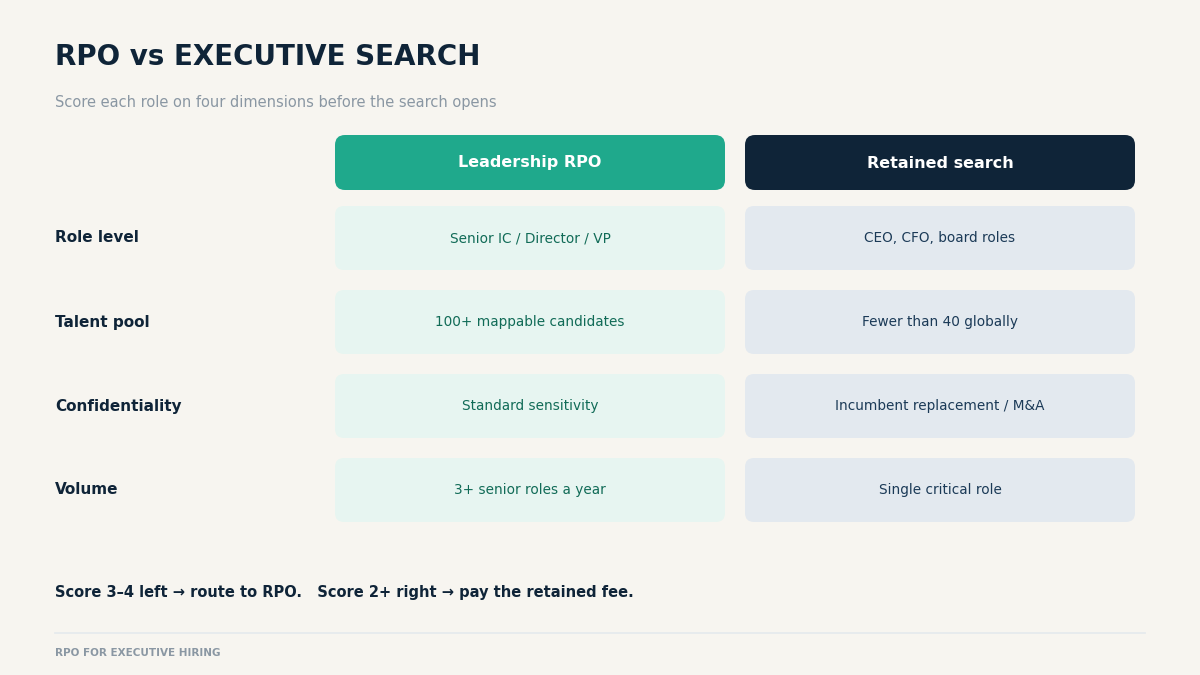
The RPO vs executive search question resolves cleanly once you score the role on four dimensions rather than debating vendors in the abstract.
| Dimension | Route to Leadership RPO | Route to Retained Executive Search |
| Role level | Senior IC, Director, VP, functional heads | CEO, CFO, board roles, business-unit P&L heads |
| Talent pool | 100+ mappable candidates in-market | Fewer than 40 viable candidates globally |
| Confidentiality | Standard or moderately sensitive | Incumbent replacement, M&A-linked, investor-visible |
| Volume & timeline | 3+ senior roles per year, 45–75 day targets | Single critical role, assessment depth over speed |
Score a role 3–4 in the left column and the leadership hiring approach through RPO will be faster and 50–70% cheaper. Score 2+ in the right column and pay the retained fee without hesitation. The difference between RPO and retained executive search at that altitude is not price, it is access to candidates who will only engage through a trusted search partner and an assessment process built for one-shot decisions.
Hybrid structures also exist: some providers now offer retained-style depth for one or two anchor roles inside a broader RPO subscription. These work, but only when the provider staffs former retained-search consultants on those roles specifically.
What Most Teams Get Wrong
The most expensive mistake is not choosing the wrong vendor, it is letting the engagement model drift. Dedicated teams sign an RPO contract for mid-level volume, then quietly slide director, VP, and eventually CXO roles into the same pipeline because the marginal cost looks like zero. It is not zero. The pattern across dozens of programs is consistent: the first 2–3 senior roles close acceptably, confidence builds, and then a genuinely hard search niche market, confidential, board-visible stalls for a quarter and takes the provider relationship down with it.
The second mistake is the mirror image: treating C-suite hiring RPO skepticism as a reason to send every ₹50 lakh+ role to retained search. Director-level roles in large talent markets do not need a retained firm’s network; they need disciplined outbound sourcing and fast, structured assessment. Paying 30% of first-year compensation for that is paying for a scalpel to cut bread.
The insider heuristic: decide the routing rule per role level in writing, at contract stage before any individual search creates pressure to improvise. Companies that document this routing rule renegotiate vendors 3x less often than those that decide search-by-search.
Pressure-Test Your Leadership Hiring Model Before You Commit
If you are deciding which of your next 4–6 senior roles belong in an RPO model and which justify retained fees, run the routing exercise before signing anything. Supersourcing has structured this decision across leadership hiring engagements spanning VP, director, and senior technology roles, and can map your open and upcoming roles against the framework in a single working session including where our own model is not the right answer.
Start with the Leadership Hiring Services page or reach out directly at mayank@engineerbabu.com via contact us. Bring your role list; leave with a routing decision you can defend to your CFO and your board.
Frequently Asked Questions
Is RPO good for executive hiring?
It is genuinely effective for senior individual-contributor, director, and VP roles typically delivering 45–75 day closes at 50–70% below retained fees. It is a poor fit for CEO, CFO, and board-level searches, where candidate access, confidentiality protocols, and assessment depth favor retained firms. The honest framing: RPO covers roughly 80% of leadership hiring volume, and retained search covers the critical 20%.
What is the difference between RPO and executive search?
RPO embeds recruiters into your ongoing hiring process under a subscription or per-role model, optimizing for repeatable senior hiring. Retained executive search is a project-based engagement for a single critical role, priced at 25–33% of first-year compensation, built around exclusive candidate relationships and deep assessment. One is an operating model; the other is a specialist intervention.
How much does executive search cost compared to RPO?
In India, retained search for a leadership role commonly runs ₹20–45 lakhs per hire. Leadership-grade RPO typically prices at ₹3–8 lakhs per senior role, or ₹2.5–5 lakhs monthly for a dedicated recruiter covering multiple requisitions. At 4+ senior hires per year, the RPO model usually saves ₹40–80 lakhs annually provided the roles fit the model.
Can RPO handle confidential C-suite searches?
Rarely, and you should pressure-test any provider claiming otherwise. True confidential replacement searches require outreach fully outside your ATS, NDA-gated disclosure, and a consultant senior enough that candidates trust the process. A few hybrid providers staff former retained consultants for exactly this. For most C-suite replacements, retained search remains the lower-risk path.
How long does executive hiring take through RPO?
Plan for 45–75 days for director and VP roles with healthy talent pools, versus 90–150 days typical of retained C-suite searches. The variable that moves timelines most is not the vendor, it is compensation-band accuracy at intake and interview-panel availability, which together account for the majority of stalled weeks.
Which leadership roles should stay with retained search?
Any role that is board-visible, incumbent-replacement, tied to a fundraiser or M&A event, or drawn from a global pool of fewer than roughly 40 candidates. If you are unsure where a specific role falls, a 30-minute scoping conversation against the four-dimension framework above will usually settle it and that is worth doing before the search opens, not after it stalls.
