

Most companies find out their RPO relationship isn’t working about four months too late after time-to-fill has crept from 25 days to 45, after two hiring managers have quietly started sourcing on their own, and after someone in finance asks why cost-per-hire went up despite “outsourcing efficiency.” By the time the decision to leave is made, the instinct is to rush the exit. That instinct is exactly what causes the damage.
Switching RPO providers mid-contract is not primarily a vendor problem. It’s a data-and-continuity problem. The recruiting relationship you’re ending holds your candidate pipeline, your employer-brand messaging, your interview scorecards, and in many contracts the legal right to contact candidates it sourced for a defined period after termination. Get the notice period, the data handover, and the pipeline transfer wrong, and you don’t just lose momentum. You lose candidates who were 48 hours from an offer, restart requisitions that were 80% filled, and hand your new provider a blank slate instead of a running start.
Reliance on outsourcing is only increasing. According to the HR Outsourcing Market Report, the global HR outsourcing market is projected to surpass $45 billion by 2027, reflecting growing dependence on RPO models heading into 2026. This makes smooth vendor transitions more critical than ever.
This guide is the operational playbook: the notice-period math, the exact data your outgoing vendor owes you, how to run a parallel pipeline without candidates falling through, and a realistic day-by-day timeline from decision to full cutover. Firms that specialize in RPO transition plans Supersourcing among them tend to structure this as a named project with its own owner, timeline, and success metrics, rather than a footnote attached to the new vendor’s onboarding deck. That distinction is often what separates a switch that costs a quarter of hiring momentum from one that barely registers on the requisition dashboard.
It helps to be honest about why teams end up here in the first place. The decision to leave an RPO provider rarely comes from a single bad month; it comes from a slow accumulation of missed SLAs, generic candidates who clearly weren’t screened against the actual role, and a dedicated account manager who turns out to be shared across six other client accounts. By the time leadership signs off on switching, the recruiting team has usually already lost trust in the channel, which is exactly why the transition needs to visibly rebuild that trust fast, not just technically complete a vendor swap on paper.
What Is RPO Provider Switching?
RPO provider switching is the structured process of ending an active recruitment process outsourcing contract with one vendor and transferring ongoing hiring operations, candidate data, and requisition ownership to a new vendor or in-house team, without creating a hiring gap.
This is not the same as:
- A staffing vendor swap adding or removing one contingent-staffing agency from a multi-vendor panel, which doesn’t involve full pipeline or data ownership transfer.
- Renegotiating your current RPO contract staying with the same provider under revised SLAs or pricing, with no handover involved.
- Insourcing recruitment entirely can be one outcome of a switch, but “switching RPO providers” specifically implies moving to another external partner, even if in-house buildout is evaluated alongside it.
Why It Matters: The Business Case for Getting This Right
A poorly executed RPO transition has measurable, not vague, costs:
- Time-to-fill resets. Every requisition mid-pipeline with your outgoing vendor effectively restarts if candidate data and interview notes aren’t transferred cleanly, turning a 30-day-old requisition back into a day-zero one. On a role that was already 20 days into a 30-day cycle, losing the pipeline history alone can add 15-20 days back onto the clock, because the new team has to re-source rather than simply re-engage.
- Candidate drop-off. Candidates in late-stage interviews who go silent for two weeks during a vendor handover assume the role is dead and take other offers. On contract and IT roles, silence during a transition is one of the single biggest drivers of last-mile candidate loss and unlike early-funnel drop-off, a lost offer-stage candidate is nearly impossible to recover, because they’ve usually accepted somewhere else by the time you notice.
- Duplicate spend. Running two vendors in parallel (which you often need to, briefly) means paying two retainers or two management fees for 4-6 weeks. Budget for this explicitly rather than discovering it mid-transition finance teams that aren’t warned about this overlap cost tend to treat it as a billing error rather than a planned expense, which slows down approval for the very overlap window that protects your pipeline.
- Hiring managers trust erosion. If hiring managers experience a visible dip in shortlist quality or speed during the switch, they start bypassing the RPO channel entirely sourcing on their own, posting roles on their personal networks, or asking internal HRBPs for help which undermines the entire point of outsourcing and is hard to reverse even after the new vendor stabilizes.
- Compliance exposure. Candidate PII, background-verification (BGV) records, and NDA-covered client data sitting with an outgoing vendor past the contractual data-retention window is a real compliance liability, especially for GCC and regulated-industry hiring where data residency and retention rules are explicit, not optional.
- Vendor relationship damage. How you exit affects your reference-ability with that vendor and, in small verticals like specialized tech recruiting, your reputation with the recruiters who move between agencies. Recruiting is a small world at the senior end of any technical niche, and an acrimonious exit has a way of resurfacing years later.
None of this means don’t switch. It means budgeting the transition as its own project with a timeline, an owner, and a success metric rather than treating it as a footnote to the vendor decision itself.
The Core Problem: What Goes Wrong Without a Transition Plan
Most teams underestimate the actual transition timeline by 2-3x. A switch that “should” take two weeks routinely takes six to eight, because three things are almost always missed:
- The notice period is misread. Most RPO contracts require 30-60 days’ written notice for termination for convenience, but teams start the clock from the day they decide to leave, not the day formal notice is served, losing 1-2 weeks before the clock even starts.
- Data handover scope isn’t defined in the contract. Many MSAs specify “reasonable cooperation” on handover without listing exactly which artifacts (resumes, interview scorecards, sourcing notes, candidate communication history) must be transferred, in what format, and by when. Vague clauses become a source of stalling once notice is served.
- No parallel-run buffer. Companies terminate the outgoing vendor’s access on day one of the new vendor’s contract, leaving a dead zone where no one owns in-flight candidates. A 5-10 business day parallel-run window, where both vendors have limited, defined access, prevents this gap and should be negotiated into both contracts up front.
The pattern across botched transitions is consistent. Assume everything you didn’t put in writing during onboarding will be contested during offboarding.
A fourth, quieter failure mode is requisition amnesia; nobody on either side keeps a single source of truth for which roles are open, which are on hold, and which were quietly deprioritized months ago. Dedicated teams that go into a transition without first reconciling their own requisition list against the outgoing vendor’s list routinely discover a handful of “ghost requisitions” roles the business assumed were closed or paused that the vendor was still actively working, or vice versa. Left unresolved, this either wastes the new vendor’s first two weeks working roles nobody wants filled, or drops roles the business genuinely needs, right at the point when momentum matters most.
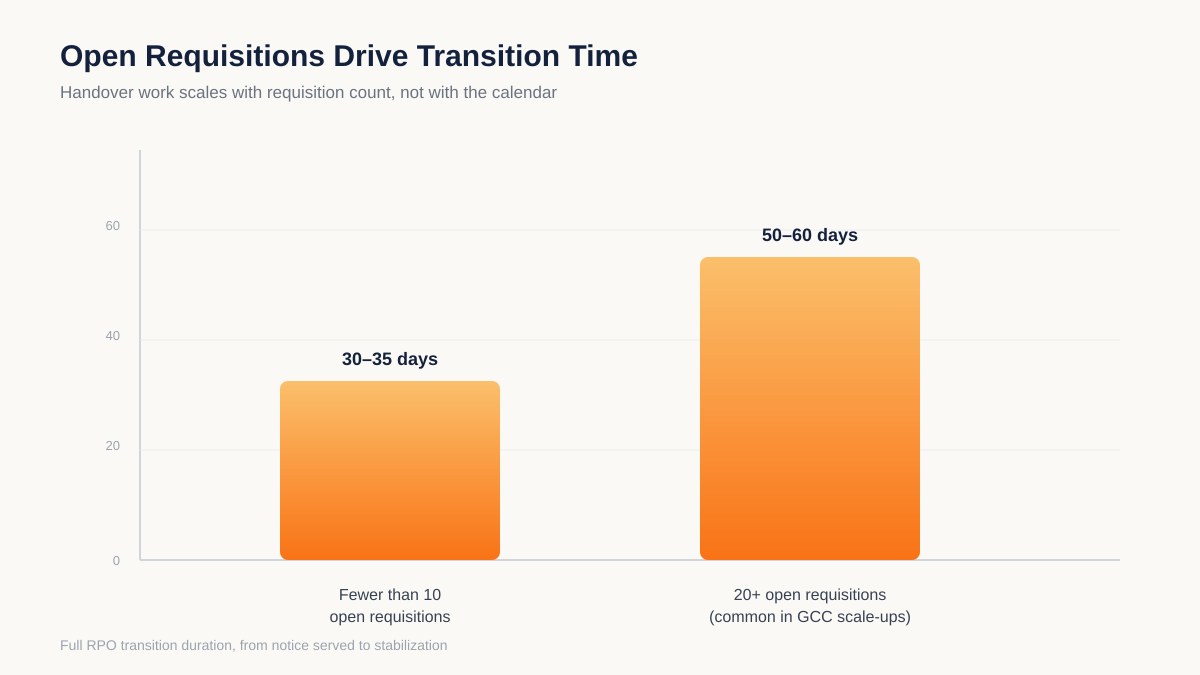
Industry benchmarking data also suggests a scale effect: teams switching providers with fewer than 10 open requisitions typically complete a full transition in 30-35 days, while teams with 20+ concurrent requisitions common in GCC scale-up phases routinely take 50-60 days simply because the data-handover and pipeline-transfer work scales with requisition count, not with calendar time.
The A-to-Z Walkthrough: Switching RPO Providers From Decision to Full Cutover
Phase 1: Confirming the Decision and Reading Your Exit Terms
Before you serve notice, get three things confirmed in writing (internally) and re-read in your contract:
Checklist before you serve notice:
- Locate the termination clause: “for convenience” vs. “for cause.” For-convenience exits typically require 30-60 days’ notice with no penalty. For-cause exits (SLA breach, missed guarantees) may allow shorter notice but require documented evidence of the breach.
- Confirm the notice-period start date rule. Some contracts start the clock on receipt of written notice by a named contact, not on the date you send an email.
- Check for early-termination fees or minimum-commitment clawbacks (common in 12-24 month RPO contracts with volume-based pricing tiers).
- Check the candidate ownership and non-solicitation clause most contracts grant the client ownership of candidates sourced during the engagement, but some cap this to candidates hired within 6-12 months of introduction, which matters if you plan to hire from the outgoing vendor’s pipeline after termination.
- Check the data-retention and data-deletion clause: how long is the vendor obligated to retain candidate records post-termination, and are they required to delete data on your request (relevant under GDPR or India’s DPDP Act if you operate a GCC).
- Confirm the NDA and IP-assignment terms survive termination (they almost always should).
Red flag: if your current contract has no explicit data-handover clause at all, assume you’ll need to negotiate handover terms from a position of weakness once notice is served. Flag this to legal before serving notice, not after.
Two clauses deserve a closer read than most teams give them.
First, the service credit and SLA-breach documentation clause if you’re planning a for-cause exit to avoid an early-termination fee, you need a documented, dated trail of the specific SLA misses (missed shortlist deadlines, quality scores below the contracted threshold, account manager turnover beyond the contracted limit) rather than a general sense that “IT service has been declining.” Vendors routinely contest for-cause claims that aren’t backed by dated evidence, and what looked like an open-and-shut breach case can turn into a drawn-out dispute that delays the whole transition.
Second, the transition assistance clause, if one exists, some contracts explicitly commit the outgoing vendor to a defined number of hours or weeks of paid transition support post-termination. If yours has this, it’s your strongest lever for a clean handover; if it doesn’t, this is worth raising directly with your current account manager as a good-faith ask before notice is served, since a vendor with nothing left to gain has little incentive to prioritize your handover once the relationship is formally ending.
Budget bands for switching costs:
| Cost item | Typical range |
| Early-termination fee (if for convenience, mid-term) | 1-2 months of retainer/management fee |
| Parallel-run overlap (both vendors active) | 2-4 weeks of dual management fees |
| New vendor onboarding/ramp-up fee | ₹0-5 lakhs / $0-6,000, waived by many providers |
| Internal transition-management time | 15-25 hours/week for 4-6 weeks (HR + hiring managers) |
Phase 2: Sourcing and Vetting a New RPO Provider (Run in Parallel to Notice Period)
Don’t wait for the exit to complete before starting the new vendor search. Run this in parallel with the notice period so there’s zero coverage gap.
Evaluation checklist for the incoming provider:
- Time-to-shortlist benchmarks ask for their median days from job description to interview-ready shortlist for roles comparable to yours (a realistic, provable benchmark is 7-10 working days for mid-level tech roles).
- Candidate joining rate and drop-off rate ask for their historical joining rate (95%+ is a strong signal) and contract-role drop-off rate (under 2% is strong).
- Dedicated vs. shared bandwidth confirm whether you get a dedicated account team or shared/pooled recruiters across clients; shared bandwidth is the single most common root cause of the original vendor complaint you’re trying to escape.
- Replacement guarantee terms get the exact replacement window in writing (7-10 business days if a hire doesn’t work out is a reasonable, achievable standard) and what triggers it.
- NDA and IP protection confirm client and candidate data is contractually protected and not shared across other client engagements.
- Transition/handover experience explicitly asks how many of their current clients came from a mid-contract switch, and asks for a reference client who went through that exact process.
Red flag: any provider who can’t clearly explain how they’ll absorb your in-flight requisitions and pipeline in the first two weeks hasn’t done this before and treat this as a real signal, not a minor gap.
Beyond the checklist, it’s worth pressure-testing how a shortlisted provider talks about the vendor you’re leaving. A provider that immediately pitches generic promises without asking about your specific requisition mix, your current pipeline size, or the reason you’re switching is optimizing for closing the deal, not for the handover.
Providers that have actually run mid-contract transitions before will ask pointed questions early about how many open roles, what stage each is in, and whether BGV is in progress for any offer-stage candidates because they know those specifics determine the realistic transition timeline.
Supersourcing’s approach to this stage, for instance, is to map the incoming requisition list against a defined week-one, week-two ownership plan before the contract is even signed, precisely because vague onboarding promises are where most transitions quietly start to slip.
Phase 3: Serving Notice and Structuring the Overlap Window
- Serve written termination notice per the contract’s specified method and named recipient email to a personal inbox does not count if the contract specifies otherwise.
- Simultaneously request, in writing, a data handover schedule covering: candidate database exports, resumes and portfolios, interview scorecards and feedback, sourcing/BD notes, offer-stage candidate status, and BGV records in progress.
- Negotiate a parallel-run window (5-10 business days is typical) where the outgoing vendor retains limited access to close out active candidates already at offer stage, while the new vendor begins onboarding.
- Set a hard cutover date for system access revocation (ATS, job boards, careers page admin) don’t leave this open-ended.
Engagement model reminder during transition: if you’re moving from a dedicated RPO model to a hybrid staff-augmentation model (or vice versa), confirm the new engagement model, SOW, and pricing structure are signed before the old vendor’s access is cut, not during the gap.
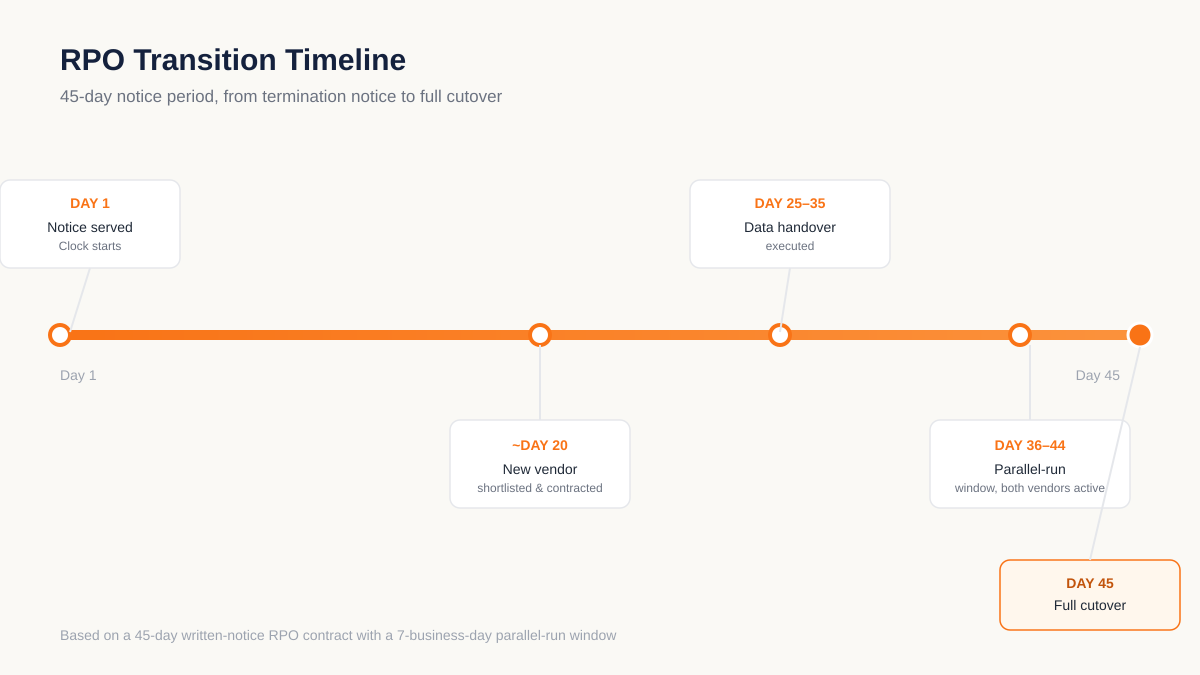
Worked example of the notice-period math: say your contract requires 45 days’ written notice, and you serve it on the 1st of a month. The old vendor’s obligations don’t end until the 15th of the following month. If you also negotiate a 7-business-day parallel-run window inside that period, the practical sequence looks like this: notice served day 1, new vendor shortlisted and contracted by roughly day 20, data-handover schedule agreed and executed between day 25 and day 35, parallel-run window from day 36 to day 44, full cutover on day 45.
Teams that instead wait until day 45 to even start looking for a new vendor are the ones who end up with a genuine coverage gap, because none of the sourcing, evaluation, or contracting work has a chance to run in parallel.
A related point worth flagging to your legal or procurement team early: notice-period ambiguity is the single most common source of transition delay disputes. If the contract says notice must be delivered “in writing to the designated contract owner,” and that person left the vendor’s organization eight months ago with no formal update on file, you may find yourself re-serving notice to the correct contact and losing 1-2 weeks to the ambiguity. Confirm the current designated contact in writing before you serve formal notice, not as part of the notice itself.
Phase 4: Data Handover and Pipeline Transfer
This is the phase most transitions get wrong. Build it as its own mini-project with a named owner on your side.
The data handover checklist:
- Full candidate database export CSV/API export of all active and passive candidates, tagged by requisition, stage, and last contact date.
- Requisition-by-requisition status reports every open role, its current pipeline count by stage (sourced, screened, interviewed, offer), and expected close date.
- Interview scorecards and feedback history not just pass/fail, but the actual notes, so the new team doesn’t re-interview candidates from scratch.
- Offer-in-hand and pre-offer candidates a named, prioritized list with a clear owner assigned on day one of the new engagement; these are your highest-risk drop-off candidates.
- BGV and compliance records in progress confirm chain of custody so verifications don’t restart.
- Employer brand and messaging assets job description templates, careers page copy, candidate email templates, so tone and positioning don’t visibly shift mid-funnel.
- Vendor and job-board account access confirm what transfers vs. what needs re-provisioning under the new vendor’s own accounts.
The 3-day rule: for any candidate in an active interview loop or at the offer stage, the new vendor should make first contact within 3 business days of cutover. Beyond that window, candidate drop-off rises sharply and treats this as a hard internal SLA for the new provider, not a nice-to-have.
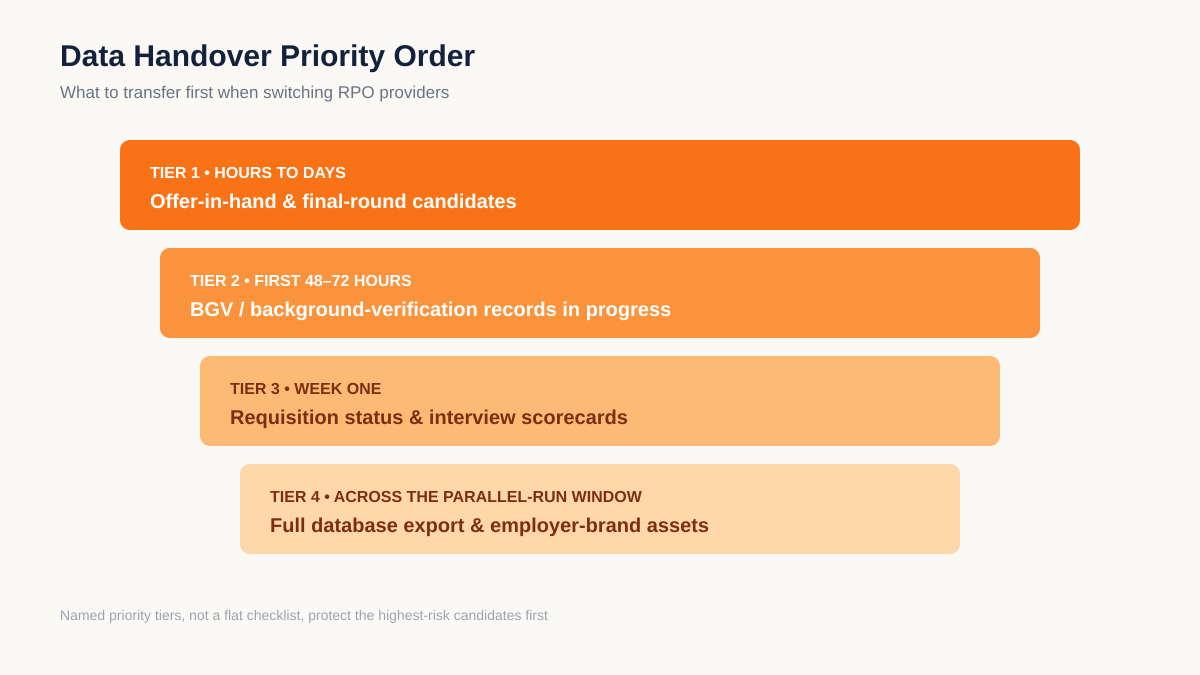
Not all seven items on the handover checklist carry equal urgency, and treating them as a flat list is a common mistake. In practice, prioritize in this order:
- Offer-in-hand and final-round candidates first are hours-of-days sensitive, not weeks.
- BGV records in progress second restarting a verification that was already 70% complete wastes real money and delays start dates.
- Requisition status and scorecards third needed within the first week so the new team can triage which roles to prioritize.
- Full database export and employer-brand assets are still important, but these don’t have the same clock ticking against them, and can be transferred over the full parallel-run window rather than on day one.
This sequencing matters because outgoing vendors, especially ones who feel the relationship ended badly, tend to deprioritize handover work relative to their new-client onboarding.
Naming the priority order explicitly, and getting the outgoing vendor to commit to dates against each tier rather than a single vague handover date, is what actually gets the highest-risk candidates protected first.
Phase 5: Onboarding the New Provider and Communicating the Switch
First-two-weeks onboarding checklist:
- Grant ATS and systems access on day one of the parallel-run window, not on full cutover day.
- Run a joint kickoff call with hiring managers to reset expectations on cadence, reporting format, and points of contact.
- Have the new provider shadow 2-3 live requisitions in week one before taking full ownership, rather than a cold handoff.
- Set a weekly (not monthly) check-in cadence for the first 4-6 weeks specifically to catch handover gaps early.
- Communicating the switch transparently to active candidates: a short note from the hiring manager or a warm introduction from the new recruiter goes further than silence, especially for candidates already mid-loop.
What “done well” looks like by week 4: every requisition open before the switch has a named owner on the new vendor’s side, every offer-in-hand candidate from the old vendor has either joined or been re-engaged, and time-to-fill on new requisitions opened after the switch is within 10-15% of your pre-transition baseline.
On the candidate communication piece specifically, resist the temptation to over-explain. Candidates don’t need to know the internal reasons for the vendor switch; they need three things: confirmation the role is still live, a named point of contact going forward, and a next step with a date attached.
A one-line note along the lines of “we’ve brought on a new recruiting partner to keep things moving quickly, here’s who you’ll be working with going forward, and here’s your next step” does more to prevent drop-off than a longer explanation ever will.
The same logic applies to hiring managers: they care less about which vendor is running the process and more about whether their open roles are still being actively worked, so lead every update with requisition-level status, not vendor-relationship narrative.
Phase 6: Stabilizing, Scaling, or Planning the Next Exit
Once the new provider is fully ramped (typically week 6-8):
- Re-baseline your KPIs time-to-fill, cost-per-hire, joining rate, drop-off rate against the old vendor’s numbers to confirm the switch actually improved outcomes.
- Formalize the reporting cadence and account management structure for steady-state operation (weekly reporting, dedicated account manager, quarterly business reviews are a reasonable standard).
- Revisit the contract’s own termination and data-handover clauses with the new vendor now, while you have leverage this is the best time to fix the gaps you just experienced.
- If scaling headcount with this vendor, confirm their replacement guarantee and escalation path are documented, not verbal.
This is also the point where it’s worth deciding, deliberately, what “good” looks like going forward rather than just reverting to whatever cadence the old vendor used. Teams that were burned by a shared-bandwidth model in their previous engagement often over-correct by demanding excessive reporting detail from the new vendor, which can slow the recruiting team down without actually improving outcomes.
A better approach is to agree on 3-4 KPIs that map directly to the reasons you switched in the first place if the old vendor’s failure was slow shortlists, track time-to-shortlist weekly; if it was candidate quality, track hiring-manager satisfaction scores per requisition rather than volume metrics. Scaling or exiting decisions six months out should be made against those specific metrics, not a general sense of whether the relationship “feels” better than the last one.
Case Studies
Fintech scale-up, engineering hiring surge: A fast-growing fintech company needed to scale engineering headcount rapidly while its existing RPO vendor’s shared-bandwidth model caused shortlist delays. Moving to a dedicated-team RPO model with structured handover of in-flight requisitions helped the company sustain hiring velocity through a high-growth quarter without a visible dip in shortlist quality, the kind of outcome companies like Swiggy have targeted during aggressive engineering scale-up phases.
Fintech engineering hiring at volume: Razorpay-scale fintech hiring at volume typically runs into the same failure mode: dozens of parallel open requisitions where a vendor switch without a structured handover would mean dozens of restarted pipelines simultaneously. Structuring the transition around a prioritized, offer-stage-first handover keeps the highest-risk candidates protected even when the total requisition count is high.
Healthtech compliance-sensitive hiring: Apollo Hospitals-type healthtech and healthcare hiring carries additional BGV and compliance sensitivity, since candidate verification records can’t simply restart from zero without cost and delay. A transition plan that explicitly carries forward in-progress verification chain-of-custody, rather than treating it as a “nice to have” in the handover checklist, avoids duplicate verification costs and compliance gaps.
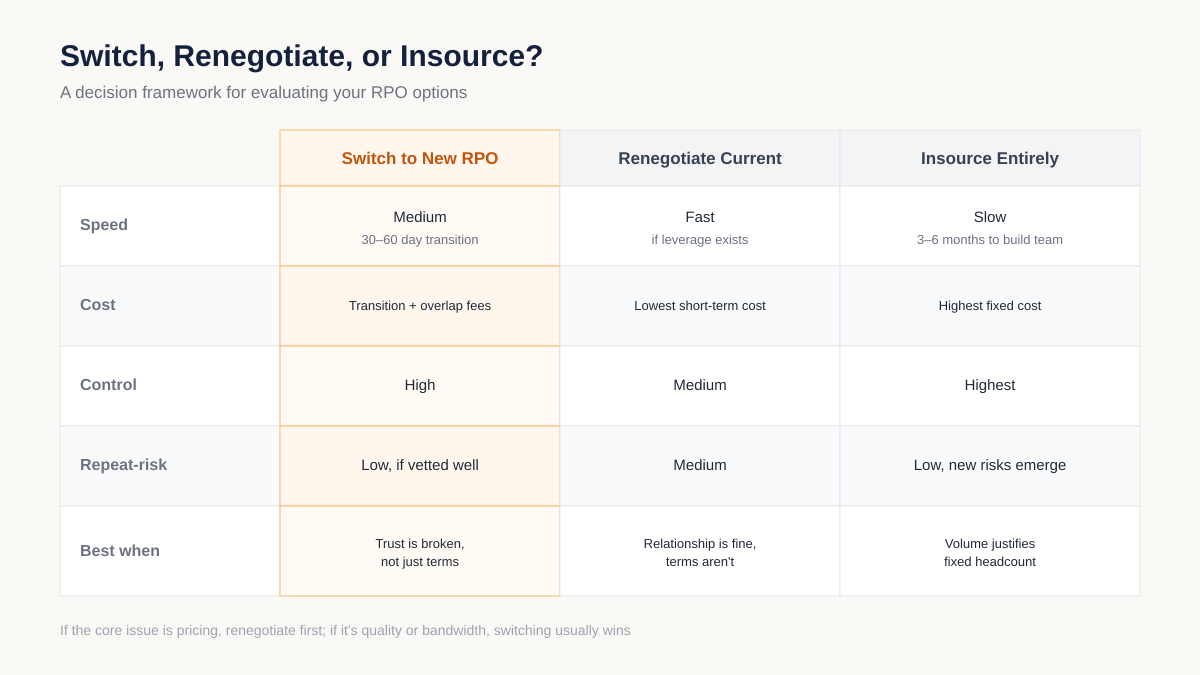
Comparison / Decision Framework: Switch, Renegotiate, or Insource?
| Factor | Switch to new RPO | Renegotiate current RPO | Insource entirely |
| Speed to fix the problem | Medium (30-60 day transition) | Fast (if leverage exists) | Slow (3-6 months to build team) |
| Cost | Transition + possible overlap fees | Usually lowest short-term cost | Highest fixed cost (salaries, tools) |
| Control over pipeline | High, once transitioned | Medium (same team, new terms) | Highest |
| Risk of repeat problem | Low, if new vendor vetted well | Medium root cause may recur | Low, but new execution risks emerge |
| Best when | Trust is broken, not just terms | Relationship is fine, terms aren’t | Hiring volume justifies fixed headcount |
Use this as a gut-check: if the core issue is pricing or SLA terms, renegotiate first a switch won’t fix a pricing problem. If the core issue is quality, responsiveness, or shared-bandwidth service, renegotiation rarely fixes it long-term, and switching is usually the better bet.
What Most Teams Get Wrong
- They negotiate the exit like a legal problem instead of an operational one. Getting the termination clause right matters, but the candidates-in-flight problem is what actually costs money, and it rarely gets the same attention.
- They treat the notice period as dead time. The 30-60 day notice window is exactly when the new vendor search, evaluation, and contract signing should happen, not after the old contract ends.
- They under-scope the data handover in writing. “Reasonable cooperation” clauses sound fine until you’re the one trying to get a former vendor to prioritize your data export against their own new-client workload.
- They cut vendor access too early. Killing the outgoing vendor’s system access on the same day the new contract starts, rather than running a short parallel window, is the single most common cause of dropped offer-stage candidates.
- They don’t tell candidates anything. Silence during a vendor transition is read by candidates as “the role went away.” A short, honest update costs nothing and saves late-funnel candidates.
- They pick the new vendor on price alone. A cheaper monthly retainer that comes with shared, pooled recruiters reproduces the exact problem the switch was meant to solve dedicated bandwidth is usually worth the price difference, and it’s the single variable most correlated with a repeat switch 12-18 months later.
- They skip the post-transition retrospective. Once the new vendor stabilizes, most teams move on without formally comparing pre- and post-switch KPIs, which means the next time service quality slips, there’s no baseline to point to and the same slow-burn problem repeats.
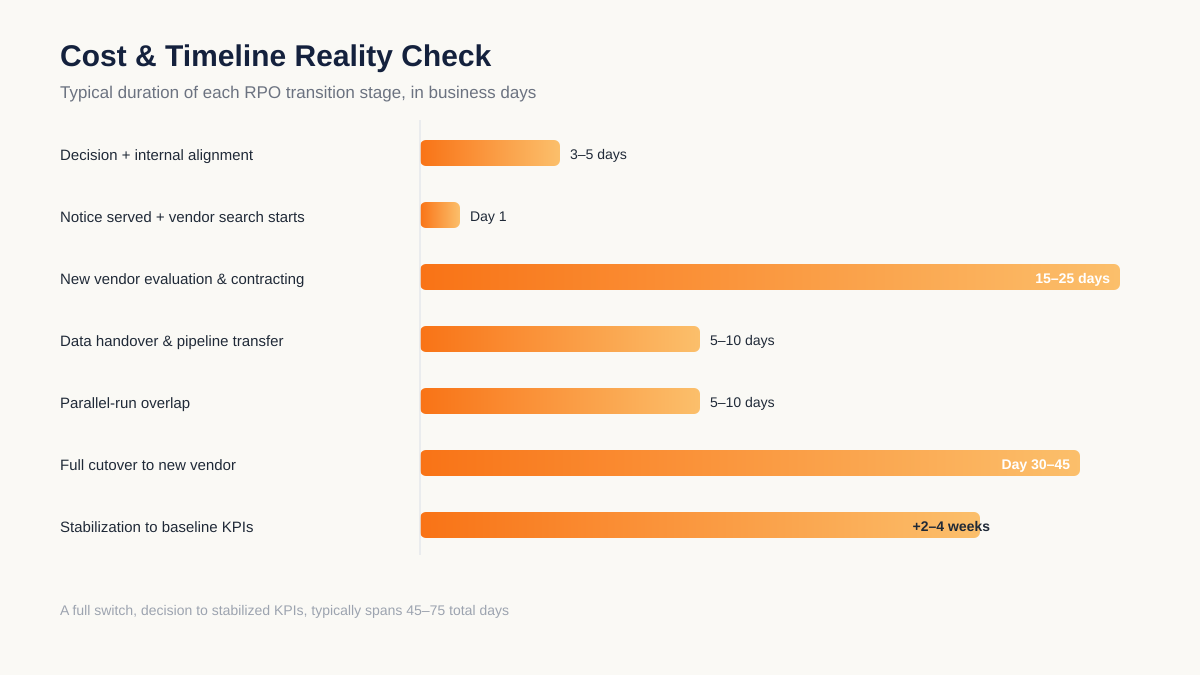
Cost and Timeline Reality Check
Realistic transition timeline:
| Stage | Duration |
| Decision + internal alignment | 3-5 business days |
| Serve notice + start new vendor search | Day 1 of notice period |
| New vendor evaluation and contracting | 15-25 business days (parallel to notice) |
| Data handover and pipeline transfer | 5-10 business days |
| Parallel-run overlap | 5-10 business days |
| Full cutover to new vendor | Day 30-45 from notice served |
| Stabilization to baseline KPIs | Additional 2-4 weeks |
What drives the timeline up:
- No written data-handover clause in the original contract (adds 1-3 weeks of negotiation)
- More than 15-20 concurrent open requisitions at time of switch
- Regulated-industry BGV/compliance handover requirements
- Outgoing vendor slow-walking cooperation post-notice (common if the relationship ended acrimoniously)
What drives the timeline down:
- A parallel-run clause already built into both contracts
- A single named transition owner on your side, not a distributed responsibility
- A new vendor with prior experience absorbing mid-contract handovers
Where to Go From Here
If you’re already inside a notice period or actively evaluating a new provider, the highest-leverage next step is getting your data-handover checklist and parallel-run window written down and agreed in writing with both vendors before, not after, you serve notice.
Supersourcing’s RPO team has run this exact handover process for companies mid-contract, with a dedicated account manager owning the pipeline transfer end to end and a 7-10 day replacement guarantee on any hire that doesn’t work out post-transition. If you’re mid-decision and want a second read on your current contract’s exit terms or a transition timeline specific to your open requisition count, you can talk to the team.
FAQ
How do you switch RPO providers without losing active candidates?
Run a parallel-run window (5-10 business days) where the outgoing vendor retains limited access to close active offer-stage candidates while the new vendor onboards. Prioritize offer-in-hand and late-interview candidates for first contact within 3 business days of cutover; this single step prevents most drop-offs.
What is the standard notice period to exit an RPO contract?
Most RPO master service agreements require 30-60 days’ written notice for termination for convenience. For-cause termination (documented SLA breach) may allow shorter notice, but requires evidence trail per the contract’s breach-notification terms.
Who owns candidate data when an RPO contract ends?
This depends entirely on the contract’s data-ownership and retention clause. Most agreements grant the client ownership of candidates sourced during the engagement, but check for time-boxed clauses (e.g., ownership capped to candidates hired within 6-12 months of introduction) and confirm data-deletion obligations under applicable privacy law.
How long does an RPO transition typically take?
A well-run transition, from serving notice to full stabilization at baseline KPIs, typically takes 45-75 days: 30-45 days to full cutover, plus 2-4 weeks to re-baseline hiring metrics against pre-switch performance.
What should be in an RPO handover checklist?
At minimum: full candidate database export, requisition-by-requisition pipeline status, interview scorecards and feedback history, offer-in-hand candidate list with named ownership, BGV records in progress, and employer-brand/messaging assets like job description templates and candidate email copy.
Can you terminate an RPO contract mid-term?
Yes, if the contract includes a termination-for-convenience clause (common) usually with 30-60 days’ notice and sometimes an early-termination fee. Contracts without this clause require either mutual agreement or evidence of a for-cause breach.
How do you evaluate a new RPO provider during a transition?
Look past pricing to dedicated vs. shared bandwidth, provable time-to-shortlist and joining-rate benchmarks, a documented replacement guarantee, and specific prior experience absorbing mid-contract handovers ask for a reference client who went through exactly that.
Is there a cost penalty for exiting an RPO contract early?
Sometimes. Check for early-termination fees (often 1-2 months of retainer) or minimum-commitment clawbacks tied to volume-based pricing tiers. Budget separately for 2-4 weeks of parallel dual-vendor fees during the overlap window this is a real cost most teams don’t plan for. If you’re mid-transition and unsure how your current contract’s specific termination language applies to your situation, a hiring or vendor-management specialist can help you map the clause to your timeline before you serve notice.
