

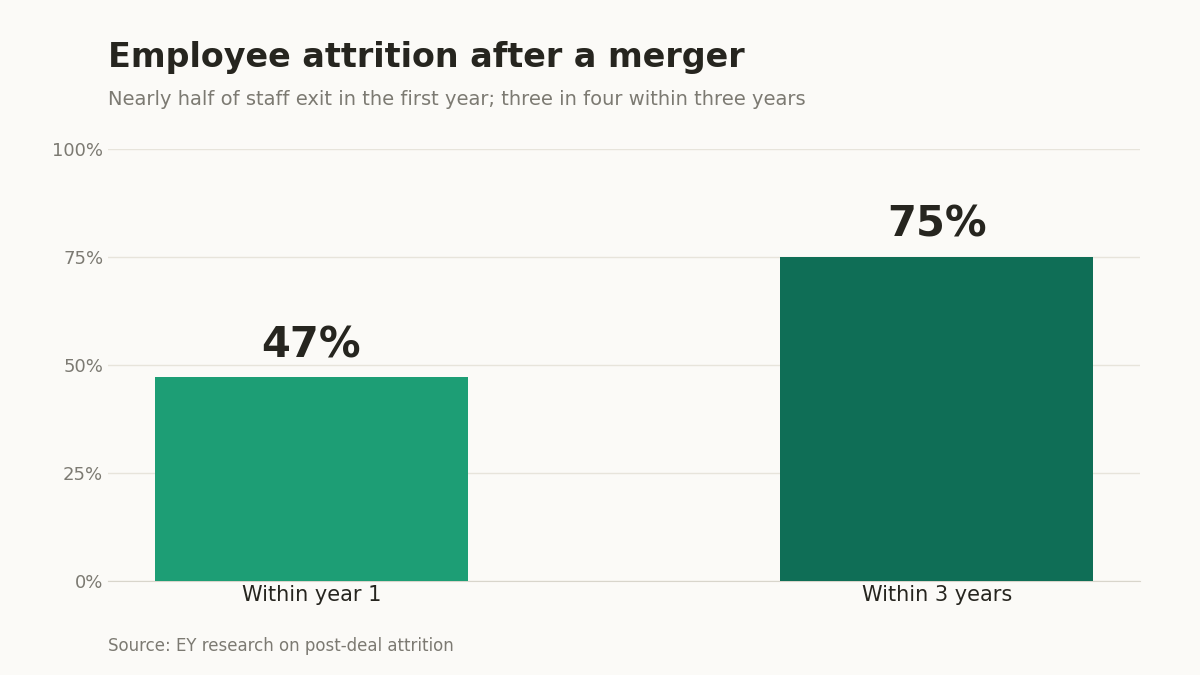
Roughly 47% of employees leave within the first year after a merger, and 75% are gone inside three years, according to EY research on post-deal attrition. That single figure quietly rewrites the math on most acquisitions. Leadership models the deal as a headcount gain; the workforce data says it is often a slow-motion headcount loss.
This is the part of dealmaking that spreadsheets rarely capture. You buy a 400-person engineering org to accelerate a roadmap, and 18 months later you are recruiting to rebuild it. The synergy case assumed continuity. The people never signed the synergy case.
RPO for M&A hiring exists precisely for this gap: the sudden, high-volume, deadline-bound recruiting surge that follows a signed deal and that no internal talent team is staffed to absorb. Most acquirers treat hiring as a downstream integration task, something HR handles after legal and finance finish. That sequencing is backwards. By the time the org chart is finalized, the attrition clock has already been running for months.
According to PwC Global M&A Industry Trends Outlook, deal activity and post-merger integration demands are expected to remain strong through 2026, with companies increasingly focusing on operational execution and talent retention to realize deal value. This makes scalable hiring models like RPO critical during the post-acquisition phase.
The companies that scale cleanly after a transaction share one trait: they plan recruiting capacity as a deal input, not a deal aftershock. They know that a 200-role integration hiring wave cannot be run by three in-house recruiters who are also backfilling BAU roles. And they know the cost of getting it wrong is measured in blown synergy targets, not just open requisitions.
This piece breaks down when a recruitment surge becomes a strategic risk, how RPO for M&A hiring actually works in a post-deal context, what it costs, and where most integration teams misjudge the timeline by a factor of three.
What Is RPO for M&A Hiring?
RPO for M&A hiring is a form of recruitment process outsourcing in which an external partner takes over some or all of the recruiting function during a merger or acquisition, rapidly scaling talent acquisition capacity to backfill attrition, staff net-new integration roles, and hit deal-driven headcount targets on a fixed timeline. It is deployed as a temporary, high-throughput extension of the internal team.
The Core Problem: Deal Timelines Move Faster Than Hiring Capacity
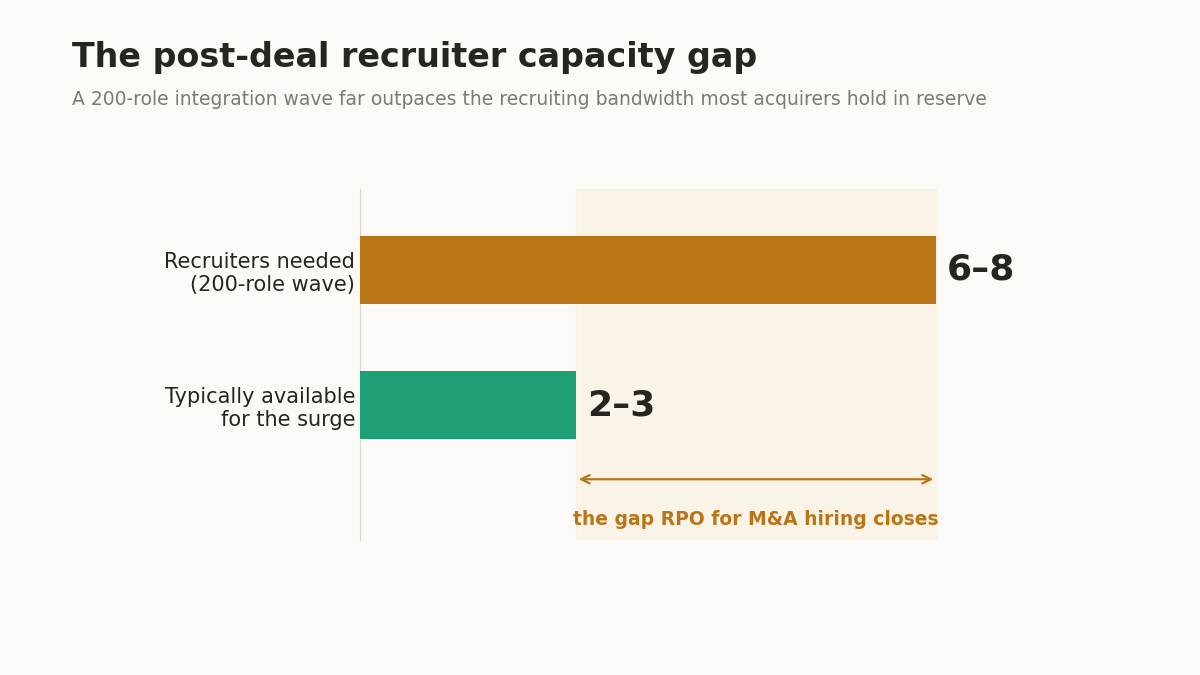
The friction is arithmetic. A mid-market acquisition frequently triggers 100–300 hires inside the first 12 months, a mix of backfill hiring for departures and net-new roles created by the combined operating model. An internal talent team sized for steady-state growth typically closes 4–6 hires per recruiter per month. Do the math and a 200-role wave needs the equivalent of 6–8 full-time recruiters for a year, on top of business-as-usual demand.
Almost no acquirer carries that recruiter bandwidth in reserve. Hiring it internally takes 3–4 months to source, onboard, and ramp and then you are left with a bloated team once the surge ends.
Meanwhile, the losses compound quietly. Retention risk is highest in the 6–18 month window after close, exactly when uncertainty about roles and reporting lines peaks. Every unfilled requisition in a critical function means overloaded survivors, which accelerates the next round of departures. The 47% first-year attrition figure is not a fixed cost; it is a curve that steepens when hiring can’t keep pace.
There is also a quality trap. Under deadline pressure, stretched internal teams lower the bar to close reqs, and a bad integration-period hire is expensive twice: once to hire, once to replace. Time-to-fill and quality are being traded against each other precisely when the business can afford neither.
Put plainly, RPO for M&A hiring is built to break that trade-off: it adds throughput without asking the internal team to choose between speed and standards.
How RPO for M&A Hiring Actually Works
Post-merger hiring at scale is an operational problem before it is a sourcing problem. The value of RPO for M&A hiring is not simply “more recruiters” , it is a pre-built engine that plugs into your systems and absorbs volume without a four-month spin-up. A well-run RPO for M&A hiring engagement behaves less like a vendor and more like a temporary internal function with its own delivery infrastructure. Here is how that engagement is structured.
How to Scale a Team After an Acquisition, Step by Step
A disciplined RPO for M&A hiring program follows a repeatable sequence:
- Diligence-phase workforce mapping. Before close, map the combined org against the target operating model to identify redundant roles, critical single-points-of-failure, and net-new positions. This is where headcount planning and workforce integration intersect and where most teams start six weeks too late.
- Attrition forecasting. Model expected departures by function using the acquired company’s tenure data and comp positioning. Assume the EY curve until you have evidence otherwise.
- Capacity sizing. Convert the forecast into recruiter-months and a talent pipeline target, then structure the RPO team to match the volume curve rather than a flat headcount.
- Systems and process integration. Configure the ATS, define intake and interview loops, and align on scorecards so the external team operates inside your process, not alongside it.
- Employer brand alignment. Craft messaging that addresses acquisition uncertainty directly candidates will ask about the deal. Strong employer branding here doubles as a retention signal to existing staff.
- Sourcing and delivery. Run high-throughput sourcing against the pipeline target with weekly SLA reporting on time-to-fill, pass-through rates, and offer acceptance.
- Onboarding handoff. Coordinate with People Ops so onboarding velocity matches hiring velocity filled reqs that don’t ramp are not synergy.
- Wind-down and knowledge transfer. As volume normalizes, transition open pipelines back to the internal team and decommission the surge capacity.
Architecture and Model Choices
An RPO for M&A hiring engagement comes in three shapes. Enterprise RPO hands the external partner end-to-end ownership of the recruiting function appropriate for large, multi-function integrations. Project RPO scopes a defined role count and window the common fit for a single acquisition. On-demand or modular RPO flexes recruiters up and down by function, useful when the deal’s hiring shape is still uncertain at close.
The integration hiring outsourcing model you choose has direct cost implications. Project RPO is typically priced per hire or on a monthly management fee plus per-placement fee, landing far below the 20–25% of salary that contingency staffing agencies charge and below the fully-loaded cost of building then dismantling an internal team.
Compliance and Cross-Border Considerations
Acquisitions frequently combine entities across jurisdictions, which turns hiring into a compliance exercise. Worker classification, right-to-work verification, data-privacy rules on candidate data, and country-specific offer requirements all shift when you hire into a newly acquired entity. A mature RPO for M&A hiring partner runs this as standard; an internal team improvising under deadline is where liability accumulates.
Real-World Application
The clearest evidence for RPO for M&A hiring shows up in the numbers after close, not the theory before it.
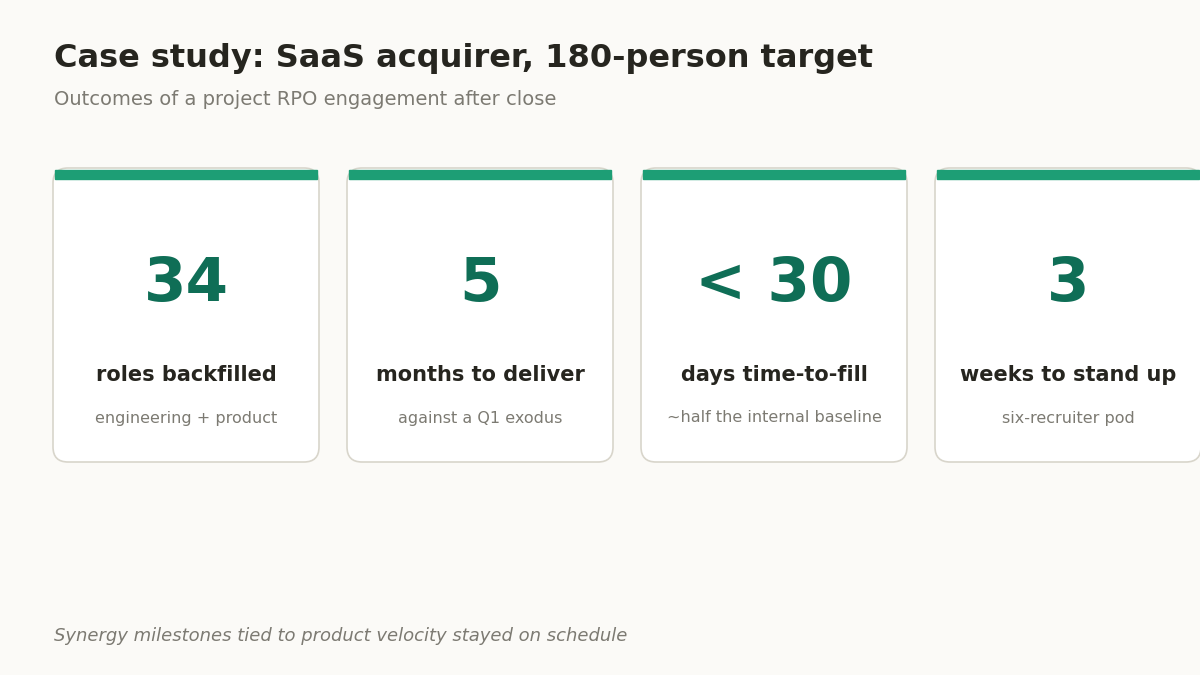
A US-based SaaS company acquiring a 180-person European product team faced 40+ voluntary departures in the first quarter post-close. An RPO for company acquisitions engagement stood up a six-recruiter pod in under three weeks, backfilled 34 engineering and product roles in five months, and held time-to-fill under 30 days roughly half the internal baseline. Synergy milestones that hinged on product velocity stayed on schedule.
In a second case, a private-equity-backed roll-up combining four regional firms used a single integration hiring outsourcing partner across all four entities to standardize scorecards and reporting. The result was 120 hires in nine months against a fragmented internal capacity that had been closing fewer than 20, and a unified pipeline that survived the next bolt-on acquisition.
Comparison: How to Cover a Post-Deal Hiring Surge
The decision usually comes down to three paths. This is where an RPO for M&A hiring model tends to separate from the alternatives on speed and unit economics.
| Approach | Ramp time | Cost model | Best fit |
| Build internal recruiting team | 3–4 months | Salaries + overhead, hard to unwind | Steady long-term hiring, not surges |
| Contingency staffing agencies | Days | 20–25% of salary per hire | Small, one-off, senior roles |
| RPO for company acquisitions | 2–3 weeks | Fee + per-hire, scales down cleanly | High-volume, deadline-bound integration hiring |
The pattern is consistent: agencies win on speed for a handful of roles, internal teams win on long-run cost for predictable volume, and RPO for company acquisitions wins the specific scenario in the middle dozens to hundreds of roles, compressed timeline, and temporary need. For that middle case, RPO for M&A hiring is the default answer rather than the fallback.
What Most Teams Get Wrong
The most common and most expensive mistake is treating hiring as a phase-two integration task. By the time the new org chart is signed, you have already lost a quarter of runway on the attrition curve. Recruiting capacity should be modeled during diligence, alongside the synergy case because the synergy case depends on it.
The second error is underestimating volume by 3–4x. Teams plan for the net-new roles they can see on the org chart and ignore the backfill wave from attrition they can’t yet see. A 50-role plan becomes a 180-role reality, and the internal team discovers the gap in month four, when it is hardest to fix.
Scoping RPO for M&A hiring against the forecast rather than the visible org chart is what keeps that gap from opening.
Third, acquirers over-index on executive retention bonuses and under-invest in the broader cultural integration and mid-level hiring that actually keeps the business running. Throwing money at the top of the org while the middle quietly leaves is a well-documented way to lose the deal you already paid for.
The teams that get RPO for M&A hiring right stop treating it as vendor procurement and start treating it as deal insurance.
Before Your Next Deal Closes
If you are evaluating RPO for M&A hiring and want to pressure-test your integration hiring plan before you commit to a vendor or a headcount, model two numbers first: your realistic attrition curve and your internal recruiting throughput. The gap between them is your risk.
Supersourcing has run high-volume, deadline-bound hiring across integration and scale-up engagements, and can help you stress-test whether RPO for M&A hiring fits your capacity, timeline, and cost profile before any commitment. It’s a low-pressure conversation, not a pitch.
Reach out at mayank@engineerbabu.com or start at supersourcing.com/contact-us.
FAQ
What is RPO in M&A hiring?
It is recruitment process outsourcing applied to the specific hiring surge that follows a merger or acquisition. An external partner takes over defined recruiting scope sourcing, screening, coordination and scales capacity to backfill departures and fill net-new integration roles on the deal’s timeline, then scales back down once volume normalizes.
How do you hire after an acquisition?
Start during diligence, not after close. Map the combined org, forecast attrition by function, size the required recruiter capacity, and decide early whether internal bandwidth can absorb it. When the projected volume exceeds internal throughput by more than 2x, RPO for M&A hiring closes the gap faster than hiring recruiters you will later have to release.
Why do companies lose employees after a merger?
Uncertainty is the primary driver. Unclear roles, reporting changes, comp questions, and cultural mismatch push people to seek stability elsewhere EY data puts first-year turnover near 47%. The losses cluster in the 6–18 month window and hit hardest when survivors are overloaded because open roles aren’t being filled fast enough.
How long does post-merger integration take?
Full integration commonly runs 12–24 months, but the hiring-critical window opens the day the deal is announced. Attrition and role uncertainty begin immediately, so recruiting capacity needs to be live within weeks of closure not staged for a later integration phase.
Is RPO cheaper than building an internal recruiting team?
For a temporary surge, almost always. Building internal capacity means 3–4 months of ramp plus the cost of downsizing once the wave passes. Understanding the true cost of hiring after a company acquisition means counting that build-and-unwind overhead which is exactly what a project-based RPO model avoids while still beating agency per-hire fees.
What is the difference between RPO and a staffing agency?
A staffing agency fills individual roles for a per-placement fee and owns none of your process. An RPO partner operates inside your systems, owns a defined scope of the recruiting function, reports on SLAs, and is built for volume. Recruitment process outsourcing for post-merger integration is designed for dozens of coordinated hires; agencies are designed for one-off placements. That ownership and volume orientation is why RPO for M&A hiring fits an integration wave that a per-placement agency cannot.
How fast can an RPO partner ramp hiring?
A specialized partner can typically stand up a functioning recruiter pod in 2–3 weeks versus 3–4 months to build internally because the team, tooling, and playbooks already exist. That speed advantage is the core reason acquirers reach for RPO for M&A hiring instead of scaling in-house. If you want to pressure-test that timeline against your own deal, it is worth modeling before you commit.
