

The gap between “has a GitHub account” and “can be found, evaluated, and reached through GitHub” is where most technical sourcing effort gets wasted. Recruiters copy a job title into the GitHub search bar, get 40,000 irrelevant results, and conclude the platform doesn’t work for hiring. It works. The search syntax, the evaluation criteria, and the outreach mechanics are just never taught together in one place; they’re scattered across engineering blog posts written for other engineers, not for the person whose job is to fill the req.
There’s also a compounding effect that most one-off sourcing attempts miss entirely. Every GitHub search you run, every profile you evaluate, and every outreach message you send teaches you what the talent pool for a specific stack actually looks like, who’s active, what companies they’re currently at, what they’re contributing to.
Recruiters who treat GitHub sourcing as a repeatable process, not a one-time search, build an informal talent map of an entire niche within a few weeks. That map is worth more than any single hire, because it’s what makes the next search for the same role type take days instead of weeks.
This guide fixes that. It walks through how to source developers on GitHub from a cold search to a signed offer, using the same search operators, screening criteria, and outreach sequencing that technical sourcing teams run daily. Nothing here requires a GitHub Enterprise license or a six-figure sourcing tool budget; the free search interface, used correctly, gets you most of the way.
India’s developer base on GitHub grew to 21.9 million in 2025, adding 5.2 million new developers in the year, and per GitHub’s own projection is on track to overtake the US as the platform’s largest developer population by 2030. Any GitHub sourcing strategy built only around US-based search filters is already sourcing from a shrinking share of the talent pool.
TL;DR
This guide is for recruiters, technical sourcers, and founders who need to fill an engineering role and want to source developers on GitHub directly instead of waiting for inbound applications. It covers search operators, profile evaluation, outreach, vetting, contracts, onboarding, and what to do when in-house sourcing stops scaling.
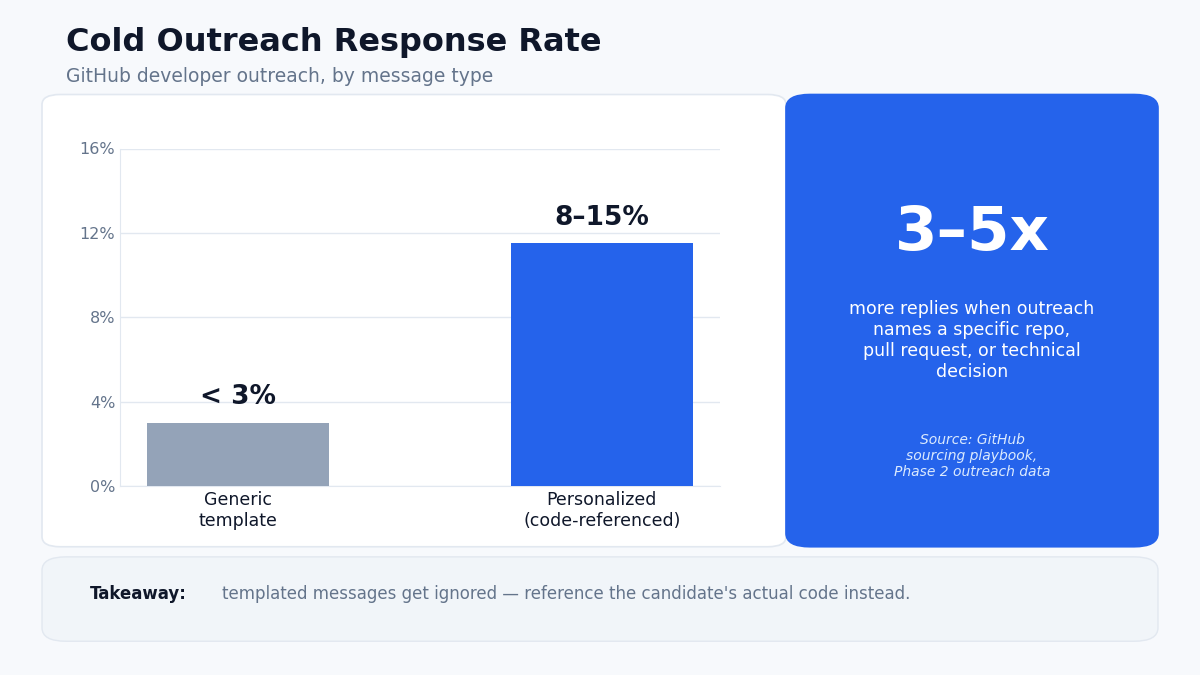
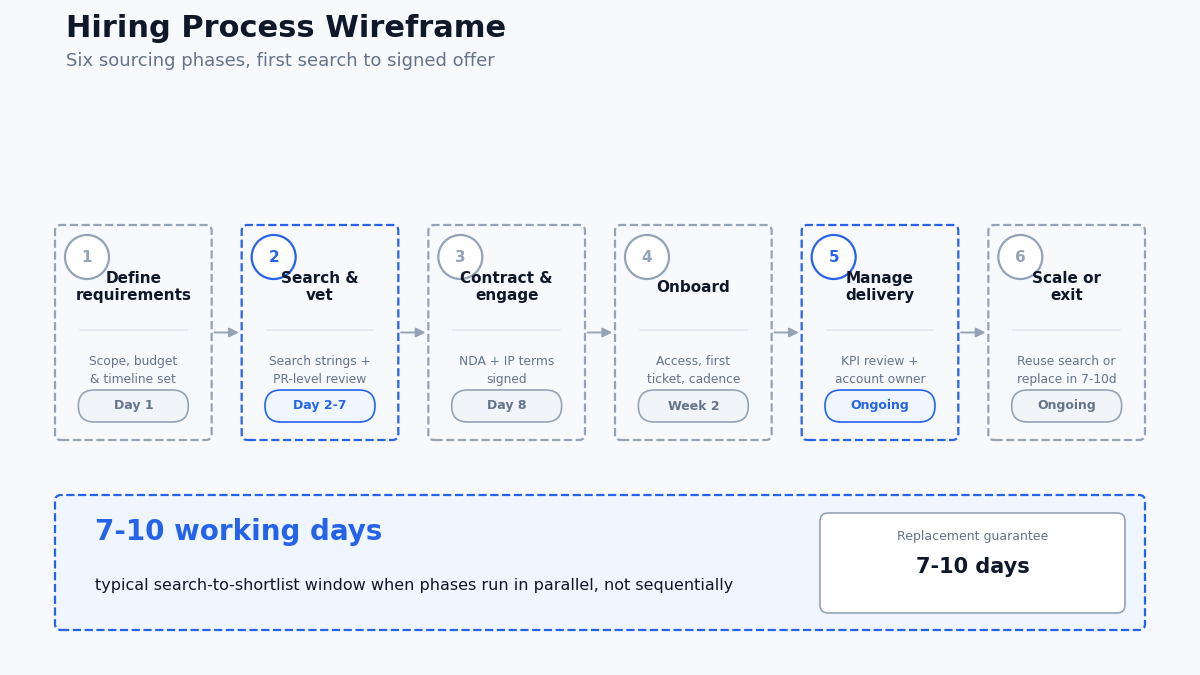
The single biggest number to remember: a well-run GitHub sourcing sequence search, shortlist, first message, follow-up typically produces a response rate in the 8-15% range from cold outreach, and a properly scoped technical hire (from first search to signed offer) takes 7-10 working days when the sourcing, vetting, and outreach steps below are run in parallel rather than sequentially.
By the end, you'll be able to build a github recruiting strategy from scratch: write search strings that actually narrow results, tell a strong GitHub profile from a decorated one, message a developer without sounding like a bot, and know exactly when it's cheaper to hand the whole process to a specialist partner instead.
What Are Sourcing Developers on GitHub?
Sourcing developers on GitHub is the practice of identifying, evaluating, and initiating contact with software engineers based on their public code, contribution history, and repository activity rather than a resume to build a pipeline for open technical roles. It’s not the same as job posting, and it’s not the same as reviewing a candidate’s GitHub link after they’ve already applied.
It is commonly confused with:
- Passive scraping pulling bulk profile data without a search strategy or evaluation filter. This produces long lists and low response rates.
- GitHub Jobs / job board posting GitHub’s job board features are inbound; sourcing is outbound and proactive.
- LinkedIn sourcing with a GitHub link check using GitHub only to verify a candidate found elsewhere isn’t sourcing on GitHub; it’s using GitHub as a reference check.
Why It Matters: The Business Case for GitHub Sourcing
Technical hiring managers underestimate what a working GitHub channel is worth until they’ve run one against a job-board-only pipeline for a full quarter. The differences show up in four places:
- Speed to first qualified conversation. A targeted GitHub search returns candidates whose skills are already demonstrated in code, cutting the resume-screening step almost entirely. Teams running this well report first-contact-to-technical-screen timelines of 2-4 working days, versus 1-2 weeks for job-board inbound.
- Access to passive candidates. The overwhelming majority of active GitHub contributors are not job-searching. Job boards only reach the ~20-25% of the market actively applying; GitHub sourcing reaches engineers who aren’t on any job board at all.
- Lower mis-hire risk. Code, commit patterns, and how someone handles a pull request review are harder to fake than a resume bullet. Teams that pair GitHub-sourced candidates with a structured technical screen report meaningfully lower first-90-day attrition than resume-only pipelines.
- Cost control on senior and niche roles. For roles like DevOps, ML engineering, or blockchain where agency fees commonly run 20-30% of first-year salary a working GitHub sourcing motion can cut external agency spend substantially, since the “hard to find” premium is exactly what direct sourcing offsets.
- Channel diversification when job boards dry up. Job-board application volume for technical roles fluctuates with the broader hiring market; a functioning developer outreach GitHub channel doesn’t depend on how many people happen to be actively job-hunting in a given quarter, because it reaches people regardless of whether they’ve decided to look.
None of this means GitHub replaces every other channel. It means a GitHub-blind sourcing strategy is leaving the most information-rich candidate pool on the table.
The Core Problem Most Buyers Face
Here’s what actually goes wrong when a team decides to start sourcing developers on GitHub without a plan:
They search like it’s Google, not a database. Typing “React developer India” into GitHub’s search bar returns repositories and code, not ranked candidate profiles. GitHub’s native search isn’t optimized for people-search the way LinkedIn Recruiter is, so untrained searches return noise. Most teams give up within the first hour and conclude “GitHub doesn’t work for sourcing,” when the real issue is search syntax, covered in Phase 2 below.
They message like a mass-mailer. A templated, no-personalization InMail-style message sent through a public GitHub profile or email gets ignored or flagged as spam. Response rates on cold GitHub outreach without any reference to the person’s actual repositories commonly fall below 3%, compared to 8-15% for messages that cite specific code.
They can’t tell the signal from noise on a profile. A high follower count, a green contribution graph, and a forked-not-authored repository all look like activity but mean very different things. Dedicated teams routinely over-index on vanity metrics (stars, followers) and under-index on the metrics that actually predict on-the-job performance (merged PRs, issue resolution patterns, code review comments).
They have no plan for what happens after “yes.” Sourcing gets all the attention; contracting, onboarding, and 90-day retention get none. A team that nails the search and outreach but has no structured onboarding plan routinely sees new hires disengage inside the first month. The sourcing effort was real, the retention plan wasn’t.
Most teams underestimate the total time cost of doing this well by 3-4x, because they count only the search time and ignore evaluation, outreach sequencing, interview coordination, and offer negotiation all of which take longer for passive, GitHub-sourced candidates than for inbound applicants who already expect to be interviewed.
The pressure behind all of this is structural, not situational. Gartner reported that in a survey of 190 HR leaders, 48% agreed that demand for new skills is now evolving faster than their existing talent structures and processes can support. Demand for technical headcount isn’t easing which means the teams that build a working GitHub sourcing motion now are building a durable advantage, not a one-quarter fix.
The Walkthrough: From First Search to Signed Offer
This is the full lifecycle of six phases, in order. Skip none of them; the phases most teams skip (3, 5, 6) are exactly where hires either stick or churn.
Phase 1 Defining Requirements Before You Open GitHub
Before any search string gets typed, lock down four things. Searching without this step is the single biggest time sink in technical sourcing github work.
- Scope the role precisely. Not “backend developer” “backend engineer, Node.js + PostgreSQL, 3-5 years, comfortable owning a service end-to-end.” GitHub search rewards specificity; vague scoping produces thousands of irrelevant results.
- Set the skill non-negotiables vs. nice-to-haves. List 2-3 hard requirements (language, framework, deployment environment) and separate them from preferences (cloud provider, testing framework) that can be trained.
- Set a realistic timeline. For a mid-level individual contributor role, a 7-10 working day search-to-shortlist window is achievable with focused effort. Senior/niche roles (staff engineer, ML infra, security engineering) commonly need 3-5 weeks.
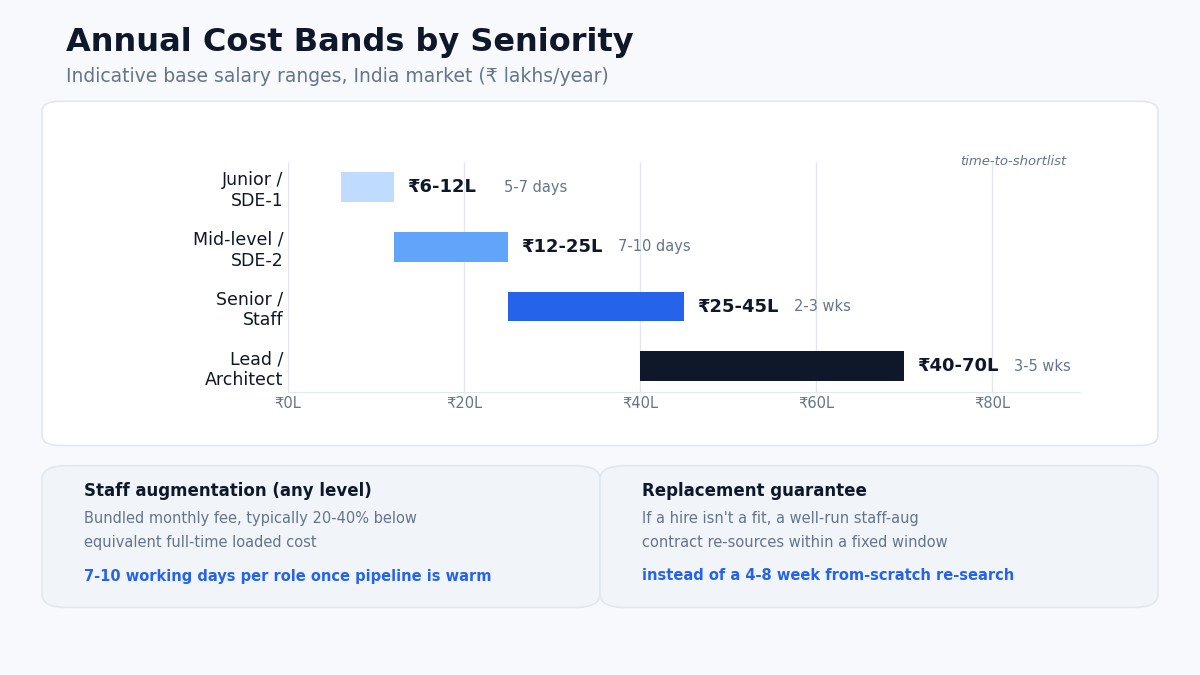
- Set budget bands upfront. Indicative annual bands (base only, India market): junior/SDE-1 ₹6-12 lakhs, mid-level/SDE-2 ₹12-25 lakhs, senior/staff ₹25-45 lakhs, engineering lead/architect ₹40-70 lakhs+. US remote-friendly bands typically run $70k-110k mid-level and $120k-180k+ senior. Ranges vary meaningfully by stack, location, and whether the engagement is full-time, contract, or staff augmentation.
Checklist before you search:
- Role scoped to a specific stack and seniority band, not a generic title
- 2-3 non-negotiable skills identified and separated from nice-to-haves
- Timeline set and communicated to stakeholders
- Budget band agreed with finance/hiring manager
- Decision made: full-time hire, contract, or staff augmentation (this changes the entire sourcing approach see Phase 3)
Phase 2 Search & Vetting: The Actual Mechanics of GitHub Sourcing
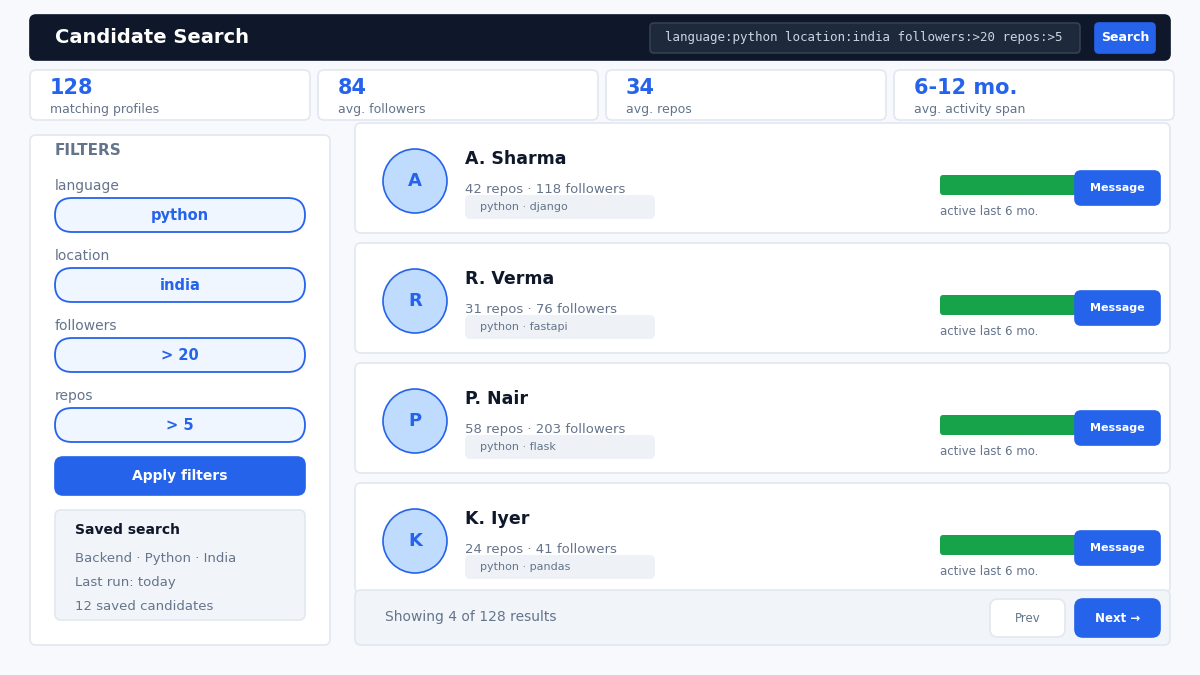
This is where sourcing developers’ open source communities gets technical. GitHub’s native search supports qualifiers that most recruiters never learn and the good news for anyone asking how to find developers on GitHub for free is that every operator below works in GitHub’s standard search bar with no paid tool required.
Search operators that actually narrow results:
| Operator | What it does | Example |
| language: | Filters repos/users by primary coding language | language:python |
| location: | Filters by profile-listed location | location:bangalore |
| followers:> | Filters by follower count threshold | followers:>50 |
| repos:> | Filters by number of public repositories | repos:>10 |
| created: | Filters by account creation date range | created:<2020-01-01 |
| in:bio | Searches the profile bio text | in:bio “senior engineer” |
| sort:joined | Sorts by account age | Combine with location/language filters |
What good screening looks like once you have a shortlist:
- Read three merged pull requests, not the README. A README can be copy-pasted; a merged PR shows how someone actually writes code, responds to review comments, and handles disagreement.
- Check commit frequency and consistency, not just volume. A steady cadence of meaningful commits over 12+ months signals more than a burst of 200 commits in one week (often a bootcamp project or a resume-padding sprint).
- Look at forked vs. original repositories. A profile full of forks with no original contributions is not evidence of independent capability; it’s a bookmark list.
- Read the issue tracker, not just the code. How someone writes a bug report or responds to one tells you more about communication skill than any interview question will in the first round.
Red flags:
- The 3-day rule: if every commit across a 6-month history is dated within a 3-day window before the profile was likely updated for a job search, treat the activity as staged, not organic.
- Profiles with high star counts on a single project but zero contribution to any other repository are often one lucky viral repo, not a demonstrated pattern of skill.
- Contribution graphs with suspiciously uniform daily green squares frequently indicate automated commit scripts rather than real work.
- A bio and pinned repositories that were all edited within the past week, with no matching update to the actual code underneath a common sign the profile was freshly staged for a job search rather than reflecting sustained work.
GitHub sourcing tools for recruiters beyond the native search bar:
Once the manual search process above is comfortable, three categories of tooling extend it without changing the underlying logic:
- Boolean X-ray search via Google or Bing, using site:github.com combined with the same language and location terms useful for surfacing profiles that don’t rank well in GitHub’s own search relevance model.
- Browser extensions and sourcing plug-ins that overlay contact-enrichment data on top of a GitHub profile page helpful for volume, but every red flag above still needs a human read of the actual code before outreach, not an automated skip.
- GitHub’s public API/GraphQL endpoint, for teams sourcing at high enough volume (10+ open roles) to justify building a lightweight internal script that pulls contribution and language data into a spreadsheet or ATS automatically, rather than manually reviewing each profile.
None of these tools replace Phase 1 scoping or the manual PR-reading step; they only make the search-and-shortlist stage faster once you already know exactly what you’re looking for.
This is also where role-specific sourcing diverges. If the search turns up strong backend candidates, that’s the moment to route them toward a hire Python developers pipeline; if the shortlist skews infrastructure-heavy, the same search pattern applies to a hire DevOps engineers search with language:hcl or language:go swapped in depending on the toolchain the team runs.
Phase 3 Engagement Models & Contracts
Once a candidate is interested, the contract structure decision happens before the offer, not after and it changes based on Phase 1’s answer:
- Full-time hire: standard employment contract, benefits, direct reporting line. Best when the role is core, long-term, and requires deep product context.
- Staff augmentation: the developer works under your direction and process but is employed/contracted through a staffing partner. Best for scaling a team fast without expanding headcount overhead, or when local employment law makes direct hiring slow.
- Dedicated team / project-based: a partner-managed team delivers against a defined scope with less day-to-day direction from you. Best for well-specified projects with a clear deliverable and end date.
Quick decision guide for which model fits:
- Role is core to the product roadmap and expected to last 2+ years → full-time hire.
- Need to add 3-5 engineers within a quarter without expanding permanent headcount → staff augmentation.
- Well-specified project with a fixed scope and end date (a migration, an integration, an MVP build) → dedicated team or project-based engagement.
NDA and IP terms are non-negotiable regardless of model. Any contract full-time, staff-aug, or project-based should specify: IP assignment (work product belongs to you, not the developer or their employer), confidentiality terms covering code and product information, and a defined notice/termination period. If you’re sourcing through a staffing or IT staffing services partner, confirming their standard contracts already carry NDA-backed IP protection before candidates are even shortlisted retrofitting IP terms after a candidate has started is a common and avoidable mistake.
Phase 4 Onboarding & Ramp-Up
The first two weeks determine whether a well-sourced hire actually becomes productive. This phase gets skipped constantly because sourcing teams consider their job “done” at signed offer.
Week 1 checklist:
- Repository access, environment setup, and credentials provisioned before day one (not on day one before it)
- A named point of contact for technical questions, separate from the manager, assigned on day one
- First ticket assigned within 48 hours small, scoped, shippable to create an early win
- Communication cadence set explicitly (daily standup, async check-ins, weekly 1:1) rather than assumed
Week 2 checklist:
- First code review completed and feedback delivered directly, not filtered through a manager
- Access to team documentation, architecture decisions, and past post-mortems (context a resume never captures)
- Informal check-in on communication style fit remote/distributed teams especially need this explicit, not assumed
Phase 5 Managing Delivery
For any engagement beyond a direct full-time hire staff augmentation, dedicated teams, RPO-managed pipelines delivery needs a reporting structure from week one:
- Weekly velocity/output review against the ticket or sprint commitment, not just “how’s it going.”
- A single account manager or point of escalation on the partner side, so issues don’t get lost in a shared inbox. Shared-bandwidth arrangements (where your account manager is also managing five other clients) are a common source of dropped communication to confirm dedicated account management before signing, not after the first missed deadline.
- A defined KPI set: sprint completion rate, code review turnaround time, defect rate in production agreed before work starts, reviewed monthly.
- A published escalation path. If a delivery issue isn’t resolved by the account manager within an agreed window (commonly 48-72 hours), there should be a named next point of contact waiting for “someone to get back to you” on a live production issue is how a good hire quietly turns into a bad engagement.
Signals a delivery relationship is working well:
- Sprint commitments are hit consistently without last-minute scope renegotiation.
- Code review comments read as collaborative, not adversarial, on both sides.
- The account manager proactively flags risk before you have to ask about it.
Phase 6 Scaling or Exiting
Two decisions eventually come up on every engagement: add more headcount, or end it.
- Scaling: if you’re adding a second or third developer to the same team, the sourcing search string and evaluation criteria from Phase 1-2 are already built, reuse and refine them rather than starting from zero.
- Replacement policy: confirm before day one what happens if a hire isn’t a fit. A 7-10 working day replacement guarantee (standard in well-run staff augmentation contracts) protects you from re-running the entire search-to-onboarding cycle from scratch.
- Offboarding: access revocation, IP handoff, and knowledge-transfer documentation should be a checklist item in the contract, not an afterthought handled over Slack on the last day.
Case Studies
The patterns below are drawn from publicly documented scale-up hiring at companies across fintech, healthtech, and enterprise SaaS, the same client segments the Supersourcing delivery team has worked within over the past decade of technical hiring engagements.
Fintech engineering scale-up. A high-growth Indian fintech platform needed to scale its engineering org rapidly during a period of aggressive product expansion the kind of hiring surge Swiggy’s engineering team has publicly described navigating during its own scale-up phases, where dozens of backend and platform roles needed to be filled without slowing product velocity. The lesson that generalizes: sourcing volume alone doesn’t solve scale-up hiring; it’s the combination of a repeatable sourcing search process (Phase 2) plus dedicated account management (Phase 5) that prevents pipeline quality from collapsing as volume increases.
Fintech engineering hiring under compliance pressure. OkCredit’s engineering hiring, scaling a bookkeeping platform used by millions of small merchants, illustrates a different constraint: technical roles needed candidates who could work within data-security and compliance requirements from day one, not learn them after onboarding. The takeaway for GitHub sourcing specifically: for regulated-adjacent products, screening for security-conscious commit patterns (dependency hygiene, secrets handling in code) during Phase 2 evaluation catches issues a resume-based screen never would.
Recruitment automation for a healthtech platform. Somnoware’s need to automate parts of its recruitment process reflects a pattern common across healthtech and enterprise SaaS teams: once sourcing volume crosses a threshold (roughly 15-20 open technical roles running in parallel), manual GitHub search-and-outreach stops scaling without either a dedicated internal sourcing function or an RPO partner running the process end-to-end.
Large-scale engineering hiring at a payments platform. Paytm’s well-documented push to hire 100+ engineers reflects the volume end of this spectrum, where the constraint isn’t finding any candidates it’s maintaining evaluation consistency (Phase 2’s PR-reading discipline) across dozens of parallel searches without the shortlist quality degrading as the recruiting team scales up to meet the number.
Comparison / Decision Framework: Choosing Your Sourcing Model
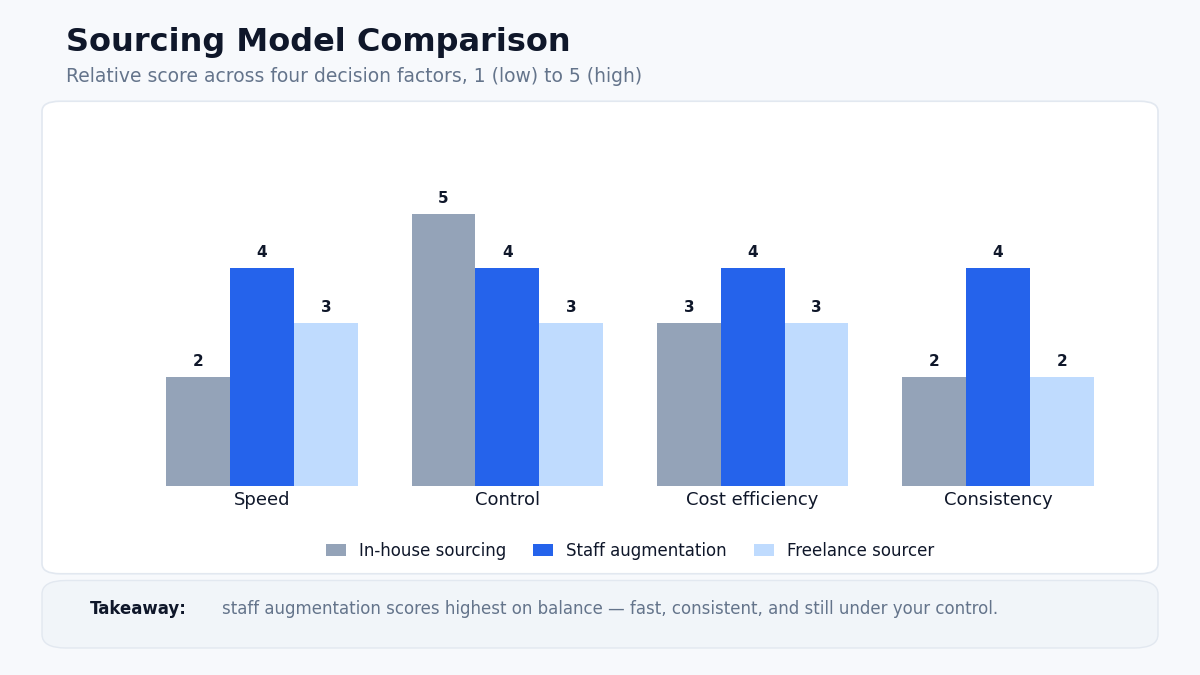
Use this framework once you know the role is real and scoped. The right model depends on how much control you need versus how fast you need to move.
| Model | Cost | Control | Speed | Risk |
| In-house GitHub sourcing | Lowest direct cost, highest time cost | Full control over search, screening, outreach | Slow to start (learning curve), scales poorly past 3-4 concurrent roles | Mis-hire risk if evaluation criteria (Phase 2) aren’t rigorous |
| Freelance/independent sourcer | Low-to-moderate, hourly or per-hire fee | Moderate you still own final decisions | Faster start than in-house, but variable quality | Inconsistent process; no institutional replacement guarantee |
| Staff augmentation partner | Moderate, often bundled with the hire’s cost | High you direct day-to-day work | Fast pre-vetted pipelines shortcut Phase 1-2 | Lower risk if partner offers a replacement guarantee and dedicated account management |
How to use this table: if you’re filling one role and have time to build the muscle, in-house sourcing following Phases 1-2 above is genuinely viable. If you’re filling 5+ technical roles in a quarter, or the role sits in a hard-to-search niche (ML infra, security, blockchain), the time cost of building in-house GitHub sourcing expertise from scratch usually exceeds the cost of a staff augmentation or recruitment process outsourcing engagement that already has the pipeline built.
Cost & Timeline Reality Check
The ranges below reflect patterns observed across a decade of technical hiring and staffing engagements, including Supersourcing’s own placement data, rather than industry-wide averages that rarely hold up at the individual-role level.
Cost tiers by engagement type (indicative, India-based full-time hire unless noted):
| Tier | Annual cost band (base) | Typical time-to-shortlist |
| Junior / SDE-1 | ₹6-12 lakhs | 5-7 working days |
| Mid-level / SDE-2 | ₹12-25 lakhs | 7-10 working days |
| Senior / Staff | ₹25-45 lakhs | 2-3 weeks |
| Lead / Architect | ₹40-70 lakhs+ | 3-5 weeks |
| Staff augmentation (any level, monthly) | Bundled per-role monthly fee, often 20-40% below equivalent full-time loaded cost | 7-10 working days per role once pipeline is warm |
Typical timelines by scenario:
- Single mid-level IC role, in-house sourcing, dedicated sourcer: 7-10 working days search-to-shortlist, 3-4 weeks total to offer.
- Single senior/niche role (ML infra, security, staff engineer): 3-5 weeks search-to-shortlist, 6-8 weeks total to offer.
- 5+ roles in parallel via staff augmentation or RPO partner with pre-vetted pipelines: 7-10 working days per role once the engagement is running, because sourcing and vetting happen continuously rather than starting from zero each time.
What drives cost up:
- Niche stacks with a genuinely small talent pool (Rust, embedded systems, specific ML frameworks) require broader geographic search and longer outreach sequences.
- Compressed timelines force premium pay bands or agency fees to compete for the same passive candidates other companies are also sourcing.
- Poor Phase 4 onboarding causing early attrition the true cost of a bad hire is rarely the search; it’s re-running the entire cycle within 90 days.
What drives cost down:
- Reusable search strings and evaluation criteria (Phase 2) once a role type has been sourced before.
- Staff augmentation models that avoid full-time benefits and employer-side compliance overhead for shorter-term needs.
- A replacement guarantee that eliminates the sunk cost of re-sourcing when a hire genuinely isn’t a fit a 7-10 day replacement window is a meaningful cost hedge compared to the 4-8 weeks a from-scratch research takes.
Where to Go From Here
If you’ve read this far, you’re either about to run this process yourself or you’ve realized how much of it the search precision, the evaluation discipline, the outreach sequencing, the NDA and onboarding structure is genuinely a full-time job once you’re filling more than one or two roles a quarter. Both are reasonable places to land.
If you’re mid-decision on whether to build this in-house or hand it to a partner with an existing vetted pipeline and a 7-10 day replacement guarantee, the fastest way to find out which makes sense for your specific role and timeline is a direct conversation, not another guide. Talk to the team about the role you’re trying to fill and get a straight answer on realistic timeline and cost before you commit either way.
Frequently Asked Questions
Is it legal to source candidates using their GitHub activity?
Yes, public GitHub profiles, repositories, and commit activity are public data, and reviewing them for recruiting purposes is standard practice. The legal question arises specifically around bulk-scraping personal data (like emails from commit metadata) and storing it without a clear lawful basis, which matters most for GDPR-covered candidates. When in doubt, use GitHub’s own contact mechanisms rather than scraped emails.
How do you find active developers on GitHub?
Combine search operators (language:, location:, followers:>, repos:>) with a check on recent commit activity look for consistent contributions over the trailing 6-12 months rather than a single burst, which signals ongoing engagement rather than a dormant or staged profile.
What’s the best way to message a developer you found on GitHub?
Reference a specific repository, pull request, or technical decision they made is not a generic compliment. Keep the first message short, state the role and stack concretely, and make it easy to say no without pressure; developers respond better to low-pressure, specific outreach than to enthusiasm alone.
Can you search GitHub by location and skill at the same time?
Yes, GitHub’s native search supports combining language: and location: qualifiers in a single query, along with followers:> and repos:> to narrow results further. This combination is the core of any usable github talent sourcing search string.
How much does it cost to hire a developer sourced from GitHub?
The sourcing itself (search and outreach) has minimal direct cost if done in-house the cost is time. Total hiring cost depends on the engagement model: a direct full-time hire carries salary plus benefits overhead, while staff augmentation or RPO models bundle sourcing, vetting, and often a replacement guarantee into a predictable per-hire or monthly fee.
Is GitHub better than LinkedIn for technical recruiting?
They serve different purposes. LinkedIn has broader reach and better filtering for seniority, company history, and network signals; GitHub gives direct evidence of code quality and technical judgment that LinkedIn simply doesn’t surface. The strongest github recruiting strategy uses both LinkedIn to confirm role/seniority context, GitHub to verify actual capability.
How do you judge code quality from a GitHub profile alone?
Read merged pull requests (not just commits), check how the person responds to code review comments, and look at issue-tracker discussions for communication style. Avoid judging by star count or follower count alone; those measure popularity, not skill.
How long does GitHub sourcing typically take to fill one role?
For a well-scoped mid-level role with a dedicated sourcer running the search and outreach steps above, 7-10 working days from first search to an interview-ready shortlist is a realistic benchmark; senior or niche roles typically take 3-5 weeks. If your timeline is shorter than that and you don’t already have a warm pipeline, a staff augmentation or RPO partner with a pre-vetted developer pool will consistently outpace a from-scratch in-house search.
How many GitHub contributions should someone have before you consider hiring them?
There’s no fixed threshold, and treating contribution count as a hard cutoff screens out strong engineers who work mostly in private repositories. A more reliable signal is consistency over volume: a candidate with 40 well-documented, merged pull requests across 12 months tells you more than one with 400 trivial commits in a single sprint. Use contribution count as a starting filter to build a shortlist, never as the deciding factor.
