

If hiring outcomes are inconsistent, the issue is rarely limited to sourcing or candidate quality. In most cases, the gap sits within the recruitment process itself. According to LinkedIn, companies with a structured hiring process are 2x more likely to improve quality of hire.
Enterprise hiring today operates under very different constraints compared to even a few years ago. There is higher competition for specialised talent, longer decision cycles, and increasing pressure to reduce time to hire without compromising quality. In this environment, an unstructured approach to recruitment does not scale.
A well-defined recruitment process brings consistency across teams, improves evaluation quality, and makes hiring more predictable. It also creates better alignment between recruiters, hiring managers, and leadership.
In this guide, we will break down the 7 stages of recruitment process with a practical lens. The focus is on how modern hiring teams are structuring their end to end recruitment process, where inefficiencies typically occur, and what can be improved at each stage.
Let’s Explore the 7 Stages of Recruitment Process (Step-by-Step)!
Recruitment is finding and hiring the best candidates for a job. It involves several key steps to ensure the right person is chosen for the right role. Here’s a step-by-step guide to understanding the 7 stages of the recruitment process:
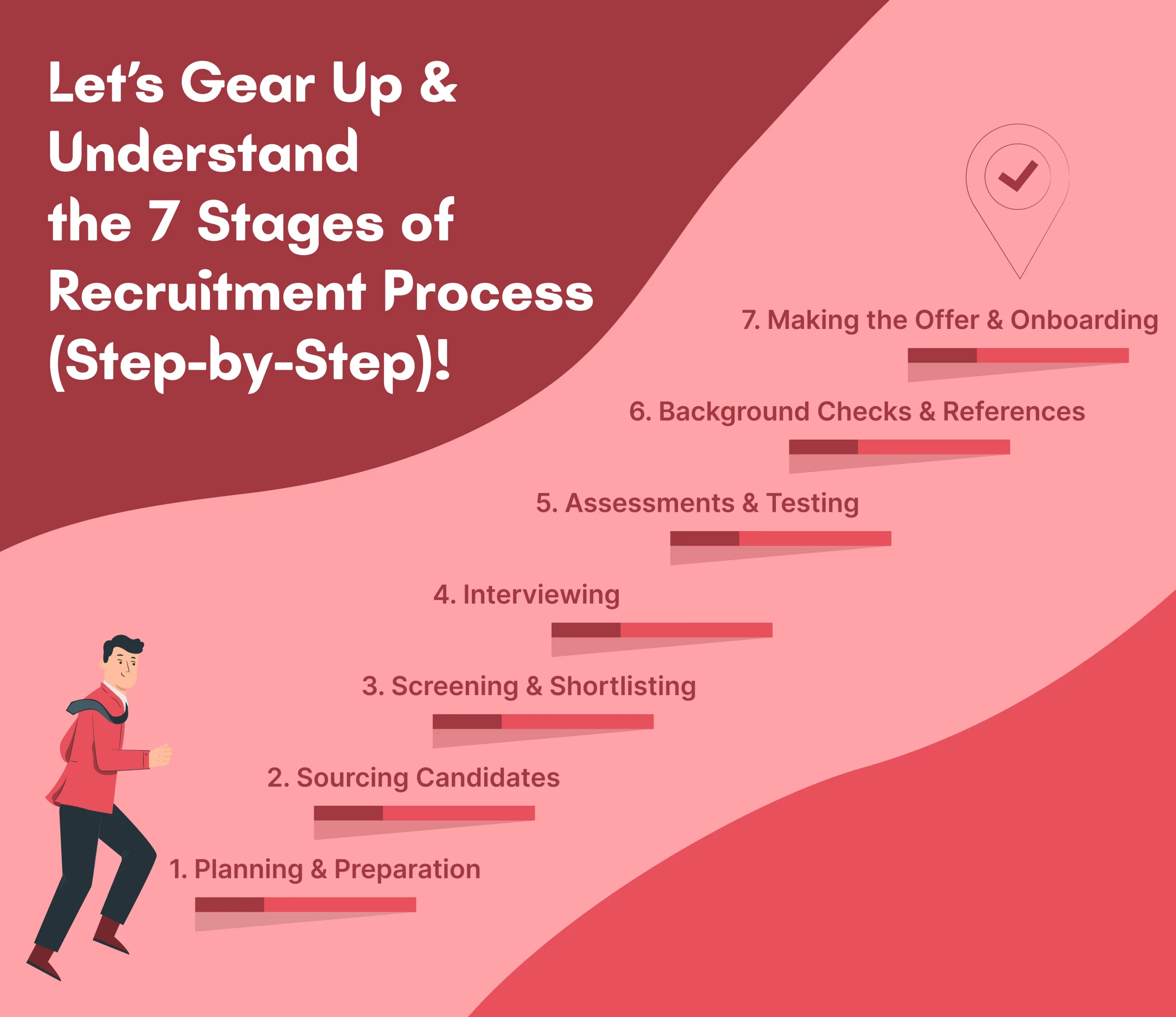
Stage 1: Planning and Preparation
This stage of recruitment process determines how efficient the rest of the recruitment process will be. Most delays and mismatches can be traced back to unclear role definition or poor alignment at this point.
The hiring need should be clearly defined first, whether it is a backfill, expansion, or a new role, as this impacts timelines, approvals, and sourcing strategy.
High-performing teams go beyond generic job descriptions and define:
-
Business outcomes expected from the role within a specific timeframe
-
Non-negotiable skills versus flexible requirements
-
Reporting structure and cross-functional dependencies
-
Context on why the role is critical at this stage
This level of clarity improves both sourcing accuracy and evaluation consistency.
Early alignment between recruiters, hiring managers, and stakeholders ensures that the candidate profile and selection criteria are agreed upon before the hiring process begins.
Many teams use structured intake frameworks to standardise this stage and reduce rework later.

Stage 2: Sourcing Candidates
Candidate sourcing should be driven by defined talent pools rather than open-market visibility. For critical roles, teams should start with market mapping. This includes identifying target companies, relevant teams, and comparable roles to build a focused list of potential candidates. Outreach is prioritised based on experience alignment and role fit.
For recurring roles, internal sources are often more effective. ATS databases, past applicants, and previously shortlisted candidates are revisited before expanding to external channels. Employee referrals work best when guided by specific targeting criteria rather than broad asks.
Calibration is built into the process. The first set of candidate profiles is reviewed with hiring managers to validate fit and refine sourcing direction before scaling outreach.
Effectiveness is measured through conversion metrics such as shortlist and interview rates, not application volume.
Stage 3: Screening and Shortlisting
Screening should operate against clearly defined criteria. Most agencies should have a pre-defined candidate vetting process.
Each profile needs to be evaluated on specific parameters such as relevance of past roles, scope of ownership, consistency in career progression, and alignment with required skills or domain experience. This reduces subjectivity and keeps decisions consistent across recruiters.
Knockout criteria are often applied early to remove clear mismatches, especially in high-volume roles. For the remaining pool, structured scorecards help standardise evaluation and make it easier to compare candidates.
Shortlisted candidates should reflect the agreed hiring bar. Any variation at this stage usually leads to misalignment during interviews.
Teams typically track screening-to-interview conversion to identify whether the issue lies in sourcing quality or screening filters.
Stage 4: Interviewing
The interview stage should be built around clear evaluation ownership and defined criteria. Each round is mapped to specific competencies. For example, technical capability, problem-solving, and stakeholder management are assessed separately to avoid overlap and ensure full coverage. This also makes it easier to identify gaps instead of relying on general impressions.
To maintain consistency:
-
Assign competencies to each interviewer: Interviewers are responsible for evaluating specific areas. This avoids duplication and keeps feedback focused.
-
Use structured scorecards: Feedback is captured against predefined criteria such as depth of experience, quality of decisions, and relevance of past work. This improves comparability across candidates.
-
Standardise evaluation inputs: Candidates are assessed using similar problem statements, case discussions, or role-specific scenarios. This is critical for roles where execution and decision-making matter.
-
Run aligned debriefs: Feedback is discussed collectively to reach a clear decision based on evidence, not individual opinions.
-
Control interview timelines: Delays between rounds are minimised to prevent candidate drop-off and offer losses.
When this stage is tightly structured, it reduces re-interviews, speeds up decisions, and improves confidence in the final selection.
Stage 5: Assessments and Testing
Assessments are used to validate capability in areas that interviews cannot reliably measure, especially for roles that require hands-on execution or role-specific decision-making.
The format of assessment should be aligned to the role. For technical roles, this may include coding tasks or system design exercises. For non-technical roles, case studies, simulations, or role-based assignments are more effective than generic aptitude tests.
To ensure assessments add value:
-
Keep them role-specific: Generic tests often fail to reflect actual job requirements. Tasks should mirror real scenarios the candidate is likely to handle.
-
Limit assessment length and complexity: Overly time-consuming assignments lead to drop-offs, especially among experienced candidates. Focus on depth, not volume.
-
Define clear evaluation criteria: Review should be based on predefined parameters such as approach, problem-solving, and decision quality, not just final output.
-
Integrate assessments into the interview process: Wherever possible, use live problem-solving or discussion-based evaluation instead of standalone take-home tasks.
-
Track completion and conversion rates: Low completion rates often indicate friction in the process or misalignment with candidate expectations.
Well-designed assessments improve confidence in hiring decisions and reduce the risk of skill mismatches after onboarding.
Stage 6: Background Checks and References
This stage of recruitment process is used to validate key claims before the offer is finalised. Delays or gaps here can stall closures, especially when candidates are already in multiple processes.
Verification typically covers employment history, tenure, role scope, and, where relevant, education or certifications. The focus should be on confirming consistency between what was assessed during interviews and the candidate’s actual track record.
Reference checks are more useful when structured. Instead of generic questions, feedback is gathered on specific areas such as ownership, decision-making, and collaboration with stakeholders. This makes the input more relevant to the role.
To keep this stage efficient:
-
Run checks in parallel with final interview stages where possible: This reduces time between decision and offer rollout.
-
Use standardised templates for reference checks: Ensures consistency across candidates and reduces ad hoc questioning.
-
Prioritise role-relevant validations: Not all roles require the same level of verification. Focus on what impacts performance in the role.
-
Track turnaround time for checks: Delays at this stage often lead to offer drop-offs.
A streamlined verification process helps close candidates faster while reducing risk in the final hiring decision.
Stage 7: Making the Offer and Onboarding
The final stage of the recruitment process is where most offer drop-offs happen, usually due to delays, misalignment, or lack of clarity during closure.
Offer management starts with aligning on compensation, role expectations, and joining timelines before the formal rollout. This reduces negotiation cycles and last-minute surprises. Approval workflows also need to be clearly defined to avoid delays between decision and offer release.
Key areas to manage at this stage:
-
Pre-offer alignment: Compensation range, role scope, and location or flexibility should be discussed in advance to avoid rework.
-
Faster offer rollout: Time taken from final interview to offer release is a critical metric. Delays here often lead to candidate drop-offs.
-
Structured follow-ups during notice period: Regular check-ins help maintain engagement and reduce the risk of offer declines.
-
Defined onboarding plan: Onboarding should be treated as part of the end to end recruitment process, not a separate activity. Clear first-week plans, stakeholder introductions, and role context improve early productivity.
-
Tracking offer-to-join ratio: This metric highlights gaps in compensation, candidate experience, or expectation setting during the hiring process.
A well-managed closure stage of recruitment process improves joining rates and ensures that hiring efforts translate into actual workforce impact.
Hiring Process Flowchart
A hiring process flowchart helps standardise how candidates move through each stage of the recruitment process. It is especially useful when multiple stakeholders are involved and decisions need to stay consistent across roles and teams.
Below is a simplified version of a typical hiring process flowchart used by structured HR teams:
In practice, this flow is not always linear. Some stages run in parallel to reduce delays. For recruitment teams, the value of a hiring process flowchart lies in clarity and control. Each stage should have:
-
Defined ownership (recruiter, hiring manager, panel)
-
Entry and exit criteria for candidates
-
Expected timelines and SLAs
-
Measurable conversion metrics between stages
Most applicant tracking systems (ATS) are configured around this flow, allowing teams to track movement across stages and identify bottlenecks in the recruitment process. A well-defined flowchart makes the entire process of recruitment easier to scale, audit, and optimise across different business units.
Conclusion
A structured recruitment process is what separates consistent hiring from reactive hiring. Across these 7 stages of recruitment process, the focus is not just on moving candidates forward but on maintaining quality, alignment, and speed at each step. Gaps in early stages tend to compound later, whether that shows up as poor shortlist quality, interview misalignment, or offer drop-offs.
For most organisations, the opportunity is not to redesign the entire process, but to tighten execution within each stage. Clear role definition, targeted sourcing, structured evaluation, and faster closure cycles have a direct impact on both time to hire and quality of hire.
When the end to end recruitment process is well-defined and consistently followed, it becomes easier to scale hiring across teams without losing control over outcomes.
FAQs
1. What are the 7 stages of recruitment process?
The 7 stages of recruitment process include planning and preparation, sourcing candidates, screening and shortlisting, interviewing, assessments, background checks and references, and offer management and onboarding. These stages together form a complete hiring framework.
2. What is an end to end recruitment process?
An end to end recruitment process covers the entire hiring lifecycle, starting from identifying the need for a role to onboarding the selected candidate. It ensures that each stage of hiring is connected and aligned with business goals.
3. How is talent acquisition different from recruitment?
Recruitment is typically focused on filling open roles, while talent acquisition takes a broader approach. It includes long-term workforce planning, building talent pipelines, and engaging candidates proactively rather than reacting to vacancies.
4. What is a hiring process flowchart?
A hiring process flowchart is a visual representation of the steps involved in recruitment. It outlines how candidates move from one stage to another, helping teams standardise workflows and identify bottlenecks in the process of recruitment.
5. How can companies improve their recruitment process in hrm?
Improvement usually comes from better clarity and consistency. Defining roles clearly, using structured evaluation methods, tracking stage-wise conversion metrics, and reducing delays between stages can significantly improve the hr recruitment process.
