

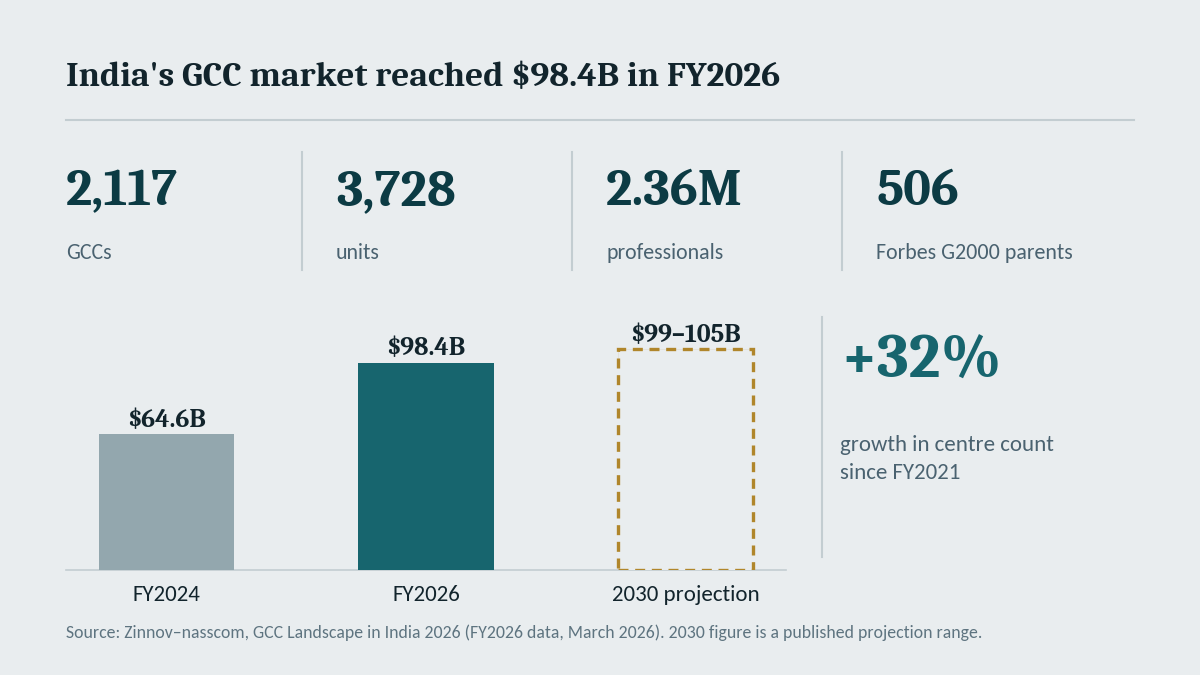
India crossed the $100 billion GCC mark roughly four years ahead of every major forecast. As of FY2026, the country hosts 2,117 GCCs operating 3,728 units, employing 2.36 million professionals and generating $98.4 billion in revenue against a 2030 projection of $99–105 billion that most consultancies published as recently as 2024.
That gap between forecast and reality is the single most useful thing to understand about GCC companies in India right now. It means the market you are benchmarking against is not the market in the reports on your desk. Salary bands, site-leadership availability, and Grade-A office supply in Bengaluru have all repriced faster than most business cases assume.
The second thing worth noting: this is no longer a Fortune 500 story. Of those 2,117 centres, 506 belong to Forbes Global 2000 parents meaning roughly three-quarters do not. The Zinnov–nasscom FY2026 dataset counts 583 mid-market GCCs and 423 whose parent companies earn under $100 million in revenue. A 40-person centre is now a normal GCC, not an experiment.
So this guide does two jobs. First, it profiles the ten centres that best represent what mature GCC companies in India actually look like at scale with reported headcounts rather than the vague “thousands of employees” you will find on most listicles. Second, it extracts the operating patterns behind them: how they entered, what they own, what they cost, and where the ones that stall get stuck.
GCCs accounted for 37.7% of India’s gross office leasing in 2025 a record ~31 million sq ft and Colliers projects 60–65 million sq ft of GCC leasing across 2026–27, up 15–20% on the prior two-year period.
TL;DR
This guide is for anyone evaluating India as a capability location: a CTO weighing a captive against a vendor, a COO building the board case, or an operator benchmarking against peers. It profiles the largest GCC companies in India by reported headcount and explains the mechanics underneath each one.
The number that matters most: India's GCC ecosystem hit $98.4 billion in FY2026, effectively reaching its 2030 target four years early, and all-in cost per engineer still lands in the $25,000–$80,000 range against US equivalents. Speed, not cost, is now the binding constraint on GCC setup in India entity incorporation alone runs 10–16 weeks before you can legally hire.
By the end you will be able to name your realistic entry model, defend a city choice with cost logic rather than default reasoning, and spot the three failure patterns that quietly cap a centre at Stage 2 maturity for years.
What Are GCC Companies in India?
GCC companies in India are multinational enterprises that operate wholly owned offshore centres Global Capability Centres staffed with in-house employees who own core functions such as product engineering, data, risk, finance, and AI development. Unlike outsourcing vendors, these centres sit inside the parent’s org chart and carry direct accountability for global outcomes.
The Problem Nobody Puts in the Board Deck
The business case usually clears easily. Cost per engineer in India runs 40–60% below US equivalents, and that math survives contact with a spreadsheet.
What breaks is the timeline. Entity incorporation SPICe+ filing, PAN, TAN, GST, PF and ESI codes, a functioning bank account, FEMA and FC-GPR compliance on the inbound investment realistically consumes 10–16 weeks before a single offer letter can go out legally. Most parent organisations budget four to six weeks for this, then discover the gap after the board has already approved a go-live date.
Then comes the second compression. A site leader search in Bengaluru or Hyderabad for a credible engineering director takes 8–14 weeks on its own, and that search cannot meaningfully start until the entity or an interim employment vehicle exists. Sequential dependencies stack: a “six-month launch” is commonly a ten-to-twelve-month launch by the time the first engineer commits code.
The third problem is quieter and more expensive. Centres that hire before they have defined ownership boundaries end up staffed with capable engineers executing tickets written elsewhere. That is the Stage 2 trap, and once a centre is perceived at HQ as an execution arm, reversing that perception takes years of deliberate governance work, not more hiring.
Also Read – Top 7 Benefits of Setting up a GCC in India
Top 10 GCC Companies in India by Scale
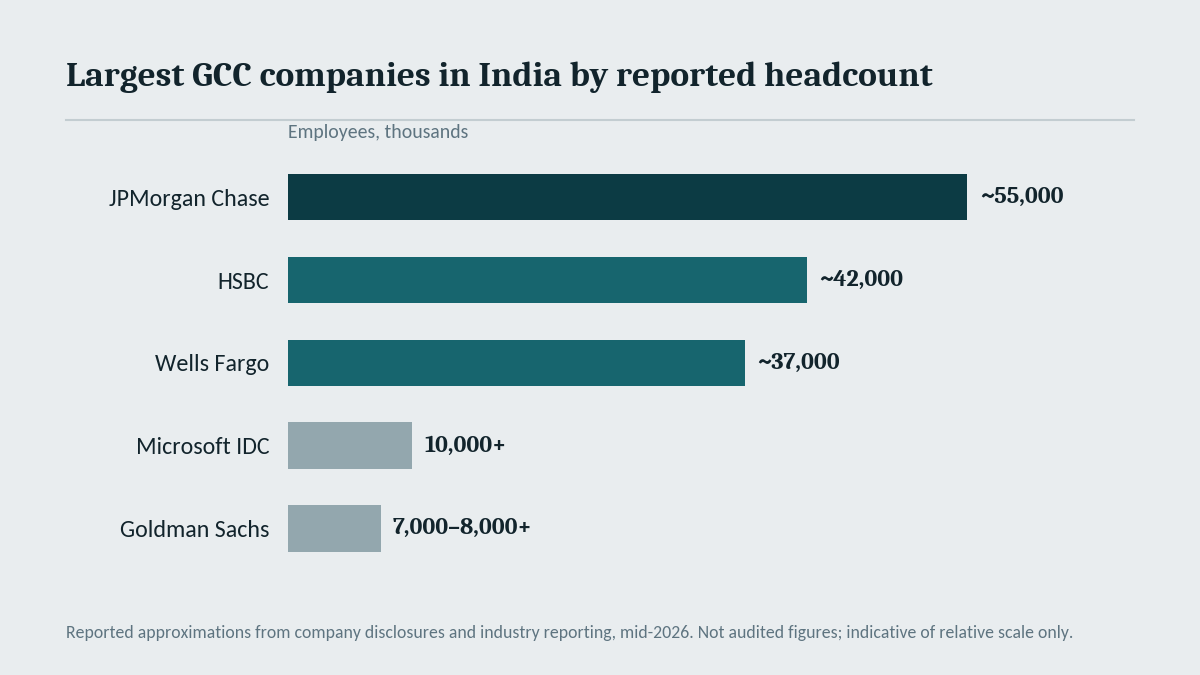
Headcounts below are reported approximations drawn from company disclosures and industry reporting as of mid-2026, not audited figures. They are useful for relative scale, not precision.
1. JPMorgan Chase India
The largest banking GCC in the country by a wide margin, with a reported ~55,000 professionals across Mumbai, Bengaluru and Hyderabad. Its India teams run live global systems trading, risk models, payments infrastructure, and AI-driven investment tooling rather than supporting them. The Powai campus announced in late 2024 is set to be its largest globally.
2. HSBC Global Technology Centres
India is HSBC’s largest employment base worldwide, at a reported ~42,000 people in Hyderabad, Bengaluru and Pune. The instructive detail: HSBC has expanded India headcount while executing global workforce reductions elsewhere, a clean signal of where capability, not cost, is being consolidated.
3. Microsoft India Development Center
A 28-year track record and a reported 10,000+ engineers across Hyderabad, Bengaluru and Noida. IDC is the clearest example of full peer-headquarters status: India teams own shipping components of Azure and Microsoft 365 outright and hold architectural decision rights alongside Redmond.
4. Amazon India (Retail + AWS)
Amazon’s Hyderabad campus is its largest corporate campus outside the United States. India engineering spans AWS service development, ML systems for pricing and recommendations, and the fulfilment technology stack with mandates that serve global markets, not just the India business.
5. Goldman Sachs Services India
Bengaluru and Hyderabad together form the firm’s second-largest presence globally, at a reported 7,000–8,000+ people. The work is genuinely front-office adjacent: quantitative strategies, risk engineering, and platform development used across global equities, fixed income and wealth management.
6. Walmart Global Tech India
Concentrated in Bengaluru and Chennai, this is among the largest retail-technology GCCs anywhere. India teams build the AI supply-chain, pricing and omnichannel systems deployed across Walmart’s global store network, with India-based VPs owning global product lines end to end.
7. Wells Fargo India & Philippines
A reported ~37,000 professionals, making it one of the largest BFSI centres in the country. Its footprint spans Bengaluru, Hyderabad and Chennai across technology, operations, risk and analytics, a useful benchmark for anyone modelling a large regulated-industry centre.
8. Bosch Global Software Technologies
Bengaluru and Coimbatore anchor Bosch’s engineering R&D in India, covering automotive software, EV and mobility platforms, and industrial IoT. It is the strongest example in this list of a non-tech, non-BFSI parent running deep product engineering out of India.
9. Citi Solution Centers India
Pune, Bengaluru and Chennai host Citi’s technology and operations engine core banking platforms, data analytics, and cybersecurity for the global network. Citi’s India centres are a long-running case of incremental mandate expansion rather than a single large build.
10. Shell Business Operations, Bengaluru
Finance, procurement, trading support and energy-transition analytics. Shell’s Bengaluru centre demonstrates something the tech-heavy lists miss: some of the highest-value GCC work in India is in finance operations and sustainability modelling, not software.
Also Read – How to setup a GCC in India
What the list actually tells you
Three patterns repeat across every centre above.
Ownership precedes scale, not the reverse. In each case, headcount grew after the India site was handed a P&L-relevant mandate not before. Centres that scaled first and sought mandate later are conspicuously absent from lists like this.
A consulting delivery centre is not a GCC. Deloitte, EY and their peers run India delivery networks that get counted in GCC lists, and they are excellent operations. But structurally they are shared delivery capacity serving client engagements, not captive centres owning a parent’s internal functions. If you are benchmarking, compare against Microsoft or Bosch, not against a Big Four delivery centre.
BFSI, not tech, is now the growth engine. Four of the ten largest centres here are banks. Colliers found BFSI and engineering/manufacturing office take-up rose 3–4x between 2021 and 2025, while technology GCC demand stabilised.
What It Costs and How Long It Takes
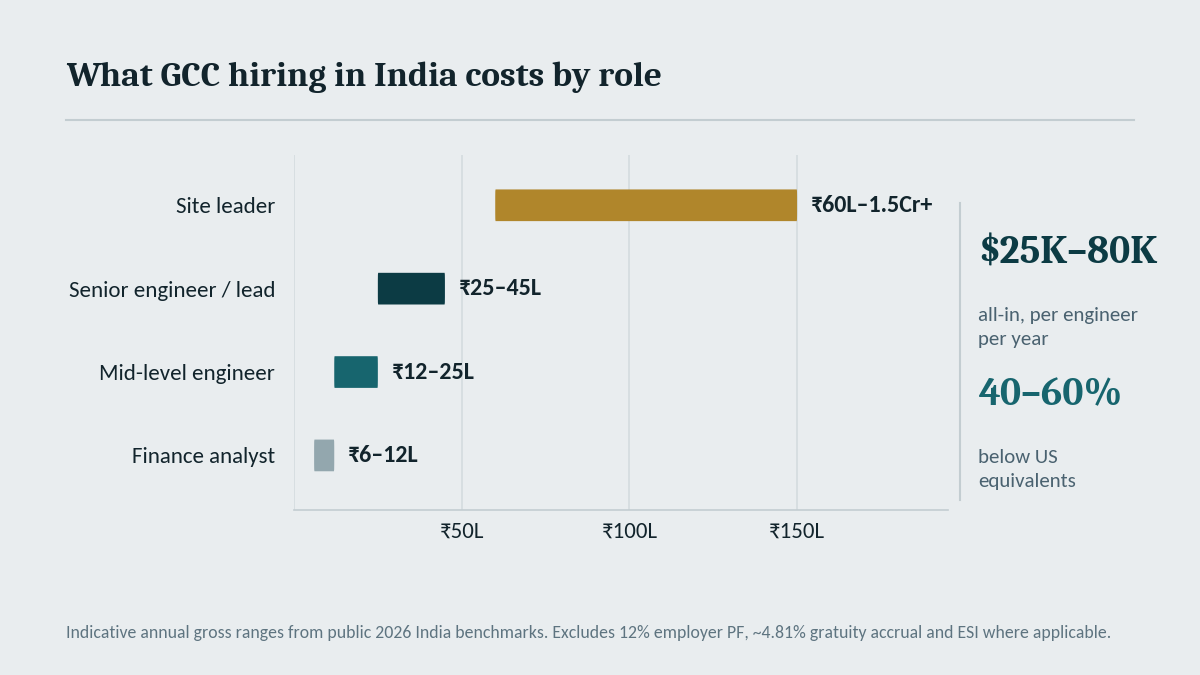
If the profiles above make the case, these are the numbers that make the plan. All figures are public 2026 benchmarks validate them against live quotes for your specific role mix and city before they enter a board deck.
Cost to set up a GCC in India per engineer
- All-in cost per engineer: $25,000–$80,000 per year depending on seniority and function, roughly 40–60% below US equivalents.
- Stand-up cost for a 50–100 person centre: commonly benchmarked at $500,000–$3 million, driven mostly by fit-out and leadership hires.
- Entity setup, one-time: $15,000–$40,000 including professional fees and registrations.
- Indicative annual salaries: mid-level software engineer ₹12–25 lakh; senior engineer or lead ₹25–45 lakh; finance analyst ₹6–12 lakh; site leader ₹60 lakh–₹1.5 crore+.
- Statutory add-ons: 12% employer PF, ~4.81% gratuity accrual, plus ESI where applicable budget these on top of gross, not inside it.
- Space planning norm: 60–80 sq ft per seat; Tier-2 rents run roughly half of Tier-1.
How long does it take to set up a GCC in India
A realistic sequence, and the one worth putting in front of a board:
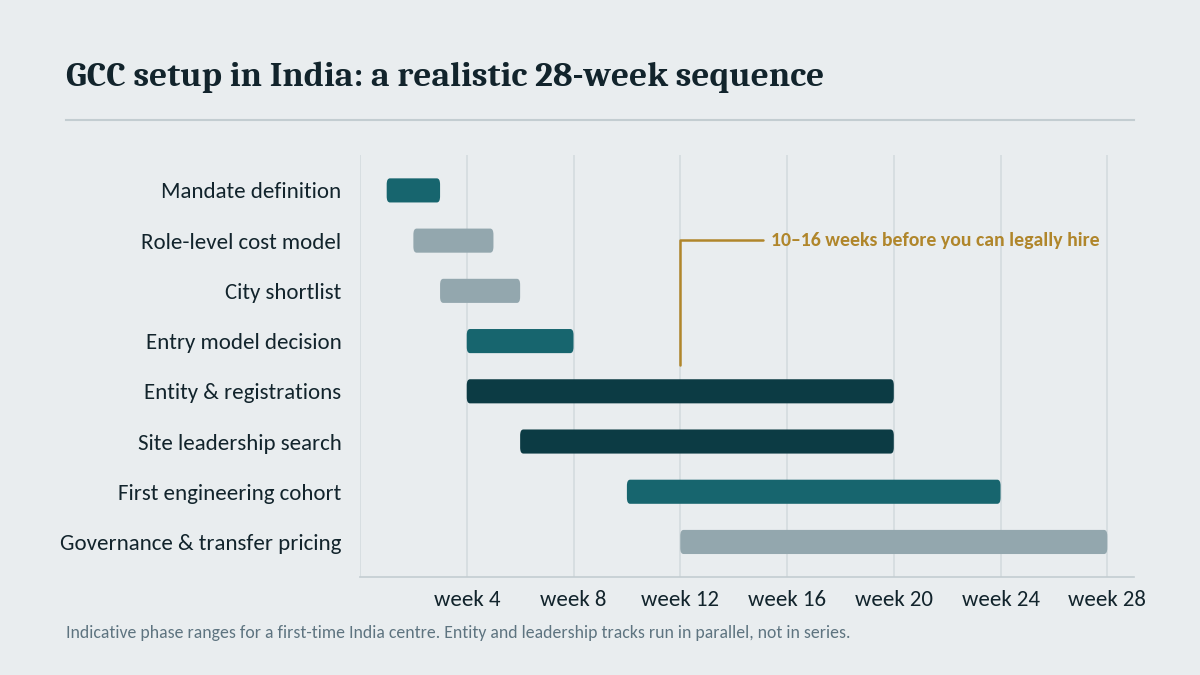
- Weeks 1–3 Mandate definition. Name the functions, the 12/24/36-month headcount curve, and what success means (cost saved, capability built, or both).
- Weeks 2–5 Role-level cost model. Benchmark against live India salary data, not global survey averages. This is what converts an estimate into evidence.
- Weeks 3–6 City shortlist. Two cities, weighted by talent profile. Defaulting to Bengaluru without comparison can add 15–25% to total talent cost.
- Weeks 4–8 Entry model decision. Employer-of-record first, captive later, or direct incorporation. This is the fork that sets your cash curve.
- Weeks 4–20 Entity and registrations, in parallel. SPICe+, PAN, TAN, GST, PF and ESI codes, bank account, FEMA and FC-GPR filings, DPDP readiness.
- Weeks 6–20 Site leadership search. Start before the entity closes; this is the longest single-thread dependency.
- Weeks 10–24 First engineering cohort. Hire in pods with a named owner, not as individual requisitions.
- Weeks 12–28 Governance and transfer pricing. Cost-plus markups of 8–15% are the market norm for captive service GCCs, backed by a Year-1 transfer pricing study. Skipping this creates a Year-3 audit problem.
Two levers compress the total materially. Hiring under an employer-of-record while the entity incorporates removes the 10–16 week dead zone entirely. And a Tier-2 hub-and-spoke structure trims real estate and salary costs by a further 25–30%.
If your build depends on scarce skills the sequencing changes when you need to hire machine learning engineers or hire cloud engineers at pace, because those searches run 2–3x longer than generalist backend roles and should start first, not last.
What This Looks Like in Practice
Across 10+ years and 527+ delivered IT projects, the pattern that separates a centre that clears its first year from one that stalls is almost never the cost model. It is offer-to-join integrity.
Pattern one the fintech pod build. Working with fintech and consumer-tech clients including Swiggy, Paytm and Razorpay, the constraint was never sourcing; it was shortlist quality. Compressing job descriptions to interview-ready shortlists into 7–10 working days, with AI-assisted screening against the top 2% of vetted talent, is what lets those teams close pods in a single hiring cycle rather than three.
Pattern two enterprise contract stability. In enterprise engagements spanning Adani, Apollo Hospitals and Brillio, the measurable outcome was retention at the point of joining: a 98% candidate joining rate and under 1% drop-off on contract roles, against an industry reality where reneged offers routinely blow out launch timelines by four to six weeks per role. Where a hire still misses, the replacement runs inside 7–10 days.
Neither of these is a cost-arbitrage story. Both are timeline stories which is the actual currency of a GCC launch.
Which Entry Model Fits You
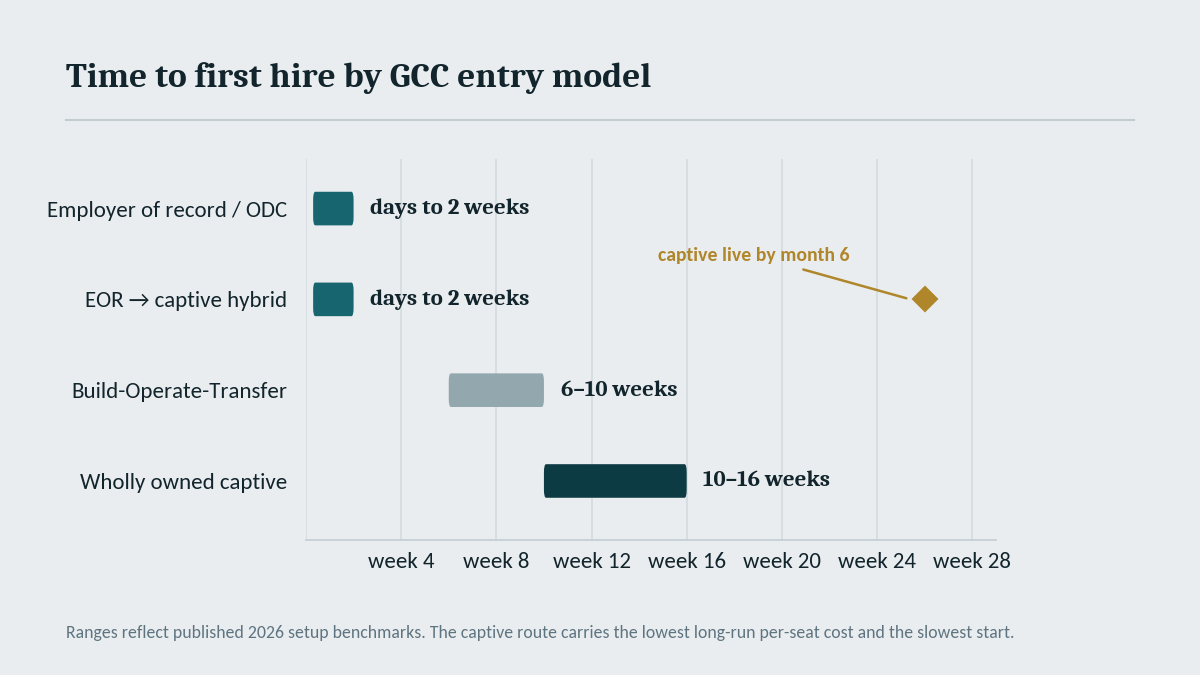
| Model | Time to first hire | Best when | The trade-off |
| Employer of record / ODC | Days to 2 weeks | Under ~50 seats, or entity not yet incorporated | Highest per-head cost; conversion fees on transfer later |
| EOR → captive hybrid | Days, captive by month 6 | Most Seed-to-Series-B and mid-market builds | Requires deliberate migration planning |
| Build-Operate-Transfer | 6–10 weeks | Low early cash, no India management bandwidth | Vendor margin in your run-rate; negotiated transfer price |
| Wholly owned captive | 10–16 weeks minimum | 200+ planned seats, long-term mandate | Highest upfront cost and management load; lowest long-run per-seat cost |
None of these is cheaper in the abstract. They distribute the same underlying cost across different timelines, and the right answer depends on whether your binding constraint is early cash, speed, or long-run efficiency.
What Most Teams Get Wrong
The most common failure is treating the India site head as a delivery-manager hire. It is a peer-executive hire. When the site leader reports three levels below the function owner at HQ, every mandated conversation becomes an escalation, and the centre calcifies at execution work regardless of how strong the engineers are.
A second red flag we see repeatedly in diligence: a headcount plan with no attrition assumption. Centres that model 0% attrition in year one are almost always the ones that miss year-two capacity, because they have no replacement pipeline and no bench logic.
The third is a negotiation detail that costs real money. Vendor and IT staffing contracts are commonly signed without a defined replacement window or a shared-bandwidth clause. If a supplier can rotate your engineers onto other accounts, you are buying capacity, not a team and your effective cost per productive engineer is 20–30% higher than the rate card implies.
Pressure-Test Your Plan Before You Commit
If you are evaluating GCC setup services or building the internal case for a centre, the expensive mistakes happen in the first 90 days in the entity sequencing, the site-leader spec, and the contract clauses nobody reads twice.
Supersourcing has run talent and GCC engagements across 527+ delivered projects for companies including Swiggy, Paytm, Razorpay, Adani and Apollo Hospitals, with an 8.5 NPS and a 7–10 day replacement guarantee on hires that miss. If you want a second read on your location, entity and hiring assumptions before a vendor conversation, that is a 30-minute call, not a pitch.
Reach out at mayank@engineerbabu.com or via supersourcing.com/contact-us.
FAQs About GCC Companies in India
How many GCC companies are in India?
India hosted 2,117 GCCs operating 3,728 units as of FY2026, per the Zinnov–Nasscom India GCC Landscape Report up 32% since FY2021. Together they employ about 2.36 million professionals and generate $98.4 billion in revenue. Roughly a quarter have Forbes Global 2000 parents; the rest are mid-market, PE-backed, or sub-$100M-revenue companies.
Which city hosts the most GCC companies in India?
Bengaluru leads decisively, with roughly 1,080 GCC units about 29% of the national total and over a third of installed GCC talent. Hyderabad follows, with Pune, Chennai, Mumbai and Delhi NCR close behind. About two-thirds of new centres in the last two years still chose Tier-1 cities, despite the Tier-2 narrative.
How much does it cost to set up a GCC in India?
Public 2026 benchmarks put a 50–100 person centre at $500,000–$3 million to stand up, with all-in per-engineer costs of $25,000–$80,000 annually 40–60% below US equivalents. Entity setup alone runs $15,000–$40,000. Tier-2 locations and stacked SEZ, STPI and state incentives can reduce the effective figure a further 15–30%.
Is a GCC better than IT outsourcing?
They solve different problems. Outsourcing buys elastic capacity with no fixed cost and no entity; a global capability center buys ownership, IP retention and institutional knowledge that compounds. Below roughly 30–40 seats, or where the need is genuinely project-shaped, outsourcing or IT staffing services usually win on economics. Above that, and where the work is the core product, a captive wins.
How do I choose a GCC location in India?
Weight by talent profile rather than headline cost. Bengaluru commands a premium for AI, cloud and product engineering depth. Hyderabad and Pune offer comparable depth in analytics, data engineering and procurement at lower compensation benchmarks. Defaulting to Bengaluru without a comparison commonly adds 15–25% to total talent cost.
What is the future outlook for GCCs in India?
Nasscom projects the market reaching around $100 billion with headcount crossing 2.5 million, and JLL expects over 2,500 centres and 2.8 — 2.9 million professionals by 2030. The more meaningful shift is qualitative: India now holds 250,000+ AI and ML professionals, and mandate ownership not headcount, is the metric the next phase will be judged on.
